Think of a cloud phone system as your business's entire phone network, but instead of living in a dusty closet full of wires, it runs entirely over the internet. It’s a lot like swapping out a massive CD tower for a Spotify account. All the complexity is handled by a provider in highly secure data centers, so you can just enjoy the service.
This simple shift means your team can make and receive calls on their business line from literally anywhere—using a desk phone at the office, a softphone on their laptop, or an app on their mobile.
The Modern Alternative to Traditional Phones
For years, businesses were tethered to a Private Branch Exchange (PBX). This was the physical, on-site hardware box that managed all the office phones. A cloud phone system, often called Hosted VoIP or a Cloud PBX, gets rid of that clunky setup completely.
Instead of sending calls over old copper wires, it uses your existing internet connection to manage everything digitally. That's the key difference. Your phone system is no longer a piece of hardware in a specific building; it’s a secure service online. This makes it a perfect match for how we work today, supporting teams that are in the office, fully remote, or a mix of both.
Understanding the Core Technology
The magic behind it all is Voice over Internet Protocol (VoIP). This technology simply takes your voice, turns it into digital data, and sends it over the internet. It’s far more efficient and flexible than the analog phone lines we grew up with. If you’ve ever used FaceTime or made a call through WhatsApp, you've used a form of VoIP.
This internet-first approach brings some serious perks:
- Location Independence: Your business number follows you, not a specific desk or building.
- Simplified Management: You can change settings, add users, and check call logs from a simple online dashboard. No need to call in a technician.
- Advanced Features: Powerful tools like an auto-attendant ("Press 1 for Sales…"), call recording, and detailed analytics come standard, not as expensive extras.
By moving your phone system to the cloud, you're not just upgrading technology—you're making your business more agile. It unifies communication, allowing your team to stay connected across any device, from anywhere.
For a clearer picture, let's break down the core differences in a simple table.
Cloud Phone System vs Traditional PBX at a Glance
This table offers a quick side-by-side comparison, highlighting why so many businesses are making the switch from legacy hardware to modern cloud communications.
| Aspect | Cloud Phone System (Hosted VoIP) | Traditional PBX System |
|---|---|---|
| Infrastructure | Hosted by the provider in the cloud | On-premise hardware in your office |
| Upfront Cost | Low; typically just the cost of phones | High; requires expensive PBX hardware |
| Maintenance | Handled entirely by the provider | Requires on-site IT staff or technicians |
| Scalability | Easily add or remove users online | Complex and costly to add new lines |
| Location | Works anywhere with an internet connection | Tied to the physical office location |
| Features | Includes a wide range of advanced features | Basic features; advanced ones cost extra |
| Disaster Recovery | Built-in; calls can be rerouted instantly | Vulnerable to power outages or hardware failure |
The contrast is pretty stark. One is built for flexibility and the future of work, while the other is rooted in a physical location.
If your business is still running on older infrastructure, getting to grips with these differences is the best place to start. You can dive deeper into the comparison between VoIP and traditional phone systems to see just how much the technology has evolved. Moving away from hardware isn't just a trend; it's a huge step forward for business communication.
How Cloud Phone Systems Actually Work
So, how does all of this work behind the scenes? It all starts with a technology called Voice over Internet Protocol (VoIP). This is the engine that converts your voice into digital data that can zip across the internet.
Forget those old-school copper phone lines. VoIP works more like sending an email than mailing a letter. An email gets there in seconds because it uses the internet; a physical letter has to travel through a whole network of post offices and carriers. VoIP does the same for your phone calls—making them faster, more flexible, and loaded with features that traditional phones just can't match.
When a customer dials your business number, the call is instantly routed from their phone, through the internet, to your provider's secure cloud servers. These servers are your virtual "phone closet" or PBX, and they do all the heavy lifting of figuring out where that call needs to go.
This diagram shows just how simple that journey is, connecting a caller to your employee, no matter where they happen to be working.
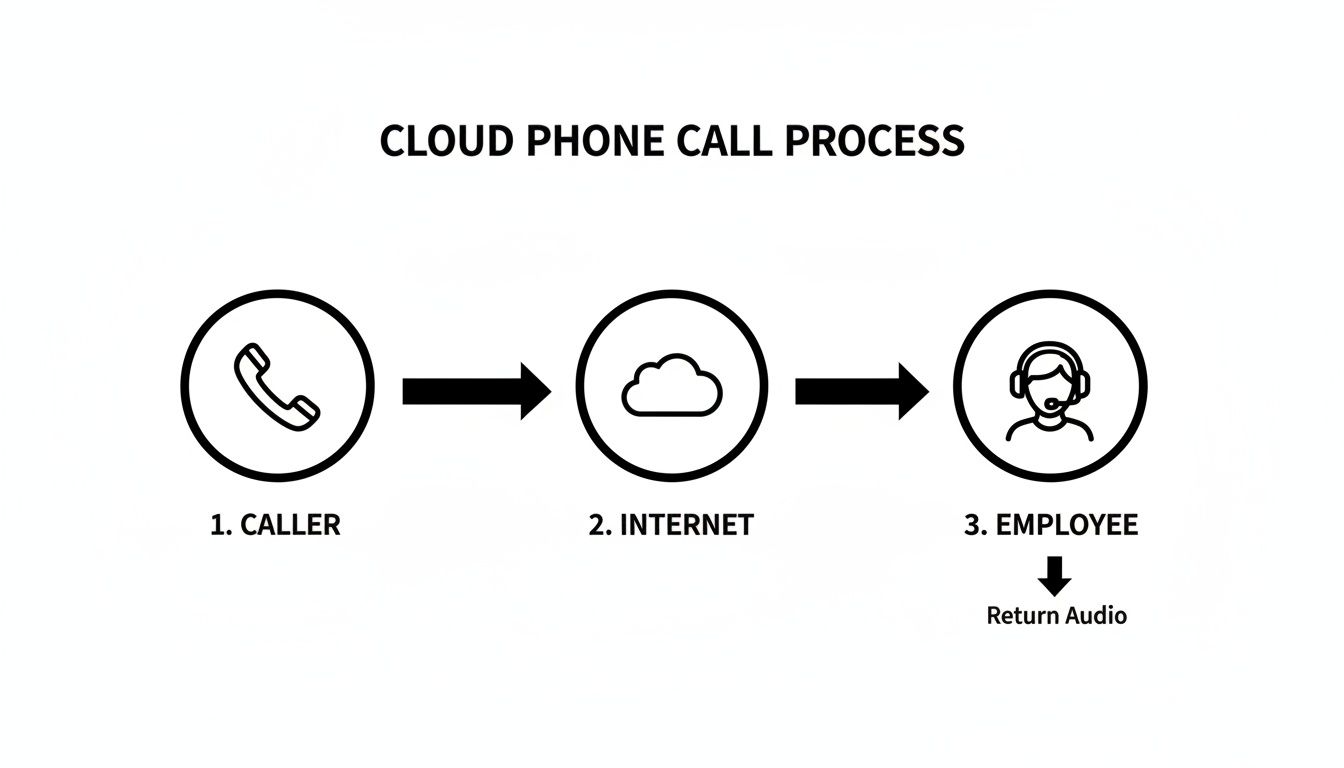
As you can see, the internet becomes the central hub connecting your team to your customers, not a physical office.
The Virtual PBX in Action
This is where the real power of a cloud phone system comes into play. That virtual PBX isn't just a simple switchboard; it’s an intelligent routing machine that can direct calls to the right person or department based on rules you set.
Let’s walk through a common scenario:
- A Customer Calls: Someone dials your main business number.
- The Auto-Attendant Answers: Instead of ringing endlessly, the system plays a professional greeting: "Thanks for calling! Press 1 for Sales, 2 for Support."
- Smart Routing Kicks In: The customer presses 1. The system sees it's after 5 PM, so instead of sending the call to an empty office, it routes it directly to the on-call sales agent’s mobile app.
- A Perfect Connection: The agent answers on their smartphone, ready to help. The customer gets great service, and the agent didn't have to be chained to their desk.
All of this happens in the blink of an eye. The result is a seamless, professional experience for your caller and total freedom for your team.
The core function of a cloud phone system is to digitize and intelligently manage voice communication. By moving the "switchboard" from a physical box into secure data centers, businesses gain reliability, flexibility, and powerful features that were once only available to large enterprises.
This shift isn't just about cool features; it has a real impact on the bottom line. Businesses that move their contact centers to the cloud often see major operational improvements. In fact, some studies show an average call-handling cost reduction of around 15%, thanks to lower overhead and better efficiency. You can find more VoIP statistics on Nextiva.com that break down the numbers.
Powerful Features That Unify Your Communications
A modern cloud phone system is so much more than just a dial tone. Think of it as the central command hub for all of your business communications. It brings a whole suite of powerful, enterprise-level tools—once reserved for the big players—right to your fingertips, making your company look more professional and run far more smoothly.
These aren't just flashy bells and whistles; they're features built to solve real-world problems.
Imagine a customer dials your main line. Instead of the phone just ringing endlessly, they’re greeted by an Auto-Attendant—your 24/7 virtual receptionist. It professionally welcomes them with a custom menu ("Press 1 for Sales, Press 2 for Support…") and instantly gets them to the right person. This small touch dramatically improves the caller's experience and, just as importantly, frees up your team from constantly playing switchboard operator.
Core Tools for Smarter Call Management
Once that first greeting is handled, a cloud phone system really shows its intelligence with smart call routing. This isn't just basic call forwarding; it's a dynamic system that follows whatever rules your business needs.
- Time-Based Routing: Set it and forget it. Calls that come in after 5 PM can automatically go to voicemail or be routed to an on-call team member.
- Ring Groups: Need the whole sales team to get a lead? Make one number ring multiple phones at once, so the first person available can grab the call. No more missed opportunities.
- Voicemail-to-Email: This is a game-changer. Get voicemails sent as audio files and text transcriptions right to your email inbox. You can scan messages in seconds and decide who needs a call back first.
These tools all work in harmony, making sure you never miss an important call and that every customer gets to the right person, right away.
To really grasp how these features translate into day-to-day improvements, let's break them down. The table below shows what some of these core tools do and, more importantly, the direct impact they can have on your business operations and customer satisfaction.
Key Features and Their Business Impact
| Feature | What It Does | How It Helps Your Business |
|---|---|---|
| Auto-Attendant | Greets callers with a custom menu and directs them to the right department or person. | Presents a professional image, improves caller experience, and saves staff time. |
| Ring Groups | Rings multiple phones simultaneously when a single number is dialed. | Reduces missed calls, improves response times, and distributes workload efficiently. |
| Call Queues | Places incoming callers in a virtual line when all agents are busy, often with music on hold. | Manages high call volumes without losing customers and provides a better waiting experience. |
| Voicemail-to-Email | Transcribes voicemails to text and sends them with the audio file to your email. | Allows for quick message scanning, easy archiving, and faster response prioritization. |
| Call Recording | Records incoming and outgoing calls for quality assurance, training, and compliance. | Helps train staff, resolve disputes, and ensure service quality meets your standards. |
As you can see, each feature is designed not just for convenience but to produce a tangible business result—whether that's closing more deals, improving support, or simply making your team's life easier.
The Power of Unified Communications
The best cloud phone systems today have evolved into what we call Unified Communications as a Service (UCaaS) platforms. This is just a fancy way of saying they bring all your communication channels—voice, video, and messaging—together into one single, seamless application.
Instead of your team jumping between a phone app, a video meeting tool, and a separate team chat program, everything happens in one place.
This integrated setup is a massive productivity boost. An employee can start a quick chat with a colleague, elevate that chat to a phone call, and then switch to a full video conference with screen sharing, all without ever leaving the app. It removes all the friction of switching contexts, which is absolutely vital for today's remote and hybrid teams. Everyone stays connected and on the same page, no matter where they're working from.
By pulling everything under one roof, a UCaaS platform simplifies workflows and makes collaboration feel effortless. To see the full scope of what's possible, you can explore the complete list of cloud phone system features that businesses are using to unify their operations.
So, why should you even consider moving your business phones to the cloud? It's a fair question, and the answer comes down to some very real, tangible benefits that affect your budget, your team's agility, and your ability to compete. This isn't just about a new way to make calls; it's about fundamentally changing how your business communicates for the better.
Let's start with the most obvious win: cost. Traditional PBX systems are a massive capital expense. You have to buy the box, pay someone to install it, and then keep paying for maintenance contracts just to keep it running. A cloud phone system gets rid of all that.
Instead of a huge upfront bill, you simply pay a predictable monthly fee per person. This shifts the cost from a capital expense (CapEx) to an operating expense (OpEx), which is a much healthier model for cash flow. You're not buying hardware that will be obsolete in a few years; you're subscribing to a service that's always up to date.
Scale Up or Down in an Instant
One of the biggest headaches with old-school phone systems is how rigid they are. What happens when you need to hire five new people for a seasonal rush? With an on-premise PBX, you're looking at ordering new hardware, scheduling a technician, and waiting… and waiting.
A cloud phone system completely changes the game. Adding or removing users is as simple as a few clicks in an online dashboard.
- Onboard new hires in minutes: Get a new team member set up with their own extension and ready to take calls before their laptop is even configured.
- Pay for what you actually need: Your monthly bill adjusts automatically as your team changes. You're never stuck paying for phone lines you aren't using.
This kind of flexibility is a superpower for growing businesses. If you land a huge contract and need to double your support staff overnight, your phone system won't be the bottleneck. It scales right alongside you, something a physical PBX could never do.
Your Office Is Wherever Your Team Is
Work isn't a place anymore; it's what you do. A cloud phone system is designed for this modern reality, giving your hybrid and remote teams the power to work from anywhere without missing a beat. Every employee gets one business number that follows them from their desk phone to their laptop to their smartphone.
With a cloud system, your team looks and sounds professional whether they're at corporate HQ, their home office, or a coffee shop between client meetings. They have access to every feature—call transfer, voicemail, conference calling—right from the device they're using.
It's no surprise that as remote work has become standard, the demand for cloud-based communication has exploded. The market is booming, with one report from ResearchAndMarkets projecting it will hit $29.27 billion by 2029. This isn't just a trend; it's a reflection of how thousands of businesses are ditching old hardware for greater agility.
Understanding Security, Reliability, and Implementation
It’s completely normal to have questions about security and reliability when you're thinking about moving your business phones to the cloud. After all, your voice communications are a core part of your operations. The good news is that leading providers have built their platforms on a foundation of trust, using multiple layers of security to keep your conversations private.
Think of it like online banking. Call encryption is the first line of defense, scrambling your voice data as it travels across the internet so no one can eavesdrop. Beyond that, the entire system doesn't live in your office closet; it’s housed in incredibly secure data centers with physical and network protections that most individual businesses could never afford to build themselves.
Ensuring Business Continuity and Uptime
Reliability is just as critical as security. A common concern is, "What happens if our office internet goes down?" With an old-school phone system, that often meant dead phone lines and missed calls. A cloud system, however, is built specifically to handle these situations.
Because your system lives in the cloud, not in your office, a local outage doesn't take it offline. Features like automatic call failover are designed to keep you connected no matter what.
If your main internet connection ever fails, incoming calls can be instantly rerouted to other devices without your customers ever knowing there was a problem. Calls can be set to automatically forward to:
- Employee mobile phones via the system’s app
- A different branch office
- A designated backup landline or a remote team member
This built-in resilience ensures you never miss that important call, protecting your professional image even when things go wrong. Of course, a stable connection is key for top-notch quality, and it's smart to find out how much bandwidth you need for VoIP to guarantee crystal-clear conversations.
A Straightforward and Managed Implementation
Maybe the best part is how simple it is to get started. Forget the disruptive, expensive, and lengthy installations that came with legacy PBX hardware. Switching to a cloud phone system is a smooth, managed process.
Most quality providers offer what’s called "white-glove" onboarding, where they handle everything for you. This means they take care of porting over your existing phone numbers, setting up all your call routing rules (like your auto-attendant), and getting every user configured. The whole point is to make the switch seamless, with zero downtime, so your team can get right back to business without skipping a beat.
How to Choose the Right Cloud Phone System
With a sea of providers all claiming to be the best, picking the right cloud phone system can feel like a huge task. The secret is to tune out the marketing noise and zero in on what your business actually needs to succeed. A system designed for a massive call center, for instance, is likely overkill for a small, nimble startup.
First things first, take stock of where you are now and where you're headed. How many people need a phone line today? Do you expect to hire 10 new team members in the next six months? Thinking about this now helps you find a provider that can grow with you, so you aren’t forced into a painful switch down the road.
Evaluate Your Core Feature Needs
More features don't always mean better, especially if you're paying for bells and whistles you'll never use. Think critically about your day-to-day work and pinpoint the tools that will genuinely move the needle for your team.
- For customer-facing teams: Do you need serious call center muscle? Look for things like smart queue management, real-time analytics dashboards, and custom wait-time announcements to give callers a professional experience.
- For remote or hybrid workforces: Are top-notch mobile and desktop apps a deal-breaker? A truly unified platform that brings voice, chat, and video into one place is essential for keeping everyone in sync, no matter where they are.
- For administrative efficiency: How much time could you save with an auto-attendant to route calls, visual voicemail that transcribes messages, or direct integration with your CRM? These tools can automate tedious tasks and free up your staff.
Create a simple checklist of "must-have" versus "nice-to-have" features. This single step will do more than anything else to help you cut through the clutter and find a system that’s a perfect match.
Look for a True Partner, Not Just a Provider
The technology is only one part of the puzzle. The quality of support you receive and how smoothly the initial setup goes are just as critical to your long-term success. As you vet potential vendors, don't be shy about asking tough questions about their service.
Choosing a new phone system is a big commitment. You want a partner who provides dedicated, white-glove onboarding and handles the entire setup—especially porting your existing numbers—so your business experiences zero downtime.
Finally, make sure they offer reliable, 24/7 support with actual humans you can get on the phone. When something goes wrong, you need a partner who will jump on it immediately, not leave you hanging for an email reply. A provider that’s invested in your success from day one is always the right choice.
Frequently Asked Questions
Even after seeing all the benefits on paper, you probably still have a few practical questions. It's only natural. Let's tackle some of the most common things business leaders ask when they're thinking about how a cloud phone system would actually work day-to-day.
Do I Need to Buy All New Phones?
That's one of the best parts—not necessarily. You’ve got options here, which is a huge plus. Many businesses just keep using their existing VoIP-compatible desk phones and they work great.
Of course, you can also decide to go a different route. Some companies opt for new IP phones to get access to the latest features. And many teams skip the desk hardware altogether and use a "softphone"—an app on their computer or a mobile app on their smartphone. This gives your staff the freedom to make and take business calls from anywhere, on any device.
What Happens If Our Office Internet Goes Down?
This is a perfectly valid concern, but it's one where cloud systems truly shine. Unlike an old PBX in your server closet, your phone system doesn't live in your building. It’s hosted in highly secure, redundant data centers.
So, if your local internet connection drops, the system itself keeps running. You can set up automatic failover rules so you never miss a beat. For example, calls can be instantly rerouted to:
- Employees' mobile numbers
- A different office location that's still online
- A backup number or a special auto-attendant announcement
Your business stays open and connected, even when your local ISP is having a bad day.
Just How Secure Is a Cloud Phone System?
Extremely. Top-tier providers take security far more seriously than most small or medium-sized businesses can afford to on their own. They build in multiple layers of protection to keep your conversations and data safe.
Think of it this way: security protocols like call encryption (using SRTP) act like a secret code for your voice data as it zips across the internet, making it unreadable to anyone trying to listen in. On top of that, providers operate out of hardened data centers with around-the-clock monitoring to guard against threats. This ensures your calls stay private and your service remains rock-solid.
Ready to see how a modern, secure, and flexible phone system can change the game for your business? The team at SnapDial offers white-glove setup and 24/7 support to make your transition completely painless. Learn more at SnapDial.