
At its core, a VoIP phone number is simply a phone number that places and receives calls over the internet instead of a traditional copper wire. This frees you from being tied to a physical location, letting you take calls on a computer, your smartphone, or a specialized VoIP desk phone—basically, anywhere you have an internet connection.
How a VoIP Number Works
The best way to grasp this is with a simple analogy. Think of a traditional landline number like your home's mailing address. It's fixed to one specific spot. If you move, you either have to go through a complex process to take it with you or get a new one.
A VoIP number, on the other hand, acts more like your email address. It’s tied to you, not a place. As long as you can get online, you can access it, send, and receive messages—or in this case, calls. This one simple change, moving from physical wires to digital data, is what gives VoIP its incredible flexibility.
This technology isn't exactly new, but it has come a long way since its early days. A VoIP number uses Voice over Internet Protocol to turn your voice into digital bits of information (called packets) that zip across the internet. The concept first emerged back in 1995 with the launch of the first internet phone software, kicking off a huge shift in how we communicate. You can learn more about the history of VoIP and its impact on the modern world.
Breaking Down the Core Differences
To truly understand what a VoIP phone number is, it helps to see it side-by-side with the old-school alternative. While they both let you make a phone call, how they get there—and what they can do along the way—couldn't be more different.
A landline is tied to a location; a VoIP number is tied to a user. This fundamental difference is what unlocks modern features like remote work accessibility, multi-device ringing, and seamless scalability for businesses.
Here's a quick comparison to make the differences crystal clear.
VoIP vs Traditional Landline at a Glance
This table breaks down the key distinctions between the two technologies, from the hardware they use to how easily they can grow with your business.
| Feature | VoIP Phone Number | Traditional Landline |
|---|---|---|
| Technology | Transmits calls as digital data over the internet. | Transmits calls as analog signals over copper wires. |
| Hardware | Works on IP phones, computers, and mobile apps. | Requires a specific analog phone plugged into a wall jack. |
| Location | Independent of physical location; works anywhere with internet. | Tied to a single physical address and phone line. |
| Scalability | Add or remove lines instantly through a web portal. | Requires a technician to install new physical lines. |
As you can see, VoIP isn't just a different way to make a call; it's a completely different approach to business communication that prioritizes flexibility and user control over physical infrastructure.
How VoIP Technology Turns Your Voice into Data
From the outside, making a call with VoIP feels exactly the same as using a traditional phone. You dial, you talk, you hang up. But what’s happening in the background is a completely different ballgame, and it’s this difference that makes a VoIP number so much more powerful than an old-school landline.
Think of it like a lightning-fast digital courier service for your voice. When you speak into your headset or phone, the VoIP system doesn't send your voice as one long, unbroken sound wave. Instead, it instantly slices it into tiny digital pieces called data packets. Each of these packets gets a digital address label pointing to the person you're calling.
These little packets then shoot across the internet independently, each one finding the fastest possible path to get where it's going. The whole journey happens in the blink of an eye.
The process is simple but incredibly effective, as this flowchart shows.
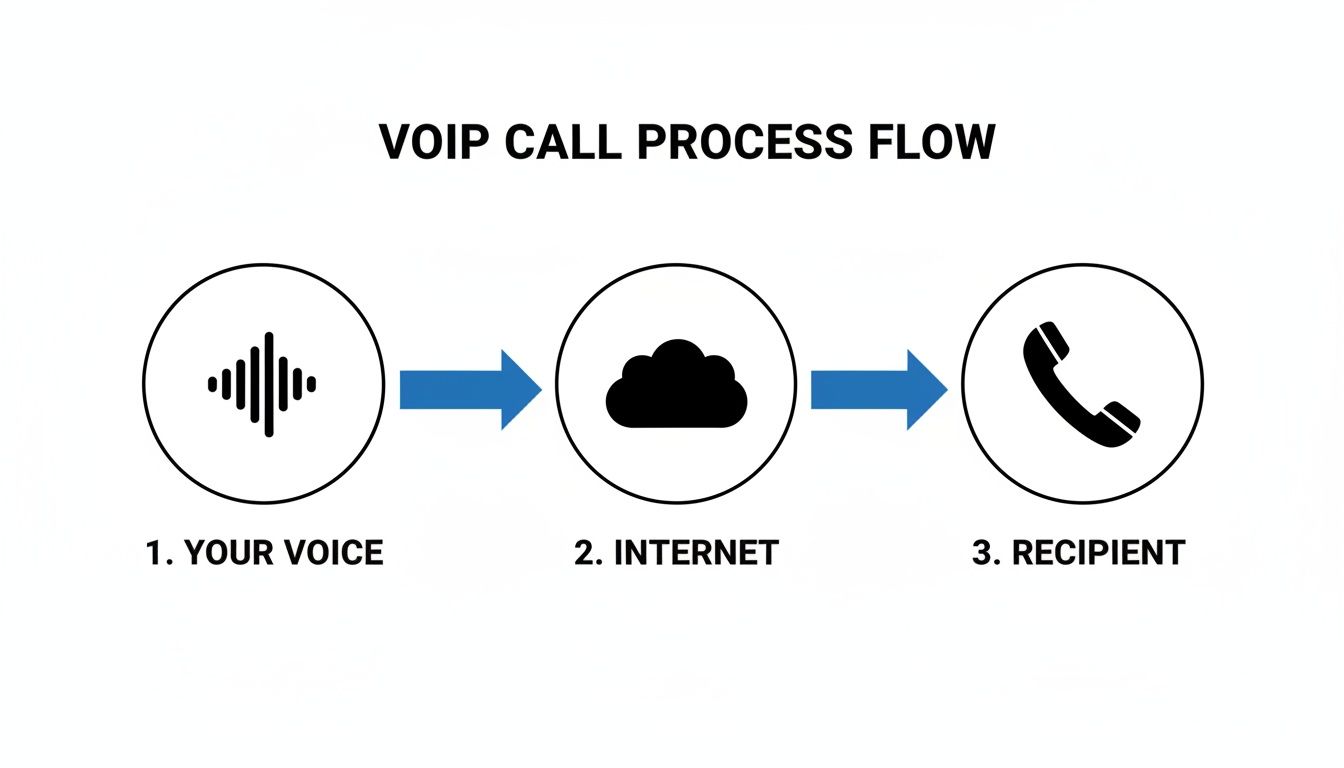
As you can see, the whole thing hinges on a solid internet connection to package up your voice and put it back together again on the other end. That's why having enough bandwidth is non-negotiable for good call quality.
The Key Components That Make It Work
To keep your calls from turning into a jumbled mess of digital noise, a few key technologies work in concert behind the scenes.
-
Codecs (Coder-Decoder): Think of these as expert translators. A codec’s job is to compress your voice into small, efficient packets before sending them out. On the receiving end, it decompresses them back into clear, natural-sounding audio. The better the codec, the higher the audio quality.
-
SIP Trunking: If data packets are the letters, SIP (Session Initiation Protocol) trunks are the digital mail trucks that carry them. A SIP trunk is a virtual connection that replaces the need for a bundle of physical phone lines, allowing your whole office to make and receive calls over the internet.
-
Direct Inward Dialing (DIDs): A DID is essentially a personal digital mailbox. It’s the virtual phone number that’s assigned directly to a specific user, desk phone, or even a team. This lets calls ring straight through to the right person, no switchboard operator required.
The amazing part is that this entire sequence—chopping up your voice, sending it across the world, and reassembling it perfectly—happens almost instantaneously. All you need is a stable internet connection. That’s why it’s so critical to understand how much bandwidth you need for VoIP to guarantee every call is crystal-clear.
Ultimately, this digital-first approach is what frees your phone number from a physical location. As long as your voice "packets" can find their way onto the internet, your phone line works. This simple concept is what modern business communication is built on, untethering teams from desks and wires for good.
What Kinds of VoIP Numbers Can You Get?
Picking a VoIP number is about more than just getting a new set of digits. It's a strategic move that shapes how your customers see you and how easily they can get in touch. Traditional phone lines are stuck in one physical location, but VoIP gives you a flexible toolkit to build your brand’s presence, whether you're a neighborhood favorite or a growing national company.
Each type of number has a different job to do, helping you line up your communication strategy with your business goals. A local bakery, for instance, benefits most from a number with a familiar area code to build trust with the community. On the other hand, a nationwide e-commerce store needs a number that feels accessible to everyone, no matter where they're calling from.
Think of your VoIP number as a powerful marketing tool. It can make your business feel local and approachable, project a big corporate image, or simply be a breeze for customers to remember. The secret is matching your choice to your brand and your audience.
Local Numbers: Building a Community Feel
A local VoIP number comes with an area code tied to a specific city or region. For small businesses, this is almost always the best bet. It immediately signals that you have a local presence, which makes people feel more comfortable picking up the phone and calling you.
Picture a new plumbing service starting up in Dallas. Slapping a (214) or (972) number on their trucks and website tells residents they’re part of the community, not some faceless corporation from out of state. That small detail can be the difference-maker, driving more calls from local folks who prefer to hire and support nearby businesses.
Toll-Free Numbers: Casting a Wider Net
If your customers are scattered all over the country, a toll-free number (you know the ones—starting with 800, 888, or 877) is a must-have. It removes any worry about long-distance charges, encouraging more people to reach out while making your business look professional and established. For an online retailer or a national consulting firm, a toll-free number says, "We're here for you, no matter where you live."
Vanity Numbers: Making Your Brand Unforgettable
Finally, we have vanity numbers. These are all about being memorable. They’re custom numbers that spell out a word or a catchy phrase, like 1-800-FLOWERS or 1-888-NEW-ROOF. By building your brand right into your contact info, you create a powerful memory hook that sticks in people’s minds after seeing an ad. A pizza joint with the number 555-PIZZA is going to get a lot more recall than one with a random string of digits, turning their phone number into a killer marketing asset.
The Real Business Benefits of Switching to VoIP

Okay, so we've covered the technical side of how a VoIP phone number works. But for any business owner, the real question is always the same: Why should I care?
The answer comes down to real-world, bottom-line benefits that go way beyond just making calls over the internet. Switching to VoIP isn’t merely a tech upgrade; it’s a smart business move that directly impacts your finances, your team’s efficiency, and the professional image you present to the world.
For most businesses, the first and most powerful advantage is a serious drop in costs. Traditional phone systems, with all their clunky hardware and separate line fees, are notoriously expensive. It’s not uncommon for businesses to slash their monthly phone bill by up to 60% just by making the switch to a VoIP solution.
This isn't just about paying less per call. You're also cutting out expensive maintenance contracts and the hefty capital investment of a physical PBX box sitting in a closet. Instead, you get a simple, predictable monthly subscription that bundles everything—features, support, and service—into one neat package. For a small or mid-sized business, that's a lot of cash freed up for other things.
Effortless Scalability and Flexibility
Remember what it was like to grow with an old-school phone system? Hiring a new team member meant calling a technician, waiting for them to show up, and paying them to physically wire a new line. The whole ordeal could take days, if not weeks.
VoIP throws that entire process out the window. Need to add a new user? Just log into your admin portal and click a few buttons. You can have a new employee fully set up with their own business number in minutes. This kind of agility means your communication system can grow at the exact same pace as your business, with zero friction.
And that flexibility isn't just about adding new lines. It’s about supporting how people actually work today. Whether your team is fully remote, in a hybrid setup, or spread across different locations, VoIP allows everyone to use their business number from anywhere, on any device they choose.
Powerful Features That Boost Productivity
Beyond the savings and scalability, a VoIP number gives you access to a suite of powerful communication tools that used to be reserved for giant corporations with deep pockets. These aren't just flashy bells and whistles; they are features that actively improve how your business runs and how your customers see you.
Here are a few game-changers that come standard:
- Auto-Attendant: Think of it as a digital receptionist that greets every caller and professionally routes them to the right person or department. It works 24/7, so you always make a great first impression.
- Voicemail-to-Email: Get voicemail recordings and even transcriptions sent straight to your inbox. You can read or listen to messages on the fly without ever having to dial into your voicemail box.
- Call Forwarding & Routing: Set up smart rules to send calls to the right place based on the time of day, who’s calling, or team availability. This is how you make sure no important call ever slips through the cracks.
These tools help a small team punch well above its weight, projecting the image and efficiency of a much larger, more established company. They cut down on manual tasks and create a much smoother, more professional experience for your customers.
The difference becomes crystal clear when you look at the underlying infrastructure. To really see what you’re gaining, it helps to compare modern VoIP with the legacy systems it replaces. You can dive deeper by reading our complete guide on VoIP vs POTS phone systems. At the end of the day, moving to VoIP is about giving your business a smarter, more affordable, and more adaptable foundation for communication.
Getting Started with a VoIP Number

Deciding to switch to a VoIP phone number is the hardest part. Believe it or not, the actual move is usually much simpler than business owners think, especially when a modern provider is there to walk you through it. It really just comes down to checking a few boxes and picking the right tools for your team.
Because the whole system is powered by your internet, the very first step is making sure your network can handle it. You don't need some blazing-fast, top-of-the-line connection, but it does need to be stable. You'll want enough bandwidth to support all your calls without sacrificing that crystal-clear quality.
With that sorted, you can decide how your team will actually make and take calls. That’s the real beauty of a VoIP number—the sheer flexibility it gives you. You can mix and match different hardware to fit what each person on your team actually needs.
Choose Your Calling Hardware
You've got a few great options here, and none of them require a technical genius to set up.
- IP Phones: These look just like the desk phones everyone is used to, but they plug into your internet with an Ethernet cable instead of a wall jack. They’re known for fantastic audio quality and give your team a familiar device to work with.
- Softphones: A softphone is just an app you install on a computer or smartphone. When you pair it with a good headset, it turns that device into a powerful business phone. This is a game-changer for remote employees and anyone who’s constantly on the go.
- Analog Telephone Adapters (ATAs): Got a collection of older analog phones that you don't want to part with? An ATA is a small box that acts as a bridge, connecting your trusty old hardware to your new internet-based phone system.
Most providers, like SnapDial, make this even easier by shipping pre-configured IP phones. You just plug them in, and they work. No technical headaches involved.
Keeping Your Existing Business Number
"Can I keep my current phone number?" This is one of the first questions we always get, and the answer is a big, resounding yes. The process is called number porting, and it's a standard, regulated practice that moves your number from your old phone company to your new VoIP provider.
Your business phone number is a key piece of your brand. A good VoIP provider will handle the entire porting process for you, making sure there's no downtime so you never have to worry about missing a customer call.
Once you've picked your provider, decided on your hardware, and kicked off the porting process, the last step is the fun part: configuration. This is where you bring your system to life by setting up your auto-attendant greeting, defining call routing rules, and assigning user extensions. With an easy-to-use web portal, you can manage everything from anywhere, turning what used to be a complicated IT project into a simple setup you can knock out in an afternoon.
Choosing the Right VoIP Provider for Your Business
Picking a provider for your business phone service is a big decision, and it’s about a lot more than just finding the lowest monthly fee. It’s easy to get drawn in by a low price tag, but the real value comes from a service that's reliable, secure, and has your back with solid support when you run into trouble.
You need to dig a little deeper than the marketing claims. Ask potential providers the hard questions: What’s your guaranteed uptime? Do you offer a service level agreement (SLA)? How do you make sure calls are always crystal clear? The answers you get will tell you everything you need to know about their commitment to quality.
A cheap VoIP service that constantly drops calls or has poor audio quality isn't a bargain—it's a liability. Your business phone is a direct line to your revenue, so prioritizing reliability is a non-negotiable part of the selection process.
Key Evaluation Criteria
As you start comparing different services, it helps to have a checklist. This keeps you focused on the features and guarantees that truly matter for your day-to-day operations and future growth.
Here are the essential factors to consider:
- Reliability and Uptime: Don’t settle for anything less than a 99.9% uptime guarantee. This is the industry standard for a reason—it means your phones are always on when your customers need to reach you.
- Security Protocols: How is your data protected? Ask about security measures like call encryption. Protecting your conversations is absolutely critical, especially if you’re handling sensitive customer information.
- Customer Support: When something goes wrong, you need help fast. Look for providers who offer 24/7 support with real, knowledgeable people who can solve problems quickly, not just read from a script.
- Feature Set: Does the platform include essentials like an auto-attendant, call recording, and integrations with your CRM? Make sure the service can handle your current needs and has room to grow with your business.
VoIP Provider Feature Checklist for Businesses
To help you compare apples to apples, we've put together a checklist of what to look for when you're vetting potential VoIP providers. Use this table to make sure you're covering all your bases and choosing a partner that truly fits your business.
| Feature/Consideration | What to Look For | Why It Matters |
|---|---|---|
| Uptime Guarantee | A formal Service Level Agreement (SLA) with 99.9% or higher uptime. | Ensures your phone lines are always open for business, preventing lost sales and customer frustration. |
| Call Quality | High-Definition (HD) voice, Quality of Service (QoS) settings. | Crystal-clear audio is crucial for professional communication and a positive customer experience. |
| Security Measures | End-to-end encryption (TLS/SRTP), compliance certifications (e.g., HIPAA). | Protects sensitive business and customer conversations from eavesdropping and data breaches. |
| Customer Support | 24/7 availability, multiple contact channels (phone, chat, email), in-house experts. | Gives you peace of mind that you can get fast, effective help whenever technical issues arise. |
| Scalability | Ease of adding/removing users and phone numbers on demand. | Allows your phone system to grow (or shrink) effortlessly as your business needs change. |
| Essential Business Features | Auto-attendant, call forwarding, voicemail-to-email, call recording. | These tools automate workflows, improve professionalism, and boost team productivity. |
| Integrations | Native or Zapier integrations with your CRM, helpdesk, and other business software. | Connects your communication data with other tools, streamlining processes and providing better insights. |
| Pricing Transparency | Clear, all-inclusive pricing with no hidden fees for essential features. | Prevents surprise bills and makes it easier to budget for your communication costs accurately. |
Remember, a VoIP provider isn’t just a utility—they’re a partner in your company's success. By choosing one that delivers on reliability and offers a powerful feature set, you're not just buying a phone line. You're investing in a complete communication platform. For many businesses, the ideal solution is a comprehensive cloud phone system that bundles all of these critical elements into a single, easy-to-manage service.
Got Questions? We’ve Got Answers.
Even after you see how it all works, it's totally normal to have some lingering "what if" questions before you jump in. Things like keeping your number, what happens if the internet goes out, and call security are top of mind for most businesses. Let’s clear those up.
The big one we hear all the time is, "Can I keep my current phone number?" The answer is a resounding yes. Thanks to a standard process called number porting, you can bring your existing number with you. Your new VoIP provider handles all the behind-the-scenes work, moving the number from your old carrier to their system so you don't miss a single call.
What Happens If My Internet Goes Down?
This is a fair question for any service that runs online. Your VoIP system needs the internet to work, but that doesn't mean your business grinds to a halt during an outage. Smart VoIP systems are built for this.
If your office internet cuts out, your calls don't just vanish. Advanced call forwarding rules kick in instantly, automatically redirecting incoming calls to a backup number—like your cell phone or a colleague's line. Business keeps moving, and your customers never know the difference.
Just How Secure Are VoIP Calls?
Security is another huge priority, and for good reason. Reputable VoIP providers use powerful encryption protocols like Transport Layer Security (TLS) and Secure Real-Time Transport Protocol (SRTP) to protect your conversations.
Think of it like an armored truck for your voice data. These protocols scramble the data as it travels over the internet, making it completely unreadable to anyone trying to eavesdrop. Honestly, this is often a major security upgrade compared to old-school analog phone lines, which typically have no encryption at all.
Ready to explore a phone system that gives you this kind of flexibility and peace of mind? SnapDial offers a white-glove setup that includes seamless number porting and 24/7 Texas-based support to make your switch completely painless. Find a better way to connect with your customers at https://snap-dial.com.