The main difference between a call center and a contact center boils down to the channels they use to talk to customers. A traditional call center is all about the phone, built from the ground up to handle inbound and outbound voice calls. That's its entire world.
A contact center, on the other hand, is a modern, omnichannel hub. It’s designed to manage customer conversations across a whole spectrum of channels—not just phone calls, but also email, live chat, SMS, and even social media.
Defining Your Customer Communication Strategy

While both are your front line for customer support, they operate on completely different principles. A call center's main job is to resolve problems quickly and efficiently over the phone. Its tech stack, featuring tools like Automatic Call Distributors (ACD) and Interactive Voice Response (IVR), is purely optimized for managing and routing a high volume of calls.
Contact centers are built for something bigger: creating a single, consistent customer experience no matter how someone gets in touch. They pull every communication channel into one unified platform. This gives agents a complete picture of a customer's history, whether they last emailed, chatted, or called. That’s huge, because nobody wants to repeat their story every time they switch from a chat window to a phone call.
This difference changes everything, from how you train your team to the kind of insights you can gather. Call center agents become masters of phone etiquette and sticking to the script. Contact center agents need to be skilled multitaskers, juggling conversations across multiple platforms at once.
The core evolution from a call center to a contact center is the shift from managing transactions on a single channel to managing relationships across all channels. It's about meeting customers where they are.
Ultimately, choosing between a call center and a contact center is a choice about your customer service philosophy. One path prioritizes efficient, voice-only problem-solving. The other is all about building a seamless, connected customer journey. Bringing these channels together is one of the key advantages of unified communications, because it eliminates those frustrating communication gaps.
For a quick breakdown, the table below highlights the core distinctions.
At a Glance Key Differences Between Call Centers and Contact Centers
This table provides a quick summary of the fundamental distinctions between traditional call centers and modern contact centers across key operational areas.
| Attribute | Call Center | Contact Center |
|---|---|---|
| Primary Channels | Voice Calls (Inbound/Outbound) | Voice, Email, Live Chat, SMS, Social Media |
| Customer Focus | Transactional (Resolving a specific call) | Relational (Managing the entire customer journey) |
| Agent Workflow | Sequential Call Handling | Simultaneous, Multichannel Conversations |
| Technology Core | PBX, IVR, ACD for Voice | Unified Communications Platform, CRM Integration |
| Strategic Goal | Call Volume Management & Efficiency | Omnichannel Customer Experience & Satisfaction |
As you can see, the scope and strategic purpose of each are fundamentally different, which directly influences the technology, agent skills, and customer experience you deliver.
The Evolution From Voice Calls To Digital Engagement
The shift from traditional call centers to modern contact centers wasn’t just a trend. It was a direct response to a massive change in how customers live and communicate. For decades, the phone was the only real game in town for customer service, so businesses built their entire support world around it. The goal was simple: master that one channel, handle as many calls as possible, and keep those calls short.
That phone-first model worked well for a long time. But as we all started living our lives online, our expectations for customer service changed right along with it. We got used to the instant gratification of live chat, the on-the-go ease of texting, and the public forum of social media. Naturally, we started expecting businesses to be available on those same channels.
Meeting Customers Where They Are
Suddenly, the call center's single-minded focus on voice became a huge bottleneck. Think about it: a customer sends a DM on social media with a question, only to be told they have to call a 1-800 number. Then, they have to start from scratch, repeating the whole story to a brand-new agent. It’s clunky, frustrating, and a surefire way to damage customer loyalty.
Businesses quickly learned that voice is still incredibly important, but it's just one part of a much bigger conversation. Its real power comes alive when it’s woven into a seamless communication strategy that lets customers move effortlessly from one channel to another. This is the heart of the call center vs. contact center difference—one is built for isolated transactions, the other for connected, ongoing relationships.
The Data-Driven Shift To Omnichannel Support
The numbers tell the story loud and clear. While phone calls are still a huge piece of the puzzle—inbound voice share actually grew from 53.5% in 2022 to 55.4% in 2023—digital channels are catching up fast. In that same year, live chat usage climbed from 7.0% to 7.2%, social media jumped from 2.8% to 3.0%, and SMS saw a boost from 1.3% to 1.6%.
This isn't happening by accident. The contact center software market was valued at $72.6 billion in 2025 and is expected to blow past $170 billion by 2030. You can check out more revealing call center statistics to get the full picture. That money is being poured into cloud-based platforms designed to bring voice, chat, SMS, and social media under one roof for a reason. The payoff is just too big to ignore.
The move to a contact center is about adapting to market demands for seamless, contextual conversations. It's about empowering agents with a complete view of the customer's journey to improve first-contact resolution and boost efficiency.
By pulling all these communication streams together, companies unlock some serious advantages:
- Improve First-Contact Resolution: When an agent sees a customer's entire history—from a tweet to a previous chat—they can solve the problem on the spot without making the customer repeat themselves.
- Boost Agent Efficiency: Juggling multiple conversations from one screen is far more effective than hopping between different apps. Agents get more done with less stress.
- Enhance Customer Experience: Being available on a customer's favorite channel and providing a smooth, consistent experience is how you build trust and keep people coming back.
At the end of the day, this evolution isn't about replacing the phone. It's about giving it a team of other channels to work with, creating a flexible and powerful system that matches the way people actually communicate today.
Comparing Core Technology And Capabilities
The real story in the call center vs. contact center debate isn't just about the number of channels they handle. It's about the engine under the hood. The underlying technology is what truly separates them, creating massively different experiences for both your customers and your agents.
Think of it this way: a call center's tech is built for a single, straight road—efficiently handling one phone call after another. A contact center, on the other hand, is built like a modern traffic control system, managing a fluid, data-rich conversation that can weave across multiple lanes.

This technological gap directly shapes business outcomes, from agent productivity to the kind of customer insights you can actually use. Nailing down these core differences is the first step to choosing a solution that truly fits your goals.
Let's break down the key technology and feature differences to see how they stack up in the real world.
Technology and Feature Showdown: Call Center vs Contact Center
The following table offers a detailed comparison of the technological capabilities found in traditional call centers versus the advanced features of modern contact centers, like those powered by SnapDial. This isn't just a list of features; it's a look at how these technologies directly impact your business operations and customer relationships.
| Feature Area | Traditional Call Center Capabilities | Modern Contact Center Capabilities (SnapDial Enabled) | Impact on Business |
|---|---|---|---|
| Routing | Basic ACD (Automatic Call Distributor) routes calls to the next available agent. Simple IVR for department selection (e.g., "Press 1 for Sales"). | Omnichannel routing with skills-based and contextual logic. Unified queues for all channels (voice, email, chat, social). | Moves from a "first-in, first-out" model to "best-fit," dramatically improving first-contact resolution and customer satisfaction. |
| Analytics & BI | Voice-centric metrics: call volume, average handle time (AHT), calls abandoned. Offers a narrow, operational view. | Holistic journey analytics across all channels. AI-powered sentiment analysis, channel preference tracking, and root cause identification. | Transforms data from a simple report card into a strategic tool for understanding customer behavior and making informed business decisions. |
| CRM Integration | Basic call logging. Agents often need to manually switch between phone system and CRM, leading to data silos and repetitive work. | Deep, seamless integration creates a unified customer profile. Agent screens auto-populate with the customer's full interaction history. | Empowers agents with complete context, eliminating the need for customers to repeat themselves and creating a smooth, personalized experience. |
| Workforce Management | Manual scheduling based on historical call volume forecasts. Limited flexibility for agent management. | AI-driven forecasting and scheduling across all channels. Real-time adherence monitoring and automated agent assistance tools. | Optimizes staffing, reduces overhead, and boosts agent productivity and morale by providing them with better tools and support. |
As you can see, the leap from a call center to a contact center is significant. It's a shift from managing calls to orchestrating conversations and leveraging data to build stronger customer relationships.
Routing And Customer Queues
In a classic call center, routing is pretty straightforward. The workhorse is the Automatic Call Distributor (ACD), which simply sends the next incoming call to the next available agent. It's a first-in, first-out system that values speed and volume above all else. Some might have a basic Interactive Voice Response (IVR) letting callers "Press 1 for Sales," but the logic is almost always tied to just that phone call.
Modern contact centers use a much smarter approach called omnichannel routing. This system doesn't just see a phone call or an email; it sees a whole customer conversation, no matter where it happens.
- Skills-Based Routing: Instead of just finding a free agent, the system finds the right agent. A complex billing question coming in via live chat gets automatically sent to a senior agent who actually knows finance.
- Contextual Routing: The system uses data from your CRM to make smarter choices. When a high-value client sends an email, their follow-up phone call can be fast-tracked to the front of the line and routed directly to their dedicated account manager.
- Unified Queues: Every interaction—social media DMs, text messages, emails, calls—lands in one central queue. Supervisors get a complete view of everything, and agents can manage different conversations from a single screen.
This kind of intelligent routing is more than just distribution; it's a strategic tool for getting things right the first time and keeping customers happy.
Analytics And Business Intelligence
Analytics in a traditional call center are almost entirely focused on voice metrics. Supervisors are looking at things like call volume, average handle time (AHT), and how many calls were answered versus abandoned. It's useful for staffing, but it gives you a very narrow view. You know what happened on the phone, but you have no idea why.
A contact center's analytics engine, however, is built to see the whole story. It pulls in data from every single touchpoint to build a complete picture of the customer journey.
A contact center transforms analytics from a simple operational report into a strategic business intelligence tool. It moves beyond "how many calls did we take?" to answer "what are our customers truly experiencing across their entire journey?"
This rich, comprehensive data allows you to:
- Map the Customer Journey: See how an interaction started with a web chat, moved to an email exchange, and ended with a phone call to finalize a purchase.
- Identify Channel Preferences: Learn that your younger customers prefer social media for quick questions while older demographics stick to email for detailed support.
- Perform Sentiment Analysis: Use AI to scan emails and chat transcripts for emotional cues, flagging frustrated customers so you can proactively step in before a problem gets worse.
This level of insight is simply out of reach in a call-center world, where every channel is its own island. It gives leaders the power to make smart decisions about everything from product design to agent training, all based on what customers are actually doing and saying.
CRM Integration And The Unified Profile
This might be the single biggest technological game-changer. How a system connects with your Customer Relationship Management (CRM) platform says a lot. For a call center, the integration is often an afterthought—it might log that a call happened, but the agent is still manually flipping between screens and re-typing information.
In a contact center, the CRM is the central nervous system. The integration is so deep and seamless that it creates a unified customer profile. The moment a customer gets in touch, the agent's screen instantly fills with their entire history across every channel.
Picture this scenario:
- A customer starts a live chat on your site asking about a product feature.
- An hour later, they send an email with a follow-up question.
- Finally, they call to place their order.
With a contact center's deep CRM integration, the agent who picks up that call sees the full chat and email transcripts right away. No more "Can you please repeat your issue?"—just a smooth, efficient experience. This unified view empowers agents to provide personalized, context-aware service that builds real loyalty. In the call center vs. contact center comparison, this is a massive advantage that directly boosts both agent efficiency and customer satisfaction.
Matching the Model to Your Business Needs
Moving past a technical feature list and into real-world application is where the rubber meets the road. Deciding between a call center and a contact center isn't just an IT item on a checklist; it's a strategic move that defines how you build relationships with your customers, how efficiently you operate, and ultimately, how healthy your bottom line is. You're essentially aligning your communication technology with your core business goals.
For plenty of businesses, a focused, voice-only call center is all they need—and it works brilliantly. This is especially true when customer interactions are straightforward, transactional, and best handled by the directness of a phone call.
When a Call Center Makes Sense
A dedicated call center really shines in specific, high-volume scenarios where the phone is king. If your team's workflow is built around voice, this focused approach is often the smartest fit.
Consider these situations:
- Outbound Appointment Setting: Think B2B sales development or medical practice scheduling. The mission is clear: get appointments on the calendar. Agents are dialing from a list, and success is measured by how many meetings they book over the phone.
- Simple Order Taking: For companies that take orders by phone for a straightforward product catalog, a call center is perfect. The process is linear and doesn't get tangled up in multi-channel follow-ups.
- Surveys and Market Research: When you need to gather direct feedback using a structured questionnaire, a phone call offers a controlled and immediate way to collect that data.
In cases like these, sinking money into a full-blown omnichannel contact center probably won't deliver a good return. The extra digital channels might just sit there unused, adding complexity to what should be a simple and effective process.
When a Contact Center Is Non-Negotiable
For most modern businesses, however, an omnichannel contact center isn’t a luxury—it’s a necessity for staying competitive. Customer expectations have fundamentally shifted. If you can't meet them on their channel of choice, you risk losing them for good. This is particularly true in industries built on complex interactions and long-term relationships.
The push toward a contact center often comes from a painful place: the high cost of a bad customer experience. When your customers can switch to a competitor with a single click, providing seamless, multi-channel support becomes a core business-retention strategy.
The stakes are incredibly high because poor service hits your revenue directly. Around 40% of consumers say they'll walk away from a brand after just one negative interaction, and 53% will spend less with a company after a bad experience. This turns metrics like First Contact Resolution (FCR) into a tangible business risk.
A modern communications hub is essential for businesses like these:
- E-commerce Support: Customers expect to use live chat for quick questions, get order confirmations via email, receive shipping alerts by SMS, and call in for complex returns. A contact center brings all these touchpoints together into one seamless conversation.
- Technical Help Desks: Solving a tech issue is rarely a one-and-done phone call. It might start with an email ticket, move to live chat for basic troubleshooting, and then escalate to a phone or video call for in-depth problem-solving.
- Multi-Location Retail: A customer journey can be complex. They might see a sale on social media, use a website chatbot to check inventory, and then call their local store to confirm product availability. A unified contact center connects all these dots.
For these companies, a contact center's power lies in its ability to track a single customer conversation across multiple channels. This is what drives higher FCR rates—with industry benchmarks sitting between 70–80%—and boosts Customer Satisfaction (CSAT) by saving people from the maddening experience of repeating their story over and over.
The engine behind this is often a flexible, cloud-based platform. You can learn more about the technology in our guide on what is a cloud phone system. Ultimately, choosing a contact center is an investment in building strong, positive customer relationships, no matter where those conversations happen.
How To Choose The Right Communications Solution
Picking the right communications platform is a massive business decision, not just another IT project. Whether you stick with a voice-focused call center or move to an omnichannel contact center will directly shape customer satisfaction, how efficiently your team operates, and your ability to grow down the road. The right choice comes from a hard look at what you need now, where you're headed, and, most importantly, what your customers actually expect from you.
Forget a simple feature-for-feature comparison for a moment. Instead, start by asking some tough, strategic questions about your business. This simple framework will quickly tell you whether a streamlined, voice-only setup is enough or if you need a more dynamic, multi-channel approach to keep up.
A Checklist For Your Decision
Before you even look at a demo, your team needs to be on the same page about a few key things. Think of these questions as your North Star, making sure whatever you choose fits your business like a glove.
- How do our customers really want to talk to us? Dive into your current interaction data. Are you noticing more emails, social media DMs, or web chats popping up? If your customers are already trying to find you on digital channels, a contact center isn't just an upgrade—it's essential.
- What does our ideal customer journey look like? Map it out, from the first "hello" to the final resolution. If that journey naturally hops between channels—say, from a quick web chat to a follow-up phone call—only a unified contact center can make that feel seamless.
- Can our system actually support a hybrid or remote team? Modern work demands flexibility. A cloud-based platform is non-negotiable if you want your agents to be effective from anywhere without losing access to the tools and data they need to do their jobs.
- How well will this play with our existing tech stack? Your communications hub has to talk to your CRM and other critical software without a hitch. Solid integrations break down data silos and give agents the full picture, empowering them to solve problems on the first try.
This decision tree gives you a great visual for matching common business needs—like high-volume sales or in-depth technical support—to the right solution.
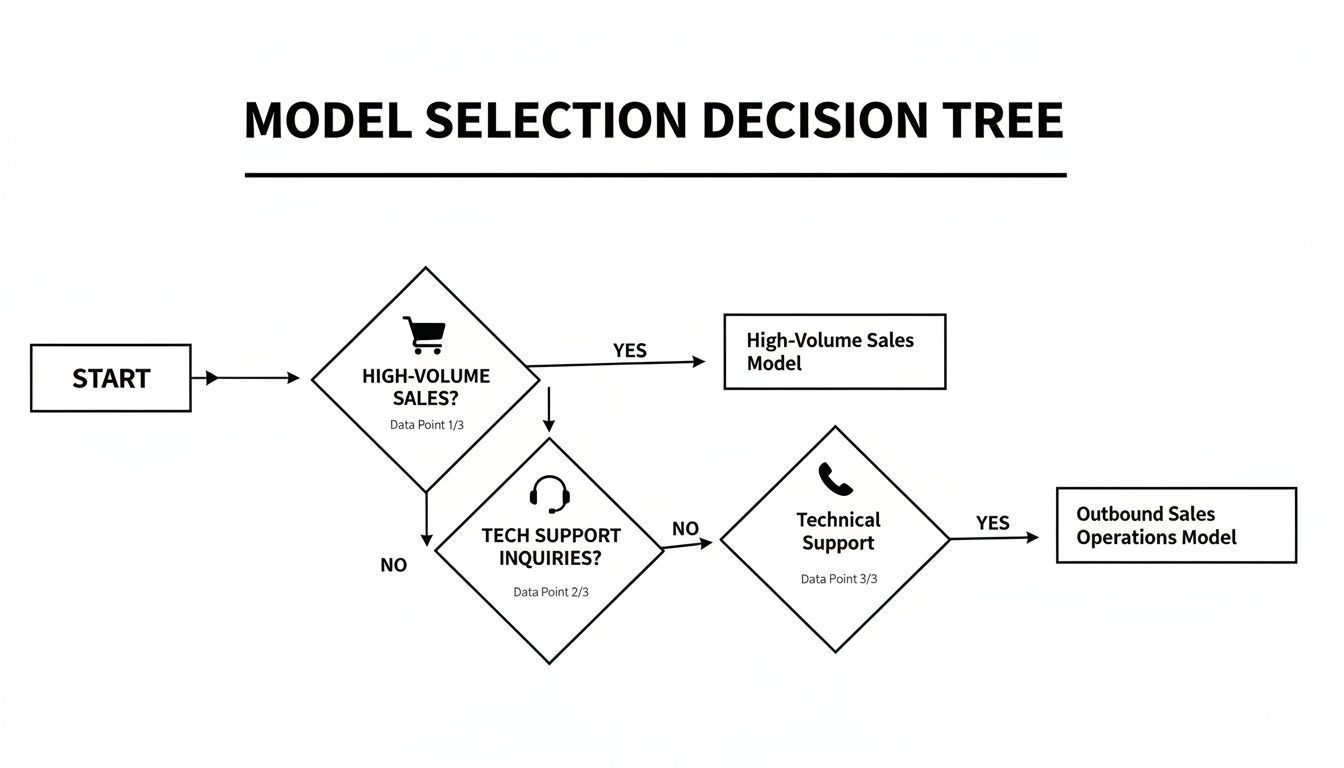
As the flowchart shows, businesses with more complex, multi-step customer interactions (think e-commerce or tech support) get the biggest bang for their buck from a contact center’s omnichannel muscle.
Future-Proofing Your Communications Investment
For a lot of companies, the whole call center vs. contact center debate is starting to feel a little dated. The smartest move is often finding a platform that can start as a best-in-class call center but has the power to evolve into a full contact center as your business grows and customer habits change. This approach takes the risk out of the investment and saves you from a painful, costly platform migration later on.
A flexible, cloud-based system delivers exactly that. You can start by absolutely nailing your voice operations with top-tier features, then flip the switch on digital channels like chat, SMS, or social media when you’re ready, all without having to start from scratch.
The smartest investment is a solution that meets you where you are today and grows with you tomorrow. A scalable platform eliminates the need to choose between a call center and a contact center—it allows you to have both, adapted to your specific needs.
This forward-thinking strategy isn't just for the big players anymore. The global contact center workforce has ballooned to over 17 million people, with nearly 3 million agents in the U.S. alone. This has fueled incredible innovation and competition. For small and mid-sized businesses, this means features like IVR, queue callbacks, and real-time analytics are now table stakes.
Choosing a vendor with predictable, all-inclusive pricing and a hands-on onboarding process breaks down the old barriers, letting SMBs access the same powerful tools that enterprises use. You can learn more about where the industry is heading with these contact center statistics and benchmarks.
Ultimately, you're looking for a partner, not just a product. A provider that handles the heavy lifting of setup, offers 24/7 support, and gives you a clear path for growth will ensure your communications system remains one of your most valuable assets for years to come.
Planning Your Move to a Modern Platform

Making the jump from an old-school phone system to a modern communications platform is a big deal. When you're moving from a basic call center to a more capable contact center, you can't just flip a switch. It takes a solid plan to pull it off without chaos and make sure your team is ready to hit the ground running.
The first thing you have to do is get the lay of the land. Take a hard look at your current setup—map out your call flows, figure out who your key user groups are, and make a list of every single phone number that needs to come with you. This groundwork is essential so that nothing important gets left behind.
Creating a Seamless Transition Plan
With a clear picture of what you have, you can start building your migration roadmap. The name of the game is achieving zero downtime. The best way to do this is to have both the old and new systems running side-by-side for a brief period before you make the final cutover.
This parallel approach gives you a safety net for testing everything thoroughly and lets your team get comfortable with the new tools. A few key steps are non-negotiable here:
- Number Porting: Getting the ball rolling to transfer your existing business numbers to the new provider.
- Routing Configuration: Building out your call routing logic, auto-attendants, and queues in the new system. This is also a great time to improve them.
- Hardware Deployment: Getting any new IP phones or headsets unboxed, configured, and tested.
Look for a provider that offers a "white-glove" setup. This is a game-changer. It means their experts handle the heavy lifting, taking the technical pressure off your team and ensuring every last detail is managed for a smooth transition.
Empowering Your Team for Success
The last piece of the puzzle—and honestly, the most important—is training your team. Shifting from a phone-only world to an omnichannel one means new ways of working. Good training shouldn't be a boring feature dump; it needs to focus on real-world situations, showing agents exactly how to juggle conversations across different channels from one unified screen.
When your team feels confident from day one, you know the migration was a success. For any business heading down this road, taking some time to understand modern VoIP call center solutions will give you a much stronger foundation for your strategy. A well-thought-out plan turns a technical project into a true business upgrade.
Common Questions Answered
When you're weighing a call center against a contact center, a lot of practical questions pop up. Business owners and IT managers often have the same core concerns, so let's tackle them head-on with some straight answers.
Is a Contact Center Overkill for a Small Business?
Not like it used to be. The idea of a "contact center" being a massive, complex operation is outdated. Today's cloud platforms are built to scale, which means small businesses can access the same powerful features as large enterprises without the hefty price tag.
You can start small, maybe with just phone and email, and then bolt on other channels like web chat or SMS as your business grows. The pricing is predictable, and the setup is usually handled for you, so those old barriers to entry are pretty much gone. This really levels the playing field, allowing even a small team to provide top-tier customer service.
The biggest shift is flexibility. Modern contact center software is designed to fit your business, not the other way around. You get enterprise-level tools scaled perfectly for your team's size and budget.
This flexibility completely changes how a small or medium-sized business should think about this decision.
How Hard Is It to Switch from a Basic Phone System?
With the right provider, it’s surprisingly smooth. The key is to look for a partner that offers a "white-glove" setup. This means they handle the entire migration for you—from moving your existing phone numbers over to setting up call routing rules and training your staff.
This hands-on approach is all about minimizing disruption to your daily operations. The goal is to get your team comfortable and confident with the new system from day one, without any steep learning curve or technical headaches. It all comes down to choosing a vendor who makes onboarding and support a priority.
If I Switch, Do I Lose My Phone Call Functionality?
Absolutely not—in fact, it gets better. A modern contact center doesn't replace your voice channel; it enhances it. Voice is still a core piece of the puzzle, and it's fully integrated into the platform, often with much better call quality and reliability than older systems.
Your phone calls simply become part of a unified system alongside email, chat, and SMS. This lets your agents handle every single customer interaction from one screen. Instead of jumping between different tools, you create a more efficient workflow and a much more consistent customer experience. You're not losing voice; you're giving it an upgrade.
Ready to modernize your business communications with a platform that grows with you? SnapDial offers a powerful, all-in-one solution with white-glove setup and 24/7 support, making the transition to a modern contact center seamless. Schedule your free demo today!