
At its heart, a VoIP call center solution is a powerful, internet-based communication platform built to handle a high volume of customer calls. Instead of relying on old-school, on-site phone hardware, these systems operate entirely from the cloud. This simple shift gives businesses of all sizes the freedom to deliver incredible customer service from literally anywhere.
Why Your Business Needs More Than Just a Phone System
Let's be honest, is your current phone system holding you back? A surprising number of companies are still stuck with traditional PBX (Private Branch Exchange) systems. These setups are often expensive to maintain, a nightmare to scale, and physically chained to the office. In today's world, that’s not just an inconvenience—it's a major roadblock to growth and keeping customers happy.
Think about it like this: a classic flip phone makes calls, and that's pretty much its entire job. A modern smartphone, on the other hand, is your central hub for everything—apps, messaging, video calls, and a thousand other tools that keep you connected and productive. Traditional phone systems are the flip phones of business communication.
VoIP call center solutions are the smartphones. They don't just "handle" calls; they create a complete communications ecosystem designed to make every single customer interaction better.
The Leap From Basic Calling to a Communication Hub
Switching from an old system to a modern VoIP solution is a bigger deal than just changing how you dial. It’s a fundamental upgrade in how your business communicates, giving you powerful tools that used to be reserved for massive corporations with deep pockets.
Moving to a cloud-based platform opens up a whole new level of efficiency and customer connection. Here's a quick look at the advantages:
- Real Cost Savings: By ditching expensive hardware and unpredictable landline bills for a simple subscription, businesses can cut their communication costs by up to 40%.
- Powerful Business Tools: You get access to features like auto-attendants, intelligent call routing, and in-depth analytics that not only improve how you handle calls but also give you priceless insights into your business.
- Unbeatable Flexibility: Effortlessly support your remote and hybrid teams. Your staff can stay connected from anywhere with an internet connection, using a desk phone, a computer softphone, or a mobile app.
Traditional PBX vs. VoIP Call Center At a Glance
To really see the difference, it helps to put the old and new side-by-side. This table gives a quick snapshot of why so many businesses are making the switch.
| Feature | Traditional PBX Systems | VoIP Call Center Solutions |
|---|---|---|
| Infrastructure | Requires physical on-site hardware and wiring. | Cloud-based, no bulky hardware needed. |
| Scalability | Difficult and expensive; requires new hardware and technician visits. | Easily scalable; add or remove users instantly from a web dashboard. |
| Location | Tied to a single physical office location. | Accessible from anywhere with an internet connection. |
| Cost | High upfront investment, ongoing maintenance, and per-minute call charges. | Low initial cost, predictable monthly subscription fees. |
| Features | Basic calling, voicemail, limited routing. | Advanced features like IVR, smart queues, analytics, and CRM integrations. |
| Maintenance | Managed by in-house IT or expensive third-party technicians. | Managed and updated automatically by the provider. |
The takeaway is clear: while traditional systems served their purpose, modern VoIP solutions are built for the way we work today—flexible, data-driven, and customer-focused.
Consider this guide your roadmap. We’ll walk through the core features, the real-world benefits, and the practical steps for choosing and setting up a VoIP call center solution that doesn't just meet your needs—it actually fuels real, measurable growth for your business.
Ultimately, the goal is to move past a simple dial tone and embrace a system that actively helps you serve your customers better. Getting a handle on what is a cloud phone system is the first critical step in turning your business communications from a cost center into a strategic advantage. This article will show you exactly how to get there.
The Key Features That Power a VoIP Call Center
To really get why a VoIP call center is such a big deal, you have to look under the hood. It’s not just one thing; it's a collection of smart features working in concert to make communication smooth and efficient. Think of it like a high-performance engine—every component has a specific job, and when they all fire in sync, you get incredible power.
These tools do more than just connect calls. They turn your phone system into a strategic asset by automating the tedious stuff and giving you a clear view of what’s happening. This frees up your team to focus on what actually matters: talking to customers and solving their problems.
Let's pull back the curtain on the essential features that make this all possible.
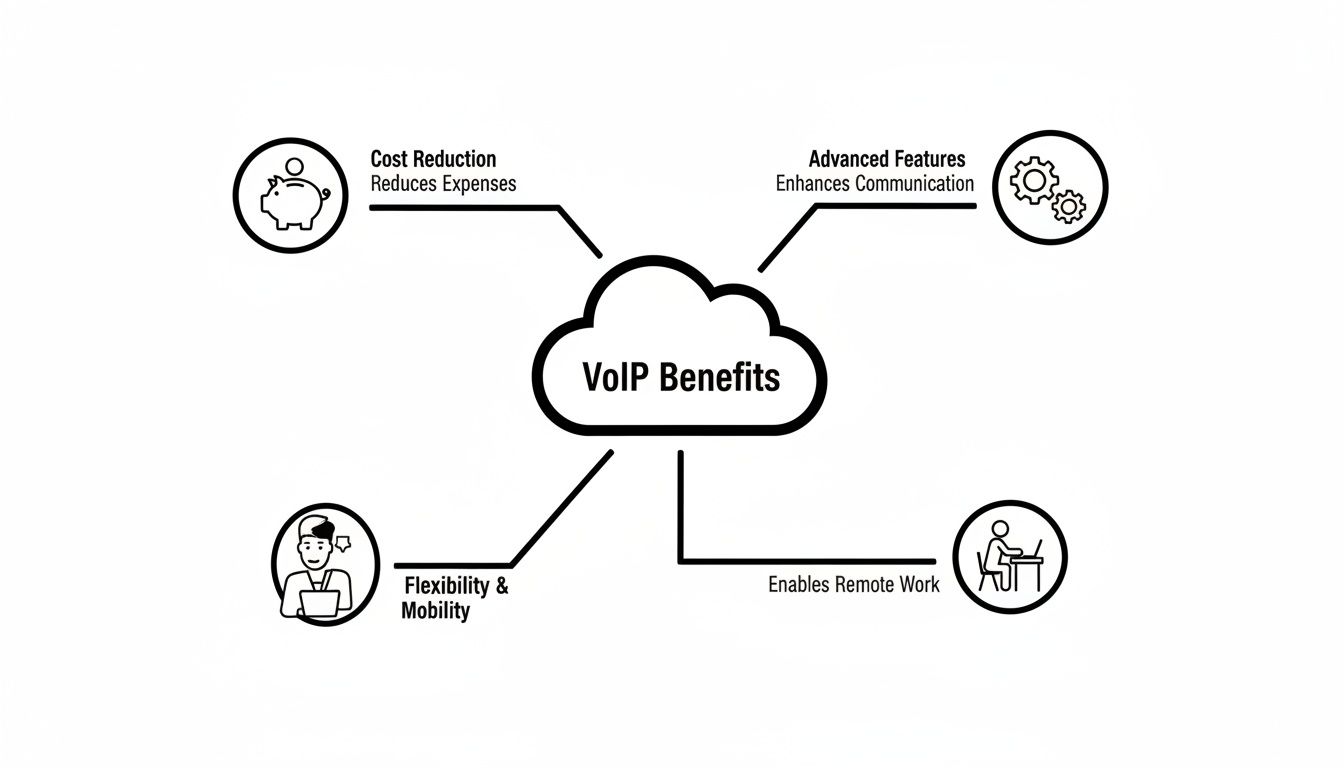
As you can see, all these benefits—saving money, getting better features, and being more flexible—are all connected. They work together to completely modernize how a business communicates.
Interactive Voice Response (IVR): Your 24/7 Digital Receptionist
An Interactive Voice Response (IVR) is basically your business’s digital front desk, and it works around the clock. It’s that automated voice you hear when you call a company: "For Sales, press 1. For Support, press 2." But it's so much more than a simple call director.
By letting customers route themselves, the IVR makes sure they get to the right person on the first try. That simple step cuts down on frustrating transfers and gets problems solved faster. For your agents, it means they're not playing switchboard operator—they're spending their time on actual customer issues.
Smart Queues: The Air Traffic Controller for Calls
When calls start flooding in, smart queues act like air traffic control. Instead of a chaotic free-for-all, this feature organizes all incoming calls into an orderly line. It can play music or custom messages to let callers know you haven't forgotten about them.
Modern queues go beyond just making people wait, though. They give managers a real-time dashboard showing:
- How many people are currently waiting
- The average and longest wait times
- How many agents are free to take a call
This visibility is crucial. It lets a manager shift people around on the fly to keep wait times down and customers happy.
Queue Callback: A Virtual Placeholder in Line
Let's be honest: nobody likes being on hold. The queue callback feature is a genuine game-changer for customer experience because it offers a simple, powerful choice. Callers can opt to hang up, keep their spot in line, and get an automatic call back when it's their turn.
This one feature shows you respect the customer's time, and it drastically reduces the number of people who just give up and hang up. Instead of getting more and more annoyed listening to hold music, they can get on with their day, knowing you'll call them back.
For any call center, this is gold. It turns a negative waiting experience into a positive, convenient one. That alone can send your customer satisfaction scores through the roof.
Reporting and Analytics: The Brains of the Operation
You can't fix what you can't see. Reporting and analytics are the brains of your VoIP system, turning mountains of raw call data into insights you can actually use. These tools give you a crystal-clear picture of your entire call operation.
With detailed reports, you can track vital metrics like:
- Call Volume Trends: Pinpoint your busiest hours and days so you can staff accordingly.
- Average Handle Time (AHT): See how long calls are taking, which might highlight a need for more agent training.
- First Call Resolution (FCR): A key measure of efficiency—how often are you solving issues on the very first call?
Having this data means you're no longer guessing. You're making smart, informed decisions that make your team more productive and your customers happier.
CRM Integration: The Single Source of Truth
Connecting your VoIP system to your Customer Relationship Management (CRM) software is like giving your call center a perfect memory. The moment a call comes in, the system instantly fetches that customer's entire history and puts it right on the agent's screen.
This means your team has everything they need right in front of them—past orders, support tickets, contact notes, you name it. The impact is immediate:
- More Personal Service: Agents can greet customers by name and already have the context for the call. No more "Can you give me your account number again?"
- Faster Problem Solving: With all the info at their fingertips, agents can get to the root of the issue and solve it much more quickly.
- Better Data: Call logs, recordings, and notes are automatically saved to the right customer record in the CRM, creating a perfect history of every interaction.
This single, unified view is what separates a decent call center from a truly customer-focused one. Each of these features plays a critical role, but when they work together, they build a communication system that is efficient, intelligent, and ready for anything.
The Real ROI of Switching to a VoIP Call Center
Sure, the fancy features are impressive, but let's be honest—any new technology investment has to answer one crucial question: What’s the return? When it comes to VoIP call center solutions, the ROI isn't some fuzzy promise. It’s a real, measurable impact you’ll see in your budget and in the way you do business.
The story of VoIP ROI starts with the numbers, but it definitely doesn't end there.
The most obvious win is how it slashes your communication costs. We’ve all been burned by traditional phone systems with their tangled billing, sky-high rates for long-distance calls, and extra fees for every little feature. VoIP flips the script by running calls over the internet, something you're already paying for. Right away, a whole category of old-school expenses shrinks or vanishes completely.
Hard Savings: The Financial Wins
The financial argument for making the switch is incredibly compelling, especially if you're a small or mid-sized business or have teams spread across different offices. You get to ditch those unpredictable monthly phone bills for a simple, fixed subscription. That predictability alone is a massive victory for anyone trying to manage a budget.
And the savings really add up when you start looking at the details. Study after study shows businesses saving a bundle after moving to a hosted VoIP system. It’s not unusual to see costs for local calls and conference calls drop by 30–40%. For companies with an international footprint, the savings are even more stunning—often as high as 80–90% on international calls compared to traditional landline rates. You can dig into more of these stats and what they mean over at ElectroIQ.
Another huge financial plus is that you no longer have to shell out a fortune on hardware. Legacy PBX systems meant buying bulky, expensive equipment that just sits in a closet losing value and needing pricey maintenance. With a cloud-based VoIP solution, that entire headache just goes away.
This shift from a heavy upfront investment (CapEx) to a predictable monthly cost (OpEx) is more than just an accounting trick. It's a strategic move that frees up cash for what really matters—growing your business, marketing, or developing new products.
Operational ROI: Boosting Efficiency and Keeping Customers Happy
Beyond the direct savings, the operational ROI is where a VoIP call center really shines. This is all about working smarter, not just cheaper. The powerful features that come standard with modern VoIP platforms are designed to solve the everyday problems that cost you money in missed opportunities and frustrated customers.
Think about what these tools actually do for your team:
- Fewer Missed Calls: With smart call routing and mobile apps, calls find the right person, no matter where they are. Every call that gets answered is a potential lead saved or a customer kept happy.
- Faster Problem Solving: When a call comes in and your agent instantly sees the customer's entire history thanks to CRM integration, they can solve the issue on the spot. That improvement in First Call Resolution (FCR) is gold for any support team. It means fewer callbacks and more satisfied customers.
- A Better Customer Experience: Little things, like offering a callback instead of making someone wait on hold, show you respect your customers' time. That small gesture can turn a frustrating wait into a positive interaction, building the kind of loyalty that keeps people coming back.
These operational wins have a ripple effect. A more efficient team can handle a higher volume of calls without you needing to hire more people. Happy customers stick around longer and are more likely to recommend you to others. This is the part of ROI people often forget—the long-term value you build by delivering a consistently great experience.
How to Choose the Right VoIP Solution for Your Business
With so many providers out there making big promises, picking the right VoIP call center solution can feel overwhelming. The real key is to cut through all the marketing noise and focus on a few core pillars that will actually determine your success with the system.
Think of it less like buying a product and more like choosing a long-term partner for your business communications. This isn't just about ticking boxes on a feature list. It’s about evaluating the very foundation of the service—its reliability, potential for growth, security, and the quality of help you'll get when you inevitably need it. Get these right, and your phone system becomes a dependable asset, not a source of constant headaches.
Prioritize Reliability and Uptime
Before you even glance at a single feature, you have to look at a provider's reliability. A phone system that goes down isn't just an inconvenience; it's lost revenue and a damaged reputation. The gold standard for uptime in this industry is 99.999%, which translates to less than six minutes of potential downtime over an entire year.
But don't just take a provider's word for it. You need to ask some pointed questions about their infrastructure:
- Do they have geographically redundant data centers? This is crucial because it ensures your service keeps running even if one of their locations has a major outage.
- What does their Service Level Agreement (SLA) actually promise? A strong SLA will guarantee a certain level of uptime and offer you credit if they fail to deliver.
- What is their track record? Look for real-world case studies or customer testimonials that speak directly to system stability.
This is the bedrock of your communication system. Without guaranteed reliability, even the most advanced features are completely useless.
Ensure the Solution Can Scale with You
Your business isn't static, and your phone system shouldn't be either. A critical part of choosing the right voip call center solutions is making sure the platform can grow right alongside your company. For a cloud-based system, scalability means you can add or remove users, phone lines, or even entire office locations with just a few clicks in a web portal.
Imagine you suddenly need to double your support team to handle a seasonal rush. With an old-school PBX, this would be a slow and expensive ordeal involving new hardware and scheduling technician visits. A truly scalable VoIP solution lets you make that change instantly, paying only for what you need, exactly when you need it. That kind of agility is a massive competitive advantage. For a deeper look at how this stacks up against older technology, understanding the differences between hosted VoIP vs PBX can offer some valuable context.
Scrutinize Security and Compliance Protocols
In an age where data breaches are front-page news, the security of your communications can't be an afterthought. Your phone system handles sensitive customer information every single day, and protecting it is ultimately your responsibility.
Any reputable provider will offer robust security measures as standard. You should look for key features like Transport Layer Security (TLS) and Secure Real-time Transport Protocol (SRTP), which work together to encrypt both call signaling and the audio data itself. This is what prevents eavesdropping and keeps your conversations private. And if your business is in a regulated industry like healthcare or finance, you absolutely must confirm if the provider can meet compliance standards like HIPAA or PCI.
A provider that is transparent about its security architecture and proactively discusses compliance is one that takes its role in protecting your data seriously. This is a non-negotiable part of the evaluation process.
Evaluate the Quality of Customer Support
When something inevitably goes wrong, the quality of your provider's support team suddenly becomes the most important feature they offer. A cheap plan with unresponsive support is a terrible bargain in the long run. You need a partner who will be there for you with real, human help when you need it most.
Here’s what great support actually looks like in practice:
- Guided Onboarding: A provider like SnapDial that offers "white-glove" setup handles the entire migration for you. They take care of everything from porting your numbers to configuring your call flows, ensuring a perfectly smooth transition with zero downtime.
- 24/7 Accessibility: Problems don't stick to a 9-to-5 schedule. Look for providers with round-the-clock support available via phone, chat, and email.
- U.S.-Based Teams: Getting support from a dedicated, knowledgeable team often leads to faster and more effective problem-solving, without language barriers or time-zone headaches.
Your phone system is your direct line to your customers. Choosing a provider with excellent, accessible support is like having an expert IT team on call 24/7, making sure that lifeline is always open. It's an investment in pure peace of mind.
Your VoIP Call Center Evaluation Checklist
To help you put all this into practice, we’ve created a simple checklist. Use this table when you're talking to potential vendors to compare them systematically and make sure you're asking the right questions.
| Evaluation Criteria | Key Questions to Ask Your Vendor | Why It Matters |
|---|---|---|
| Reliability & Uptime | Can you provide documentation for your 99.999% uptime? Do you have redundant data centers? What does your SLA guarantee? | Ensures your phone system is always operational, preventing lost revenue and customer frustration. |
| Scalability | How easy is it to add or remove users? Is there a minimum or maximum user count? What is the process for adding new locations? | A scalable system grows with your business, allowing you to adapt quickly to changing needs without costly hardware upgrades. |
| Security | What encryption protocols (like SRTP/TLS) do you use? Can you provide details on your security architecture? | Protects sensitive customer data and private business conversations from unauthorized access. |
| Compliance | Are you compliant with industry-specific regulations like HIPAA or PCI? Can you sign a Business Associate Agreement (BAA)? | Essential for businesses in regulated industries to avoid hefty fines and legal trouble. |
| Core Call Features | Does your IVR support multi-level menus? How customizable are the call queues and routing rules? Do you offer a callback feature? | The right features create a professional and efficient caller experience, reducing wait times and improving satisfaction. |
| Integrations | Which CRMs do you integrate with out-of-the-box? Do you have an open API for custom integrations? | Seamless integration with tools like your CRM provides agents with context, leading to more personalized and effective support. |
| Customer Support | Is your support team available 24/7? Are they based in the U.S.? Do you offer a dedicated onboarding specialist? | When issues arise, fast and knowledgeable support is critical to minimizing disruption and getting back to business. |
| Pricing & Contracts | Is your pricing per-user, per-month? Are there any hidden fees or setup costs? What are the contract terms and cancellation policies? | Transparent, predictable pricing helps you budget effectively and avoid surprise charges down the line. |
Walking through these points with each potential provider will give you a clear, side-by-side comparison that goes far beyond the flashy marketing claims. It helps you find a true partner that fits your business needs today and is ready to support you tomorrow.
Unlocking Peak Efficiency with Advanced VoIP Features
This is where a modern VoIP call center solution really earns its keep and leaves a basic phone system in the dust. We're moving beyond just making and taking calls; these features transform your phone system into a powerful tool that actively makes your team better and faster. They aren't just bells and whistles—they are the engines of efficiency that can give a small business the operational muscle of a massive enterprise contact center.
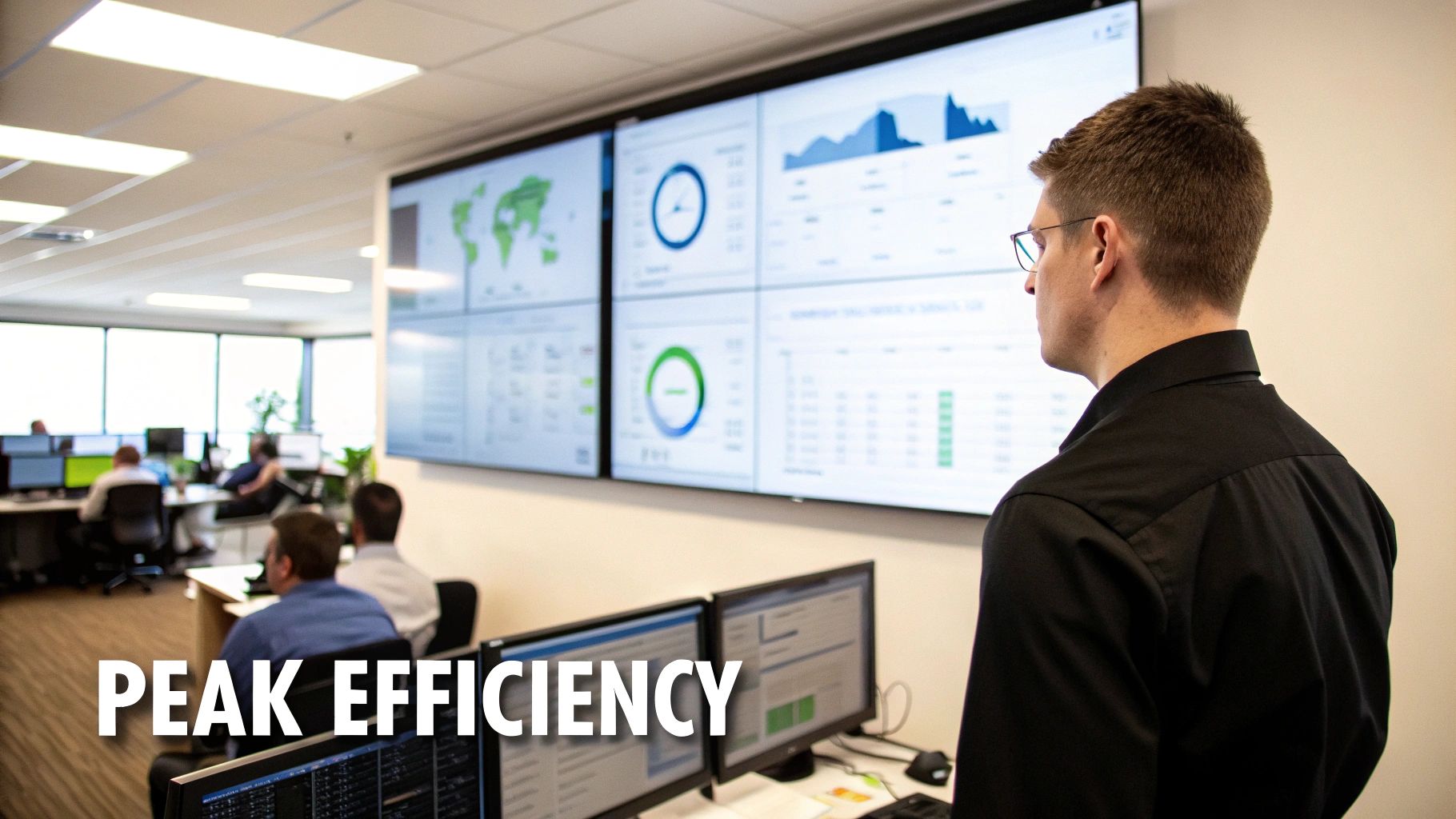
Think of it like a busy restaurant kitchen. Without someone expediting tickets and managing the flow, the chefs would be lost in a sea of orders, tickets would get mixed up, and customers would be left waiting. In a call center, advanced VoIP features play that exact role, bringing smart organization to the chaos of incoming calls.
From Call Routing to Call Intelligence
At their core, features like IVR systems and smart queues inject intelligence into how you handle calls. They make sure every single customer gets to the right person on the first try, which cuts down on frustration for them and wasted time for your team. This isn't just a minor tweak; it has a direct, measurable impact on the metrics that matter.
The numbers don't lie. By 2025, about six in ten contact centers are expected to be using IVR or cloud-based queue management. Why? Because companies that adopt these tools often see their Average Handle Time (AHT) drop by a massive 30–40% and watch wait times plummet. It’s a direct result of smarter call management. These trends show how VoIP platforms deliver real productivity gains, a topic you can dig into with these VoIP statistics from Yeastar.
The takeaway is simple: when you use technology to handle the repetitive, manual work of sorting and directing calls, you free up your human agents to focus on what they do best—solving complex customer problems.
This shift is a game-changer for businesses with remote or hybrid teams. A cloud-based system gives every agent—whether they're at HQ or their kitchen table—the same powerful toolkit. Just be sure your network is up to the task. You can learn more by checking out our guide to find out how much bandwidth you need for VoIP.
Gaining Unprecedented Visibility with Analytics
Maybe the single most powerful evolution in VoIP call center tech is the rise of real-time analytics and reporting dashboards. These tools give supervisors a bird's-eye view of everything that's happening, turning a flood of raw call data into sharp, actionable insights.
This kind of visibility empowers managers to:
- Monitor Performance in Real-Time: See at a glance how many calls are in the queue, what the current average wait time is, and which agents are free or on a call.
- Identify Bottlenecks Instantly: If wait times for a specific team suddenly spike, a manager can see it happen and reassign agents to handle the surge on the fly.
- Make Data-Driven Staffing Decisions: Look at historical call volume to know exactly when your busiest hours are, so you can schedule your team perfectly and avoid being understaffed.
- Coach and Support Agents: Use metrics like AHT and call recordings to pinpoint training opportunities and give agents the specific feedback they need to get better.
This level of insight isn't just helpful; it changes everything. It allows leaders to stop reacting to problems and start proactively managing the workflow and supporting their people, no matter where they're working from. A good VoIP solution turns your communication platform into a command center for optimizing your entire customer experience.
Answering Your Questions About VoIP Call Center Solutions
Jumping to a new technology platform always brings up a few questions. That’s completely normal. When it comes to something as central to your business as your phone system, you need straight answers to feel confident you're making the right move. Let's tackle some of the most common things business owners and managers ask when looking at VoIP call center solutions.

We'll get into the practical side of making the switch—from what you’ll need technically to how security is handled—so you can move forward with a clear picture of what to expect.
How Difficult Is the Switch From a Traditional PBX?
This is probably the number one concern we hear: the fear of disrupting business. The good news? Migrating from that old on-premise PBX to a modern VoIP system is a whole lot smoother than people think. The days of complicated, week-long installations are over.
The secret to a pain-free transition is finding a provider that offers a truly guided, hands-on onboarding process. They essentially act as your project managers, handling the move from start to finish. Here’s what that usually looks like:
- Network Check-Up: First, they’ll take a look at your internet connection to make sure it’s ready to handle high-quality voice calls.
- Keeping Your Numbers: The provider takes care of "porting" your existing phone numbers over to the new system. You won't miss a single call.
- Custom Setup: They'll work with you to configure everything just right, from your auto-attendant greeting and menu options to your call queues and routing rules.
When a provider offers this kind of "white-glove" setup, they do all the heavy lifting. You can focus on your business while they manage the technical details in the background, ensuring there is absolutely zero operational downtime during the changeover.
What Kind of Internet Is Needed for Reliable VoIP?
Because VoIP calls travel over your internet connection, the quality of that connection is everything. A single call doesn't eat up a ton of bandwidth, but what really matters for clear audio is consistency and stability. Bumpy, unstable connections are what cause those classic call quality problems like jitter (choppy, robotic-sounding audio) and latency (that annoying delay).
For that reason, we always recommend a business-grade fiber or a high-speed cable internet connection. These services are built to provide the stable, low-latency performance you need for crystal-clear conversations. Trying to run a business call center on a standard consumer-grade DSL or a shared connection will almost certainly lead to frustration for both your team and your customers.
A good VoIP provider won't just sell you a phone plan; they'll act as a partner. They can assess your network's readiness and suggest tweaks if needed, all to make sure your service is top-notch from day one.
Can Remote and In-Office Staff Use the Same System?
Yes, and honestly, this is one of the biggest wins you get with a modern VoIP call center solution. The whole system lives in the cloud, so it isn't tied down to a specific building or office. This makes it a perfect fit for today's flexible work models.
This unified platform means every single person on your team has access to the exact same tools, no matter where they're logging in from.
- In-Office Staff can use a physical IP desk phone just like they always have.
- Remote Staff can use a "softphone" app on their computer or a mobile app on their smartphone.
- Hybrid Workers can bounce between their desk phone and mobile app seamlessly as they move from the office to home.
Everyone is connected to the same central hub. An agent working from their home office can transfer a call to a manager at headquarters just as easily as if they were sitting in the next cubicle. That level of flexibility keeps your entire operation connected and running smoothly, no matter how your team is spread out.
How Secure Are VoIP Phone Systems for Sensitive Data?
For any business tool, security is non-negotiable—and top VoIP providers treat it that way. When you're evaluating VoIP call center solutions, you need to look for specific security protocols designed to protect your conversations.
The best providers build security in layers. The most important features to ask about are call encryption protocols like TLS (Transport Layer Security) and SRTP (Secure Real-time Transport Protocol). Think of these as a secure, armored tunnel for your calls. They encrypt both the call data and the audio itself, making it virtually impossible for anyone to eavesdrop.
And for businesses in regulated industries like healthcare or finance, compliance is a must. You need to confirm that your provider can meet standards like HIPAA or PCI. A secure VoIP solution from a provider who takes these measures seriously ensures your customer conversations—and their private data—stay protected.
Ready to see how a secure, flexible, and feature-rich VoIP solution can elevate your business communications? The expert team at SnapDial offers a white-glove setup process, ensuring a seamless transition with zero downtime, all backed by our 24/7 Texas-based support. Discover a better way to connect with your customers by visiting us at https://snap-dial.com.