When your business grows, your phone system often struggles to keep up. Suddenly, you're not just handling a few calls; you're managing a flood of emails, web chats, and social media messages. This is where an enterprise contact center solution comes in.
Think of it as the central nervous system for all your customer communications. It’s not just a phone system—it’s a powerful platform that brings every customer interaction, whether it's a call, email, or live chat, into one single, manageable place. This technology is what allows large businesses to deliver a consistently great customer experience, no matter how a customer chooses to get in touch.
What Are Enterprise Contact Center Solutions
Let's use an analogy. A basic business phone is like a single-lane country road. It works fine for a little bit of traffic, but it gets jammed up quickly. An enterprise contact center, on the other hand, is like a major city’s traffic control center—it’s designed to manage a massive, complex flow of vehicles coming from all directions.
These solutions are mission-critical hubs that unify every customer touchpoint. They tear down the walls between your phone support, email team, and social media managers, creating a single, cohesive view of the customer. For your agents, this means they have all the context they need right at their fingertips, allowing them to provide smarter, faster, and more personal support.
From Multiple Channels to a Single Conversation
The real magic of an enterprise platform is its ability to turn scattered interactions into one continuous conversation. A customer might start with a question on web chat, follow up with an email, and then call in a week later. With the right solution, your agent sees that entire history instantly. Context is never lost.
This shift from a multi-channel mess to a streamlined, omnichannel experience is fundamental. To get a better handle on this evolution, it’s worth understanding the key differences between a traditional call center and a modern contact center. You can learn more about how a contact center provides a more holistic view in our guide on call centers vs. contact centers.
This concept map illustrates how an enterprise platform acts as the central hub, intelligently managing all your communication channels.
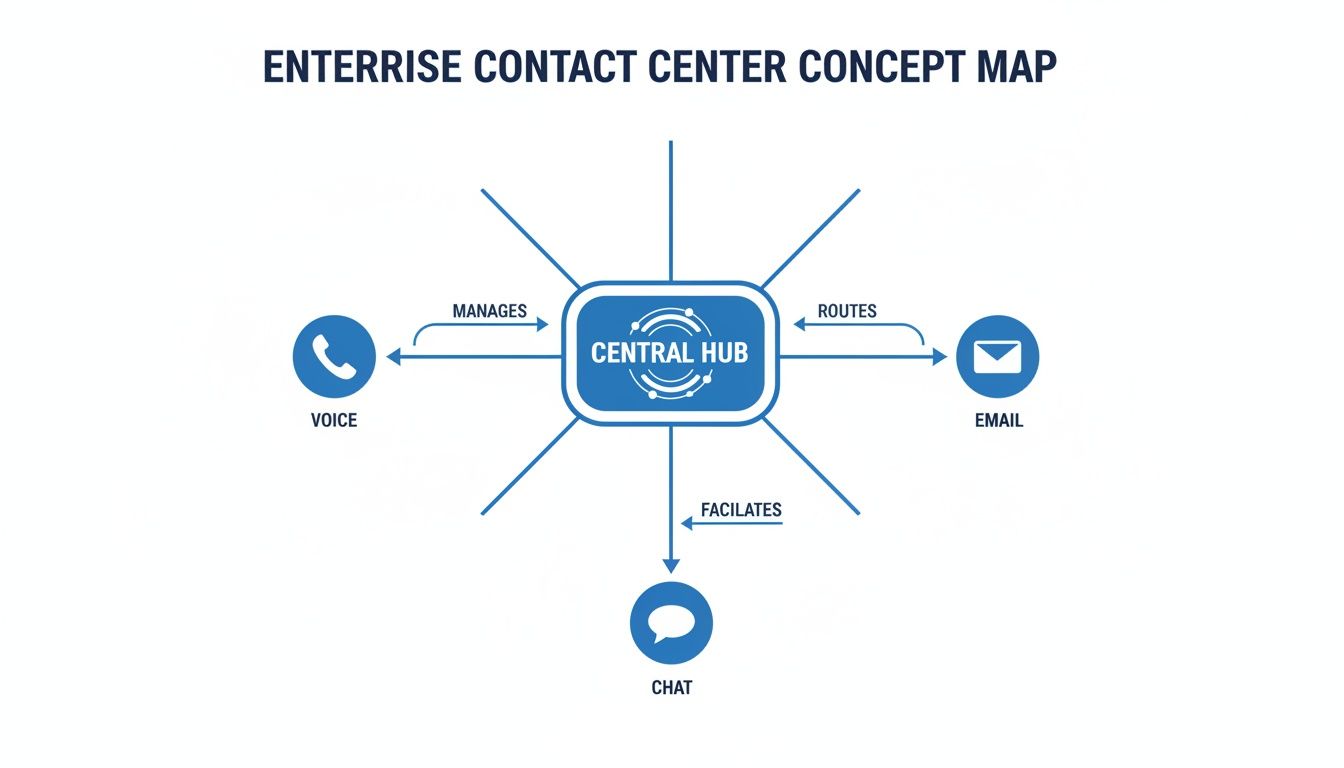
As you can see, every channel feeds into a central system, giving your business a single source of truth for every customer conversation. This unified approach is a game-changer for both efficiency and customer satisfaction.
Comparing Traditional vs. Enterprise Systems
The leap from a standard phone setup to an enterprise contact center is significant. This table breaks down the core differences in capabilities.
Traditional Phone System vs Enterprise Contact Center Solution
| Capability | Traditional Phone System | Enterprise Contact Center Solution |
|---|---|---|
| Channel Support | Primarily handles voice calls. | Unifies voice, email, chat, SMS, and social media. |
| Routing | Basic call forwarding or direct dials. | Intelligent, skills-based routing (ACD). |
| Customer Context | No historical context; each call is a new interaction. | Provides a complete customer history across all channels. |
| Self-Service | Limited to basic voicemails or simple menus. | Advanced IVR, AI-powered chatbots, and knowledge bases. |
| Analytics | Basic call logs (duration, time of call). | In-depth reporting on agent performance, queue times, and CX. |
| Integration | Standalone; difficult to connect with other business tools. | Integrates seamlessly with CRM, helpdesk, and other software. |
Ultimately, a traditional system just connects calls. An enterprise solution orchestrates the entire customer experience.
A Growing Market for Better Experiences
The demand for these sophisticated platforms is booming. The global market for enterprise contact center software is expected to hit $36.21 billion in 2025, a notable increase from $34.92 billion in 2024. It’s no surprise that large enterprises make up about 60% of this market, as they require robust, scalable systems to handle millions of interactions.
An enterprise contact center isn't just about answering questions. It’s about proactively managing the entire customer journey, using data to anticipate needs and solve problems before they even start.
This proactive mindset is what separates a simple help desk from a world-class customer experience engine. If you're ready to see what modern platforms are capable of, you can explore enterprise-grade contact center solutions to get a feel for the features available. In the end, it’s all about creating an effortless experience for your customers and empowering your agents to do their best work.
The Core Features That Power Every Interaction
At its core, an enterprise contact center solution is an engine. It’s a powerful combination of several key pieces of technology working in harmony to manage, route, and resolve every customer inquiry with impressive precision and speed. They take what could be a chaotic flood of calls, emails, and messages and turn it into a structured, manageable workflow.
The goal is simple: connect every customer with the right person, at the right time, every single time.

Think of these features less like separate tools and more like an interconnected system. Each one has a specific job, but it's how they work together that creates a truly seamless customer journey. Let’s pop the hood and look at the essential parts of this engine.
Interactive Voice Response (IVR)
Imagine walking into a massive corporate headquarters. Instead of one overwhelmed receptionist, a smart digital directory greets you. It asks a few simple questions to figure out who you need to see and then gives you clear directions. That’s precisely what an Interactive Voice Response (IVR) does for your phone lines.
An IVR acts as a digital front desk, using automated voice prompts ("Press 1 for Sales, Press 2 for Support") to guide callers. But modern IVRs are much more than simple menus. They can handle common requests all on their own, like checking an account balance or tracking a package. This self-service frees up your human agents to handle the more complex, high-value conversations.
An effective IVR doesn't create a barrier; it builds a fast lane. By resolving simple issues automatically, it ensures that customers with urgent or complicated problems get to a live agent faster, improving satisfaction for everyone.
By filtering and sorting callers before they ever reach a person, an IVR makes the entire contact center dramatically more efficient. It’s the first, and arguably most important, step in creating an intelligent call flow.
Automatic Call Distribution (ACD)
So, a caller has navigated the IVR menu. Now what? The next step is connecting them to the perfect agent, and that’s where Automatic Call Distribution (ACD) shines. If the IVR is the building's directory, the ACD is the smart elevator system that takes them directly to the right floor and office.
An ACD doesn't just blindly send a call to the next available person. It's a sophisticated routing engine that uses rules you define to make smart decisions. These rules can be based on all sorts of factors:
- Skills-Based Routing: The call goes to an agent with the specific expertise needed, whether that’s a Tier 2 technical specialist or a Spanish-speaking sales rep.
- Time-of-Day Routing: Calls are directed to different teams or locations based on business hours across various time zones.
- Caller ID or CRM Data: The system can recognize a VIP customer's number and fast-track their call directly to a dedicated account manager.
This intelligent distribution means customers aren't just answered quickly—they're answered by the person best equipped to solve their problem on the first try. That has a huge, direct impact on key metrics like First Call Resolution (FCR).
Smart Queue Management and Callback
Let’s be realistic—no matter how efficient your system is, there will be times when all your agents are busy. This is where smart queue management becomes non-negotiable. Instead of forcing customers to listen to hold music indefinitely, modern enterprise contact center solutions offer much better alternatives.
A customer-favorite feature is the virtual queue callback. The system simply offers the caller the option to hang up, keep their place in line, and get an automatic call back when an agent is free. This small gesture transforms a negative waiting experience into a positive one, showing customers you value their time.
Other essential queue management tools include:
- Wait-Time Announcements: Telling callers their estimated hold time manages expectations and dramatically reduces frustration.
- In-Queue IVR Options: Giving callers the power to leave a voicemail or switch to another channel (like email) without losing their spot.
By actively managing the queue, you can slash call abandonment rates and boost overall customer sentiment. The data you get from these systems is also incredibly valuable. Understanding peak call times and queue performance is crucial, and you can learn more about how this data drives decisions with comprehensive call analytics. This is the information you need to staff your teams effectively and fine-tune your routing for even better results.
Advanced Capabilities That Create a Competitive Edge
Getting the core features right makes your contact center functional. But it’s the advanced capabilities that truly give you a competitive edge and turn customer service into a powerful engine for growth. This is what separates an okay customer experience from an exceptional one.
These aren't just bells and whistles. They provide the deep insights and smooth, intelligent workflows that let you anticipate customer needs instead of just reacting to them. This is where top-tier enterprise contact center solutions really prove their worth, moving beyond simply handling calls to orchestrating smart, data-informed customer journeys. The result? A more efficient operation and customers who feel genuinely heard.

True Omnichannel Routing
It’s easy to confuse "multichannel" with "omnichannel," but the difference is night and day for your customers. A multichannel setup means you’re available on different platforms—phone, email, social media—but they all operate in their own little bubbles. A customer might have to explain their problem from scratch every time they switch channels, which is a recipe for frustration.
Omnichannel routing smashes those silos. Think about it: a customer starts a conversation with a chatbot on your site. When the issue gets too complex for the bot, they’re seamlessly transferred to a live agent on the phone. That agent sees the entire chat history instantly. The conversation just continues, context intact, without missing a beat.
An omnichannel approach doesn't just offer multiple doors into your business; it ensures every door leads to the same, single, informed conversation. This continuity is the cornerstone of a modern, customer-centric experience.
This unified view gives agents the power to solve issues faster and more accurately, which is a win for both agent productivity and customer happiness. It's a non-negotiable for any business that’s serious about its customer experience.
Powerful Reporting and Analytics
If your contact center is the engine, then reporting and analytics are the dashboard. This is where you get the critical data to see what’s really going on, spot bottlenecks, and make smart decisions to improve performance. Without solid analytics, you're flying blind.
Modern platforms give you a treasure trove of real-time and historical data. Key metrics you can finally get a handle on include:
- Agent Performance: Metrics like Average Handle Time (AHT) and First Call Resolution (FCR) show you which agents are knocking it out of the park and who might benefit from a bit more coaching.
- Queue Performance: You can see peak call times, track abandonment rates, and monitor average wait times to make sure you have the right number of people staffed at the right times.
- Customer Satisfaction (CSAT): By integrating quick post-call surveys, you get immediate feedback on the quality of service your team is delivering.
This data isn't just for managers, either. Displaying real-time dashboards can create a healthy sense of competition and encourage a culture of continuous improvement. Some of the most sophisticated platforms even incorporate AI tools for analyzing client communication styles to help agents connect with customers on a much deeper level.
Cloud PBX and Unified Communications Integration
The real game-changer is when you break down the final wall—the one separating your external customer conversations from your internal team collaboration. By integrating your contact center with a cloud PBX and a unified communications platform, you create a single, cohesive ecosystem for the entire business.
What does that look like in practice? An agent can put a customer on a brief hold and instantly pull a product specialist from another department into a quick chat or video call to get an answer. It means everyone, from the front-line agent to the back-office expert, is connected and available to help solve customer problems on the first try.
This kind of integrated system also makes life easier for your IT team, with less to manage and lower overhead. To see how a fully connected platform can drive this kind of efficiency, you can explore how SnapDial handles unified communications for business. When your entire organization is aligned, delivering outstanding service becomes second nature.
Making the Business Case for a Modern Contact Center
Let's start by looking at your customer service department differently. It's not just a cost center or a necessary overhead; it's a powerful engine for revenue. The trick is to draw a straight line from the features of an enterprise contact center solution to real-world business results—like lower operating costs, more sales, and customers who stick around for the long haul.
This isn't about fuzzy, feel-good benefits. It's about building a solid internal case for the investment, one that’s backed by clear financial and strategic wins. When you can show your leadership team exactly how new tech translates into measurable ROI, the decision to upgrade becomes a no-brainer.
Drive Down Costs, Push Up Productivity
One of the first places you'll see a financial impact is in operational efficiency. Think of smart features like IVR self-service as your first line of defense. It can automatically handle all those routine questions—"Where's my order?" or "Can I confirm my appointment?"—without an agent ever getting involved. Every one of those automated interactions is money saved.
That automation also frees up your best agents to tackle the complex, high-value conversations that actually require a human touch. On top of that, intelligent routing makes sure that when a call does need an agent, it gets to the right person with the right skills on the first try. This simple change drastically cuts down on frustrating internal transfers and escalations, making your whole team more productive.
The real goal here isn’t just answering calls faster. It's about solving the customer's problem completely on the first attempt. A modern contact center gives your team the tools to do just that, turning them from call handlers into expert problem-solvers.
Mastering the Metrics That Matter
To prove the value of your investment, you have to measure what matters. A good contact center platform gives you the tools to track and analyze the key performance indicators (KPIs) that really define success.
- First Call Resolution (FCR): This is the gold standard. It tracks the percentage of issues you resolve in a single interaction. A high FCR means you're efficient and your customers are happy. The right platform gives agents a full view of the customer's history, which massively improves their odds of solving the problem on the first try.
- Average Handle Time (AHT): This is how long an agent spends on an interaction, from "hello" to wrap-up. By plugging into tools like your CRM and putting information at your agents' fingertips, they can find answers and close tickets faster. The result? AHT goes down without ever sacrificing the quality of the service.
Getting a handle on these metrics isn't just an operational exercise. It directly impacts your bottom line by cutting down on repeat calls and letting your team manage more conversations without needing to hire more people.
From Customer Satisfaction to Lifetime Value
In today's market, exceptional service is where you win. When you offer a seamless omnichannel experience—where a customer can switch from chat to phone without repeating themselves—your customer satisfaction (CSAT) scores will climb. And happy customers don't just stay with you; they spend more money and tell their friends about you.
This is becoming even more critical as the market shifts. Small and medium-sized businesses (SMEs) are now the fastest-growing group adopting contact center software, with the market projected to expand at a CAGR of 22.11% between 2025 and 2032. They're flocking to cloud solutions because they're affordable and can scale up as the business grows, letting them compete with the big players on customer experience. You can dig into the numbers in this contact center software market analysis.
At the end of the day, a modern contact center helps you reduce customer churn and build loyalty, which directly boosts customer lifetime value (CLV). That strategic advantage, combined with the flexibility to support a high-performing remote team, changes your service department from a necessary expense into a true cornerstone of your company's growth.
How to Choose and Implement the Right Solution
Making the leap to a modern enterprise contact center solution can feel like a massive undertaking, but it doesn't have to be. With the right approach, the transition is surprisingly smooth, and the payoff is huge. The key is to look past the flashy feature lists and focus on what really matters for your business—today and down the road.
Ultimately, choosing the right solution isn't just about the technology; it's about finding the right partner. You need a system that's flexible, powerfully supported, and slots right into the tools your team already relies on.
The Three Pillars of a Smart Decision
As you start looking at different options, every feature and promise should be weighed against these three essentials. Think of them as the foundation for a successful, long-term relationship with your contact center provider.
-
Scalability: Can this platform keep up with your ambition? A system that works great for 20 agents might completely buckle when you hit 100. Real scalability means you can add new people, open new locations, and turn on advanced features without having to rip everything out and start over. Your platform should fuel your growth, not stifle it.
-
Integration: How well does it play with your other tools? Your contact center is the hub of customer interaction, but it can't live on an island. It needs to talk to your Customer Relationship Management (CRM) software, helpdesk platforms, and other business-critical systems. This is what gives your agents a 360-degree view of the customer, letting them provide smarter, faster, and more personal service.
-
Vendor Support: When something goes wrong at a critical moment, who’s got your back? The software is only part of the deal. Look for a partner that offers responsive, expert support and a dedicated implementation team. A "white-glove" setup—where the provider handles everything from porting your numbers to configuring the system—is a game-changer. It turns a complex IT project into a smooth, managed transition.
It's no surprise that the market for these platforms is booming. Valued at $14.5 billion in 2021, the global cloud-based contact center market is projected to skyrocket to $82.43 billion by 2030. This incredible growth is fueled by the undeniable benefits of cloud solutions, like lower upfront costs and lightning-fast deployment. You can dive deeper into this growing market and its key drivers for more insights.
Demystifying the Migration Process
Moving from an old, clunky on-premise system to a sleek cloud solution can sound intimidating. In reality, it's a well-trodden path, and a good provider will manage the entire migration to ensure your business doesn’t skip a beat.
Here’s what that process typically looks like:
- Discovery and Planning: First, the provider sits down with you to understand your current call flows, how your teams are structured, and what you want to achieve.
- Number Porting: Your existing business phone numbers are carefully transferred to the new system. Your vendor should handle this from start to finish with zero downtime.
- System Configuration: The provider then builds out your new contact center environment, setting up your IVR menus, call queues, routing rules, and agent profiles.
- Training and Go-Live: Before you flip the switch, your team gets hands-on training so everyone feels confident and ready to go on day one.
The goal of a successful implementation isn't just to get the technology working; it's to ensure your team can use it to its full potential from the moment it goes live. This is where a hands-on implementation partner makes all the difference.
Key Evaluation Criteria for Your Next Contact Center Solution
As you start comparing vendors, it's easy to get lost in the details. Use this checklist to cut through the marketing fluff and stay focused on the criteria that will have the biggest impact on your business.
| Evaluation Criterion | What to Look For | Why It Matters |
|---|---|---|
| Pricing Model | All-inclusive, predictable pricing with no hidden fees. | You'll avoid nasty surprises on your bill for "extras" that should be standard, like call recording or analytics. |
| Implementation | "White-glove" setup and migration included at no extra cost. | This ensures a seamless, expert-led transition without heaping more work onto your internal IT team. |
| Support Availability | 24/7 access to real, knowledgeable human support via phone and online. | When issues pop up, you need help now, not in a few days. This guarantees you have a lifeline whenever you need it. |
| Core Functionality | Must include IVR, ACD, queue management, and robust reporting. | These are the non-negotiable workhorses of any serious contact center. They drive efficiency and are critical for a great customer experience. |
By keeping these practical considerations at the forefront, you can confidently choose a solution that doesn't just work, but actively helps your team shine and keeps your customers happy.
Frequently Asked Questions About Enterprise Solutions
Thinking about a major upgrade to your business communications always brings up questions. It’s natural. Getting the right answers is what helps you move forward with confidence, knowing you're making the best choice for your company.
Let's walk through some of the most common questions we hear about modern enterprise contact center solutions.

This final section is all about clarity—cutting through the jargon to tackle those lingering points of confusion and highlight what a new system really means for your day-to-day operations.
Are Enterprise Contact Center Solutions Only for Large Companies?
Not anymore. That’s one of the biggest myths out there. The term "enterprise" used to mean a massive, complex system that only a Fortune 500 company could afford. Today, cloud technology has completely changed the game.
Now, small and mid-sized businesses can get their hands on the exact same powerful tools—like intelligent call routing, deep analytics, and omnichannel support—without the enterprise price tag. The key is finding a solution built to scale. You can start with what you need today and add more features as you grow, all without buying a single piece of hardware.
What Is the Difference Between Multichannel and Omnichannel?
This is a really important one because it gets to the heart of the customer's experience. Think of it this way:
Multichannel means you’re available on different platforms—phone, email, web chat—but they all operate in their own little silos. A customer might email you, then call an hour later, and the phone agent has no clue about the email. It forces the customer to start over from scratch.
Omnichannel connects all those platforms into one single, flowing conversation. When a customer calls, your agent can instantly see their recent email, their chat transcript from yesterday, and their entire history with your company. It’s one continuous story, not a bunch of separate, frustrating interactions.
This single change makes a world of difference. It gives your team the context they need to resolve issues fast and stops customers from having to repeat themselves over and over.
How Difficult Is It to Migrate from a Traditional Phone System?
The thought of switching from an old on-premise PBX system can feel overwhelming, but it doesn't have to be. A good cloud provider makes the whole process smooth and manageable, often with zero downtime for your business.
The migration is usually broken down into a few clear steps:
- Number Porting: Your existing phone numbers are carefully moved over to the new service without any interruption to your calls.
- System Configuration: The provider works with you to build out your ideal setup, from custom call flows and IVR menus to agent queues.
- Team Training: Your staff gets practical, hands-on training so they feel comfortable and ready to go on day one.
Look for a provider that offers a "white-glove" setup. This means you have an expert partner managing the entire project from start to finish, turning a potentially complex technical move into a simple, seamless upgrade.
Ready to bring Fortune 500 communication power to your business without the complexity? SnapDial offers a complete cloud phone system with advanced contact center capabilities, all backed by our white-glove setup and 24/7 Texas-based support. Discover how we can transform your customer experience at https://snap-dial.com.