Still relying on a phone closet filled with a tangled mess of wires? If so, you're probably feeling the pain of its limitations, from frustrating busy signals to the struggle of supporting a flexible, remote team. The best IP phone system is a strategic move that turns your communications from a costly, hardware-dependent liability into a flexible, cloud-based asset.
Why Modern Businesses Are Switching to IP Phone Systems
If that old PBX (Private Branch Exchange) system feels like an anchor holding your business back, you’re not alone. Legacy phone systems were built for a world where everyone worked in the same office from nine to five. That model just doesn't cut it anymore. Today, your team is distributed, your customers expect instant answers, and your communication tools need to keep pace.
Traditional systems create real-world problems that directly hit your bottom line. When a key client calls and gets a busy signal because all your physical lines are tied up, that's a lost opportunity. When a remote employee has to use their personal cell for business calls, it comes across as unprofessional and opens up a security risk.
Legacy PBX vs. Modern IP Phone System: A Quick Comparison
To see just how different these two approaches are, it helps to put them side-by-side. This table breaks down the core differences and shows why the shift to an IP-based solution is so compelling for growing businesses.
| Feature | Legacy PBX System | Modern IP Phone System (like SnapDial) |
|---|---|---|
| Technology | Relies on copper wiring and on-site hardware | Uses your internet connection (VoIP) |
| Initial Cost | High (server hardware, installation, licenses) | Low to none (subscription-based) |
| Scalability | Difficult and expensive; requires technician visits | Simple; add or remove users instantly via a web portal |
| Remote Work | Not supported or requires complex, clunky workarounds | Natively supported on desktop and mobile apps |
| Maintenance | Your responsibility; requires IT staff or contracts | Fully managed by the provider in the cloud |
| Features | Basic calling; advanced features are costly add-ons | All-inclusive (auto-attendant, recording, analytics, etc.) |
The contrast is pretty stark. One model requires you to become a phone system expert, while the other lets you focus on your business while a partner handles the technology.
Moving Beyond Hardware Limitations
The biggest problem with legacy systems is their complete reliance on physical hardware and dedicated copper wiring. Need to add a new employee? That means scheduling an expensive technician visit, installing new hardware, and dealing with significant downtime. It’s a rigid, costly, and inefficient way to operate in a fast-moving business world.
This inflexibility is exactly why the market is changing so dramatically. The global IP phone market is projected to hit a staggering $44.72 billion in revenue by 2025, with North American businesses leading the charge. This surge is all about companies ditching their old PBX systems for communication tools that can actually scale.
Embracing Agility and Unified Communications
An IP phone system, often called a VoIP (Voice over Internet Protocol) system, solves these problems by sending calls over the internet. Think of it like upgrading from a single, private dirt road to a multi-lane superhighway. Instead of being stuck with a physical box in a closet, your phone system lives securely in the cloud.
This fundamental shift unlocks some game-changing advantages:
- Location Independence: Your team can make and receive calls from their business line on any device—desk phone, laptop, or smartphone—anywhere they have an internet connection.
- Predictable Costs: Instead of a huge upfront capital expense, you pay a predictable monthly subscription. This turns a volatile cost into a manageable operational expense.
- Effortless Scalability: Adding a new user is as simple as a few clicks in a web portal, not a complicated and expensive hardware installation.
- Enhanced Professionalism: Features like auto-attendants, call queues, and music-on-hold—once reserved for massive enterprises—are now easily accessible to businesses of any size.
The switch is about more than just better phone calls; it's about bringing all your communication channels together. Businesses are quickly discovering the advantages of unified communications, where voice, video, and messaging all work together seamlessly. This isn't just a trend; it's a strategic move toward building a more efficient and resilient company.
How an IP Phone System Actually Works
Let's cut through the jargon. To get a real handle on how a modern phone system works, it helps to think in simple terms.
Imagine your old-school phone line is a private, single-lane road built just for one conversation. It’s expensive, inefficient, and can only do one thing at a time. An IP phone system blows that up and replaces it with the internet—a massive superhighway that carries voice, video, and data all at once.
Instead of being tied to those old copper wires, this system converts your voice into tiny digital packets. These packets zip across the internet just like an email or a webpage, and then get reassembled on the other end for the person you're talking to. The technology behind this magic is called Voice over Internet Protocol (VoIP).
VoIP is the engine that makes everything possible, but it’s just one piece of the puzzle. The entire system needs a command center to direct calls, send them to the right people, manage voicemail, and handle all the professional features your business relies on.
The Cloud Command Center: Hosted PBX
In the not-so-distant past, this command center was a clunky physical box called a Private Branch Exchange (PBX). You had to buy it, install it in a closet, and keep a technician on speed dial for every little change. It was expensive and a constant headache.
A modern IP phone system replaces that box with a Hosted PBX (you'll also hear it called a Cloud PBX). Your phone system's entire "brain" lives securely in your provider's data centers, not gathering dust in your office. This gives you all the power of an enterprise-grade system without any of the hardware nightmares or maintenance bills.
From a simple web portal, you can suddenly:
- Add or remove users and phone lines in seconds.
- Set up a professional auto-attendant to greet callers.
- Create smart call routing rules so no call ever gets missed.
- Access call recordings, voicemails, and detailed analytics.
This infographic paints a clear picture of the difference between a modern, cloud-based system and the old way of doing things.
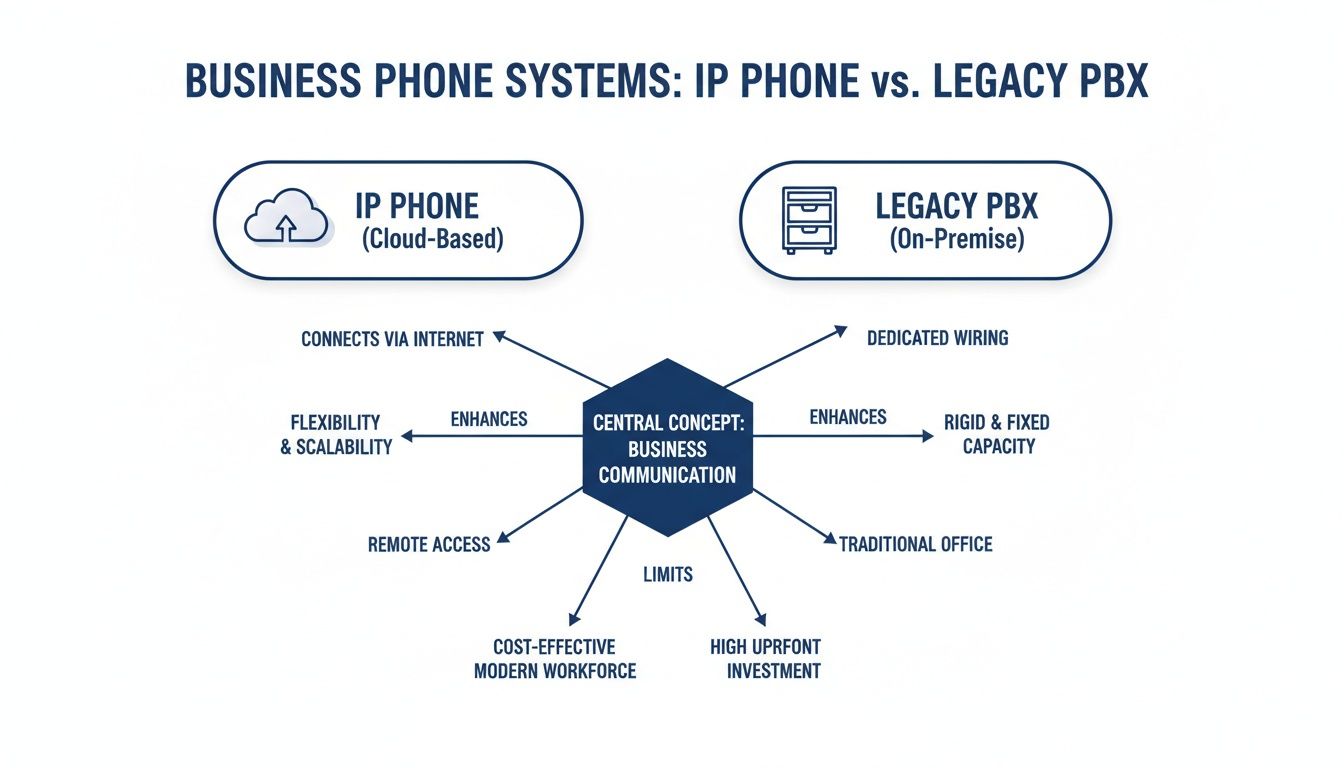
You can see the shift right away—from a complex, hardware-heavy model to a flexible, software-driven approach that's managed entirely online.
Connecting to the Global Phone Network
Okay, so you have your VoIP engine and your cloud command center. But how do you actually call people who are still on traditional landlines or their cell phones? That's where SIP Trunking comes into play.
Think of SIP Trunking as the digital on-ramp that connects your private business phone system to the public telephone network. It completely replaces the need for old-fashioned, physical phone lines from the phone company.
A single SIP trunk can handle a virtually unlimited number of concurrent calls, constrained only by your internet bandwidth. This eliminates the frustrating "all lines are busy" problem that plagues businesses using traditional phone systems with a fixed number of physical lines.
This is what gives an IP phone system its incredible flexibility. Instead of paying for 20 physical lines just in case you need them, you have a system that scales up or down instantly to handle your call volume as it changes.
This modern setup—VoIP, a Hosted PBX, and SIP Trunking working together—is the foundation of the best IP phone system. It transforms business communication from a rigid, costly utility into a powerful asset that supports remote work, boosts customer experience, and grows right alongside your company. It’s a complete game-changer.
Essential Features Every Business Phone System Needs
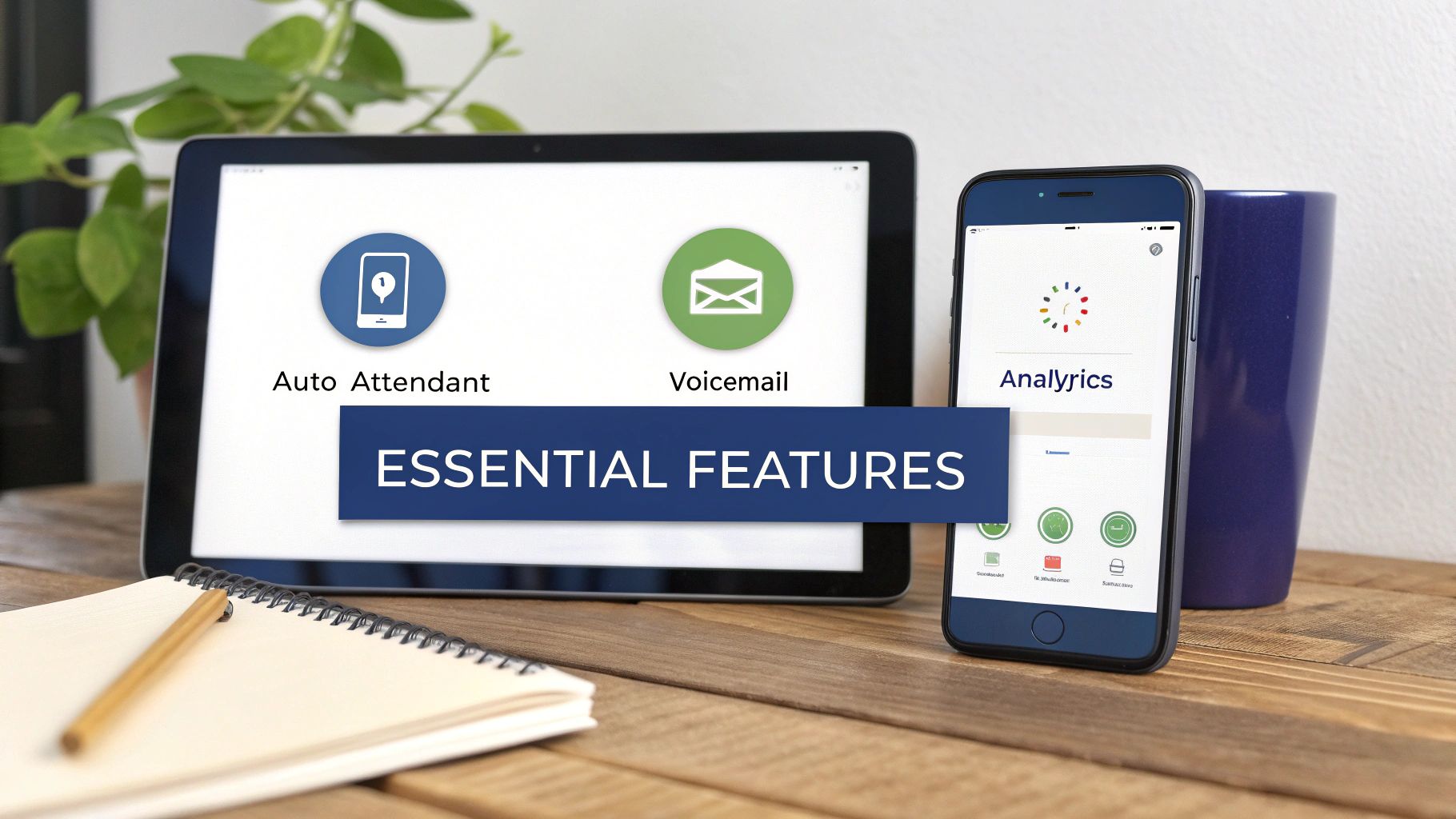
Knowing the tech behind an IP phone system is one thing. But what really matters is what it can do for your business. The best system isn't just about making calls; it's a powerhouse of features built to solve real problems, make customers happier, and help your team get more done.
Let's break down the must-have features into three key areas: the tools that shape your customer's experience, the ones that make your team more productive, and the ones that give managers the data they need to make smart moves.
Tools That Craft an Amazing Customer Experience
Your phone system is often the first handshake a customer gets. The right features make sure every single one is professional, smooth, and positive.
An Auto Attendant—sometimes called a virtual receptionist—is your 24/7 front desk. It greets every caller with a custom, professional message and guides them to the right place ("Press 1 for Sales, Press 2 for Support"). Just this one feature can eliminate missed calls and reassure callers they’ve found the right business, even after hours.
Intelligent Call Routing takes that a step further. This isn’t just about blindly forwarding a call; it’s about connecting your most important customer to the right expert, instantly. You can build rules based on the time of day, who’s calling, or the menu option they picked, making sure every call gets handled by the most qualified person without a frustrating delay.
Call routing is the cornerstone of a great customer experience. It transforms a chaotic, "everyone-answers" environment into an organized, professional operation where callers feel heard and valued from the first second.
This is exactly why businesses are flocking to feature-rich, cloud-based platforms. The hosted PBX market, the engine behind systems like SnapDial, is set to explode from $13.71 billion in 2023 to $42.55 billion by 2030. Companies are ditching basic on-premise hardware for flexible solutions loaded with these critical customer-facing tools. You can find more details in the IP phone systems market report on cognitivemarketresearch.com.
Features That Boost Team Productivity and Flexibility
A modern phone system should empower your team to work from anywhere—the office, home, or on the road. The best IP phone systems do this by cutting the cord that ties communication to a physical desk.
The Mobile App is probably the single most important productivity tool. It turns any employee's smartphone into a secure business line. They can make and take calls using their business number, which protects their personal privacy while keeping up a professional company image. This is a non-negotiable for supporting hybrid and remote teams.
Other key productivity boosters include:
- Visual Voicemail: Instead of dialing in and listening to messages in order, your team sees a list of voicemails in an inbox, just like email. They can even read transcriptions and prioritize returning the most urgent calls first.
- Call Recording: With the right permissions, recording calls is a goldmine for training, quality control, and settling disputes. It ensures no important detail ever gets missed.
- Ring Groups: This feature routes an incoming call to a whole group of people at once. The first person to answer takes the call, slashing wait times and making sure someone is always there to help.
These tools all work together to create a seamless communication hub where your team has the flexibility and information they need to be at their best.
Management Insights and Administrative Control
Finally, a great system gives you the data and control you need to manage everything effectively. You can't improve what you don't measure, and a modern IP phone system delivers a level of clarity that was impossible with old hardware.
Call Analytics and Reporting are your window into how your business communicates. With a few clicks in a web portal, you can see:
- Call Volume: Pinpoint your busiest hours to make sure you have enough people on deck.
- Missed Calls: See exactly when and why calls are being missed so you can fix your routing rules.
- Agent Performance: Track who's answering the most calls and how much time they're spending.
- Queue Wait Times: Understand how long customers are sitting on hold and find ways to shorten it.
This data is crucial for fine-tuning your workflows and improving service. A user-friendly Admin Portal ties it all together, letting you manage the entire system from anywhere. You can add new users, tweak your auto-attendant greeting, and adjust call routing in real time—all without having to call a technician. That level of control makes the system incredibly responsive to your business's ever-changing needs.
Choosing Your Deployment Model: Cloud vs. On-Premise
One of the biggest decisions you’ll make when picking an IP phone system is where it will actually "live." This choice boils down to two very different paths: a modern cloud-hosted system or a traditional on-premise setup. Each option has huge implications for your budget, your IT team's workload, and your ability to adapt down the road.
Think of an on-premise system like buying a house. You get total control and can customize it any way you want. But you’re also on the hook for the massive upfront cost, all the ongoing maintenance, unexpected repairs, and any future upgrades. It's a major capital investment that puts the burden of management squarely on your shoulders.
A cloud-hosted system, on the other hand, is like leasing a premium, fully-serviced office. You get immediate access to the best amenities, professional support, and the latest technology for a predictable monthly fee. The provider handles all the upkeep, security, and updates, freeing you up to focus on running your actual business.
The Financial Fork in the Road: CapEx vs. OpEx
The most immediate difference between these two models is how you pay for them. It’s a classic showdown between Capital Expenditures (CapEx) and Operational Expenditures (OpEx).
An on-premise deployment requires a huge CapEx investment. You have to buy the physical PBX server, all the phones, networking gear, and software licenses upfront. This initial outlay can easily run into thousands or even tens of thousands of dollars, a massive hurdle for most small and mid-sized businesses.
Cloud-based systems completely flip this model, shifting to a predictable OpEx structure. There are little to no upfront costs. Instead, you pay a manageable monthly subscription fee for each user, which makes budgeting far simpler and keeps your capital free for other growth initiatives.
The global shift toward cloud communications is undeniable. VoIP's unstoppable momentum is making cloud IP phone systems the new standard. The market was valued between $145-151 billion in 2024 and is projected to explode to $413.36 billion by 2032. This growth is directly tied to the flexibility modern businesses need, especially since 83% of workers now favor a hybrid model. You can find more insights on VoIP's market growth at brightlio.com.
Cloud-Hosted vs. On-Premise IP PBX: Which Is Right for You?
Choosing between a cloud-hosted and an on-premise system comes down to your company's specific needs, resources, and growth plans. To help you weigh the critical factors, this side-by-side comparison breaks down the key differences.
| Evaluation Criteria | Cloud-Hosted System (e.g., SnapDial) | On-Premise System |
|---|---|---|
| Initial Cost | Low to none; typically $0 upfront. | High; requires purchasing servers, software, and hardware. |
| Pricing Model | Predictable monthly operating expense (OpEx). | Large, upfront capital expense (CapEx). |
| Maintenance | Fully managed by the provider, including all updates. | Your IT team is responsible for all upkeep and repairs. |
| Scalability | Instant; add or remove users with a few clicks. | Complex and costly; requires new hardware or licenses. |
| Remote Work | Natively supported via mobile and desktop apps. | Difficult; often requires complex and insecure VPNs. |
| Security | Managed by experts in secure, redundant data centers. | The entire security burden falls on your in-house team. |
As you can see, the choice isn't just about technology—it's about your entire operational philosophy. One path demands significant in-house expertise and investment, while the other offers agility and predictability, letting you focus on your core business.
Scalability and Supporting a Modern Workforce
Business needs are never static. You hire new employees, open new offices, or adjust to seasonal demand. How your phone system handles these changes is absolutely critical.
With an on-premise PBX, scaling is a painful, manual process. Adding a new employee often means buying more hardware or licenses and then scheduling a technician to come on-site. Trying to support a remote worker involves setting up complex and often insecure network configurations that are a constant headache for IT. You can learn more about the complexities of a traditional PBX in our guide explaining what a PBX system is and how it works.
This is where cloud systems truly shine. Scaling is practically instant. Need to set up a line for a new hire? It takes just a few clicks in a web portal. Have an employee who needs to work from home? They just log into the mobile or desktop app, and their business line is ready to go—securely and professionally. For today's distributed teams, this kind of agility isn't just a nice-to-have; it's a necessity.
Security, Maintenance, and Future-Proofing
Maintaining an on-premise system is a heavy, ongoing responsibility. Your IT team is solely responsible for every security patch, software update, and hardware repair. If a server fails in the middle of the night, your phones are dead until you can get it fixed.
A cloud-hosted provider like SnapDial removes this entire burden. Security and maintenance are handled by a dedicated team of experts in secure, redundant data centers. The platform is continuously and automatically updated with the latest features and security protocols, ensuring your system is always current without you lifting a finger.
This managed approach not only slashes your operational risk but also future-proofs your investment. As new communication technologies emerge, they are seamlessly integrated into the cloud platform. This gives you access to the latest tools without ever needing to buy a new piece of hardware. For most growing businesses, this combination of financial predictability, effortless scalability, and managed security makes a cloud-based IP phone system the clear choice.
Unlocking Advanced Call Center Capabilities

For any business with a dedicated customer support or sales team, the right IP phone system is much more than a utility. It’s an engine for revenue and customer loyalty. This is where we get into the sophisticated features that turn standard customer calls into smooth, professional experiences.
These “enterprise-level” tools aren’t just for Fortune 500 companies anymore. They’re now accessible—and essential—for businesses of any size. Modern systems bake these capabilities right into the platform, turning your phone system into a command center for customer engagement. The goal here is simple: eliminate friction for both your customers and your agents.
Smart Queue Management and Callback Options
Think of a traditional call queue as a single, frustrating line at the DMV. Everyone waits, no matter what they need. Smart Queue Management is like having an intelligent concierge who directs each person to the shortest, most relevant line. It ensures callers are routed to the agent best equipped to handle their specific needs, which drastically cuts down on wait times.
Of course, even with smart routing, high call volumes can still lead to hold times. This is where a Queue Callback feature becomes a game-changer for customer satisfaction.
Instead of forcing a customer to listen to hold music, the system offers to save their place in line and call them back when an agent is free. This simple option turns a moment of potential frustration into a positive, respectful experience, showing customers you value their time.
This focus on the customer experience is a huge driver of VoIP adoption. For call centers, advanced features like queue management and real-time reporting are critical for delivering those CX wins. The global trend is clear, with markets like India seeing VoIP subscriptions hit 39 million in 2024, a 23% year-over-year jump. You can discover more insights about VoIP's rapid expansion on brightlio.com.
Real-Time Analytics and Performance Dashboards
You can't fix what you can't see. The best IP phone systems give managers real-time analytics dashboards, offering a live view of all call center activity. It's like having a bird's-eye view of your entire support operation, allowing you to make data-driven decisions on the fly.
With these dashboards, managers can monitor crucial metrics, including:
- Active Calls: See exactly how many agents are currently on the phone with customers.
- Queue Wait Times: Instantly spot bottlenecks when hold times start to creep up.
- Agent Status: Know which agents are available, on a call, or wrapping up paperwork.
- Service Level: Track the percentage of calls answered within your target timeframe.
This live data empowers managers to reallocate resources in seconds. If the support queue is getting slammed, they can pull agents from another department to help out, ensuring service levels stay high during unexpected peaks. This kind of agility is at the heart of running an efficient contact center. To dig deeper, check out our guide on how to implement these VoIP call center solutions for your business.
By bringing these advanced features together, a modern IP phone system does more than just handle calls. It actively works to boost customer satisfaction, improve agent productivity, and give you the insights needed to constantly fine-tune your operations for peak performance.
What to Expect from a Top-Tier Provider
When you're choosing the best IP phone system, you're not just buying software. You're picking a long-term partner. A top-tier provider isn't just trying to sell you a service; they're delivering a complete communication experience designed to make your business run smoother and look more professional. Think of them as a strategic partner who's invested in seeing you succeed.
The foundation of that experience is a robust, all-inclusive feature set. This means you get everything from an auto-attendant and smart call routing to advanced call center tools without getting nickel-and-dimed for every little thing. A great provider knows your needs will change, so they offer a platform that grows right alongside your business, effortlessly.
Beyond the Software Itself
What really separates the good from the great are the critical details that guarantee a smooth transition and ongoing success. These aren't just nice-to-haves; they should be non-negotiable when you're looking for the best possible experience.
Look for these key differentiators:
- White-Glove Setup: A dedicated team handles your entire move, from porting your existing numbers to setting up your call flows. This ensures a seamless, zero-downtime switch.
- Transparent Pricing: You should get one predictable, all-inclusive monthly bill. No hidden fees, no surprise charges, and no confusing add-ons for core features like call recording.
- Dedicated Human Support: When you need help, you get a real person on the phone, 24/7. This commitment to expert, accessible support is the ultimate safety net for your business communications.
A top-tier provider recognizes that technology is only half the solution. The other half is the human expertise and unwavering support that ensures the technology works flawlessly for your specific business needs, day in and day out.
The Right Hardware and Hybrid Work Support
Even as software takes center stage, the right hardware is still vital for a lot of businesses. The whole VoIP ecosystem is booming, signaling a massive shift toward cloud-based systems that empower hybrid and remote teams. While this has led to a small dip in desk phone sales as more people use softphones, many companies still count on dedicated IP phones for their rock-solid reliability and superior audio quality. You can explore the latest trends in the IP phone market on intelmarketresearch.com to get a feel for this dynamic.
A premier provider will offer a curated selection of high-quality, pre-configured IP phones, making sure they work perfectly right out of the box. They understand how to blend physical desk phones with mobile and desktop apps to build one cohesive system that supports your employees wherever they are—in the office, at home, or on the road. This holistic approach makes sure every team member has the best tool for their job, creating a truly unified and productive communication environment.
Got Questions? We've Got Answers
Making the final call on a new phone system can feel like a big step. To help you feel confident in your choice, we’ve put together straightforward answers to the questions we hear most often from businesses just like yours.
What Kind of Internet Speed Do I Need?
This is a great question, but the answer isn't just about raw speed. It's really about the quality of your connection. A single VoIP call only uses about 100 kbps of bandwidth, so even a team of 10 people on the phone at once would only need a tiny fraction of a modern internet plan—about 1 Mbps.
The real secret to crystal-clear calls is a stable, low-latency connection. That's why business-class fiber or cable internet is the gold standard. It minimizes the jitter and packet loss that cause choppy, robotic-sounding audio. Any good provider will help you check your network's readiness to make sure you have a flawless experience from day one.
Can I Keep My Existing Business Phone Numbers?
Yes, absolutely. You don't have to give up the numbers your customers already know and trust. The process is called "number porting," and it’s a standard, regulated procedure that lets you move your current local and toll-free numbers to your new provider.
A top-tier provider handles the entire porting process for you. Their job is to make sure the switch happens behind the scenes with zero downtime, so your customers won't even notice a change. You get to upgrade your technology while your customers keep calling the same numbers they always have.
Are Cloud-Based IP Phone Systems Secure?
This is a big one, and the short answer is: very secure. In fact, modern cloud systems are often far more secure than an on-premise server that might be sitting in a closet and rarely gets updated.
Leading providers build their platforms with multiple layers of security. This includes things like call encryption (using TLS and SRTP) to stop eavesdropping, physically secure data centers, and round-the-clock network monitoring to catch and shut down fraud.
Because the system is managed by experts in the cloud, it's constantly being updated with the latest security patches. This takes a huge security and maintenance burden off your IT team's plate. You get the benefit of enterprise-grade protection without having to manage it all yourself, keeping your conversations and your business data safe.
Ready to see how a truly modern, secure, and fully-supported IP phone system can transform your business communications? SnapDial offers a complete, all-inclusive solution with white-glove setup and 24/7 Texas-based support. Discover a better way to connect with your team and customers at https://snap-dial.com.