At its heart, a Private Branch Exchange (PBX) system is your company's own private telephone network. Think of it as a smart switchboard operator working behind the scenes, managing every call that comes in or goes out. It lets everyone on your team share a smaller number of external phone lines, which is a huge money-saver and keeps communication flowing smoothly.
Understanding Your Business Phone Network
Imagine your office is a small neighborhood. Without a PBX, every single house (or employee) would need its own private road leading out to the main highway (the public phone network). You can see how that would get expensive, messy, and just plain inefficient.
A PBX acts like a central intersection for your whole neighborhood. All the local streets (your internal phones) connect right to it. When someone needs to call another house in the same neighborhood, the intersection routes them directly—no highway needed. When they need to get out to the city, the intersection efficiently directs them to an open on-ramp.
This little analogy gets right to the core of what a PBX does: it manages call traffic with intelligence. It connects internal calls between colleagues for free and provides a shared, cost-effective gateway for all external calls. That's the simple answer to "what is a PBX system," but the technology has come a long, long way over the years.
The Two Flavors of PBX Systems
Today, businesses really have two main choices for their phone system, and they’re built on fundamentally different philosophies. Getting a handle on this distinction is the first step toward modernizing how your team communicates.
- Traditional On-Premise PBX: This is the classic model. It's a physical box of hardware that gets installed and maintained right in your office. It connects to old-school phone lines from the phone company and requires a big upfront investment in equipment, plus ongoing care from your IT staff.
- Modern Cloud PBX (Hosted PBX): This is the new school of thought, running entirely over the internet. A third-party provider hosts and manages all the brains of the system in their secure data centers. You just plug your IP phones into your internet connection and pay a predictable monthly fee for each user.
A Cloud PBX, often powered by VoIP (Voice over Internet Protocol), gets rid of the need for that expensive on-site hardware. It turns your phone system from a big capital expense into a flexible, scalable operating expense.
This shift from owning physical hardware to using a cloud service is something we've seen everywhere—think about moving from a server in a closet to using cloud storage. The modern Cloud PBX offers far more flexibility, a richer set of features, and the remote work capabilities that older systems just can't touch, making it the go-to choice for growing businesses today.
Traditional PBX vs Modern Cloud PBX at a Glance
To make the differences crystal clear, it helps to see the two approaches side-by-side. This table breaks down how old-school hardware stacks up against a modern cloud solution across the things that matter most to a business.
| Feature | Traditional PBX | Cloud PBX (Hosted VoIP) |
|---|---|---|
| Initial Cost | High (Server hardware, installation) | Low to None (Subscription model) |
| Maintenance | Your IT team's responsibility | Fully managed by the provider |
| Scalability | Difficult and expensive | Add or remove users instantly |
| Remote Work | Very limited; complex to set up | Natively supported on any device |
| Advanced Features | Costly add-ons or unavailable | Included in the subscription |
| Reliability | Depends on your office power/internet | Guaranteed uptime from provider |
Looking at this comparison, the choice becomes a lot clearer. One model requires you to own, manage, and fix your phone system, while the other lets you focus on your business while experts handle all the technology. For most businesses, the agility and predictable costs of the cloud make it the obvious path forward.
On-Premise vs. Cloud-Hosted PBX Systems
When it comes to your business phone system, you’re facing a big choice that mirrors a lot of other tech decisions these days: Do you want to own and maintain all the hardware yourself, or would you rather subscribe to a service managed by experts? That’s the fundamental difference between an on-premise and a cloud-hosted PBX.
Think of it like this: an on-premise PBX is like having a physical server closet in your office. You buy the servers, you set them up, and your IT team is on the hook for every single update, repair, and security patch. It's a major capital investment that gives you direct control but also saddles you with full responsibility.
A cloud-hosted PBX, on the other hand, is like using Google Drive or Dropbox for your files. You don't own the servers; you just pay a predictable monthly fee to use a service that a specialized provider handles for you. They take care of all the complicated infrastructure, security, and updates in the background, so you can focus on running your business.
This choice between physical ownership and a managed service has huge implications for your costs, your ability to scale, and your day-to-day operations.
Understanding the On-Premise PBX Model
The classic on-premise PBX is a tangible piece of hardware—a server or an appliance—that lives right there within your office walls. It connects to the old-school phone network (the PSTN) using traditional phone lines or a more modern SIP trunk. This model absolutely puts you in the driver’s seat.
But that control comes with a lot of baggage. You're on the hook for:
- High Upfront Costs: Buying the PBX hardware, the phones, and the server racks can easily run into thousands of dollars.
- Dedicated IT Staff: You need someone with real telecom expertise to install, configure, and maintain the system.
- Ongoing Maintenance: When something breaks or an update is needed, the responsibility—and the cost—is all yours.
- Limited Scalability: Adding new employees often means buying new hardware cards or expensive licenses, making growth a slow and costly process.
This model made sense back when the internet wasn't as reliable as it is today. Now, it often creates more headaches than it solves, especially for small and mid-sized businesses that need to stay nimble.
The Rise of the Cloud Hosted PBX
The cloud-hosted PBX (also called hosted VoIP or a cloud phone system) has become the go-to choice for modern businesses, and for good reason. With this model, the provider houses all the complex PBX technology in their secure, redundant data centers. Your office phones simply connect to their service over your existing internet connection.
This completely flips the traditional model on its head, shifting the burden from you to the provider. The global Cloud PBX system market is on track to hit USD 5.95 billion by 2035, which tells you everything you need to know about where the industry is heading. A huge driver of this growth is small and mid-sized businesses, which accounted for over 48% of PBX installations in 2023 as they look for more flexible and affordable ways to communicate.
A cloud-hosted PBX transforms your phone system from a large, one-time capital expense (CapEx) into a predictable monthly operating expense (OpEx). This makes budgeting a breeze and gets rid of the risk of surprise repair bills.
For a deeper dive into how this all works, take a look at our guide on what is a cloud phone system.
This decision tree helps visualize which PBX model is typically the best fit for different business sizes and priorities.
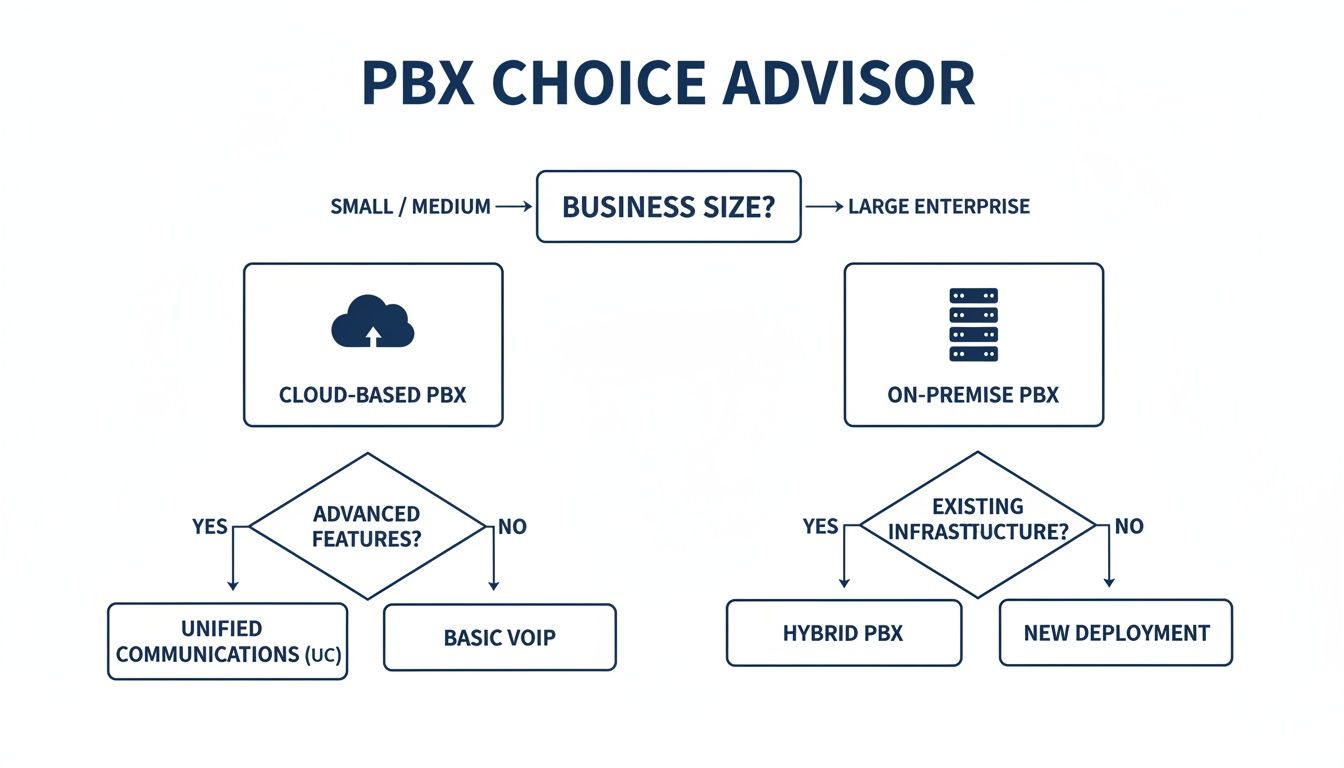
As the chart shows, smaller, growing businesses almost always lean toward the flexibility of cloud solutions. Larger enterprises that already have a lot of infrastructure might still consider on-premise systems, but even that is becoming less common.
Detailed Feature and Cost Comparison
Choosing the right deployment model is a critical piece of your company's communication strategy. To really get a handle on the core distinctions, you can explore the key differences between cloud and on-premise solutions.
To make the choice even clearer, let's break down how each system stacks up against the factors that matter most to your business.
| Consideration | On-Premise PBX | Cloud Hosted PBX (e.g., SnapDial) |
|---|---|---|
| Initial Cost | Very High. Requires a large capital investment in hardware, software licenses, and professional installation. | Low to None. Based on a predictable monthly subscription with no major upfront hardware costs. |
| Ongoing Costs | Unpredictable. Includes maintenance contracts, IT staff time, replacement parts, and costly upgrades. | Predictable. A fixed per-user, per-month fee covers all features, support, and maintenance. |
| Maintenance | Your Responsibility. Your IT team is on the hook for all updates, security patches, and troubleshooting. | Provider's Responsibility. The provider manages all backend infrastructure, security, and updates 24/7. |
| Scalability | Difficult and Expensive. Adding users often requires buying new hardware cards or licenses and manual configuration. | Effortless and Instant. Add or remove users in seconds through a simple online portal. |
| Remote Work | Limited. Often requires complex, insecure VPNs to connect remote employees to the office system. | Natively Supported. Employees can use mobile and desktop apps to work from anywhere, seamlessly. |
| Features | Basic. Advanced features like call recording or analytics are often expensive, bolt-on extras. | All-Inclusive. Enterprise-grade features are typically included in the standard subscription. |
This side-by-side comparison really highlights the operational differences. An on-premise system demands a significant upfront investment and ongoing management, while a cloud PBX is built for simplicity and predictability from day one. For most modern businesses, the financial common sense, effortless scalability, and rich feature set of a cloud-hosted PBX make it the clear winner.
Core Features That Power Modern Business Communication
So, what does a modern PBX actually do for you? Beyond the technical jargon, its real value comes from the powerful features that solve the everyday headaches of business communication. These aren’t just bells and whistles; they’re practical tools that make your team more efficient, boost your professional image, and make sure you never miss a critical customer call.
Think of a basic phone line as an empty toolbox. A modern PBX fills that box with specialized instruments designed to get the job done right. Instead of just making and taking calls, you get a whole suite of capabilities that helps your business operate like a much larger, more established company.
Your Virtual Receptionist and Traffic Director
At the front line of any modern PBX is the Auto Attendant. It’s your tireless virtual receptionist. This feature greets every single caller with a professional, custom message and gives them a clear menu of options ("For Sales, press 1; for Support, press 2").
This simple tool stops callers from getting lost in a frustrating loop of unanswered rings or being bounced to the wrong person. It instantly routes customers where they need to go, improving their experience and freeing up your staff from having to manually direct every call.
Working hand-in-hand with the Auto Attendant is Advanced Call Routing. This is the smart logic running behind the scenes. A PBX can direct calls based on all sorts of rules you create, such as:
- Time of Day: Automatically send calls that come in after hours to voicemail or to an on-call team member’s cell.
- Skill-Based Routing: Got a tricky technical question? The system can send that call straight to your most experienced agent.
- Round-Robin: Make sure every sales lead is distributed fairly by sending incoming calls to the next person in line.
Tools for Quality, Training, and Efficiency
To ensure you’re always delivering great service—and to protect your business—Call Recording is an absolutely essential feature. It lets you record calls for quality assurance, employee training, or dispute resolution. Managers can review conversations to give their teams constructive feedback, helping to standardize the customer experience.
Another huge efficiency booster is Visual Voicemail. Instead of having to listen to your messages one by one, this feature transcribes them into text and sends them right to your email or mobile app. You can quickly scan a message to see how urgent it is, forward it to the right person, or archive it for your records, all without ever picking up the phone.
By combining tools like call recording and visual voicemail, a modern PBX system transforms raw communication into actionable business intelligence. It provides insights into customer interactions and helps identify opportunities for operational improvement.
The True Mobile Office Experience
Maybe the most game-changing feature for today’s flexible work world is the ability to take your business phone system anywhere. With dedicated mobile and desktop apps, a PBX turns an employee's smartphone or laptop into a full-featured extension of their desk phone.
This means your team can make and receive calls using their business number—not their personal one—from anywhere with an internet connection. They can access the company directory, transfer calls to colleagues, and join conference calls just as if they were sitting in the office. This is what creates a cohesive, professional communication experience, no matter where your team is working.
Of course, to get the most out of these capabilities, you need the right hardware. Our guide to the best IP phone system options can help you pick devices that fully support all these modern features. At the end of the day, a modern PBX brings all these tools together on a single, unified platform, giving your business the communication power it needs to grow.
The Business Benefits of Upgrading Your PBX System
Moving to a modern PBX is a lot more than a simple tech refresh. It’s a strategic decision that pays off across your entire company. The upsides go way beyond just getting clearer calls—they touch your budget, your ability to compete, and your capacity to grow. Think of it as an investment in making your business more agile and giving your customers a far more professional experience.
By ditching that bulky, on-premise hardware, you immediately start seeing some serious financial wins. You can say goodbye to expensive maintenance contracts, the IT hours spent just keeping the old system alive, and the looming dread of having to replace aging equipment. A modern PBX swaps out unpredictable capital costs for a clear, predictable monthly expense.
This shift is a huge reason the telephony market is changing so fast. The overall PBX market, valued at USD 9.96 billion in 2021, is on track to hit nearly USD 12 billion by 2025. This growth is being driven by businesses just like yours looking for cost savings, with a subscription model often slashing capital expenses by 40-70% compared to a legacy PBX. You can explore more data on how cloud adoption is reshaping business communications to see the full picture.
Gain Unmatched Scalability and Flexibility
One of the biggest headaches of an old PBX system is how rigid it is. When your business grows, scaling your phone system is a slow, expensive ordeal involving new hardware cards and scheduling a technician. And if you need to downsize? You're stuck with hardware you paid for but no longer need.
A cloud-based PBX system completely demolishes those barriers.
- Effortless User Management: Add a new employee to the phone system in seconds through a simple web portal, not in a matter of weeks.
- Instant Scalability: Whether you're opening a new office or just adjusting for a seasonal rush, your phone system can scale up or down with just a few clicks.
- Geographic Freedom: A modern PBX isn't chained to a physical location. You can have team members working from home, in different cities, or even across the country, all seamlessly connected to the same professional phone system.
This kind of agility means your communications can finally keep up with your business goals, actually supporting your growth instead of holding it back.
Strengthen Business Continuity and Reliability
What happens to your business calls if the office loses power or the internet goes out? With an on-premise PBX, your entire phone system goes dark. That means missed calls, lost leads, and a complete shutdown of customer communication—a potential disaster for your reputation and revenue.
A modern PBX, on the other hand, is built from the ground up with reliability in mind. Because the core system is hosted in secure, geographically redundant data centers, a local outage at your office is barely a hiccup.
With a cloud PBX, you can instantly reroute calls to mobile phones or alternate locations if your primary office is offline. This built-in redundancy ensures you remain operational and accessible to your customers, no matter what happens.
Project a Polished Professional Image
Finally, upgrading your PBX gives your business access to the kind of enterprise-grade features that used to be affordable only for huge corporations. Tools like a professional Auto Attendant, smart call queues to manage high call volumes, and hold music create a polished, professional experience for every single caller.
This isn't just about looking good; it's about building trust. When a customer calls and is greeted by a system that efficiently gets them to the right person, it sends a powerful message: your company is organized, capable, and ready to help. A modern PBX system levels the playing field, allowing your business to deliver a Fortune 500-level communication experience that makes you far more competitive.
How to Choose the Right PBX System for Your Company
Picking the right PBX system is one of those foundational decisions that will echo through your company’s operations for years. Once you get what a PBX is, the next step is looking in the mirror. You need a solution that fits your team's workflow and your budget, not the other way around.
The perfect phone system for a five-person startup is going to look completely different from what a 50-person company with a dedicated support team needs. So, the first move is a practical, honest assessment of where your organization is right now. A few straightforward questions about your team’s size and day-to-day needs will instantly cut through the noise and point you toward the right kind of providers.
Evaluate Your Current and Future Needs
Before you even think about looking at vendors, you need to map out your own requirements. A fuzzy idea of what you want leads to a bad investment. Get specific.
- Number of Users: How many people on your team need a phone line today? And just as important, where do you see that number in two or three years? A cloud-based system lets you add a new user in about five minutes, while an on-premise PBX might mean buying expensive new hardware.
- Budgeting Model: Are you more comfortable with a big, one-time capital expense (CapEx) to own the hardware outright? Or does a predictable, monthly operational expense (OpEx) make more sense for your cash flow? For a deep dive into the numbers, our guide on hosted VoIP vs on-premise PBX breaks down the real financial impact of each model.
- Essential Features: Sit down and make a "must-have" list. Do you absolutely need call recording for compliance? Is an auto-attendant critical for directing calls professionally? Do you have team members who need a solid mobile app to work on the go? Prioritizing this list keeps you from overpaying for flashy features you'll never touch.
Key Questions to Ask Potential Vendors
Once you have your internal needs sorted out, it's time to start talking to providers. The way a vendor answers these next questions tells you everything you need to know about their reliability, service quality, and whether they see you as a partner or just another account number.
Don't be afraid to push for details. A great first step is to see what other businesses are using. A solid guide to the top business phone systems for small businesses can give you some valuable context before you start making calls.
Choosing a PBX provider is about more than just technology; it's about entering a long-term partnership. The right partner will not only provide a reliable service but will also offer expert support to help you maximize its value.
Here are the questions you should be asking every single provider you consider:
- What does your implementation process look like? Ask them point-blank if they offer a fully managed, "white-glove" setup. You want a team that will handle moving your numbers and configuring the system so you experience zero downtime.
- What are your security protocols? Get specific. Ask about call encryption (like SRTP), the physical security of their data centers, and what kind of fraud detection they have in place to protect your business communications.
- Where is your support team located, and what are their hours? A US-based, 24/7 support team you can actually get on the phone is a world away from being stuck with email-only tickets handled by a team in a different time zone.
- Do you supply and support the physical hardware? Make sure the provider offers high-quality, compatible IP phones and, crucially, that they'll provide support for them. This ensures you get great call quality and have a seamless user experience from day one.
Making the Move to a Cloud PBX, Minus the Headache
Switching your business over to a modern cloud PBX can feel like a massive undertaking. I get it. The fear of downtime, tangled complexity, and surprise costs is real, and it’s why so many businesses stick with outdated phone systems far longer than they should. But here’s the thing: with the right partner, the migration isn't a scary, disruptive project. It's a smooth, managed transition that sets your business up for the future.
Let’s picture a small consulting firm that’s still limping along with an old phone system. They're dropping important client calls because their lines are constantly tied up, and their team struggles to sound professional when working from home. This communication bottleneck isn't just an annoyance; it's actively costing them business. A modern cloud PBX is the obvious fix, but for a small team with no dedicated IT staff, the thought of making that switch is completely overwhelming.
This is exactly where a provider focused on a seamless transition changes the game. A true "white-glove" setup means a dedicated team of experts manages the entire switch for you, from start to finish. They’ll handle moving your existing phone numbers, setting up your new IP phones, and configuring all your call routing rules—all without a single second of downtime.
Your Path to Effortless Communication
The whole point is to take migration anxiety off the table completely. A provider like SnapDial does the heavy lifting so you can stay focused on running your business, not wrestling with technical logistics. For your customers, the transition should be invisible. For your team, it should feel effortless.

Here are the key ingredients for a painless switch:
- Zero Downtime: Your new system gets built and tested behind the scenes. The final cutover happens instantly, so you never have to worry about missing a single call.
- Predictable Pricing: All-inclusive plans mean you won't get hit with hidden fees for essential features, support, or the setup process itself.
- Intuitive Management: Once you’re live, you can easily manage users, check voicemails, and review call logs through a simple web portal. No IT degree required.
Choosing a partner for your cloud PBX isn't just about the technology; it's about the experience. The right provider removes the fear and complexity, delivering a communication system that works for you from day one.
The market for hosted PBX is expected to explode to USD 45.32 billion by 2032, which tells you businesses are catching on to the benefits. By making the move, companies aren't just slashing costs by up to 60% compared to their old on-premise hardware; they're getting powerful tools that help them grow. You can read more about the trends shaping the hosted PBX market to see just how fast this shift is happening.
For that consulting firm, the switch means no more missed opportunities. It means a professional image projected by a new auto-attendant and a team that can collaborate effectively, no matter where they are. A modern PBX isn't just a phone system anymore; it’s the communications hub your growing business needs.
Got Questions? We've Got Answers
Making the final call on a new phone system can feel like a big step. To help you feel confident in your choice, we’ve put together straightforward answers to the questions we hear most often from businesses just like yours.
What’s the Real Difference Between PBX and VoIP?
This one trips a lot of people up, but it’s actually pretty simple once you break it down. Think of the PBX (Private Branch Exchange) as the brain of your phone system—it’s the traffic controller that routes all your calls and connects your team internally. VoIP (Voice over Internet Protocol) is the technology, or the highway, that those calls travel on.
An old-school on-premise PBX might use traditional copper phone lines, which are like slow, winding country roads. A modern Cloud PBX, on the other hand, uses the high-speed VoIP highway to send and receive calls over the internet. So, they aren't competing things; modern PBX systems simply use VoIP to work.
How Hard Is It to Switch to a Cloud PBX?
Honestly, the difficulty of switching depends almost entirely on the provider you pick. With a hands-on, service-focused partner, the whole process is designed to be completely seamless and stress-free.
The gold standard here is what's called a "white-glove" setup. This means the provider's technical team literally handles every single step of the move for you. They take care of moving your numbers, setting up your new phones, and configuring all your call routing, all while guaranteeing zero downtime. For any business without a big, dedicated IT team, choosing a provider that offers this kind of fully managed transition is the most important factor for success.
The goal of a well-managed migration is for the switch to be invisible to your customers and effortless for your team. The right partner removes the technical burden, allowing you to enjoy the benefits from day one.
Can We Keep Our Existing Business Phone Numbers?
Yes, absolutely. In fact, you should insist on it. The process is called number porting, and it's a standard, legally required procedure that any reputable Cloud PBX provider will handle for you.
You always keep full ownership of your business numbers. When you switch, your new provider coordinates everything with your old carrier to transfer the numbers over to their network. It's all carefully timed to make sure there's no interruption in service, so your customers can keep calling the same numbers they've always used.
Just How Secure Is a Cloud-Based Phone System?
This is a big one, and the short answer is: very secure. Reputable cloud phone providers invest heavily in multiple layers of security that are often far more advanced than what a typical small business could manage on its own.
This security is built on a few key pillars:
- Call Encryption: Using protocols like TLS and SRTP to scramble call data, making conversations unreadable to anyone trying to eavesdrop.
- Fortified Data Centers: The core infrastructure is housed in physically secure facilities with backup power, redundant connections, and 24/7 monitoring.
- Fraud Detection: Automated systems are constantly watching for weird calling patterns to spot and block toll fraud, protecting your account from unexpected charges.
In most cases, a cloud solution managed by a team of dedicated security experts is significantly more secure than an old on-premise box that a small business has to maintain and protect all on its own.
Ready to transform your business communications without the headache? SnapDial offers a complete cloud PBX solution with a white-glove setup process to ensure a seamless transition. Get a system that grows with you at https://snap-dial.com.