When you hear the term cloud based VoIP phone system, it's easy to get lost in the jargon. But the concept is actually pretty simple. Forget about the dusty old phone closet with a tangled mess of wires. Think of it as a powerful, smart communication service you subscribe to, just like you do with Netflix or Google Drive. All the heavy lifting happens in the cloud.
What Is a Cloud Based VoIP Phone System Anyway

Let's try a better analogy. A traditional phone system is like buying a clunky desktop computer back in the early 2000s. You needed a dedicated room for it, a specialist to come in for every little update, and if your company grew, you had to sink a ton of money into expensive new hardware.
A cloud based VoIP system, on the other hand, is like a modern subscription software. It’s powerful, you can access it from anywhere, and a team of experts handles all the maintenance behind the scenes. Need to add a new employee? It takes a few clicks, not a few thousand dollars for new equipment. This move from hardware to software is what makes modern business communication so incredibly flexible and affordable.
Breaking Down the Core Components
The name itself tells you everything you need to know. It’s really just three core pieces of technology working together to make your calls happen.
- VoIP (Voice over Internet Protocol): This is the engine that makes everything run. VoIP technology takes the sound of your voice, chops it up into tiny digital packets of data, and sends them across the internet—just like an email. On the other end, it reassembles them into crystal-clear audio.
- The Cloud: This is simply where your phone system "lives." Instead of a physical server box humming away in your office, all the complex software for routing calls, managing voicemail, and handling features is hosted on secure, powerful servers managed by your provider. This means you can log in and manage your entire system from a web browser on any device.
- PBX (Private Branch Exchange): The PBX is the brain of the operation, the traffic controller for your phone network. It's the part that directs incoming calls to the right person, handles extensions, and enables features like call transfers and automated greetings. In a cloud system, this is a virtual PBX—a sophisticated piece of software doing the job of a traditional hardware PBX, but with way more intelligence and flexibility.
By moving the PBX to the cloud, businesses can access enterprise-level communication tools without the enterprise-level cost or complexity. This approach eliminates the need for on-site hardware maintenance and provides unmatched scalability.
Ultimately, a cloud based VoIP phone system unchains your business communications from a single, physical location. It transforms your phones from a static piece of hardware into a dynamic, software-driven tool that can adapt to how you work. If you want to get into the nuts and bolts, it helps to understand what a PBX system is and see how it acts as the central nervous system for business phones. This shift is what opens the door to better productivity, smarter customer interactions, and real operational agility.
How Cloud VoIP Redefines Business Communication

Understanding the tech behind cloud VoIP is one thing, but seeing how it completely changes the game for businesses is what really matters. A cloud based VoIP phone system does a lot more than just send calls over the internet. It fundamentally reshapes how teams operate, connect with customers, and grow. This shift unlocks powerful capabilities that used to be reserved for massive corporations and puts them in everyone's hands.
The adoption numbers tell the story. Over 60% of small and medium-sized businesses have already made the jump, making cloud VoIP their go-to communication platform. This switch is being driven by huge cost savings and the incredible flexibility it offers. In fact, a staggering 82% of companies report a significant drop in costs after moving their phones to the cloud.
When you move from clunky hardware to smart software, the old barriers just fall away, creating a more agile and professional framework for any business.
To get a clearer picture of how these systems stack up, it helps to see a direct comparison. The differences in cost, flexibility, and maintenance become pretty stark when you put them side-by-side.
Traditional PBX vs Cloud Based VoIP
| Feature | Traditional On-Premise PBX | Cloud Based VoIP Phone System |
|---|---|---|
| Initial Cost | High upfront investment in hardware, installation, and licensing. A major capital expense. | Low to $0 setup. You pay a predictable monthly subscription per user. |
| Maintenance | Your problem. Requires an in-house IT team or an expensive third-party contract for upkeep and repairs. | Fully managed by the provider. Updates, security, and maintenance are all included. |
| Scalability | Difficult and costly. Adding new lines means buying and installing more hardware. | Effortless. Add or remove users instantly from a web portal. Scales with your business. |
| Features | Basic calling is standard. Advanced tools like auto-attendants or call recording are costly add-ons. | All-inclusive. Enterprise-grade features are built-in for every user. |
| Remote Work | Very limited. Often requires complex and clunky VPNs to connect off-site employees. | Natively supported. Works anywhere with an internet connection via mobile and desktop apps. |
As the table shows, one model forces you to become a phone system expert, while the other lets you focus on your business while the tech is handled for you. For most modern companies, the agility and predictable costs of the cloud make it the obvious choice.
Unifying Teams Across Any Distance
If your company has multiple offices or a distributed team, you know the headache of communication silos. Each location with its own hardware and phone numbers makes seamless collaboration feel next to impossible.
A cloud based VoIP phone system completely dissolves those geographical lines. It weaves everyone into a single, unified network, making it feel like your whole team is in the same building.
- Effortless Call Transfers: An employee in New York can transfer a call to a colleague in Los Angeles just by dialing their extension, as if they were sitting at the next desk.
- Consistent Caller Experience: Customers dial one main business number and can be routed to the best available person, no matter where they are physically located.
- Centralized Management: You can manage users, add new lines, and tweak call routing for all your locations from a single, simple web portal.
This unified approach makes sure your business presents a cohesive, professional front, no matter how spread out your team is. You can learn more about how this works by checking out our guide on https://snap-dial.com/unified-communications-for-business/.
Empowering Remote and Hybrid Workforces
The massive shift to remote work has made mobility a flat-out necessity. A cloud VoIP system is built for this new reality, turning any spot with an internet connection into a fully functional office.
This is mostly done through mobile and desktop apps, often called softphones. These apps transform an employee's smartphone or computer into a secure, feature-rich business line.
A huge advantage here is the complete separation of personal and business calls. Your team can make and receive calls using their business number on their personal smartphone, without ever giving out their private cell number to clients.
This means your team can maintain a polished, professional presence whether they're working from home, on the road, or anywhere in between. They get the same powerful tools—like call recording, conferencing, and visual voicemail—that they'd have on a physical desk phone.
Making Enterprise-Grade Features Accessible to Everyone
Maybe the biggest impact of a cloud based VoIP phone system is how it levels the playing field. Advanced features that were once incredibly expensive and complex are now just standard.
- Auto-Attendant: This virtual receptionist greets every caller professionally and routes them to the right person or department, making sure no call ever gets lost in the shuffle.
- Call Recording: An essential tool for training, quality control, and resolving disputes, call recording is available with just a few clicks.
- Advanced Analytics: Get real insights into call volumes, wait times, and peak hours. This turns your phone system into a source of smart business intelligence you can actually use.
Many businesses are also integrating these tools to speed up their operations. For instance, understanding how a CRM with VoIP integration works can be a game-changer for sales teams. By making these powerful tools accessible, cloud VoIP empowers smaller businesses to punch well above their weight, improving customer interactions and operating with greater efficiency.
What Can You Actually Do With a Modern VoIP System?
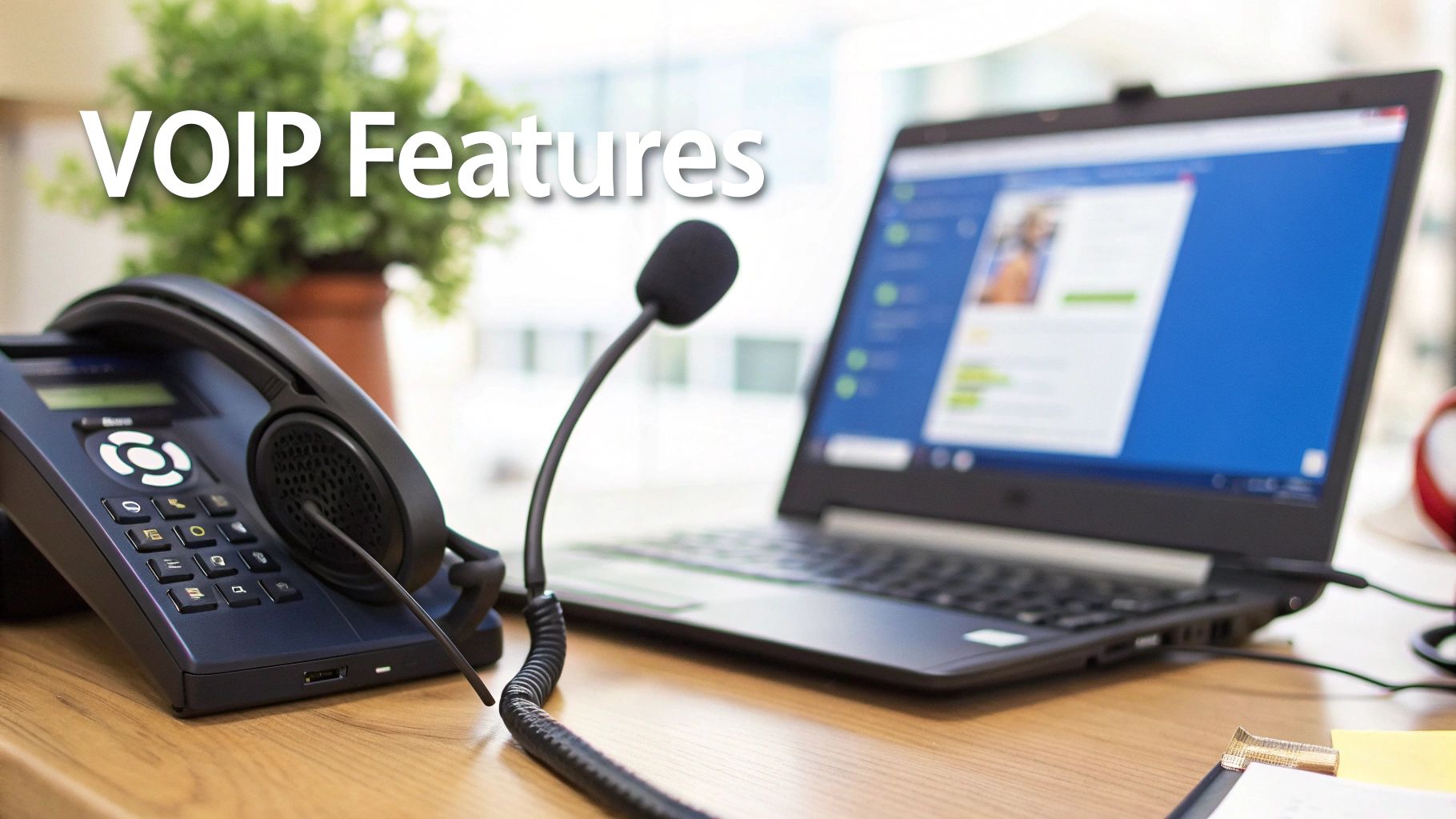
A cloud based VoIP phone system is so much more than a new way to make calls. It's a whole suite of powerful tools designed to make your business sound more professional, work more efficiently, and serve your customers better. These aren't clunky add-ons; they're baked right into the platform, ready to go from day one.
Let's cut through the buzzwords and look at what these features actually do for you. Think of them as a team of specialized virtual employees—they work around the clock, they don't make mistakes, and they're all included in your subscription. Understanding how they work is the key to getting the most out of your new system.
Your 24/7 Virtual Receptionist
One of the first and most impactful features you'll use is the Auto Attendant. You might also hear it called a virtual receptionist or IVR (Interactive Voice Response). This is the professional, automated greeting that answers your main business line and instantly makes your company sound more established.
Instead of a person manually directing every single call, the auto attendant gives callers a simple menu. It might say, "Thank you for calling. For sales, press 1. For support, press 2." This single tool ensures every caller gets to the right person or department right away, eliminating human error and freeing up your staff to focus on more important work.
Core Tools for Everyday Productivity
Beyond that first greeting, a cloud based VoIP phone system is packed with features that solve real-world business problems and make your team's day-to-day work easier. These aren't just for show; they boost efficiency in tangible ways.
Here are a few of the game-changers:
- Visual Voicemail: Forget dialing in to check your messages. This feature turns your voicemails into text and sends them straight to your email. You can scan a message in seconds, prioritize what's important, and forward it to a colleague without ever picking up the phone.
- Call Recording: With a single click, you can record any incoming or outgoing call. This is an invaluable tool for training new hires, ensuring quality on your support team, or just keeping a clear record of important client conversations for compliance.
- Unlimited Lines: One of the quickest ways to frustrate a customer is to make them hear a busy signal. Cloud VoIP gets rid of that completely by giving you unlimited virtual lines. You can handle dozens of calls at once, meaning you never miss an opportunity because your line was tied up.
The real power here is how these features work together. A sales manager can review a recorded call from their email, forward the voicemail transcript into a CRM, and start a new call from their mobile app—all in a matter of minutes. This is the kind of seamless workflow that was once out of reach for most small businesses.
Putting You in Full Control
A huge advantage of moving your phones to the cloud is the control it gives you. You no longer need to call a technician and wait days for simple changes. Modern VoIP systems come with a Self-Service Admin Portal—a straightforward web dashboard where you can manage your entire phone system yourself.
From this portal, you can:
- Add or remove users in seconds as your team grows.
- Change your Auto Attendant greeting for holiday hours.
- Forward an employee’s extension to their mobile phone.
- Pull up call logs, recordings, and usage reports.
This puts you in the driver's seat, allowing for immediate adjustments without needing to submit a support ticket. That kind of agility is a core benefit of a software-based platform.
Advanced Tools for Call-Heavy Teams
For businesses that live and breathe by the phone—like sales teams or customer support centers—a cloud based VoIP phone system offers even more powerful tools. These features can turn your phone system from a simple utility into a source of valuable business intelligence.
Smart Queues are designed to intelligently manage high volumes of inbound calls. Instead of just dumping callers into a generic hold pattern, you can provide estimated wait times, offer an automated callback so they don't lose their place in line, and route calls based on agent skills.
When you pair this with real-time analytics dashboards, managers get a live view of queue performance and agent productivity. This allows them to make data-driven decisions on the fly to improve the customer experience, transforming your call handling from a reactive chore into a proactive strategy.
Choosing the Right Cloud VoIP Provider for Your Business
Picking a provider for your cloud-based VoIP phone system is a whole lot more than just comparing line items on a spreadsheet. You’re not just buying a service; you're choosing a communications partner that will be woven into the fabric of your daily operations. The right choice can be a catalyst for your growth, while the wrong one can become a constant source of headaches.
A smart decision means looking past the sticker price to see the whole picture. You need to think about how reliable the service is, the quality of support you'll actually get when you need it, how transparent the pricing is, and what security is in place to protect your business. Think of it like hiring a key team member who’s going to manage your most critical interactions with customers and between your own staff.
The market for these services is growing fast, which tells you a lot about the massive shift in how businesses are working. The global VoIP services market is on track to jump from $85.2 billion in 2021 to $102.5 billion by 2026. A huge part of that surge is companies finally ditching their old on-premise hardware, with over 61% planning to phase out traditional systems completely by 2026 to better support how we work now. Discover more insights about the VoIP market's growth.
Evaluate Customer Support and Service Quality
When your phone system is the lifeblood of your business, you simply can't afford to sit in a long queue waiting for help. Before you even think about signing a contract, you need to get a clear picture of what a provider's support really looks like in practice.
Don’t be shy—ask direct questions to get the answers you need:
- Is support available 24/7/365? Your business doesn't clock out at 5 PM, and your support shouldn't either.
- Can I talk to a real person right away? Trying to navigate a frustrating robot menu during an outage is a recipe for disaster.
- Where is the support team actually located? A dedicated, in-house team almost always provides a higher quality of service than an outsourced call center reading from a script.
Beyond just fixing problems, look at the proactive service they offer during setup. A provider that offers a "white-glove" implementation will handle the entire migration for you—from porting your numbers to configuring your call flows—ensuring you switch over without any downtime or disruption.
Scrutinize Pricing Models and Hidden Fees
VoIP pricing can look simple on the surface, but the devil is always in the details. The two most common models are metered (per-minute) plans and all-inclusive (per-user) plans. While metered pricing can seem cheaper at first glance, the costs can spiral quickly with usage. Worse, these plans are often loaded with hidden fees for things you’d assume are standard, like call recording or even basic support.
All-inclusive pricing gives you predictable monthly costs, which makes budgeting a whole lot easier. You get all the features for one flat fee per user, eliminating surprise charges and making sure your team has the tools they need without you getting nickel-and-dimed.
Always demand a complete breakdown of what’s included and, more importantly, what costs extra. That clarity is absolutely essential for finding a partner that fits your budget and the way you actually operate.
Prioritize Security and Reliability
Handing over your business communications to a third party requires a huge amount of trust. For any IT leader or business owner, security and reliability are completely non-negotiable. Your provider must be able to show you a robust infrastructure that's built to keep your conversations private and your service online, no matter what.
Here’s a practical checklist of technical questions to ask every single vendor you consider:
- What is your guaranteed uptime? Look for a Service Level Agreement (SLA) of 99.99% or higher. Anything less isn't good enough.
- How is our voice data secured? Make sure they use encryption protocols like TLS and SRTP to protect your calls from eavesdropping.
- What are your disaster recovery plans? Your system needs to have failover capabilities that can automatically reroute calls to mobile phones or other locations if your main internet connection goes down.
- Do you offer a Business Associate Agreement (BAA)? This is a legal must-have for any healthcare-related business that needs to maintain HIPAA compliance.
Choosing the right cloud based VoIP phone system provider means finding a partner who nails all these areas—support, pricing, and security. A thorough evaluation process gives you the power to select a solution that doesn't just meet your technical needs but becomes a reliable foundation for your business's future.
Your Step-By-Step Migration to a Cloud Phone System
Switching your business phone system can feel like a massive undertaking, but I’ve seen firsthand that a well-planned move to a **cloud based VoIP phone system** is surprisingly smooth. The key is to break it down into a series of manageable steps instead of trying to tackle it all at once. When you have a methodical process, that fear of downtime disappears, and you can be confident your business communications won’t skip a beat during the transition.
The journey doesn’t start with yanking out old hardware. It begins with a simple, honest look at your current setup. This foundational step is all about making sure your network is ready to handle high-quality voice traffic. From there, it's just a logical sequence of planning, configuring, and training your team that sets you up for a flawless launch day.
Prepare Your Network and Plan Your Setup
Before you do anything else, you have to be sure your internet connection is up to the task. VoIP calls depend on a stable, high-speed connection to deliver that crystal-clear audio quality your customers expect. Running a network readiness check is the first, non-negotiable step. This simple test measures key metrics like bandwidth, latency, and jitter to flag any potential issues that could mess with call quality.
Once your network gets the green light, the next phase is all about planning how your new system will work. This is where you get to map out exactly how you want your calls to behave.
- Design Your Call Flows: How should incoming calls be handled? This is where you'll set up your Auto Attendant, deciding which menu options to offer and where each choice sends the caller—maybe to a specific department, an individual's extension, or a pre-recorded message with business hours.
- Port Your Existing Numbers: Yes, you can absolutely keep your current business phone numbers. The process of "porting" them is managed entirely by your new provider. They’ll coordinate everything with your old carrier to ensure the numbers transfer seamlessly, with no service interruption.
- Set Up Users and Devices: Before going live, your provider will help you create accounts for every user, assign them extensions, and set their permissions. This is also the time to get any new IP phones configured or make sure your team has downloaded the mobile and desktop apps they'll need.
The infographic below really nails the most crucial things to consider—support, pricing, and security—which should guide your choice of provider and your migration plan.
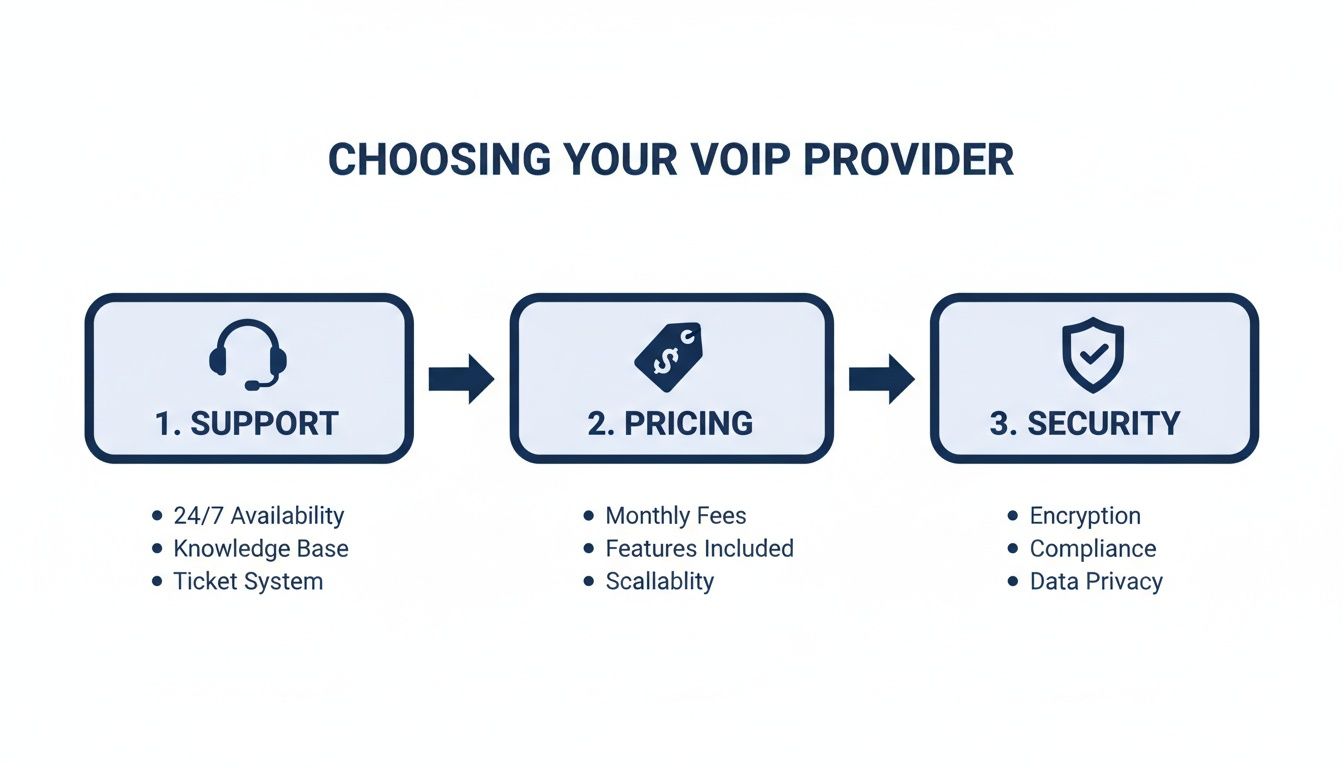
This visual drives home the point that a successful migration hinges on finding a provider who excels in all three areas, creating a solid foundation for your communications.
Execute the Go-Live and Train Your Team
With all the backend work done, the final stage is the "go-live" and getting your team onboard. A provider that offers a fully managed, "white-glove" implementation makes this part effortless. They will handle the technical cutover at a time that causes the least disruption to your business, often after hours or over a weekend.
The most successful migrations I've seen always prioritize user training. Even the most powerful system is useless if your team doesn't know how to use it. A good provider will offer live training sessions and easy-to-follow guides to get everyone comfortable with their new tools.
This training should cover everything from the basics of making and transferring calls to using advanced features like visual voicemail and call recording. By empowering your team from day one, you guarantee a smooth transition and immediate adoption.
If you want to dive deeper into the technical prep, you can find out how much bandwidth you need for VoIP to make sure your network is perfectly ready. Following these steps turns a potentially complex project into a straightforward, successful upgrade.
Got Questions? We've Got Answers
Making the jump to a modern communication platform is a big decision, so it's only natural to have a few questions. A cloud based voip phone system is a serious upgrade, and getting a handle on the practical details is the key to feeling confident about the switch. Let's tackle some of the most common things businesses ask about.
What Happens If My Office Internet Goes Down?
This is probably the number one worry we hear, and it’s where a cloud system really proves its worth. What happens to your calls if the internet in your building cuts out?
Because the system’s "brain" lives in the cloud—not in your server closet—your phone system itself is never actually down. You can set up smart, automatic failover rules.
This means if your office connection ever drops, all incoming calls are instantly rerouted to pre-selected mobile numbers or another location. Your customers will never have a clue there was a hiccup, ensuring you don't miss a single important call.
Can I Keep My Phone Numbers and Equipment?
Another big question is whether you have to start from scratch with new numbers and phones. The short answer is no.
- Can I keep my current business phone numbers? Yes, 100%. The process is called "number porting," and it's a standard, regulated procedure. Your new provider takes care of the entire transfer from your old carrier, making sure the switch is seamless and your main business lines stay active without any downtime.
- Do I need to buy all new phones? Not always. You've got options. While brand-new IP phones designed for HD voice will give you the best possible call quality, you can also use softphone apps. These handy applications turn any computer or smartphone into a full-featured business phone, letting your team make and take calls from their business number on the devices they already have.
How Secure Are My Calls?
Security is a top priority, especially when your business conversations are traveling over the internet instead of old-school phone lines. Any reputable provider of a cloud based voip phone system builds their platform with multiple layers of security to keep your calls and data safe.
Your voice data is shielded using advanced encryption protocols like TLS and SRTP. This basically scrambles the call data, making it completely unreadable to anyone who might try to listen in. Your business conversations stay private, period.
Providers also have incredibly robust security measures at their data centers to protect the core infrastructure. And if you're ever curious about the types of numbers you're dealing with, a service can help you identify VoIP numbers from others. It's all part of moving to a system that’s not just more flexible, but more secure, too.
Ready to see how a truly reliable, all-inclusive cloud based voip phone system can support your business? SnapDial offers white-glove setup, 24/7 Texas-based support, and a full suite of enterprise-grade features with predictable, transparent pricing.