
The contact center experience isn't just about closing a ticket or answering a question. It’s the total impression a customer walks away with after they’ve reached out to your team, no matter how they did it. It’s the feeling they have throughout the entire process, from the second they look up your number to the moment their problem is solved.
What Is the Contact Center Experience and Why It Matters Now
Think about the difference between grabbing a coffee at a rushed, impersonal chain versus your favorite local coffee shop where the barista knows your order. Both give you caffeine, but one is just a transaction you’ll forget, while the other is a positive interaction that makes you want to come back. The contact center experience is your business’s version of that feeling.
It’s the sum of every single touchpoint a customer has with your support team. This bigger picture moves us beyond old-school metrics like how long a call lasts. Instead, it puts the focus squarely on the quality of the interaction and the emotional impact of the entire journey. In an economy where a staggering 86% of buyers will happily pay more for a great customer experience, getting this right has moved from a "nice-to-have" to a core competitive advantage.
A powerful contact center experience doesn’t happen by accident. It's carefully built on a few core components that all have to work together. This table gives you a quick snapshot of these pillars, which we'll be breaking down in detail.
Pillars of the Modern Contact Center Experience
| Component | Core Focus | Impact on Business |
|---|---|---|
| The Customer's Journey | How easy and intuitive it is for customers to get help across any channel. | A smooth journey reduces customer frustration and cuts down on repeat contacts. |
| The Agent's Effectiveness | Empowering agents with the right tools, training, and information. | A great agent experience leads directly to a better customer experience and higher retention. |
| The Technology Connecting Them | The platform that intelligently routes calls, shares data, and ensures clear communication. | The right tech eliminates friction, improves efficiency, and provides crucial performance data. |
Let's dig a little deeper into what each of these really means for your business.
The Three Pillars of Experience
A great contact center experience is built on three interconnected pillars. When they're all strong, they create a support system that’s both seamless for the customer and incredibly effective for your team.
- The Customer's Journey: This is the complete path a customer follows when they need you. It starts with how they find your contact info, covers the channels they choose (phone, chat, email), and ends with how easily they get a resolution. A well-designed journey feels effortless and shows you respect their time.
- The Agent's Effectiveness: Your agents are the human face of your company, and their experience on the job has a massive, direct impact on the customer's. Giving them the right tools, solid training, and a supportive environment lets them turn even the toughest situations into positive outcomes.
- The Technology Connecting Them: Technology is the essential bridge linking your customer to your agent. Modern systems, like cloud-based contact centers, are the engine that makes everything work—routing calls intelligently, putting customer information at an agent's fingertips, and keeping communication consistent across every channel.
When these three pillars are in sync, your contact center transforms from a simple cost center into a powerful engine for building real customer loyalty and burnishing your brand’s reputation. A single positive interaction can turn a deeply frustrated customer into your biggest fan.
Ultimately, mastering the contact center experience means seeing every single interaction as an opportunity. It's a chance to prove your company is reliable, empathetic, and truly values its customers. As businesses compete more on service than on price, this focus is what separates the leaders from everyone else. To get a better handle on how today's solutions have evolved, you can learn more about the difference between a call center vs contact center in our guide.
Deconstructing the Core Components of a Winning Experience
A truly exceptional contact center experience isn't about one brilliant agent or a single piece of software. It’s a carefully built system where several key components work together to make every customer interaction seamless, efficient, and genuinely helpful. Getting a handle on these pillars is the first step toward building a support operation that doesn't just put out fires but actively builds loyalty.
Think of it like building a high-performance car. You need a powerful engine, a responsive steering system, a comfortable interior, and a dashboard that gives you all the right information at a glance. If any one of those pieces is out of sync, the entire driving experience suffers. The same exact principle applies here.
The four primary pillars that hold up a winning contact center experience all revolve around the customer, with the agent right there at the heart of the system.
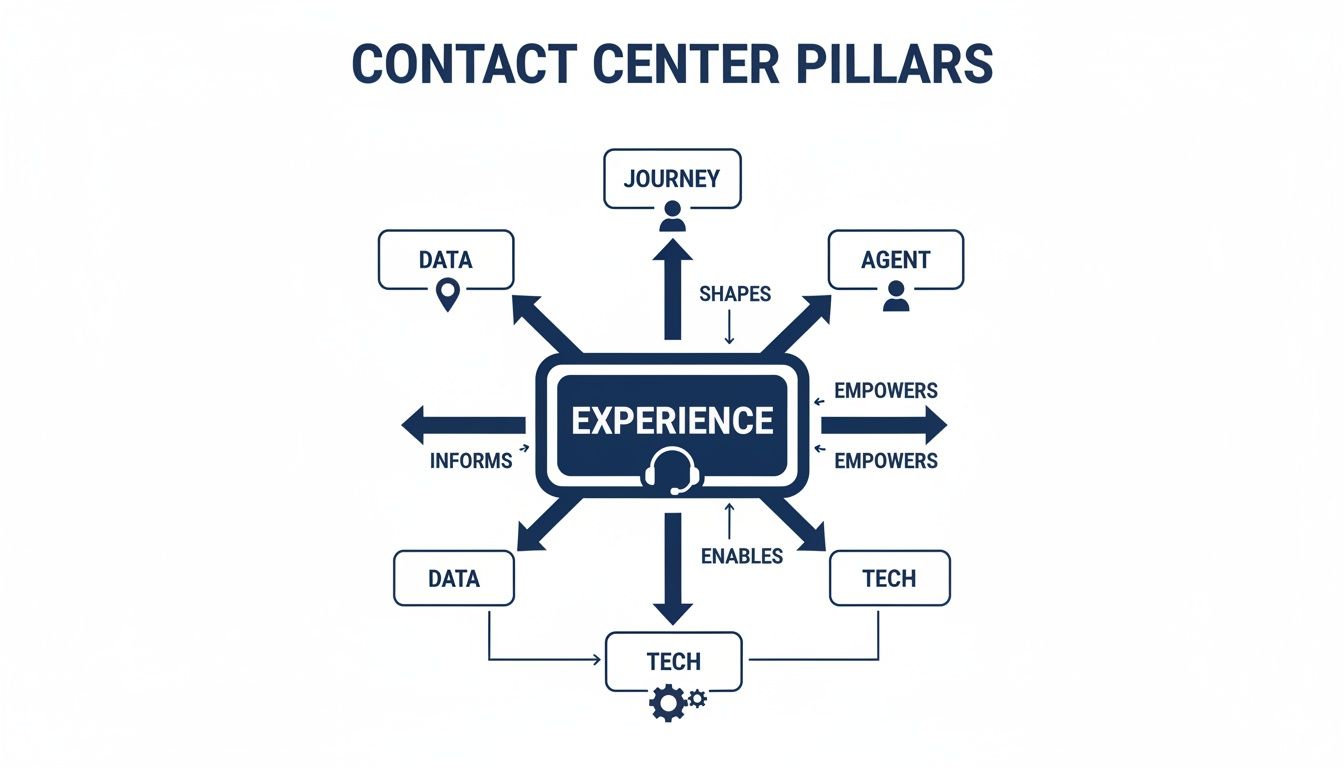
This visual really shows how the customer's journey, the agent's experience, the technology you use, and the data you track are all linked. Each one plays a critical role in shaping the final outcome.
Mapping the Customer Journey
The customer journey is the complete path someone takes when they need help, from their first thought of a problem to the final resolution. It includes every single touchpoint and every potential roadblock along the way. A poorly designed journey feels like a maze with dead ends, forcing people to repeat themselves and making them more frustrated by the minute.
A great journey, on the other hand, is completely intuitive. It anticipates what the customer needs and guides them effortlessly to the right solution—whether that’s through a self-service portal, a clear IVR menu, or a direct line to a knowledgeable agent. The goal is to make getting help feel easy and respectful of their time. To really get inside your customers' heads, performing effective Voice of Customer analysis is a must.
Elevating the Agent Experience
Your agents are the heart and soul of your contact center. No amount of tech can replace a skilled, empathetic human who feels empowered to solve problems. That's why the agent experience is every bit as crucial as the customer’s. When agents have intuitive tools, clear information, and supportive management, they can focus on what they do best: helping people.
This means giving them a single, unified screen that shows the customer's entire history, so they don't have to ask the same questions over and over. It also means providing ongoing training in both product knowledge and soft skills.
A positive agent experience directly translates to a superior customer experience. Agents who feel valued and supported are far more likely to deliver the kind of memorable service that turns frustrated customers into loyal advocates. One study found that companies with highly engaged employees outperform their competitors by a staggering 147%.
The Technology and Infrastructure Foundation
Technology is the backbone that makes both a smooth customer journey and an effective agent experience possible. Clunky, on-premise phone systems are often rigid, expensive to maintain, and simply can't keep up with the demands of a modern business. This is where cloud-based solutions have completely changed the game.
Cloud platforms give you the flexibility and scalability needed to deliver a modern contact center experience. They enable powerful features like intelligent call routing, which makes sure a customer gets to the agent best qualified to handle their specific issue on the very first try. This isn't just a minor trend; it's a fundamental shift in how businesses approach customer service.
Measuring Success with Metrics and Analytics
Finally, you can't improve what you don't measure. But the key is to measure the right things. Old-school metrics like Average Handle Time (AHT) can sometimes push agents to rush customers off the phone, which completely torpedoes the experience.
Modern contact centers have shifted their focus to more meaningful KPIs that actually reflect the quality of the interaction and the overall health of the customer relationship. These numbers provide real, actionable insights for coaching agents, refining processes, and making smarter strategic decisions.
Here are a few essential metrics you should be tracking:
- First Contact Resolution (FCR): This is the percentage of issues you solve in a single interaction. A high FCR is a powerful sign of both efficiency and happy customers.
- Customer Satisfaction (CSAT): Typically measured with a simple survey right after an interaction, this asks customers to rate how satisfied they were.
- Net Promoter Score (NPS): This metric gauges long-term loyalty by asking one simple question: how likely is a customer to recommend your company to others?
By focusing on these four core components—the journey, the agent, the technology, and the metrics—you create a resilient and effective system that consistently delivers a winning contact center experience.
The Human Element: Empowering Your Agents for Success
All the technology in the world can build a modern contact center, but your agents are the heart and soul of the entire contact center experience. They're the human voices that build trust, show empathy, and turn frustrating problems into moments of genuine relief. The single most powerful investment you can make is transforming your support team from task-doers into true brand ambassadors.
An empowered agent is an effective agent. It really starts with recognizing the immense pressure they're under every day and actively working to head off burnout. Overwhelmed agents just can't deliver quality service, which kicks off a nasty cycle of low morale and sinking customer satisfaction. The key is to give them tools and processes that make their jobs easier, not harder.
This means putting intuitive software in their hands that cuts down on the administrative busywork. When agents aren't wrestling with a clunky system or hunting for information across five different screens, they can give their full, undivided attention to the customer on the other end of the line.

Shifting from Quantity to Quality Metrics
One of the most crucial steps in empowering your agents is to completely rethink how you measure their performance. Old-school metrics that worship call speed actually encourage agents to rush through interactions, leaving customers feeling unheard and their problems half-solved. If you want a healthier and more productive environment, the focus has to be on quality over quantity.
Instead of fixating on call duration, the most successful teams emphasize metrics that show what really matters: resolution and customer sentiment.
- First Contact Resolution (FCR): Did the agent solve the problem on the first try? This metric rewards thoroughness and genuine expertise.
- Customer Satisfaction (CSAT): How did the customer rate the interaction? This gives you direct, unfiltered feedback on agent performance.
- Agent Satisfaction (ASAT): How do your agents feel about their work? Happy agents are 31% more productive and, in turn, create much happier customers.
When you celebrate quality resolutions, you send a clear signal that you value thoughtful problem-solving far more than just clearing calls from a queue.
The Power of Continuous Training
Exceptional service takes more than just knowing a product inside and out. It requires continuous training to build a team that can handle any situation with confidence and grace. This can't be a one-and-done onboarding session; it needs to be woven into the very fabric of your contact center's culture.
Investing in a positive agent experience isn't just a feel-good strategy; it's a proven business driver. Companies that prioritize it benefit from lower employee turnover, higher morale, and a measurable increase in customer loyalty, creating a virtuous cycle of success.
This ongoing education should really zero in on two key areas. First is technical skill with your systems and products. The second, which is just as important, is the development of soft skills.
- Empathy: The ability to genuinely understand and share a customer's feelings.
- Active Listening: Fully concentrating on what's being said, not just passively hearing the words while thinking about what to say next.
- Conflict Resolution: The skill of de-escalating tense situations and finding a positive path forward.
For more hands-on strategies, be sure to check out our guide on call center management best practices.
The Enduring Importance of the Human Voice
While digital channels are definitely growing, the fundamental need for human connection isn't going anywhere. There are roughly 17 million agents employed in contact centers globally, driving a market valued at a staggering USD 352.4 billion in 2024.
This massive scale underscores the enduring power of a real conversation. Surprisingly, 71% of Gen Z still see a live phone call as the fastest way to solve a problem, proving that sometimes, the most effective solution is simply talking to another person.
Ultimately, by focusing on your agents' well-being, skills, and tools, you empower them to deliver the kind of outstanding contact center experience that technology alone can never create.
Using Technology to Architect a Seamless Customer Journey
Strategy and good intentions can only take your contact center experience so far. To actually bring that vision to life, you need the right technology acting as the architect. Modern cloud communications platforms are the tools that build a seamless, intelligent, and satisfying journey for every single customer who reaches out.
These systems aren’t just about connecting calls anymore. They're about connecting people to solutions in the most efficient way possible. They replace frustrating roadblocks with smart, automated pathways that guide customers where they need to go, often with minimal effort on their part. This is where tools once reserved for massive enterprises become accessible for businesses of all sizes, letting you compete on the quality of your experience.
Crafting the Perfect First Impression with IVR
The first interaction a customer often has is with your Auto Attendant, also known as an Interactive Voice Response (IVR) system. A poorly designed IVR can quickly turn into a customer's worst nightmare, trapping them in an endless loop of irrelevant options. A great one, however, is a clear and helpful guide.
Think of a well-designed IVR as a friendly digital concierge for your business. Its only job is to quickly figure out why someone is calling and get them to the exact person or department that can help them.
- Clarity is Key: It uses simple, plain language and offers logical, distinct choices.
- Efficiency is the Goal: It helps customers solve simple queries or get to the right agent without a single wasted step.
- Provides an Escape: It always offers an easy way to reach a live person if the menu options don't quite fit the customer's needs.
This initial touchpoint sets the tone for the entire interaction. Getting it right ensures the customer journey starts on a positive and productive note.
Respecting Customer Time with Smart Queues
Nobody likes waiting on hold, but sometimes it's just unavoidable. How you manage that wait time makes a massive difference in the overall contact center experience. Smart Queues transform this potential negative into a manageable, and even positive, interaction.
Instead of subjecting callers to bad music or dead silence, Smart Queues provide value while they wait. They can offer helpful wait-time announcements, share useful tips, or provide answers to frequently asked questions. The most powerful feature, though, is the Queue Callback option.
A Queue Callback feature tells your customers that you value their time more than you value their place in line. By giving them the option to hang up and receive a call back when an agent is free, you turn a moment of frustration into one of convenience and respect.
This simple piece of technology fundamentally changes the dynamic of waiting. It gives control back to the customer and can drastically reduce your call abandonment rates.
Ensuring Expertise with Advanced Call Routing
Getting a customer to the right agent on the very first try is the gold standard of an efficient contact center. Advanced Call Routing makes this possible by moving beyond the simple "next available agent" model. Instead, it uses intelligent rules to match a caller with the best-qualified person to solve their specific problem.
Routing strategies can be based on all kinds of factors:
- Skills-Based Routing: Sends a call about a specific product to an agent who is an expert on that product.
- Time-Based Routing: Directs calls to different teams or voicemails depending on your business hours.
- Relationship-Based Routing: Connects a customer directly to their dedicated account manager. You can see how this works through a strong VoIP and CRM integration.
This level of precision doesn't just improve First Contact Resolution rates. It also boosts agent confidence, since they're consistently handling issues that fall squarely within their area of expertise. Digging into advanced strategies for modern contact center operations, including AI and omnichannel approaches, can seriously boost efficiency and overall customer satisfaction.
The screenshot above shows a real-time agent wallboard, which gives managers an at-a-glance view of team performance. This kind of visibility allows leaders to make instant, data-driven decisions to optimize call flows and support their teams effectively.
The role of technology continues to grow, with AI revolutionizing how contact centers operate. The global call center AI market is projected to grow from USD 3.98 billion in 2025 to USD 4.89 billion by 2026. While 98% of contact centers already use AI for routine tasks, 61% of leaders see a rise in difficult interactions, showing the need for a smart blend of technology and human empathy. Discover more insights about these call center statistics.
Your Actionable Contact Center Implementation Checklist
Moving from theory to practice is where the real work of upgrading your contact center experience begins. The key to a smooth rollout that doesn't disrupt your business is a structured implementation plan. Think of this checklist less like a rigid set of rules and more like a roadmap to get you from where you are today to a more efficient, customer-friendly future.
A great launch is all about solid preparation. It’s no surprise that 73% of companies with "above average" customer experience outperform their competitors financially. That financial upside starts right here, with a thoughtful plan that anticipates your team’s needs and irons out potential wrinkles before they can become problems for your customers or agents.

Phase One: Laying the Foundation
Before you touch a single setting in a new system, you need a crystal-clear picture of your starting point and your destination. This foundational phase is all about auditing your current processes and defining exactly what you want to achieve. It’s the essential groundwork that ensures your new tech will solve the right problems.
Audit Your Current Customer Journey: Map out every single step a customer takes to get help from you right now. Where do they hit dead ends? What parts are the most frustrating? Pinpointing these specific friction points gives you a concrete to-do list for your new setup.
Define New Call Flows and Routing Logic: Based on what you found in your audit, design the ideal path for your customers. For example, should sales calls go directly to your sales team instead of landing in the general support queue? Documenting this logic is absolutely critical for an effective setup.
Establish Your Key Performance Indicators (KPIs): You have to decide how you'll measure success. Will your main focus be on improving First Contact Resolution (FCR), boosting Customer Satisfaction (CSAT), or slashing call abandonment rates? Pick 3-5 primary KPIs to start.
Phase Two: Configuring the System
With your blueprint in hand, it’s time to start building. This is where you’ll configure the core features of your new platform—like SnapDial—to match the call flows and logic you just mapped out. A methodical approach here guarantees every feature serves a specific purpose in making the customer journey better.
A well-planned implementation isn’t just about technology; it’s about aligning people, processes, and platforms. Getting this alignment right from the start prevents costly rework and ensures your team can use the new tools to their full potential, directly impacting the customer experience.
Configure Your Auto Attendant (IVR): Build your IVR menu based on your new call flow design. Keep the language simple, make the options clear, and always provide an obvious way to reach a live person. Record professional greetings that actually sound like your brand.
Set Up Smart Queues: Create dedicated queues for different departments or skills (e.g., "Technical Support," "Billing Inquiries"). Configure helpful on-hold messages, offer estimated wait times, and—most importantly—enable the Queue Callback feature to give customers back control of their time.
Phase Three: Empowering Your Team
Your technology is only as good as the people using it. This final phase is all about training, testing, and going live. Properly preparing your team is the single most important factor for a successful switch and is key to maintaining a positive agent experience from day one.
Train Your Team on the New Platform: Don't just show them how to answer a call. Train agents on how to use every important feature, from transferring calls smoothly to understanding the new reporting dashboard. Run a few mock calls to build their confidence before the system goes live.
Launch, Monitor, and Refine: It's time to go live! But the work isn't done. Keep a close eye on your reporting dashboard and monitor your chosen KPIs in real time. Be ready to make small tweaks to your call routing or IVR menu based on what the initial data and agent feedback are telling you.
After you've launched, the real test begins. You need to track the right metrics to see if your changes are actually making a difference. This is where your reporting dashboard becomes your best friend.
Essential KPIs to Track in Your Dashboard
Here’s a look at the critical metrics you should be monitoring to measure the impact of your new contact center setup and drive continuous improvement.
| KPI | What It Measures | Why It's Important for Customer Experience |
|---|---|---|
| First Contact Resolution (FCR) | The percentage of inquiries resolved on the first interaction. | High FCR means customers get their problems solved quickly without needing to call back, which is a huge driver of satisfaction. |
| Customer Satisfaction (CSAT) | A direct measure of customer happiness with a specific interaction, usually captured via a post-call survey. | This gives you direct, unfiltered feedback on agent performance and the overall service quality. |
| Average Handle Time (AHT) | The average duration of a single customer interaction, from initiation to wrap-up. | While not a goal in itself, tracking AHT helps identify efficiency gains or areas where agents may need more training. |
| Call Abandonment Rate | The percentage of callers who hang up before connecting with an agent. | A high rate is a major red flag, often pointing to long wait times or a confusing IVR menu that needs fixing. |
| Queue Wait Time | The average time a customer spends on hold waiting in a queue. | This is a direct measure of customer effort. Reducing it is one of the fastest ways to improve the overall experience. |
Tracking these KPIs isn't just about collecting data; it’s about using that information to refine your processes, coach your team, and make sure your contact center is consistently delivering the kind of experience that builds customer loyalty.
Got Questions? We've Got Answers
Thinking about upgrading your contact center can bring up a lot of questions. I get it. It can feel like a huge project, but once you get clear answers on the big concerns—cost, time, and impact—the path forward starts to look a lot less intimidating.
Let's tackle some of the most common questions we hear from business leaders. The goal here is to demystify the process. Investing in a better customer and agent experience isn't about chasing the latest tech trend; it's a strategic move that pays real dividends in loyalty, efficiency, and growth.
How Can a Small Business Afford a Modern Solution?
This is probably the number one misconception we run into: the idea that a top-tier contact center is financially out of reach for smaller businesses. That fear is rooted in the old world of on-premise hardware, which meant shelling out a massive upfront investment for servers, phone lines, and the specialized IT crew needed to keep it all running.
Thankfully, modern cloud-based systems have completely flipped the script. These platforms run on a subscription model, often called Software-as-a-Service (SaaS). This completely eliminates the need for any huge, initial hardware purchase.
Instead of a hefty capital expense that drains your budget, it becomes a predictable monthly operational expense. This pay-as-you-go approach makes enterprise-level features accessible to literally any business, no matter the size. You can scale your service up or down in minutes based on seasonal demand or business growth, which means you only ever pay for what you actually use.
What Is the Single Most Important Metric to Track?
While a dashboard full of data is great, sometimes focusing on just one or two key metrics gives you incredible clarity. If I had to pick just one, my vote goes to First Contact Resolution (FCR). It's probably the most critical sign of a healthy contact center experience.
FCR measures the percentage of customer issues you solve completely on the very first try—no follow-up calls, no emails, no transfers needed. A high FCR rate is a powerful signal that your processes are dialed in, your agents know their stuff, and your customers are leaving happy.
Why is it so vital?
- It Respects the Customer's Time: Nothing frustrates a customer more than having to call back and repeat their entire story. Solving it the first time shows you value them.
- It Boosts Agent Morale: Successfully closing a case on the first go gives agents a real sense of accomplishment. It also cuts down on the number of calls they get from already-frustrated repeat callers.
- It Lowers Operational Costs: Every follow-up call is an extra cost. A high FCR directly shrinks your overall call volume and makes your whole operation more efficient.
Sure, metrics like Customer Satisfaction (CSAT) are also crucial, but FCR is often the root cause of good or bad satisfaction scores. It’s a foundational number that tells you a lot about the health of your entire support system.
Will Automation Make Our Experience Less Personal?
This is a really important and valid concern. The fear is that if you bring in automation like IVRs and chatbots, you’ll end up with a cold, robotic experience that alienates customers. When it’s done right, however, automation should do the exact opposite.
The goal of automation isn’t to replace your skilled human agents but to empower them. Think of it as a smart filter that handles all the simple, repetitive tasks, freeing up your team’s time and mental energy for the issues that truly need a human touch.
Automation should be used to remove friction, not relationships. A smart system handles the routine so that your human agents can focus on the moments that require genuine empathy, critical thinking, and a personal touch.
For example, a well-designed IVR can instantly answer a common question like, "What are your business hours?" without ever needing to bother an agent. That's a win for everyone. The customer gets an immediate answer, and the agent is now free to help someone else with a complex billing issue that requires a real conversation. This strategic blend of technology and human touch is what a superior contact center experience is all about.
How Long Does It Take to Implement a New System?
The time it takes to get up and running can vary, but with modern cloud solutions, it’s much faster than you probably think. Unlike old on-premise systems that could take months of planning and installation, a cloud-based contact center can often be live in a matter of days or weeks.
The timeline really depends on the prep work. A business that has already mapped out its desired call flows, written scripts for its IVR, and organized its user lists is going to have a much quicker rollout. The technology itself is usually ready to go instantly; it's the configuration and training that set the final schedule. For most small to mid-sized businesses, a phased rollout over a couple of weeks is a totally realistic and achievable goal.
Ready to build a contact center experience that wins customers for life? SnapDial provides all the tools you need, from intelligent call routing and smart queues to real-time analytics, all backed by our white-glove setup and 24/7 support. Discover how SnapDial can transform your customer communications.