
Let’s be honest, the term "AI" gets thrown around a lot. But when we talk about AI agents in customer support, we’re not talking about those clunky, scripted chatbots from a few years ago. This is something entirely different.
These are autonomous systems that can truly understand context, pull information from your business data, and solve complex problems without a human ever stepping in. Think of them less like a digital FAQ and more like a new digital employee who’s ready to work on day one.
For any business, this marks a huge shift—moving away from a support model that just reacts to problems and toward an intelligent system that proactively elevates the entire customer experience.
Meet the New Frontline of Customer Support

Imagine your customer support team going from a group of operators manually juggling calls one by one to an intelligent, self-organizing system that handles the routine work instantly. That’s the leap you make when you bring in AI agents for customer support. This guide is designed to give you a clear roadmap for doing just that.
We’ll get into how modern AI agents have grown up, moving far beyond simple scripts to become systems that can think, remember past conversations, and solve real problems on their own. For business leaders and IT managers, this is your starting point for figuring out how to plug these digital employees into your workflow.
The Evolution from Chatbot to Agent
The real difference comes down to two words: autonomy and capability. A traditional chatbot is stuck on a pre-written script, like a phone menu that can type. If a customer asks something a little differently or goes off-script, the bot breaks. An AI agent plays a whole different game.
- It Understands Intent: Using natural language processing, it figures out what a customer actually means, not just what they type. Wording can be awkward or unusual, and the agent still gets it.
- It Accesses Your Systems: An agent can connect directly to your CRM, billing software, or knowledge base to find answers or take action, like processing a refund or checking an order status.
- It Makes Decisions: Based on the business rules you set, it can decide on the best next step—whether that’s solving the problem itself or escalating it to the right human expert.
Think of it this way: a chatbot is like a digital FAQ page that can talk. An AI agent is like a new team member who has already read every company document, learned from every past customer interaction, and is ready to start solving problems from the minute you turn it on.
This isn't just a small tech upgrade; it’s a fundamental change in how customer service gets done. Instead of just deflecting tickets, AI agents for customer support are built to resolve them, accurately and instantly.
This shift gives you a serious competitive edge, turning your support center from a cost center into a powerful tool for customer retention. By handling all the routine inquiries with speed and precision, AI agents free up your human team to focus on what they do best: building relationships and tackling the most complex customer challenges.
How AI Agents Actually Work in Customer Support

Let's cut through the jargon for a minute. The easiest way to understand how an AI agent works is to picture your most experienced team member—the one who has a perfect memory and instant access to every single piece of company information. This isn't just about spitting out canned replies; it's about building a digital employee that can genuinely think, reason, and act on a customer's behalf.
At its core, an AI agent operates on a couple of key ideas. It uses sophisticated language models to figure out what a customer really means, even if they phrase it awkwardly. But more importantly, it plugs directly into your business systems, like your CRM or billing platform. That's what gives it the power to not just answer questions but to actually do things.
Traditional Bots vs Modern AI Agents
The jump from old-school chatbots to today's AI agents is a big one. It's the difference between a simple calculator and a full-blown spreadsheet. One follows a script, and the other executes a strategy. To make this clear, let's break down how they stack up.
| Feature | Traditional Chatbot/IVR | Modern AI Agent |
|---|---|---|
| Interaction Style | Follows a rigid, pre-programmed script. | Engages in dynamic, natural conversation. |
| Problem-Solving | Limited to a narrow set of known questions. | Handles complex, multi-step problems. |
| Decision Making | Based on a simple "if-then" decision tree. | Makes autonomous decisions based on data. |
| System Access | Can't access or change data in other systems. | Integrates with CRMs, billing, etc., to take action. |
| Context Awareness | Starts every conversation fresh; has no memory. | Remembers past interactions for a personalized feel. |
| When It Fails | "I'm sorry, I don't understand." | Asks clarifying questions to understand the real goal. |
As you can see, we've moved far beyond basic automation. AI agents are designed to be true problem-solvers, not just call deflectors.
From Static Scripts to Dynamic Decisions
The biggest leap here is the move away from rigid, linear scripts. A traditional interactive voice response (IVR) or chatbot is stuck on a strict path. If a customer asks something it wasn't programmed for, the system hits a wall and defaults to, "I'm sorry, I don't understand." Sound familiar?
An AI agent, on the other hand, has a real conversation. It can pivot, ask clarifying questions, and pull up new information on the fly. This is all thanks to a concept called agentic automation, which is just a fancy way of saying the AI has the freedom to make its own decisions based on the rules and data you've given it.
An AI agent doesn't just follow a script; it executes a strategy. It figures out what a customer needs, checks its knowledge base and connected systems, and comes up with the best plan to solve the problem—all in real time.
This is what allows an AI to handle complicated issues that would instantly stump a basic chatbot. It’s the difference between a tool that deflects tickets and a team member that actually resolves them.
Memory and System Integration: The Power Duo
An agent’s real power comes from two things: its memory and its connections.
Think of the agent's memory as its ability to instantly pull up a customer's entire history—every past purchase, support ticket, and conversation. When a customer calls, the agent already knows who they are and has a pretty good idea of why they might be calling.
This "memory" is built by connecting with your core business platforms.
- Customer Relationship Management (CRM): This gives the agent a complete picture of the customer's history and profile.
- Knowledge Base: This is the agent's library, filled with product info, FAQs, and troubleshooting guides.
- Billing and Order Systems: This allows the agent to check on payments, process a refund, or track a shipment.
When you bring all these systems together through a central communications hub like a Cloud PBX, the AI agent becomes the brain of your entire support operation. This level of deep integration is what’s driving massive efficiency gains. In fact, by 2026, AI agents in customer support are expected to autonomously resolve up to 80% of routine tickets. That's a huge jump from the 30-40% that simpler bots could handle in 2023. You can dig into these trends in the latest AI customer support research.
The Real-World Business Value of AI Support

Let's move past the technical jargon for a minute. The real question every business owner asks is simple: what will AI agents in customer support actually do for my bottom line? This isn't just about shaving off a few minutes here and there. It’s about fundamentally changing how your support team operates, and the value breaks down into three core areas that work together to fuel growth.
It all starts with a massive boost in efficiency. Think about all the time your team spends answering the same questions over and over—"Where's my order?", "How do I reset my password?", "What are your hours?". An AI agent handles all of that instantly, 24/7, without getting tired or making mistakes. That's not a minor tweak; it's a huge operational lift.
This efficiency quickly translates into serious cost savings, freeing up your team to do much more valuable work.
Achieving Radical Efficiency and Cost Reduction
Here’s how it plays out in the real world. A customer calls your main business line. Instead of a clunky, rigid menu, an AI-powered Interactive Voice Response (IVR) greets them. It understands what they're saying naturally, figures out what they need, and often solves the problem right on the spot.
That kind of instant, autonomous resolution means a huge chunk of your calls never even need to reach a human. The financial impact is staggering. Gartner predicts that by 2026, conversational AI will help businesses cut call center labor costs by a whopping $80 billion globally. It's already happening—84% of support reps say AI helps them handle tickets more easily, saving them over two hours a day for tougher cases.
For a business, this means your most valuable asset—your people—can stop functioning as human FAQ pages and start focusing on high-impact, revenue-generating activities that require a human touch.
This shift turns customer service from a necessary cost into an efficient engine for your entire operation.
Delivering Superior Customer Experiences
Speed and accuracy are the bedrock of a great customer experience. Today’s customers expect answers now, not later, and AI agents deliver on that promise. They provide instant, consistent responses around the clock, wiping out frustrating wait times and making every customer feel heard the second they reach out.
This immediate gratification builds a ton of trust and loyalty. When a customer knows they can get a reliable answer in seconds—whether on your website's chat or by calling your office—their entire perception of your brand improves.
And when an issue is too complex for an AI agent? The handoff to a human is completely seamless. The AI passes along the entire conversation history and customer context, so your team member can jump right in without forcing the customer to repeat themselves. It eliminates one of the most common and annoying parts of customer service.
Unlocking Strategic Scalability for Growth
For small and mid-sized businesses, one of the biggest headaches is scaling support to keep up with growth. Hiring and training new agents is slow and expensive. AI agents solve this problem by giving you a scalable workforce that can handle a virtually unlimited number of conversations at once without a dip in quality.
This means you can handle seasonal rushes, new product launches, or rapid expansion without needing to double your support headcount. It allows a small business to offer the kind of 24/7, enterprise-level support that used to be possible only for massive corporations.
- Handle Unlimited Volume: An AI agent can manage one conversation or ten thousand at the same time with the same level of quality.
- Support Global Customers: Provide instant support across different time zones without needing a globally distributed human team.
- Grow Without Barriers: Add new products or enter new markets knowing your support infrastructure can scale on demand.
By implementing the best AI agents for customer support, you’re not just solving today's problems. You're building a flexible, resilient foundation for whatever comes next.
Integrating AI Agents with Your Cloud Phone System
An AI agent is a powerful tool on its own, but its real magic happens when you plug it into the heart of your business communications. Think of your cloud phone system as the central nervous system for every single customer interaction. It's already handling your calls, routing messages, and connecting your team, which makes it the perfect foundation for intelligent automation.
When you integrate AI agents with customer support using a Hosted VoIP or Cloud PBX platform, you're not just adding another tool. You're creating a single, cohesive system. The AI becomes an active player in your communication workflows, able to manage voice, chat, and more from one unified hub. This is what elevates a basic chatbot into a fully functional digital team member.
How a Cloud PBX Becomes the AI's Command Center
Imagine a customer calls your main business line. Instead of getting stuck in a frustrating phone menu, an AI voicebot picks up instantly. Because it’s wired into your cloud phone system, it already knows who's calling and can pull up their history from your CRM. It understands natural language, transcribes the call in real time, and can often solve the issue right there on the spot.
But what if the problem is too complex? The AI doesn't just blindly forward the call. It intelligently routes the customer—along with the full conversation transcript and all the context—to the exact human agent who is best equipped to take over. This kind of seamless handoff is only possible when the AI and the phone system are working as one.
A cloud phone system gives your AI agent its eyes and ears. It provides the infrastructure to listen to calls, understand intent, access customer data, and intelligently direct the flow of every conversation, whether it ends with the AI or with a human expert.
This integration turns your phone system from a simple utility into a strategic asset. You can get a deeper understanding of this foundational technology by exploring our guide on what a cloud phone system is and how it centralizes all your business communications.
Creating True Omnichannel Continuity
Today's customers bounce between channels. A support request might start with an AI chatbot on your website, shift to a text message, and finish with a phone call. Without an integrated system, this journey becomes a frustrating mess where customers have to repeat themselves every single time.
This is where a unified platform really shines. By connecting your AI agent to your cloud communications hub, you create true omnichannel continuity.
- Seamless Transitions: A customer can start a chat with an AI on your website. If the problem needs a voice call, the AI can trigger a call to their phone right through the cloud PBX.
- Preserved Context: When that call connects, the human agent sees the entire chat history. They know who the customer is, what they’ve already tried, and what they need help with. It completely eliminates the dreaded, "So, can you explain the problem from the beginning?"
- Consistent Experience: Your customer gets the same level of smart, context-aware service whether they're typing on a keyboard or talking on their phone.
This unified approach is absolutely critical for modern customer service. It shows you respect your customer's time and effort, which goes a long way in building trust and loyalty.
Practical Integration Examples in Action
Let’s look at how this all plays out in the real world:
- Automated Appointment Scheduling: A patient calls a clinic. The AI voicebot checks the clinic’s calendar, finds an open slot that works for the patient, books the appointment, and sends a confirmation text—all without a human lifting a finger.
- Proactive Order Updates: A customer's shipment gets delayed. The AI agent, which is integrated with your logistics software, proactively calls the customer through your VoIP system to let them know the new delivery date and offer a discount for the trouble.
- Intelligent Skill-Based Routing: A high-value client calls with a tricky technical question. The AI recognizes their number, sees in the CRM that they’re a VIP, and immediately routes them to a senior support engineer, letting them bypass the general queue entirely.
In every one of these cases, the AI agent isn't just answering a question; it's taking decisive action by using the tools provided by the cloud phone system. This deep integration is what turns AI agents for customer support into a truly autonomous and effective part of your team.
A Practical Guide to Implementing AI Customer Support
Rolling out AI agents for customer support isn't as simple as flipping a switch. It’s a full-blown strategic project that lives or dies on careful planning. For it to succeed, you need a solid foundation built on smart architecture, tight security, and—most importantly—a seamless link between your new digital workforce and your human team.
The smartest way to start is with a focused pilot project. Forget trying to automate everything on day one. Instead, pick one or two high-volume, repetitive tasks that are bogging down your team. This lets you test the waters, learn what works, and show some quick wins before you go all in. Just as critical is picking the right vendor; you need a partner who gets the big picture and offers rock-solid integration support and enterprise-grade security.
Architecture and Integration
Think of your AI agent like a new hire. To be effective, they need the right tools and access to the right information. This means connecting it seamlessly with the systems you already use every day. The goal is to create a single, reliable source of truth, tear down data silos, and give the AI a complete 360-degree view of every customer.
Here are the must-have connections:
- Customer Relationship Management (CRM): Hooking into your CRM gives the agent instant access to a caller's entire history—past purchases, old support tickets, you name it. To see how a connected system elevates your service, check out our guide on VoIP CRM integration.
- Knowledge Base: This is the AI's brain. A well-organized, comprehensive knowledge base filled with FAQs, product manuals, and troubleshooting steps is absolutely essential for it to give accurate and genuinely helpful answers.
- Cloud Phone System: Integrating with your Cloud PBX is what allows the AI to handle actual voice calls, transcribe what’s being said, and intelligently route the really complex issues to the right human agent—with the full context of the conversation attached.
Data Privacy and Security
Letting an AI handle customer data naturally brings up some serious security questions. Protecting sensitive information isn’t just a good idea; it’s completely non-negotiable. It’s absolutely critical to partner with vendors who treat security as a top priority and comply with data protection laws like GDPR and CCPA.
Your implementation plan has to include clear rules for how data is handled, encryption for data both when it's moving and when it's stored, and regular security audits. You need to define exactly what information the AI is allowed to see and make sure every interaction is logged for accountability.
Mastering the Human Handoff
The moment you pass a customer from an AI to a human agent is the moment of truth. A clunky, awkward handoff can wipe out all the goodwill you just built with the AI's speed and efficiency. The process has to be buttery smooth, completely contextual, and invisible to the customer.
This flow shows how an incoming call can be managed intelligently, making sure it always gets to the right place without a hitch.
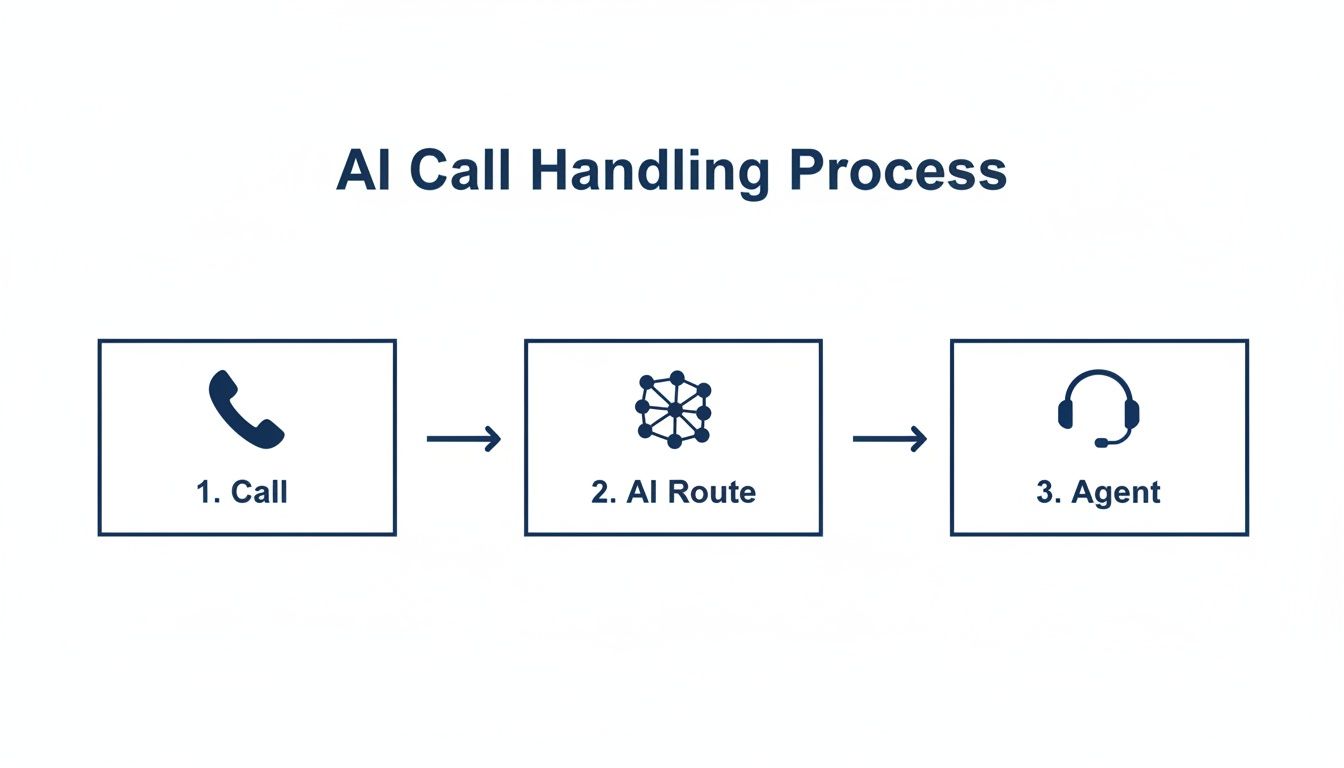
The key is that a seamless flow keeps customers from getting frustrated because the context is never, ever lost.
The ultimate goal of the handoff is for the human agent to pick up the conversation exactly where the AI left off, with the full transcript and customer history already on their screen. This prevents the customer from having to repeat themselves—a major source of frustration.
While customers are definitely warming up to self-service, that human connection is still vital. The numbers don't lie: while 92% of customers are happy to use an AI knowledge base, 75% get frustrated with AI that's fast but unhelpful, and a whopping 90% lose loyalty if they can't easily reach a human. If you're looking for the right tools, you'll want to review platforms that offer the best AI chatbot for customer service.
Measuring the Success and ROI of Your AI Agents
So, you’ve invested in AI agents for customer support. Now comes the big question: is it actually working? Proving the value of this kind of investment means looking way beyond simple stats like the number of chats an AI handles. You have to connect the dots between the AI’s performance and real business outcomes.
It's about shifting the conversation from "how many tickets did it deflect?" to "how much did this improve our efficiency, our customer happiness, and our bottom line?" To build a solid business case, you need to track the right Key Performance Indicators (KPIs). These are the numbers that show not just what the AI is doing, but how well it's solving problems and making your entire support operation better. A clear framework is essential for understanding How to Measure Automation Success and ROI.
Key Performance Indicators That Truly Matter
Forget vanity metrics. The goal here is to measure real, tangible impact. Modern communication platforms come with detailed analytics that make tracking these vital KPIs refreshingly straightforward.
Here are the core metrics you should be laser-focused on:
- AI Resolution Rate: What percentage of customer problems does the AI solve all by itself, with zero human help? A strong rate here—aiming for 40-60% or higher—is the clearest sign of an effective and well-trained agent.
- First Contact Resolution (FCR) for AI: This tells you how often the AI nails the solution on the very first try. A high FCR means the agent is accurate and truly understands what customers are asking for, which is huge for reducing frustration.
- Reduction in Human Agent Workload: This is a simple but powerful one. Track the drop in routine, repetitive tickets that your human team has to deal with. This directly proves how the AI is freeing up your people for more complex, high-value conversations.
- Customer Satisfaction (CSAT) Scores: Don't guess—ask. After an AI-led chat, prompt customers for feedback. Consistently high CSAT scores for your AI agents are proof positive that they’re delivering a great experience.
- Cost Per Ticket: Do the math: divide the total cost of your support operation by the number of tickets. As your AI handles more and more volume, this number should drop significantly, showing you direct, hard cost savings.
The ultimate measure of success isn't just ticket deflection; it's resolution. An AI that resolves 50% of incoming queries autonomously has a far greater impact than one that simply deflects 80% of them to a human agent.
Calculating Your Return on Investment
Figuring out the ROI for AI in customer support isn't just about the money you save; it's also about the value you create. It’s a simple but powerful calculation that paints a clear financial picture.
1. Quantify Your Cost Savings
Start with the most direct number: the reduction in labor costs. If your AI agent handles the work of two full-time employees, you can calculate the savings based on their salaries, benefits, and other overhead. For many businesses, these savings alone can generate a positive ROI in just 3-6 months.
2. Measure Value Generation
Next, look at the value created by having better, faster service. This is where the impact really multiplies.
This includes things like:
- Increased Customer Retention: Happy customers stick around. Faster, more accurate support leads directly to customers who are less likely to churn, and even a small bump in retention can have a massive impact on revenue over time.
- Improved Human Agent Productivity: With all the repetitive stuff off their plates, your human agents can focus on handling more complex issues, solving bigger problems, or even doing proactive outreach that contributes directly to sales and loyalty.
When you combine these hard savings with the softer (but equally important) value from a superior customer experience, you can paint a complete and compelling picture of the ROI your AI agents customer support initiative is delivering.
Got questions about bringing AI into your customer support world? You're not alone. When it comes to something as important as talking to your customers, getting clear, straightforward answers is a must. Let's tackle the big questions businesses have when they're thinking about adding AI agents to their support team.
Will AI Agents Completely Replace Our Human Team?
Not a chance. The goal here isn't replacement—it's teamwork. The smartest way to use AI is in a hybrid model where AI agents and your human team work side-by-side. AI is a rockstar at handling the high-volume, repetitive stuff like checking an order status or resetting a password. It can do it instantly, accurately, and 24/7.
This frees up your human agents from the monotonous grind, letting them sink their teeth into the complex, high-value, and emotionally tricky situations where they really shine. Think of AI as the ultimate assistant, empowering your skilled team to do their best work where empathy and sharp thinking are everything. It’s a win for efficiency and a huge boost for job satisfaction.
The most successful setups use AI to make their human teams better, not to get rid of them. When you automate the routine, you elevate the role of your human experts, turning them into the go-to problem-solvers for your most important customer challenges.
How Difficult Is It to Integrate an AI Agent?
It's a lot smoother than you might think, especially since modern platforms are built specifically to play well with others. Cloud-based phone systems that use open standards are designed to connect easily with the other tools you're already using. The best AI agent vendors provide APIs and pre-built connectors for popular CRMs, helpdesks, and platforms like Slack or Microsoft Teams.
The key is picking a communications provider and an AI vendor that both make seamless connections a priority. With the right partners, the technical lift on your team is way smaller than most businesses expect. A well-planned integration ensures the AI has all the context it needs to be genuinely helpful from day one.
What Kind of Training Data Does an AI Agent Need?
An AI agent learns directly from the knowledge your company already has. We're talking about your internal knowledge base, public-facing FAQs, help articles, and product documentation. It can also be trained on historical customer support chat logs and call transcripts (anonymized for privacy, of course).
The richer and more organized this data is, the faster the AI learns and the more accurate its answers will be. Today’s AI models are incredibly good at absorbing and making sense of this information, which means they can start adding real value almost right out of the box.
How Do We Make Sure the AI Sounds Like Us?
This is a critical step, and it's completely in your control. You get to "train" the AI agent on your specific brand guidelines by showing it examples of your communication style and tone.
You can tell it to be formal, friendly, super technical, or empathetic, depending on what the situation calls for. By setting clear rules and feeding it examples from your best human agents, you can ensure the AI maintains a consistent and authentic voice across every single customer interaction. This protects your brand's personality while you scale up your support.
Ready to see how a modern communication platform can be the foundation for your AI strategy? The team at SnapDial can help you unify your communications and get ready for intelligent automation. Learn more about our cloud phone system.