
Imagine a world where your customers never hear a busy signal and their calls get picked up instantly, day or night. That’s not some far-off idea; it’s the reality being built right now with AI voice agents for customer service. We're talking about intelligent, conversational partners that actually understand and solve issues 24/7.
The End of Answering Calls and the Start of Solving Problems
Forget those clunky, robotic IVRs from years ago that forced callers through endless, frustrating phone menus. Today’s AI voice agents are designed to do far more than just answer a call—they’re built to solve problems from the very first sentence. This shift is turning customer service from a reactive cost center into a proactive, efficient engine for your business.
By handling all the routine stuff—like answering common questions or scheduling appointments—these AI agents free up your human team. This lets your experts focus on the complex, high-value conversations that really need a human touch, instead of getting bogged down by the same repetitive queries over and over. It's a total rethink of how businesses manage their most critical customer touchpoint.
Powering Intelligent Conversations
The whole system falls apart if the AI can't understand what the customer is actually saying. As businesses move from just answering calls to actually solving problems, the first step is often getting a clean, accurate call center audio transcription to feed into the AI. When the AI starts with precise data, you get much better outcomes.
Here’s what makes this transformation possible:
- Instantaneous Responses: AI agents pick up immediately. This completely eliminates hold times and cuts down on customer frustration right from the start.
- 24/7 Availability: They provide consistent, reliable support around the clock, capturing leads and resolving issues long after your doors have closed for the day.
- Seamless Escalation: When a problem does need human expertise, the AI can intelligently route the call to the right person or department, passing along the full context of the conversation so the customer doesn't have to repeat themselves.
The Accelerating Pace of Automation
This move toward automation isn't some distant trend; it's happening right now, and it’s picking up speed. Companies are adopting these tools to stay competitive and meet the rising expectation for immediate, effective service.
Gartner projects that by 2026, one in ten agent interactions will be fully automated, with AI voice agents taking center stage in this shift.
That means a huge chunk of all support tickets and calls could soon be handled without any direct human involvement. For businesses already using modern cloud PBX systems like SnapDial, integrating AI voice capabilities is no longer just an interesting idea—it’s a strategic necessity. You can find more insights on this by checking out the latest voice AI trends on cuberoot.ai.
How an AI Voice Agent Actually Understands Your Customers
To really get what AI voice agents for customer service can do, you need to peek under the hood. It’s not a black box of magic code. Think of it as a highly trained digital employee that follows a specific, four-part process for every single conversation. Each step logically builds on the last, turning spoken words into resolved issues.
The whole point is to intercept the common frustrations of phone support—like busy signals and endless hold music—and turn a potentially negative experience into a quick, positive one.
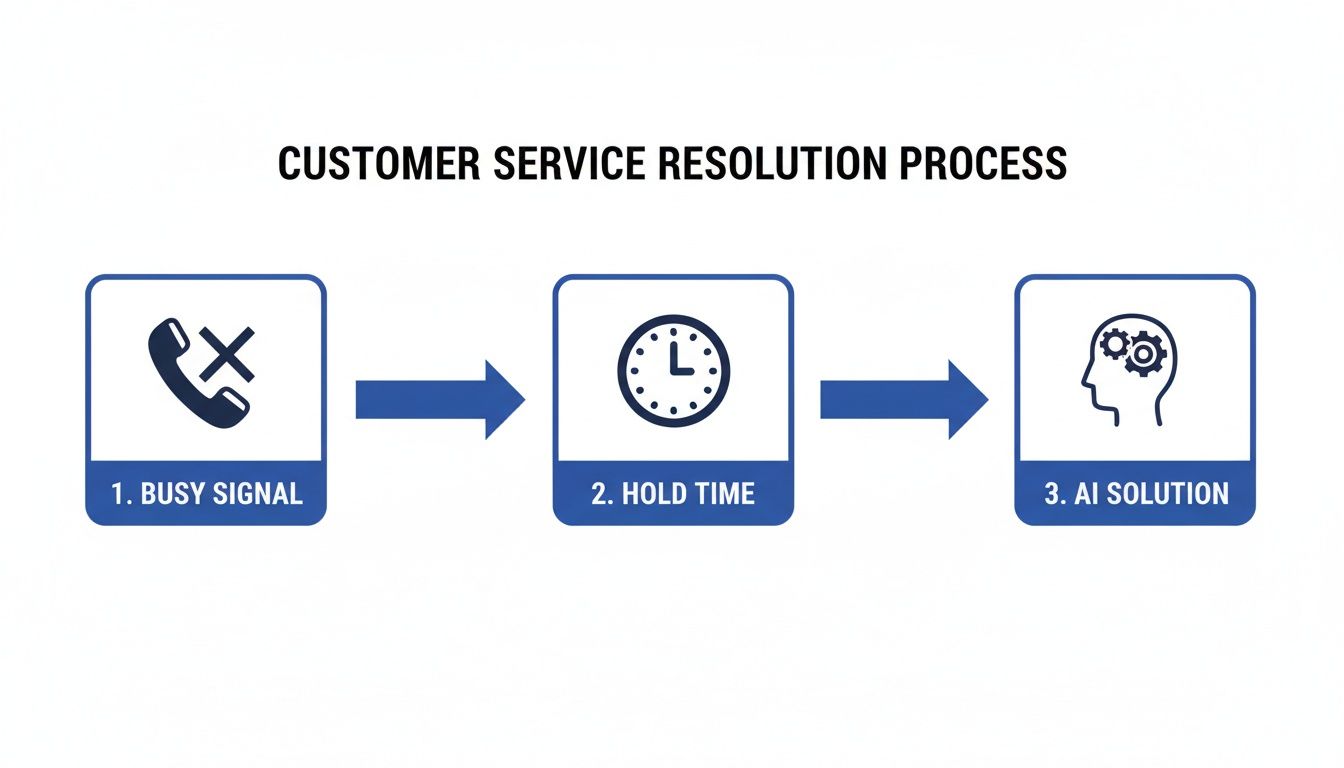
This process is what transforms a customer headache into an efficient, AI-driven solution, turning a potential lost customer into a happy one. But how does the technology actually work? It all comes down to four key pillars working together in perfect sync.
The Four Pillars of AI Voice Agent Technology
The magic behind a natural-sounding AI conversation isn't a single piece of tech but a symphony of four distinct components. Each has a specific job, and together, they create a seamless loop that mimics a human interaction.
| Technology Component | Function (The 'How') | Analogy (Think of it as…) |
|---|---|---|
| Automatic Speech Recognition (ASR) | Converts the caller's spoken words into digital text. | The Ears |
| Natural Language Understanding (NLU) | Analyzes the text to figure out the caller's true intent and meaning. | The Brain |
| Dialog Management | Decides the next best action or response based on the understood intent. | The Strategist |
| Text-to-Speech (TTS) | Converts the AI's text response back into natural, human-sounding audio. | The Voice |
Let's break down exactly what each of these components does and why a high-quality version of each is non-negotiable for a good customer experience.
Automatic Speech Recognition (ASR): The Ears
The conversation always starts here. Automatic Speech Recognition (ASR) is the system's "ears," and its only job is to listen to the soundwaves of a customer's voice and turn them into written text. It’s like a world-class court stenographer who types at the speed of sound and never misses a word.
But it's more than just simple dictation. Modern ASR is trained on massive datasets of human speech, which allows it to cut through different accents, speaking speeds, and even annoying background noise with surprising accuracy. If the ASR gets the words wrong, the entire conversation gets derailed, which is why a top-tier ASR engine is absolutely critical.
Natural Language Understanding (NLU): The Brain
Once the words are in text form, Natural Language Understanding (NLU) takes the baton. This is the "brain" of the operation. Its job is to figure out what the customer really wants. It doesn't just look for keywords; it digs deeper to grasp the underlying intent.
For example, a customer might say, "My internet is down again," "I can't get online," or "Why isn't my WiFi working?" The phrasing is totally different each time, but a good NLU system instantly recognizes the core intent is the same: they have a connectivity problem that needs fixing.
NLU is the critical difference between a frustrating, robotic IVR that forces you into menu options and an intelligent agent that actually gets you. It’s what lets the AI handle the beautiful messiness of human language.
The NLU model then breaks the sentence down to pull out key pieces of information, often called "entities," giving the system structured data to work with.
- Intent: Report an outage
- Urgency: Implied by the word "again"
- Service: Internet/WiFi
This clear, actionable summary is then passed to the next stage.
Dialog Management: The Strategist
With a solid grasp of the customer's goal, the Dialog Management component comes into play. You can think of this as the "strategist" or the conversational playbook. It decides what the AI should say or do next to guide the interaction toward a successful outcome.
This isn't just a rigid script. The Dialog Management system uses logic and pulls data from integrated knowledge bases or a CRM to figure out the most efficient path forward.
Using our internet outage example, the Dialog Management system would map out the next steps:
- Acknowledge the problem with an empathetic phrase like, "I'm sorry to hear your internet is down."
- Ask for their account number or address to verify their identity.
- Ping an internal system to check for known service outages in their area.
- Based on that check, either provide an estimated fix time or offer to create a new support ticket.
Each step is a calculated decision designed to move the conversation forward without friction. It keeps the interaction productive and on track.
Text-to-Speech (TTS): The Voice
The final piece of this puzzle is Text-to-Speech (TTS), which acts as the AI's "voice." Once the Dialog Management system has crafted the right text response, the TTS engine converts it back into natural, human-like audio for the customer to hear.
Thankfully, modern TTS is a world away from the monotone, robotic voices of the past. Today's systems can adjust their tone, pitch, and pacing to convey empathy or urgency, making the customer feel like they're being heard and respected. This completes the conversational loop, creating a smooth, back-and-forth experience.
The Real-World Business Impact of Voice Automation
Knowing the tech behind ai voice agents for customer service is one thing, but seeing the actual results on your bottom line is what really counts. Once you move past the technical jargon, you start to see that voice automation delivers tangible improvements that directly impact your business’s health and growth, giving you a serious competitive edge.
The first and most dramatic impact is a sharp drop in your operational costs. Just think about all the resources tied up answering the same routine phone calls over and over—questions about business hours, appointment confirmations, or order status checks. Every one of those calls, while necessary, eats up valuable time from your human agents.
By handing off these high-volume, low-complexity calls to an AI voice agent, you free up your team to focus on the things that actually generate revenue and solve complex problems. This isn’t just about cutting costs; it’s about reallocating your most valuable asset—your people—toward tasks that drive real growth.
Slashing Operational Costs
These financial benefits aren't just a hypothetical. Businesses that have jumped on board are already seeing huge savings. Industry data reveals that AI voice agents are making a big dent in operational costs, with some companies seeing call-related expenses fall by as much as 19% just from automated quality assurance and coaching.
And this trend is only picking up speed. Projections show that by 2025, 80% of customer service organizations will be using generative AI to make their agents more efficient. These platforms are perfectly suited to handle repetitive tasks like basic tech support and order tracking, which adds up to significant savings. You can find more details in this analysis of top AI customer service agents for 2026.
This efficiency boost gets even better when your AI is plugged into a solid cloud phone system. The two together create a streamlined communication hub where costs are tightly managed, and every single interaction is optimized.
Achieving True 24/7 Availability
Your office might close at 5 PM, but your customers' needs don't follow a schedule. One of the biggest wins with an AI voice agent is its ability to offer genuine 24/7/365 availability. It never sleeps, takes a break, or goes on vacation, making sure you capture every single lead and support request, no matter the time of day.
Think about a potential client for a local service business who only has time to research and book an appointment late at night. Without an AI agent, their call goes straight to voicemail, and you risk them just calling a competitor. With a voice agent, their appointment gets booked on the spot, locking in new business while your team is sound asleep.
An AI voice agent transforms your phone line from a 9-to-5 liability into a round-the-clock asset. It works tirelessly to ensure no opportunity is ever missed due to a "we're currently closed" message.
This constant availability doesn't just make customers happier; it directly grows your revenue by turning after-hours calls into real business.
Delivering Unmatched Scalability
One of the biggest headaches for any business is dealing with unpredictable call volume. A successful marketing campaign, a seasonal rush, or an unexpected service issue can flood your phone lines, overwhelming your team and leading to long hold times and angry customers. Bringing on temporary staff is slow and expensive.
This is where AI voice agents offer incredible scalability.
- Handling Unexpected Surges: An AI can juggle hundreds or even thousands of calls at the same time without breaking a sweat. During a holiday sales rush, an e-commerce store's AI can answer every single order status query instantly, preventing a total support meltdown.
- Growing Without Overhiring: As your business expands, so will your call volume. Instead of being stuck in a constant cycle of hiring and training new agents, you can simply scale your AI's capacity to meet the new demand, keeping your human team lean and focused.
This elasticity means you're ready for anything, without the financial drag of maintaining a huge, on-call support team. And when it’s powered by a flexible cloud PBX system, this scalability becomes even more powerful, creating an unstoppable customer service machine. For those looking at different options, our guide on the best AI voice agents available offers a deeper look into picking a solution that can grow with you.
Practical Use Cases That Drive Growth

The true value of AI voice agents for customer service really comes alive when you see them solving real, costly business problems. This isn't just theory anymore; it's a practical tool that’s actively creating efficiency and unlocking new revenue streams across a ton of different industries. By taking over the high-volume, repetitive tasks, these agents free up your human teams to focus on strategic, growth-oriented work.
So, let's look at how different sectors are actually putting AI voice agents to work to tackle their unique challenges. From e-commerce to healthcare, the applications are both specific and seriously impactful, turning phone lines into powerful operational assets.
Retail and E-commerce Automation
In the fast-paced world of retail, customers want instant answers about their orders. Any delay leads to frustration and, pretty quickly, lost loyalty. AI voice agents are perfectly suited to manage this constant flow of "where's my stuff?" inquiries, providing immediate, accurate information without needing a human to step in.
Imagine a customer calling about a recent purchase. An AI agent can:
- Provide instant order status updates by plugging directly into your fulfillment system.
- Kick off a return or exchange by walking the caller through the steps and firing off an email with a shipping label.
- Answer frequently asked questions about product availability, store hours, or shipping policies, pulling all those simple calls out of the main support queue.
This kind of automation is a lifesaver during peak seasons like the holidays, when call volumes can go through the roof without warning. An AI agent scales up effortlessly to handle thousands of simultaneous calls, making sure every customer gets an immediate response.
Healthcare Patient Coordination
The healthcare industry is often buried in administrative tasks that eat up valuable staff time. Scheduling appointments, sending reminders, and processing prescription refills are all essential but mind-numbingly repetitive duties that lead to burnout and operational bottlenecks.
AI voice agents are stepping in to streamline these workflows, making life easier for staff and improving the patient experience at the same time.
An AI voice agent can manage the entire appointment lifecycle—from the initial booking to post-visit follow-ups—ensuring clinics run smoothly and patients stay in the loop. This cuts down on no-show rates and frees up front-desk staff to focus on patients who are physically in the clinic.
For example, an agent can call a patient to confirm an upcoming appointment, offer to reschedule if needed, and even provide pre-visit instructions. This proactive communication helps patients stick to their care plans and keeps the clinic’s schedule running like clockwork. As you can imagine, there are all sorts of examples of VoIP applications that make this kind of advanced integration possible.
Finance and Banking Modernization
The financial world demands a high degree of security, accuracy, and around-the-clock availability. Customers need immediate access to their account info and quick help for common issues like a lost card or a questionable transaction. AI voice agents provide a secure and efficient first line of defense for these interactions.
A bank or credit union can use a voice agent to:
- Authenticate customers securely using voice biometrics or by verifying account details.
- Provide real-time account balances and recent transaction histories.
- Report a lost or stolen card and start the replacement process on the spot.
- Answer questions about loan products or branch locations, 24/7.
This not only empowers customers with self-service options but also tightens up security by creating a consistent, auditable process for sensitive requests. For a great real-world example of advanced voice AI in action, check out how Lunar's GPT-4 Voice AI in European banking marked a major industry breakthrough, showing just what’s possible today.
Weaving AI into Your Cloud Phone System

Putting an AI voice agent to work isn't about ripping out your existing phone setup and starting over. Think of it as giving your current system a massive intelligence boost. The real magic of ai voice agents for customer service happens when they work in perfect harmony with your modern Cloud PBX or VoIP platform.
This tight-knit integration transforms your AI from a standalone novelty into the smart frontline of your entire communications hub. It becomes the first point of contact, ready to solve common problems on its own before seamlessly passing tougher challenges to the right human expert. This isn't a replacement for your team; it's an enhancement that makes your entire operation smarter and more responsive.
The AI as Your Intelligent Frontline
The most common and effective way to integrate is by placing the AI voice agent at the very start of the call. When a customer dials your business, they're greeted by the AI instead of a clunky IVR menu or a phone that just rings and rings. The AI's first job is to figure out what the caller needs, and to do it fast.
From there, it makes a strategic call:
- Resolve It Now: If the request is simple—like checking an order status or booking an appointment—the AI handles it from start to finish. The customer gets what they need, and your team is never interrupted.
- Route It Right: If the issue needs a human touch, the AI uses smart call routing to transfer the caller directly to the most qualified person or department. No more being bounced around.
This two-pronged approach ensures that straightforward queries get instant answers, freeing up your team for more valuable work. At the same time, it guarantees that customers with complex problems connect with a human who can actually help, skipping the soul-crushing experience of navigating a phone tree.
The AI acts like a sophisticated traffic controller for your phone system. It directs simple requests into an automated resolution lane and sends complex ones to the express lane for human support, making sure every caller gets to their destination as quickly as possible.
How Smart Call Routing and Context Work Together
A crucial piece of a successful integration is the "warm transfer." This is a massive upgrade from the cold, blind transfers we've all experienced. When the AI voice agent escalates a call to a human, it doesn't just forward the call; it passes along the entire conversation's context.
This is a game-changer for the customer experience. Your human agent gets a screen pop-up with a summary of who the caller is, what they need, and what the AI has already tried. The customer never has to repeat their story—a major point of friction in traditional support centers.
Unifying Communications with Cloud PBX Features
Modern Cloud PBX systems, like SnapDial, come packed with features that work beautifully with an AI voice agent. The integration creates a single, powerful system where every component makes the others more effective.
- Advanced Call Queues: The AI can intelligently place escalated calls into specific queues based on the caller's needs (e.g., sales, technical support, billing). It can even provide estimated wait times or offer a queue callback option, which the phone system handles automatically.
- Real-Time Analytics: Data from the AI's conversations flows directly into your phone system's analytics dashboard. This gives you a complete picture of your call volume, resolution rates, and escalation patterns, combining both AI and human interactions in one place.
- CRM Integrations: Your Cloud PBX is likely already hooked into your CRM. The AI taps into this same connection to pull customer history for more personalized conversations and to automatically log new interaction details, keeping your records perfectly up to date.
By combining these elements, you create a cohesive communication ecosystem. You can learn more about how businesses are using these tools by exploring how AI agents for customer support are being deployed in real-world scenarios. This unified approach turns your business phone system from a simple utility into a true strategic asset.
Your AI Implementation Roadmap
Knowing how AI voice agents for customer service work is one thing, but actually putting one into action requires a clear plan. The good news is, launching this technology doesn't have to be some long, drawn-out ordeal. If you follow a structured roadmap, you can move from a rough concept to a live, value-delivering agent with confidence.
The whole process kicks off by nailing down exactly what you want the AI to accomplish. From there, it's about designing conversations that genuinely help your customers, plugging the agent into your existing tools, and setting up a cycle of continuous improvement. This step-by-step approach is how you build a solution that solves real business problems instead of just creating another tech headache.
A Step-by-Step Implementation Plan
Successfully deploying an AI voice agent involves a lot more than just flipping a switch. It’s a strategic process that ensures the technology lines up perfectly with your operational goals and customer needs right from day one.
Define Your Goals: Start by picking the single biggest problem you need to solve. Is it slashing hold times? Capturing leads that call after hours? Or maybe automating appointment scheduling? A narrow, measurable goal—like "resolve 30% of order status inquiries without human intervention"—gives you a clear target to aim for.
Choose the Right Partner: Let's be honest, not all voice AI vendors are created equal. You need a partner whose platform plays nice with the systems you already rely on, like your Cloud PBX and CRM. We'll dig into how to pick the right one in just a bit.
Design Your Conversation Flows: This is where you map out the ideal journey for a customer conversation. What are the most common questions they ask? What information does the AI need to grab to actually solve their problem? A good platform will let you use a visual, no-code builder to create logical and natural-sounding interaction paths.
Integrate with Your Tools: Connect the AI to your core business systems. This is where the magic really happens, allowing the agent to pull customer history from your CRM, check inventory levels in your e-commerce platform, or book appointments directly into your company calendar.
Test and Optimize: Before you go live, you have to run the agent through its paces. Use simulations and internal test calls to find and fix any awkward phrasing or broken logic. Once it's live, use the analytics to keep an eye on performance and continuously fine-tune the conversation flows based on what you see in real-world interactions.
Your Vendor Selection Checklist
Choosing the right provider is probably the most critical decision you'll make in this entire process. A great partner makes implementation feel easy, while the wrong one can cause endless headaches. Think of this checklist as your guide to evaluating potential vendors and making sure they’re the right fit.
A vendor's platform should feel like an extension of your team, not another complicated piece of software to manage. Their success should be tied directly to yours.
When you're vetting potential partners, it's crucial to look beyond the flashy sales pitch and focus on the criteria that will actually impact your success. Use this table to cut through the noise and make an informed choice.
Essential Vendor Selection Checklist
| Evaluation Criteria | What to Look For | Why It Matters |
|---|---|---|
| Seamless Integration | Pre-built connections to your Cloud PBX, CRM, and helpdesk. | Weak integrations are the #1 cause of failed AI projects. The agent must be able to access and update data in real-time. |
| Customization Options | A no-code or low-code interface for building and editing conversation flows. | You need the agility to update scripts, add new skills, and adjust routing rules without relying on the vendor’s engineers. |
| Security and Compliance | Certifications like SOC 2, ISO 27001, and HIPAA for handling sensitive data. | Protecting customer data is non-negotiable. The vendor must meet industry-standard security protocols to ensure trust. |
| Support Model | A dedicated support team and clear service-level agreements (SLAs). | When issues arise, you need responsive, expert help. A strong support model ensures you get fast resolutions and ongoing guidance. |
Ultimately, the goal is to find a partner who not only provides solid technology but also understands your business and is committed to helping you succeed. A great vendor will feel less like a software supplier and more like a trusted advisor on your journey.
Got Questions? We've Got Answers
Stepping into the world of AI voice agents naturally brings up a few questions. It’s a big shift from how customer service has always been done, so it's smart to wonder about performance, customer reactions, and what it actually takes to get one up and running.
Let's clear the air and tackle the most common questions we hear. Our goal is to give you straightforward answers so you can make a decision that feels right for your business. We'll cover how this tech differs from the old stuff, what happens when the AI gets stuck, and what it really takes to get started.
How Is an AI Voice Agent Different from a Traditional IVR?
Think of a traditional Interactive Voice Response (IVR) system as a one-way street with a very strict map. It forces your customers into that frustrating loop of "Press 1 for sales, Press 2 for support." The system has no idea what the caller actually wants; it can only follow its pre-programmed menu. It's a recipe for a bad customer experience.
An AI voice agent, on the other hand, is built for a real, two-way conversation. It uses Natural Language Understanding (NLU) to figure out what a customer is saying in their own words. Instead of just offering a menu, it actively works to understand the problem and find a solution. It's a problem-solver, not just a call router.
What Happens If the AI Can't Solve a Problem?
This is a critical point, and any well-designed system has a clear plan: seamless escalation. An AI voice agent is programmed to know its own limits. When it comes across a really complex issue, senses the caller is getting frustrated, or gets a request it wasn't designed for, it doesn't hit a dead end.
Instead, it intelligently transfers the call to the right human agent.
The best systems do what's called a "warm transfer." This means the AI briefs the human agent on the entire conversation so far, including what the customer was trying to do. The customer never has to repeat themselves, turning a potential moment of frustration into a surprisingly smooth handoff.
Can AI Voice Agents Handle Complex Customer Emotions?
Modern AI voice agents are getting surprisingly good at this, thanks to sentiment analysis. The system can pick up on a customer's emotional state by analyzing their word choice, tone of voice, pitch, and volume. While the AI doesn't "feel" empathy, it can be programmed to respond in a much more human-like way.
For instance, if the AI detects that a caller's frustration is rising, it can:
- Adjust its own tone to sound more patient and reassuring.
- Immediately offer to transfer the call to a human agent for a more personal touch.
- Prioritize the call in the queue for a supervisor.
What Kind of Training Is Required to Set Up an Agent?
Thankfully, the days of needing a team of developers for every little tweak are over. Today’s leading providers offer low-code or even no-code platforms. These systems often come with a visual, drag-and-drop interface where you can design conversation flows and set up your business rules without writing a single line of code.
While the initial technical setup to connect the AI to your phone system and CRM takes a bit of expertise, the day-to-day management is built for business users, not programmers. "Training" the AI is more about giving it your business goals and walking it through example scenarios, not wrestling with complex software.
Ready to transform your customer service and never miss another call? At SnapDial, we specialize in integrating powerful AI voice agents with our robust cloud phone system, creating a seamless and intelligent communication hub for your business.