

Imagine your entire company, from your office in London to your team in Los Angeles, operating on one single, seamless phone system. That’s the real power of global phone services. It’s a strategic move away from tangled, hardware-heavy setups to a nimble, cloud-based solution that connects everyone, everywhere.
What Are Global Phone Services and Why Do They Matter
At its core, a global phone service is a unified communications platform that lets a business operate as a single entity across multiple countries. It completely ditches the old model of having separate, disjointed phone systems in each office. Instead, it pulls all your calling, messaging, and conferencing into one easy-to-manage cloud environment.
Think of it as the master key for your company's communication. You can instantly establish a local presence in a new market with a local phone number, all while managing the entire network from one central dashboard. This isn't just a convenience anymore; it's a critical tool for any organization that wants to compete on a global scale. The benefits ripple through the whole business, helping teams work together more effectively and serve customers better, no matter where they are.
Unifying a Dispersed Workforce
For companies with multiple offices or a growing remote workforce, global phone services solve some of the most fundamental communication headaches. Instead of fumbling with different carriers and confusing international dialing codes, employees can connect with colleagues just by dialing a simple extension, as if they were all in the same building.
This unified approach brings some major advantages to the table:
- Simplified Management: Your IT team can add users, tweak call routing rules, and check performance from a single web portal. This gets rid of the need to juggle multiple vendor contracts and babysit physical hardware.
- Cost Reduction: By routing calls over the internet (VoIP), businesses can slash expensive international calling rates and completely eliminate the maintenance costs that come with traditional PBX systems.
- Enhanced Scalability: Adding a new office or bringing on remote employees is as simple as assigning a new user in the system. There’s no new hardware to buy or install, which means your business can scale up or down without friction.
Staying Connected in a Mobile-First World
You just can't overstate the importance of a mobile-ready communication strategy. With the number of unique mobile phone users expected to hit 5.78 billion by October 2025—that’s over 70.1% of the world's population—businesses have to meet customers and employees where they are: on their mobile devices. You can get more details on this trend in the latest global digital overview on datareportal.com.
A modern global phone service extends full business functionality to mobile apps, turning any smartphone into a secure, feature-rich office extension. This ensures your team remains productive and reachable, whether they are in the office, at home, or traveling internationally.
Making the shift to this kind of cohesive, cloud-based infrastructure is essential for growth. By breaking down geographical silos, these services create a more connected, responsive, and efficient organization that’s ready for the challenges of a global marketplace. If you're new to this technology, you might find our guide on what a cloud phone system is and how it works helpful.
The Technology Behind Seamless Global Communication
To really appreciate how modern global phone services work, it helps to pop the hood and look at the technologies that make it all possible. We've come a long way from the clunky, hardware-heavy systems of the past. Today's solutions are built on a smart, flexible, internet-based foundation where every component works in sync.
At the heart of it all is the Cloud PBX (Private Branch Exchange). Think of it as the air traffic control for your entire phone system. Instead of a dusty box of wires in a server closet, this powerful software lives in the cloud, directing every single call, voicemail, and auto-attendant function. It's the magic that lets your team member in Tokyo dial a simple four-digit extension and instantly connect with a colleague in Toronto.
But how do those calls actually zip across the globe? That's where SIP (Session Initiation Protocol) Trunking comes in. If the Cloud PBX is air traffic control, SIP Trunking is the fleet of private jets. It converts your voice calls into data packets and sends them over the internet, completely bypassing the old, expensive traditional phone lines.
Establishing Your Global Footprint
One of the most powerful tools for any international business is the International Direct Inward Dialing (DID) number. In simple terms, these are local phone numbers for countries where you don't have a physical office. A potential customer in London can dial a local London number, and the call is instantly routed to your support team in Chicago without them ever paying for an international call.
This technology acts like a local passport for your business, creating an immediate, trustworthy presence in any market you choose. It removes the psychological and financial barriers that often prevent international customers from reaching out.
To see just how flexible modern connectivity has become, it's worth understanding related technologies like what an eSIM is and how it works, which gives international teams even more mobile freedom.
This concept map helps visualize how a central cloud system pulls everything together, enabling unified communications, global reach, and simplified management from a single platform.
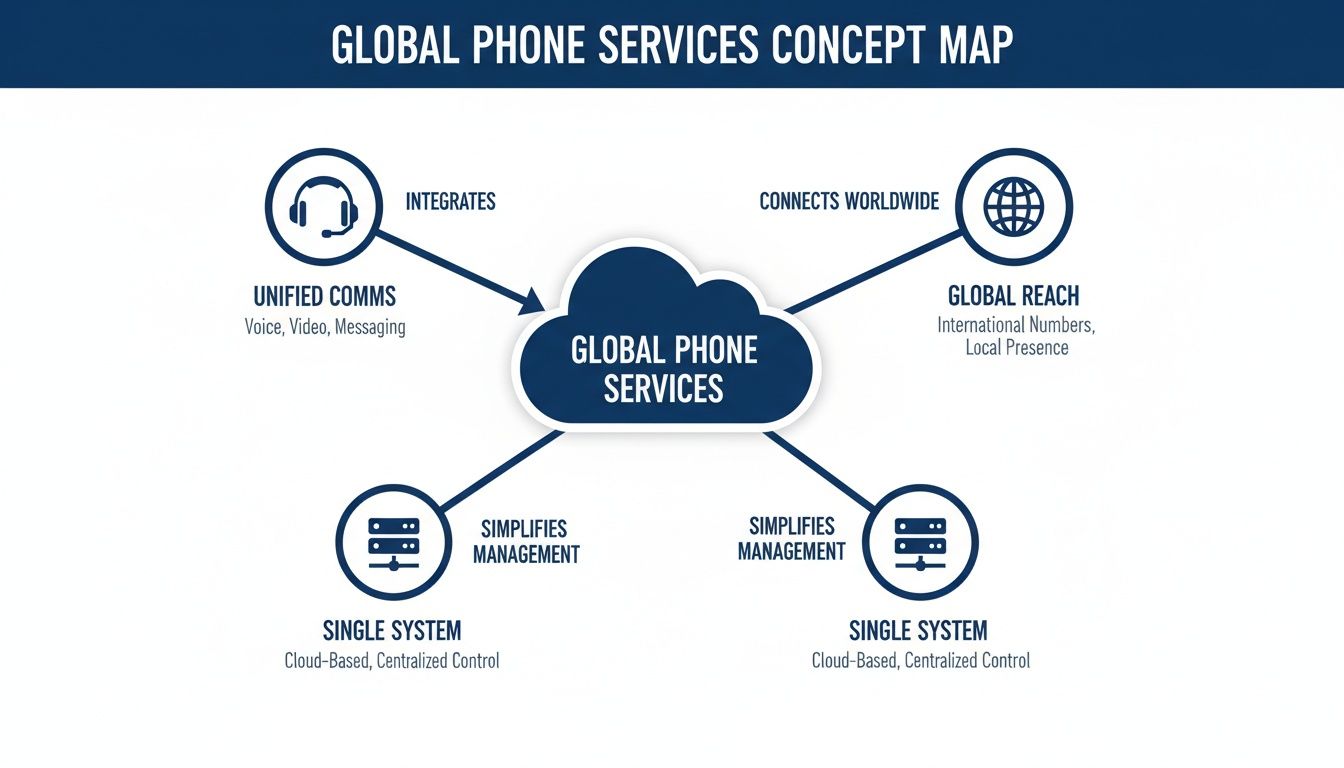
As you can see, modern communication is about much more than just calls. It's about integrating multiple tools into one cohesive and globally accessible system.
To make these technical concepts easier to digest, here's a simple breakdown of how each piece of the puzzle works and why it matters to your business.
Core Technologies of Global Phone Services Explained
| Technology Component | Simple Analogy | Business Impact |
|---|---|---|
| Cloud PBX | The brain or mission control center. | Manages all call routing, voicemail, and advanced features from a single, central platform without needing on-site hardware. |
| SIP Trunking | A digital superhighway for voice calls. | Slashes costs by sending calls over the internet instead of traditional phone lines, enabling high-quality, scalable communication. |
| International DIDs | A local passport for your business. | Establishes an instant local presence in any country, making it cheap and easy for international customers to contact you. |
| Quality of Service (QoS) | A dedicated express lane on the internet. | Prioritizes voice traffic to ensure crystal-clear, professional-sounding calls by eliminating jitter, latency, and packet loss. |
By combining these elements, a global phone service creates a communication network that is not only powerful and far-reaching but also incredibly reliable.
Ensuring Crystal-Clear Call Quality
Of course, none of this technology means a thing if the call quality is terrible. That's why Quality of Service (QoS) is such a critical piece of the puzzle.
Imagine the internet is a massive, multi-lane highway with all sorts of traffic—emails, cat videos, file downloads, and your voice calls. QoS acts like a dedicated express lane just for your voice traffic. It gives those data packets priority, ensuring they travel without delay or interruption. This simple act prevents the most common VoIP headaches:
- Jitter: When data packets arrive out of order, making the audio sound choppy and distorted.
- Latency: That awkward delay between when you speak and when the other person hears you, leading to people talking over each other.
- Packet Loss: When data packets get lost along the way, creating gaps or dead air in the conversation.
With proper QoS in place, your calls stay crystal-clear and professional, no matter how far they have to travel.
By combining a cloud-based "brain," a digital "superhighway," local "passports," and a dedicated "express lane," global phone services deliver a reliable, high-quality, and cost-effective communication experience that truly connects your business to the world.
Real-World Wins With Global Phone Services
The tech is impressive, sure, but seeing how it solves actual business problems is where the lightbulb really goes on. Global phone services aren't just a list of features; they're about delivering real results that make you more efficient, keep customers happy, and clear the path for growth. By tying all your scattered locations into one smart system, you unlock some serious operational advantages.
These services turn buzzwords like "unified communications" into tangible wins. Picture a retail chain with 20 stores across North America and Europe. In the past, every store had its own phone system, creating a mess of communication silos that was a nightmare to manage. After switching to a global phone service, all 20 stores now act as one.
The store manager in Paris can dial a simple four-digit extension to reach the inventory manager in New York, and it doesn't cost a dime. That kind of seamless internal communication doesn't just streamline operations—it speeds up decisions and builds a much tighter company culture, no matter how many time zones you cross.

Powering Global Support Centers
Think about a software company with a "follow-the-sun" support model, with teams in California, London, and Singapore. A global phone service lets them run as a single, 24/7 virtual call center. When a customer in Germany calls the support line after hours, the system is smart enough to route the call to the next available agent in Singapore, who already has the customer's entire history on their screen.
This kind of advanced call routing means customers get a live person on the line fast, which slashes wait times and boosts first-call resolution rates. Many businesses get huge wins by using a virtual phone number for business to create this global, yet local, presence.
This intelligent call distribution does more than just make customers happy; it optimizes your whole team. Workload gets balanced across time zones, preventing agent burnout and making sure you're getting the most out of your staff.
This setup offers a few game-changing benefits:
- Reduced Wait Times: Smart queues and automatic call distribution (ACD) find the best-suited agent anywhere in the world, instantly.
- Improved Customer Experience: Customers get round-the-clock support without ever knowing about the complex global routing happening behind the scenes.
- Actionable Insights: Centralized reporting gives managers a bird's-eye view of call volumes, agent performance, and customer satisfaction across the entire global team.
Enabling the Modern Hybrid Workforce
The shift to remote and hybrid work created a huge communication challenge. How do you keep things professional and connected when your team is spread out across home offices and coworking spaces? Global phone services are the answer, extending your corporate phone system right onto an employee's smartphone.
Through a mobile app, an employee working from their home in Denver has the exact same tools as someone at headquarters. They can make and receive calls from their business number, keeping their personal number private while maintaining a professional company image. They get access to call recording, voicemail-to-email, and internal extension dialing—all from the device they already have in their pocket.
Tangible Business Outcomes
At the end of the day, adopting a global phone service leads to real, measurable improvements across the board. It’s not just about getting new tech; it’s about building a more agile, responsive, and cost-effective business. For a closer look at how this plays out, you can explore various examples of VoIP in action to see how different industries are cashing in.
The key wins usually fall into three main buckets:
- Drastic Cost Reduction: Getting rid of expensive international calling rates and the headaches of maintaining on-site hardware can cut communication expenses by up to 60%.
- Instant Scalability: Need to add a new international office or onboard a team of remote workers? You can get them on the system in minutes without spending a penny on new equipment.
- Enhanced Business Continuity: Since the whole system is in the cloud, a local power outage or office closure won't affect your communications. Calls can be instantly rerouted to mobile devices or other locations, ensuring you never miss a customer call.
By connecting people and processes across geographical lines, global phone services give you the foundation for building a truly modern, efficient, and customer-focused organization.
How to Choose the Right Global Phone Service Provider
Picking a global phone service isn't like buying a new piece of software. It’s more like hiring a critical team member. The provider you choose becomes a strategic partner, the one responsible for keeping your most important communication lines—both with customers and between your own teams—crystal clear and reliable.
Getting this decision right from the start saves you from a world of operational headaches and costly disruptions later on. It means looking past the flashy marketing and focusing on the nuts and bolts of what it takes to support a business that operates across borders. You need a partner who gets the tangled web of international compliance, knows how to deliver rock-solid network performance, and has real humans ready to help when you’re dealing with issues across different time zones.
Evaluate Network Reliability and Uptime
First things first: reliability is non-negotiable. A global phone service is completely useless if your calls are choppy or constantly dropping. You need to look for providers who are open and honest about their network infrastructure and can back up their claims with a solid guarantee.
Ask any potential provider for their Service Level Agreement (SLA). Any reputable company will have one that guarantees a specific level of uptime, often 99.999%. That number isn't just marketing fluff; it translates to just over five minutes of potential downtime in an entire year. It’s a real commitment to keeping your business running. You should also ask where their data centers are located and what kind of redundancy they have in place to ensure your service stays online, no matter what.
A provider's network is the foundation of your global communications. Choosing one with a proven track record of stability and a strong uptime guarantee is essential for maintaining professional conversations and customer trust across borders.
Prioritize Security and Global Compliance
In a world where everything is connected, security and compliance are paramount. Your voice data is sensitive, and you have to protect it from being intercepted. On top of that, doing business in different countries means you have to navigate a complex maze of data privacy laws.
Your evaluation has to include a deep dive into how a provider handles security.
- Encryption Standards: Make sure they use modern encryption protocols like Transport Layer Security (TLS) and Secure Real-time Transport Protocol (SRTP). These are the technologies that protect your calls while they're in transit.
- Compliance Certifications: Ask if they are compliant with major international regulations that matter to your business, like the General Data Protection Regulation (GDPR) in Europe.
- Fraud Detection: Inquire about the systems they have in place to monitor and shut down fraudulent calling activity. This is a big one, as it can save you from getting hit with huge, unexpected bills.
A provider that’s serious about security will have no problem showing you clear documentation on their protocols and certifications. This is a crucial step in protecting your company's data and its reputation. For a better handle on how modern systems work, it's worth understanding the key differences between hosted VoIP and traditional PBX systems, as this provides valuable context on security architectures.
Scrutinize Customer Support and Onboarding
When something goes wrong, you need to talk to a real, helpful person—fast. Not get stuck in a frustrating chatbot loop. This is especially true when you're running a global operation, where problems can pop up at any hour of the day or night.
Look for providers that offer 24/7/365 live support staffed by qualified technicians. You can even test them out during the sales process. If they're slow to get back to you when you’re a potential customer, imagine how slow they’ll be once you’ve signed the contract. Also, ask about their onboarding process. A "white-glove" setup, where the provider handles all the number porting and initial configuration for you, is a lifesaver that ensures a smooth, pain-free switch from your old system.
Understand the True Cost of Service
Finally, make sure you get the full story on pricing. Hidden fees and unpredictable international calling rates can quickly turn a supposedly "affordable" service into a major budget headache. Demand total transparency.
Look for providers with straightforward, all-inclusive plans. Be very skeptical of complex, tiered plans that nickel-and-dime you for essential features like call recording or access to their mobile app. You need to ask for a detailed list of their international calling rates and check for any extra per-user fees, setup charges, or taxes that aren’t baked into the advertised price. A trustworthy partner will give you a clear, predictable cost structure that you can actually budget for.
To help you organize your evaluation, here’s a checklist that breaks down what to look for when comparing providers. Think of this as your scorecard for finding a partner that truly understands the demands of a global business.
Global Phone Service Provider Evaluation Checklist
| Evaluation Criteria | What to Look For | Why It Matters for Global Business |
|---|---|---|
| Network Reliability | Guaranteed uptime of 99.999% via an SLA, geo-redundant data centers. | Ensures your communication lines are always open, preventing lost sales and customer frustration. |
| Security Protocols | End-to-end encryption (TLS/SRTP), proactive fraud detection systems. | Protects sensitive voice data from interception and safeguards your business from costly toll fraud. |
| Global Compliance | Certifications like GDPR, HIPAA, or others relevant to your industry. | Avoids steep fines and legal trouble by ensuring you adhere to international data privacy laws. |
| Customer Support | 24/7/365 live human support, dedicated onboarding team. | Provides immediate help across time zones, minimizing downtime and operational disruption. |
| International Numbers | Availability of local/DID numbers in key countries you operate in. | Creates a professional, local presence for your customers, making it easier for them to reach you. |
| Pricing Transparency | All-inclusive pricing models, clear international rate decks, no hidden fees. | Allows for predictable budgeting and avoids surprise costs that can inflate your communications spend. |
| Scalability | The ability to easily add or remove users and locations from a central portal. | Ensures your phone system can grow seamlessly with your business without requiring a massive overhaul. |
Using a structured checklist like this makes it much easier to compare your options objectively. It forces you to look beyond the surface-level features and focus on the core capabilities that will actually support your business as it grows and operates on a global scale. A smart choice here pays dividends for years to come.
Your Step-by-Step Implementation Guide
Switching to a new communications platform can feel like a massive project, but a well-managed move to a global phone service is much smoother than you might think. A good provider won't just hand you a login and a manual; they'll guide you through a structured process. It’s all about a seamless transition that avoids disruption and gets your team running on day one.
The journey is broken down into clear, manageable stages, turning what seems like a complex technical shift into a straightforward business upgrade.
The whole thing kicks off with a discovery phase. This isn't just a sales call—it's a deep dive into how your business actually works. A solutions expert will spend time with you to understand your current communication headaches, your plans for growth, and what your teams around the world really need. This first step is crucial for building a system that actually fits your business, not the other way around.
From there, the focus shifts to making sure your network is ready for crystal-clear voice traffic.
Preparing for a Seamless Switch
A key part of the setup is a network readiness check. Your provider will analyze your internet connection to make sure it can handle high-quality calls without a hitch. This proactive step catches any potential bottlenecks before they can cause problems, guaranteeing reliability from the get-go.
Next up is one of the most critical steps: number porting. This is just the technical term for moving your existing business phone numbers over to the new service. A dedicated porting team should handle this whole process for you, coordinating with your old carrier to ensure there is zero downtime. Your customers and partners will never even know a change happened behind the scenes.
A "white-glove" setup is the gold standard here. This means the provider’s experts do the heavy lifting—from setting up your call routing and auto-attendants to configuring individual user extensions. This frees up your IT team to focus on other priorities.
Configuring Your Global System
Once the technical groundwork is laid, the provider will configure the system to match your day-to-day workflow. This is where your global phone service really comes to life. The setup process usually involves these key actions:
- Building Your Call Flow: Experts will map out exactly how calls are handled. This includes setting up your main auto-attendant ("Press 1 for Sales, Press 2 for Support"), creating ring groups for different departments, and establishing rules for after-hours calls.
- Setting Up International Routing: For teams in different countries, call routing is configured to "follow the sun." A call from a customer in Europe can be automatically sent to your London office during their business hours, then seamlessly forwarded to your US team later in the day.
- Deploying Hardware and Software: Any physical IP phones are shipped pre-configured and ready to plug in. At the same time, your team gets simple instructions to download and log into the mobile and desktop apps, turning their laptops and smartphones into powerful business phone extensions.
Empowering Your Team for Success
The final stage is all about getting your team on board. A successful rollout isn't finished until your people feel confident using their new tools. Your provider should offer comprehensive training resources tailored to different roles, from your front-line staff to your system admins.
This often includes live training webinars, a library of video tutorials, and easy-to-search knowledge base articles. The goal is to give your team self-service capabilities, letting them manage their own voicemail settings, call forwarding rules, and other preferences through a simple web portal.
When it's managed properly, the implementation process demystifies the move to the cloud. It becomes a smooth, predictable transition that equips your organization with a powerful communication platform built for the long haul.
Frequently Asked Questions About Global Phone Services
Making the switch to a new communication platform always brings up a few key questions. As you get closer to a decision, you start thinking about the practical, nuts-and-bolts details. That's a good thing. It means you're serious about finding the right fit.
We've pulled together the most common questions we hear from businesses making this exact move. Here are the straightforward answers you need to feel confident in your choice.
Can I Keep My Existing Business Phone Numbers When Switching?
Yes, absolutely. You don’t have to give up the numbers your customers already know and trust.
This process is called "number porting," and it’s a standard, well-managed procedure for any reputable global phone service provider. It allows you to move all your current numbers—local, toll-free, or even international—over to your new cloud-based system without disrupting the business identity you've worked hard to build.
A good provider will have a dedicated porting team that handles the entire transition for you. They coordinate everything with your old and new carriers behind the scenes to ensure a seamless transfer with no service interruption. The goal is to make the switch completely invisible to your customers.
How Do Global Phone Services Handle International Calling Rates?
This is where things get a lot better than the old way of doing things. Global phone services completely change the math on international calling, making it far more predictable and affordable. Instead of getting hit with high, often confusing per-minute rates from traditional carriers, these systems route calls over the internet using VoIP, which slashes the cost.
Here's how that usually breaks down for your budget:
- Inclusive Calling Plans: Many providers offer plans that bundle a generous number of international calling minutes to specific countries right into your monthly fee. This takes the guesswork out of your bill.
- Transparent Per-Minute Rates: For any calls that fall outside your plan, providers offer competitive and clearly published per-minute rates. No more mystery charges.
- Cost Elimination with DIDs: This is the real game-changer. By using international DIDs (which are just local phone numbers in other countries), your overseas customers can call you at a local rate. This not only makes you more accessible but also completely eliminates international charges for those incoming calls.
This approach turns what used to be a major, variable expense into a manageable, predictable part of your operations.
What Kind of Internet Connection Do I Need for Reliable Service?
For crystal-clear, reliable voice calls, a stable, business-grade broadband connection is what matters most. It's less about raw speed and more about the quality and consistency of your connection.
A good rule of thumb is to have about 100 kbps of both upload and download bandwidth available for each simultaneous call. So, if you expect to have 10 people on the phone at the same time, you'd want at least 1 Mbps of bandwidth dedicated just for voice traffic.
But here’s the most critical part: it’s the quality of your connection that makes or breaks the experience. A top-tier provider will help you check your network’s stability and set up Quality of Service (QoS). This clever technique tells your network to prioritize voice data over everything else, ensuring your calls stay clear and free of annoying jitter or lag.
Is a Cloud-Based Global Phone System Secure?
Yes, and for leading providers, security isn't just a feature—it's a core part of their infrastructure. They use multiple layers of protection to keep your conversations and data safe. A reputable platform is designed from the ground up with robust security measures built-in.
When you’re vetting a provider, ask them about these specific security features:
- Call Encryption: Make sure they use protocols like Transport Layer Security (TLS) and Secure Real-time Transport Protocol (SRTP). These are the technologies that scramble your call data, making it completely unreadable to anyone who might try to listen in.
- Secure Data Centers: The provider’s servers should be housed in geographically redundant data centers with strong physical security, powerful firewalls, and systems that detect any intrusion attempts.
- Proactive Fraud Detection: Modern systems use smart algorithms to monitor calling patterns in real time. This helps them spot and block suspicious activity, like unauthorized international calls, protecting you from surprise charges.
- Compliance Certifications: Check that the provider complies with major data privacy regulations that matter to your business, like GDPR.
By choosing a provider that takes security seriously, you can focus on your business, not on worrying about your communications.
Ready to unify your communications and connect your teams anywhere in the world? SnapDial offers a secure, reliable, and all-inclusive global phone system with white-glove setup and 24/7 support. Discover how SnapDial can streamline your business communications today.