At its most basic, call routing is an automated process that sends incoming calls to a specific person or department using a set of rules you define. Think of it as the brain of your phone system—a smart director that makes sure every caller gets to the perfect destination without anyone having to manually transfer them.
Understanding Call Routing and Why It Matters
Imagine a customer calling your business. Without call routing, that call is a game of chance. It might land on a single phone and ring endlessly, get stuck on hold, or bounce between confused employees. The customer gets frustrated, and you might lose a sale or damage a hard-won relationship.
Call routing stops that chaos before it starts. It’s the technology that intelligently sorts and directs your calls, creating an organized, professional, and efficient experience for everyone. This isn't just a feature for giant corporations, either. For any business that cares about its customers, a smart routing strategy is the critical first step toward sounding professional and making sure no opportunity is missed.
The Driving Force Behind Modern Business Communication
The proof is in the numbers. The global market for call routing software was valued at $7.92 billion in 2025 and is expected to grow at an impressive 13.5% CAGR. This massive growth shows a clear shift in business priorities toward operational efficiency and delivering a better customer experience. This technology has come a long way from simple call forwarding, becoming an essential tool for any company that values its customers' time.
Call routing turns every incoming call from a potential interruption into a structured opportunity. It gives you the power to serve customers faster, distribute work fairly, and present a polished, unified front—no matter how big your company is or where your team is located.
Now, let's break down the tangible advantages a well-thought-out call routing system brings to the table. These benefits aren't just abstract concepts; they have a direct impact on your daily operations, customer loyalty, and ultimately, your bottom line.
Core Benefits of Effective Call Routing at a Glance
The table below provides a quick overview of the primary advantages businesses gain from implementing a modern call routing strategy.
| Benefit | Impact on Your Business |
|---|---|
| Fewer Missed Opportunities | Every call is answered or directed, preventing lost leads and customer inquiries. |
| Better Customer Experience | Callers reach the right person faster, reducing frustrating hold times and transfers. |
| Higher Team Productivity | Workloads are balanced automatically, preventing agent burnout and improving efficiency. |
| A More Professional Image | Even a one-person business can sound like an established enterprise with an organized system. |
Each of these benefits stems from the ability to control and direct your communications flow, turning a potential weakness into a significant competitive advantage. Let's dig a little deeper into what these look like in the real world.
- Reduced Missed Opportunities: By sending calls to available team members, specific departments, or even straight to voicemail after hours, you make sure no lead or customer question falls through the cracks.
- Improved Customer Experience: Callers are connected to the right person on the first try. That simple win minimizes frustrating transfers and long hold times, setting a positive tone for the entire relationship.
- Enhanced Team Productivity: The system automatically distributes the workload, preventing any single person from getting swamped. And it's not just about the tech—the environment where your team handles these calls matters. A well-designed space with effective call center office cubicles has a direct impact on focus and service quality.
- Professional Business Image: A well-configured system, often starting with an Auto-Attendant ("Press 1 for Sales…"), makes even the smallest business sound organized and ready for business. It builds instant credibility.
The 7 Most Common Types of Call Routing Explained
Once you get that call routing is the brain behind your phone system, the next logical step is to explore the different ways it can "think." Not every call has the same priority or destination, which is exactly why modern phone systems come with a powerful toolkit of routing strategies.
Each type serves a specific purpose, all working toward one simple goal: getting the right call to the right person, right away. Let’s break down the most common types and see how they solve real-world business problems.
1. Auto-Attendant or IVR
This is the one you’ve definitely run into before. An auto-attendant (or its more advanced cousin, Interactive Voice Response) is your digital receptionist, greeting callers with a pre-recorded menu. Think, “Press 1 for Sales, Press 2 for Support.”
It puts callers in the driver's seat, letting them sort themselves into the right bucket. This filters traffic before it ever hits an employee, making sure calls land in the correct department from the very start.
2. Time-Based Routing
Your team can’t be available 24/7, but your phone system can. Time-based routing automatically changes where calls go based on the time of day, the day of the week, or even specific dates like holidays.
During business hours, calls can ring your main office group. But after 5 PM, they could be sent straight to a dedicated after-hours voicemail, or even to an on-call team member’s mobile phone. It’s a simple way to maintain a professional presence around the clock.
3. Skill-Based Routing
This is where routing gets really smart. Instead of just thinking about departments, skill-based routing focuses on matching a caller’s specific need to the agent who is best qualified to handle it.
For instance, a customer calling with a highly technical software question can be automatically sent to a senior support engineer. This lets them bypass junior agents, leading to faster, more expert problem-solving and a much happier customer.
This simple diagram shows how routing directs calls to different parts of the business.
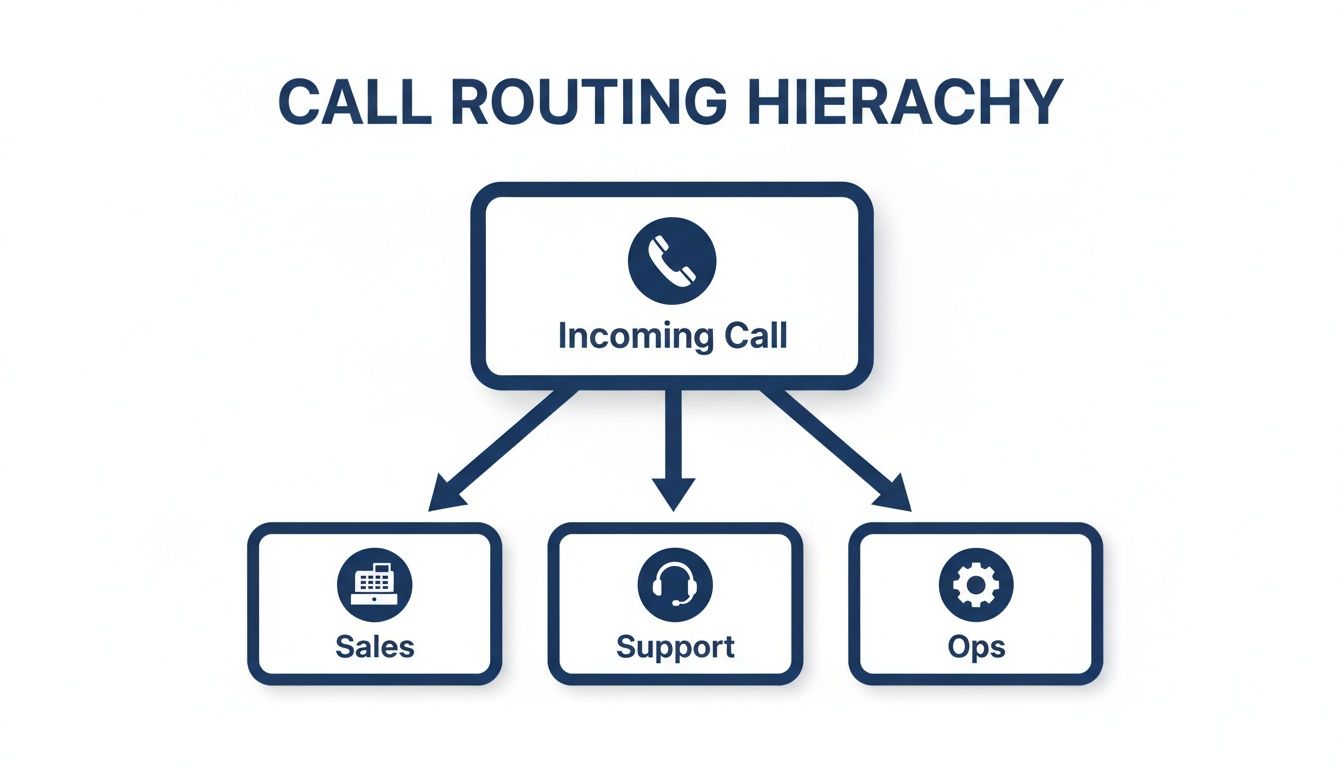
No matter how complex the rules get, the fundamental goal is always the same: sort incoming calls and deliver them to the most appropriate destination.
4. Round-Robin Routing
Fairness and balance are the name of the game with round-robin routing. This method distributes calls evenly among a group of available agents in a simple, cyclical pattern.
The first call goes to Agent A, the second to Agent B, the third to Agent C, and then it circles back to the beginning. It’s perfect for sales or support teams where you want to prevent any one person from getting swamped while making sure everyone gets an equal shot at handling new opportunities.
5. Least-Occupied Routing
Similar to round-robin, least-occupied routing also focuses on agent workload, but it uses real-time data to make its decisions. It sends the next incoming call to the agent who has been idle the longest or has taken the fewest calls that day.
This method is incredibly efficient for maximizing team productivity in high-volume environments. It keeps everyone engaged and helps bring down customer wait times by finding the fastest path to an available person.
A smart routing plan is about more than just efficiency; it’s a direct reflection of your commitment to customer service. By connecting callers to the right person quickly, you show them you value their time.
6. Least-Cost Routing
For any business making a high volume of outbound calls—especially long-distance or international ones—least-cost routing (LCR) is a powerful money-saver.
The system automatically analyzes multiple phone carriers in the background and selects the cheapest route for any given call. It all happens instantly, trimming your communications budget without anyone having to lift a finger.
7. Failover Routing
Last but certainly not least, failover routing is your business continuity plan built right into your phone system. If your primary phone line goes dead or your internet connection drops, this rule automatically reroutes all incoming calls to a predetermined backup.
That backup could be a cell phone, another office location, or a group of remote employees. It’s the safety net that ensures you never miss a critical call, even during an unexpected outage.
Getting a handle on these options is the first step toward building a communication system that's both resilient and customer-focused. For an even deeper look at managing your call flow, check out our guide on how to set up smart call queues.
How Call Routing Works With a Modern Cloud Phone System
Remember the dusty old phone closet? The one with a tangled mess of wires that you needed a specialist (and a big invoice) to touch? Thankfully, those days are over. Modern call routing doesn't live in a closet anymore; it lives in the cloud, powered by a Cloud PBX. This completely changes the game by moving your entire phone system from clunky physical hardware to smart, flexible software.
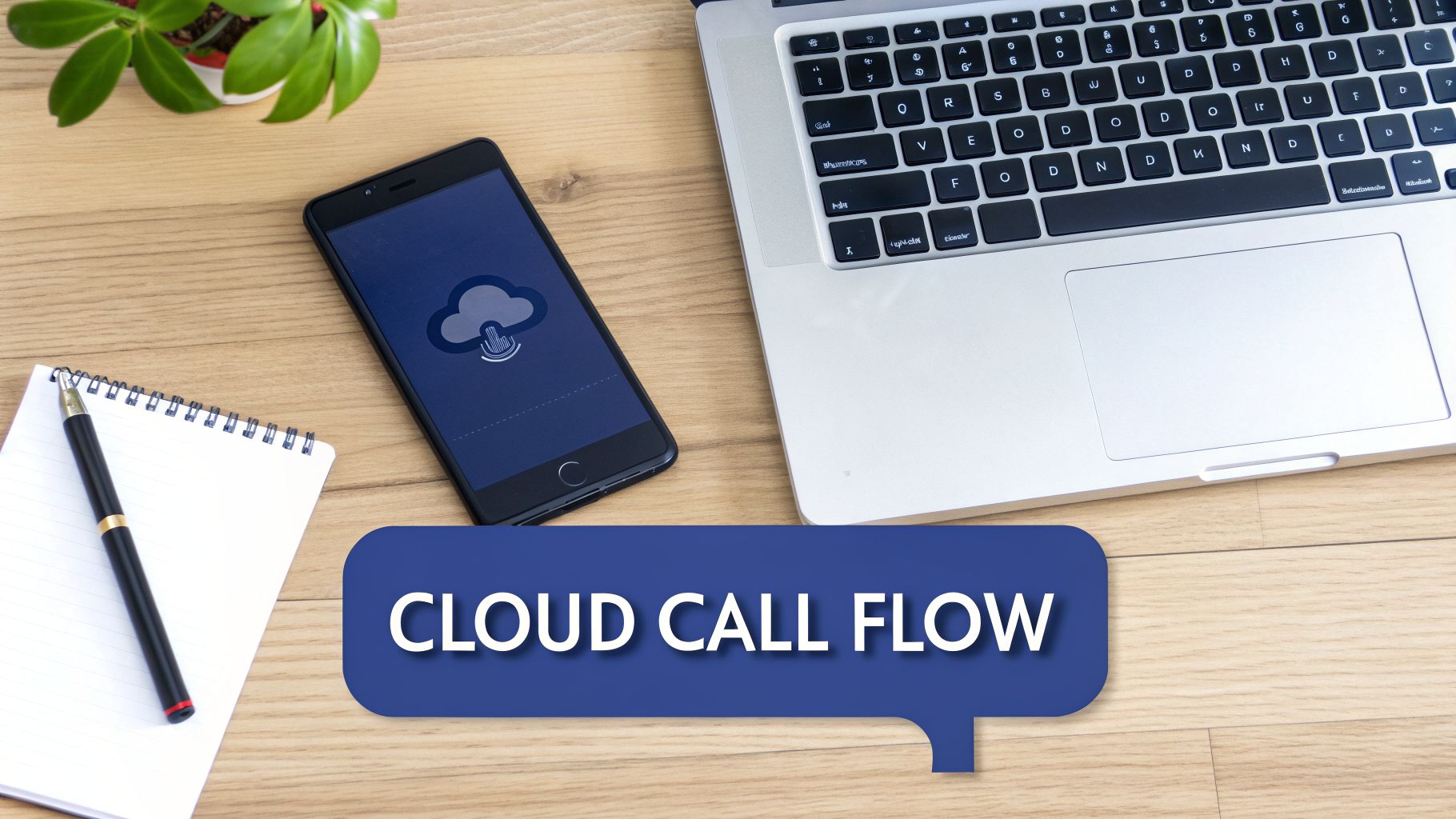
Think of it like this: instead of physically rewiring a switchboard to change where a call goes, you now just log into a simple web portal. From there, you can see and control your entire call flow with a few clicks. The complex telephony and data connectivity that makes it all work hums along quietly in the background, making powerful call management accessible to anyone.
The Cloud-Based Call Flow
So, what actually happens when a customer dials your number? With a modern cloud system, a logical sequence of events unfolds in milliseconds. It’s simple, but incredibly powerful.
- Call Arrives: A customer dials your business number. Instead of hitting a physical line at your office, the call instantly connects to your provider's secure cloud infrastructure.
- System Checks the Rules: The system immediately looks at the routing rules you’ve set up. It starts asking questions: Is it after 5 PM? Did the caller press 2 for Support? Is this number flagged as a VIP client?
- Command Execution: Based on the answers, the system executes the right command instantly. It might ring a group of phones in the office, forward the call to a specific employee's mobile app, or send it to an after-hours voicemail box.
The best part? You manage this entire process yourself through a self-service portal. This gives you incredible flexibility to adapt on the fly—whether you're adjusting for new staff, a marketing campaign, or an unexpected office closure. No waiting for a technician. You can find more detail in our article explaining what a cloud phone system is and how it all works.
Empowering a Mobile and Hybrid Workforce
This cloud-based approach is the engine that drives the modern, distributed workforce. Call routing is no longer chained to a physical desk in a specific office.
With a cloud PBX, your business number follows your employees, not the other way around. A call can ring an agent’s desk phone in the office, their laptop at home, and their mobile app on the road—all at the same time.
This ensures seamless business continuity and finally makes the "mobile office" a practical reality, not just a buzzword. It's this foundational technology that's fueling the growth of the broader call center market, which is projected to hit $83.2 billion by 2036. That explosive growth is driven by businesses demanding flexible, intelligent platforms that can support their teams, no matter where they work.
Measuring Success With Key Call Routing Metrics
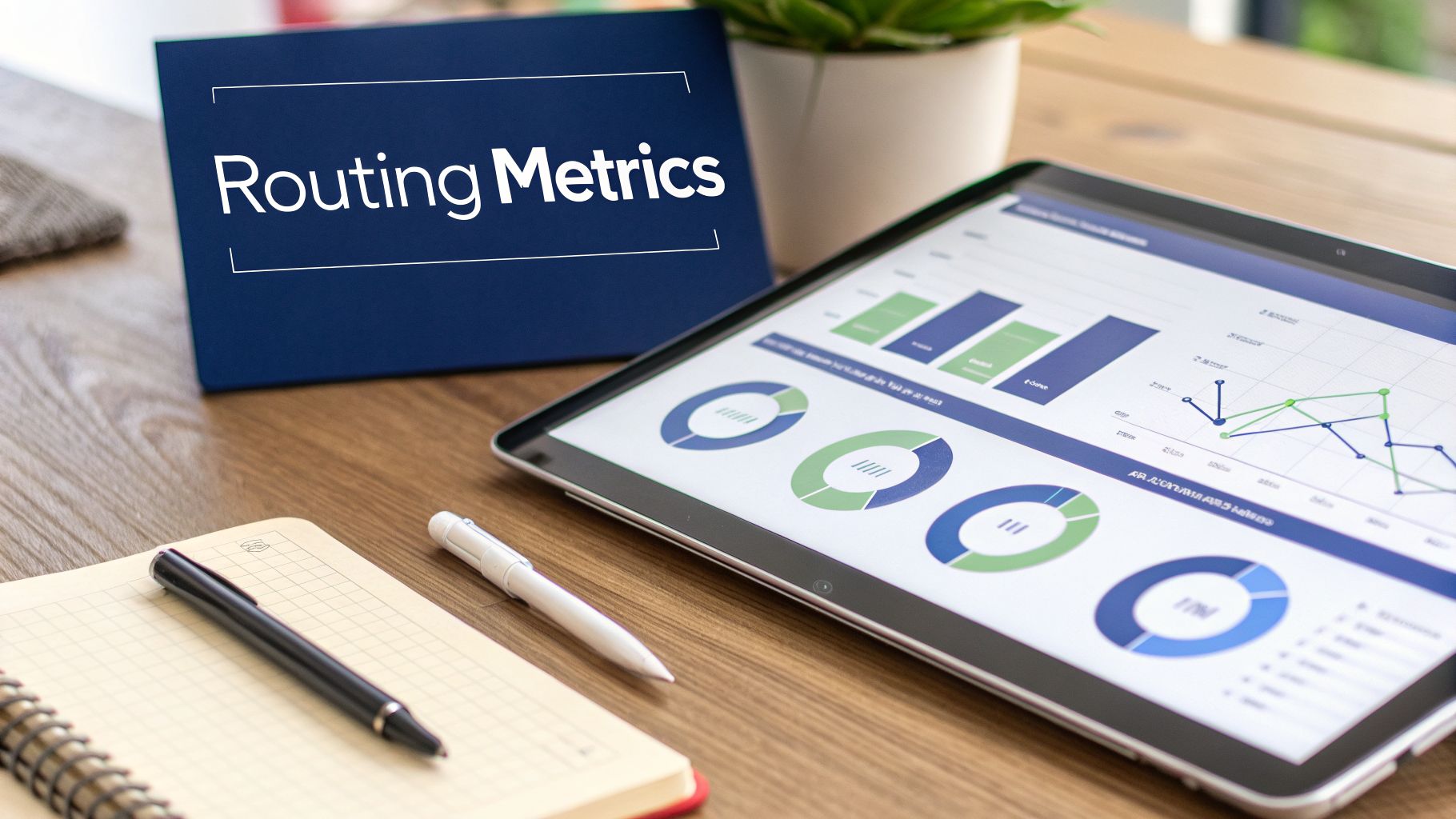
Putting a smart call routing strategy in place is a huge first step. But how do you know if it’s actually paying off? The answer isn’t guesswork; it’s in the data. By tracking the right key performance indicators (KPIs), you can see exactly what your callers are experiencing and make decisions that directly improve your service and efficiency.
These numbers aren't just abstract figures on a dashboard. They tell the story of your customer's journey, showing you what’s working well and, more importantly, where the friction points are. They’re the voice of your customer, quantified.
Core Metrics for Your Routing Dashboard
Think of each KPI as answering a critical question about your call flow. By keeping a close eye on a few essential metrics, you can quickly diagnose problems and measure the real impact of every tweak you make to your routing rules.
These are the metrics you absolutely need to be watching:
Call Abandonment Rate: This is the percentage of callers who hang up before ever reaching an agent. A high rate is a massive red flag. It’s a direct sign that your wait times are too long or your IVR menu is confusing. It answers the question: Are we losing business simply because we're hard to reach?
Average Wait Time (AWT): This measures, on average, how long a customer sits in a queue before a human picks up. This number has a direct relationship with customer frustration. Getting your AWT down is one of the most tangible ways to show customers you respect their time.
First-Call Resolution (FCR): This tracks the percentage of issues you solve on the very first call, with no need for a transfer or a follow-up. A high FCR is the gold standard of customer service. It proves your routing is smart enough to get callers to the right expert on the first try.
Beyond the Basics: Advanced Insights
As technology moves forward, so do the ways we can measure what works. Predictive call routing, which uses AI to anticipate a caller's needs and route them more intelligently, is a perfect example. This is no longer a futuristic concept; it’s a fast-growing market. This technology generated $477.3 million in 2024 and is on track to hit $1,595.7 million by 2030, growing at a 22.6% CAGR.
This explosive growth shows a clear shift toward using advanced data to fine-tune call flows. Companies are seeing measurable ROI by using these advanced call routing technologies to drive down handle times and boost FCR.
Your phone system’s reports are more than just data—they are a roadmap for improvement. A high abandonment rate isn't a failure; it's a clear signal telling you exactly where to focus your efforts to improve the customer journey.
By regularly reviewing these key metrics, you can turn your call routing system into a continuously improving engine for customer satisfaction. You stop guessing and start engineering a better experience for every single person who calls your business.
Your Call Routing Implementation Checklist
Okay, we’ve covered the theory behind call routing. Now for the important part: turning that knowledge into a practical shopping list for your next business phone system.
Choosing a new provider can feel like a huge task, but it gets a lot easier when you know exactly which features solve your real-world problems. Think of this as your buyer's guide—a checklist of the non-negotiable tools you need to build a better caller experience and set your business up for success.
Essential Features to Look For
When you're comparing providers, don't get lost in a sea of marketing buzzwords. These are the core features that form the foundation of any smart call routing strategy. They’re what separates a basic phone line from a true business communication platform.
A User-Friendly Auto-Attendant: This is your digital receptionist and first impression. You need a system that makes it incredibly easy to record professional greetings and build a simple menu (“Press 1 for Sales, Press 2 for Support”). A clear, intuitive auto-attendant instantly tells callers they’ve reached a well-organized company.
Intelligent Call Queues: What happens when all your agents are busy? Calls shouldn't just ring endlessly. Smart queues are the answer. They hold callers in a virtual line, play custom music or announcements, and make sure the call goes to the next available agent. This single feature can dramatically reduce customer frustration and hang-ups.
A Dedicated Mobile App: Business doesn't stop when you're away from your desk. A provider’s mobile app should turn any employee’s smartphone into a full-featured business extension. This allows them to make and receive calls from the company number anywhere, which is absolutely essential for supporting a modern mobile or hybrid team.
Simple Self-Service Management: You shouldn't need an IT degree or have to submit a support ticket just to manage your phone system. A modern provider like SnapDial gives you a web portal where you can change routing rules, add new users, and check call logs on your own, giving you total control.
A great phone system doesn’t just connect calls; it empowers you to design the entire caller journey from start to finish. The right features give you the flexibility to adapt your call flow as your business grows and your needs change.
For instance, a robust system makes it simple to handle calls when your office is closed for a long weekend or a holiday. You can check out our guide on how to configure holiday routing to see just how straightforward this should be.
Got Questions? We've Got Answers
Making the final call on a new phone system can feel like a big step. To help you feel confident in your choice, we’ve put together straightforward answers to the questions we hear most often from businesses just like yours.
How Hard Is It to Change Call Routing Rules?
Long gone are the days of needing to call an IT technician and wait for days to modify your phone system. Modern cloud-based platforms have completely changed the game.
With an intuitive web portal, you can adjust your call routing rules in minutes. These systems are designed for business owners, not engineers, often using simple visual interfaces. This means you can update rules for holidays, new staff members, or marketing campaigns instantly, without any specialized knowledge.
Can Calls Be Routed to Employee Mobile Phones?
Absolutely. This is one of the biggest advantages of a modern phone system. Cloud PBX platforms like SnapDial come with powerful mobile apps that turn any employee’s smartphone into a full-featured business extension.
When a call comes into your main business number, it can be set to ring on their mobile app, just as it would on a desk phone. This ensures your team stays connected and professional, whether they are in the office, working from home, or on the road.
What Is the Difference Between an Auto-Attendant and an IVR?
While people often use the terms interchangeably, they serve different functions. Think of an auto-attendant as a simple digital receptionist offering a basic menu: “Press 1 for Sales, Press 2 for Support.” Its main job is to direct callers to the right department or person efficiently.
An Interactive Voice Response (IVR) system is much more advanced. It can interact with callers to gather information, check account balances, or even process payments before an agent ever gets involved.
The core difference is complexity and function. An auto-attendant offers a simple, direct path for callers, while an IVR provides a more powerful, interactive experience that can handle complex tasks and gather detailed information.
Ready to see how simple, powerful call routing can transform your business communications? The team at SnapDial offers white-glove setup to build the perfect call flow for your needs. Discover how SnapDial can help you connect every call, every time.