
To really boost your first call resolution, you need to shift your team's focus from just closing tickets to solving problems on the first touch. This means giving your agents the tools, knowledge, and authority to get the job done right, right away.
When you optimize your call routing, build out a solid knowledge base, and cut down on escalations, you're not just improving a metric—you're directly improving customer satisfaction and reining in operational costs.
What Is First Call Resolution and Why It Matters

First call resolution (FCR), often called first contact resolution, is the call center metric that tracks the percentage of customer issues you solve in a single interaction. No follow-up calls. No back-and-forth emails. No transfers to three different people.
The problem is simply solved.
But FCR isn't just another number for your dashboard. It's a direct measure of how much you respect your customer's time. When someone calls your support line, they’re often already frustrated or confused. A quick, competent resolution can turn that negative experience into a moment of genuine brand loyalty.
The Business Impact of a High FCR
Getting FCR right creates a positive ripple effect that you'll feel across the whole company. The biggest wins usually fall into three camps:
- Boosted Customer Satisfaction and Loyalty: Solving a problem on the first try makes customers feel heard and valued. That’s a powerful driver for loyalty, and it’s how you turn frustrated callers into brand advocates.
- Lower Operational Costs: Every single repeat call adds to your operational expenses. When you solve issues the first time, you naturally reduce your overall call volume, which frees up your agents and lowers costs. It's that simple.
- Happier, More Engaged Agents: Nothing burns out an agent faster than dealing with angry customers who have to call back again and again about the same issue. High FCR means your team is actually succeeding, which boosts morale and job satisfaction.
Key Insight: For every 1% improvement in your FCR rate, you can expect a corresponding 1% improvement in customer satisfaction. This direct correlation highlights how critical FCR is to the overall customer experience.
First Call Resolution (FCR) Performance Levels
So what does a "good" FCR rate even look like? It can vary a bit by industry, but there are some clear benchmarks. Use this table to see how your performance stacks up against the industry standards.
| Performance Level | Typical FCR Rate | Business Impact |
|---|---|---|
| Below Average | Below 60% | High customer frustration, high agent turnover, and high operational costs. |
| Industry Average | 70-79% | A solid performance level where most customers are satisfied, but there's room for improvement. |
| World-Class | 80% or higher | Exceptional customer loyalty, high agent satisfaction, and highly efficient operations. |
Achieving these numbers isn't magic; it's the result of smart technology paired with well-trained, empowered agents.
Setting Realistic FCR Benchmarks
While the industry average FCR hovers between 70-79%, the global standard in 2026 sits at 74%. This number has actually climbed as self-service options handle the simple stuff, leaving agents with more complex problems to solve on the first try.
The truly elite contact centers—only about 5% of them—manage to push their FCR above 80%.
For any business that handles a steady flow of inbound calls, making FCR a strategic priority is a non-negotiable move that pays for itself in both efficiency and loyalty. This guide will walk you through the actionable steps to get there.
Pinpointing the Root Causes of Repeat Calls
Boosting your First Call Resolution rate isn't about guesswork. It’s about becoming a detective. You need to dig in and find out exactly why customers are forced to call you a second, third, or even fourth time.
You have to move beyond assumptions and find the real source of the problem. It’s almost never one single thing, but a cocktail of clunky processes, agent knowledge gaps, and system roadblocks that create a frustrating cycle for your customers.
Analyze Call Recordings and Transcripts
Your call recordings are the single best source of truth. Listening to the calls that ended up as repeat contacts reveals the patterns that raw data will never show you.
You might hear an agent's voice waver with uncertainty when explaining a policy, a dead giveaway of a training gap. Or you might notice a long, awkward silence as they hunt for information in a clunky system.
Text analytics can also fast-track this process by scanning transcripts for obvious red flags. Look for phrases like:
- "I already talked to someone about this."
- "The last person told me to call back."
- "No one ever got back to me."
These phrases are your starting point. Digging into the context around them will lead you straight to the breakdown—whether it was bad information, a botched transfer, or a process that simply didn't deliver.
Key Takeaway: Stop listening to calls just for QA scores. Start listening for root causes. Pull the recordings for every customer who called back within a week and ask one simple question: What went wrong the first time?
Dig Into Agent Notes and CRM Data
Your CRM should tell the complete story of every customer interaction. When you’re investigating a repeat call, the first place to look after the recording is the agent’s notes from the initial contact.
Are the notes clear and specific, or are they vague one-liners like "Customer had billing question"? Useless notes are a classic symptom of a broken process. They force the next agent to start from square one, which is a guaranteed way to infuriate a customer who has already explained their problem.
This is also where your reporting tools come in handy. Look for trends. Do certain issue types have a ridiculously high repeat call rate? For example, if you find that 30% of all calls related to "service activation" need a follow-up, you've just isolated a major fire that needs to be put out immediately.
Common Culprits Behind Low FCR
As you dig into the data, you’ll start to see that most FCR failures fall into a few common buckets. Knowing these categories helps you organize the problems you find and figure out the right fix. A solid understanding of Knowledge Management and how it can end repetitive questions is key to tackling many of these issues head-on.
Most repeat calls can be traced back to one of three areas:
- Agent-Related Issues: This isn't about blame; it's about support. It could be a lack of training on a new product, no confidence in their answers, or not having the authority to issue a simple credit without escalating to a manager.
- Process and Workflow Gaps: The problem might be baked into your operations. Maybe a process requires a follow-up task that always gets dropped, or an internal policy is so confusing that no one can explain it correctly.
- System and Technology Limitations: This is when the tools fail the agent. They can’t see the customer’s full history, the knowledge base is a mess, or the software is so slow and disconnected that resolving anything on the first call is nearly impossible.
Figuring out which of these buckets your problems fall into is the whole point of this diagnostic phase. If repeat calls are happening because agents need a manager’s approval for a $5 credit, the fix isn't more training—it's agent empowerment. This is how you move from guessing to executing a real strategy.
Designing Your Call Experience for Resolution
A customer's path to a solution begins the moment they decide to call you. A clunky, confusing phone menu is one of the quickest ways to guarantee a repeat call before an agent even says hello. Fixing this initial experience is absolutely fundamental to improving first-call resolution.
The goal isn't just to answer the phone; it's to guide the customer swiftly and accurately to the person who can actually solve their problem. A well-designed Interactive Voice Response (IVR) system should act like a skilled concierge, not a frustrating gatekeeper.
Simplify Your IVR Menu
We've all been there. You call a company and are hit with a dozen menu options. By the time you hear number seven, you’ve already forgotten the first three. This is a common and completely avoidable mistake.
Your IVR menu needs to be simple, clear, and laser-focused on the top reasons customers are calling you in the first place. Dig into your call data to find the most frequent issue types and put those options front and center.
- Limit choices to 3-5 options per menu level. This prevents what's known as cognitive overload.
- Use plain language, not internal jargon. A customer understands "Check my bill" far better than "Inquire about account receivables."
- Always provide a clear path to a live agent. An option like "To speak with a team member, press 0" is an essential escape hatch that prevents frustrated customers from just hanging up.
When you simplify the IVR, you're not just making it easier to navigate. You are directly reducing the odds a customer will choose the wrong option out of sheer confusion—a primary cause of transfers and callbacks.
This initial sorting process is your first and best chance to get the call to the right place. To make it even more powerful, you need intelligent call routing logic working behind the scenes.
Set Clear Expectations with Smart Queues
Once a customer makes their selection, the next critical moment is the wait. Dead silence or a repetitive "your call is important to us" only creates anxiety and makes an abandoned call more likely. Modern VoIP systems can transform this dead time into a productive part of the experience.
Use smart queue features to give callers accurate, dynamic information. Announcing the estimated wait time or their position in the queue gives them a sense of control and helps them decide if they want to wait.
An even better solution? Offer a queue callback option. This feature allows the customer to hang up, keep their place in line, and receive an automatic call back when an agent is free. This simple act of respecting their time dramatically cuts down on abandoned calls and customer frustration.
AI is also making a huge impact here. AI-powered intent routing is now slashing customer "hunting time" in IVR systems by an incredible 54%. And contact centers using GenAI-enabled agents are seeing a 14% bump in issue resolution per hour. It’s all part of a move toward "human-in-the-loop" models where AI handles the routing, freeing up your agents to focus on solving the complex problems.
Empowering Your Agents to Be Resolution Experts

Technology is a fantastic enabler, but your agents are the true heroes of first call resolution. Even the most sophisticated routing system falls flat if it sends a customer to an agent who lacks the knowledge, confidence, or authority to actually solve the problem.
If you want to move the needle on FCR, empowering your team is the most direct path forward. This means shifting your mindset away from rigid scripts and punishing handle times, and toward equipping agents to be genuine problem-solvers. When an agent feels trusted and has the right tools, they take ownership of an issue and see it through to the end—dramatically cutting down on callbacks and escalations.
Build a Single Source of Truth
Nothing kills FCR faster than an agent having to say, "Let me put you on hold while I find that." A centralized, easily searchable knowledge base isn't just a nice-to-have; it's the backbone of any high-performing support team. Think of it as your team’s collective brain.
This living library should house everything from product specs and policy details to step-by-step troubleshooting guides for common snags. The key here is accessibility. The answer an agent needs must be easier to find in the knowledge base than it is to ask a colleague or flag down a manager.
Make it even more powerful by getting your team involved in keeping it fresh. Encourage agents to suggest updates or new articles when they discover a new solution on their own. This creates a culture of shared ownership and ensures your information never gets stale.
Key Takeaway: An agent’s confidence is directly tied to the quality of their resources. A well-organized knowledge base gives them the certainty they need to provide definitive answers on the first call, instead of hesitant guesses that lead to callbacks.
Turn Call Recordings into Coaching Tools
Too often, call recordings are seen through the narrow lens of quality assurance—just checking boxes on a scorecard. To actually boost first call resolution, you have to reframe them as powerful coaching instruments. The goal isn't to catch agents making mistakes; it's to uncover opportunities for growth.
Instead of just scoring a call, sit down with your agent and listen to it together. Zero in on the specific moments that led to a repeat call or an unnecessary escalation.
- Was there a point of hesitation? This could signal a gap in product knowledge.
- Did the customer sound confused? This might be a chance to practice explaining things more clearly.
- Did the agent have to ask for help? This could highlight a need for more permissions or better documentation in the knowledge base.
This collaborative approach turns quality monitoring from a punitive process into a supportive one. It helps agents build the specific skills they need to handle complex issues on their own. To truly empower your team, consider implementing these 8 call center training best practices to boost their efficiency and confidence.
Cultivate a Culture of Call Ownership
Call ownership is a simple but powerful idea: the agent who takes the call is responsible for resolving the issue, no matter what it takes. This mindset is the complete opposite of a "pass the buck" culture, where agents are just looking for the quickest way to transfer a call off their plate.
Fostering this kind of culture requires two things from leadership: trust and authority.
- Grant Appropriate Permissions: Give agents the power to issue refunds, apply credits, or make other goodwill decisions within reasonable limits—without needing a manager's sign-off every time.
- Reward Resolution, Not Speed: Shift your primary success metric from Average Handle Time (AHT) to FCR. When agents know they're being measured on solving problems, they'll invest the time needed to do it right the first time.
Recent industry data shows this focus on agent empowerment is paying off. While only 5% of contact centers hit a world-class FCR above 80% in 2026, teams that prioritize agent support with live prompts and smarter workflows are making significant gains. With interaction analytics adoption rising to 37.5%, companies are getting much better at mining calls for insights that close knowledge gaps, helping their teams consistently reach FCR benchmarks in the 70-79% range. You can explore more about these trends and what they mean for the future in this detailed contact center strategy report from Yeastar.
While empowered agents are the heart of your support operation, the right technology is the central nervous system that makes true First Call Resolution possible. It connects everything.
Modern communication platforms aren’t just about making calls; they’re packed with features designed specifically to help your team solve problems definitively on the first attempt. When you match your biggest FCR challenges to the tech that solves them, you create a direct path to improvement.
This is how you get agents to stop fighting their systems and start focusing on the customer, creating a seamless environment where information flows freely and intelligence guides every single interaction.
Connect Agents to the Right Calls Instantly
The fastest way to solve a problem is to get it in front of someone who actually knows the answer. This is where intelligent call routing becomes your most powerful ally in the quest for a higher FCR.
Modern VoIP systems go far beyond basic "ring groups" that just blast a call to everyone. They use skills-based routing to analyze a caller’s IVR selection, their phone number, or even their history in your CRM to connect them to the agent best equipped for their specific issue.
Think about it: a call from a customer flagged as a "VIP" in your CRM can automatically jump to the front of the queue and go straight to a senior agent. A question about a specific product can be routed directly to a product specialist. This kind of precision eliminates the internal transfers that absolutely kill FCR rates.
Unify Communications for a Complete Customer View
That dreaded phrase, "I need to put you on hold while I look that up," is a classic symptom of disconnected systems. When an agent has to juggle multiple apps just to piece together a customer's story, resolution slows to a crawl.
This is precisely the problem unified communications was designed to solve.
A truly unified platform brings everything an agent needs into one place. They can see a customer's entire history—previous calls, support tickets, and notes—the moment the phone rings.
Expert Insight: According to a report from Zendesk, 71% of consumers expect a company to share their information internally so they don't have to repeat themselves. Failing to meet this basic expectation immediately puts your agent on the back foot and makes a first-call resolution far less likely.
Integrating your phone system with your CRM is the cornerstone of this strategy. When an agent sees the customer's full history pop up on their screen, they can skip the repetitive questions and get straight to the heart of the issue. You can learn more about how a powerful VoIP CRM integration completely transforms customer interactions and streamlines your support workflows.
Respect Customer Time with Smart Features
Not all technology for improving FCR is agent-facing. Some of the most effective tools are the ones that improve the customer's waiting experience, preventing them from getting frustrated before they even speak to a person.
Queue Callback: This is a total game-changer. Instead of forcing a customer to wait on hold, you offer them the option to get an automatic call back when it's their turn. They keep their place in line without being tethered to their phone, which dramatically reduces abandoned calls and repeat attempts to get through.
Wait-Time Announcements: It's amazing how much of a difference this makes. Simply telling callers their estimated wait time or position in the queue gives them a sense of control. It manages their expectations and helps them make an informed decision, which is far better than leaving them in silence.
These features show a fundamental respect for the customer's time—a key ingredient in creating a positive experience, even when there’s a wait involved.
Key VoIP Features and Their Impact on FCR
The right business phone system is an ecosystem of features that all work together to enable one-touch resolutions. It's not about one single tool, but how they combine to empower your team.
Here’s a quick breakdown of how specific VoIP tools directly contribute to a better FCR.
| Feature | How It Improves FCR | SnapDial Example |
|---|---|---|
| CRM Integration | Displays the caller's full history instantly, eliminating repetitive questions and providing immediate context for the agent. | An agent sees the customer's previous order and support tickets pop up on their screen as the phone rings. |
| Skills-Based Routing | Matches the customer's need to the agent with the right expertise, avoiding unnecessary transfers and escalations. | A call about a billing dispute is automatically sent to an agent in the finance queue, not a general support agent. |
| Mobile Apps | Allows subject matter experts who aren't at their desks to be looped into a call for a quick consultation, preventing a callback. | A field technician can join a call via their mobile app to help an agent troubleshoot a complex technical issue live. |
| Queue Callback | Prevents caller frustration and abandoned calls by letting customers hang up and receive a call back without losing their place in line. | A customer calling during a peak rush can press "1" to get a call back in 15 minutes instead of waiting on hold. |
By building a tech stack that’s designed for resolution from the ground up, you give your team the infrastructure they need to solve problems efficiently and effectively on the very first try.
Building Your FCR Improvement Roadmap
Let's be clear: boosting your First Call Resolution isn't a project you can just check off a to-do list. It's a continuous commitment. Trying to fix everything at once just leads to team burnout and mixed results.
A solid roadmap is what separates a vague goal from a series of smart, achievable moves. It’s about making steady, measurable progress.
Before you can map out where you're going, you have to know exactly where you're starting. Your first move is to get a firm baseline. Use the standard FCR formula—total issues resolved on the first contact divided by the total number of issues received—to lock in your starting number.
Setting Realistic Goals and KPIs
With your baseline in hand, you can start setting goals that actually make sense. I've seen too many teams make the mistake of aiming for a massive jump, like trying to go from 65% to 85% FCR in a single quarter. That’s a recipe for failure.
A much savvier approach is to target incremental wins. Aiming for a 5% increase over six months is not only more realistic but also keeps your team motivated.
Your roadmap also needs to track the other Key Performance Indicators (KPIs) that feed into FCR. Don't just watch the main number; look at the contributing factors.
- Repeat Call Rate: What percentage of customers are calling back about the same problem within a week? This is a direct reflection of FCR failure.
- Agent Satisfaction (ASAT): It's simple. Happy, supported agents are better problem-solvers.
- Customer Satisfaction (CSAT): The ultimate gut check. Directly asking customers if their issue was resolved gives you the unfiltered truth.
The core of any good FCR roadmap is gradual change. Don't try to overhaul your IVR, training, and software all at once. Roll out one significant change, measure the impact, and then decide on the next move. This is how you learn what actually works.
The diagram below breaks down how the right tech—routing, integration, and a unified platform—creates the foundation for resolving issues on the first try.
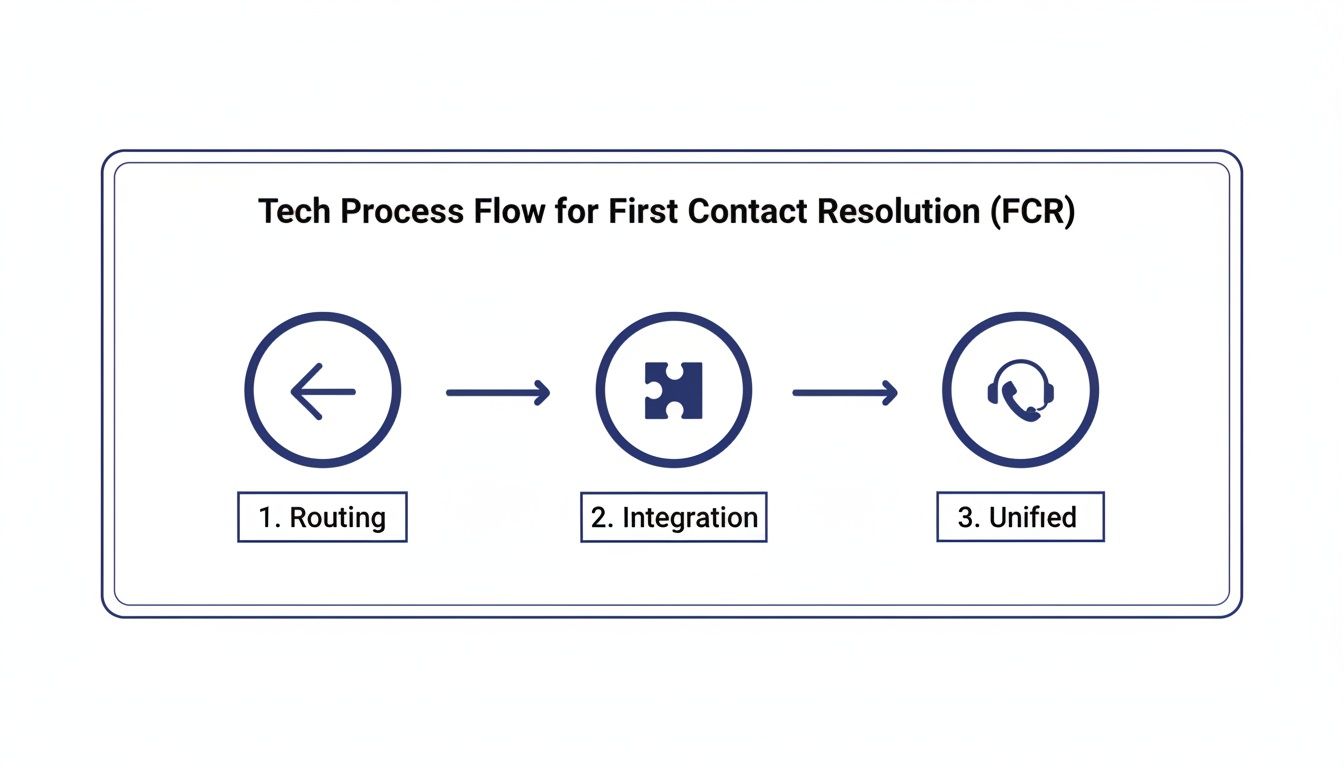
This process really starts with smart routing, gets its power from integrated systems, and is ultimately delivered by agents working from a single, unified screen.
Adopting a Continuous Improvement Cycle
Your roadmap isn't a static document you write once and file away. It's a living guide for a continuous cycle of improvement that should become part of your operational rhythm.
Instead of thinking in big, daunting projects, think in a simple, repeatable loop: Measure, Analyze, Act, and Repeat.
First, you're constantly tracking your FCR and those related KPIs. Then, you dig into the data to see what it's telling you—are new friction points popping up? Finally, you act by implementing a targeted fix. Then the cycle starts over as you measure the impact of that change.
This loop transforms FCR from a massive undertaking into a manageable, ongoing business discipline. It’s how you bake problem-solving into your company’s DNA.
Got FCR Questions? We've Got Answers
As teams start digging into First-Call Resolution, a few key questions almost always pop up. Getting straight answers to these common hurdles is the key to setting smart goals and focusing your energy where it will make a real difference.
What's a Realistic FCR Rate to Aim For?
Everyone wants to know the magic number. While the gold standard for world-class FCR is north of 80%, the reality is that only about 5% of contact centers consistently operate at that level. A much more practical starting point is aiming to hit the industry average, which sits between 70-79%.
But a better approach is to forget the averages for a minute. First, benchmark your own performance. Once you know your baseline, set an achievable goal, like a 5-10% improvement within the first six months. FCR is a game of inches, not miles. Progress is incremental.
How Can I Measure FCR Accurately?
The most common way centers track this is operationally: Did the same customer call back about the same problem within a specific window, like 7–14 days? It's a decent starting point, but it's notoriously incomplete and often misses the real story.
The only way to get a true FCR reading is to blend that operational data with direct customer feedback. The simplest, most effective method is a post-call survey that asks one direct question: "Was your issue completely resolved during our conversation today?"
This combination gives you both what your system sees and what your customer actually experienced.
Should I Prioritize FCR Over Average Handle Time?
Yes. Full stop. While leaders often get hung up on Average Handle Time (AHT) as a sign of efficiency, making it your primary KPI almost always backfires. It creates a culture where agents rush through calls to hit a time target, leading to half-answers, frustrated customers, and—you guessed it—more callbacks.
Shifting your focus to FCR is actually the smarter path to efficiency. When you resolve issues the first time, your total call volume naturally drops. This reduces overall operational costs and, more importantly, frees up your agents to deliver the kind of high-quality support that prevents callbacks in the first place.