When you're on the hunt for the "cheapest VoIP service," it's easy to get fixated on the lowest sticker price. But that's often a trap. The real value isn't found in the cheapest plan, but in understanding the Total Cost of Ownership (TCO)—a predictable monthly bill that includes every feature you need, with no nasty surprises.
The True Cost of a Cheap VoIP Service

It happens all the time. A business sees an ultra-low monthly fee and thinks they've found a bargain, only to end up paying way more in the long run. There's no doubt the VoIP market is exploding, with businesses saving up to 40% on local calls and an incredible 90% on international calls by ditching their old landlines.
But those savings can vanish in a flash if you pick the wrong provider. A service advertised for just a few dollars a month might look like the best deal, but it often operates on a sneaky à la carte model that bleeds you dry.
Distinguishing Price from Value
The key is looking past the advertised rate and asking, "What's actually included?" That attractively low price often hides a minefield of extra expenses that lead to confusing, inflated invoices.
Think about these common scenarios where "cheap" suddenly gets very expensive:
- Per-Minute Charges: Some plans come with a stingy number of minutes—or none at all. Suddenly, every single call adds to your bill.
- Essential Feature Add-Ons: Critical tools you can't live without, like an auto attendant (IVR), call recording, or even a mobile app, can all cost extra per month.
- Tiered Support: Need help from a real person, and fast? You might have to pay for a "premium" support package to get it.
- Setup and Porting Fees: Getting your system configured or just moving your existing phone number over can come with surprise one-time charges.
The most cost-effective VoIP service isn't the one with the lowest sticker price. It's the one that delivers every feature your business needs for a flat, predictable monthly fee.
All-Inclusive vs. À La Carte Models
To find a genuinely cost-effective solution, you have to understand the two main pricing philosophies in the VoIP world. An all-inclusive plan bundles everything—features, support, and usage—into one price. An à la carte plan, on the other hand, nickels-and-dimes you for every little thing.
An all-inclusive provider like SnapDial gives you a fixed cost every month. This delivers financial predictability and gives you access to a full suite of professional tools from day one. You can see everything that goes into a truly complete plan by exploring what a hosted VoIP seat includes.
This all-in-one model is designed to support your growth, ensuring you have the communication tools you need without ever having to worry about surprise costs. It’s simply a much smarter long-term investment.
Breaking Down VoIP Pricing Models
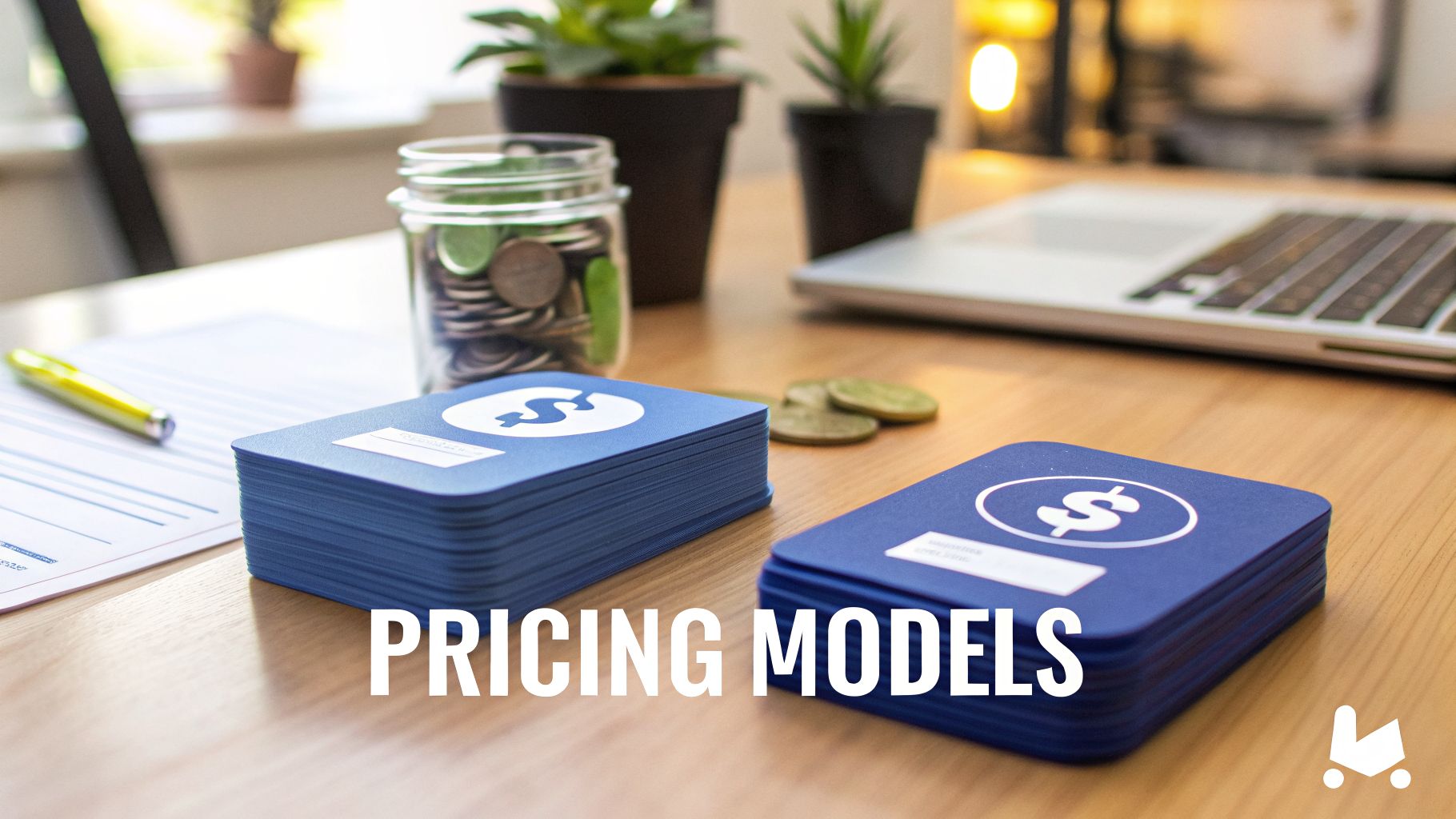
If you really want to find an affordable VoIP service, you have to look past the sticker price. The way providers bill you is often where the true costs hide, and the initial number you see rarely tells the whole story. Getting a handle on their pricing structures is the first real step toward making a smart financial decision for your business.
You'll almost always run into two main models: Per User, Per Month and Pay-As-You-Go (sometimes called metered or per-minute billing). Each has its place, but picking the wrong one can either bleed your budget dry or leave you paying for things you don't use. Your call volume, team size, and growth plans will dictate which one makes sense.
Per User, Per Month Plans
This is the most common model you'll see for business VoIP, and for good reason. It offers a predictable, fixed cost for each employee. You pay one flat monthly fee for each "seat," which rolls in a whole bundle of features and, more often than not, unlimited calling in a specific region like the U.S. and Canada.
For most small to mid-sized businesses with a stable team and fairly consistent calling needs, this model is a slam dunk. It makes budgeting dead simple and takes away the anxiety of a phone bill that swings wildly from one month to the next. You know exactly what you’ll pay, whether your team spends ten hours on the phone or a hundred.
Key Takeaway: Per-user plans are all about financial stability. For any business that needs predictable expenses and a full suite of professional features, this all-inclusive approach delivers far better value and protects you from surprise overage fees.
Think about a 10-person sales team. With a per-user plan, they can hit the phones as much as they need to without anyone worrying about racking up per-minute charges. It empowers them to do their job without being handcuffed by communication costs.
Pay-As-You-Go (Per-Minute) Plans
On the flip side, pay-as-you-go models lure you in with an incredibly low monthly base fee for a phone number and then charge you for every single minute of calling, both inbound and outbound. This is often what pops up when people search for the absolute "cheapest" VoIP service out there.
And to be fair, these plans can be a great fit for a few specific scenarios. A tiny startup with almost no call volume, a solopreneur who lives on email, or a business that just needs a backup line for emergencies could save money with this approach.
The risk, however, is huge. The moment your business starts to grow and your call volume picks up, the costs can spiral. That "cheap" plan can quickly become a budget nightmare, costing you way more than a flat-rate alternative would have.
Recent market analysis shows just how low the entry point can be. You'll see providers like VoIP.ms offering plans for as little as $0.85 per month plus usage fees, or Sonetel starting at $1.79 per month. But even in this category, businesses that need a more complete package with reliable features often find plans closer to $15 per month offer better long-term value. You can read more about these pricing structures by exploring the cheapest VoIP services currently available.
Making the Right Choice for Your Business
Figuring out which model is right for you comes down to a simple gut check of your team's daily habits versus the potential costs.
Choose Per User, Per Month if:
- You have a team of two or more people.
- Your business relies on consistent calling (think sales or support).
- You need a predictable monthly bill with no surprises.
- You want all the business features without paying extra for each one.
Consider Pay-As-You-Go if:
- You're a solopreneur with extremely low call volume.
- The phone line is for a very limited, specific purpose.
- Your budget is so tight you’re willing to monitor every minute of usage.
For the vast majority of growing companies, the stability, predictability, and all-inclusive nature of a per-user plan will always win out over the tempting but risky "savings" of a metered service.
Uncovering the Hidden Costs of Budget VoIP
That advertised price for a VoIP service? It's often just the tip of the iceberg. When you're on the hunt for the cheapest VoIP service, what you see upfront is almost never what you’ll actually pay. Many of the ultra-low-cost providers have mastered a deceptive pricing strategy. They lure you in with an impossibly low monthly fee, only to pile on charges once you're locked in.
This is where the dream of a cheap phone system turns into a real financial headache. The sticker price might say $5 per month, but your final bill can easily be three or four times that amount after all the hidden fees and feature add-ons are tallied. To avoid this trap, you have to become a pricing detective, armed with the right questions to uncover the true total cost.
Looking Beyond the Monthly Fee
A provider’s advertised rate is a marketing tool, not a promise. The real costs are buried in the fine print and often come as a complete surprise to businesses that weren't looking for them. These fees can quickly turn an apparent bargain into a significant monthly expense.
Let’s dissect some of the most common charges that providers quietly add to your bill.
- Phone Number Porting: Want to keep your existing business number? Most providers allow it, but many budget plans will hit you with a one-time fee to "port" it over. This can range from a small administrative cost to a more substantial charge, especially if you have multiple numbers.
- Hardware and Setup Costs: While some providers include pre-configured phones, others expect you to buy your own or rent them for a monthly fee. You might also run into activation or setup fees just to get your service running.
- Taxes and Regulatory Fees: Your VoIP bill will always include mandatory taxes and fees like the Federal Universal Service Fund (FUSF) charge. The problem is that some providers are less than transparent about these, leading to a bill that's 15-25% higher than the advertised price.
Paying Extra for Essential Features
Perhaps the most frustrating hidden cost is paying for features you assumed were standard. Many of the tools that make VoIP a powerful business asset are locked behind a paywall on budget plans. These are often the very features a business needs to operate professionally and efficiently.
Think about these common feature "upgrades":
- Interactive Voice Response (IVR): That auto-attendant directing callers ("Press 1 for Sales, Press 2 for Support") is fundamental for most businesses. On cheap plans, this is almost always an extra monthly fee.
- Call Recording: For training, quality assurance, or compliance, call recording is essential. Expect this to be a premium add-on that often costs extra per user or per block of storage.
- Voicemail-to-Email/Transcription: Getting voicemails as text or audio files in your inbox is a massive time-saver. This convenience frequently comes with an additional price tag.
The cheapest VoIP service on paper can become one of the most expensive once you add all the features a modern business actually needs. A truly cost-effective provider includes these tools in a single, predictable price.
The Hidden Cost of Support and Reliability
When something goes wrong, you need help—fast. This is another area where budget providers love to cut corners. They often operate on a tiered support model where basic email support is free, but getting a real person on the phone means paying for a premium support subscription.
Your internet connection also plays a critical role in call quality. While the provider isn't responsible for your connection, ensuring you have enough capacity is crucial. You can learn more by checking out our guide on how much bandwidth you need for VoIP. Low-cost providers may also offer lower uptime guarantees, meaning more potential for service disruptions that can cost your business real money.
Before you sign any contract, use this checklist to demand complete pricing transparency from any provider you're considering. It will help you see past the marketing and find out what you'll really be paying.
Checklist for Uncovering Hidden VoIP Costs
| Cost Category | What It Means | Key Question to Ask Your Provider |
|---|---|---|
| Number Porting Fees | The one-time cost to transfer your existing phone number to the new service. | Is there a fee to port my number, and if so, how much is it per number? |
| Hardware Costs | The price of buying or renting IP phones and other necessary equipment. | Are phones included, rented, or must I purchase them separately? Are they compatible with other systems? |
| Feature Add-Ons | Extra monthly charges for tools like IVR, call recording, or analytics. | Which specific features are included in my plan, and what are the exact costs for any I need to add? |
| Support Tiers | Different levels of customer support access, often with phone support costing more. | What level of technical support is included, and are there extra fees for 24/7 or phone support? |
| Taxes & Surcharges | Mandatory government fees and other provider-specific surcharges. | Can you provide a detailed estimate of my total monthly bill, including all taxes and fees? |
By asking these pointed questions, you force providers to be upfront about the total cost. This simple step can save you from a major financial headache down the road and ensure you partner with a provider who values transparency.
Comparing the Best Low-Cost VoIP Providers for 2026
When you start hunting for the cheapest VoIP service, it’s easy to get fixated on the monthly price tag. But the best choice for your business depends entirely on how you operate. A plan that’s a perfect, low-cost fit for a freelancer could be a costly mistake for a growing team.
To show you what I mean, let's move past generic feature lists. We'll walk through three common business scenarios to see how the total cost, scalability, and real-world trade-offs stack up with different types of providers.
Scenario 1: The Solopreneur with Low Call Volume
For the one-person shop, every dollar counts. You probably have a low call volume, and the main goal is just getting a professional business number to separate work from your personal life. It's all about minimizing your monthly bill while still looking credible.
- Top Contender: A pay-as-you-go provider like VoIP.ms.
- Cost Breakdown: With this model, you might pay just $0.85 per month for the number itself, and then a tiny per-minute rate for calls (think $0.01/minute). If you only talk for 100 minutes in a month, your bill could easily be under $2.00.
- The Trade-Off: This is the absolute rock-bottom price, but you pay for it with your time. You’re on your own to configure your device (like an ATA or IP phone), set up how calls are routed, and figure out the features in a web portal. Support is often limited to email or forums, so you need a bit of a DIY attitude.
For the technically savvy solopreneur, a pay-as-you-go service delivers unbeatable cost savings. But for anyone who isn't comfortable with tech projects, the time sunk into setup and the lack of real support can become a major hidden expense.
Scenario 2: The 10-Person Hybrid Team
Now, let's picture a small, dynamic team. Some people are in the office, others work from home. They need a system that keeps everyone connected, working seamlessly on desk phones and mobile apps. Here, call volume is higher and more consistent.
- Top Contender: A basic per-user plan from a well-known name like Google Voice for Business.
- Cost Breakdown: A standard Google Voice plan at $10 per user/month puts this team at a predictable $100 per month. It's straightforward, but that simplicity comes with some serious strings attached.
- The Trade-Off: While it seems affordable, these entry-level business plans are often missing tools you can’t live without. You probably won't get an auto-attendant (IVR) to greet callers, call recording for training, or advanced call queues for your support team unless you upgrade to a much pricier tier. That $100 monthly cost is just a starting point; adding the features you actually need could double your bill.
As you look at providers, you have to watch out for costs that aren't advertised in the monthly fee. This infographic breaks down some of the most common surprise charges you'll run into.
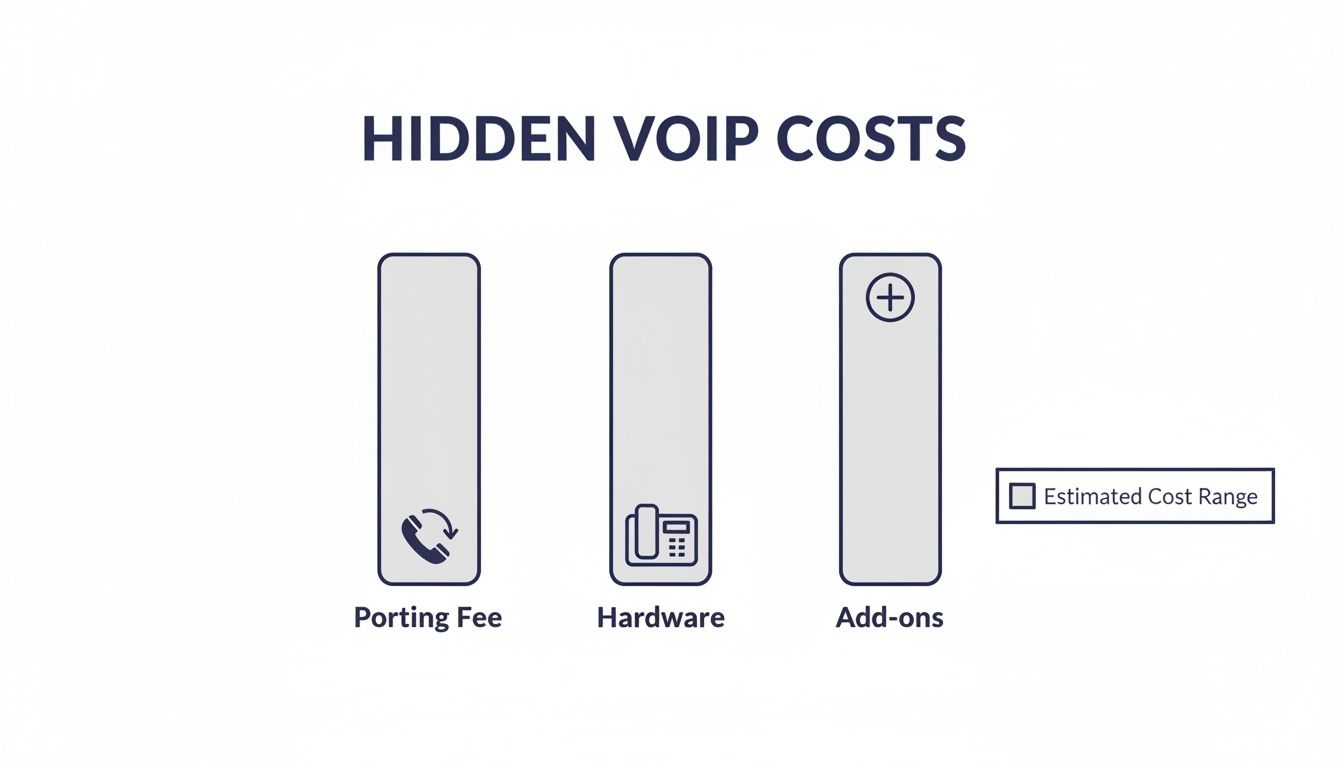
It’s clear that one-time number porting fees, ongoing hardware rentals, and monthly charges for what should be standard features can quickly blow up the budget on a supposedly "cheap" plan.
Scenario 3: The Small Business with Growth Ambitions
This business has 15-20 employees, a dedicated sales or support team, and big plans to expand. They need more than just a dial tone—they need a full-blown communication platform. We’re talking about an IVR, call queues, recording, analytics, and top-tier support. For them, reliability and scalability aren't just nice-to-haves; they're non-negotiable.
- Top Contender: An all-inclusive provider like SnapDial.
- Cost Breakdown: The per-user price might look higher than the bare-bones options at first glance, but it includes everything from day one. There are no surprise add-on fees for critical features like IVR, call recording, or the mobile apps. This model gives you complete cost certainty, even as your team grows.
- The Trade-Off: The initial sticker price isn't the absolute lowest you'll find. But when you calculate the total cost of ownership—factoring in all the included features, hands-on support, and the lack of hidden fees—this model almost always delivers far better long-term value. A business like this would likely end up paying more for a "cheaper" plan once they started bolting on all the features they actually need à la carte.
For businesses that want to dig deeper into this value proposition, exploring the best small business VoIP systems can shed more light on what a truly complete solution looks like.
At the end of the day, the "cheapest VoIP service" isn't the one with the lowest sticker price. It's the one that delivers the most value for your specific needs without creating budget-busting surprises down the road.
Your Guide to Choosing a Cost-Effective VoIP Partner
Navigating the crowded VoIP market can feel like a chore, but finding the right partner doesn't have to be complicated. Hunting for the "cheapest VoIP service" is a natural starting point, but the real goal is to find the best value. That means striking the perfect balance between an affordable price and the features, reliability, and support your business actually needs to operate smoothly.
To cut through all the marketing noise, you need a solid game plan. This checklist will help you evaluate any provider's true worth by moving the conversation beyond the sticker price and focusing on what really matters: your total cost and long-term success.
Pillar 1: Pricing Transparency
Before you even think about signing a contract, you have to get a complete picture of the costs. A low monthly fee is meaningless if it gets buried under a pile of hidden charges. This is the single most important step to avoid nasty budget surprises down the road.
Your first move should be to demand a full, itemized quote. Don't settle for a simple per-user price. Ask for a detailed breakdown that shows every potential fee, tax, and surcharge so you can see your real monthly payment.
A trustworthy provider will be completely upfront about all costs. If a sales rep gets evasive or can't give you a clear, all-inclusive quote, that’s a massive red flag. You can bet you'll be seeing unexpected charges later.
Pillar 2: Core Feature Set
What good is a cheap phone system if the tools you need to run your business cost extra? Many budget providers strip down their basic plans, luring you in only to upsell you on features you thought were standard. Your job is to confirm that critical functions are included right out of the box.
Make sure essential tools like these are part of the standard package, not expensive add-ons:
- Auto-Attendant (IVR): A professional digital receptionist is a must-have for almost any business.
- Mobile & Desktop Apps: These enable your team to stay connected, whether they're in the office or on the go.
- Call Recording: Absolutely crucial for training, quality assurance, and compliance.
- Voicemail Transcription: A huge time-saver that delivers voicemails as text messages or emails.
A provider that bundles these features into a single, predictable price is showing a real commitment to delivering business value, not just a dial tone.
Pillar 3: Scalability Path
Your business is going to grow, and your phone system needs to grow with it—affordably. A plan that looks like a great deal for five people might become incredibly expensive once you hit twenty. Ask what the process and costs look like for adding new users, phone numbers, and even new locations.
The ideal partner offers a simple, predictable way to expand. You should be able to add a new employee to the system with just a few clicks and a clear, pro-rated cost. No massive price hikes or complicated contract negotiations required.
Pillar 4: Reliability and Support
When your phones go down, your business grinds to a halt. Never, ever sacrifice reliability for a lower price. Look for a provider that offers a financially backed Service Level Agreement (SLA) guaranteeing a high level of uptime, typically 99.999%.
Just as important is the quality of their support. When you actually need help, can you reach a real person quickly? Dig into customer reviews and ask pointed questions about their support structure. Is 24/7 phone support included, or are you stuck with slow-moving email tickets unless you pay for a premium plan?
Pillar 5: Implementation and Onboarding
Switching your entire phone system can feel like a daunting project. A truly cost-effective provider makes this process painless. Ask them if they offer a "white-glove" setup, where their team handles all the configuration and number porting for you. You also need to know if there are any one-time setup or onboarding fees.
The right partner will act like an extension of your own team, ensuring a smooth, seamless transition without any downtime.
When you start shopping for a VoIP service, it’s all too easy to get tunnel vision and just grab the lowest sticker price you see. But experienced business owners know the real cost isn't what you pay upfront—it's about finding a system that provides long-term stability and all the tools you actually need to operate.
This is exactly where an all-in-one VoIP model shows its true value. It’s a completely different way of thinking about your phone bill.
The Strategic Power of Predictable Costs
For a small or mid-sized business, a surprise expense can derail an entire quarter. An à la carte or pay-as-you-go phone service might look cheap on paper, but that illusion shatters the first time you have a busy month. A successful sales push or a flood of support tickets suddenly causes your bill to double, and that "cheap" plan becomes a financial headache.
An all-inclusive plan gets rid of that risk entirely. You get one flat, predictable monthly fee that covers everything. This makes budgeting and financial planning ridiculously simple, freeing you up to pour resources into other parts of the business. You can finally stop watching the clock and start encouraging your team to use the communication system to its fullest potential.
The most cost-effective VoIP service isn't the one with the lowest initial price. It's the one that delivers every tool you need for a flat, predictable fee, eliminating surprise costs and providing a stable foundation for growth.
More Than Just a Dial Tone
The appeal of a bare-bones, low-cost service fades fast when you realize you have to pay extra for the features that are essential to running a modern business. An all-inclusive provider like SnapDial gets this. We know that tools like an auto-attendant (IVR), call recording, and a fully-featured mobile app aren't luxuries—they're fundamental.
When these tools are bundled into a single package from day one, you get a powerful communication platform right out of the box. Your team can route calls like a Fortune 500 company, review performance to improve service, and stay connected from anywhere, all without you having to navigate a maze of add-on fees. It turns your phone system from a simple utility into a real strategic asset.
Choosing an all-inclusive partner means you value operational stability and a complete communications toolkit over a deceptively low price tag. It's an investment in a system that supports your ambitions and grows with you, ensuring your phone service is a source of strength, not stress.
Got Questions? We've Got Answers
When you're hunting for a deal on VoIP, it's easy to get lost in a jungle of confusing pricing and hidden fees. It feels like every provider has a different definition of "affordable."
To help you cut through the noise, we’ve put together straightforward answers to the most common questions we hear from businesses trying to make a smart, value-driven choice.
Can We Keep Our Existing Business Phone Number?
Yes, absolutely. You don't have to give up the number your customers already know and trust. The process is called number porting, and it's a standard feature for virtually every VoIP provider out there.
A word of caution, though: be wary of providers that nickel-and-dime you for it. Some "low-cost" plans will hit you with a one-time porting fee. It's one of the first hidden costs you'll run into, so always ask if this service is included before you sign anything.
What's the Single Biggest Hidden Cost to Watch Out For?
The most dangerous trap is the "fair use" policy buried in the fine print of so-called "unlimited" plans. Many providers market their service as unlimited but cap your usage behind the scenes. The moment you have a busy month and go over that secret threshold, you start racking up steep per-minute overage fees that can make your bill explode.
Before you commit, demand total clarity on what "unlimited" really means. Ask them directly: "Are there any usage caps, and what are the per-minute overage rates?" A genuinely affordable service gives you predictable costs, not penalties for your success.
Is a Free VoIP Service Really Good Enough for a Business?
For personal use or a side project, a free service like a basic Google Voice account can get the job done. But for a real business, it sends the wrong message. Free services almost always lack the professional tools you need to operate effectively, like an auto-attendant (IVR), smart call routing, or any kind of dedicated customer support.
When your reputation is on the line, investing in a proper business-focused VoIP service isn't a cost—it's a necessity. It gives you the reliability and professional features you need to manage communications and grow your company.
Ready to stop worrying about hidden fees and get a truly all-inclusive communication platform? SnapDial offers predictable pricing with every enterprise feature included from day one. Learn more about our transparent, value-driven VoIP solutions.