VoIP business providers are the companies that deliver modern, internet-based phone systems. They’re what let you ditch traditional landlines for a more flexible, feature-rich, and cost-effective way to communicate. For today's businesses, these solutions have become the undisputed standard, enabling clear, reliable communication from absolutely anywhere.
Why Businesses Are Moving to VoIP Phone Systems
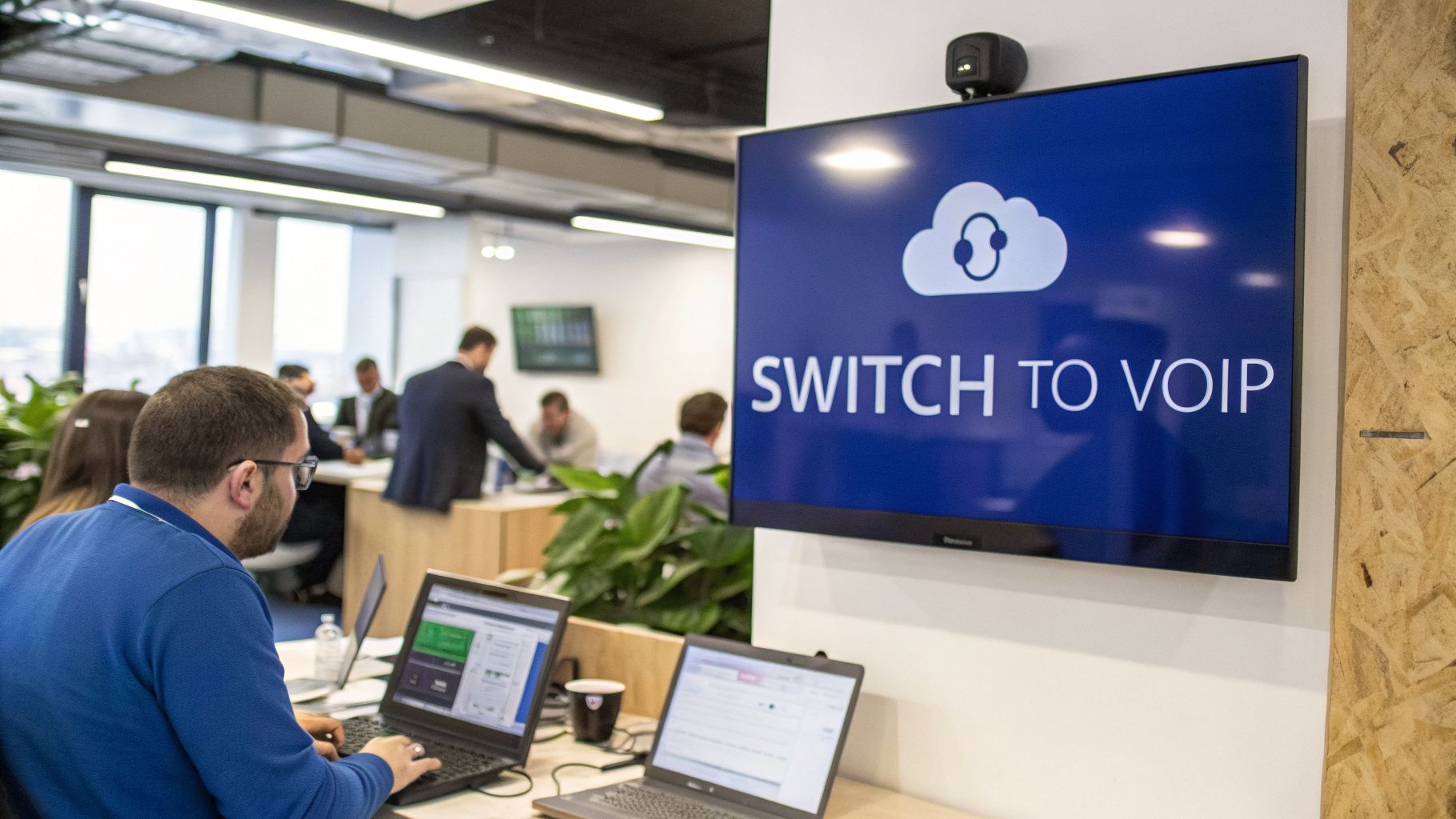
The mass migration from clunky on-premise PBX hardware to cloud-based VoIP is much more than a trend; it's a fundamental shift in how business gets done. Companies aren't just looking for a new phone line—they're actively searching for VoIP business providers to gain a real competitive edge.
This move is driven by a simple need for more agility, lower overhead, and access to sophisticated communication tools that used to be out of reach for most small and mid-sized businesses. This guide is here to help you cut through the noise, navigate a crowded market, and pick a partner that truly aligns with your business goals. A great VoIP provider doesn't just sell you technology; they give you a clear path to more efficient and resilient operations.
The Driving Forces Behind VoIP Adoption
The switch to VoIP is being fueled by some major business advantages that old-school legacy systems just can't compete with. Companies are waking up to the fact that their phone system can be a strategic asset, not just another utility bill.
Here are the key motivators pushing businesses to make the change:
- Enhanced Scalability: Cloud-based systems are built to grow with you. Adding a new employee takes just a few clicks in a web portal, not weeks of waiting for a technician to show up.
- Significant Cost Savings: By getting rid of expensive on-site hardware, painful maintenance contracts, and traditional phone line fees, businesses routinely see their monthly phone expenses drop by 40-75%.
- Advanced Communication Features: Tools like auto-attendants, call recording, and visual voicemail—features once reserved for massive enterprises—now come standard in most VoIP packages.
- Support for a Mobile Workforce: With dedicated mobile apps and web-based clients, your team can make and take calls from their main business number on any device, from anywhere in the world.
The global VoIP market is on track to hit a staggering $415.20 billion by 2034, which tells you everything you need to know about its rapid adoption. A key piece of this technology is understanding what a virtual phone number is, as it’s the magic that enables much of a VoIP system's power and flexibility.
Key Takeaway: The right VoIP partner does more than just simplify the transition from outdated hardware. They should deliver a complete solution—not just the tech, but the hands-on expertise to guarantee a seamless migration so you can stay focused on your actual business. You can learn more about this by checking out our guide on https://snap-dial.com/what-is-a-cloud-phone-system/.
When you start evaluating different VoIP business providers, it’s easy to get lost in a sea of features. The real trick isn't finding a provider that checks every box on a long list. It's about understanding which functions will actually solve a problem, make your team more efficient, and help you hit your goals.
A feature is only valuable if it makes your life easier.
Think of these core features as the foundation of your entire business communication system. They’re the non-negotiables—the tools that make you look professional, boost productivity, and make sure you never miss a critical client call. Let's break down what you should expect from any reputable provider and what these tools actually do in the real world.

Essential Call Handling and Management
At its heart, your phone system has to be great at managing calls. That sounds obvious, but modern VoIP platforms go way beyond a simple dial tone. They use intelligent features to automate workflows and give your callers a polished, professional experience, no matter how big or small your company is.
These features are the bedrock of a hosted PBX—the cloud-based brain that runs your phone system. It’s no surprise the hosted PBX market is booming, projected to surge from $13.71 billion in 2023 to an incredible $42.55 billion by 2030. This explosive growth is happening for one simple reason: businesses are ditching costly on-site hardware for flexible, feature-rich cloud solutions. You can dig deeper into these trends in the full VoIP services market report.
Here are the key call management tools you shouldn't live without:
- Auto-Attendant (IVR): This is your digital receptionist. It greets callers and guides them to the right person (e.g., "Press 1 for Sales, Press 2 for Support"). It ensures callers get help quickly and stops your team from having to manually transfer every single call.
- Call Recording: This is an invaluable tool for training, quality control, and settling disputes. A law firm might use recordings to confirm what a client said, while a sales team can review calls to sharpen their pitch and close more deals.
- Visual Voicemail: Instead of dialing into a clunky mailbox, voicemails land in your email or a mobile app, often with a full text transcription. This lets you scan messages and prioritize callbacks without having to listen to every single one in order.
These foundational features turn your phone from a basic utility into a powerful business tool that directly shapes how customers see you and how your team operates.
Expert Insight: "A well-configured auto-attendant does more than just route calls; it establishes your brand's professionalism from the first second. For a small business, this creates the impression of a larger, more organized operation, building immediate caller confidence."
Unified Communications for a Modern Workforce
Today, communication is so much more than just voice calls. Your team is collaborating on video, sending instant messages, and sharing files all day long. A top-tier VoIP provider brings all of these tools together into a single, cohesive platform known as Unified Communications as a Service (UCaaS).
This integration is absolutely critical for supporting hybrid and remote teams. Instead of forcing employees to jump between different apps for calls, meetings, and chats, they can do it all from one place. This doesn't just simplify their day; it guarantees seamless communication no matter where they are.
Look for these key unified communication capabilities:
- Integrated Video Conferencing: The ability to start a video meeting from a chat or a call with a single click is a must-have. It kills the friction of sending calendar invites for quick huddles, making collaboration spontaneous and efficient.
- Team Messaging & Presence: Think of this as your company’s internal command center. You can create channels for specific projects or departments, share files, and instantly see who is available, busy, or on a call (presence status).
- Mobility with Softphone Apps: Your business line needs to travel with you. A softphone app for desktops and smartphones lets your team make and receive calls from their business number on any device, so they're always reachable and always professional.
When you choose a provider that delivers a true unified communications experience, you’re empowering your team to work better together, breaking down communication silos and driving productivity across the board.
Comparing Advanced Call Management and Contact Center Tools
For any business where customer interactions are the lifeblood, a dial tone and basic call forwarding just don’t cut it. The real value in a modern VoIP business provider comes from its advanced call management and contact center tools. These are the features that turn a simple phone system into a sophisticated machine for customer engagement.
When you move past standard call routing, you find a whole suite of capabilities designed to handle high call volumes without a hitch, slash customer frustration, and give supervisors the data they need to actually improve performance. For any company with a dedicated support, sales, or service team, these tools aren't a luxury—they're essential.
From Simple Queues to Intelligent Call Distribution
A basic call queue is just a digital line. It puts callers on hold, first-come, first-served. But advanced systems are much smarter. They use intelligent routing strategies to connect callers to the right agent, faster. This is one of the biggest differences between a standard business phone plan and a true contact center platform.
Think about the logic you can apply with top-tier providers:
- Skills-Based Routing: Instead of just finding the next free agent, the system finds the best one. Calls get sent to agents based on their specific expertise, like language fluency or deep product knowledge.
- Round-Robin Routing: This method is all about fairness. It distributes calls evenly across the team, which prevents burnout and makes sure everyone carries their weight.
- Least Occupied Routing: The system identifies which agent has been idle the longest and sends them the next call. It’s a simple but powerful way to maximize your team's productivity.
This level of intelligence makes sure your most valuable resource—your agents' time and expertise—is used as effectively as possible. The impact on customer satisfaction is immediate.
A small e-commerce business, for example, can use skills-based routing to direct calls about returns to one agent group while sending new sales inquiries to another. This simple configuration ensures customers quickly reach an expert who can help them, reducing transfers and hold times.
Enhancing the Caller Experience Under Load
Nobody enjoys being on hold. Advanced contact center features are laser-focused on cutting down wait times and giving callers more control, which is mission-critical for protecting your brand's reputation. One of the best features for this is queue callback.
Instead of gluing a customer to their phone while they wait, this feature offers them a choice: hang up, keep their spot in line, and get an automatic call back when an agent is free. It’s a simple courtesy that shows you respect their time, and it has been proven to reduce caller abandonment rates by over 30%.
Another vital tool is the ability to play estimated wait time announcements. Just telling a caller their expected wait is "approximately five minutes" helps manage expectations and makes the wait feel far less frustrating than being stuck in silence. These small touches make a huge difference in how customers perceive your service. For a deeper look into how these features are packaged, you might be interested in our guide on enterprise-grade contact center solutions.
Gaining Actionable Insights with Dashboards and Analytics
Here’s a simple truth: you can't improve what you don't measure. The most powerful part of a contact center platform is its ability to serve up real-time and historical data on your team's performance and what your callers are actually doing. This is done through two main tools.
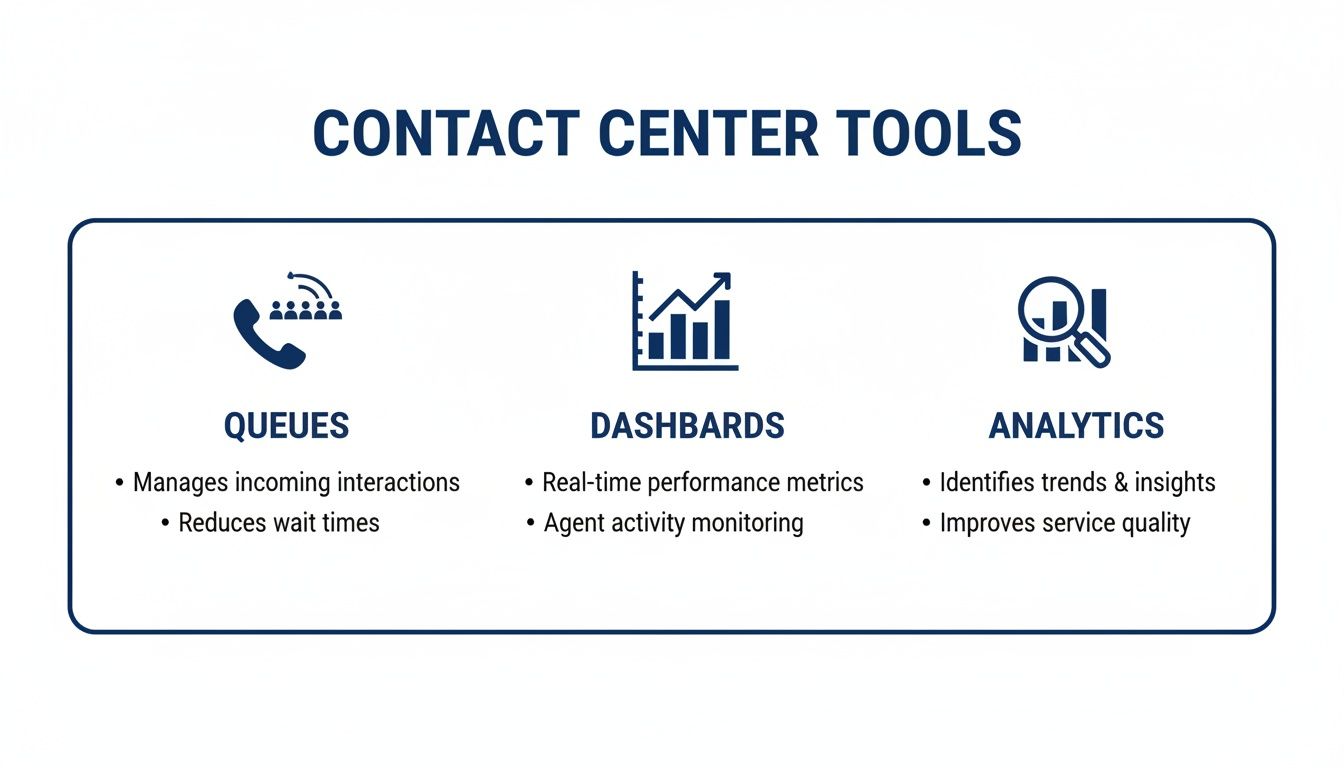
Real-Time Agent Dashboards: Supervisors get a live, bird's-eye view of everything happening in the call center. They can see who's on a call, who's available, current queue volumes, and live wait times. If a queue suddenly gets swamped, a manager can see it instantly and reassign agents to help clear the backlog.
Historical Analytics and Reporting: This gives you the long-term view of your operations. You can track key metrics like:
- Average call duration
- First-call resolution rates
- Peak call times
- Agent-specific performance
- Call abandonment rates
By digging into this data, a support manager can spot exactly when they need to schedule more staff, which agents might need some extra coaching, and how well the team is actually solving customer problems. This data-driven approach is what allows even a small team to deliver service that rivals a massive enterprise, making it a critical capability when comparing VoIP business providers.
Evaluating VoIP Pricing Models and Support Quality
Choosing the right VoIP business provider often boils down to two things that aren’t on any feature list: how you pay and what happens when something breaks. A provider's pricing model and the quality of their support reveal more about their business philosophy than any marketing slogan ever could.
Getting these two things right is crucial. It’s the difference between a stable, predictable budget and a monthly financial surprise, and between a minor hiccup and a full-blown operational crisis.
Decoding VoIP Pricing Structures
VoIP pricing isn't always as simple as it looks. Providers often package their plans in ways that make apples-to-apples comparisons tricky. You have to look past the sticker price and understand the underlying model to avoid getting blindsided by costs down the road.
You'll generally run into two main approaches: per-user plans and metered services.
- Per-User, Per-Month Plans: This is the most predictable model out there. You pay a set fee for each employee every month, which usually includes a bundle of features and either unlimited or a generous number of calling minutes. This makes budgeting a breeze.
- Metered or "Pay-as-you-go" Services: This model hooks you with a very low base fee per user. The catch? You're charged for every minute of talk time, every text message, and often for access to features that should be standard. It can work for businesses with almost no call volume, but for most, it’s an unpredictable and expensive path.
Key Insight: All-inclusive, per-user pricing gives you budget certainty. While metered plans look cheaper at first glance, they often lead to higher, more volatile costs as your business grows, turning financial forecasting into a guessing game.
Providers like SnapDial are built on a predictable, all-inclusive pricing model. Everything—unlimited calling, enterprise features, and dedicated support—is wrapped into one flat per-user fee. This transparency kills the risk of surprise bills and lets you scale without fear of runaway costs. You can dig into the benefits of a fully hosted VoIP seat to see how this works.
Assessing the True Value of Customer Support
When your phone system goes down, every minute costs you money and chips away at your reputation. This is when the quality of your provider's support team becomes painfully obvious. Not all support is created equal, and you need to understand the difference before you sign on the dotted line.
Basic providers often hide behind ticket-based systems or email-only support, which translates to long waits for a response, let alone a solution. Some mid-tier services might offer phone support, but it's usually restricted to business hours—not much help when you have an emergency at 7 PM on a Friday.
In sharp contrast, premium VoIP business providers get that communication is a mission-critical service. They invest heavily in their support infrastructure, offering:
- 24/7/365 Live Assistance: The ability to get a knowledgeable human on the phone anytime, day or night.
- Dedicated Account Managers: A single point of contact who knows your business and your setup, so you don't have to start from scratch with every call.
- White-Glove Onboarding: A fully managed implementation where the provider handles everything—porting numbers, configuring call flows, and training your team—to ensure a seamless transition with zero downtime.
This infographic highlights some of the essential tools a quality provider should offer to help you manage customer interactions.
But remember, these tools are only as good as the support team that helps you set them up and master them. A provider's dedication to top-tier support is a direct reflection of their commitment to your success.
VoIP Provider Evaluation Matrix
To help you cut through the marketing noise, we've put together this matrix. It lays out the real-world differences you'll find between the common types of VoIP providers. Think of this as your scorecard for evaluating what you truly get for your money.
| Evaluation Criteria | Basic Provider (Metered/Tiered) | Mid-Tier Provider (Hybrid Plan) | All-Inclusive Provider (e.g., SnapDial) |
|---|---|---|---|
| Pricing Structure | Low base fee with overages for minutes and features. Costs are unpredictable. | A mix of flat fees for some users and tiered features. Hidden costs are common. | A single, predictable flat fee per user per month. No surprises. |
| Included Features | Only the most basic calling. Core business tools are expensive add-ons. | Some advanced features included, but call center tools or analytics often cost extra. | All features, from auto-attendant to advanced analytics, are included for every user. |
| Support Availability | Self-service knowledge base, email, or ticketing system. Long resolution times. | Phone support during limited business hours. After-hours support is often extra or unavailable. | 24/7/365 live phone support with a dedicated, US-based team. |
| Onboarding | "Do-it-yourself" setup. You are responsible for porting, setup, and training. | Assisted setup, but often with extra fees. You still manage much of the process. | White-glove implementation at no extra cost, fully managed by experts. |
| Best For | Sole proprietors or businesses with very low call volume and technical expertise. | Businesses on a tight budget that can live with feature gaps and limited support. | Businesses of any size that need reliability, full functionality, and expert support. |
Ultimately, the choice between a low-cost provider and an all-inclusive partner like SnapDial is a strategic one. It's a decision between chasing short-term savings that invite long-term headaches, and making a predictable investment in reliability, functionality, and true peace of mind.
Thinking about switching your business phone system can feel overwhelming. I get it. The idea of moving from an old, clunky setup to a modern cloud VoIP solution is exciting, but the fear of a messy transition that grinds your business to a halt is very real.
A smooth migration isn't just a nice-to-have; it's the only acceptable outcome. The secret is having a solid, step-by-step plan. A little forethought ensures you start reaping the rewards of your new system right away, without any painful downtime or frustrated employees.
How to Plan a Seamless VoIP Migration

The right voip business provider isn’t just a vendor; they’re a partner who guides you through the entire switch. Honestly, the level of hands-on support you get during migration is one of the biggest differentiators you'll find. Understanding the steps involved helps you know what to expect—and what you should demand from your chosen partner.
The Phased Approach to VoIP Deployment
A successful move to VoIP follows a clear, logical sequence. Rushing the process or skipping steps is a recipe for dropped calls and technical headaches. A professionally managed implementation breaks the project down into four manageable phases to ensure nothing gets missed.
Here’s what a typical migration plan looks like:
- Network Readiness Assessment: First, the provider analyzes your internet connection, routers, and internal network to make sure they can handle high-quality voice traffic. This is a critical first step to prevent jitter, echoes, and poor call quality later.
- System Configuration: All your call flows, auto-attendant menus, user extensions, and ring groups are built out in the cloud before any of your numbers are moved. It’s like staging the house before the move-in day.
- Hardware Deployment: If you’re getting new IP phones, they’re shipped to your office pre-configured and ready to plug in and go.
- Number Porting: This is the official, regulated process of moving your existing phone numbers from your old carrier to the new VoIP provider. It’s the final, and most crucial, step in the technical process.
This structured approach minimizes risk and ensures every piece is tested before you go live. While a VoIP migration is certainly less complex than a full server move, many of the same project management principles apply. Understanding these general best practices is crucial, and this data center migration checklist has some great tips that can be adapted for any major tech upgrade.
Self-Service Setup vs. White-Glove Implementation
When you start comparing voip business providers, you'll quickly run into two totally different onboarding philosophies. The one you choose will have a massive impact on the success—and stress level—of your migration.
A self-service setup puts the entire burden on your shoulders. The provider flips a switch, gives you access to a portal and a library of help articles, and you’re left to figure out the rest. You’re responsible for everything from configuring call routing to managing the number porting process. This might work for a tech-savvy solopreneur, but for most businesses, it’s a risky and time-consuming path.
Key Takeaway: A white-glove implementation is a hallmark of a premium provider. It’s a fully managed service where the provider’s experts handle every technical detail of the migration for you, guaranteeing a seamless transition with zero downtime.
In sharp contrast, a white-glove implementation, like the one included with SnapDial, treats your migration as a professional project. A dedicated project manager handles the whole process from start to finish. They run the network assessment, program your system based on your exact needs, coordinate the number porting, and train your staff. This approach eliminates the common pitfalls and guarantees your system works perfectly from day one.
Ensuring a Smooth Employee Transition
The final piece of the puzzle is preparing your team. New technology is only as good as people's ability to use it. A top-tier provider knows this and will include comprehensive employee training as part of the onboarding process.
This training should cover the key functions your team will use every day, like:
- Using the new desk phones or softphone apps.
- Managing voicemails and accessing call recordings.
- Starting video conferences and using team messaging.
This ensures your team can take full advantage of all the new system's capabilities immediately, maximizing your return on investment. The difference in a provider's approach to migration—from DIY to fully managed—is one of the clearest indicators of their overall commitment to your success.
Key Questions to Ask Potential VoIP Business Providers
Choosing the right partner is the single most important decision you'll make in this process. Armed with the right questions, you can cut right through the marketing fluff and figure out which VoIP business providers are really built to support a business like yours.
A slick sales deck is one thing. Having solid, confident answers to tough operational questions is something else entirely. Use this checklist to vet every potential provider. A strong partner will be transparent and ready for these. A weak one will get vague or try to change the subject.
Questions About Security and Reliability
Your phone system is a lifeline. It has to be secure, and it has to be dependable. Don't be shy about digging into the technical weeds here—their answers will tell you everything you need to know about their commitment to protecting your business. A provider’s network is their product, so they better be able to talk about it.
Here’s what you need to ask:
- What are your specific security protocols? Look for detailed answers that include end-to-end encryption (using standards like TLS/SRTP), 24/7 network monitoring, and compliance with certifications like SOC 2 or HIPAA if that matters to your industry.
- Can you describe your network redundancy? A great answer will involve geographically distributed data centers and automatic failover systems. This is what ensures that if one of their servers has a problem, your service continues uninterrupted from another location.
- What is your guaranteed uptime SLA? Anything less than 99.99% should be a major warning sign. Even more important: ask what happens if they don't meet it. Will you get a service credit? The answer reveals how much skin they have in the game.
A vague answer on security is the biggest red flag you'll see. If a provider can't clearly articulate how they protect their network and your data, it's a sure sign they don't take it seriously enough.
Questions About Support and Onboarding
The quality of a provider's support is what separates the good from the truly great. When something goes wrong, you need to know you can get a real, knowledgeable human on the phone right away. Likewise, the onboarding process sets the tone for the entire relationship.
Drill down on the specifics of how they’ll actually serve you:
- What does your onboarding process look like, and is there a fee? Look for providers like SnapDial that offer a "white-glove" implementation, where their own experts manage the entire migration for you at no extra cost. This is a game-changer for businesses without a big IT team.
- What are your support hours, and is it live phone support? A 24/7/365 US-based support center is the gold standard. A provider that funnels you into email tickets or only works 9-to-5 isn't serious about keeping your business running.
- Will I have a dedicated account manager? Having a single point of contact who knows your account history is infinitely more efficient than re-explaining your setup to a new agent with every single call. This is a key differentiator for premium, business-focused service.
Got Questions? We've Got Answers
Making the final call on a new phone system can feel like a big step. To help you feel confident in your choice, we’ve put together straightforward answers to the questions we hear most often from businesses just like yours.
Can We Keep Our Existing Business Phone Numbers?
Yes, absolutely. You don't have to give up the numbers your customers already know and trust.
The process is called number porting, and it’s a standard, regulated procedure that lets you move your current local and toll-free numbers to your new provider. A good provider will handle the entire porting process for you. Their job is to make sure the switch happens behind the scenes with zero downtime, so your customers won't even notice a change.
What Kind of Internet Connection Do We Need?
Another common concern is internet connectivity. You’re right to be thinking about it—a stable connection is essential for clear VoIP calls. The good news is, you probably don't need a massive, enterprise-grade fiber line.
For most small to mid-sized businesses, a standard business-class cable or fiber connection provides more than enough bandwidth. A reputable provider will help you assess your network readiness to confirm you have what you need for crystal-clear call quality before you ever make the switch.
Key Insight: It's a mistake to confuse business-grade VoIP with the free residential services you might use at home. Business VoIP is built on high-availability networks with redundancy, includes robust security, and is backed by a Service Level Agreement (SLA) that guarantees uptime. Residential services simply don't offer these critical protections.
Do We Have to Buy All New Desk Phones?
Businesses often wonder about hardware, and while you can certainly use new IP desk phones, they aren't always a requirement.
Many top-tier VoIP business providers offer softphone applications. These let your team make and receive calls directly from their computers and smartphones, all while using their main business line. This is perfect for supporting remote or hybrid teams without the hassle of shipping physical hardware.
What's the Real Difference in Customer Support?
Finally, it’s crucial to understand the difference in support. Business-grade service must come with business-grade support. This means having access to 24/7/365 expert help, dedicated account managers, and a white-glove onboarding process to ensure your transition is completely smooth.
This level of support should be a core part of the service, not a pricey add-on. It's one of the biggest differentiators between a true partner and a budget option.
Ready to see how a truly all-inclusive VoIP provider can transform your business communications? With SnapDial, you get enterprise-grade features, predictable pricing, and our signature white-glove implementation at no extra cost. Explore our platform today.