
Between 2010 and 2023, landline telephone prices rose approximately 48% while internet-service prices rose about 9%, according to the FCC's communications marketplace report. That widening gap is the reason so many businesses are pricing their phone service again.
What they find first is a per-user rate. Pricing analysis from VoIP.ms puts most high-quality hosted providers near $25 per user per month, before taxes and hardware. Treat that figure like a sticker price on a car: it describes the seat, not the invoice.
The number worth comparing is the first-year all-in invoice. Take the seat rate, then add handsets, number porting, emergency calling fees, taxes, and any network work your office needs. Set that total against the cost of keeping or refreshing your existing PBX, and a cloud proposal's savings finally become measurable, or fail to.
Hosted Phone System Pricing Ranges in 2026
2026 hosted phone system price bands
These are published market benchmarks for planning, not SnapDial rates. Feature descriptions are a checklist to verify in a proposal, not promises that every plan includes them.
| Plan band | Monthly price | Usually included | Often billed extra |
|---|---|---|---|
| Entry hosted PBX | About $12-$15 per user | Basic calling and voicemail | Recording, SMS, toll-free |
| Typical SMB VoIP | $15-$35 per user | Domestic calling, auto attendant, apps | E911, taxes, handsets |
| High-quality average | About $25 per user | Voice service and standard features | International minutes and storage |
| Broad cloud VoIP range | $10-$40 per user | Calling tools specified by bundle | Hardware, porting, hands-on support |
| Full hosted PBX range | $15-$45 per user | Seat license and core PBX | Higher feature tiers |
| Traditional business lines | More than $300 per month | Carrier line service | PBX hardware and maintenance |
The entry and full hosted PBX benchmarks come from VideoSDK's 2024 pricing guide, which reported approximately $15-$45 per user monthly, with entry plans starting near $12. At the bottom of a proposal, look closely for omitted recording, messaging, and toll-free service rather than assuming basic calling means a complete office system.
For the central planning band, Market Intelo reported typical 2025 SMB business VoIP pricing of $15-$35 per user per month. This is a historical benchmark for a 2026 budget, not a verified current quote.
The average provides another useful reference: VoIP.ms reported approximately $25 per user per month for most high-quality providers in 2025. Use that as an estimating anchor while you decide which features and support responsibilities belong in the contract.
The broader comparison from Phone.com's 2025 cost guide put cloud VoIP at $10-$40 per user monthly, compared with more than $300 monthly for traditional lines. Those units aren't equivalent: one is per user, and the other is a business-line bill, so don't multiply the traditional figure by your headcount.
Turn the range into a working budget
For an illustrative office with ten paid users, multiplying the central band by headcount gives $150-$350 monthly for service alone. Neither end includes a promise about devices, implementation, or your local tax treatment.
When reviewing deployment choices, the business phone options from F1Group offer another resource for comparing a hosted telephone system with your current setup. Keep a written list of what the office needs before comparing packages.
An old invoice also isn't a dependable market benchmark. ElectroIQ reported that small-business monthly VoIP bills fell from $250 to $150 over the preceding three years in 2025, a 40% decrease, but that reported change doesn't guarantee equivalent savings for your office.
Per-User Per-Feature and Bundle Models
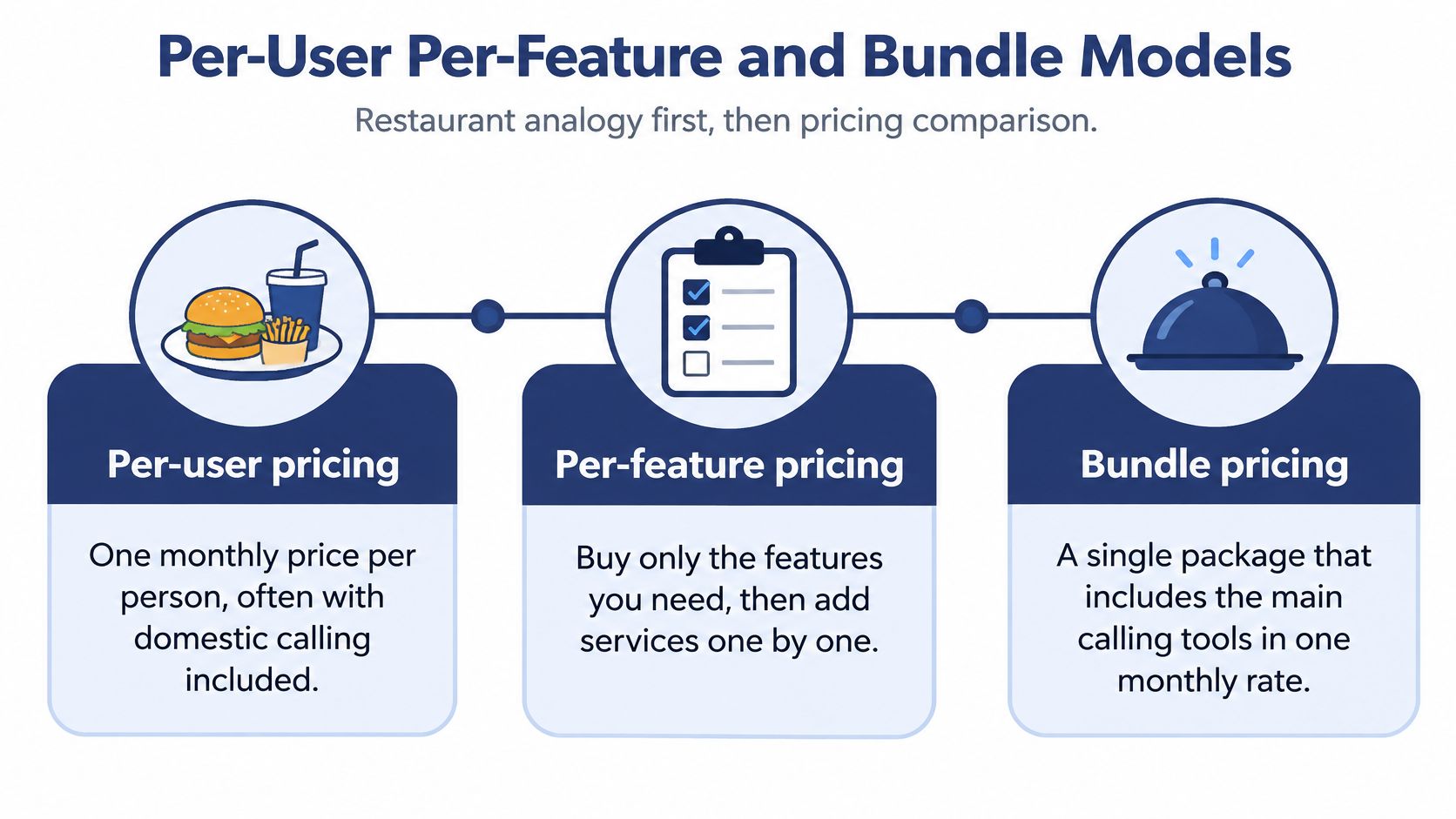
Think of per-user pricing as a restaurant meal plan. Each person gets access to a defined service for a monthly charge, often including domestic calling.
Per-feature pricing is à la carte. You start with calling, then add recording, messaging, storage, or queue tools separately. Bundle pricing is the set menu: a higher package price includes a collection of tools.
The concept map shows how these models fit together before you compare their totals.
Compare the completed order
Say, hypothetically, an office receives a $20 seat proposal that becomes $35 after recording, messaging, and queue features are added. A competing $30 bundle would cost less for employees who need all those tools.
Those are illustrative prices, not market quotes. The decision depends on the completed feature list, not whether the vendor labels its offer Basic, Pro, or Business.
| Pricing model | What to inspect |
|---|---|
| Per user | Which people, shared devices, and common-area phones need paid seats |
| Per feature | Whether an add-on applies to selected users or the entire account |
| Bundle | Whether the included tools replace charges you would otherwise pay |
| Concurrent channel | Which active calls count toward capacity |
Our explanation of a hosted VoIP seat helps distinguish a user's service entitlement from a handset or telephone number. Buying another device doesn't necessarily mean you need another paid user, but the proposal must make that distinction explicit.
Minutes and capacity are separate questions
A plan can include domestic calling while charging separately for other destinations or usage categories. For sales teams, compare the metered alternative against actual call records rather than a quiet month's estimate.
Some systems charge for concurrent call capacity instead of individual seats. In a hypothetical team of fifty employees that peaks at ten active calls, capacity-based licensing and seat-based licensing would use different billing quantities, but capacity must still accommodate busy periods and growth.
Buying rule: Compare the same working phone system under each model, not the cheapest starting configuration.
The FCC's local telephone competition report identifies December 2008 as the first full reporting period for interconnected VoIP subscribers. That reporting milestone helps explain why buyers now evaluate an established subscription-service category alongside traditional PBX ownership and carrier charges.
Fees, Taxes and Network Costs on the Invoice
A seat price isn't an all-in invoice. The Cloud Communications Alliance's pricing research describes emergency-calling charges of approximately $1-$3 per user monthly and taxes and regulatory charges that may add 10%-20% of service in many U.S. states.
Those are budgeting ranges, not a tax calculation for your address. Require a sample invoice using each actual service location.
Charges that sit outside the seat price
| Charge | Typical amount or pricing rule | Scales by | Buyer note |
|---|---|---|---|
| E911 or emergency calling | Approximately $1-$3 per user monthly | User or location, according to the quote | Budget unless explicitly included |
| Taxes and regulatory fees | Approximately 10%-20% of service in many states | State and jurisdiction | Request location-specific calculations |
| Desk phones | Quoted purchase or lease cost | Device | Compare ownership with app use |
| Cabling or PoE readiness | Site survey and installation scope | Building and network ports | Inspect older wiring |
| Number porting | Quoted migration fee | Phone number | Include every number being retained |
| International, SMS, toll-free | Destination and usage schedule | Minute or message | Confirm allowances and overages |
| Call recording storage | Retention and storage schedule | Storage volume or package | Specify retrieval and deletion terms |
Separate deployment from recurring charges
Organize the proposal into service, devices, network readiness, and installation labor. Devices may be purchased or leased, while softphones can remove the need for some desk phones without removing the need for suitable headsets and reliable connectivity.
Check whether switches supply Power over Ethernet, which powers compatible phones through the network cable. Ask the installer to identify unusable ports, missing cable runs, and any equipment that must be replaced before migration.
Usage charges need their own schedule. International calls, messaging, toll-free traffic, and recording retention shouldn't be hidden inside a miscellaneous estimate.
Size the network for the busiest period
Cisco's bandwidth design guidance puts G.711 Ethernet bandwidth at approximately 87.2 kbps per direction, or 174.4 kbps combined for a two-way call. Using that planning model, twenty-five simultaneous calls consume approximately 4.36 Mbps combined, or about 5.2-5.7 Mbps with capacity headroom.
Don't mistake that combined figure for the required capacity in each direction. Validate upload and download separately, and leave capacity for other business applications.
Use our VoIP bandwidth planning guide to prepare the network conversation. A compressed codec can reduce bandwidth needs, but bandwidth savings involve audio-quality trade-offs and don't solve congestion by themselves.
Sample First-Year Bills Versus a Legacy PBX
Cloud doesn't mean zero upfront cost. You may remove the on-site switchboard while still buying phones, moving numbers, and preparing the building.
The budgeting ranges summarized by Mordor Intelligence's communications software market guidance include approximately $50-$300 per desk phone and $10-$25 per ported number, with older-building cabling potentially costing as much as the phone hardware. Get an installation scope for your building rather than treating those ranges as an installer's estimate.
Make the assumptions visible
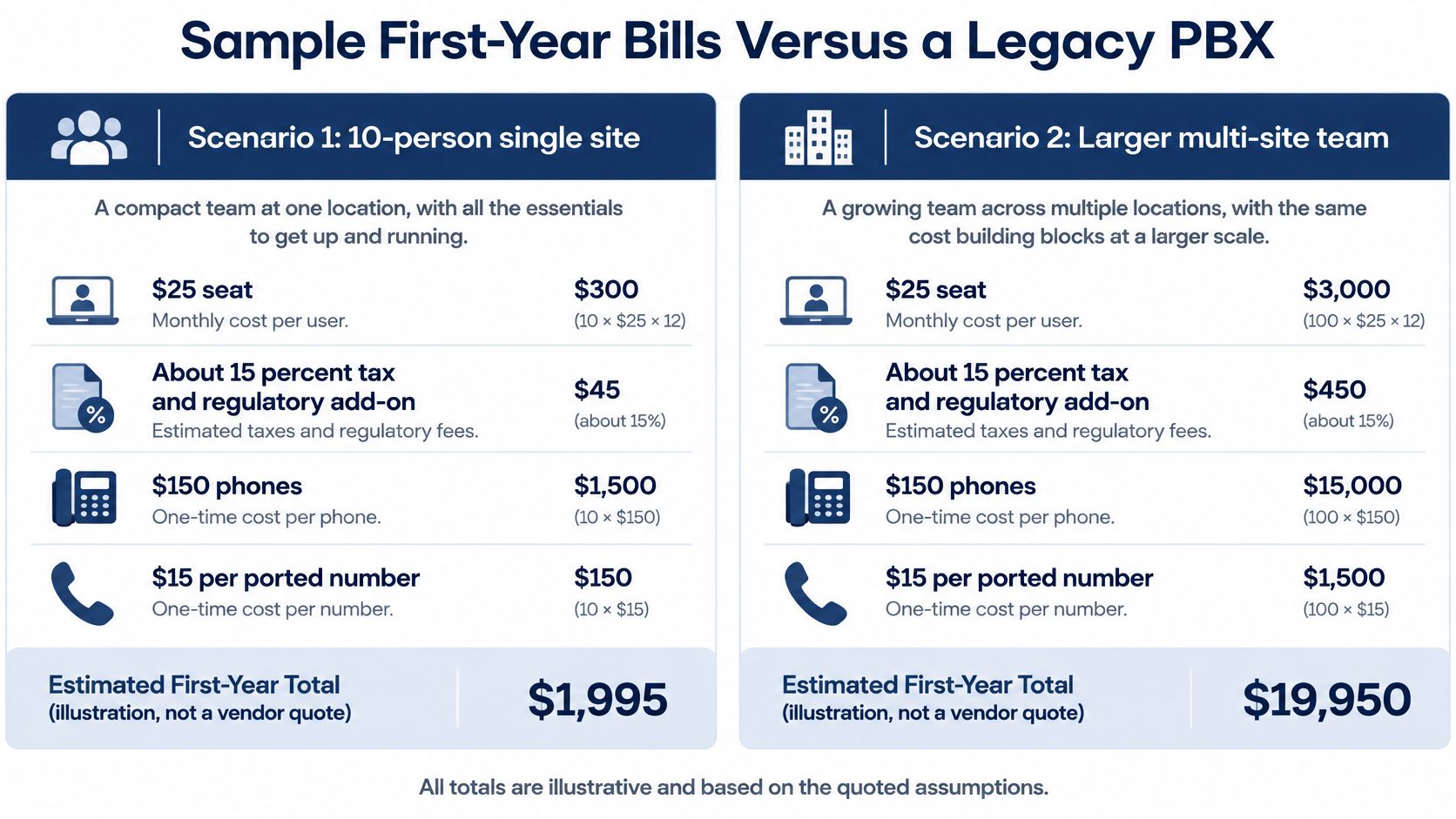
The following calculations are hypothetical illustrations, not vendor quotes. They assume a $25 monthly seat, a 15% tax and regulatory allowance applied to service, purchased phones at $150 each, porting at $15 per number, and a separate $2 monthly E911 allowance per user.
The comparison visual highlights the cost building blocks. The calculations below also account explicitly for emergency calling.
Illustrative first-year cost versus a legacy PBX
| Scenario | Hosted year one | Legacy year one | What drives the gap |
|---|---|---|---|
| 10-person office | $5,840-$6,840, including a hypothetical installation allowance | Actual annual line bill plus quoted refresh and maintenance | Phones, porting, and old hardware |
| 25 hybrid users | $11,850 before installation, circuit upgrades, and extra usage | Actual lines, maintenance, and any refresh required | Seats, 15 phones, and bandwidth |
| 50-agent queue | $18,450 service, tax allowance, and E911 subtotal, plus devices, porting, network work, and unbundled tools | Quoted on-premises licenses, trunks, equipment, and upkeep | Whether queues and recording are bundled |
For the ten-person office, annual service is 10 × $25 × 12 = $3,000. Add $450 in assumed taxes and regulatory charges, $240 for E911, $1,500 for phones, and $150 for porting, giving a $5,340 subtotal.
A hypothetical installation allowance of $500-$1,500 produces the table's range. International traffic, extra messaging, additional storage, and any separate equipment taxes remain excluded.
For the hybrid office, annual service is 25 × $25 × 12 = $7,500. Add $1,125 in assumed taxes and regulatory charges, $600 for E911, $2,250 for fifteen phones, and $375 for porting to reach $11,850 before site-specific work.
Don't invent the legacy comparison
For the queue operation, the illustrative service calculation is 50 × $25 × 12 = $15,000. The assumed tax allowance adds $2,250 and E911 adds $1,200, producing the $18,450 subtotal, not a completed deployment price.
A legacy total needs your actual trunk or line bill and a written refresh quote. There's no defensible universal PBX replacement price for every building and call center.
Our hosted VoIP versus PBX comparison can help separate ownership responsibilities from service charges. Evaluate year one and a three-year ownership period using the same assumptions, including expansion, maintenance, and contract increases, rather than deciding from the first monthly invoice.
How to Negotiate the Quote You Actually Pay
Negotiate the scope before negotiating a discount. A lower seat price isn't useful if the supplier removes installation, monitoring, or the features your staff needs.
Use this checklist to turn a proposal into a written purchasing decision.
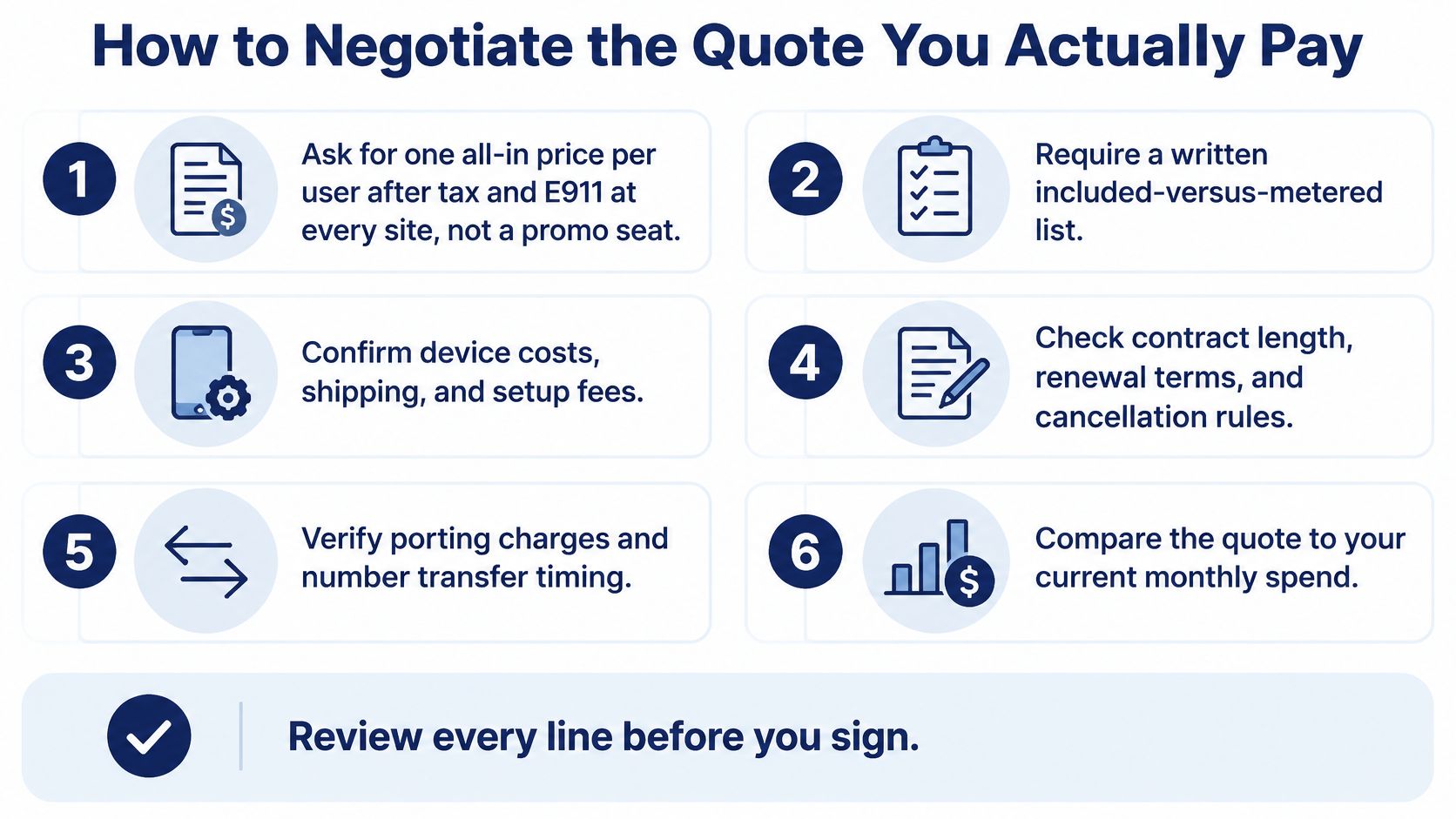
Request the payable monthly amount. Ask for service, taxes, emergency calling, and mandatory charges at every location. The written answer should distinguish the initial promotion from the continuing bill.
Define included and metered services. Require an itemized schedule for recording, retention, SMS, international calling, toll-free traffic, and queues. Include the billing unit and what happens when an allowance is exceeded.
Assign network responsibility. Name who performs the assessment, configures quality of service, monitors calls, supplies failover, and fixes faults. Cisco's VoIP quality guidance cites a target below 150 milliseconds one-way end-to-end delay and packet loss below 1% for G.729. Use appropriate quality criteria in acceptance testing, and specify how the parties will measure them.
Settle device ownership and deployment costs. Record whether phones are purchased or leased, who owns them at the end, and whether shipping, provisioning, and setup are included. Identify which employees will use apps instead.
Price the exit. Put port-out charges, renewal notices, cancellation obligations, annual increases, and recording retrieval in writing. Confirm number-transfer responsibilities before authorizing cancellation of the old service.
Compare the ownership periods. Request a first-year total and a longer-term projection under matching assumptions. Separate one-time work from ongoing charges so a temporary promotion doesn't disguise the continuing cost.
Make support promises testable
For help turning a support promise into contract language, Purple's guide to service level agreements provides useful context. Look for responsibilities, measurement methods, escalation paths, and remedies rather than accepting an undefined assurance of reliable service.
A provider can control its platform without controlling your building's wiring or an employee's home connection. The agreement should explain how the parties isolate those faults and who pays for the corrective work.
Use this text in your quote request:
Please quote the all-in monthly amount for every location, including taxes and emergency calling. Name every excluded usage charge and one-time cost, and state which network assessment, setup, monitoring, failover, and remediation work is included.
What All-Inclusive SnapDial Pricing Includes
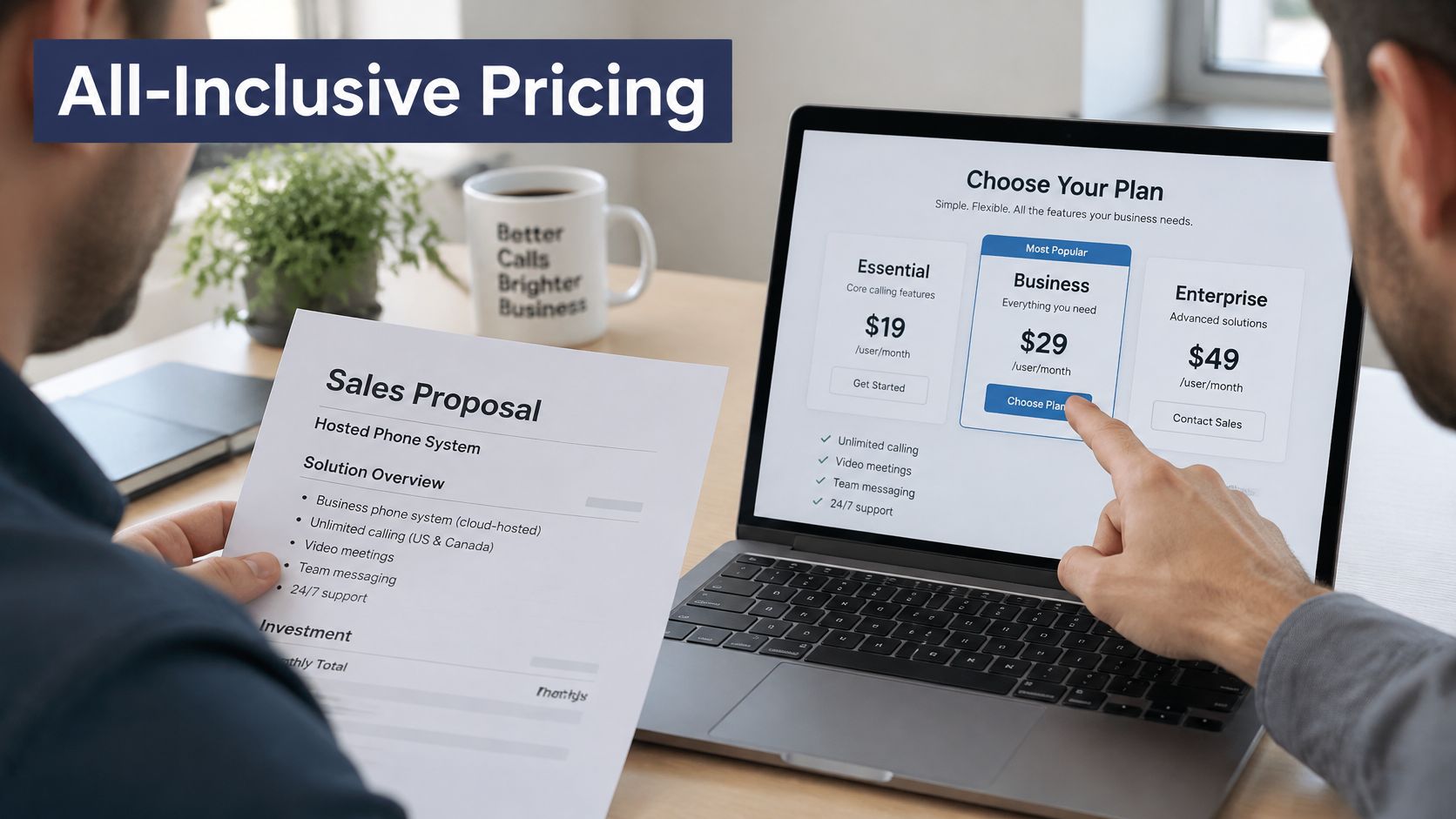
SnapDial sits at the bundle end of the pricing spectrum. Our all-inclusive pricing covers a unified communications solution, call statistics, and call recordings, rather than requiring you to assemble those core tools individually.
A useful proposal discussion starts with how your staff will answer, transfer, and review calls.
Recording and migration aren't separate projects
Call recording is included at no cost and runs with the service. If recording isn't appropriate for your company, we can disable it on request.
Our technicians also handle the setup, configuration, and replacement of an existing VoIP phone system from start to finish at no cost to the customer. That addresses the implementation labor that can otherwise make a low subscription rate difficult to compare.
It doesn't mean you should assume every building upgrade or device purchase is included. Keep hardware choices and physical-network requirements visible in the written quote.
The video provides another way to review the service before discussing your configuration.
Match the toolkit to the working day
For a receptionist or office administrator, the practical value is controlling where calls go and how missed messages reach employees. For a mobile worker, it's answering the office number without publishing a personal number.
- Office calling: Unlimited lines support individual employee numbers or a shared outbound caller ID. An auto attendant directs incoming callers to the right destination.
- Messages and mobility: Visual voicemail transcribes messages and makes them accessible through email, the app, or online. The mobile app lets employees place calls that appear to come from the office.
- Administration: The web portal provides access to voicemails, call logs, recordings, and routing changes. Cloud fax includes collision avoidance.
- Customer workflows: Integrations connect with more than 30 CRM platforms. Support teams can use smart queues, unlimited IVRs, wait-time announcements, queue callback, real-time statistics, and reporting.
We also offer 24/7 help from a Texas support center and a choice of Yealink phones, from entry models to executive touch devices. Hardware remains a purchasing decision you can tailor to the people who need it.
There's no published dollar rate to substitute for a configured quote. The value to evaluate is a predictable service scope and a managed migration, with your actual users, locations, devices, and operating requirements priced together.
Decide With an All-In Quote Not a Seat Price
Move when the complete proposal works financially and operationally. A hosted system is a sound replacement when its deployment cost and continuing bill compare favorably with a required PBX refresh, carrier service, and maintenance, and when the contract clearly assigns responsibility for support.
Don't replace functioning equipment solely because a sales page shows a low seat rate. Existing hardware may still have useful life, while a building with poor cabling may need an infrastructure budget before a phone migration makes sense.
Choose according to the work your office does
An all-inclusive bundle deserves close consideration when employees need recording, queues, mobile calling, or coordinated routing across locations. A basic plan can still be sensible for simple calling needs, provided you've already accounted for devices, labor, usage, and support.
If major wiring work makes the first-year total unaffordable, wait and rebudget rather than removing necessary network work from the proposal. A subscription that fits the budget won't help if staff can't reliably answer customers.
Bring these inputs to a quote conversation:
- Seat count: Identify paid users and any shared or common-area devices.
- Locations: List offices and remote-working requirements, including emergency-calling addresses.
- Peak concurrent calls: Use busy-period call activity, not just total headcount.
- Recording preference: State whether recording should remain enabled and explain your retention needs.
Choose the proposal that makes the cost and the responsibilities clear enough for someone else in your office to administer it.
You can request a quote or schedule a call with our team. Contact support at (888) 881-7495 or help@snap-dial.com, and request a written all-in proposal that separates recurring charges, equipment, and any site-specific work.
The outcome should be a predictable monthly figure, a clearly scoped migration handled at no cost, and no surprise line for standard call recording. Make those expectations part of the purchasing decision, not assumptions left until installation.
Visit SnapDial to request a hosted phone system quote built around your users, locations, and call-handling needs. We offer all-inclusive communications with included recording and no-cost setup, configuration, and replacement of your existing VoIP system, so you can compare a defined service rather than just a seat price.