
Picture this: a team member who works 24/7, never lets a lead slip through the cracks, and knows exactly what every customer wants the second they call. That’s no longer a fantasy—it's what modern AI voice agents do. These intelligent, conversational systems are quickly becoming a must-have for businesses that want to scale up without burning out their staff.
Why AI Voice Agents Are a Game-Changer for Business Calls
For years, the words "automated phone system" made us all cringe. We’d get stuck in frustrating, robotic menus, endlessly pressing "one for sales." Customers felt ignored, and businesses lost out because the technology was just too rigid. Thankfully, that whole experience is now a relic, all thanks to the rise of sophisticated AI voice agents.
These aren't your typical pre-programmed bots. They're dynamic conversational partners. Think of them less like a clunky phone directory and more like a super-efficient, endlessly patient receptionist. They can understand context, figure out what a caller is trying to do, and give genuinely helpful answers—all in a natural, human-like voice.
It's More Than Just Basic Automation
The real difference is that these agents can think, not just react. A traditional Interactive Voice Response (IVR) system is stuck on a strict script. If a caller says something it doesn’t expect, the whole thing breaks down. An AI voice agent, on the other hand, can handle a massive range of questions and adapt as the conversation unfolds.
This ability is completely changing how businesses operate, offering perks that used to be reserved for huge corporations:
- 24/7 Availability: You can capture leads, book appointments, and answer common questions around the clock. You'll never miss an opportunity just because the office is closed.
- Instant Response: No more infuriating hold music. Every single call gets answered right away, making a great first impression.
- A More Productive Team: By automating all the routine, repetitive questions, you free up your human team to tackle the complex, high-value issues where their expertise really shines.
The Massive Shift to Voice AI
This isn't just a small trend; it's a full-blown market earthquake. The global market for AI voice agents is set to skyrocket from $2.4 billion in 2024 to an incredible $47.5 billion by 2034. This explosive growth shows just how fast companies are jumping on board to make their customer interactions better. You can read the full research about the voice AI market to see why North America is leading the charge.
If your business is struggling with missed calls, staffing shortages, or the high cost of providing round-the-clock support, AI voice agents are no longer some futuristic idea. They are a practical, accessible tool you can use right now to boost efficiency and give your customers a far better experience.
Ever wondered what's really happening in the split second between when you speak to an automated system and it actually answers you? It’s not magic, but it’s close. Modern AI voice agents use a sophisticated three-step process to hold a conversation that feels surprisingly human.
We can break it all down into a simple framework: Listen, Think, and Speak.
This isn't your parents' old IVR menu that just listens for rigid keywords. Today's agents are built to understand nuance, figure out what you actually mean, and have a genuinely dynamic conversation. This process is what moves them far beyond a pre-programmed script.
The graphic below shows how this intelligence turns a common business problem—like a missed call—into a real opportunity.
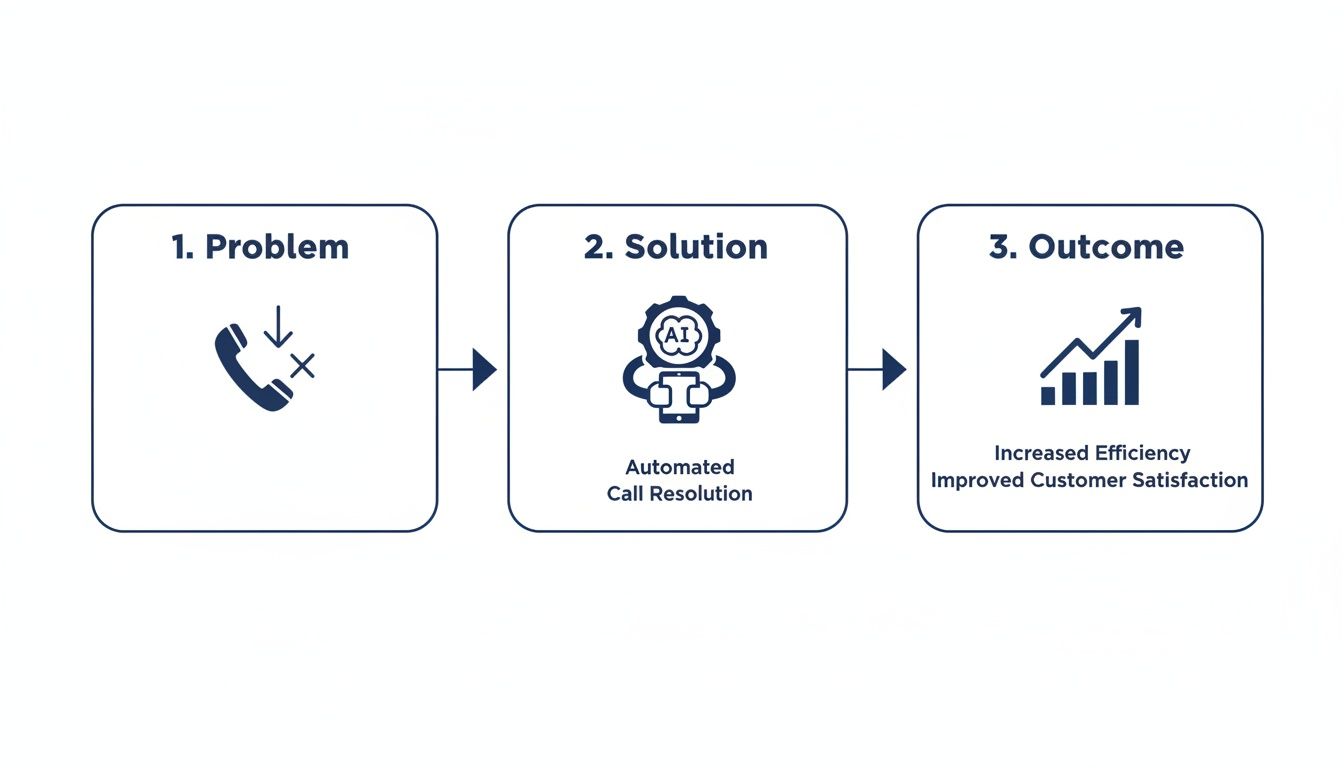
As you can see, the right AI solution can automate resolutions from start to finish, leading directly to better customer outcomes.
Step 1: Listen With Digital Ears
The whole conversation kicks off the moment a caller says "hello." The first, and most critical, job for the AI is to accurately hear what’s being said. This is handled by a technology called Automatic Speech Recognition (ASR). Think of ASR as the agent’s digital ears.
ASR has one core function: converting the sound waves of your voice into written text. Today’s ASR models are incredibly good at this, easily understanding different accents, dialects, and speaking speeds with amazing accuracy. This clean text is the foundation for everything that comes next.
Step 2: Think Like a Problem-Solver
Once the caller's words are in text form, the AI's "brain" kicks in. This is where Natural Language Processing (NLP) and its more advanced cousin, Natural Language Understanding (NLU), do the heavy lifting. This is the real secret sauce that separates a simple bot from an intelligent agent.
Instead of just looking for keywords, NLU dives deep to figure out the true meaning and intent behind the words. It’s not just about what was said, but why.
- Intent Recognition: Does the caller want to book an appointment, check on an order, or ask about a bill? The AI figures it out.
- Entity Extraction: It then pulls out the key pieces of information, like names, dates, order numbers, or product names.
- Sentiment Analysis: It can even get a read on the caller's mood. Are they happy, frustrated, or just neutral?
This whole analytical process is what allows the AI to understand messy, real-world sentences. A caller might say, "Uh, I need to change my booking for tomorrow," and the NLU model instantly deduces the intent (reschedule), the entity (booking), and the timeframe (tomorrow) without needing a perfect, robotic command.
To really get under the hood, you can explore what an AI answering service is and how it works in more detail. This deep understanding is what allows the agent to come up with a genuinely helpful response instead of just falling back on, "I'm sorry, I didn't understand that."
Step 3: Speak With a Natural Voice
After listening and thinking, it's time to talk back. The final step is handled by two powerful technologies working in perfect harmony: a generative AI model and a Text-to-Speech (TTS) engine.
First, the generative AI crafts the perfect response in text form. Based on everything it understood from the "think" step, it puts together an answer that is contextually right, helpful, and even empathetic. This is what makes the conversation feel natural and unscripted.
Then, the TTS engine takes that text and turns it into audible speech. The best TTS systems today produce voices that are remarkably human, with natural-sounding pitch, pacing, and intonation. The result is a smooth, conversational partner that guides the caller all the way to a successful resolution.
Putting AI Voice Agents to Work in Your Business
Okay, the tech behind AI voice agents is fascinating, but seeing what they can actually do for a business is where it all clicks. When you move past the theory, you find these agents aren't just answering phones—they're actively helping companies grow, work smarter, and completely change the game for their customers.
Let's look at a few real-world situations where these smart systems are making a huge difference in day-to-day operations.

Revolutionizing Customer Support
Picture this: your support line is constantly ringing with the same basic questions. "What are your hours?" "Where's my order?" "How do I reset my password?" They're important questions, sure, but they pull your human agents away from the complex, high-stakes problems where they're needed most.
This is where an AI voice agent steps in as your first line of defense. It can instantly pull information from your knowledge base, CRM, or order system to give callers immediate, accurate answers to all those routine questions. This frees up your skilled team to focus on troubleshooting tough issues, handling sensitive situations, and building real relationships with your customers.
But what about the tricky stuff? When an issue is too complex, the AI performs an intelligent handoff. It gathers the essential details—like the caller's name, account number, and what they need help with—and then smoothly transfers the call, along with all that context, to the right human expert. No more making frustrated customers repeat themselves over and over.
Powering Your Sales and Lead Generation
A potential customer calls your business after hours, ready to book a consultation or get a quote. With a standard phone system, that hot lead goes straight to voicemail. By the next morning, that opportunity might be long gone.
AI voice agents act like a sales assistant that never sleeps. They can:
- Qualify Leads: The agent can ask a few smart questions to figure out if a caller is a good match for your services.
- Book Appointments: It can plug directly into your team's calendar and schedule demos, service calls, or consultations on the spot.
- Provide Instant Quotes: For straightforward services, it can gather the details it needs from the caller and give them a price estimate right then and there.
This means you never miss a chance to connect with a motivated buyer, no matter the time of day. This ability to handle multi-step tasks on its own is what makes voice AI so powerful. The market is catching on fast, too. Current data shows 23% of companies are already scaling this type of AI, with another 39% actively experimenting. You can discover more insights about the agentic AI market to see why its adoption is accelerating.
Business Task Transformation with AI Voice Agents
The shift in how work gets done is dramatic. The table below gives you a clear before-and-after look at how common business tasks change when you introduce an AI voice agent. You can see massive gains in speed, efficiency, and the overall customer experience. And if you're looking to explore this further, you can learn more about how to choose the best AI customer support agents for your specific needs.
| Business Task | Traditional Approach (Without AI) | Modern Approach (With AI Voice Agent) |
|---|---|---|
| Appointment Booking | A receptionist manually checks calendars, finds open slots, and confirms details. This process is limited to business hours. | The AI agent accesses calendars 24/7, offers available times, and books the appointment in seconds, sending an automatic confirmation. |
| Order Status Check | A customer waits on hold for an agent who then has to look up the order details in a separate system, leading to delays. | The caller provides their order number, and the AI instantly retrieves and relays the real-time status from the shipping database. |
| Answering FAQs | Staff members spend a significant portion of their day answering the same set of basic questions repeatedly, reducing productivity. | The AI handles 100% of routine questions instantly, freeing human agents to focus on complex, revenue-generating tasks. |
| Call Routing | A basic auto-attendant offers a rigid menu. Callers often press the wrong option, leading to multiple transfers and frustration. | The AI understands the caller's intent in their own words and routes them directly to the correct department or person on the first try. |
By automating these key interactions, you not only improve productivity but also deliver a superior experience that customers definitely notice and appreciate.
Integrating AI with Your Cloud Phone System
An advanced AI voice agent is a fantastic tool, but it can’t do its job in a vacuum. To actually deliver results, it has to connect flawlessly with the heart of your business communications: your phone system. This is where modern, cloud-based phone systems really shine, making the whole integration process simpler and more powerful than ever before.
Gone are the days of needing a massive hardware overhaul or calling in expensive on-site techs just to connect a new tool. Modern platforms are built for flexibility, using Application Programming Interfaces (APIs) to create a digital bridge between your phone service and your AI agent.
Think of an API as a universal translator. It lets two completely different software systems speak the same language, sharing information and commands seamlessly. This API-first approach means you can plug an AI voice agent right into your call flows without ripping apart your existing setup. The entire thing is managed through software, giving you a fast, scalable, and cost-effective way to bring intelligent automation on board.
Smart Call Routing and AI Handoffs
Once the connection is made, the real strategic work begins. You don’t want your AI voice agent just answering calls at random; you want it handling the right calls at the right time. This is done with smart call routing, a feature you can easily configure right inside your cloud phone system’s online portal.
You can set up rules that send specific types of calls to the AI first. For example:
- After-Hours Calls: Any call that comes in outside of business hours is automatically sent to the AI agent to capture leads or provide 24/7 support.
- Specific Departments: Inbound calls to your billing or support lines can be routed to the AI to handle common questions, like "What's my account balance?"
- High-Volume Scenarios: During a big marketing campaign or a service outage, the AI can manage the initial flood of calls, stopping long hold times before they even start.
Of course, not every conversation can or should be handled by AI from start to finish. The most critical part of this entire setup is the human handoff. A well-designed system ensures a caller can be transferred to a live person without any friction. The AI can even pass along vital context—like the caller’s name and why they're calling—so your human agent can pick up the conversation without missing a beat. This way, you get the efficiency of AI without sacrificing the personal touch when it matters most.
Unified Reporting and Performance Dashboards
So how do you know if your new AI team member is actually pulling its weight? Integrating your AI with a cloud phone system gives you a single source of truth for all your call data. Instead of trying to piece together reports from separate platforms, you get a unified dashboard that tracks both AI and human agent metrics, side-by-side.
This combined view allows you to see the full picture of your customer interactions. You can track key performance indicators (KPIs) like call resolution rates, transfer rates, and average handling times across your entire team—both human and AI.
This holistic data is priceless for making improvements. You can pinpoint which queries your AI handles best, spot areas where your call routing could be smarter, and make data-driven decisions to boost both customer happiness and operational efficiency. To learn more about how these platforms work, you can explore our detailed guide on what a cloud phone system is and the benefits it brings.
Calculating the Real ROI of an AI Voice Agent
For any business leader, the question always comes back to the bottom line. While bringing an AI voice agent on board involves an initial investment, its real value is measured in the powerful return it generates. Understanding this return on investment (ROI) goes way beyond looking at a subscription fee; it’s about adding up the combined impact of cost savings, new revenue, and happier, more loyal customers.

The financial case for this technology is incredibly strong. Real-world examples show that voice AI agents deliver exceptional results, with some businesses seeing over 150% ROI in the first year alone. These gains often come hand-in-hand with a jump in customer satisfaction and major cost reductions compared to a traditional call center.
Quantifying Labor Cost Savings
The most direct way to see the ROI is by looking at what you’re spending on labor. Start by thinking about the repetitive, time-sucking calls your team handles every single day. We’re talking about appointment scheduling, order status updates, and answering the same questions over and over.
Now, let's do some quick math. If your team collectively spends 20 hours per week on these routine calls, and your average burdened labor cost is $25 per hour, that’s $500 per week spent on tasks an AI can handle. A voice agent can take on nearly all of that volume for a fraction of the cost, freeing up your team for more complex, high-value work.
For a concrete example, look at how a consumer electronics brand achieves 50% cost savings in its tech support division just by using an AI solution.
By offloading these tasks, you're not just cutting costs; you're reallocating your most valuable resource—your team's time—toward activities that directly drive growth, like sales follow-ups or proactive customer outreach.
Measuring Increased Revenue and Retention
Beyond just saving money, an AI voice agent is a powerful tool for generating new revenue. Missed calls are missed opportunities, especially when potential customers call after hours or during your busiest times. An AI agent is on the clock 24/7, making sure every single lead is captured, qualified, and scheduled for a follow-up.
To put a number on this, track how many after-hours or abandoned calls your business used to get. If an AI agent converts just a handful of these into paying customers each month, that extra revenue can quickly outpace the cost of the service.
On top of that, a better customer experience has a direct line to retention. Faster answers and instant help lead to happier customers who stick around longer. While this can be harder to measure right away, just think about the long-term value of reducing customer churn by even a few percentage points.
Building Your Business Case
To build a rock-solid financial justification for bringing on an AI voice agent, you just need to focus on these three key areas.
- Cost Reduction: Figure out the hours your team will get back by automating routine calls and multiply that by your hourly labor rate.
- Revenue Growth: Estimate the value of the leads you’ll now capture outside of business hours that would have otherwise been lost for good.
- Customer Lifetime Value: Factor in the long-term financial bump you get from keeping more customers through better, faster service.
When you put all these pieces together, the financial argument becomes undeniable. An AI voice agent isn't an expense; it's a strategic investment that pays for itself through greater efficiency and growth.
How to Choose the Right AI Voice Agent Solution
Picking the right AI voice agent is a lot like hiring a key employee. You're not just buying software; you're bringing a new digital team member on board and choosing a long-term partner for your business. The market is crowded, so knowing what to look for is the only way to find a solution that fits your needs today and can grow with you tomorrow.
This guide is your buyer's checklist. We'll walk through the most important features and considerations. By sizing up potential vendors against these core criteria, you can confidently pick an AI voice agent that will deliver real value, make your customer interactions better, and give you a solid return on your investment.
Core Technical Capabilities
Before you even think about the price tag, you have to be sure the agent’s core technology is up to snuff. The quality of the AI's conversational skills is non-negotiable—it directly shapes your customer experience.
Look for a solution that really shines in these three areas:
- Speech Recognition Accuracy: How well does it understand different accents, speaking speeds, and background noise? A low error rate is the foundation of a smooth conversation.
- Natural Language Understanding (NLU): Can the AI figure out what a caller really means, or does it get tripped up by specific keywords? You need an agent that can handle complex, multi-part questions without breaking a sweat.
- Voice and Tone Quality: The agent’s voice has to sound natural and engaging, not like a robot from the 90s. The best AI voice agents can even shift their tone based on the conversation's context, making the interaction feel more human and empathetic.
Seamless Integration and Scalability
An AI voice agent doesn't work in a vacuum. Its real power comes from its ability to plug into the rest of your tech stack. If a solution can't integrate easily, it will just create data silos and operational headaches.
Your top priority should be seamless integration with your cloud phone system. The vendor needs to provide crystal-clear documentation and support for connecting their agent to your call flows. This ensures that tasks like smart routing and warm transfers to human agents are simple to set up and manage.
Next, think about its ability to connect with other essential business tools. Can it pull customer info from your CRM? Can it book appointments right into your scheduling software? These integrations are what turn a basic answering service into a fully automated business engine.
As you look at different platforms, think about the future, too. The right one should be able to handle more calls and more complex tasks as your business grows—without forcing you to start over from scratch.
Security and Compliance Standards
In any customer-facing role, you're handling sensitive information. That makes rock-solid security and compliance an absolute must-have when choosing an AI voice agent provider. You're trusting this tech with your customer data, and any breach could have serious consequences.
Make sure to grill potential vendors on their security posture and certifications. Look for a clear commitment to industry standards and regulations that matter to your business, such as:
- Data Encryption: All data—whether it's moving or sitting still—should be encrypted to keep it safe from prying eyes.
- GDPR and CCPA Compliance: If you do business with customers in Europe or California, the solution must meet these strict privacy rules.
- HIPAA Compliance: For any healthcare organization, you have to confirm the vendor is willing to sign a Business Associate Agreement (BAA). This is non-negotiable.
Choosing a provider that takes security seriously means you can automate your communications without putting your customer data or your business on the line. If you want to take a closer look at specific solutions, you can explore our guide on the best AI agents for customer support to see how the leading options stack up.
Got Questions? We've Got Answers
Stepping into the world of AI automation can bring up some very practical questions. I get it. As a business owner or manager, you want to be absolutely sure you’re making a smart, future-proof decision.
Let's cut through the noise and give you clear, straightforward answers to the most common concerns we hear about bringing AI voice agents on board. We'll cover setup, how they actually sound to customers, and what it all costs, so you can move forward with total confidence.
Are AI Voice Agents a Headache to Set Up?
This is a common worry, but the short answer is no—not when you're working with a modern cloud phone system. These platforms are designed from the ground up to connect easily with other tools using APIs, which lets an AI voice agent slide right into your existing workflows.
Unlike old-school systems that demanded complex hardware changes and on-site technicians, a cloud-based setup is a different world. You configure everything—from how calls are routed to how the agent behaves—through a simple online portal. This means you can get up and running incredibly fast, often without needing a deep bench of technical experts.
Will an AI Voice Agent Sound Like a Robot?
While the automated systems of the past rightfully earned a reputation for sounding clunky and robotic, today’s technology is dramatically different. It's not even in the same league.
The best AI voice agents today use advanced generative AI and modern Text-to-Speech (TTS) engines to have incredibly natural, human-like conversations. They understand context, use the right tone, and can even pick up on nuances like empathy, ensuring a positive and professional experience every single time.
This evolution is the key to protecting your brand's reputation for high-quality service.
How Much Does an AI Voice Agent Actually Cost?
Bringing an AI voice agent on board is far more affordable than hiring additional staff to cover the same round-the-clock responsibilities. Most providers use a scalable subscription model based on usage, like a simple per-minute or per-call rate. This makes your costs predictable and easy to manage as your business grows.
When you factor in the massive savings on labor costs and the incredible value of capturing every single lead 24/7, the investment often pays for itself, and then some. In fact, many businesses see over 150% ROI in their first year alone, making it a financially sound strategic decision.
Ready to see how an AI-powered communication platform can truly change the game for your business? SnapDial makes it simple to integrate intelligent automation into your call flows, ensuring you never miss another opportunity. Discover our powerful, easy-to-use cloud phone system at https://snap-dial.com.