
Average handle time (AHT) is a bread-and-butter metric for any team that talks to customers. It’s the average time it takes to handle one customer interaction, from the moment it starts until the very last bit of follow-up work is done.
This isn’t just about how long an agent is on the phone. AHT includes the total conversation, any time the customer spends on hold, and the "after-call work" an agent does to wrap things up. It’s the entire lifecycle of a single customer issue.
What Average Handle Time Really Tells You
It’s tempting to look at AHT as just a measure of speed. But if you’re only focused on getting that number as low as possible, you’re missing the bigger picture—and you might even be hurting your customer experience.
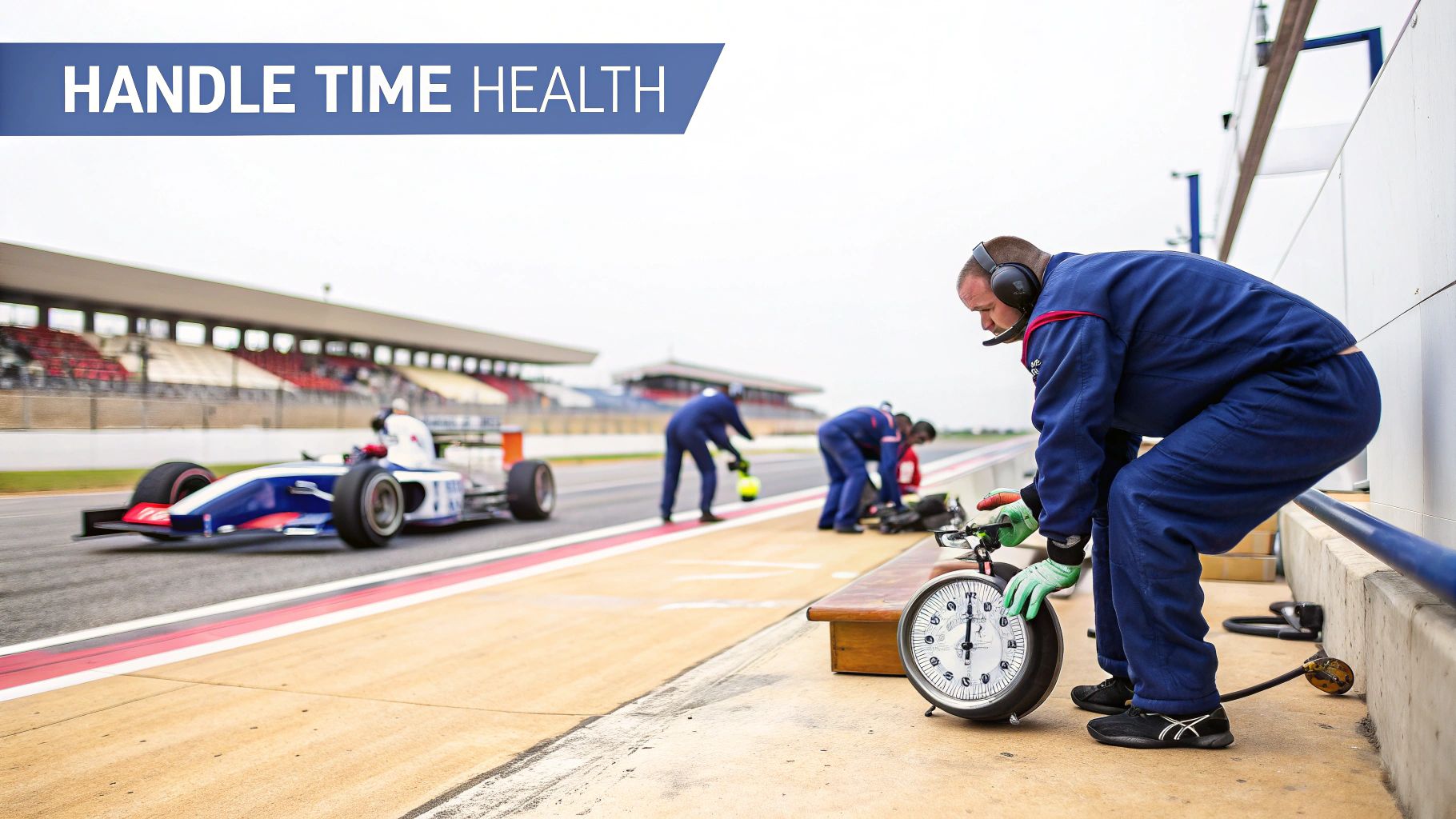
Think of AHT like a Formula 1 pit stop. Sure, the goal is to be fast. But a pit crew that rushes and fails to tighten a lug nut properly is setting the driver up for a disaster. The best pit crews are fast because their process is flawless and every team member is perfectly coordinated, not because they cut corners. AHT works the same way; it’s a diagnostic tool, not just a stopwatch.
The Three Core Components of AHT
To really get what AHT is telling you, you need to look at its three main ingredients. Each one shines a light on a different part of your operation.
-
Total Talk Time: This is the actual time your agent spends talking to the customer. A high talk time could mean you’re dealing with complex problems, which is fine. But it could also signal that your agents need more training or can't find information quickly.
-
Total Hold Time: This is the total time a customer is left waiting on the line during a call. Long hold times are a classic sign of inefficiency. It usually means agents are stuck hunting for answers or waiting for a supervisor to help out.
-
Total After-Call Work (ACW): This covers everything an agent does after the call ends—typing up notes, updating the CRM, sending a follow-up email. If ACW is high, it often points to clunky software or too many manual steps in your process.
By looking at these three pieces separately, you stop just timing your agents and start diagnosing your process. You can pinpoint exactly where the delays are coming from—whether it's a people, process, or technology issue.
A Deeper Look at Operational Health
When you look at AHT this way, it transforms from a simple KPI into a powerful strategic insight. A consistently high AHT doesn't necessarily mean you have slow agents. It’s often a symptom of bigger problems under the hood.
For instance, are both talk time and hold time high? That's a huge clue that your internal knowledge base might be a mess. Agents are forced to put customers on hold while they desperately search for the right info. Or is after-call work taking forever? You probably need to look at automating data entry or integrating your systems better.
In the end, managing AHT is all about finding the right balance. You want to empower your agents to solve customer problems completely and correctly on the first try, while also removing the frustrating roadblocks that waste time for both your team and your customers. Getting that balance right is the key to cutting costs, boosting agent morale, and earning long-term customer loyalty.
How to Nail Down Your Average Handle Time
Before you can even think about improving your Average Handle Time (AHT), you need a rock-solid baseline. Trying to lower it without measuring it first is like flying blind—you might stumble in the right direction, but you’re relying on luck, not strategy. Getting an accurate calculation is the first, most critical step to understanding where you are today and tracking how you improve over time.
The formula itself is pretty simple. It just adds up the three main parts of any customer interaction to give you the full picture of the time involved.
AHT Formula: (Total Talk Time + Total Hold Time + Total After-Call Work) / Total Number of Calls
This formula makes sure you’re capturing the entire journey of a call, from "Hello, how can I help you?" all the way to the final note being saved in the CRM. If you leave any one of those pieces out, you’re not getting a true read on your team's efficiency.
Let's Break Down the AHT Formula
Let's make this less abstract with a real-world example. Picture a small support team of five agents on a typical busy day. To figure out their team's AHT, you’d pull together the data for a set period, like that one workday.
Here’s what you need to do:
- Add Up All the Talk Time: Combine the total minutes every single agent spent actively talking to customers.
- Add Up All the Hold Time: Tally the total time customers spent waiting on hold across every call.
- Add Up All After-Call Work (ACW): Sum the total time agents spent on wrap-up tasks after hanging up, like logging notes or sending a follow-up email.
- Count the Total Calls: Get the final count of all calls the team handled during that time.
Once you have those four numbers, you just plug them into the formula. This simple process gives you a clear, data-driven starting point for any changes you want to make.
AHT Calculation in Action
Let’s put some numbers to this. The table below shows a breakdown for our five-agent team over a single day. It illustrates how each agent's individual performance contributes to the team's overall AHT.
AHT Calculation Example for a 5-Agent Team
| Metric | Agent 1 | Agent 2 | Agent 3 | Agent 4 | Agent 5 | Team Total |
|---|---|---|---|---|---|---|
| Talk Time (mins) | 200 | 180 | 210 | 190 | 180 | 960 |
| Hold Time (mins) | 30 | 45 | 35 | 40 | 30 | 180 |
| ACW (mins) | 65 | 55 | 60 | 50 | 70 | 300 |
| Calls Handled | 25 | 22 | 26 | 23 | 24 | 120 |
As you can see, the team's daily totals are:
- Total Talk Time: 960 minutes
- Total Hold Time: 180 minutes
- Total After-Call Work: 300 minutes
- Total Calls Handled: 120 calls
Now, let's plug those totals into our formula:
(960 + 180 + 300) / 120 = 12 minutes
The team’s baseline AHT is 12 minutes. That's your benchmark. From here, you can use powerful call analytics to dig deeper. Is hold time the problem? Or is one agent’s after-call work taking much longer than everyone else’s? This is where the real insights come from, helping you focus your coaching where it’ll make the biggest difference.
Common Pitfalls to Avoid
An accurate AHT is only as good as the data you feed it. A few common mistakes can really throw off your numbers and lead you to the wrong conclusions.
- Counting Internal or Wrong-Number Calls: Make sure you filter out calls between agents, IT test calls, or misdials. These aren't real customer interactions and will artificially drag your AHT down.
- Mixing Up Your Channels: If your team also handles chats and emails, you need to calculate AHT for each channel separately. Lumping phone calls in with chats will give you a useless, distorted metric for both.
- Sloppy Wrap-Up Time Tracking: Agents need to be diligent about logging their after-call work correctly. If they start taking another call before finishing the notes on the last one, that ACW time can easily get lost or assigned to the wrong interaction.
Setting Realistic AHT Benchmarks
"So, what's a good Average Handle Time?" It's the first question most managers ask, and the honest answer is… it depends. There’s no magic number. Chasing a one-size-fits-all benchmark is like a local coffee shop trying to match the drive-thru speed of a fast-food giant. The context, complexity, and customer expectations are worlds apart.
Trying to shoehorn your team into a generic industry standard usually backfires. It leads to rushed agents, unresolved problems, and frustrated customers who just have to call back—which completely defeats the purpose of being efficient in the first place. The goal isn't just to be fast; it's to be effectively fast for your specific business and your customers.
Why Industry Averages Are Just a Starting Point
Looking at what others in your industry are doing can give you a useful frame of reference, but it should never be the final word. A simple order status question for an e-commerce site will always be quicker to resolve than a complex technical support call for enterprise software.
Let's look at the data. AHT benchmarks can vary wildly from one sector to another. For instance, financial services often see AHTs between 4.01 and 6 minutes because of mandatory security checks and complex policy details. On the other hand, retail and e-commerce calls often wrap up in 3-4 minutes, since the issues are typically more straightforward. You can find more details on these trends in various call center performance studies.
AHT is deeply contextual. What’s considered a "good" number for one company could be a disaster for another, even if they're in the same industry.
This is because your AHT is a unique fingerprint, shaped by a blend of factors specific to your own operation.
To give you a clearer picture, here’s a look at how AHT varies across different sectors.
Average Handle Time by Industry
A comparative look at typical AHT benchmarks across various sectors to help businesses set realistic performance targets.
| Industry | Typical AHT Range (Minutes) | Key Influencing Factors |
|---|---|---|
| Retail & E-commerce | 3 – 4 | Order tracking, return policies, product questions, and checkout issues. |
| Telecommunications | 5 – 7 | Technical troubleshooting, billing disputes, and complex service plan changes. |
| Financial Services | 4 – 6 | Strict security verification, compliance requirements, and detailed account inquiries. |
| Healthcare | 6 – 8 | Patient privacy (HIPAA), insurance complexities, and sensitive medical information. |
| Travel & Hospitality | 5 – 7 | Complex booking changes, loyalty program questions, and multi-leg itineraries. |
| Tech Support (SaaS) | 7 – 10+ | In-depth troubleshooting, bug replication, and walking users through complex software. |
As you can see, the nature of the customer's problem is the biggest driver of handle time. A customer trying to change a flight will naturally need more time than someone asking about a shipping confirmation.
Key Factors That Influence Your AHT
Before you can even think about setting a goal, you have to understand what’s pushing your AHT up or pulling it down. These are the variables that make a universal benchmark impossible and show why you need a customized approach.
Here are a few of the most important ones:
- Issue Complexity: Are you fielding simple billing questions or troubleshooting multi-step technical glitches? The more complex the average call, the longer it should rightfully take.
- Agent Experience and Training: A team of seasoned pros will naturally be faster than a group of new hires who are still learning the ropes and figuring out your internal systems.
- Internal Tools and Resources: How fast can an agent find an answer? A well-organized, searchable knowledge base can slash hold times, while clunky, slow software will bloat every part of the AHT.
- Compliance and Security Needs: Industries like healthcare and finance have strict verification and documentation rules that add necessary, non-negotiable time to every single call.
This is where breaking down the AHT formula becomes so important.
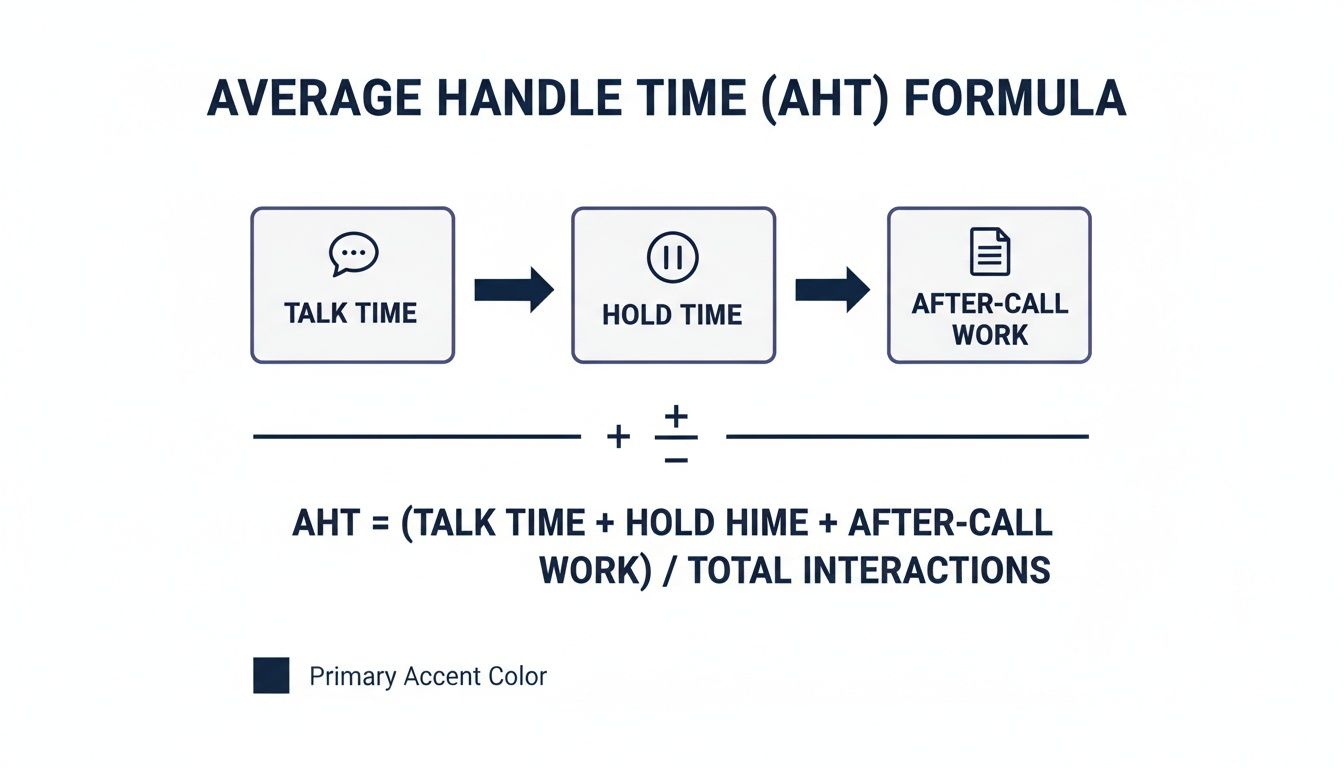
When you see how Talk Time, Hold Time, and After-Call Work all add up, you can start to pinpoint exactly where you need to focus your efforts.
Setting Smart and Achievable AHT Goals
Once you have all this context, you can stop chasing generic industry numbers and start setting intelligent, realistic targets for your team.
Here's how to do it right:
- Establish Your Baseline: First things first, figure out your current AHT. No guesswork. This is your starting line.
- Analyze the Components: Now, break that number down. Is hold time sky-high? Is after-call work taking longer than the actual conversation? This tells you where your biggest opportunities are.
- Benchmark with Context: Go ahead and look at those industry averages, but see them through the lens of your business. If you offer premium, high-touch support, your AHT should be higher than a budget competitor's.
- Set Incremental Goals: Don't try to slash your AHT in half overnight. It won't work. Instead, set a small, achievable goal, like aiming to reduce hold time by 15 seconds over the next quarter.
This methodical approach lets you make real, sustainable improvements that boost efficiency without ever sacrificing the quality of your customer service. It’s about working smarter, not just faster.
Actionable Strategies to Optimize AHT

Alright, you've measured your average handle time and you know your numbers. That was the diagnosis. Now it's time for the treatment.
Smartly reducing AHT has nothing to do with rushing agents or cutting conversations short. Instead, it’s about surgically removing the friction and roadblocks in their workflow that waste time for both your team and your customers.
Think of it like a professional chef. They're not fast because they chop ingredients carelessly. They're fast because their knives are sharp, their workspace is organized, and they know the recipe by heart. Optimizing AHT is about giving your agents the sharpest tools and the clearest processes.
Build a Robust Internal Knowledge Base
One of the biggest time-sinks on a call? The frantic search for an answer. Every time an agent has to say, "Can you hold while I look that up for you?" it's a huge red flag that your internal information is a mess.
A well-built, easily searchable knowledge base acts like an agent's second brain. It gives them instant access to product specs, company policies, and troubleshooting guides, turning a potential five-minute hold into a quick, 15-second search.
For this to work, your knowledge base needs to be:
- Easily Searchable: A great search bar is non-negotiable. Agents need to find what they're looking for with just a few keywords.
- Consistently Updated: Information goes stale fast. You need someone in charge of keeping articles current and accurate.
- Simple to Navigate: Use clean categories, tags, and formatting so information is easy to scan and digest.
A solid knowledge base doesn't just cut down talk and hold times—it empowers your agents with the confidence to handle calls quickly and correctly.
Use Call Analytics for Targeted Coaching
Generic coaching is a waste of everyone's time. To actually improve agent performance, the feedback has to be specific, backed by data, and lead to a clear action plan. This is where call analytics really shines.
By digging into call recordings and transcripts, managers can pinpoint the exact moments where agents get stuck. Maybe they stumble over pricing questions. Or maybe they struggle to explain a certain technical feature. These insights allow for laser-focused coaching that fixes the root cause, not just the symptom.
Instead of saying, "Your AHT is too high," you can now say, "I noticed on three separate calls you spent two minutes looking for the return policy. Let's walk through the quickest way to find that."
This data-driven approach turns coaching from a critique into a collaborative problem-solving session. To get the most out of this, it's worth exploring best practices in call center quality assurance.
Optimize Call Routing and IVR Design
The customer's journey before they even speak to an agent matters immensely. A clunky Interactive Voice Response (IVR) system or inefficient call routing can tack minutes onto your AHT before the conversation even begins. The goal is simple: get the customer to the right person on the first try.
Smart call routing automatically sends callers to the agent or department best suited to help them. A technical question goes to a tech expert, not a billing agent who just has to transfer the call anyway.
When you're designing your IVR, stick to these rules:
- Keep Menus Short and Simple: No one wants to listen to a novel. Limit each menu to five options or less.
- Use Clear, Simple Language: Ditch the corporate jargon. Speak like a human.
- Always Offer an 'Agent' Option: Make sure there's always an easy, obvious way to reach a person at every step.
A smooth front-end experience doesn't just lower AHT; it dramatically cuts down on customer frustration, strengthening your entire call center operations.
Leverage AI and Automation Tools
Repetitive, manual tasks are a massive drain on an agent's day, especially during after-call work (ACW). Things like manually typing up call summaries, updating CRM records, and sending follow-up emails can add several minutes to every single interaction.
This is where AI and automation tools can make a huge difference.
Modern phone systems can handle many of these chores automatically. For example, SnapDial's visual voicemail with transcription turns audio messages into text, so agents can quickly understand the issue without listening to a long message. Similarly, AI tools can generate call summaries and log interaction details into your CRM without the agent lifting a finger.
These small efficiencies stack up. A high AHT is a known driver of agent burnout, contributing to 52% agent attrition in 2023, as reps get overwhelmed. By automating the grunt work, you free up your team to focus on what they do best: solving complex customer problems. This not only slashes your AHT but also boosts agent morale and the quality of your customer service.
Using Technology to Improve Your AHT
While better processes and sharp coaching are crucial, the right tech is a massive force multiplier. It gives your team the tools they need to work smarter, not just harder. Modern business phone systems are so much more than a dial tone; they're intelligent platforms built to cut out the friction and automate the tedious tasks that drive up your average handle time.
Think about it this way: you wouldn't ask a master carpenter to build a house with just a hand saw. Giving them power tools doesn't just make the work faster—it improves precision and consistency across the board. The same principle applies to your support team. Giving them the right tech completely changes their ability to handle calls efficiently.
Real-Time Dashboards for Proactive Management
One of the biggest game-changers technology offers is the shift from being reactive to proactive. Instead of waiting for a monthly report to find out your AHT is slowly creeping up, real-time dashboards give you a live, at-a-glance view of performance as it’s happening.
With a platform like SnapDial, you can see live call queues, wait times, and individual agent statuses in an instant. This immediate feedback loop lets managers spot bottlenecks the second they start forming. For example, if you see the queue length suddenly spike, you can shift agents over before long hold times start to torpedo the customer experience.
Here’s a look at how a real-time statistics dashboard gives you immediate visibility into what’s happening on the floor.
This kind of insight allows you to make data-driven decisions on the fly, directly tackling the hold time component of your AHT.
Smart Call Routing and Queue Management
Nothing grinds a customer's gears more than getting bounced between departments. Every single unnecessary transfer adds minutes to the handle time and sends satisfaction scores plummeting. This is where intelligent call routing and queue management become absolutely essential.
These features are designed to connect a customer with the right person on the very first try.
- Skills-Based Routing: Calls are automatically sent to the agent best equipped to handle that specific issue, whether it's a tricky technical problem or a simple billing question.
- Queue Callback: Instead of making customers listen to hold music, this feature gives them the option to get a call back when an agent is free. It completely eliminates hold time from their experience.
- Wait-Time Announcements: Keeping customers in the loop about their place in line and the estimated wait manages expectations and cuts down on abandoned calls.
For SnapDial users—especially multi-location teams or remote workforces—this means using smart queue management and real-time stats to shave precious seconds off calls without ever sacrificing service quality.
Streamlining After-Call Work with Automation
After-call work (ACW) is often the silent killer of a low AHT. Manually typing up call notes, updating the CRM, and sending follow-up emails can easily take just as long as the call itself. Thankfully, technology offers some powerful ways to minimize this administrative drag.
Automating post-call tasks is one of the quickest ways to reduce your average handle time. It allows agents to move directly to the next customer, boosting overall team productivity.
For instance, using specialized customer support transcription services can dramatically cut down on documentation time. Even built-in tools like SnapDial's visual voicemail with transcription automatically convert voicemails into text. This lets agents quickly scan a customer's issue and get a solution ready before they even dial them back.
By integrating your phone system with your CRM, call details get logged automatically, freeing agents from mind-numbing data entry. This not only makes things faster but also keeps your customer records more accurate. For more strategies, check out our complete guide to call center management best practices.
The True Cost of a High Average Handle Time

A high average handle time isn't just another metric on a report; it's a quiet drain on your business. While it might look like a small detail, an inflated AHT steadily eats away at your profits, agent morale, and the goodwill you've built with your customers. It’s a sure sign of inefficiency, and those extra minutes on every call add up faster than you'd think.
Let's put it simply: time is money. Every additional minute an agent spends on the phone is a direct labor cost. If your team fields hundreds or even thousands of calls daily, shaving just a few seconds off your AHT can translate into thousands of dollars in payroll savings over the year. This isn't about rushing agents; it's about making your entire support operation run smarter.
The Impact on Your Bottom Line
When AHT creeps up, it sets off a domino effect that goes way beyond your payroll. The financial and operational fallout can hit several parts of your business at once.
Here’s a quick look at how the damage spreads:
- Bloated Labor Costs: Longer calls mean you need more people to handle the same volume. This inflates staffing budgets and squeezes your margins.
- Sinking Agent Productivity: Agents stuck on drawn-out calls can't get to the next customer in line. This creates longer queues and reduces the team's overall output.
- Rampant Agent Burnout: Facing one long, difficult call after another is a recipe for stress and turnover. And we all know how expensive it is to hire and train new agents.
A high AHT is a clear signal that operational friction is costing you money. It forces you to overstaff to compensate for inefficient processes, turning your contact center into an expensive cost center rather than an efficient growth engine.
Driving Your Customers Away
The hit to your finances is only half the problem. The damage to your customer relationships can be even more severe—and longer-lasting. Nothing frustrates a customer more than long waits and calls that drag on forever. Today’s consumers just don't have the patience for slow service.
Consider the numbers. Research links a 5.91% call abandonment rate directly to an average hold time of just 3 minutes and 13 seconds.
That impatience has a real impact on loyalty. A shocking 66% of customers will simply hang up after waiting on hold for only two minutes. These aren't just abandoned calls; they're often lost customers. By not respecting their time, you’re practically sending them to your competitors. You can dig deeper into how wait times affect customer behavior on CallCriteria.com.
At the end of the day, managing your AHT is more than an operational task—it’s a core strategy for keeping your customers happy and your business healthy.
Common Questions About Average Handle Time
Even after you get the hang of the basics, a few tricky questions always pop up when teams start tracking their average handle time. Nailing down these details is crucial for putting what you've learned into practice and sidestepping common mistakes that could set you back. Let's tackle some of the most frequent ones.
Is a Lower Average Handle Time Always Better?
Absolutely not. This is probably the biggest and most damaging myth about AHT. While being efficient is great, chasing a lower number at all costs can backfire in a big way. It's a fast track to rushed agents, half-baked solutions, and unhappy customers who have to call back again—which wipes out any time you thought you saved.
The goal isn't just reduction; it's optimization. A good AHT strikes the perfect balance between running a tight ship and achieving high First Call Resolution (FCR) rates and happy customers. Sometimes, a longer call is actually a good sign. For a tricky technical issue or a sensitive customer complaint, a longer handle time often means your agent is providing thorough, high-quality service, not wasting time.
The real win is finding that sweet spot where agents solve problems completely on the first try without getting bogged down by clumsy processes. A low AHT paired with a low FCR is a recipe for disaster.
How Does First Call Resolution Relate to AHT?
Think of Average Handle Time and First Call Resolution as two sides of the same coin. You should never look at one without the other. They are deeply connected. A super-low AHT is worthless if it comes from agents hurrying customers off the phone without actually fixing their problems.
Put it this way: a quick, three-minute call that doesn't solve anything is way less efficient than a seven-minute call that closes the book on the issue for good. That first scenario just creates repeat calls, which jacks up your total call volume and costs you far more than one slightly longer, successful conversation ever would. Your strategy should always aim for the lowest possible AHT that still allows you to maintain or even boost your FCR rate.
What Are the First Steps to Improve AHT?
Diving in can feel overwhelming, but a step-by-step plan makes it totally manageable. The key is to avoid trying to boil the ocean.
- Establish an Accurate Baseline: First things first, you need to know where you stand. Start by measuring your current AHT and its components—talk time, hold time, and after-call work. This tells you where the time is actually going.
- Identify the Biggest Bottleneck: Look at the data. Is hold time the main problem? Is the wrap-up work after the call taking longer than the conversation itself? Finding your biggest time sink ensures your efforts will make a real difference.
- Implement One Targeted Change: Pick one specific thing to improve. It could be as simple as updating a few articles in your knowledge base, tweaking a confusing menu in your IVR, or coaching a few agents on handling a common problem more effectively.
By making one focused change at a time and measuring the results, you can build momentum with sustainable, data-backed improvements that don't overwhelm your team.
Ready to transform your customer communications with a platform built for efficiency? SnapDial gives you the real-time dashboards, smart call routing, and automation you need to optimize your average handle time and deliver better service. Explore SnapDial's solutions to see how we can help.