When you start looking for the best AI voice agents, it's easy to get lost in the jargon. The reality is, businesses need more than just a slick chatbot—they need intelligent, human-like conversation that actually solves problems. The top platforms blend incredible voice quality and sharp language understanding with a smooth connection to your existing phone system, like a cloud PBX, to deliver results you can actually measure.
The Evolution of AI Voice Agents in Business
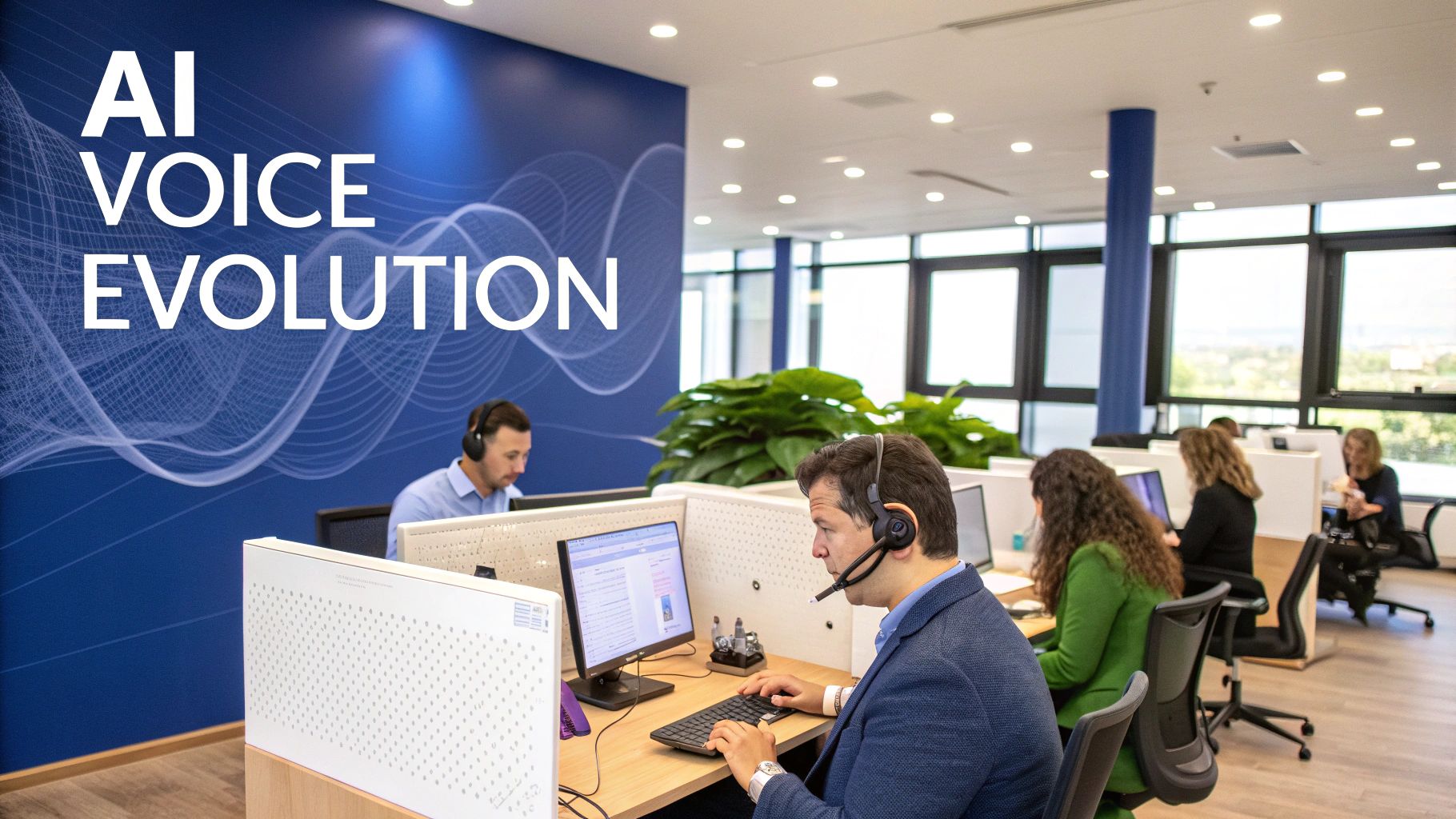
AI voice agents have come a long, long way from the rigid and infuriating phone menus we all used to dread. Those early Interactive Voice Response (IVR) systems were a painful exercise in button-mashing ("press 1 for sales, press 2 for support"), often leading nowhere but to a frustrated customer. Today’s conversational AI is a completely different beast.
These modern agents are built on powerful Natural Language Understanding (NLU) engines. This is the magic that lets them grasp not just the words a person says, but the intent behind them. They can handle complex questions and follow the thread of a conversation without getting lost, moving from simple call routers to genuine virtual team members.
From Consumer Gadgets to Enterprise Tools
While consumer gadgets like Siri and Alexa made voice commands a normal part of daily life, enterprise-grade AI agents are laser-focused on solving specific business headaches. The market for these tools is exploding, projected to climb from $20.7 billion in 2024 to an incredible $37.7 billion by 2026. For businesses upgrading from old-school phone systems, plugging AI agents into a cloud PBX like SnapDial's Hosted VoIP can slash operational costs by up to 90% and boost customer satisfaction by 35%. You can dig into these market trends in this detailed report.
This article is designed to give you a clear framework for picking the right AI voice agent for your needs. We'll show you how to connect them with your communication platforms to get real, tangible outcomes. You can also explore our collection of articles on voice AI agents to get a deeper understanding.
The core shift is from a system that directs calls to one that resolves them. A modern AI voice agent's primary goal is to handle a customer's request from start to finish, only escalating to a human when absolutely necessary.
The focus now is on business results you can see and feel. Modern AI agents are built to:
- Elevate the Customer Experience: Provide instant, 24/7 support and solve problems on the first call.
- Boost Operational Efficiency: Automate routine tasks like booking appointments or checking order statuses, freeing up your human team for more complex, high-value work.
- Enable Scalable Growth: Handle sudden spikes in call volume without having to hire more staff, ensuring your service stays consistent even during your busiest times.
How to Evaluate AI Voice Agent Platforms
Picking the right AI voice agent is a big strategic move, not just a tech purchase. To find the best fit, you need to look past the slick demos and dig into the core capabilities that actually drive results. A structured game plan ensures you choose a partner that clicks with your team's workflow, your customer service goals, and your vision for the future.
When you're sizing up potential platforms, it’s also smart to think about the bigger picture of voice communication, which includes things like choosing the best real-time language translator app if you deal with a global customer base. A holistic view ensures every part of your voice strategy is covered.
This market is absolutely exploding. The voice AI market is set to skyrocket from $2.4 billion in 2024 to an incredible $47.5 billion by 2034, largely thanks to autonomous AI voice agents. And the demand for realistic, brand-specific voices is huge, with AI voice generation expected to hit $20.4 billion by 2030. While many large companies stick with on-premise solutions for security reasons, cloud platforms like SnapDial now offer a secure, white-glove setup without any downtime. You can get a closer look at these powerful market shifts in this voice AI market analysis.
To help you organize your search, we’ve put together a simple framework. This table breaks down the key criteria into straightforward questions you should be asking every single vendor.
AI Voice Agent Evaluation Framework
Use this checklist to score potential vendors against the things that truly matter to your business. It helps you move beyond feature lists and focus on real-world performance and fit.
| Evaluation Criterion | Key Questions to Ask Vendors | Importance Level (Low/Medium/High) |
|---|---|---|
| Voice Quality & NLU | Can it handle regional accents and background noise without failing? Does the voice sound natural or robotic? | High |
| Telephony Integration | Does it support SIP for easy connection to our cloud PBX? How does it hand off calls to a human agent? | High |
| Security & Compliance | What certifications do you have (PCI DSS, HIPAA)? How is customer data encrypted and stored? | High |
| Reporting & Analytics | What specific metrics can we track? Can we see containment rates, handle times, and escalation reasons? | Medium |
| Scalability & Reliability | How does the platform handle sudden spikes in call volume? What is your guaranteed uptime (SLA)? | Medium |
| Cost & ROI | What is the pricing model (per-minute, per-call, subscription)? Are there hidden fees for setup or support? | High |
This framework isn't just about finding a vendor; it's about finding a partner. Having these clear criteria ready before you start conversations will help you cut through the sales pitches and get to the heart of what each platform can actually deliver.
Natural Language Understanding and Voice Quality
The soul of any voice agent is its ability to understand what people are saying and respond like a real person. This is all about Natural Language Understanding (NLU). A top-tier NLU engine can figure out a caller's intent, even when they ramble, have a thick accent, or have a dog barking in the background.
When you're testing platforms, throw some curveballs at the AI. See how it handles vague or ambiguous questions. Does it ask for clarification to get the conversation back on track, or does it just give up with a generic "I'm sorry, I can't help"? You’re looking for a fluid conversation, not a clunky, robotic script.
Just as important is the quality of the text-to-speech (TTS) voice. A choppy, synthetic voice can turn customers off in a second. The best platforms offer a library of high-quality, natural-sounding voices. Some even let you clone a voice to create a unique persona that perfectly matches your brand.
Telephony and Cloud PBX Integration
An AI voice agent can't operate on an island. It has to plug seamlessly into the communication tools you already use, and for most businesses, that means your cloud PBX system. This is a non-negotiable for keeping your call management unified and sane.
Look for platforms that support open standards like Session Initiation Protocol (SIP) trunking, which makes connecting to your phone system a straightforward process. The integration needs to be smart, allowing your PBX to route certain calls to the AI while sending others straight to your human team.
A critical feature to assess is the "human-in-the-loop" capability. The platform must provide a smooth, context-aware handoff from the AI agent to a live person without forcing the customer to repeat themselves. This preserves context and prevents frustration.
Security and Compliance Standards
Customer conversations often involve sensitive information, from names and addresses to credit card details. That makes rock-solid security and compliance table stakes. Your evaluation has to confirm the platform meets the standards that matter for your industry.
For instance, if you plan on taking payments over the phone, the agent must be PCI DSS compliant to protect cardholder data. If you’re in healthcare, HIPAA compliance is absolutely essential to safeguard protected health information (PHI). Don't just take their word for it—ask potential vendors for their certifications and documentation on their security protocols, like data encryption.
Reporting Analytics and Scalability
You can't fix what you can't see. The best AI voice agents come with a detailed analytics dashboard that gives you real insight into how things are performing.
Make sure you can track these key metrics:
- Containment Rate: What percentage of calls are fully handled by the AI without ever needing a human?
- First Call Resolution (FCR): How often does the AI solve the customer's problem on the first try?
- Average Handle Time: How long do AI-led calls take compared to calls with human agents?
- Escalation Rate: How often are calls passed to a live agent, and why?
Finally, think about scalability. The platform you choose should be able to handle swings in call volume without breaking a sweat. Whether it’s a predictable holiday rush or a sudden burst of growth, a scalable cloud architecture ensures your customer service stays consistent and reliable.
Comparing the Top AI Voice Agent Solutions
Picking the right AI voice agent isn't about finding a single "best" platform. It’s about finding the one whose DNA matches your specific business needs. The market is packed with impressive options, but they're all engineered to solve different kinds of problems. This comparison goes beyond a simple feature list to get at their situational strengths, helping you match the right tool to your real-world operations.
The whole decision process can feel a bit tangled, which is why a clear visual map helps. This decision tree boils the evaluation down to three critical pillars: NLU, Integration, and Security. It's designed to get you asking the right questions from the start.
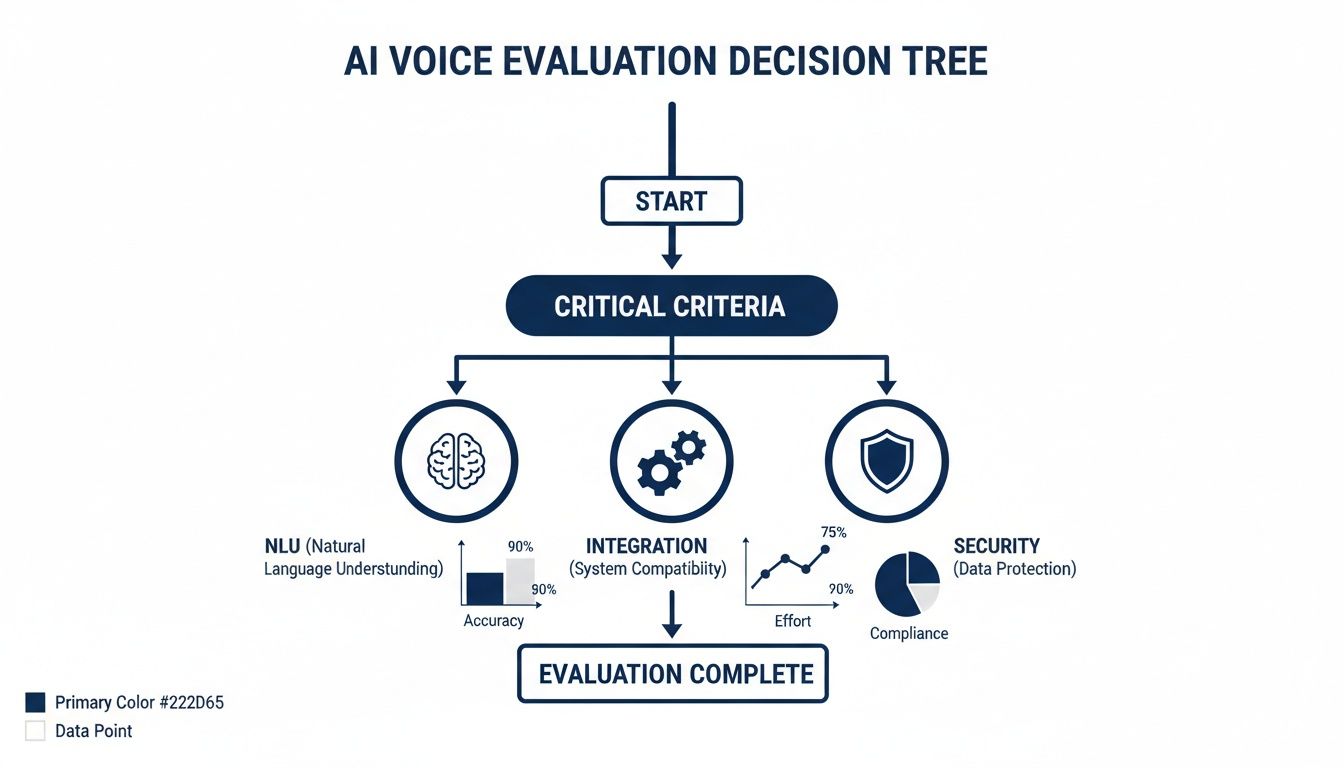
As the flowchart shows, the path to the right AI voice agent begins with your core needs, then branches out based on your technical reality and compliance demands.
H3: Google Cloud Dialogflow: The NLU Powerhouse
When your biggest challenge is understanding the messy, unpredictable ways humans talk, Google's Dialogflow is in a league of its own. It’s built on the same AI that powers Google Assistant, so its Natural Language Understanding (NLU) is simply top-tier. It has an uncanny ability to figure out what a user wants even when they phrase it in weird or unexpected ways.
This makes Dialogflow the perfect choice for businesses needing to automate conversations that don't follow a straight line. Think about a customer calling to check an order status, then pivoting to ask about a return policy, and then asking for store hours—all in one go. Dialogflow handles these conversational twists without getting tripped up, delivering an experience that feels remarkably natural.
But all that power comes with a steeper learning curve. While it has pre-built agents to get you started faster, tapping into its true potential usually requires some developer know-how. Connecting it to a cloud PBX like SnapDial via SIP for basic call handling is straightforward, but designing the sophisticated conversational flows inside Dialogflow is a much more involved job.
H3: Amazon Lex: The AWS Ecosystem Champion
For any business already running on Amazon Web Services (AWS), Amazon Lex is a no-brainer. Its biggest selling point is its dead-simple, native integration with other AWS services like Amazon Polly for text-to-speech, Lambda for serverless code, and DynamoDB for data. This lets you build a tightly knit, incredibly scalable infrastructure inside an ecosystem you already know.
Lex shines when it comes to task-oriented automation. We’re talking about things like booking appointments, resetting passwords, or handling simple transactions. Its entire structure is geared toward guided conversations where the AI needs to collect specific bits of information in a logical order. It's a pragmatic, workhorse solution for automating high-volume, predictable customer requests.
The real differentiator for Lex is its deep hook-in with the AWS stack. This allows for lightning-fast development and deployment in a familiar environment, dramatically shortening the time-to-value for teams that already have AWS skills.
The conversational chops of Lex are solid, though maybe not quite as fluid for wide-open dialogues as Dialogflow. The integration complexity with a cloud PBX is moderate, leaning on standard telephony protocols that are widely supported.
H3: NVIDIA Riva: For High-Performance, Real-Time Applications
NVIDIA Riva carves out its own space by zeroing in on high-performance, low-latency voice AI. It’s built for situations where real-time responsiveness is non-negotiable. This includes live transcription and analysis during sales calls, real-time agent assist bots that feed info to human agents mid-call, or voice-controlled apps on a factory floor. For a great overview of how AI is changing sales roles, check out this guide on AI automation for sales appointment setters.
Riva's advantage is pure speed and customizability. It lets you train custom speech recognition and text-to-speech models on your own data, which can lead to ridiculously high accuracy for industry-specific jargon or unique accents. This makes it the go-to for specialized fields like healthcare, finance, or manufacturing, where generic models often fall short.
The trade-off is complexity, and it's a big one. Deploying Riva typically requires serious in-house technical chops and dedicated GPU infrastructure. This makes it a much better fit for large enterprises or tech companies than for your average small business. It’s less of a plug-and-play tool and more of a powerful engine for building custom voice AI applications from the ground up.
Situational Strengths of Leading AI Voice Agents
To make this decision clearer, the table below maps each platform to its sweet spot, highlighting the core differentiators that should really drive your choice. It’s designed to help you move from a generic list of features to a specific recommendation based on what your company truly needs to accomplish.
| AI Voice Agent Platform | Best For (Use Case) | Integration Complexity with Cloud PBX | Key Differentiator |
|---|---|---|---|
| Google Dialogflow | Complex, multi-turn customer service conversations and open-ended queries where understanding user intent is paramount. | Moderate | Superior Natural Language Understanding (NLU) for fluid, human-like dialogue. |
| Amazon Lex | Task-oriented automation within the AWS ecosystem, such as appointment scheduling and simple transactions. | Low to Moderate | Deep, native integration with AWS services, enabling rapid development for existing AWS users. |
| NVIDIA Riva | High-performance, real-time applications like live call transcription, agent-assist bots, and custom voice models. | High | Low-latency performance and deep model customization for specialized, demanding environments. |
At the end of the day, the best AI voice agents aren't defined by a feature checklist but by how well they align with your operational reality. A small business that just wants to automate appointment booking has totally different needs than a financial firm that needs to analyze calls in real time. By focusing on your main use case and technical capabilities, you can pick a platform that delivers real value instead of a bunch of complexity you don't need.
Real-World Use Cases in Business Operations

It’s one thing to talk about the technical side of AI voice agents, but seeing them solve real, everyday business problems is when it all clicks. For small businesses and busy call centers, this isn't some futuristic fantasy. It's a practical solution to the bottlenecks that slow you down. By hooking an AI agent into your cloud PBX, you create a powerful system that never sleeps.
This isn't just a niche trend. Projections show we'll see 8 billion AI-powered voice assistants in use globally by 2026. While commerce is a big driver, the financial services sector is leading the charge with a 32.9% market share, already seeing cost reductions of 20-30%. Healthcare is on track to save a staggering $150 billion a year by 2026 through this kind of automation. For a business using a platform like SnapDial, this translates to real ROI, often hitting over 150% in the first year alone. You can explore more of these AI business statistics to get the full picture.
Implement 24/7 Customer Support Triage
One of the most immediate wins is creating a smart front door for your customer support. An AI voice agent can work 24/7, making sure no customer call ever goes unanswered, no matter the time of day. This is a complete game-changer for businesses that can't afford a round-the-clock human team.
Think of the agent as a smart triage system. It can instantly field the high-volume, repetitive questions that tie up your phone lines.
- Order Status Checks: "Where is my package?"
- Account Balance Inquiries: "What is my current balance?"
- Basic Troubleshooting: "How do I reset my password?"
When an issue is too complex, the AI agent gathers the essential info first—like an account number or the nature of the problem—and then makes an intelligent handoff. When it's integrated with a cloud PBX like SnapDial, the call is routed to the right person with all that context attached. The customer never has to repeat themselves, which boosts both efficiency and their overall happiness.
Automate Appointment Scheduling and Reminders
For any service-based business—clinics, salons, consulting firms—managing the appointment book is a constant, time-draining task. An AI voice agent can lift that entire workload off your team, cutting down on administrative overhead and minimizing costly no-shows.
The process feels natural and conversational. A customer can call and say, "I need to book an oil change for next Tuesday afternoon," and the agent checks the calendar, offers available slots, and confirms the booking without any human intervention.
This automation goes beyond just booking. The AI can be set up to send automated reminder calls or texts the day before, asking the customer to confirm, cancel, or reschedule. That simple step alone can slash no-show rates by over 30%, directly protecting your revenue.
When you link this to your cloud PBX, every appointment-related call is logged and recorded, giving you a clear audit trail and useful data on booking trends.
Streamline Outbound Lead Qualification
Your sales team's time is their most valuable asset. It should be spent closing deals, not sifting through cold leads. Too often, their day gets eaten up by the repetitive grind of lead qualification. The best AI voice agents can be deployed for outbound campaigns to handle that initial filtering.
The AI can work through a list of new leads, engaging them in a short, scripted conversation to see if they're interested and meet your basic criteria.
Example Lead Qualification Flow:
- Introduction: The AI introduces itself and your company.
- Initial Question: "Are you currently looking for a new business phone system?"
- Filtering: Based on the answer, it asks a follow-up, like, "How many employees are in your company?"
- Handoff: If the lead qualifies, the AI can schedule a call with a sales rep or transfer them directly.
This process ensures your sales team spends their time on warm, qualified prospects, which dramatically boosts their productivity and conversion rates. And with your PBX integration, you get detailed call analytics to see which scripts work best, helping you fine-tune your outreach over time.
Integrating Your AI Voice Agent with a Cloud PBX
An AI voice agent is only as good as its connection to your phone network. You can pick the most advanced AI on the planet, but if it isn't hooked into your communications setup properly, you're not getting the real value. For most businesses, that means connecting it directly to a cloud PBX system.

This isn't about ripping out your phone system and starting over. It's about making it smarter. The goal is to build one unified system where your AI and human agents can work together seamlessly, all managed from the platform you already use. Thankfully, modern cloud systems make this much simpler than it sounds. If you're new to the concept, it helps to understand how a cloud phone system works, as it’s the foundation for this kind of project.
Understanding Key Integration Patterns
The most common and reliable way to connect an AI platform to your phone network is through Session Initiation Protocol (SIP) Trunking. Just think of a SIP trunk as a digital phone line that lets voice traffic travel over the internet, linking your cloud PBX and your AI voice agent.
This setup gives you incredible flexibility. Your PBX stays the central hub for all your business numbers and call management, while the AI agent acts as a specialized endpoint, ready to jump in and handle specific tasks when needed.
The real magic here is in the call routing rules you set up in your PBX portal. You get fine-grained control to decide exactly which calls go to the AI and when. This allows you to roll things out in phases, with very little risk.
For example, you could start small by routing only your after-hours calls to the AI agent. Once you see it performing well and you're comfortable with the results, you can expand its duties to handle overflow during peak business hours or even take all initial inbound support questions.
Designing a Human-in-the-Loop Workflow
A successful AI deployment is never about getting rid of people. The smartest strategy is to design a solid "human-in-the-loop" workflow, which guarantees that a customer can get to a live person smoothly at any point in the conversation.
Nothing frustrates customers more than a dead-end AI. The integration between your voice agent and cloud PBX has to be set up for a "warm transfer," where all the context the AI has gathered gets passed along to the human agent. No one wants to repeat themselves.
Think about these critical escalation points:
- Explicit Request: The caller says a clear trigger phrase like "speak to an agent" or "I need a person."
- Failed Understanding: The AI can't figure out what the caller wants after a set number of tries (usually two or three).
- Complex Issue Detection: The AI picks up on keywords or a frustrated tone that signals a complex or sensitive problem that needs a human touch.
Unlocking a Complete View of Interactions
Hooking your AI agent into a cloud PBX does more than just route calls—it gives you a single, unified view of every single customer interaction. Your PBX becomes the central source of truth, pulling together data from both AI and human-led conversations.
This consolidation is absolutely essential for measuring performance and figuring out where you can improve.
- Unified Call Logs: See every call in one place, whether it was handled by the AI or a person.
- Comprehensive Call Recording: Record conversations with both AI and human agents for quality assurance and training.
- Advanced Reporting: Analyze key metrics like call duration, transfer rates, and first-call resolution across your entire system, not just one part of it.
This complete picture lets you see the full customer journey. You can refine your AI's conversational flows and train your human team more effectively, creating a powerful feedback loop that constantly makes your customer experience better.
Measuring ROI and Building an Adoption Roadmap
Bringing an AI voice agent into your business is a big move, and its success really boils down to one thing: connecting the investment to real, tangible results. To make the effort worthwhile, you need a clear way to measure its impact and a solid plan for rolling it out. This is how you shift the conversation from cool features to concrete business value.
The whole point is to prove that your new AI system isn't just another expense but a genuine engine for making your business more efficient and profitable. A good roadmap ensures you get from the initial "yes" to measurable success without getting sidetracked.
Defining Your Key Performance Indicators
Before you can even think about ROI, you have to define what winning looks like. The best AI voice agents will throw a ton of analytics at you, but you need to know which numbers actually matter for your operations. Zero in on the metrics that directly show you're running more efficiently and keeping customers happy.
Here are the essential KPIs you should be tracking:
- First Call Resolution (FCR): What percentage of customer problems does the AI completely solve on the first try? When this number goes up, it’s a sure sign your conversational design is hitting the mark.
- Average Handle Time (AHT): How long does the AI take to handle a call versus a person? Slicing significant time off here translates directly into cost savings.
- Containment Rate: What percentage of calls does the AI handle entirely on its own, without ever needing to escalate to a live agent? This is the true test of the AI's autonomy.
- Customer Satisfaction (CSAT) Scores: How do customers feel after talking to the AI? Simple post-call surveys are a great way to keep a pulse on this crucial metric over time.
A Simple Framework for Calculating ROI
You don't need a complicated financial model to figure out your ROI. You can build a rock-solid business case by focusing on the two biggest areas of impact: labor savings and efficiency gains. This approach gives you a clear, easy-to-defend estimate of the value your AI agent is creating.
Start by figuring out the costs your AI agent will take over. Calculate how much time your team currently spends on the exact tasks you plan to automate. Then, multiply those hours by your average loaded hourly labor rate to get your baseline cost.
The core of your ROI calculation is simple: compare your current labor costs for a specific task to the monthly cost of the AI agent handling that same work. When the savings are bigger than the subscription fee, you’ve got a positive ROI.
For instance, say your team spends 100 hours a month scheduling appointments, and your loaded labor cost is $25/hour. That single task is costing you $2,500 every month. If an AI agent can automate 80% of that work for a $500 per month subscription, your net savings are $1,500 monthly—a clear and immediate return. For more insights on this topic, you can learn how SnapDial helps deploy effective AI customer support agents.
Your Step-by-Step Adoption Checklist
A successful deployment is a journey, not a flip of a switch. This checklist gives you a structured path to follow, from the initial planning stages all the way to ongoing optimization. Following it will ensure a smooth transition and seriously boost your odds of success.
Phase 1: Planning and Vendor Selection
- Define a Specific Use Case: Start small. Pick one clear, high-impact problem to solve, like handling appointment scheduling or answering order status questions.
- Establish KPIs: Based on that use case, choose the handful of metrics you'll use to measure success.
- Evaluate Vendors: Use your criteria to size up different platforms, focusing on the quality of their NLU, how easily they integrate, and their reporting tools.
- Run a Pilot Program: Before going all-in, test your chosen solution with a small, controlled group of calls to make sure it performs as expected.
Phase 2: Implementation and Launch
5. Design the Conversation Flow: Map out the ideal script and logic for the AI, including clear and logical paths to escalate a call to a human agent.
6. Integrate with Your Cloud PBX: Get the technical side sorted. Configure the SIP trunking and set up call routing rules to send the right calls to your new AI agent.
7. Train Your Team: Get your staff up to speed on how the AI works and, just as importantly, how they should handle warm transfers coming from it.
Phase 3: Optimization and Expansion
8. Monitor Performance: Keep a close eye on your KPIs and listen to call recordings to spot any areas for improvement.
9. Refine and Iterate: Use the data you're collecting to tweak the conversational flows and make the AI more accurate and effective over time.
10. Identify New Use Cases: Once your first deployment is a proven success, it's time to find the next high-value task to automate.
Got Questions? We've Got Answers
Making the leap to an AI voice agent can feel like a big move. To help you feel confident in your decision, we’ve put together straightforward answers to the questions we hear most often from businesses just like yours.
How Hard Is It to Actually Integrate an AI Voice Agent?
Honestly, it depends almost entirely on your current phone system. If you're on a modern cloud PBX platform like SnapDial, it's often surprisingly simple. These systems are built for this stuff, usually using open standards like SIP. In many cases, it's as easy as tweaking a call routing rule in a web portal to point certain calls to your new AI agent.
If you're still running an old-school, on-premise PBX, you might face more of a challenge. These legacy systems can be rigid and sometimes require extra hardware to connect to the outside world. The smoothest path forward is making sure both your phone system and your AI platform speak the same open-standard language—it cuts out a ton of complexity.
Can an AI Voice Agent Really Sound Human?
Yes, and the technology has gotten scarily good. The best AI voice agents don't use those robotic, choppy voices from a few years ago. They run on neural text-to-speech (TTS) engines that produce voices with incredibly natural-sounding tones and inflections. The top platforms even offer a whole library of different voices, languages, and dialects to find one that perfectly matches your brand.
Beyond the voice itself, their Natural Language Understanding (NLU) has come a long way. These models are trained on massive datasets, which helps them accurately figure out what a caller wants, even if they have a regional accent or there's noise in the background. That said, you should always test a vendor’s models with real audio clips from your own customers to see how they hold up.
What’s the Typical Cost Structure?
Pricing models do vary a bit between vendors, but they almost always boil down to usage. There's no big upfront hardware cost like with old phone systems. The most common models you'll run into are:
- Per-Minute Pricing: Simple and direct. You pay for every minute the agent is actively talking to a caller.
- Per-Conversation Pricing: You’re charged a flat fee for each unique interaction the AI handles from start to finish.
- Subscription Tiers: A predictable monthly fee that includes a certain number of minutes or conversations, with overages if you go past your limit.
When you're crunching the numbers, just remember to factor in any related telephony costs, like your SIP trunking fees, and any one-time setup charges if you're doing a highly custom build-out.
How Do I Make Sure It's a Good Customer Experience?
A great customer experience comes down to two things: a smartly designed conversation and an easy escape hatch. Start small. Pick a few simple, high-volume tasks for the AI to handle first—things it can't possibly get wrong, like checking an order status or confirming business hours. This builds confidence and delivers value right away.
The most important rule? Always give callers a clear, simple way to say "speak to an agent" at any point in the conversation. A good AI agent never traps a customer. It's there to intelligently help your human agents, not replace them entirely.
From there, you just watch the data. Use the analytics from your AI platform and your cloud PBX to see how calls are flowing, spot any points where callers get stuck, and continuously tweak the agent's logic to make it better.
Ready to see how a modern phone system can serve as the perfect foundation for your AI strategy? The team at SnapDial offers white-glove setup to ensure your communications are ready for the future. Learn more about SnapDial's platform.