
When you’re running a small business, staring at a mounting phone bill while juggling missed calls is a painfully familiar story. That old landline, once a business staple, now feels like a boat anchor in a world that demands you stay light on your feet.
This is why so many businesses are making the switch to VoIP (Voice over Internet Protocol). Think of it less as a phone and more as a complete communications toolkit that lives in the cloud, ready to go wherever you are. It’s not just a tech upgrade; it’s a direct solution to some of the most common headaches that hold small businesses back.
Why Modern Businesses Are Switching to VoIP
Instead of being tethered to a desk in a physical office, your team can make and receive calls on their mobile phones, laptops, or desk phones—all from your main business number. It creates a unified, professional front for your customers, whether your team is in one office or scattered across the country.
Switching to VoIP isn't just about getting a dial tone over the internet. It's about solving real-world business problems and getting rid of the operational drag that keeps you from growing.
Solving Key Business Challenges
This move directly tackles the issues that cause the most frustration and lost revenue for small business owners.
Skyrocketing Phone Bills: Let's start with the obvious one. VoIP can slash your monthly phone costs by up to 60% compared to a traditional plan. Because the calls run over the internet, providers like SnapDial can offer predictable, all-inclusive pricing without the surprise fees for fancy features or long-distance.
Missed Opportunities: Every missed call could be a lost sale. With tools like an auto-attendant and smart call routing, every call gets answered professionally and sent to the right person, even if it's after hours. You stop losing leads and frustrating customers.
A Disconnected Team: If you have remote or hybrid employees, VoIP is the glue that holds your communication together. That one business number can ring on everyone's device, keeping the team connected and productive no matter where they're working from.
The market numbers tell the same story. The global VoIP industry hit $144.77 billion in 2024 and is on track to hit a massive $326.27 billion by 2032. And it's the small and medium-sized businesses that are leading the charge, adopting this tech even faster than big corporations. You can explore more about these VoIP market trends to see just how big this shift is.
Think of it this way: your old PBX system is like a desktop computer from the 90s—powerful for its time but ultimately stuck in one place. A modern VoIP solution is like a cloud-synced suite of apps on your phone, tablet, and laptop, giving you full access and power wherever you are.
This shift allows a small team to project the image and efficiency of a much larger company. By getting a system with advanced call management, you’re not just updating your phones; you’re building a more resilient, scalable, and customer-focused business from the ground up.
When you start digging into VoIP systems, it’s easy to get lost in a sea of features. But here’s the thing: a great phone system isn't just a list of bells and whistles; it’s a tool that solves real-world business problems. It should actively help you grow, not just provide a dial tone.
Think of it like buying a car. The base model gets you from A to B, sure. But it’s the features—the navigation, the safety systems, the hands-free calling—that make the drive smooth, productive, and stress-free.
This section is your buyer's checklist. We’ll cut through the noise and break down the non-negotiable features every small business needs, showing you exactly how they solve the daily headaches you’re probably all too familiar with.
Your 24/7 Virtual Receptionist
First on the list is the Auto Attendant, sometimes called an Interactive Voice Response (IVR) system. This is your digital receptionist, and it works 24/7 without ever taking a coffee break. It’s the tool that ensures you never miss a lead and that every single person who calls your business is greeted professionally.
Imagine a new customer calls. Instead of the phone ringing endlessly in an empty office, they hear: "Thank you for calling Citywide Plumbers. For sales, press 1. For service and support, press 2. For billing, press 3."
Right away, you project the image of a much larger, more organized company. More importantly, that simple menu gets the caller exactly where they need to go without any human legwork, setting the stage for a great customer experience from the very first second.
Smart GPS for Your Calls
Working hand-in-hand with your auto attendant is Call Routing. If the auto attendant is the receptionist, then call routing is the smart GPS that directs calls to the right person or team based on rules you create.
Let's be honest, your team isn't chained to their desks. They're on job sites, in meetings, or working from home. Intelligent call routing makes this a non-issue.
You can set up simple but powerful rules like:
- Time-of-Day Routing: Send calls to your main office during business hours, but forward them to an on-call technician's mobile phone or a dedicated after-hours voicemail at night.
- Simultaneous Ring: When a call comes in, make it ring on an employee's desk phone and their mobile app at the same time. They can answer wherever they are, without missing a beat.
- Skills-Based Routing: Got a Spanish-speaking customer? The system can automatically route their call directly to your bilingual agents, providing a seamless, personalized experience.
This graphic shows how these features contribute to the bigger picture, driving benefits that flow from cost savings all the way to a more polished and professional business image.
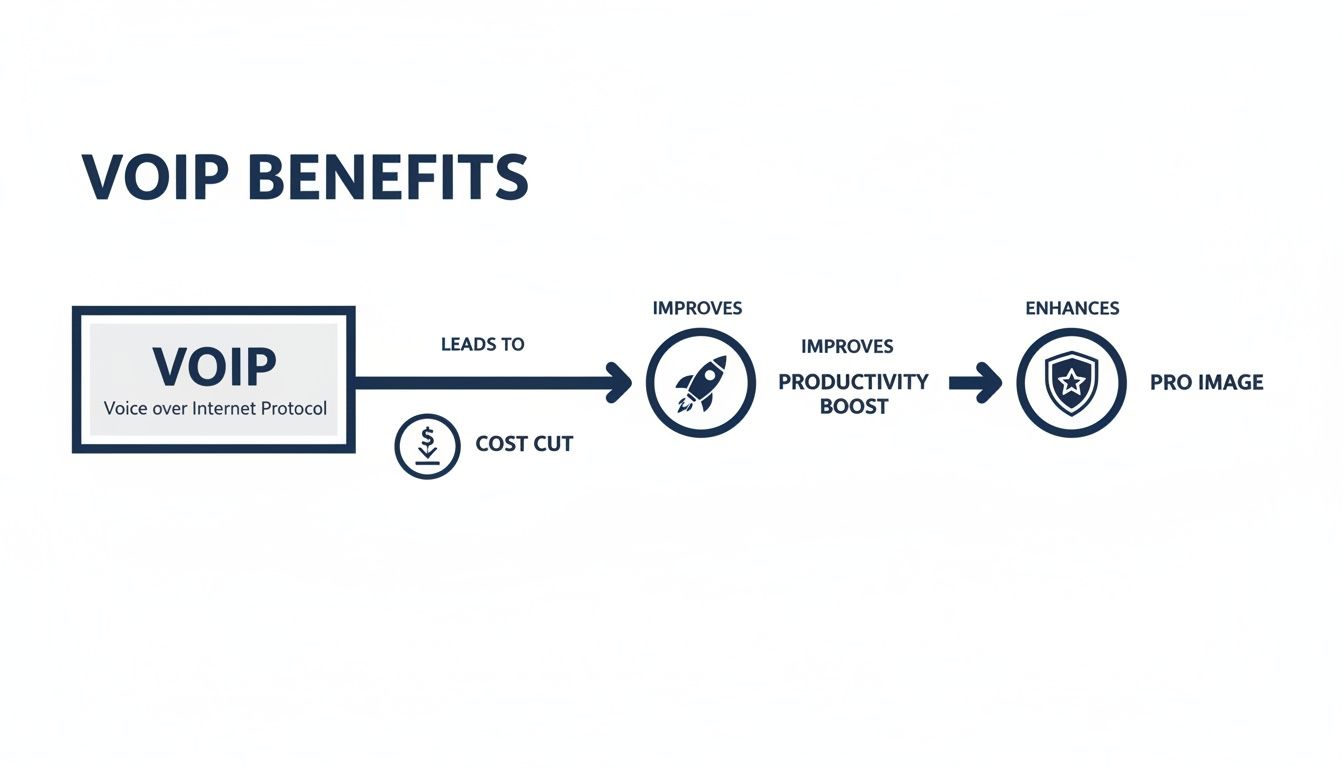
As the flowchart shows, it’s a virtuous cycle. By cutting operational costs with smart features, you can reinvest in tools that boost your team's efficiency, which in turn elevates your entire professional presence.
Tools for the Modern Mobile Workforce
In today's world, the office is wherever you happen to be. The best VoIP systems don't just tolerate this; they embrace it with powerful mobile and desktop apps. These apps effectively turn any employee's smartphone, tablet, or laptop into a full-featured extension of your business phone system.
An employee can be out on a job site and make a client call from their personal smartphone, but the customer sees the main business number on their caller ID. This maintains a professional image and, just as importantly, protects your employee's personal privacy.
But these apps do more than just make and receive calls. They are a window into your entire communications hub.
We've covered some of the most critical tools, but it's helpful to see them laid out plainly. This table breaks down the core features, what they do in simple terms, and the direct impact they have on your bottom line and daily operations.
Essential VoIP Features and Their Business Impact
| Feature | What It Is (Simple Analogy) | Key Business Benefit |
|---|---|---|
| Auto Attendant (IVR) | A digital receptionist that greets callers and offers a menu. | Projects a professional image and instantly sorts callers, reducing manual work. |
| Call Routing | A smart GPS that directs calls to the right person based on your rules. | Ensures no call is missed and customers reach the right expert quickly. |
| Mobile & Desktop Apps | Turns any smartphone or computer into a business phone. | Empowers remote work and ensures your team is connected from anywhere. |
| Visual Voicemail | An email-style inbox for your voicemails, often with text transcription. | Saves massive amounts of time and allows for quick prioritization of messages. |
| Call Recording | The ability to save a recording of a call with one click. | Critical for training, quality control, and having a record of important conversations. |
These features are not just "nice-to-haves." They are the building blocks of a modern, resilient communication system that works for your business, not against it.
When you're evaluating which VoIP system is best for your small business, these tools should be at the very top of your checklist. They are what separate a basic phone line from a true business growth engine.
How to Deliver Enterprise-Level Call Management

Getting the basics right is a solid start, but the best VoIP systems for small businesses don't stop there. They bring you powerful call management tools that used to be locked away in the massive call centers of big corporations. Now, any business can access them, letting a small team handle high call volumes like seasoned pros.
This is where you graduate from simply answering calls to strategically shaping your customer’s experience. It’s all about creating a smooth, professional journey for every caller, which pays off in stronger customer loyalty and a much better reputation. Let's dig into how these advanced features actually work.
Smart Queue Management for VIP Treatment
Think of a call queue as a digital waiting room. When your whole team is tied up, callers line up to be answered in the order they arrived. Smart queue management, however, is like having a virtual velvet rope that lets you give your best customers the A-list treatment.
You can set up priority rules that automatically bump calls from your most important clients right to the front of the line. They get fast-tracked to the next available agent every time. It’s a small touch that shows your key accounts you value their business, turning a routine call into a real relationship-builder. To see how calls are sent to the right place, you can read our guide on call routing for a deeper dive.
This level of control ensures your most critical calls never get left waiting.
Smart queue management is less about making people wait and more about intelligently organizing the wait itself. By prioritizing calls based on customer value or urgency, you turn a potential point of friction into an opportunity to deliver exceptional, white-glove service.
Respecting Customer Time with Queue Callback
Nobody enjoys being stuck on hold, listening to the same scratchy music on a loop. The Queue Callback feature is the perfect antidote. Instead of forcing someone to wait, the system offers them the option to hang up, keep their place in line, and get an automatic call back the second it's their turn.
For the customer, this is a total game-changer. They can get on with their day, trusting that you’ll reconnect with them promptly. This simple feature shows you respect their time—a gesture that leaves a powerful, positive impression.
This kind of customer-first thinking is a huge reason small businesses are flocking to VoIP. In fact, 78% of US small businesses have already made the switch, using features like queue callback to slash call abandonment rates by as much as 30%. You can discover more insights about VoIP adoption trends on Brightlio and see how it’s changing the game.
Turning Data into Better Service
How can you improve your customer service if you have no way to measure it? Modern VoIP platforms give you real-time dashboards and detailed reports that transform your raw call data into insights you can actually use.
These analytics tools hand you a crystal-clear picture of your entire call operation, including:
- Average Wait Times: See exactly how long customers are on hold before they talk to a real person.
- Peak Call Hours: Pinpoint your busiest times of day so you can make sure you're staffed appropriately.
- Agent Performance: Track key metrics like call duration and the number of calls each agent handles.
With this information, you can stop guessing and start making data-driven decisions. If wait times are creeping up on Monday mornings, you can adjust your schedule. If a new agent is struggling, you can use call recordings for targeted coaching. This turns your support team from a cost center into a powerful engine for keeping customers happy and driving growth.
Understanding VoIP Pricing and Avoiding Hidden Fees
When you're shopping for the best small business VoIP, the sticker price is just the beginning. You need to look deeper to make a smart financial decision. You’ll find a few different pricing structures out there, and getting a handle on them is the key to avoiding nasty surprises on your monthly bill.
Think of it like choosing a cell phone plan—you have to know your team's real-world usage to find the best value.
A lot of providers use a simple per-user, per-month plan. This model is like an all-inclusive buffet. You pay one flat fee for each employee, and they get full access to everything: unlimited calling, mobile apps, an auto-attendant, the works. It’s predictable, easy to budget for, and perfect for businesses that don't want to worry about overage charges.
Then there’s the other side of the coin: metered or usage-based plans. This is more like ordering from an à la carte menu. The base fee per user might seem lower, but you pay for what you actually use—every minute for outbound calls, every premium feature you turn on. This can work for teams with incredibly low call volumes, but the costs can add up fast if your usage suddenly spikes.
The Two Main Pricing Models
To make the right call here, you need to be honest about how your team communicates.
- Per-User Plans: These are ideal for businesses with pretty consistent call volumes or for anyone who just wants a predictable bill every month. You pay one flat rate per person, and everything's included. Simple.
- Metered Plans: This option can be a better fit for companies with very low or sporadic call needs, where paying by the minute ends up being cheaper than a flat-rate plan.
For most growing small businesses, the predictability of a per-user plan is a huge win. It takes the guesswork out of budgeting and guarantees you have all the tools you need without constantly watching the clock. To see how these plans are built, you can explore the details of a hosted VoIP seat and get a feel for what’s typically included.
Watch Out for Hidden Costs and Gotchas
The price you see advertised rarely tells the whole story. Some providers will bait you with a low monthly rate, only to tack on a bunch of extra fees that inflate your final bill. Knowing what these potential "gotchas" are is the only way to calculate the true total cost of ownership.
A low advertised price can be incredibly misleading. Always insist on a full, detailed quote that breaks down every single potential fee, from one-time setup charges to ongoing monthly taxes. Transparency is the mark of a provider you can actually trust.
Keep a sharp eye out for these common hidden fees:
- Setup and Implementation Fees: Believe it or not, some companies will charge you hundreds or even thousands of dollars just to get your system up and running. A great provider will handle the entire "white-glove" setup and team training at no extra cost.
- Number Porting Charges: Of course, you’ll want to keep your existing business number. While most providers help with this, some will slap you with a fee for every single number you transfer over, which can really add up if you have multiple lines.
- Hardware Costs: Are you going to need new IP phones? Some providers lock you into buying their expensive, proprietary hardware. Others offer much more flexible and affordable rental options or simply let you use your existing compatible phones.
- Premium Support Fees: Watch out for tiered support models. A cheap plan might only give you access to email support, forcing you to pay a premium to talk to a real person on the phone when something inevitably goes wrong.
The VoIP market is booming—it's forecasted to swell from $161.79 billion in 2025 to a massive $415.20 billion by 2034—and that growth is fueled by how much money it saves small businesses. In 2023, over 60% of businesses were using VoIP, and they were saving an average of 40-60% compared to their old landlines. You can discover more insights about VoIP's market impact to see why it's such a financial game-changer. But to actually realize those savings, you have to choose a provider with transparent, all-inclusive pricing. By digging into the fine print, you can find a plan that delivers powerful tools without the hidden financial traps.
How to Plan Your Migration to a New VoIP System
The idea of ripping out and replacing your business phone system can be daunting. I get it. Worries about service disruptions, dropped calls, and the chaos of training your whole team are perfectly valid. But making the switch to a modern VoIP system doesn't have to be a business-stopping nightmare.
With a good plan and the right partner, the whole thing can be a smooth, zero-downtime event.
Think of it like moving to a better office. You wouldn't just pack up and show up on the first day hoping for the best. You'd tour the new space, plan the layout, and have everything set up before your team walks in. A smart VoIP migration follows the same logical steps, turning a complex project into a completely managed, stress-free transition.
A quality provider will walk you through this exact journey, making sure every last detail is handled before your old system is ever turned off. Here’s a look at what that roadmap should look like.
Phase 1: The Audit and Network Check
First things first: you need a crystal-clear picture of your current setup. This isn't just about counting phones; it’s about understanding how your business actually communicates. A good provider will sit down with you to map out your call flows, pinpoint key personnel, and document every single one of your existing phone numbers.
At the same time, they'll check your network's readiness. VoIP calls rely on a stable internet connection—but not necessarily a blazing-fast one. Simple tests can quickly confirm your network can handle crystal-clear HD voice quality without any hiccups. Getting this check done early prevents headaches and call quality issues down the line.
Phase 2: Planning and Number Porting
With a clear audit in hand, the real planning begins. This is where your new phone system gets built out entirely in the background, completely separate from your live service. Your call routing rules, auto-attendant greetings, and user accounts are all configured and tested ahead of time.
This phase also kicks off number porting—the critical process of moving your existing phone numbers over to the new service.
For most businesses, keeping your main phone number is non-negotiable. A reputable VoIP provider manages this entire porting process for you, coordinating directly with your old carrier to guarantee a seamless transfer with zero loss of service. This isn't an extra; it's a standard part of any professional migration.
The porting itself is timed perfectly to happen on your launch day, ensuring your numbers switch over the very moment your new system goes live.
Phase 3: White-Glove Setup and Go-Live
This is where you see the difference between a great provider and just another vendor. A "white-glove setup" means their expert team handles the entire technical process for you, often at no extra charge. They don't just ship you a box of phones with a user manual and wish you luck.
This hands-on service means they do the heavy lifting:
- Pre-Configuring Hardware: Any new IP phones show up at your office already programmed. All you have to do is plug them in.
- Onboarding and Training: Their team walks your staff through everything—from using the new desk phones to the mobile apps—making sure everyone is comfortable and confident on day one.
- Go-Live Support: On the day of the switch, their support team is on standby, ready to handle any questions and make sure the cutover is flawless.
Choosing a provider that includes this end-to-end service is a total game-changer. It takes the technical burden completely off your plate and ensures a professional, zero-downtime launch. This methodical approach is what makes sure your search for the best small business VoIP ends with a successful and surprisingly stress-free upgrade.
How to Choose the Right VoIP Provider
You’ve seen what a modern VoIP system can do and which features really move the needle. Now for the final step: pulling it all together to pick a long-term partner for your business communications.
Choosing the best VoIP provider for your small business goes way beyond a simple price comparison. It’s about finding a partner who will be there to support your growth, not just sell you a service and disappear. A cheap plan from an unreliable vendor can end up costing you a fortune in lost customers and nonstop frustration.
The right choice is a provider that feels like an extension of your own team, delivering rock-solid performance and expert help whenever you need it. Let's use this final framework to size up your options and make a decision you can feel good about.
Prioritize Service Reliability and Uptime
Your phone system is your business's lifeline. Reliability isn't just a feature; it's non-negotiable. The first thing you should look for is a provider that offers a financially backed Service Level Agreement (SLA). A solid SLA will guarantee uptime, typically promising 99.999% availability.
This isn't just some marketing buzzword; it's a binding contract. If the service doesn't meet that uptime promise, the provider is obligated to compensate you. This commitment shows they have real skin in the game and are truly confident in their network's stability.
An SLA is the ultimate proof of a provider’s commitment to reliability. It moves the conversation from vague promises of "good service" to a concrete, measurable guarantee of uptime that you can depend on.
Evaluate the Quality of Customer Support
When something goes wrong—and eventually, it will—you need fast, effective help from actual people. A lot of providers cut corners here by outsourcing their support overseas or hiding it behind frustrating chatbots and email-only forms. That’s a huge red flag.
Look for a provider that offers:
- 24/7 US-Based Support: Problems don’t just happen between 9-to-5. Around-the-clock access is critical for getting issues fixed quickly, no matter when they pop up.
- In-House Experts: A dedicated, in-house support team (like SnapDial's Texas-based center) means you’re talking to people who know the system inside and out, not just someone reading from a script.
- Multiple Contact Methods: You should be able to get help by phone, email, or live chat. This gives you the flexibility to reach out in the way that makes the most sense for your situation.
Vet Their Security and Compliance Protocols
Your business conversations are full of sensitive information. Any VoIP provider worth your time must make security a top priority. This means using robust measures like Transport Layer Security (TLS) and Secure Real-time Transport Protocol (SRTP). These protocols encrypt your call data, protecting your communications from anyone trying to listen in.
But it goes beyond just encryption. Ask potential vendors about their data center security, their redundancy measures, and how they comply with industry standards. As you get ready to make the switch, it's also a good time to look at your own setup. Crystal-clear calls and uninterrupted service depend on a solid internet connection. To make sure your network is up to the task, check out the best business internet providers available today.
By zeroing in on reliability, support, and security—not just the monthly price—you can confidently choose a VoIP provider that will act as a true partner. For a side-by-side look at how top providers stack up against these criteria, you might be interested in our small business phone system comparison guide.
Got Questions? We've Got Answers
Making the final call on a new phone system can feel like a big step. To help you feel confident in your choice, we’ve put together straightforward answers to the questions we hear most often from businesses just like yours.
Can We Keep Our Existing Business Phone Numbers?
Yes, absolutely. You don't have to give up the numbers your customers already know and trust. The process is called number porting, and it’s a standard, regulated procedure that lets you move your current local and toll-free numbers to your new provider.
A good provider will handle the entire porting process for you. Their job is to make sure the switch happens behind the scenes with zero downtime, so your customers won't even notice a change.
What Kind of Internet Connection Do I Need?
You don't need to splurge on a specialized, ultra-fast internet plan. Modern VoIP is incredibly efficient and works great on the standard business broadband you likely already have, like fiber or cable. What matters most isn't raw speed, but a stable and reliable connection.
As a rule of thumb, each person on a call at the same time uses about 100 Kbps of bandwidth. A quality provider can help you run a quick network test to confirm your connection is ready to deliver crystal-clear HD voice from day one.
This means even a modest business internet plan can easily support a small team making calls simultaneously. The key is to have a solid internet service provider to keep your call quality flawless.
Just How Secure Is a Cloud-Based Phone System?
This is a big one, and the short answer is: very secure. Reputable cloud phone providers invest heavily in security measures that are often far more advanced than what a typical small or mid-sized business could manage on its own.
Think of it in layers:
- Call Encryption: They use protocols like TLS and SRTP to scramble your conversations, making them unreadable to anyone trying to eavesdrop.
- Fortified Data Centers: The infrastructure is housed in facilities with backup power, redundant connections, and tough physical and digital security.
These measures work together to keep your business communications private, safe, and reliable—often making a cloud system more secure than an old PBX box sitting in a closet. When choosing the best small business VoIP, always ask a provider about their specific security protocols.
Ready to upgrade to a phone system that saves you money and empowers your team? With SnapDial, you get all-inclusive pricing, enterprise-grade features, and a 24/7 Texas-based support team. Discover how SnapDial can transform your business communications.