When you start comparing business phone systems, one thing becomes clear pretty quickly: modern cloud-based VoIP systems are simply more flexible and scalable than traditional, on-premise hardware. The choice really comes down to this: do you want a predictable monthly subscription packed with modern features, or are you prepared for a large upfront investment that comes with ongoing maintenance headaches?
How to Choose Your Next Business Phone System
Feeling overwhelmed by the sheer number of phone system options out there? Let's cut through the noise. The real decision for most businesses today isn't just about picking a provider. It's about choosing the right type of technology to support your team now and for years to come. There’s a good reason the market is moving away from clunky, old-school hardware.

The global market for business phone systems is booming. It's expected to rocket from USD 22.75 billion in 2025 to a massive USD 44.39 billion by 2034. This explosion is almost entirely driven by businesses switching to the cloud, which is growing three times faster than on-premise solutions. The proof is in the results, too—companies using mobile-ready VoIP see 62% higher productivity from their remote teams. If you want to dig into the numbers, check out this detailed industry research on business phone systems.
This guide will help you evaluate your two main options: sticking with an on-premise PBX or moving to a hosted VoIP solution like SnapDial. Getting a handle on their core differences is the first critical step toward a smart investment.
The real comparison isn't just about features; it's about Total Cost of Ownership (TCO). Cloud systems transform a hefty capital expense into a manageable operating expense, freeing up capital for growth.
An on-premise system means you buy, house, and maintain all the physical server hardware yourself. You get direct control, sure, but you also burden your IT team with constant upkeep, updates, and troubleshooting. A cloud-based system, on the other hand, gets rid of the hardware headache completely. The provider manages everything in their secure data centers and delivers phone service right over your internet connection. This gives you far more flexibility, built-in reliability, and instant access to a suite of modern communication tools.
On-Premise vs. Cloud Phone System At a Glance
To make this initial decision easier, let's break down the fundamental differences between the two approaches. This quick comparison shows how each system stacks up against key business needs, from the initial investment to supporting a modern, distributed workforce.
| Evaluation Criteria | On-Premise PBX | Cloud-Based VoIP (e.g., SnapDial) |
|---|---|---|
| Initial Cost | High (hardware, installation, licensing) | Low to none (subscription-based) |
| Maintenance | In-house IT or vendor contract required | Managed entirely by the provider |
| Scalability | Complex; requires new hardware/licenses | Simple; add or remove users instantly |
| Remote Work | Limited; often requires complex VPNs | Natively supported via mobile & desktop apps |
| Features | Basic calling; advanced features are costly add-ons | All-inclusive (IVR, recording, analytics) |
| Reliability | Dependent on your infrastructure & power | Guaranteed uptime via redundant data centers |
As you can see, the operational models are worlds apart. One requires you to become a phone system expert, while the other lets you focus on your business while the provider handles the tech. For most small and mid-sized businesses, the agility and predictable costs of a cloud solution make it the clear winner.
How to Actually Compare Business Phone Systems
Before you even start looking at providers, you need a solid game plan. The right choice comes from having a clear framework for what you actually need. Think of it as building a scorecard to objectively size up each vendor and find the system that truly fits how your business operates.
It's easy to get lost in a sea of features. But a great phone system isn't just a list of bells and whistles; it’s a tool that solves real problems. Let’s break down the core pillars you should use to measure every potential solution.
Core Calling Features and Functionality
At its heart, a phone system has to manage calls well. That sounds obvious, but modern businesses need much more than just a dial tone to handle communication professionally.
You should be looking for these essentials:
- Auto-Attendant (IVR): This is your digital receptionist. It greets callers and gets them to the right place (e.g., "Press 1 for Sales, Press 2 for Support"). Without it, callers can get lost in the shuffle.
- Advanced Call Routing: This is the logic that directs calls based on things like business hours, who's available, or even where the call is coming from. It's what stops you from missing opportunities and keeps customer wait times down.
- Call Recording and Transcription: Absolutely critical for training, quality control, and even compliance. Getting voicemails transcribed so your team can read them on the go is a huge boost for responsiveness.
These are the features that separate a basic phone line from a real business communication platform. If you want to understand the technology behind all this, it helps to know how a Private Branch Exchange (PBX) works. You can find a great guide on what a PBX system is and see how it’s changed over the years.
Pricing Models and Total Cost of Ownership
Pricing can be tricky. A low monthly sticker price can easily hide extra costs for features you can't live without, overage fees, or equipment you’re forced to rent. To compare phone systems properly, you have to look at the Total Cost of Ownership (TCO).
Generally, you'll run into two main pricing models:
- Capital Expenditure (CapEx): This is the old-school way, common with on-premise systems. You make a big upfront investment in hardware and then pay for ongoing maintenance.
- Operational Expenditure (OpEx): This is the standard for cloud-based VoIP. It’s a predictable monthly or annual subscription, usually per user.
Don't just look at the per-user price. You have to ask about setup fees, charges for moving your numbers over, taxes, and any extra costs for add-ons like call recording or analytics. An all-inclusive price usually delivers much better value in the long run.
Reliability and Uptime Guarantees
Your phone system is a lifeline. If it goes down, your business stops. A reputable provider will offer a Service Level Agreement (SLA) guaranteeing uptime, often 99.999%, which means just a few minutes of potential downtime in an entire year.
Ask vendors about their infrastructure. Do they have redundant data centers? That’s key. It means if one of their locations has a problem, your service automatically switches to another one, so your team and your customers never notice a thing.
Customer Support and Implementation
When something goes wrong, you need help now. Take a hard look at a provider’s support options—phone, chat, email—and their hours. 24/7 availability should be the standard. A US-based support team can also make a huge difference in getting clear, fast solutions.
Also, think about the setup process. A provider that offers a "white-glove setup" is a lifesaver. They'll handle the entire migration for you, from porting your existing numbers to configuring how your calls flow. For any business without a dedicated IT department, this kind of hands-on service is worth its weight in gold.
A Detailed Comparison of Leading Phone Systems
Now that we have a solid framework for evaluation, let's put these phone systems head-to-head. When you move past the marketing jargon and feature lists, you start to see how different systems actually solve real-world business problems. The contrast becomes especially stark when you compare old-school hardware with a modern cloud platform like SnapDial. This comparison will stick to the criteria that truly matter: your budget, your team's efficiency, and your customers' experience.
At its core, the difference comes down to philosophy. On-premise systems were built for a time when everyone worked from a single office. Cloud solutions, on the other hand, are designed from the ground up for the flexibility that modern businesses need to thrive.
H3: Pricing Models: The True Cost of Ownership
The most obvious difference between these systems is how you pay for them, a factor that shapes your entire technology budget. A traditional on-premise PBX is a capital expenditure (CapEx). You buy the hardware, pay a technician to install it, and you own it—for better or worse.
Owning the hardware sounds good on paper, but the hidden costs can be staggering. Traditional landlines and on-premise setups often require a massive upfront investment. We're talking $50,000+ just to get a 50-user system up and running with all the necessary hardware.
Cloud VoIP, and specifically a provider like SnapDial, completely flips this model. You get all-inclusive pricing, white-glove setup at zero cost, and unlimited lines, which typically cuts ongoing communication costs by 30-60%. For a closer look at these numbers, you can find more about these cost-saving benchmarks on datainsightsmarket.com.
A key differentiator is predictability. An all-inclusive cloud subscription wraps hardware, software, maintenance, and support into one fixed monthly fee, eliminating surprise repair bills and costly upgrade cycles.
Many basic VoIP providers lure you in with a low entry price but operate on an à la carte model. Need call recording, analytics, or a digital receptionist? Those are often expensive add-ons. This makes budgeting a nightmare, as your monthly bill can swing wildly depending on your needs.
In stark contrast, an all-inclusive solution like SnapDial gives every user the full suite of enterprise-grade features for a single, predictable price. This approach not only simplifies financial planning but also ensures your team has the tools they need to succeed without you having to worry about extra charges.
H3: Feature & Cost Comparison Matrix
To make these differences crystal clear, let's break down how each system type stacks up across key features and cost considerations. This matrix highlights the practical trade-offs you make with each choice.
| Feature/Criteria | Legacy On-Premise PBX | Basic VoIP Provider | All-Inclusive Cloud Solution (SnapDial) |
|---|---|---|---|
| Initial Cost | Very High (Hardware + Installation) | Low to None | $0 (White-glove setup included) |
| Pricing Model | Capital Expenditure (CapEx) | Operational (OpEx), often à la carte | Fixed, All-Inclusive OpEx |
| Maintenance | On-site, requires specialized tech | Limited to provider's core network | Fully managed by provider |
| Call Center Tools | Rudimentary or non-existent | Basic Queues (often an add-on) | Advanced Queues, Callback, Analytics |
| Scalability | Difficult & expensive (buy new hardware) | Easy, but features cost extra | Seamless & instant, features included |
| Mobile App | Not available | Basic functionality | Fully-featured, mirrors desk phone |
| Security | Managed in-house (your responsibility) | Provider-level, varies by vendor | End-to-end encryption, redundant centers |
| Support | Third-party vendor contracts | Self-service, ticket-based | Dedicated setup team & ongoing support |
As the table shows, the all-inclusive model removes the hidden costs and feature gaps that often catch businesses by surprise, offering a much more complete and predictable solution right out of the box.
H3: Call Center Features: Basic Queues vs. Intelligent Routing
For any business that handles a steady stream of inbound calls, call center functionality isn't a luxury—it's essential. This is where the gap between system types widens into a chasm.
A legacy PBX offers the most basic form of call distribution, usually just sending a call to the next person in line. It has no intelligence for managing high call volumes, which leaves customers stuck on hold with no idea when they'll be helped.
Many entry-level VoIP providers offer a slight improvement with simple call queues. But they rarely give you the tools to actually manage the customer experience or measure your team's performance in a meaningful way.
This is a critical point of comparison. Advanced platforms like SnapDial provide a full suite of call center tools that have a direct, positive impact on customer satisfaction and operational efficiency. These include:
- Smart Queue Management: You can prioritize calls based on rules you define, making sure your most important customers get through faster.
- Queue Callback: Give callers the option to hang up and get a call back when an agent is free. This simple feature drastically reduces frustration and has been shown to lower call abandonment rates by 25%.
- Real-Time Analytics: Supervisors get a live dashboard to monitor call volumes, wait times, and agent status. This allows them to make on-the-fly adjustments to improve service levels instantly.
This kind of functionality turns your support or sales team from a group that just reactively answers calls into a proactive, data-driven operation.
H3: Security and Reliability: Protecting Your Lifeline
Your phone system is a critical piece of your business infrastructure, and its security can't be an afterthought. With on-premise systems, the entire security burden falls squarely on your IT team.
They have to maintain the firewalls, constantly update software to patch vulnerabilities, and physically secure the server hardware. This demands a level of constant vigilance and specialized expertise that many small and mid-sized businesses just don't have in-house.
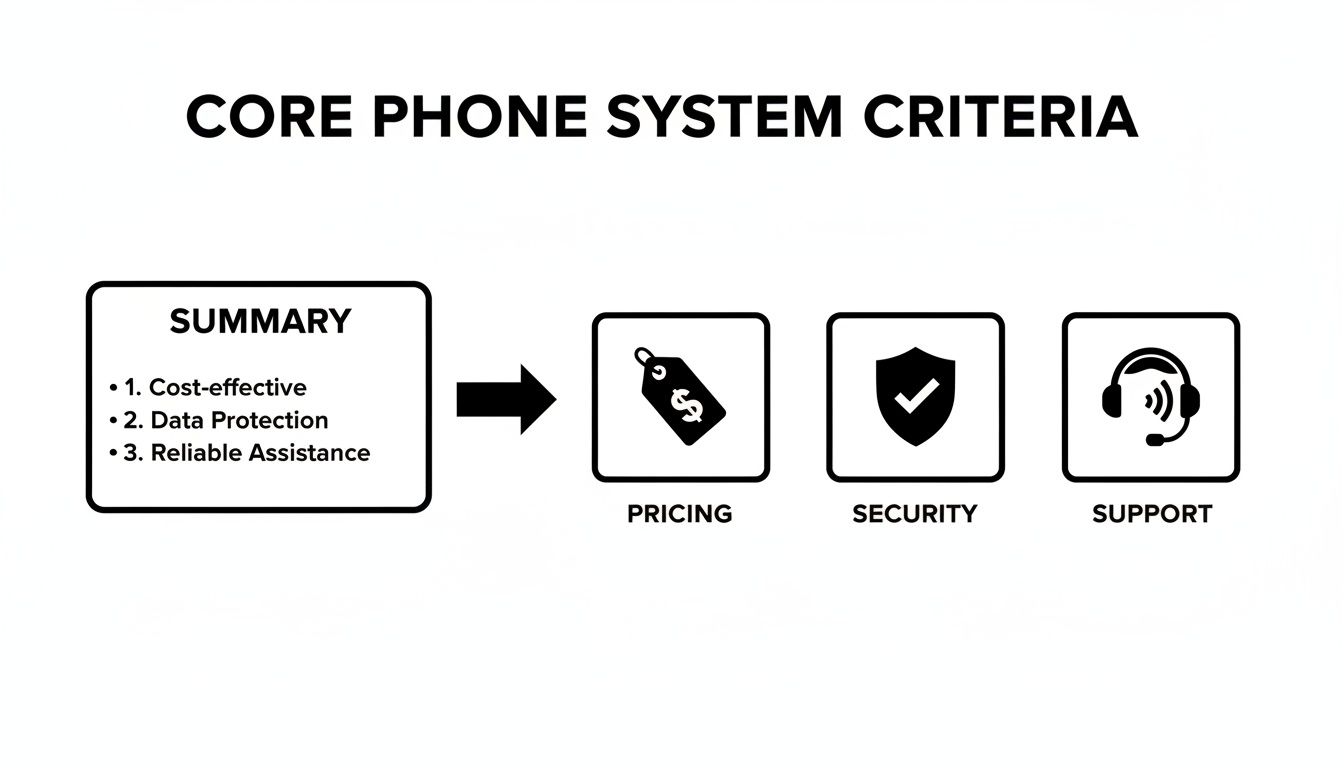
As this graphic shows, a truly reliable system is a careful balance of cost, robust data protection, and easy access to expert help when you need it.
Cloud providers, especially those focused on the business market, invest heavily in security measures that are far beyond the reach of most individual companies. We're talking about end-to-end call encryption, secure data centers with redundant power and connectivity, and 24/7 proactive threat monitoring.
For a deeper dive into the technical side of things, our guide on hosted VoIP vs on-premise PBX breaks down the architecture behind each system. Choosing a provider with a strong security posture means you're effectively outsourcing a complex and critical responsibility to the experts.
H3: Implementation and Support: The White-Glove Difference
Getting a new phone system up and running can be a massive undertaking. With a legacy system, implementation is a hands-on, often disruptive process. It involves running wires, installing hardware, and having a specialized technician spend hours on-site doing the configuration.
Even some cloud providers go with a "do-it-yourself" model. They'll ship you a box of phones and a link to their help articles, leaving your team to figure out the rest. This often leads to a rocky start, with calls going to the wrong place and frustrated employees.
This is where a premium cloud provider like SnapDial stands out by offering a "white-glove setup" service at no extra cost. For a business without a big IT department, this is a total game-changer. A dedicated team manages the entire migration for you, including:
- Number Porting: They seamlessly move your existing phone numbers over without any downtime or missed calls.
- System Configuration: They work with you to set up your auto-attendant, call queues, and routing rules to match your exact business workflow.
- Team Onboarding: They make sure every single employee knows how to use the new system from day one.
This hands-on approach guarantees a smooth transition and ensures your system is perfectly optimized for your business from the moment you switch it on. You get to see the full value immediately, without the usual implementation headaches. In any business phone system comparison, this level of support is a crucial differentiator.
Finding the Right Phone System for Your Business Model
The "best" phone system isn't about having the most features; it's about having the right features for the way you actually work. When you're comparing business phone systems, you need to look past the sales pitches and think about the real-world problems you're trying to solve. Is your team spread out? Are you handling a flood of customer calls? The right platform solves your specific communication headaches.
Let's walk through four common business scenarios. For each one, we'll pinpoint the unique challenges they face and show how an all-in-one cloud system like SnapDial is often the perfect fit, tying back to the capabilities we've already discussed.
The Multi-Location Enterprise
If your business has offices in different cities or states, you’re probably fighting a constant battle against communication silos. Separate phone lines for each location can feel disjointed for customers and make it a real chore for employees to collaborate. The main goal is to create one unified presence, no matter where your team or your customers are.
This is where a cloud-based VoIP system becomes absolutely essential. It’s not just an upgrade; it’s a strategic shift.
- A Single Face to the World: You can have one main business number that intelligently routes calls to any office. An auto-attendant can greet callers with a simple menu ("Press 1 for our East Coast office, Press 2 for the West Coast"), creating the feel of a single, national company.
- Effortless Internal Calls: Employees can dial a simple 4 or 5-digit extension to reach a colleague across the country, just like they were down the hall. This simple change tears down communication barriers and helps build a more connected culture.
- Manage Everything from One Place: An IT manager can add a new user in a new office in minutes from a single web portal. There's no need to send a technician out or buy a new piece of hardware for that location.
Trying to achieve this with an old-school PBX system would be a nightmare of complex networking and sky-high costs. A cloud solution like SnapDial puts every location under one virtual roof.
The High-Growth Startup
Startups live and breathe rapid change. You might double your team in a single quarter or pivot your entire strategy overnight. What you need most is agility. A phone system that demands a huge upfront investment or locks you into a rigid contract is more of a liability than an asset.
For a fast-growing company, it all comes down to scalability. A cloud phone system is built for exactly this kind of environment.
For a startup, tying up capital in on-premise hardware is a strategic error. A subscription-based cloud system preserves cash flow for what matters most: hiring, product development, and market expansion.
Instead of buying a new phone server when the team grows, you just add another user license with a few clicks. This "pay-as-you-grow" approach means your communication costs scale perfectly with your revenue and team size. Plus, with mobile apps, new hires can be up and running with a business line on their personal smartphone from day one—no desk required.
The Customer-Centric Call Center
For any business with a dedicated support team or call center, every call is a make-or-break moment. The daily challenges are all about efficiency, customer happiness, and tracking performance. Dropped calls, long hold times, and having no data on how agents are doing can hit your revenue and reputation hard.
This is where the advanced call center features baked into platforms like SnapDial are indispensable. Many basic VoIP providers either don't have these tools or charge a premium for them.
A truly powerful call center solution delivers:
- Smart Queue Management: This isn't just a first-come, first-served line. Calls are routed intelligently to the right agent or department based on skill, availability, or other rules you set. Callers get to the person best equipped to help them, faster.
- Queue Callback: Giving callers the choice to get a call back instead of sitting on hold is a game-changer for customer experience. This feature alone can cut down on abandoned calls by over 25%.
- Real-Time Analytics: Supervisors need a live dashboard to see wait times, active calls, and agent status at a glance. This allows them to make instant adjustments, like moving agents to a busy queue, to keep service levels high.
These tools transform a support desk from a necessary expense into a data-driven machine for keeping customers happy.
The Remote-First Company
A fully distributed company lives and dies by its communication tools. When your team is scattered across different cities and time zones, a phone system has to do more than just place calls. It has to be a rock-solid, mobile-first platform that keeps everyone connected and productive.
The biggest hurdle is maintaining a professional, consistent experience when there's no central office. A modern cloud system with great mobile capabilities is really the only way to go.
Employees can use a dedicated mobile app that turns their personal smartphone into a full-featured business phone. They can make and take calls from their business number, check voicemail, and transfer calls to colleagues—all while their personal cell number stays private. This freedom ensures that even when people are on the move, they sound professional and are always reachable, solidifying the company’s image and keeping business running smoothly.
How to Plan Your Migration to a New System
Thinking about switching your business phone system can feel overwhelming. I get it. But moving from an old, clunky setup to a modern cloud VoIP solution doesn't have to be a headache that grinds your business to a halt. The secret is having a solid, step-by-step plan.
A smooth transition is all about mapping out the journey before you take the first step. This means taking a hard look at your current setup, figuring out the logistics of transferring phone numbers, and getting your team ready. A little forethought here ensures you start reaping the rewards of your new system right away, without any painful downtime.

Audit Your Current Infrastructure
First things first: you need a crystal-clear picture of what you have now and what your new system will demand. This initial audit is the bedrock of a successful migration. It's where you spot potential issues early on and confirm your network is actually ready for high-quality voice calls.
Get started by taking inventory of your assets and network:
- Existing Phone Numbers: Make a master list of every single number you need to bring over. This includes your main business line, direct dials for staff, and any toll-free numbers. Don't miss a single one.
- Current Hardware: Jot down all your desk phones, conference room phones, and any other related gear. You'll need to check if your existing IP phones will play nice with the new system or if you need to budget for new hardware.
- Network Readiness: The quality of a VoIP call lives and dies by your internet connection. A quick bandwidth test is absolutely essential to make sure you have the juice for clear, reliable calls. We've got a guide to help you find out how much bandwidth you need for VoIP.
This audit gives you the raw data you need to put together a realistic timeline for the switch.
Map Your Call Flows and User Needs
Next, it's time to think about how you want calls to flow through your business. And here's a pro tip: don't just copy your old system's logic. This is your chance to make things better. Map out the perfect journey for every caller, from the moment they dial your number to the moment they hang up.
Ask yourself and your team a few key questions:
- How should the auto-attendant greet people? What options should it offer to get them to the right place quickly?
- Which teams or individuals should be part of specific ring groups or call queues?
- What are your actual business hours, and what happens to calls that come in overnight or during a holiday?
Getting this right is crucial for configuring your new system to be a perfect fit for your workflow. It's how you ensure no customer call ever gets lost in the shuffle.
A successful migration isn't just about technology; it's about people. Involving department heads in mapping call flows ensures the final setup reflects how your teams actually work, driving faster adoption and reducing post-launch confusion.
The Power of a White-Glove Setup
Going through this planning process really shows you why a provider offering a "white-glove setup" is so valuable. Instead of just handing you the keys and a manual, a dedicated team handles the entire technical side of the migration for you. This is a huge differentiator when you're in the middle of a business phone systems comparison.
Providers like SnapDial take charge of the tricky parts to guarantee zero downtime:
- Number Porting: They manage the entire process of moving your existing phone numbers, working directly with your old provider to make sure the switch is seamless and your lines stay active.
- System Configuration: Using the call flow map you created, their team builds out your auto-attendants, sets up call routing rules, and creates all the user profiles before you go live.
- Team Onboarding: They don't just disappear after the technical work is done. They provide the training and support to ensure every employee is confident and ready to use the new system from day one.
When you partner with someone who manages the migration, a complex project becomes a smooth, stress-free handoff. It lets you keep your focus where it belongs: on running your business.
Why SnapDial Is the Smart Choice for Your Business
Throughout this guide, we've laid out what truly matters in a business phone system: predictable costs, features that actually solve problems, and a smooth, headache-free transition. When you look at the whole picture, it becomes clear why SnapDial is the right move for businesses that are serious about growth.
It really starts with our pricing philosophy. We don't think you should ever have to guess what your phone bill will be. That's why we have a single, all-inclusive price for every single user. You get every feature we offer, from complex call routing to a powerful mobile app, without the nickel-and-diming for "premium" add-ons.
A True Communications Partner
Where other providers hand you a login and wish you luck, we take a completely different approach. We see ourselves as your partner, managing the entire switch from start to finish. Our white-glove setup is completely complimentary, meaning our team of experts handles all the heavy lifting.
We’ll port your numbers with zero downtime, map out your call flows, and even train your staff. We make sure the system is dialed in to how your business actually works from the moment you go live.
SnapDial was built to eliminate the barriers that keep small and mid-sized businesses from accessing enterprise-level communication tools. We combine powerful technology with dedicated human support to become a true extension of your team.
This hands-on approach is baked into our support model, too. Every SnapDial customer gets access to our 24/7 Texas-based support center. When you call, you get a real person ready to find a real solution—fast.
Future-Proofing Your Operations
A phone system isn't just a monthly expense; it's a long-term investment in how your company operates. SnapDial is built to grow right alongside you, whether you’re bringing on five new hires next month or opening a new office across the country.
Our feature set is designed to give you an immediate boost while preparing you for what's ahead:
- Advanced Call Center Tools: Give your team what they need to deliver a stellar customer experience with smart queue management and live analytics.
- Seamless Mobile Integration: Let your team work from anywhere with a mobile app that does everything their desk phone can, and more.
- Effortless Administration: Take control of your entire system—users, phone numbers, and call routing—through one simple, intuitive web portal.
By bringing together predictable pricing, dedicated support, and a truly complete feature set, SnapDial stands out as more than just another vendor. We're a reliable, scalable partner focused on helping your business communicate better and grow without limits.
Got Questions? We've Got Answers
Making the final call on a new phone system can feel like a big step. To help you feel confident in your choice, we’ve put together straightforward answers to the questions we hear most often from businesses just like yours.
What's the Real Difference Between an Old-School PBX and a Cloud VoIP System?
It really boils down to two things: where the hardware lives and how you pay for it. With an on-premise PBX, you’re buying, installing, and maintaining a physical server box right there in your office. That means a hefty upfront investment and the need for IT staff to manage it.
Cloud VoIP, on the other hand, is a service. The provider handles all the complex technology in their own secure data centers, and you get your phone service over the internet. This shifts the cost to a predictable monthly subscription, getting rid of the hardware headaches and giving you a ton more flexibility.
Can We Keep Our Existing Business Phone Numbers?
Yes, absolutely. You don't have to give up the numbers your customers already know and trust.
The process is called "number porting," and it’s a standard, regulated procedure that lets you move your current local and toll-free numbers to your new provider.
A good provider will handle the entire porting process for you. Their job is to make sure the switch happens behind the scenes with zero downtime, so your customers won't even notice a change.
Just How Secure Is a Cloud-Based Phone System?
This is a big one, and the short answer is: very secure. Reputable cloud phone providers invest heavily in security measures that are often far more advanced than what a typical small or mid-sized business could manage on its own.
Think of it in layers:
- Call Encryption: They use protocols like TLS and SRTP to scramble your conversations, making them unreadable to anyone trying to eavesdrop.
- Fortified Data Centers: The infrastructure is housed in facilities with backup power, redundant connections, and tough physical and digital security.
- Constant Monitoring: They stick to strict industry compliance standards and have teams actively watching the network for any suspicious activity 24/7.
All this works together to keep your business communications private, safe, and reliable.
Ready to see how an all-in-one, secure, and fully supported cloud system can change the game for your business? Discover SnapDial and get a platform designed for growth, complete with complimentary white-glove setup.