Caller ID services are your first handshake with a customer. They’re the tools that identify who's calling you and, more importantly, prove your business is legitimate and trustworthy when you’re the one making the call. In an age where everyone is skeptical of unknown numbers, getting this right is non-negotiable.
What Are Caller ID Services and Why Do They Matter?
Think of a modern caller ID service as your company’s digital business card, presented automatically every time you dial. It wasn’t always this sophisticated. In the past, caller ID was just a number and maybe a clunky, 15-character name. Today, that’s not nearly enough to earn an answer.
The explosion of spam calls and convincing call spoofing has trained us all to ignore calls from numbers we don't recognize. This creates a huge problem for legitimate businesses. When your sales reps, support agents, or service coordinators can't get through, opportunities die on the vine and customer relationships start to fray.
The Real Cost of an Unanswered Call
Declining answer rates aren't just an annoyance; they hit your bottom line. Every rejected call is a potential missed sale, an unresolved support ticket, or a failed appointment confirmation. The root cause is simple: a total lack of trust. If a customer’s phone flashes "Spam Likely" or shows the wrong business name when you call, your credibility is shot before you even say hello.
This is exactly where modern caller ID services come in. They go way beyond just showing a number and actively work to rebuild that broken trust.
Modern caller ID is less about who is calling and more about proving why someone should answer. It’s a proactive tool for reputation management in a world of digital skepticism.
To drive this point home, let’s compare the old way with the new.
Traditional vs Modern Caller ID Services
The jump from basic caller ID to a modern, branded solution is a big one. It's the difference between showing up to a meeting with a scribbled note and a professional business card.
| Feature | Traditional Caller ID | Modern Caller ID Services |
|---|---|---|
| Name Display | Basic, 15-character text, often inaccurate | Full, verified business name and branding |
| Visuals | None | Company logo, custom colors |
| Call Context | None | Verified checkmark, reason for the call |
| Reputation | Prone to "Spam Likely" flags | Proactively managed to maintain a clean reputation |
| Goal | Basic identification | Building trust and encouraging an answer |
As you can see, the modern approach is designed to solve the trust problem, not just display a number.
Branded Calling: The Modern Solution
The biggest leap forward in this space is branded calling. Instead of a generic or wrong name, these advanced services display your company’s verified name, logo, and even the reason for the call right on the recipient's screen.
For any business using a modern phone system, like a hosted VoIP platform, this is a must-have. It’s the technology that makes your outbound calls look professional and trustworthy. If you’re new to this tech, our guide on what a VoIP phone number is and how it works is a great place to start.
Branded calling turns a questionable call into a welcome one by giving the person on the other end instant context and legitimacy. That simple shift can dramatically improve engagement across your business:
- Sales Teams: Connect with more prospects on the first try, shortening your sales cycle.
- Customer Support: Build instant rapport when returning a call, making it easier to solve problems on the first go.
- Operations: Ensure appointment reminders and service updates are actually received, which helps cut down on costly no-shows.
Understanding the Technology Behind Your Caller ID
To really get why modern caller id services are so good at building trust, you have to peek under the hood at how the old system works. When a call is placed, it’s not magic. A quick series of technical handshakes happens in the background to figure out who’s calling, and the whole process hangs on a few key pieces of data.
At its most basic level, every call you make carries two main identifiers. Think of them as the call’s digital fingerprint, carrying the raw phone number.
Automatic Number Identification (ANI): This is the number your phone company uses for billing. It’s almost always accurate because it’s tied directly to the account that’s paying for the call.
Calling Line Identification (CLI): This is the number that’s supposed to show up on the recipient's screen. While it’s often the same as the ANI, the CLI can be different—especially in a business setting where you might want to display a main company line instead of a direct one.
But these identifiers only give you a number, not a name. That's where the next, often-flawed, step comes in.
The CNAM Name Lookup Process
To put a name to that number, the recipient's phone carrier has to do a quick lookup in a CNAM database. CNAM, which stands for Calling Name, is basically a giant phonebook designed to match an incoming number (the CLI) with a name.
Imagine the CLI is a street address being delivered to the post office. The post office (the carrier) has to look up that address in its own local directory (the CNAM database) to find out who lives there. That resident's name is what it writes on the mail—or, in our case, displays on the phone screen.
Unfortunately, this system has a massive problem. There isn't one single, master CNAM database for the whole country. Instead, there are dozens of them. Each carrier maintains its own, and they all update their records on different schedules.
The core problem with traditional caller ID is that the name display is at the mercy of the recipient's carrier and its potentially outdated database. You have no direct control over what they see.
This lack of a central, real-time source is exactly why your business might show up incorrectly. If the phone number you’re using once belonged to another company, an old CNAM entry could still tie your number to their name. One carrier might show "ABC Plumbing" while another displays "Spam Likely" or just the raw number.
How Inaccurate CNAM Hurts Your Business
This inconsistency is more than just an annoyance; it directly torpedoes your business reputation and outreach efforts. When your outbound sales or support calls show up with a wrong name, a generic number, or nothing at all, it creates instant distrust. People are far less likely to answer a call from an unknown source, and even less likely if it’s from a company they don’t recognize.
The fallout hits your most important metrics directly:
- Lower Answer Rates: Prospects and customers ignore your calls, which means your team spends more time dialing and less time having actual conversations.
- Damaged Brand Perception: Displaying the wrong information makes your business look disorganized and unprofessional at the first point of contact.
- Customer Confusion: A loyal customer might not recognize your call, leading to missed follow-ups, service gaps, and a frustrating experience.
Getting a handle on these technical weak spots is key. It shows why just having a phone number isn't enough; you need to actively manage how it’s presented to the world. The phone numbers you use, often called Direct Inward Dialing numbers, are valuable business assets. You can check out our guide on what a DID number is to learn more about how they fit into a business phone system. Seeing the flaws in the old CNAM system is the first step toward understanding why modern caller id services are so critical for taking back control.
How STIR/SHAKEN Is Restoring Trust in Voice Calls
Let’s be honest. For most businesses today, the phone has become an uphill battle. Scammers have poisoned the well with call spoofing—faking their caller ID to look like a local number or a legitimate company. It’s a trick they use to get people to pick up the phone.
The result? Your customers are now intensely skeptical of any call from a number they don't recognize. When your team makes a legitimate sales or support call and gets sent straight to voicemail, this is often the reason why. You’re fighting a reputation crisis you didn’t even create.
To fix this mess, the telecom industry fought back with a powerful new framework: STIR/SHAKEN.
A Digital Seal for Your Phone Calls
Think of STIR/SHAKEN as a digital, tamper-proof seal for your phone calls. It’s like sending a sensitive document in a special envelope that shows if it has been opened or messed with along the way. STIR/SHAKEN provides that same kind of guarantee for your caller ID, verifying that the number on the screen is real and hasn't been faked by a scammer.
It's a technical handshake that carriers use to digitally sign and verify every single call that moves through their networks. This process is what helps separate your legitimate business calls from the flood of illegally spoofed ones. It’s a core security layer for any modern caller id services, and it’s especially vital for advanced setups like medical office phone systems that depend on verifiable communication.
This quick flowchart shows how caller ID information typically travels from the caller to the person they’re calling—a journey that STIR/SHAKEN now secures.
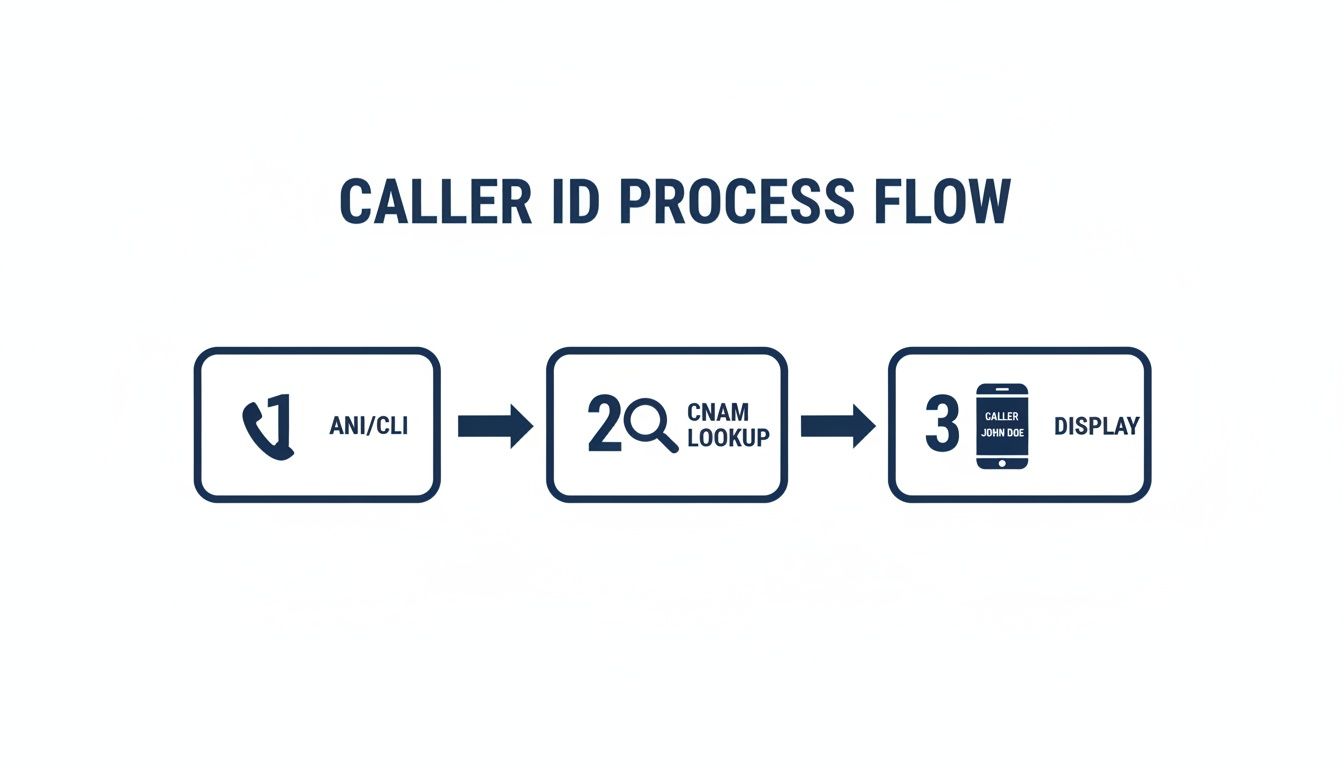
From the moment a number is identified (ANI/CLI) to the name lookup (CNAM), STIR/SHAKEN acts as a digital bodyguard, making sure the information isn't altered.
How Attestation Levels Work
At its core, STIR/SHAKEN works by giving each call a trustworthiness "grade" known as an attestation level. This grade tells the phone company on the receiving end how confident the originating carrier is that the caller is who they claim to be.
There are three main levels of attestation:
A-Level Attestation (Full): This is the gold standard. It means the carrier knows its customer, knows they have the right to use that specific phone number, and can confirm the call is truly coming from that customer. Legitimate businesses using a registered provider like SnapDial should expect their calls to get this grade.
B-Level Attestation (Partial): This is the middle ground. The carrier knows the customer, but it can't be 100% sure that the customer has the right to be using the number they’re calling from. You might see this with calls coming from older, on-premise PBX systems.
C-Level Attestation (Gateway): This is the lowest level of trust. The call came from a source the carrier can't authenticate at all. This is common for international calls entering the U.S. network and is a major red flag for spam or fraud.
Carriers use these grades to decide what to do with a call. An A-level call sails right through. A C-level call, on the other hand, is very likely to be blocked outright or show up on your customer’s phone with a "Spam Likely" warning. If this is something you're worried about, our guide on how to handle suspected spoofed DIDs offers some practical steps.
STIR/SHAKEN gives carriers the data they need to filter out the bad actors while giving legitimate businesses a clear lane to reach their customers. It’s the mechanism that protects your brand’s calling reputation.
This verification is becoming more critical by the day. As businesses fight to stand out from the noise, advanced caller ID services are surging. Projections show that branded calling frameworks, which rely on STIR/SHAKEN, will verify over 90 billion calls across the globe by 2030—an 870% jump from 2025. This growth is a direct response to the more than 40 billion robocall scams that hit the US in 2024 alone.
By working with a provider that fully embraces STIR/SHAKEN, you make sure your outbound calls get the highest attestation possible. This doesn't just keep your numbers off a blocklist; it actively proves to carriers and customers that your calls are the real deal.
Unlocking Business Growth with Enhanced Caller ID
It’s one thing to understand the technology behind caller ID, but it’s another to connect it directly to your bottom line. That’s what really matters. This isn't just about dodging a spam flag; it's about actively generating revenue and making your entire operation run smoother.
When you use enhanced caller ID, your phone stops being just a phone. It becomes a serious asset for growth. The most immediate win comes from features like branded calling. When you can show your verified company name, logo, and even a quick reason for the call, you completely change the conversation before it even starts. An unknown number instantly becomes a trusted, expected contact, and that makes people actually answer their phones.
Driving Tangible Business Outcomes
For a sales team, the impact is huge. Connecting with more prospects on the first try shortens sales cycles and makes everyone more productive. Instead of reps leaving voicemails that go straight to the trash, they’re starting more conversations and closing more deals. It’s a direct path to more revenue.
Support teams get a major boost, too. When a customer gets a verified call from "Your Company Support," it builds instant trust and lowers their guard. This positive start leads to better first-call resolution rates because customers are just more cooperative from the get-go.
Even marketing teams can run more effective campaigns, from customer surveys to event invites, because they know their calls won't be ignored. And when you integrate these tools with professional phone answering services, you can streamline every single customer interaction.
Protecting Your Most Valuable Asset: Your Reputation
In today’s climate, your caller ID reputation isn't a "nice-to-have." For any business that relies on outbound calls, it’s a make-or-break factor. Carriers and smartphone makers are constantly tightening their spam algorithms, making it harder than ever for legitimate businesses to get through if their numbers aren't managed correctly.
A strong caller ID reputation is your shield against being blacklisted. It ensures your critical communications actually reach your customers, protecting your ability to do business and maintaining trust.
A bad reputation can get your numbers blocked entirely, rendering your entire outreach team useless. That's a massive operational risk. Modern caller id services tackle this problem head-on by actively maintaining the health and integrity of your phone numbers. This protection is especially vital for remote and hybrid teams who depend on reliable phone access to do their jobs.
Caller ID reputation has become the key to outbound calling success. Carriers are getting much stricter, and sales teams are finding their legitimate calls blocked if their numbers show any spam-like activity. It’s no surprise that cold calling success rates are projected to plummet to just 2.3% in 2025, a massive 53% decline from 4.82% in 2024. These numbers, which you can explore further on ReadyMode, show just how much buyer resistance and new tech barriers are affecting outreach.
Even a simple strategy like Local Presence Dialing can boost answer rates by up to 4x compared to calling from a generic toll-free number—a huge advantage for any modern sales team.
How to Choose and Set Up Your Caller ID Service
Picking the right caller ID services and getting them set up correctly can feel like a daunting task, but it doesn't have to be. With the right questions in hand and a few best practices, you can make sure your business starts building trust with every call from day one.
Think of your caller ID as the first impression you make over the phone. You want it to be professional, accurate, and instantly recognizable. This all starts with finding a provider who is more than just a phone line vendor—they should be a true partner in managing your calling reputation.
Your Provider Selection Checklist
Before you sign any contracts, you need a solid game plan. The right provider will have clear, confident answers to these questions, showing they understand that your caller ID is a critical business asset. Use this checklist to guide your conversations and separate the serious providers from the rest.
Caller ID Service Provider Checklist
The features a provider offers for caller ID management can make or break your outbound calling strategy. This checklist outlines the key capabilities to look for to ensure your provider can help you build and protect your calling reputation.
| Feature | What to Look For | Why It Matters |
|---|---|---|
| Custom CNAM Support | Ask if you can easily set and update your Calling Name (CNAM). Find out how they ensure it's registered correctly across carrier databases. | An inaccurate or generic CNAM erodes trust before you even say hello. You need direct control over how your brand name appears. |
| Branded Calling | Inquire about enhanced services that display your logo and call reason. This is a game-changer for standing out. | This feature dramatically boosts answer rates by turning an unknown number into a verified, informative call preview. |
| STIR/SHAKEN Compliance | Your provider must explain how they ensure your calls get the highest A-level attestation. | Without top-level attestation, your calls are far more likely to be flagged as spam or blocked, making your outreach efforts useless. |
| Reputation Management | Do they offer tools or support to monitor your numbers and protect them from being incorrectly flagged as spam? | Proactive monitoring is key. It's much easier to prevent a number from getting a bad reputation than it is to fix it after the fact. |
| Department-Specific IDs | Can you easily assign different caller IDs for different teams, like "YourCo Sales" vs. "YourCo Support"? | This provides immediate context, manages customer expectations, and makes your calls feel more relevant and less generic. |
Choosing a provider isn't just about a feature list. It's about finding a partner who gets the direct link between caller ID and business growth and can offer strategic guidance, not just a technical setup.
Best Practices for Configuration
Once you’ve chosen a great provider like SnapDial that gives you these robust controls, the next critical step is getting your caller ID services configured correctly. A few smart moves here will maximize your impact and help you avoid common pitfalls.
Here are a few best practices you should put into action right away:
- Assign Department-Specific Caller IDs: Ditch the single, generic caller ID for your whole company. Set up specific IDs that give callers instant context. For example, your support team should display "YourCo Support" while your sales team shows "YourCo Sales." It’s a simple change that transforms the customer experience.
- Audit Your Numbers Regularly: Don't just set it and forget it. Periodically call your outbound numbers from different mobile carriers (e.g., Verizon, AT&T) to see what name actually displays. If you spot any problems, work with your provider immediately to get them corrected.
- Register for Branded Calling: If your provider offers it, take the time to get registered. Yes, it involves submitting your logo and business details for verification, but the payoff in higher answer rates and improved customer trust is massive.
The move toward advanced caller ID services is a huge driver behind the booming Contact Center as a Service (CCaaS) market, which is projected to grow from $7.08 billion in 2025 to $30.15 billion by 2034. As companies embrace cloud communications, these enhancements become essential.
This is especially true for remote teams. With 56% of customers admitting they'll switch to a different channel if a response is too slow, making a trustworthy first impression is non-negotiable. To learn more about how AI and ID verification are reshaping the industry, you can dig into the latest research on call center statistics.
Frequently Asked Questions About Caller ID Services
Even after digging into the tech and the benefits, you probably still have a few questions about how all this plays out in the real world. I get it. To help clear things up, we've put together straightforward answers to the questions we hear most often.
Think of this as your quick-reference guide for troubleshooting the common headaches and getting the most out of your business's calling identity.
Why Does My Business Show Up as "Spam Likely" or a Wrong Name?
This is easily one of the most frustrating things a business can run into, and it usually happens for one of two reasons. First, the phone number you're using might still be tied to a previous owner in an old CNAM database. Because these databases aren't updated instantly, that old information can stick around for months, sometimes even longer.
The second cause is that your own calling habits might be accidentally tripping automated spam filters. Things like making a huge number of very short calls can look like robocalling activity to a carrier, so they'll flag your number with a "Spam Likely" or "Scam Likely" warning just to be safe.
Pro Tip: A modern caller ID service tackles this head-on. It correctly registers your numbers across the board and uses STIR/SHAKEN verification. This digital signature proves your calls are legitimate, which dramatically lowers the chances of getting flagged by mistake.
Can I Use Different Caller IDs for Different Departments?
Absolutely. In fact, you should. This is a powerful feature and one of the biggest advantages of a modern cloud phone system. You can easily assign unique outbound caller ID names and numbers to different teams right from a simple web portal.
For example, you could set it up so that:
- Calls from your sales team show a direct sales line and the name "YourCo Sales."
- Calls from customer support display the main support number and "YourCo Support."
- Billing inquiries come from a number that says "YourCo Billing Dept."
This simple tweak makes your calls instantly more relevant to the person on the other end, sets the right expectations, and just looks far more professional than having every call come from the same generic company number.
What Is the Difference Between CNAM and Branded Calling?
While they both serve a similar purpose, think of them as two totally different generations of technology. CNAM is the old-school, traditional method, while branded calling is the modern, much smarter evolution.
CNAM, which stands for Calling Name, is the classic 15-character plain text name tied to a phone number. Its biggest flaw is that it’s wildly inconsistent. What your customer sees depends entirely on their carrier and its database, which is often out of date.
Branded calling is a huge leap forward. It delivers a rich, verified, and consistent experience right to a smartphone's screen, including:
- Your full company name (no 15-character limit).
- Your official company logo.
- The reason for the call (like "Appointment Reminder" or "Delivery Update").
This gives you way more control and builds instant trust in a way that plain old CNAM just can't match. The result is a proven, major boost in call answer rates.
How Long Does It Take for a Caller ID Name to Update?
When it comes to updating a CNAM record, a little patience goes a long way. After your provider submits a name change, it can take anywhere from a few business days to several weeks for that new name to show up everywhere.
The delay happens because there’s no single, master CNAM database for the whole country. Every carrier maintains its own records and refreshes them on its own schedule. One might pick up the change in 48 hours, while another could take three weeks.
This is exactly why working with a proactive provider is so important. A good partner will manage these registrations for you and keep an eye on the process to make sure your update spreads across the web of telecom networks as quickly and smoothly as possible.
Ready to take control of your calling reputation and make sure every call you place builds trust? SnapDial provides robust, enterprise-grade caller id services with full STIR/SHAKEN compliance and branded calling capabilities. Our white-glove setup and 24/7 support make it easy to switch. Learn more about SnapDial and start making calls that get answered.