
Conversational AI voice agents are intelligent systems that can understand and respond to human speech, essentially acting as a highly skilled digital receptionist for your business. Unlike those rigid "press 1 for sales" menus, these agents engage in natural, human-like dialogue to solve customer issues, route calls, and handle tasks 24/7.
What Exactly Are Conversational AI Voice Agents?
Think about the last time you called a company and got trapped in a frustrating phone menu. You probably mashed buttons, hoping to guess which option might finally get you to a real person. That outdated system is an Interactive Voice Response (IVR), or auto attendant, and it's a rigid, one-way street.
A conversational AI voice agent is the complete opposite. It’s like having your very best customer service rep available instantly for every single call. Instead of forcing callers down a preset path, it listens to what they need in their own words—like "I need to check on my order," or "Can I reschedule my Friday appointment?"—and actually understands the intent behind what's being said.
This ability to hold a natural, two-way conversation is what separates modern AI from those old-school systems. It doesn't just hear words; it comprehends context, asks clarifying questions, and gets things done, creating a genuinely smooth and efficient experience for the caller.
The Shift From Menus to Meaningful Conversations
The real difference here comes down to intelligence. A traditional IVR is just a simple flowchart, but a conversational AI voice agent is a dynamic problem-solver. This isn't just a minor upgrade; it's a total reimagining of how automated voice communication works.
The market reflects this massive shift. The conversational AI market is projected to surge from USD 19.21 billion in 2025 to an astonishing USD 155.23 billion by 2035. This growth is fueled by real results, with some analysts predicting that by 2026, this technology will save contact centers $80 billion in agent labor costs alone. You can read more about the growth of the conversational AI market and its financial impact.
A traditional IVR makes your customer do the work of navigating your phone system. A conversational AI voice agent does the work of understanding your customer.
This ability to understand and adapt makes these agents invaluable for businesses of all sizes, especially those looking to improve efficiency without sacrificing the quality of their customer interactions.
Comparing Old and New Voice Technology
To really appreciate the leap forward, a direct comparison is helpful. While both systems are designed to manage incoming calls, their methods and the results they deliver are worlds apart.
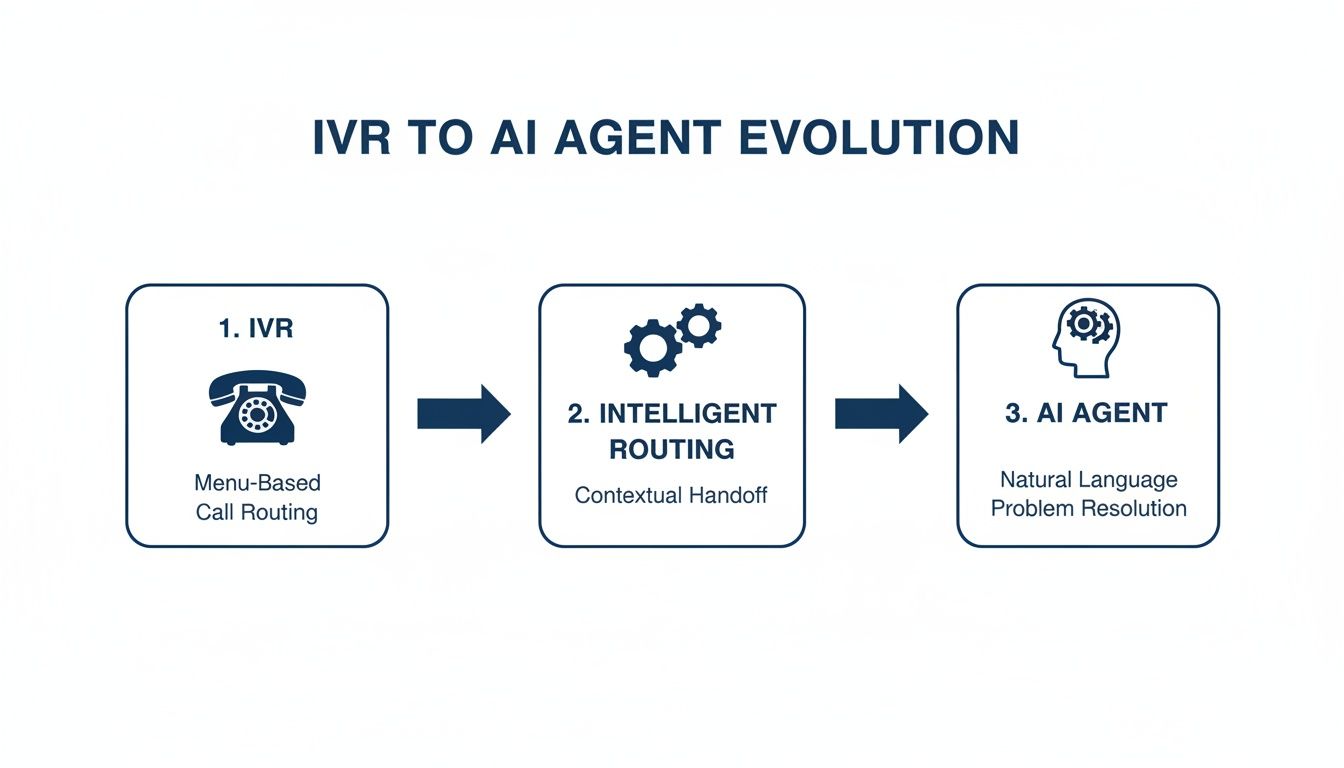
The table below breaks down the key differences between a basic auto attendant and a modern AI voice agent, showing the evolution from rigid menus to intelligent, natural-language conversations.
Traditional Phone Systems vs AI Voice Agents
| Capability | Traditional IVR (Auto Attendant) | Conversational AI Voice Agent |
|---|---|---|
| Caller Interaction | Rigid, relies on DTMF (button presses) | Flexible, understands natural language |
| Understanding | Follows a strict, pre-programmed script | Interprets intent, context, and nuances |
| Problem Solving | Limited to basic call routing | Can handle multi-step tasks like scheduling |
| Customer Experience | Often frustrating and impersonal | Engaging and highly efficient |
| Availability | 24/7, but with limited functionality | 24/7, with intelligent, task-oriented support |
| Scalability | Handles high volume but cannot learn | Learns and improves from interactions over time |
As you can see, the difference is stark. One system forces callers into a box, while the other adapts to their needs, creating a far more natural and productive interaction. This is the new standard for automated customer service.
How AI Voice Agents Understand and Respond
Ever wonder what’s going on under the hood of an AI voice agent? It’s not just one piece of technology. Think of it as a lightning-fast digital brain with four specialized parts working together in perfect sync—one for listening, one for thinking, another for planning, and a final one for speaking. This whole process happens in milliseconds and is what lets an agent go way beyond simple commands to have a real conversation.
This is a huge leap from the clunky, menu-driven phone systems of the past. We’ve moved from forcing customers into a rigid maze to having a system that intelligently understands what they need.
Each of the four components plays a critical role in making this seamless interaction possible. Let's break them down one by one.
The Ears: Automatic Speech Recognition (ASR)
The first step in any conversation is just hearing what the other person is saying. For an AI agent, this is the job of Automatic Speech Recognition (ASR). It’s the digital ears of the operation. Its only job is to capture the raw audio from a caller's voice and instantly convert it into written text.
Imagine you have a stenographer who can type every word you say the second you say it. That's ASR. The entire conversation hinges on how well this first step is done. If the transcript is wrong, everything that follows will be based on bad information. That's why high-quality AI transcription accuracy is the absolute bedrock of a good voice agent.
The Brain: Natural Language Understanding (NLU)
Once the words are on paper, they need to be understood. This is where Natural Language Understanding (NLU) steps in. It’s the agent’s brain. NLU doesn’t just read the words; it figures out the caller's intent.
For instance, a customer might say, "My internet is down," "I can't get online," or "Why isn't my Wi-Fi working?" A human knows these are all the same problem. NLU does the same thing for the AI, identifying the core intent—like "report internet outage"—and pulling out key details, or "entities," like an account number or address mentioned in the sentence.
The GPS: Dialog Management
Now that the agent knows what the caller wants, it needs a game plan. Dialog Management acts as the conversational GPS, plotting the best route forward. It decides what to do next based on the intent, the conversation history, and the business rules you’ve set.
This is the part of the system that:
- Asks smart questions: If a caller says, "I need to pay my bill," Dialog Management might prompt the agent to ask, "Great, for which account?"
- Fetches information: It can trigger a lookup in your CRM to find an order status or check an account balance.
- Routes the conversation: It determines if the AI can solve the problem on its own or if it’s time to hand the call off to a human agent.
Essentially, Dialog Management keeps the conversation on track and moving toward a solution, so you don't end up going in circles.
The Voice: Text-to-Speech (TTS)
Finally, once the agent has a plan and knows what to say, it needs a voice. Text-to-Speech (TTS) technology takes the text response and turns it back into natural-sounding audio. Modern TTS engines are incredibly good, producing speech with realistic tones and pacing that sound much more human and are worlds away from the robotic voices of old IVR systems.
Together, these four components—ASR, NLU, Dialog Management, and TTS—run in a continuous, real-time loop. This cycle of listening, understanding, planning, and responding is what makes a conversational AI voice agent a truly helpful tool instead of just an automated menu. You can get a feel for the technical side when you configure speech-to-text in modern phone systems.
Real-World Use Cases and Business Impact
Getting a handle on the technology behind conversational AI voice agents is one thing, but seeing how it actually drives business growth is where it all clicks. For small businesses and large contact centers alike, these agents stop being a theoretical concept and become a practical tool that delivers a serious return on investment (ROI). They aren't just a slick replacement for old phone menus; they're a strategic asset.
The tangible ROI can be staggering. We've seen businesses report up to a 90% reduction in operating costs compared to traditional call centers. Others have hit over 150% ROI in the first year alone, with customer satisfaction scores jumping by 35%. It's no wonder the voice AI market is projected to skyrocket from USD 2.4 billion in 2024 to USD 47.5 billion by 2034. You can dig into the growing voice AI market on famulor.io to see just how fast this is moving.

This impact isn't just for one or two industries, either. From healthcare to retail, AI agents are reshaping how companies talk to their customers, unlocking efficiencies that once seemed impossible.
Automating Routine Tasks Around the Clock
One of the most immediate wins is the ability to offer 24/7 intelligent customer support without having to staff a round-the-clock call center. An AI voice agent can handle a massive volume of common questions at any time, day or night. This frees up your human team to focus on the more complex, high-value conversations that really matter.
Think of it as adding a tireless new member to your team who absolutely loves repetitive tasks.
- Appointment Scheduling: A medical clinic can let patients book, confirm, or reschedule appointments over the phone automatically. This cuts down on no-shows and frees up the front desk.
- Order Status Checks: An e-commerce business can provide instant updates on shipping and delivery, answering the classic "Where is my order?" question without needing a human.
- FAQs and Basic Support: Any business can use a voice agent to answer frequently asked questions about store hours, locations, or basic product information.
This kind of automation translates directly to cost savings and a much better customer experience. Callers get immediate answers without sitting on hold, and your business can handle way more inquiries without adding to the payroll. You can explore more about how AI agents transform customer support in our detailed guide.
A conversational AI voice agent gives every caller instant access to your most efficient employee—one that never gets tired, never makes a mistake, and is always available.
That kind of consistent, high-quality service builds trust and loyalty, turning a simple phone call into a genuinely positive brand moment.
Creating Smarter Call Routing
For any business with multiple departments or locations, getting calls to the right place is a constant headache. Traditional phone menus are clunky and confusing, leading to frustrated callers and misdirected calls. A conversational AI voice agent fixes this by simply asking the caller what they need and instantly sending them to the right person or department.
For instance, a retailer with multiple stores can use a single phone number for everyone. When a customer calls, the AI can ask, "Which store are you trying to reach, or what can I help you with today?" Based on their natural language response, it can transfer the call to the correct location or just handle the request itself.
This creates a unified, seamless experience, which is especially powerful for companies with hybrid or remote teams. No matter where your employees are, the AI agent acts as a central, intelligent hub, making sure every call gets where it needs to go. You can finally ditch those complex call forwarding rules and stop worrying about lost calls.
Integrating Voice Agents with Your Cloud Phone System
Bringing a conversational AI voice agent into your business doesn't mean you have to rip and replace your entire technical setup. In fact, one of the biggest advantages is how cleanly these agents connect with modern tools, especially a cloud phone system. This integration acts as a powerful force multiplier, supercharging the communication platform you already use.
Think of your cloud phone system as the central switchboard for every call your company handles. Integrating a voice agent is like giving that switchboard a brain. The AI seamlessly becomes the first point of contact, intelligently handling and directing calls before they ever need to reach a person on your team.

This synergy unlocks a whole new level of efficiency. Instead of just routing calls based on someone punching numbers, the system can now truly understand what a caller needs and get them to the right place with pinpoint accuracy—all within the familiar framework of your existing phone platform.
Key Considerations for a Smooth Integration
Connecting your AI to your phone system requires a bit of forethought to make sure everything runs smoothly, securely, and can grow with you. Getting these details right from the start saves you from future headaches and makes sure you get the most out of your investment. A good provider will handle this with a "white-glove" setup, but it’s smart to know what’s going on under the hood.
The goal is to create a single, unified system where the AI and your phone features work as one cohesive unit.
- API Compatibility: Your voice agent and cloud PBX need to talk to each other. This happens through an Application Programming Interface (API), which essentially acts as a universal translator between the two systems. A solid API ensures the agent can perform actions like transferring calls, checking call queues, and logging every interaction without a hitch.
- Data Security and Compliance: The voice agent is going to handle sensitive customer information. It's absolutely critical that the integration meets industry-standard security protocols to protect that data, both while it's moving and when it's stored. This includes staying compliant with any regulations relevant to your field, like HIPAA or GDPR.
- Scalability for Growth: Your call volume today won't be your call volume next year. The entire integrated system has to be able to handle sudden spikes and grow with your business without any drop in performance. This means both the AI platform and the cloud phone system need to be built on infrastructure that can scale up on demand.
Nailing these points ensures your conversational AI voice agents not only work perfectly today but are also ready for whatever comes next.
Mapping the Customer Journey
To really see how this works, let's walk through a typical customer interaction from start to finish. This flow shows how the AI can manage a common request, either resolving it on its own or escalating it seamlessly if needed.
- Initial Greeting: The AI agent picks up the call instantly with a natural, on-brand greeting.
- Understanding Intent: The caller says what they need, like, "I'd like to check the status of my recent order." The AI's NLU component immediately identifies the "order status" intent.
- Data Collection: The agent asks for an order number to identify the customer and their specific purchase.
- Backend Integration: The AI instantly queries the company's order management system through an API to pull the relevant info.
- Resolution: The agent gives a clear answer: "Your order shipped this morning and is scheduled for delivery on Friday." It then follows up by asking if there's anything else it can help with.
- Successful Conclusion: The caller confirms they have everything they need, and the call ends without ever having to take up a human agent's time.
The whole process is fast, efficient, and gives the customer an immediate answer without the wait.
A well-integrated voice agent doesn't just answer calls; it resolves them. The goal is to contain the interaction within the automated system whenever possible, freeing up human agents for high-value tasks.
Measuring Success with the Right KPIs
So, how do you know if your new AI agent is actually working? You need to track the right Key Performance Indicators (KPIs). These numbers give you a clear, unbiased look at the agent's effectiveness and show you where you can make improvements.
- Containment Rate: This is the big one. It's the percentage of calls that are fully handled and resolved by the AI agent without ever needing to be passed to a human. A high containment rate is a direct measure of your ROI.
- First-Call Resolution (FCR): This tracks how often a customer's problem is solved on the very first call. A strong FCR rate, driven by the AI, is a massive boost to customer satisfaction.
- Average Handle Time (AHT): This is how long it takes the AI to handle a call from start to finish. You want this to be quick and efficient, but without sacrificing the quality of the interaction.
By keeping a close eye on these KPIs, you can continuously fine-tune your agent’s scripts and logic, making sure it delivers more and more value to both your business and your customers over time.
Choosing the Right Voice AI Partner
Picking a partner for your conversational AI is one of the most important calls you'll make. The right one becomes a true extension of your team, bringing the tech and the expertise to make your vision a reality. But a mismatch? That leads to a clunky customer experience, technical dead ends, and a bad investment.
This isn't just about buying a piece of software. It’s about finding a provider whose technology, support, and vision actually line up with your business goals. You need a solution that not only sounds great but also plugs right into the tools you already rely on, like your CRM and your cloud phone system.
Core Technology and Voice Quality
The first thing you’ll notice is the voice itself. A robotic, unnatural agent will turn callers off in a heartbeat and completely undermine their trust in your brand. Your partner should be using top-tier Text-to-Speech (TTS) and Automatic Speech Recognition (ASR) that can gracefully handle different accents, speaking styles, and even noisy backgrounds with high accuracy.
Ask for a live demo and listen closely. Does the voice have a natural flow and intonation? Can it understand a complex request, or does it get tripped up easily? The goal is a smooth, human-like conversation that makes callers feel heard, not like they're fighting with a machine.
A great conversational AI voice agent shouldn't just be understood—it should be pleasant to talk to. The quality of the voice directly reflects the quality of your brand.
Beyond the sound, a vendor's technical foundation is crucial. When choosing the right voice AI partner, understanding how to manage critical components like a ChatGPT API Key is essential for seamless integration and performance.
Integration Capabilities and Industry Expertise
An AI voice agent doesn't work in a bubble. For it to be truly effective, it has to connect seamlessly with your existing business systems. This is non-negotiable.
Your chosen partner absolutely must have proven, robust integrations with:
- Cloud Phone Systems: The agent needs to feel like a natural part of your PBX. It should be able to transfer calls, check call queues, and operate within the workflows you’ve already established.
- CRM Platforms: To deliver that personal touch, the agent needs to pull customer data from your CRM, like their order history or contact info.
- Business Software: Look for connections to your scheduling tools, payment gateways, and knowledge bases. This is what allows the agent to perform real, multi-step tasks that actually help your customers.
On top of that, industry expertise really matters. A provider that gets the unique challenges and lingo of your field—whether it's healthcare, retail, or finance—will be far better equipped to design conversation flows that actually work. They'll know the right questions to ask and the common problems your customers are trying to solve.
Evaluating Support, Scalability, and Pricing
Finally, think about the long-term relationship. What kind of support are you signing up for? You want a partner that offers a white-glove setup and ongoing, accessible help. When a problem pops up, you need to be able to reach a knowledgeable human—fast.
Scalability is another key piece of the puzzle. Your business is going to grow, and your call volume will have its peaks and valleys. Make sure the platform can handle more demand without dropping in performance or hitting you with a massive price hike.
This brings us to the final point: pricing. Look for transparent, predictable pricing models without sneaky hidden fees. A usage-based or tiered subscription is usually more flexible for businesses than a huge upfront investment. A clear price structure means you can accurately calculate your ROI and budget for the future without any nasty surprises.
To help you navigate this decision, we've put together a checklist to guide your evaluation process. Think of it as a scorecard to objectively compare potential partners and ensure you're asking all the right questions.
Vendor Selection Checklist
Choosing the right partner is a strategic decision that impacts your customer experience and operational efficiency. Use this checklist to systematically evaluate potential vendors.
| Evaluation Criteria | Key Questions to Ask | Why It Matters |
|---|---|---|
| Voice & Speech Quality | Can we hear live, unscripted demos? How well does it handle accents and background noise? Does the voice sound natural and engaging? | A poor-quality voice creates immediate friction and damages brand perception. High accuracy in ASR is essential for understanding user intent. |
| Integration Capabilities | What pre-built integrations do you have for our CRM, PBX, and other key software? How deep are these integrations? What's the process for custom APIs? | The agent must seamlessly connect to your existing tech stack to access data and perform actions. Without this, it's just an isolated tool. |
| Industry Experience | Have you worked with other companies in our industry? Can you provide case studies or references? Do you understand our specific terminology and customer needs? | A partner with domain expertise will build more effective conversation flows faster, understanding the nuances of your business without a steep learning curve. |
| Customization & Control | How easily can we modify conversation scripts and flows? Do we have access to an admin portal to make changes ourselves, or do we rely on your team? | Your business needs will change. You need the flexibility to update greetings, routing logic, and responses without a lengthy support ticket process. |
| Technical Support & Onboarding | What does your onboarding process look like? Do you offer a "white-glove" setup? What are your support hours and guaranteed response times (SLA)? | A complex implementation can derail the project. Strong support ensures a smooth launch and quick resolution of any issues that arise later. |
| Scalability & Performance | How does the platform handle sudden spikes in call volume? What is your guaranteed uptime? How does your pricing scale as our usage grows? | The solution must be reliable and able to grow with your business without performance degradation or unpredictable cost increases. |
| Pricing Model | Is your pricing based on usage, per-user seats, or a flat subscription? Are there any setup fees, overage charges, or other hidden costs? | A transparent and predictable pricing model is crucial for calculating ROI and avoiding budget surprises down the road. |
| Security & Compliance | How do you ensure data privacy? Are you compliant with relevant regulations (e.g., GDPR, HIPAA)? Where is customer data stored and how is it secured? | Protecting customer data is non-negotiable. A failure in security can lead to significant legal and reputational damage. |
Taking the time to go through these criteria will give you a much clearer picture of which provider is truly the best fit to become a long-term partner in your success.
Best Practices for a Successful Launch
Rolling out a conversational AI voice agent isn't a "set it and forget it" project. If you want real, long-term success, you need a smart strategy that focuses on a smooth launch, constant refinement, and an unwavering commitment to the customer experience. The goal isn't just to adopt the tech—it's to master it.
A successful launch actually begins long before your agent takes its first live call. By taking a structured approach, you can iron out the kinks, tune up the performance, and make sure your investment starts paying off from day one.
Start with a Targeted Pilot Program
Jumping straight into a full-scale deployment is a recipe for disaster. Instead, the smart move is to kick things off with a targeted pilot program. Think of it as a dress rehearsal for your AI. A pilot lets you test your voice agent in a controlled, low-risk environment with a single, measurable goal.
For example, you could start by having the agent handle just one simple, high-volume task, like checking order statuses or confirming appointments. This focused approach lets you collect real-world data and user feedback on a smaller scale. You can then use those insights to tweak conversation flows and fix any hiccups before you let the agent talk to your entire customer base.
A pilot program isn't about passing or failing; it's about learning. It provides the crucial data needed to optimize your agent's performance and ensure it's truly ready to represent your brand effectively.
Design Intuitive and Natural Dialogues
The quality of the conversation is everything. A clunky, robotic dialogue will just frustrate callers and have them screaming for a human. Your main job here is to design conversation flows that feel natural, intuitive, and genuinely helpful.
This really comes down to a few key things:
- Use simple, clear language: Ditch the jargon and overly complicated sentences. The agent needs to talk in a way anyone can easily understand.
- Anticipate what callers need: Think through the most likely questions and follow-up requests someone might have at each step of the conversation.
- Provide an escape hatch: Always, always include a clear and easy way for a caller to get transferred to a human agent. A simple phrase like, "Just say 'speak to an agent' at any time," builds trust and stops people from getting frustrated when their issue is too complex for the AI.
That last point is absolutely critical. A smooth escalation path means that even when the AI can't solve the problem, the customer still has a direct line to a resolution.
Monitor, Analyze, and Continuously Improve
Your launch is just the starting line. To get lasting value from your conversational AI voice agents, you have to commit to a cycle of continuous improvement that’s fueled by data. That means regularly keeping an eye on performance analytics and your key KPIs.
Pay close attention to metrics like containment rate, first-call resolution, and average handle time. If you see that a high number of calls are getting escalated to human agents for a specific type of question, that's a bright, flashing sign that you need to go back and improve that particular conversation flow.
This data-driven approach is how you methodically make your agent smarter and more capable over time. Every little tweak you make adds up, contributing to a more efficient system, a better customer experience, and a much bigger return on your investment.
Got Questions About AI Voice Agents? We've Got Answers.
When you're thinking about bringing a new piece of tech into your business, the big questions always come down to the practical stuff: What’s it really going to cost? Can it handle our specific problems? How much of a headache will it be to set up?
Let's cut through the jargon and get straight to the real-world answers for the most common questions about conversational AI voice agents.
How Much Does a Conversational AI Voice Agent Cost?
The cost really depends on how complex you need it to be and how many calls you handle, but the good news is that modern providers have moved away from the massive upfront investment model. You'll typically see pricing based on per-minute usage or a simple tiered subscription.
This structure makes powerful voice AI surprisingly affordable, even for small and mid-sized businesses. The key is to find a partner with straightforward, transparent pricing. That way, you can easily map your costs to the very real ROI you'll get from lower labor expenses, a more efficient operation, and happier customers.
Can a Voice Agent Handle Truly Complex Customer Issues?
Today's conversational AI voice agents are impressively smart. They can easily manage multi-step tasks like booking an appointment, processing a payment, or guiding a customer through basic troubleshooting steps. They're absolute workhorses for handling the high volume of predictable, routine calls that tie up your human agents.
But for the really complex or emotionally charged calls, the smartest approach is to build a seamless handoff to a human.
Think of the AI agent as an intelligent front door. It greets the caller, gathers all the initial info and context, and then smoothly transfers the call to the perfect human agent for the job. This gives you the best of both worlds: the efficiency of AI and the essential empathy of a human touch.
How Long Does Implementation Usually Take?
It’s much faster than you’d probably guess. The exact timeline depends on your needs, but with an integrated cloud PBX solution and a provider that offers a white-glove setup, you can have a foundational voice agent live in a matter of weeks, not months.
This quick turnaround is possible because the provider does all the heavy lifting on the technical side. Your team gets to focus on what you know best: designing the conversation flows and defining the ideal customer experience. It’s a collaborative process that ensures a smooth launch with almost no disruption to your daily business, so you can start seeing a return on your investment right away.
Ready to see how a conversational AI voice agent can transform your business communications? SnapDial offers a modern cloud phone system with seamless AI integration and white-glove setup to get you started without the hassle. Discover a smarter way to handle calls at https://snap-dial.com.