
When you hear the term enterprise VoIP, it’s easy to think it's just a fancy term for a business phone. But that’s like saying a smartphone is just a device for making calls. The reality is, it’s a fundamental shift in how your entire organization communicates.
What Is Enterprise VoIP and Why It Matters Now
Let's get straight to the point. Your old-school office phone system, the one with a tangle of wires in a closet somewhere, is a relic. It was built for a time when everyone worked in one building, and its limitations are holding you back. It’s expensive, rigid, and completely out of step with how modern teams work.
Now, imagine a communication system built for today. One that connects your entire team—whether they're in the main office, a satellite branch, or working from a home office—under a single, seamless platform. That's enterprise VoIP. It takes your voice, turns it into digital data, and sends it securely over the internet. This simple change unlocks a level of flexibility and power that traditional Private Branch Exchange (PBX) systems could never touch.

Beyond Just Making Calls
At its core, enterprise VoIP is about unifying all your business communications, not just replacing desk phones. It’s a strategic tool for connecting your people and making your business more agile, especially in a world of hybrid work and distributed teams.
This technology creates a seamless connection between employees, no matter where they are. Someone working from home can have the exact same professional presence and capabilities as someone at headquarters. This unified approach is what keeps productivity high and your company culture strong, even when you're not all in the same room.
The market’s explosive growth tells the story. The global VoIP phone market, valued at USD 60.53 billion in 2025, is set to climb to USD 132.33 billion by 2034. This isn't just a trend; it's a massive shift away from aging copper-wire systems, driven by the clear advantages VoIP offers. You can dig into more of the data behind this expansion over at Fortunebusinessinsights.com.
To make the contrast clear, let's look at how these two approaches stack up side-by-side.
Traditional PBX vs. Enterprise VoIP at a Glance
The differences between a legacy phone system and a modern VoIP platform are stark. One is rooted in the past, built around hardware and physical locations, while the other is designed for the flexibility today's businesses demand. This table breaks down the core distinctions.
| Feature | Traditional PBX | Enterprise VoIP (like SnapDial) |
|---|---|---|
| Infrastructure | On-site physical hardware (server closet) | Cloud-hosted by the provider |
| Scalability | Complex and expensive; requires new hardware | Instant; add or remove users via a web portal |
| Remote Work | Difficult; often requires complex VPNs | Natively supported via mobile & desktop apps |
| Maintenance | Your IT team's responsibility (or costly contracts) | Fully managed by the provider |
| Features | Basic calling; advanced tools are costly add-ons | All-inclusive (IVR, call recording, analytics, etc.) |
| Cost Model | Large upfront capital expense (CapEx) | Predictable monthly operating expense (OpEx) |
As you can see, it's a completely different operational model. One forces you to manage complex hardware, while the other lets you focus on your business.
Who Is Enterprise VoIP For?
One of the biggest myths is that "enterprise" means "only for giant corporations." While massive companies absolutely rely on these systems, providers like SnapDial have made these powerful tools accessible and affordable for businesses of all shapes and sizes.
An enterprise VoIP system isn't defined by the size of your company, but by the sophistication of your communication needs. It's for any organization that requires scalability, advanced call management, and tools to support a dynamic workforce.
If your business is hitting any of these roadblocks, it’s time to think about an enterprise solution:
- Multiple Locations: You need to connect several offices, stores, or branches under one unified phone system so they can operate as a single entity.
- Hybrid or Remote Teams: Your employees need to make and receive business calls from anywhere, on any device, while still sounding professional and staying connected.
- High Call Volumes: Your sales or support teams are handling a flood of calls and need sophisticated tools like call queues and analytics to manage them effectively.
- Rapid Growth: You’re expanding and need a phone system that can scale up instantly without the massive cost and headache of a hardware overhaul.
Ultimately, moving on from an outdated PBX is more than just an IT project; it’s a critical business decision. Adopting a robust enterprise VoIP platform like SnapDial is about future-proofing your operations, improving your customer experience, and giving your team the tools they need to win.
The Core Features That Define an Enterprise VoIP System
So what’s the real difference between a basic internet phone line and a true enterprise VoIP system? It’s not just about making calls over the internet. A real enterprise solution is a complete communication platform, with tools built to solve specific business problems, make your team more efficient, and clear the path for growth. These aren’t just add-ons; they're powerful capabilities that can completely change how your company communicates.
Take the Auto Attendant, for example. This isn't just a robotic menu. Think of it as your 24/7 virtual receptionist, making sure every single customer who calls gets a professional greeting and is guided to the right place—instantly. It gets rid of the frustration of a phone that just rings and rings, making your business feel more organized and capable, no matter its size.

Creating a Digital Headquarters with Unified Communications
Perhaps the biggest jump forward is Unified Communications (UC). This is what turns your phone system into a digital headquarters for your entire team, especially if you have people working from home or in different offices. It seamlessly pulls together voice calls, video conferencing, instant messaging, and team chat into a single, easy-to-use application.
Imagine a sales rep takes a call from a prospect on their desktop app. Mid-conversation, they can instantly launch a video share to give a product demo or pull a technical expert into the call via chat to get a quick answer. It all happens right there, in one place. UC tears down the walls between different communication methods and keeps everyone connected, accountable, and easy to reach.
This is exactly why large enterprises are making the switch in droves. The VoIP market, valued at USD 161.79 billion in 2025, is set to skyrocket to USD 453.75 billion by 2035. That growth is being driven almost entirely by the need for scalable platforms that can support hybrid teams and connect multiple locations. You can dig into the numbers and trends in this comprehensive VoIP market report.
Features That Directly Impact Your Bottom Line
Beyond the big-picture concepts, certain features deliver real, tangible benefits that solve common business headaches. These are the tools that make an enterprise VoIP system an indispensable part of your operation.
- Unlimited Lines and Call Paths: Remember when customers would get a busy signal? That’s a thing of the past. With unlimited lines, you can handle any number of inbound and outbound calls at the same time, so you never miss another lead or an important customer question.
- Advanced Call Routing: This is the intelligence behind your virtual receptionist. It lets you direct calls based on the time of day, who’s calling, or the menu option they choose. A VIP client can be sent straight to their account manager, while a support question from a specific region can go to the local team best equipped to help.
- Visual Voicemail and Transcription: Listening to audio voicemails is a huge time-waster. A system like SnapDial transcribes your voicemails into text and sends them right to your email or mobile app. Suddenly, voicemails are actionable tasks you can read, forward, and reply to in seconds.
An enterprise VoIP system empowers your business to operate from anywhere. The mobile app isn't just a gimmick; it’s your complete office in your pocket, giving you the power to manage your business communications no matter where you are.
With a solid mobile app, you can make and receive calls from your business number, look up colleagues in the company directory, jump into conference calls, and manage all your settings on the fly. This kind of mobility means you and your team always maintain a professional front and stay productive, whether you're at a client’s office, working from home, or on the road. For business owners and IT managers, this combination of power and flexibility is what makes a true enterprise VoIP solution a strategic investment, not just another phone bill.
Bring Big-League Call Center Power to Your Business
Not too long ago, if you wanted world-class customer service tools, you needed a sprawling office and a budget to match. Advanced contact center features were a luxury only massive corporations could afford. But enterprise VoIP has completely changed the game, putting those same Fortune 500 capabilities within reach for any business.
This shift is huge. It lets you turn a simple phone call into a smooth, professional, and data-driven customer experience. It’s no longer just about answering calls; it’s about intelligently managing the entire customer journey from the second they dial.

From Hold Music to a Great Experience
Imagine one of your customers calls in during a rush. Instead of hitting a frustrating busy signal or being stuck in a silent, seemingly endless hold pattern, they’re met with a professional greeting and placed into a smart call queue. This is where the magic really starts.
An enterprise VoIP system like SnapDial can give them an estimated wait time or announce their position in line, which immediately dials down their frustration. Even better, it can offer a queue callback. This lets the caller hang up, keep their spot in line, and get an automatic call back from the next free agent.
Queue callback is a simple but incredibly powerful tool. It’s a small gesture that tells your customers, "We respect your time." That alone can dramatically improve customer satisfaction before your agent even says a word.
With one feature, you’ve turned a negative waiting game into a positive interaction. Your customer is free to go about their day, and you’ve shown them that their time is just as valuable as yours.
Empowering Managers With Real-Time Insights
While your customers are having a better experience, your managers get a level of visibility they’ve never had before. Old phone systems were a total black box—you knew calls were coming in and going out, but that was about it. Modern VoIP platforms give you a command center with real-time analytics.
At a glance, managers can see all the critical metrics:
- Current Call Volume: Spot your peak hours and staff your team accordingly.
- Average Wait Times: Identify bottlenecks before they turn into major problems.
- Agent Status: See exactly who is on a call, available, or doing post-call work.
- Abandoned Calls: Pinpoint when and why callers are giving up and hanging up.
This data is gold. It allows managers to coach their teams in the moment. If one agent's call times are consistently high, a manager can use whisper coaching to discreetly offer live guidance or use call recordings for training later. To really get the most out of your team and stay compliant, it's also worth understanding the power of dedicated sales call recording software.
A Story of Growth
Think about a small e-commerce business with a three-person support team. As their orders took off, so did the support calls. The team was quickly overwhelmed, customers got fed up with the long waits, and satisfaction scores started to tank.
By switching to an enterprise VoIP solution, they instantly got real call center power. They set up a smart queue with a callback option, which immediately cut down on caller frustration. The manager used the real-time dashboards and noticed that most calls were just simple order status questions.
So, they updated their auto attendant to include a self-service option for order tracking. This one change deflected 30% of their call volume. It freed up the agents to tackle more complex issues, which boosted both their productivity and their morale. The takeaway is clear: a powerful, data-driven service hub is no longer a massive capital investment; it’s an affordable, scalable cloud feature. For a deeper dive, check out our guide on how SnapDial provides https://snap-dial.com/enterprise-contact-center-solutions/.
Choosing Your Deployment: On-Premise vs. Cloud-Hosted VoIP
Once you're ready to upgrade your communications, you’ll face a big fork in the road: how to actually deploy your new enterprise VoIP system. This isn't some minor technical detail—it’s a strategic choice that will shape your budget, your IT team's workload, and how nimble your business can be for years to come. The two main paths, on-premise and cloud-hosted, are fundamentally different ways of thinking about your technology.
Let's use a simple analogy. An on-premise VoIP system is like owning your own house. You buy the property (the servers and hardware), you're on the hook for all maintenance and repairs (IT staff, software patches), and you have total control over every last detail. It demands a serious upfront investment, but you own the asset outright.
A cloud-hosted VoIP system, often called Unified Communications as a Service (UCaaS), is more like renting a luxury, fully-serviced apartment. There are no huge upfront costs, just a predictable monthly payment. All the upkeep, security, and upgrades are handled for you by the property manager (your provider), and you get access to top-tier amenities you couldn't afford to build yourself.
The Case for On-Premise Control
With an on-premise solution, you purchase and house all the necessary hardware—including the PBX server—right in your own office or data center. Your internal IT team is then responsible for setting it up, configuring it, and keeping it running day-to-day. For certain organizations, especially those with unique security requirements or highly specialized integrations, this granular level of control is non-negotiable.
You get the final say on everything, from security protocols to update schedules. That control comes at a price, though. You shoulder the full burden of hardware failures, software patches, and system security. Scaling up means buying more expensive hardware, and scaling down often leaves you stuck with pricey equipment you no longer need. To get a better handle on the hardware involved, our guide on what a PBX system is provides more context.
The core trade-off with on-premise is simple: you get maximum control, but you also take on maximum responsibility and financial risk. Your IT team becomes responsible for telephony infrastructure, pulling them away from other strategic projects.
The Power of the Cloud-Hosted Model
In sharp contrast, a cloud-hosted model from a provider like SnapDial shifts all that complex hardware and software into the provider's secure, geo-redundant data centers. You access your entire phone system right through your internet connection. This approach completely changes the game for most businesses.
There’s no large capital expenditure for a server. Instead, you pay a predictable monthly subscription fee per user, which makes budgeting simple and predictable. Scalability is instant—you can add or remove users with a few clicks in a web portal, making sure you only ever pay for what you actually use. All maintenance, software updates, and security are handled by the provider, freeing your IT team to focus on core business initiatives.
This cloud-centric approach is reshaping the entire market. The UCaaS segment is growing at a massive 17.4% annually, a key driver of a broader market projected to hit USD 595 billion by 2032. This rapid adoption by businesses ditching their old legacy systems shows a clear preference for the agility and cost-effectiveness of the cloud.
On-Premise vs Cloud-Hosted VoIP Decision Matrix
To make this choice easier, let's break down the practical differences. This table will help you see how each model stacks up against the key factors that matter most to your business.
| Consideration | On-Premise VoIP | Cloud-Hosted VoIP (UCaaS) |
|---|---|---|
| Initial Cost | High (servers, hardware, licensing) | Low to None (pay-as-you-go) |
| Ongoing Costs | Unpredictable (maintenance, repairs, upgrades) | Predictable (flat monthly fee per user) |
| Maintenance | Your IT team's full responsibility | Handled entirely by the provider |
| Scalability | Slow and expensive (requires new hardware) | Instant and flexible (add users via portal) |
| Reliability | Dependent on your single location's power/internet | High (geo-redundant data centers) |
| Feature Updates | Manual, requires downtime and IT resources | Automatic and seamless, included in the service |
For most modern businesses, the agility, reduced overhead, and built-in disaster recovery of cloud-hosted VoIP make it the clear winner. A solution like SnapDial gives you all the power of an enterprise VoIP system without the cost and complexity of owning and managing it yourself.
Your Smooth Migration Roadmap to Enterprise VoIP
Thinking about switching your entire business phone system can feel overwhelming. I get it. The idea of ripping out a core piece of your operations sounds like a recipe for disruption. But moving to a modern enterprise VoIP platform doesn’t have to be a headache that grinds your business to a halt.
With a clear, step-by-step plan and the right partner, the transition can be surprisingly smooth. In fact, it should be a total non-event for your day-to-day operations.
First things first: you need a crystal-clear picture of what you have now. This initial audit is the bedrock of a successful migration. It’s where you take a hard look at your current phone system’s real costs, its limitations, and your network’s readiness for high-quality voice calls.
How much are you really paying for those old landlines and the constant PBX maintenance? Is your internet connection stable enough to handle crystal-clear HD voice? A good provider will help you answer these questions and run a network test to make sure everything is good to go.
Defining Your Must-Have Features
Once you have a handle on your starting point, it's time to map out your destination. And here's a pro tip: don't just copy your old system's setup. This is your chance to make things better.
Sit down with your key teams—from sales and support to the leadership suite—and figure out which features will solve your biggest communication headaches.
Are your teams drowning in high call volumes? Then smart call queues and a queue callback feature are non-negotiable. Is your remote workforce growing? You’ll absolutely need a robust mobile app that turns any smartphone into a full-featured business extension. The key is to think about the problems you need to solve, not just the features you want.
This planning phase is critical. Building a detailed list of your requirements will guide your decision-making and ensure you pick a solution that actually fits how your business works.
The Value of a White-Glove Setup
After you’ve chosen the right partner, the migration itself begins. This is where a provider offering a “white-glove” setup proves its worth. Instead of just shipping you a box of phones with a link to a help manual, a dedicated team manages every single step of the transition for you.
A white-glove migration means your provider acts as your dedicated project manager. They handle everything from configuring your new phones to setting up your auto attendant and call routing rules, ensuring nothing gets missed.
This hands-on process typically includes:
- Number Porting: Seamlessly moving all your existing business phone numbers to the new system so your customers never experience a change.
- Hardware Configuration: Pre-configuring every IP phone so it’s ready to plug in and use right out of the box.
- System Setup: Building out your call flows, recording professional greetings, and creating all your user accounts before you go live.
- Team Training: Hosting training sessions to make sure every employee is comfortable and confident with the new system from day one.
For a deeper look into the components involved, check out our guide on how SnapDial’s hosted voice services simplify this entire process.
This diagram breaks down the fundamental choice between an on-premise system you have to manage yourself and a cloud-based system where your provider handles everything for you.
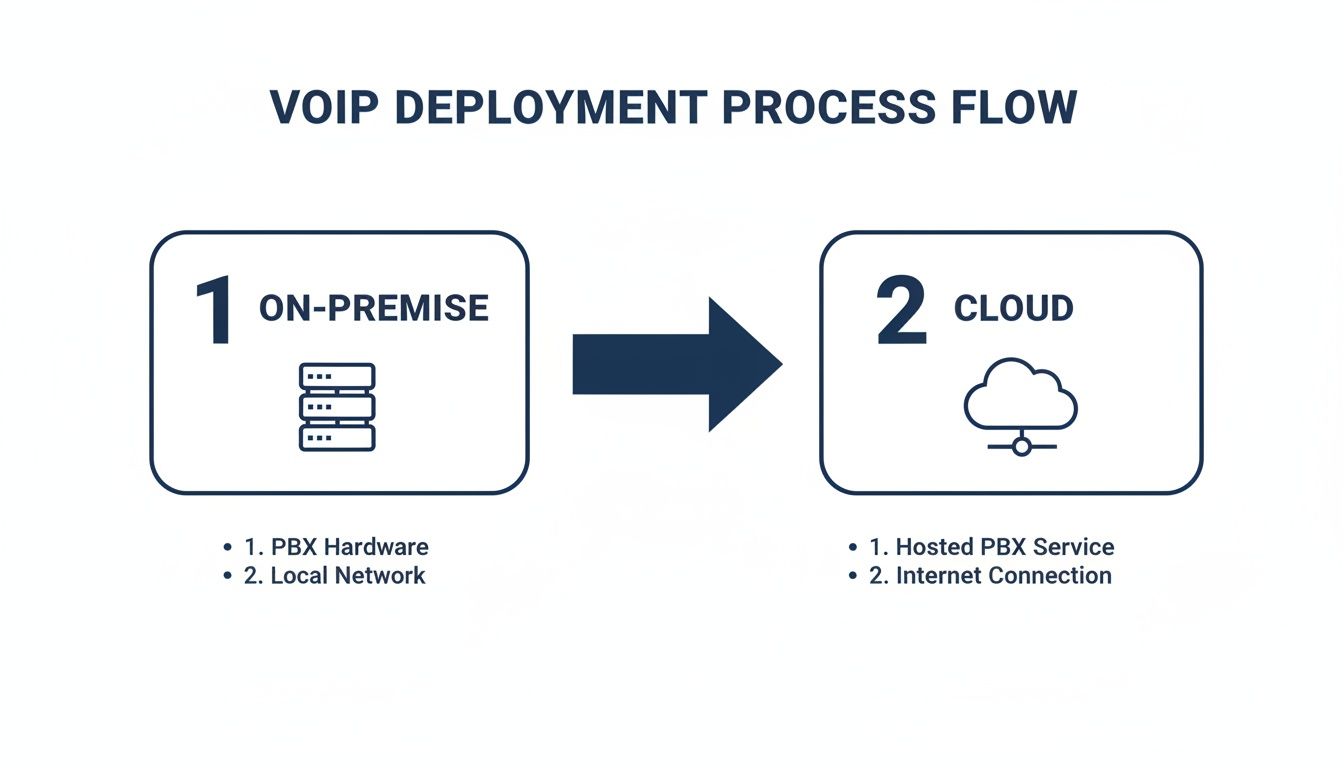
It really highlights the shift from complex, self-managed on-premise hardware to the simplicity and agility you get with a fully managed cloud solution.
With the right planning and a partner who’s committed to a seamless transition, your "go-live" day will be quiet. Your team will show up, pick up their new phones, and get right back to work—but now with a more powerful and flexible communication system at their fingertips.
The Ultimate Enterprise VoIP Provider Checklist
Picking an enterprise VoIP provider feels like you’re just comparing feature lists and pricing tables. But the truth is, this is one of the most important partnerships you’ll form. The right provider feels like an extension of your own team, while the wrong one becomes a source of daily headaches.
Slick sales pitches can be persuasive, but they rarely tell the whole story. You need to dig deeper than the marketing jargon and ask the tough questions that reveal a provider's real-world capabilities. Don't just ask about "uptime." A much better question is, "What is your financially-backed Service Level Agreement (SLA), and how do you prove your system's resilience and business continuity?" That one change shifts the conversation from a vague promise to a concrete commitment.
This checklist is your guide to asking those better questions.
Reliability and Scalability
Your phone system is your business’s lifeline, plain and simple. Reliability isn’t a feature; it’s a requirement. At the same time, the platform has to be ready to grow with you instantly, not hold you back when opportunity strikes.
Ask any potential provider these specific questions:
- Business Continuity: What happens if our office internet goes down? Do you offer automatic failover to mobile numbers or other locations to make sure we never miss a single call?
- Geographic Redundancy: Where are your data centers located? Explain how having them in different geographic regions protects our service from a major regional outage.
- Scaling Process: If I need to add 20 new users for a new office tomorrow, what's the exact process? Can I do it myself in a portal, or do I have to wait for your support team?
Security and Compliance Certifications
For any modern business, security is non-negotiable. And for those in regulated industries like healthcare or finance, it's a legal mandate. Don't just take "yes" for an answer when you ask if their platform is secure.
A provider's security posture is a direct reflection of their professionalism and commitment to protecting your business. Vague answers on compliance are a major red flag.
You need to see proof. Ask them directly, "Can you provide documentation for your HIPAA, SOC 2, or GDPR compliance?" For any healthcare-related business, their willingness to sign a Business Associate Agreement (BAA) is an absolute deal-breaker.
Support and Onboarding
When an issue pops up—and they always do—you need fast, expert help. Not a ticket number and a promise to call you back sometime next week. The quality of a provider's support is a direct window into the service you’ll get for years to come.
Likewise, a rocky start can poison the well for your entire team. A smooth onboarding process is critical for getting everyone on board and seeing value from day one.
- Support Accessibility: Is your support team available 24/7? Are they in-house experts or an outsourced call center? Can I get a real person on the phone who can actually solve my problem?
- Onboarding Process: Do you offer a "white-glove" setup where your team manages the entire migration, from number porting to system configuration, at no extra cost?
Pricing and Integrations
Finally, make sure you have a crystal-clear understanding of the total cost of ownership and the system's ability to play nice with the other tools you rely on. Hidden fees can quickly turn a great deal sour, and a lack of integration options creates frustrating data silos that slow your team down.
When building your ultimate checklist, consider aspects like system scalability, features, and the ease of integrating with providers like Vonage.
Be sure to ask pointed questions about what's not included: "Is your pricing all-inclusive, or will I see extra fees for features like call recording, analytics, or even just calling support?" This kind of transparency helps you find a true partner like SnapDial, who is invested in your success, not just in selling you a service.
Got Questions? We've Got Answers
Making the final call on a new phone system can feel like a big step. To help you feel confident in your choice, we’ve put together straightforward answers to the questions we hear most often from businesses just like yours.
It's a big decision, but you don't have to leave your established identity behind. Let's tackle one of the most frequent questions right away.
Can I Keep My Existing Business Phone Numbers?
Yes, absolutely. You don't have to give up the numbers your customers already know and trust. The process is called "number porting," and it’s a standard, regulated procedure that lets you move your current local and toll-free numbers to your new provider.
A quality provider like SnapDial handles this entire process for you as a core part of their white-glove setup. Their job is to make sure the switch happens behind the scenes with zero downtime, so your customers won't even notice a change.
How Reliable Is VoIP Compared to a Landline?
This one surprises a lot of people. Modern enterprise VoIP systems are built for a level of reliability that old copper landlines just can't touch. The secret is their redundant architecture. Top-tier providers use geo-redundant data centers, meaning your service is hosted in multiple physical locations at once.
If a server in one data center has a problem, your service automatically and instantly fails over to another one. This built-in redundancy provides a kind of business continuity that a single, on-site landline can't possibly match.
Plus, with features like a mobile app, your business line stays fully active on your smartphone's cellular network even if your office internet goes down. You're guaranteed to never miss a critical call.
Is Enterprise VoIP Secure Enough for Our Business?
This is a big one, and the short answer is: yes. Security is a non-negotiable pillar for any true enterprise-grade platform. Leading providers use a layered defense strategy to keep your calls and data safe. It starts with call encryption protocols like TLS and SRTP, which scramble call data to make it unreadable to anyone trying to eavesdrop.
Beyond that, reputable providers ensure their data centers are physically and digitally fortified, with teams actively monitoring the network 24/7 to block fraudulent activity or cyber threats.
For businesses in regulated industries like healthcare (HIPAA) or finance, it's absolutely critical to pick a provider who proves their compliance. They must be willing to sign a Business Associate Agreement (BAA) and have a proven track record of maintaining strict data security standards.
What Kind of Internet Do I Need for Quality Calls?
Excellent call quality actually depends more on the stability of your internet connection than raw speed. A single VoIP call uses a tiny amount of data—only about 100kbps. What really matters is a stable, low-latency connection that prevents issues like jitter (choppy audio) or dropped calls.
A business-grade fiber, cable, or dedicated internet connection is the gold standard. Before you switch, any good provider will help you test your network's readiness. They can also recommend setting up Quality of Service (QoS) on your router, a simple tweak that tells your network to prioritize voice traffic over other data, ensuring every call stays crystal-clear.
Ready to see how a modern, secure, and reliable communication platform can transform your business? The team at SnapDial offers a complete solution with white-glove setup and 24/7 expert support to ensure your transition is seamless. Discover the difference at https://snap-dial.com.