
So, what exactly is a hosted business phone system? Think of it this way: instead of buying, housing, and maintaining a clunky server in your office closet, you’re subscribing to a powerful, always-on phone service managed for you in the cloud. It’s a complete shift in how businesses handle their communications.
Unlocking Modern Communication
At its heart, a hosted system cuts the cord—literally. It gets rid of the old, on-site Private Branch Exchange (PBX), that bulky box of hardware that routes your calls, and replaces it with a virtual version that lives securely in your provider’s data centers. This move from owning hardware to subscribing to a service is what gives it so much power.
Your desk phones, computers, and even mobile devices connect to this system using your existing internet connection. This is all thanks to a technology called Voice over Internet Protocol (VoIP), which cleverly converts your voice into digital data and sends it across the web. When you dial a number, the hosted system handles all the heavy lifting in the background, from getting the call to the right person to enabling advanced features.
To really get a handle on this model, it helps to understand what managed cloud services are all about. Just like an IT provider manages your servers and software, a hosted phone provider like SnapDial takes complete ownership of your business communications infrastructure.
How It All Connects
The real beauty here is how simple it all is from your perspective. The provider takes on all the complicated technical work, which includes:
- Hosting the Core System: All the complex software and hardware for call routing, voicemail, and other features are housed and maintained in secure, redundant data centers.
- Ensuring Uptime and Security: The provider is on the hook for keeping the system running 24/7 and protecting it from threats—something incredibly costly and difficult for one business to do alone.
- Managing Updates and Upgrades: New features and security patches roll out automatically in the background, so your system is always current without your IT team lifting a finger.
This structure gives you access to enterprise-grade phone features that were once only available to huge corporations with massive budgets. You're no longer held back by the limitations of physical hardware in your office. For a deeper dive into the nuts and bolts, check out our guide on https://snap-dial.com/what-is-a-cloud-phone-system/.
A hosted phone system moves the "brain" of your communications from your office closet to the cloud. This frees you from the costs of hardware maintenance, management, and upgrades, turning your phone service into a predictable, scalable operating expense.
Ultimately, this model delivers a level of flexibility and power that traditional phone systems just can't touch. Calls can be answered on a desk phone in the office, a laptop at home, or a mobile app on the go—anywhere with an internet connection. This empowers remote teams, connects multiple office locations as if they were one, and makes sure you never miss an important call again. It's a foundational shift toward smarter, more agile business communication.
Why Businesses Are Leaving Old Phone Systems Behind
If you've noticed more and more businesses ditching their old phone systems, you're not seeing a passing trend. This is a fundamental shift in how companies operate, driven by a simple reality: the tools we use have to match the way we actually work.
Sticking with a dusty PBX closet full of aging hardware is no longer just an inconvenience; it’s a competitive disadvantage. Those old-school systems are rigid, expensive to keep alive, and completely out of sync with the needs of a modern, distributed team. It’s no surprise businesses are moving to a hosted business phone system to stay agile.
The numbers tell the same story. The global market for hosted PBX was already worth USD 11.20 billion in 2023. It’s expected to explode to USD 31.07 billion by 2030, growing at a massive 16.7% CAGR. This isn't a slow trickle; it's a mass migration away from legacy hardware. You can dig into the full hosted PBX market analysis to see the forces behind this massive change.
The Demands of a Modern Workforce
One of the biggest reasons for the switch is the reality of remote and hybrid work. A traditional phone system is physically chained to the office, making it almost useless for anyone working from home, on the road, or at a client's site. A hosted business phone system solves this by its very nature.
Because the whole system runs in the cloud, employees can tap into their business line from anywhere they have an internet connection. This empowers your team to:
- Make and receive calls using their business number on a mobile app.
- Hop on a conference call from their laptop, no matter where they are.
- Check voicemail and manage settings through a simple web portal.
The result is a truly unified presence. Your business looks professional and connected, whether your team is all under one roof, spread across the country, or working from their kitchen tables.
Escaping the Hardware Trap
The other major headache with on-premise PBX systems is the never-ending cycle of hardware management. The initial purchase is a huge capital expense, but that’s just the start. From there, you're on the hook for all the maintenance, repairs, upgrades, and the IT overhead needed to babysit the whole thing.
A hosted solution flips your communications from a capital expense (CapEx) into a predictable operating expense (OpEx). Instead of buying a mountain of expensive hardware, you pay a simple monthly subscription that typically includes support, maintenance, and automatic feature updates.
This shift is a game-changer, especially for small and mid-sized businesses, multi-location companies, and support centers. It tears down the financial barriers to entry for enterprise-grade phone features.
Tools that were once the exclusive domain of giant corporations—like sophisticated auto-attendants, smart call queues, and detailed analytics—are now accessible and affordable for everyone. With a provider like SnapDial, these advanced capabilities are built right in, not tacked on as expensive extras. This levels the playing field, allowing smaller organizations to deliver a customer experience that can go toe-to-toe with their largest competitors.
Core Features That Run a Modern Business
Let’s move beyond the theory. The real magic of a hosted business phone system happens when you see its features in action. These aren't just technical bells and whistles; they're the practical tools that solve everyday business headaches, boost your team's efficiency, and completely change your customer's experience.
This is where you finally trade in the old limitations of a traditional phone line for a whole new set of capabilities.
Think of these features as a digital toolkit built for modern communication. Each one is designed to fix a specific pain point that businesses have struggled with for years, from lost leads on unanswered calls to clunky, inefficient workflows. They all work together to create a smarter, more responsive communication hub for your entire company.
Your 24/7 Virtual Receptionist
One of the most powerful features you’ll get is the Auto Attendant, sometimes called a virtual receptionist or IVR (Interactive Voice Response). Instead of a caller hitting a frustrating busy signal or an unanswered ring, they get a professional greeting every single time—day or night.
The Auto Attendant is like an intelligent traffic director for your inbound calls. It gives callers a clean, simple menu ("Press 1 for Sales, Press 2 for Support…") and zips them over to the right person or department instantly. The impact of this one feature is massive:
- Never Miss a Lead: It makes sure every potential customer gets to someone who can actually help them, capturing opportunities you might have otherwise lost.
- Improve Customer Experience: Callers get immediate attention and are routed efficiently. This slashes frustration and kills long wait times.
- Free Up Your Team: It takes over the repetitive job of directing traffic, letting your staff focus on valuable work instead of acting as human switchboard operators.
With a system like SnapDial, you can set up and change your greetings and call rules anytime you want through a simple web portal. Your call flow can adapt just as quickly as your business does.
Turn Calls into Actionable Insights
Another absolute game-changer is Call Recording. This is so much more than just a security tool. It's a powerhouse for training, quality control, and putting an end to disputes.
Imagine being able to play back a top salesperson's winning pitch for a new hire, or listen to a confusing support call to understand exactly what a customer needs. Call recordings create a factual record you can use to lift performance across the board. For many businesses, 92% of all customer interactions still happen over the phone, which makes the data locked inside those calls incredibly valuable.
Call Recording transforms phone conversations from fleeting moments into a permanent, searchable library of business intelligence. It's a tool for coaching, a safety net for compliance, and an undeniable record for resolving "he said, she said" disputes.
This feature is no longer a luxury for big call centers. A modern hosted system makes it an affordable, built-in part of your daily operations, helping you keep your service standards high. Most systems, including SnapDial, let you record calls automatically or on-demand, giving you complete control.
Tame Your Voicemail Overload
Voicemail is a necessary evil in business, but managing it can be a huge time-suck. Visual Voicemail with transcription completely flips the script. Instead of being forced to listen to messages one by one, your voicemails land in your email inbox as both an audio file and—more importantly—as written text.
This means you can scan a message in seconds, just like an email, to see what’s important. You can read a voicemail in the middle of a meeting or in a noisy airport without ever picking up your phone. It’s a simple shift that adds up to huge productivity gains for your team, turning a tedious chore into a quick, readable task.
These features are just the start. The right hosted system can also plug directly into your other business tools. For example, linking your phone system to your CRM can create an incredibly powerful workflow. You can find out more about how this gives your team the context they need to deliver standout service by reading about VoIP and CRM integration.
Advanced Tools for Scaling and Support Teams
The real power of a modern hosted business phone system kicks in when you move past the basics of just making and taking calls. This is where you find the tools that let you truly separate yourself from the competition by delivering a level of service and flexibility that was simply out of reach with old-school hardware.
These aren't just niche add-ons; they're integrated features that help you scale your operations, empower a distributed team, and build a professional customer experience, no matter how big or small your company is. Let's look at how this plays out in two critical areas: true team mobility and sophisticated contact center tools.
Create a True Office in Your Pocket
In today's world, your team isn't always tied to a desk. Real mobility means much more than just forwarding office calls to a personal cell phone. It means giving every employee full-blown access to their business phone line from any device, anywhere, without ever sacrificing professionalism or features.
A hosted system makes this happen with a dedicated mobile app. This app literally turns any smartphone into a full-featured extension of your office phone system. This lets your team:
- Make and receive calls using their business number, not their personal line, so they always maintain a professional image.
- Access the company directory to find and call colleagues in a couple of taps.
- Manage voicemail, call history, and settings just like they would from a desk phone.
- Transfer calls seamlessly to other team members, whether they're in the office next door or on the road across the country.
This creates a unified presence that keeps your entire team connected and productive. A salesperson can take a crucial client call from the road, a field technician can coordinate with the back office from a job site, and a remote employee has the exact same communication power as someone at headquarters. It's the ultimate setup for hybrid and field-based teams.
Build a Fortune 500 Customer Experience
For any business with a customer-facing team, a hosted system delivers powerful contact center features that directly elevate the customer journey. These tools help you manage call volume intelligently, slash customer frustration, and arm you with the data you need to optimize your team's performance.
With a hosted system, a small business can deploy the same advanced call management strategies used by major enterprise call centers. This levels the playing field, allowing you to deliver superior service without the enterprise price tag.
Key features that can completely transform your support operations include:
- Intelligent Call Queues: Instead of hitting a busy signal, callers with high-volume inquiries are placed into a virtual line. You can play custom music or reassuring messages, letting them know you value their time.
- Queue Callback Option: This is a customer favorite. Instead of waiting on hold, callers can press a button to have the system automatically call them back when an agent is free, all while saving their spot in line.
- Wait-Time Announcements: Keep your callers in the loop by announcing the estimated wait time or their position in the queue. This simple act of transparency significantly reduces hang-ups.
These tools do more than just juggle calls; they show genuine respect for your customers' time, which is fundamental to building lasting loyalty. This is exactly why cloud-based PBX deployments are dominating the business communications market. While the total PBX market was valued at USD 12.4 billion in 2026 and is projected to hit USD 21.8 billion by 2036, nearly all of that growth is fueled by cloud solutions, thanks to their unmatched flexibility and lower cost of ownership. You can find more details in this in-depth analysis of PBX market trends.
Finally, a system like SnapDial gives managers real-time analytics and detailed reports. You can see call volumes, average wait times, individual agent performance, and dropped-call rates at a glance. This data is critical for making smart staffing decisions and pinpointing coaching opportunities, ensuring your team is always operating at its peak. For even more advanced routing, you might be interested in how AI voice agents are changing the game.
Your Migration Plan for a Seamless Switch
Thinking about switching your business phone system can feel overwhelming. I get it. The idea of service disruptions, losing your business numbers, or hitting technical roadblocks is enough to make anyone hesitant.
But here’s the reality: with a solid plan and the right partner, moving to a modern hosted business phone system is a smooth, risk-free process.
A successful transition isn’t about just flipping a switch overnight. It’s a carefully managed project. A dedicated provider like SnapDial handles the heavy lifting, turning what could be a complex mess into a predictable, step-by-step journey that keeps your business running without missing a beat.
Auditing Your Current Setup
First things first: you need a crystal-clear picture of what you have now. This audit goes way beyond just counting desk phones. It’s about digging into how your team actually communicates and what your current tech setup looks like.
A thorough audit should catalog:
- Existing Hardware: Make a list of every piece of equipment. That means desk phones, headsets, and especially the server room hardware like your old on-premise PBX.
- Phone Numbers: Create a master list of every single number your business uses. Don't forget main lines, direct dials for employees, and any dedicated fax lines.
- Feature Usage: What features are absolutely critical? Do you depend on call forwarding, specific hunt groups, or an auto-attendant to route calls?
This inventory gives you a solid baseline. It tells you exactly what needs to be replicated—or improved—in your new system and prevents anything important from falling through the cracks.
Preparing for a Cloud-Based Future
Since a hosted business phone system runs entirely over your internet connection, your network's health is paramount. Before any migration starts, your provider should run a network assessment to confirm your connection can handle high-quality voice traffic without any hiccups. This proactive check finds and fixes potential bottlenecks before they can ever impact your call quality.
Planning the porting of your phone numbers is one of the most critical stages. With a coordinated process managed by your provider, you can keep all your existing numbers with zero downtime. The switch is timed perfectly, so calls start ringing on your new system the moment the port is complete.
This is also the time to finalize your must-have features. Using your audit, you can decide if you need advanced tools like call queues for your support team or a more robust mobile app for your staff in the field. A solid plan here ensures your new system is configured to solve your real-world business challenges from day one.
This is the kind of intelligent call routing that a hosted system makes possible, ensuring callers always get to the right person, fast.
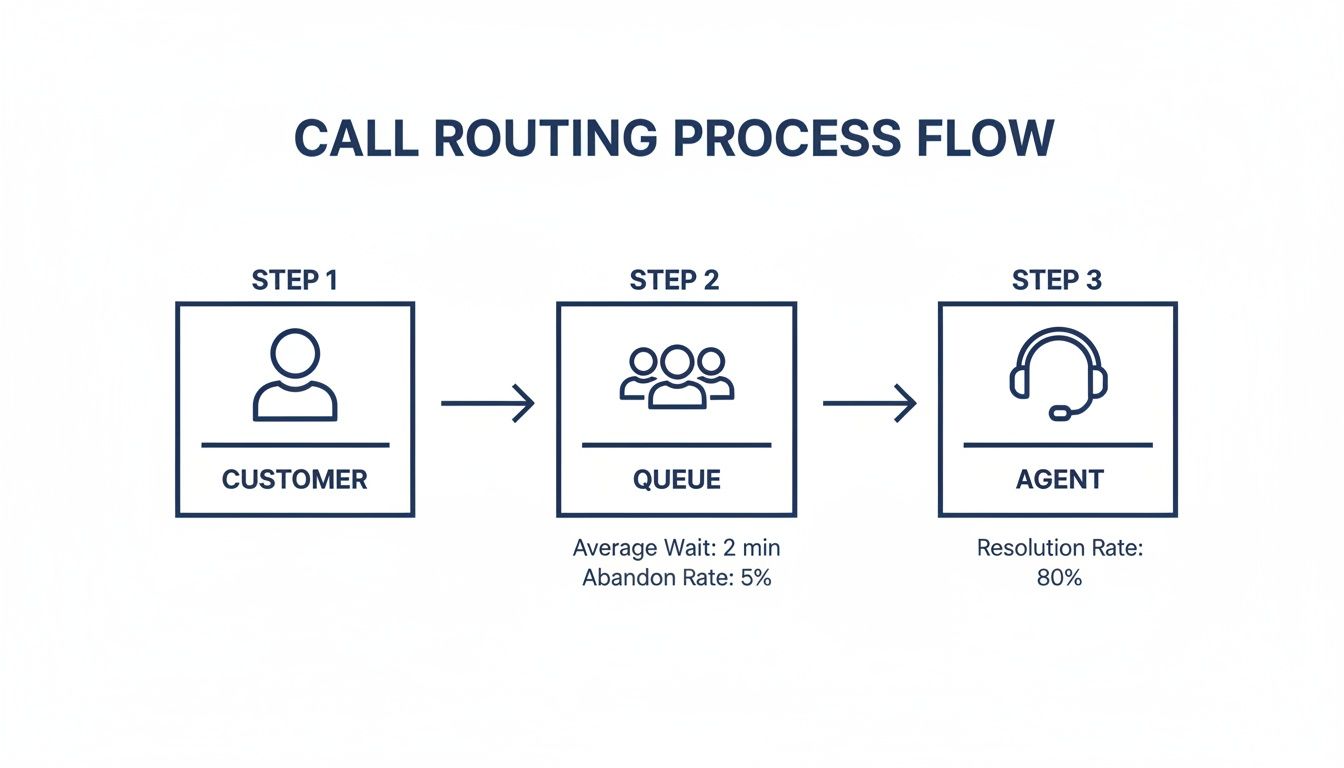
As the diagram shows, a call flows seamlessly from the customer, through an organized queue, and connects to the next available agent, slashing frustrating wait times.
This level of intelligent management is exactly why businesses are making the switch in droves. By 2025, 31% of companies worldwide will be running entirely on VoIP. In North America, 96% of enterprises have already started moving to cloud or mobile systems. You can dig deeper into this industry-wide shift in this detailed market report.
Ultimately, a hands-on migration process is non-negotiable. Partnering with a provider who offers white-glove setup and 24/7 support takes all the risk off your plate. It builds confidence and guarantees your transition to a modern hosted business phone system is a seamless success.
Choosing the Right Partner for Your Business
Picking a provider for your hosted business phone system isn’t just another vendor purchase. It’s a long-term relationship. The right partner becomes a true extension of your team, helping you grow. The wrong one? A source of endless headaches and frustration.
That’s why the most important thing you can do is shift the conversation away from just the monthly price tag. A real partner is more interested in solving your business challenges than in pushing a generic, one-size-fits-all plan. They should be asking deep questions about how your calls flow, how your teams work, and where you see the business going.
Looking Beyond the Price Tag
The way a provider structures their pricing says a lot about their entire philosophy. Some will try to reel you in with a deceptively low base price, only to hit you with extra fees for features you can't live without—things like call recording, mobile apps, or even just getting a support agent on the phone.
Instead, look for a provider with an all-inclusive pricing model. Companies like SnapDial offer a single, predictable per-user monthly bill that wraps in all the enterprise-grade features, a full white-glove setup, and ongoing support. This completely eliminates surprise charges and makes your communication costs a simple, manageable operating expense.
When you're vetting partners, also pay attention to the hardware they stand behind. Crystal-clear call quality often comes down to the desk phones you use, and providers that offer and support top-tier equipment like Yealink IP phones show they care about quality from end to end.
A partner’s true value isn't found in the lowest price, but in the total return on investment. This includes savings from eliminated maintenance contracts, reduced IT workload, and significant gains in employee productivity and customer satisfaction.
The Real ROI of a Hosted System
Calculating the true Return on Investment (ROI) for a hosted system means looking far beyond a simple comparison of monthly bills. The real value comes from the financial and operational benefits that ripple across your entire business.
Think about these key value drivers:
- Eliminated Maintenance Costs: You can finally ditch those expensive support contracts and the unpredictable repair bills that come with an on-site PBX.
- Reduced IT Burden: Your tech team is freed from babysitting phone hardware, letting them focus on bigger projects that actually move the needle.
- Productivity Gains: Features like visual voicemail, mobile apps, and CRM integrations give every single employee valuable time back in their day, boosting company-wide efficiency.
- Improved Customer Retention: With smart call queues and callback options, you can slash hold times and deliver a superior experience that turns customers into fans.
Ultimately, your goal is to find a provider who acts like a true partner—one who gives you transparent pricing, expert 24/7 support, and a real commitment to helping you succeed. That's the foundation for a smart, successful switch to a modern hosted business phone system.
Got Questions? We've Got Answers
Making the final call on a new phone system can feel like a big step, and it's completely normal to have a few questions before you commit. To help you feel confident in your choice, we’ve put together straightforward answers to the questions we hear most often from businesses just like yours.
Will My Call Quality Be as Good as a Landline?
This is usually the number one concern, and the short answer is: yes, and often, it’s even better. Modern hosted phone systems deliver crystal-clear, high-definition (HD) voice that’s a world away from the crackle of old analog lines.
The secret sauce is a stable, high-speed internet connection. Before any installation, a good provider will check your network to make sure it's ready to handle voice traffic. With the right setup, you won't have to worry about the jitter or dropped calls that gave early internet phones a bad name.
What Kind of Internet Connection Do I Need?
You don't need a top-of-the-line, ultra-expensive internet plan, but you do need a solid, reliable business-grade connection. The most important factor isn't raw speed; it's stability. The actual bandwidth you need depends on how many people will be on the phone at the same time.
Here's a simple rule of thumb:
- Each call uses about 100 Kbps of your upload and download speed.
- An office with 10 employees making calls simultaneously would only need about 1 Mbps of dedicated bandwidth for their phones.
Most modern business internet plans can handle that with ease. The real focus should be on finding a connection that's consistent, not one that just boasts the highest download numbers.
The reliability of a hosted business phone system is directly tied to the provider’s infrastructure. Top-tier providers like SnapDial operate multiple, geographically redundant data centers, ensuring your phone service remains online even if one location experiences an issue.
Is a Hosted Phone System Secure?
Absolutely. For any reputable provider, security isn't an afterthought—it's the bedrock of their entire service. They use a multi-layered strategy to keep your communications private and protected. This includes:
- Call Encryption: Using protocols like TLS and SRTP to scramble voice data, making your conversations unreadable to anyone trying to eavesdrop.
- Network Security: Their data centers are protected by enterprise-grade firewalls, intrusion detection systems, and are monitored 24/7 to block unauthorized access.
- User-Level Controls: You get the power to set permissions and manage access, making sure only the right people can make changes to your system.
Honestly, a professional hosted provider invests far more in security than a single business could ever afford for an on-premise system. You’re essentially outsourcing this critical and complex job to the experts.
Ready to see how a modern, secure, and feature-rich phone system can transform your business communications? SnapDial offers all-inclusive pricing, free white-glove migration, and 24/7 Texas-based support to make your switch seamless. Get a quote today!