
Hosted VoIP is all about taking the bulky, expensive phone system hardware out of your office closet and moving it into the cloud. Instead of relying on traditional phone lines, your calls travel as digital information right over your internet connection. The best part? Your provider handles all the complex hardware and software, freeing you from constant maintenance and the inflexibility of an old-school system.
What Is Hosted VoIP and How It Works
Imagine your entire business phone system—all the call routing, voicemail, extensions, and fancy features—living securely in your provider's data centers, delivered to you as a service. That's the essence of hosted VoIP. It completely replaces the clunky, on-premise Private Branch Exchange (PBX) hardware with a flexible, internet-powered solution.
Think of it this way: a traditional phone system is like having a massive, physical server room in your office just to run your email. It's expensive, requires an expert to maintain, and is a total headache to upgrade. Hosted VoIP is like switching to Gmail or Office 365. All the heavy lifting is done by experts in highly secure, reliable data centers. You just log in and it works.
When you make a call, your voice is converted into digital data packets. Those packets zip across the internet to your provider's network, which handles all the complex routing to connect your call. A provider like SnapDial manages the entire journey, ensuring your call reliably reaches its destination, whether it's another VoIP phone down the hall or a traditional landline across the country.
The Shift from Owning Hardware to Using a Service
This fundamental shift from buying physical hardware to using a managed service solves some of the most frustrating problems businesses face with their phones. The benefits are immediate and impactful:
- Ditch the Upfront Costs: You no longer have to sink thousands of dollars into server equipment that will be obsolete in a few years.
- Work from Anywhere: Your team can stay connected from any location with an internet connection, using a desk phone, a computer softphone, or a mobile app.
- Scale on Demand: Adding a new employee is as simple as a few clicks in a web portal. No more calling a technician to run new physical wiring.
To give you a clearer picture, this table breaks down the core differences between the old way and the new way.
Hosted VoIP vs Traditional PBX at a Glance
| Attribute | Hosted VoIP | Traditional On-Premise PBX |
|---|---|---|
| Initial Cost | Low to none; subscription-based | Very high; requires purchasing all hardware |
| Maintenance | Fully managed by the provider | Your responsibility; requires IT staff or vendor contract |
| Scalability | Instant; add or remove users via a web portal | Complex and expensive; requires new hardware and wiring |
| Remote Work | Natively supported with mobile & desktop apps | Difficult to support; often requires complex VPNs |
| Features | Includes advanced features like IVR & call recording | Basic calling; advanced features are costly add-ons |
| Reliability | High, with guaranteed uptime from redundant data centers | Dependent on your office's power and infrastructure |
As you can see, the operational models are night and day. One puts all the technical burden on you, while the other lets you focus on your business.
A hosted VoIP system essentially outsources all the complexity of business telephony. You get access to powerful, enterprise-grade features and rock-solid reliability without needing a dedicated IT team to manage a phone closet.
If you want to dig deeper into the core technology, this guide on What Is VoIP Technology and How Does It Work? is a great resource. The "hosted" part simply means a third-party expert manages that VoIP technology for you.
Ultimately, this lets any business project a professional image and connect with customers and team members from any device, anywhere. A hosted solution is just one type of modern phone system, and it’s worth understanding the broader category in our guide on what a cloud phone system is and how it can help your business. It’s all about giving you powerful communication tools without the traditional headaches.
How Does a Hosted VoIP Call Actually Work?
Making a phone call feels simple. You pick up a device, dial a number, and you’re connected. But with a hosted VoIP system, what happens in that split second is a pretty slick digital journey. Let's lift the hood and see exactly how your voice gets from point A to point B.
The magic starts the moment you speak. Whether you’re on a physical IP desk phone, a softphone app on your laptop, or our mobile app, your microphone captures your voice. Your device instantly chops those analog sound waves into tiny, digitized bits of data called packets.
Think of these packets like a stack of tiny digital envelopes. Each one contains a small piece of your conversation, sealed and addressed. As soon as they’re created, these envelopes are sent out over your office's internet connection, starting their trip through the cloud.
The Cloud PBX: Your System's Brain
This is where your hosted VoIP provider steps in. Your data packets don't just wander aimlessly across the internet. Instead, they're routed directly to your provider's secure cloud servers, where the real brain of the operation lives: the cloud PBX.
You can think of the cloud PBX as a highly advanced air traffic control tower for all your business communications. It catches the incoming packets from your phone and knows exactly what to do with them. Its job is to manage, organize, and route every single call based on the rules you’ve set up.
This diagram shows how it all comes together—from your office, through the cloud, and out to the person you're calling.
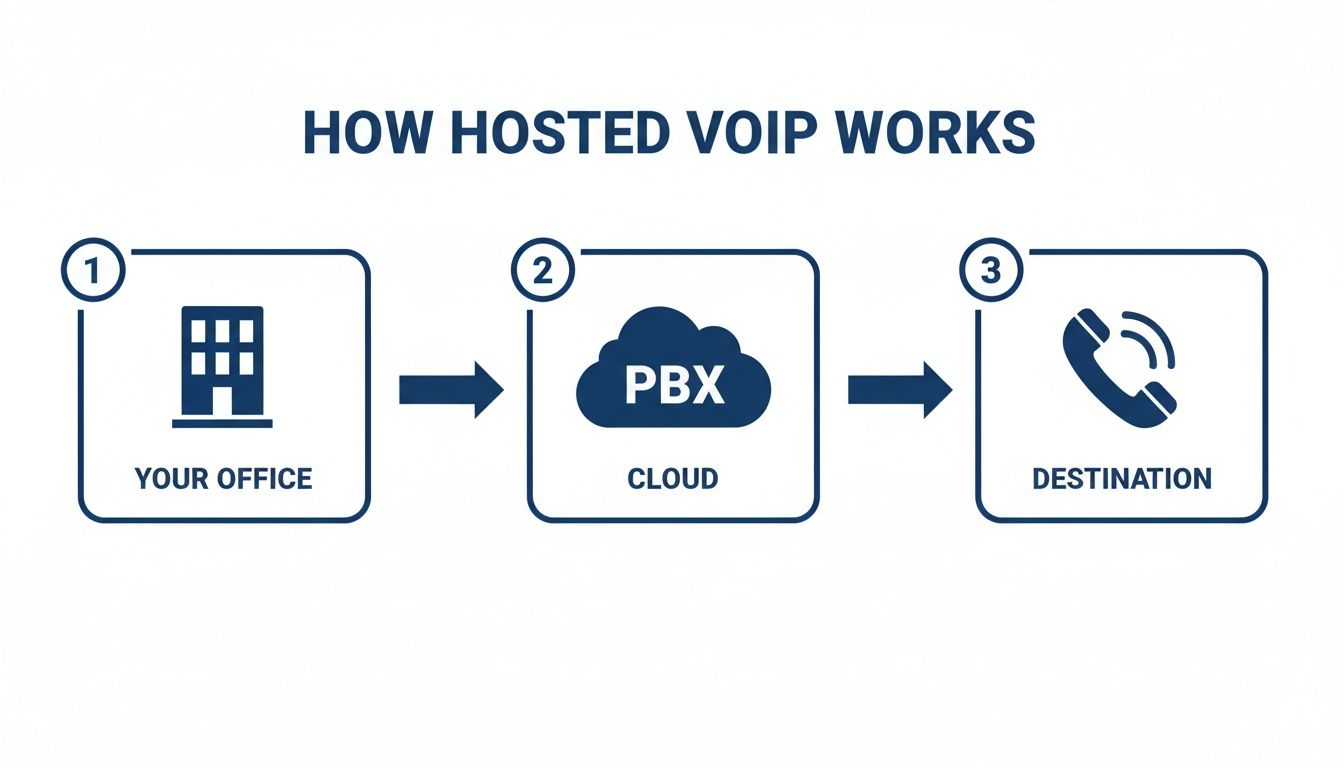
The real beauty of the hosted model is its simplicity. All the complex hardware and routing logic is handled for you, off-site. Your business just needs to manage the endpoints—your phones and apps.
Connecting Your Call to the Outside World
Once the cloud PBX gets your data, it gets to work. If you’re calling a coworker, it zips the call right to their extension, whether they’re at the next desk or using a mobile app on the other side of the country.
But what if you dial a traditional landline or a cell phone? The cloud PBX seamlessly bridges the gap by connecting to the Public Switched Telephone Network (PSTN)—that’s the global network that handles all old-school phone calls. It translates your digital packets back into a standard voice signal the other person's phone can understand, completing the call instantly.
This shift to cloud-based phone systems isn't a small trend; it's a massive migration. The global hosted PBX market was valued at around $14.7 billion in 2026 and is on track to hit an estimated $30.4 billion by 2030. That staggering growth is being driven by businesses ditching their clunky, on-premise hardware for more agile cloud solutions. You can dive deeper into these VoIP statistics and the industry’s rapid expansion in this comprehensive report.
The bottom line is this: with hosted VoIP, all the heavy lifting happens in your provider's cloud. You don't have to own, maintain, or update any server hardware in a closet. All you need is a solid internet connection and your devices.
This model doesn't just simplify your IT stack; it delivers some powerful advantages right out of the box:
- Centralized Control: You manage every user, call flow, and feature from a single, easy-to-use web portal.
- Built-in Reliability: Good providers run multiple data centers. If one has an issue, your service automatically fails over to another, so you never notice a thing.
- Instant Feature Access: Advanced tools like an auto-attendant, call recording, and powerful analytics are already built into the cloud PBX.
Ultimately, the technology handles all the technical headaches behind the scenes, delivering a reliable, feature-packed phone service that just works. It frees you up to focus on running your business, not on managing a phone system.
Key Business Benefits of Moving to the Cloud
Sure, understanding the tech behind hosted VoIP is helpful, but let's get to the real question: what will it actually do for your business? Moving your phone system to the cloud isn't just a technical swap. It’s a core business decision that has a direct impact on your bottom line, your team’s agility, and the professional image you project to the world.
The benefits go way beyond just making calls over the internet.
The first and most powerful advantage is the dramatic cost savings. Think about what it takes to set up a traditional phone system: a massive upfront capital expense (CapEx) for a physical PBX server, new phones, miles of wiring, and a technician to install it all. With a hosted solution, that entire upfront investment vanishes.
Instead of buying and owning a bulky piece of hardware that starts losing value the second you plug it in, you shift to a predictable monthly operating expense (OpEx). This subscription model makes budgeting dead simple and frees up cash that you can put back into growing your business—not into a depreciating asset collecting dust in a closet.

Unlock Unmatched Flexibility and Mobility
In the modern workplace, flexibility isn't a perk; it's a necessity. A hosted VoIP system is built from the ground up for today's distributed workforce. Because your phone system lives in the cloud, your team is no longer chained to a physical desk in a specific office to get their work done.
With tools like mobile apps and desktop softphones, every employee’s smartphone or laptop becomes their office phone. They can make and receive calls on their business number, pull up company contacts, and check voicemails from literally anywhere with an internet connection. This empowers your team to stay connected and sound professional, whether they're at home, on the road, or out in the field.
Intelligent call forwarding rules make sure important calls always find the right person. If a team member doesn't answer their desk phone, the system can instantly ring their mobile app. That means a critical customer call never hits voicemail just because someone stepped away from their desk for a coffee. This kind of mobility keeps your business running smoothly, no matter where your people are.
Project a Fortune 500 Image on a Small Business Budget
How you answer the phone says a lot about your company, and first impressions count. Hosted VoIP gives small and mid-sized businesses the keys to powerful, enterprise-grade features that used to be out of reach for anyone without a massive budget.
One of the most impactful of these tools is the Auto Attendant, or "virtual receptionist." It greets every caller with a professional welcome and a simple menu ("Press 1 for Sales, Press 2 for Support"), making sure every call gets routed to the right place without needing a dedicated receptionist. It instantly makes your business sound bigger and more buttoned-up.
With hosted VoIP, you’re not just buying a phone service; you’re investing in a professional communications platform that levels the playing field. It allows a five-person startup to present the same polished, professional image as a 500-person enterprise.
Other advanced features take your capabilities even further:
- Advanced Call Queues: If your support team gets swamped, callers are placed in a queue with on-hold music or periodic updates. This dramatically reduces hangups and keeps customers from getting frustrated.
- Voicemail-to-Email Transcription: Voicemails are automatically converted to text and sent straight to your email inbox. This allows you to quickly read messages on the go and respond faster.
- Call Recording: This becomes an incredible tool for quality assurance, training new employees, and resolving disputes with a clear record of the conversation.
This shift from a basic utility to a strategic asset is a key reason why the small and medium-sized enterprise segment is projected to see the fastest growth in the VoIP market. For a detailed breakdown of how the two system types compare, you can dive into the differences in our guide to hosted VoIP vs. on-premise PBX solutions. Ultimately, adopting a hosted system gives your business the tools to not just communicate, but to do it more professionally, efficiently, and cost-effectively.
Essential Features Your Business Can't Live Without
Switching your phone system isn't just about swapping out old tech for new. It's about arming your business with a completely new toolkit—one that helps you operate more efficiently and look more professional to every single caller.
While some providers will throw a laundry list of options at you, a handful of features have become absolute must-haves for any modern company. These aren't just shiny bells and whistles; they’re the workhorses that will actually boost your team’s productivity and sharpen your customer experience.
One of the first things you'll wonder how you ever lived without is the Auto Attendant. Think of it as a flawless digital receptionist who works 24/7. It greets every caller with a professional, custom-recorded message and gives them a simple menu ("Press 1 for Sales, Press 2 for Support") that gets them to the right person on the first try.
This one feature alone can make a small business sound like a major enterprise, putting an end to the chaos of missed calls or frantic manual transfers.
Right alongside this is the magic of intelligent call routing. You can build smart rules that go way beyond just making a desk phone ring. For instance, a call can ring an office phone for 15 seconds, then automatically ring a team member's mobile app and desk phone at the same time. Someone is always going to pick up. This smart distribution means fewer customers land in voicemail and get much faster answers.
Beyond Basic Calling: Core Productivity Tools
Once you nail the fundamentals of call management, a whole new layer of features unlocks even more value. These tools transform your phone system from a simple utility into a strategic asset that helps with everything from training and documentation to on-the-go productivity.
A perfect example is call recording. For many businesses, this is a total game-changer. It creates an undeniable record of every conversation, which is priceless for a few key reasons:
- Quality Assurance: Managers can review calls to give targeted, evidence-based feedback that actually helps improve their team’s customer service skills.
- Training New Hires: A library of successful sales or support calls becomes a powerful training manual for getting new employees up to speed fast.
- Dispute Resolution: If a disagreement ever pops up over what was said or agreed to, the recording provides a clear and accurate account.
Another non-negotiable tool for any modern team is visual voicemail with transcription. Forget dialing into a clunky voicemail box and listening to messages one by one. Your voicemails are automatically turned into text and sent right to your email or mobile app.
This lets you "read" your messages instantly, whether you're in a meeting or a noisy coffee shop, so you can prioritize callbacks and respond in a fraction of the time.
The Power of Unified Communications
The real muscle of a modern hosted VoIP system is its ability to pull all your communication channels into one cohesive platform. This is where features like mobile and desktop apps, known as softphones, come into play. These apps turn any internet-connected device—a laptop, a smartphone, a tablet—into a full-featured business phone.
Your employees can make and receive calls from their business number, check the company directory, transfer calls to colleagues, and manage voicemails, all from a single app. It keeps their personal and work lives separate and ensures they sound professional no matter where they're working from.
This shift is part of a much bigger trend. The global VoIP services market, which was estimated to hit $183.5 billion in 2026, is on track to surge to $264.27 billion by 2029. This growth is being fueled by businesses realizing they can now get advanced features that were once only available to massive enterprises. You can get detailed insights into VoIP growth on zoom.com to see just how fast this market is moving.
Hosted VoIP centralizes your entire communication stack. Instead of juggling separate tools for desk phones, mobile calling, and messaging, your team gets one unified system that works everywhere, on every device.
For businesses that rely heavily on team collaboration and detailed record-keeping, exploring the benefits of meeting transcription services can be a huge win when paired with a modern communication solution. When your phone system can handle calls, video meetings, and messaging, having an accurate text record of every interaction becomes incredibly powerful.
Ultimately, picking a hosted VoIP provider means looking beyond the dial tone. It's about finding a partner that offers an integrated suite of features designed to make your team more connected, productive, and professional. These are the tools that build a communication strategy ready to grow and adapt right alongside your business.
Your Practical Migration Checklist
Making the switch to a modern phone system can feel like a huge project, but it doesn't have to be a headache. With the right game plan, what seems like a daunting task becomes a smooth, manageable process.
This checklist will walk you through every step of moving to hosted VoIP, making sure the transition happens without any stress or downtime. The whole point is to get it right the first time. The journey starts with a simple, but critical, look at your own business. Before you even talk to a provider, you need a crystal-clear picture of your current setup and where it’s falling short.
This prep work makes all the difference, setting you up to make a smart decision when it comes time to choose a partner.
Phase 1: Audit Your Needs and Network
The first phase is all about discovery. You're gathering the raw data you'll need to make informed choices later on. Let's break this down into two key steps.
Analyze Your Communication Needs: Start by documenting how your team actually uses the phone system today. How many calls do you make and receive? What are your busiest times? Which features, like an auto-attendant or call recording, are absolute must-haves, and which are just nice extras?
Check Your Network Readiness: A hosted VoIP system runs entirely on your internet connection, so its stability is everything. You have to make sure your network can handle the added voice traffic without calls sounding choppy or dropping. Check out our guide to find out how much bandwidth you need for VoIP to confirm you’re ready.
With this info in hand, you're ready to start looking at providers. This is where you shift from internal analysis to vetting your options, ensuring you find a partner that truly matches your needs.
Phase 2: Vet Providers and Plan the Transition
Now that you know what you need, it’s time to find the right partner to deliver it. The lowest price on the sticker is rarely the best deal. You need to look deeper for a provider that offers rock-solid reliability, excellent support, and transparent pricing.
A successful migration isn't just about technology; it's about partnership. Choosing a provider like SnapDial, which offers 'white-glove setup', means their experts handle the technical heavy lifting, turning a complex process into a simple, managed project for you.
Once you’ve picked your provider, the real planning begins. This involves a couple of crucial steps:
- Plan Your Number Porting: You need to keep your existing business phone numbers. Your new provider will manage this process, which involves coordinating with your old carrier to move the numbers over. It’s smart to kick this off early, as porting can sometimes take a few weeks.
- Design Your Call Flows: This is your chance to build a smarter system from the ground up. Map out exactly what happens when someone calls your main business number. Where does the Auto Attendant send them? Which phones should ring when someone presses "1" for Sales?
This streamlined planning and deployment is a big reason the hosted IP PBX market is set for such rapid growth. Businesses are flocking to these solutions because they're easy to deploy, highly scalable, and affordable. Instead of managing expensive on-site hardware, companies are opting for hosted systems that offer centralized management and seamless upgrades with almost no IT effort. You can explore more about the VoIP market growth on PrecedenceResearch.com.
Phase 3: Deploy and Train Your Team
The final phase is where your new system comes to life. If you chose a provider that offers a managed setup, this part will be incredibly smooth. They'll handle all the configuration—user accounts, call routing rules, and auto-attendant menus—based on the design you created.
Your main job here is to focus on your team. Good training is the key to unlocking the full power of your new hosted VoIP system. Don't just show them how to make a call; demonstrate how to use the mobile app, manage voicemails right from their email, and transfer calls without a hitch.
A successful rollout ends with everyone on your team feeling confident and empowered by their new tools. By following these steps, you can ensure your migration is a strategic success that elevates how your business communicates for years to come.
Why SnapDial Is the Smart Choice for Hosted VoIP
When you start digging into hosted VoIP, you quickly realize you need more than just a dial tone. You need a partner who can solve the real-world communication problems holding your business back—from confusing costs and technical headaches to unreliable service. This is where SnapDial is different. We're not just another vendor; we're a strategic partner invested in your success.
We get rid of the cost puzzle that trips up so many businesses. Instead of complicated pricing tiers and surprise fees for "premium" features, SnapDial gives you all-inclusive, predictable pricing. That means every powerful tool we offer, from the Auto Attendant to call recording, is included in one simple monthly rate. Budgeting becomes straightforward and transparent.
Removing the Migration Headache
One of the biggest things holding businesses back from upgrading their phone system is the fear of a painful, disruptive migration. We eliminate that fear completely with our complimentary white-glove setup. Our expert team takes care of the entire transition, from moving your existing phone numbers to designing your call flows and training your staff.
SnapDial turns a complex technical project into a seamless, managed experience. We handle the heavy lifting so you can stay focused on your business without worrying about downtime or configuration errors. Your system is professionally built and ready to go from day one.
This hands-on approach ensures your new hosted VoIP system is perfectly optimized for how your business actually works, right out of the box.
A Commitment to Reliability and Support
At the end of the day, a phone system is a lifeline. If it's down, your business stops. We address this critical need for reliability head-on with our 24/7 Texas-based support. When you need help, you get a real answer from a real person who knows how to keep your business connected. No endless phone trees or offshore call centers—just expert help, whenever you need it.
Choosing SnapDial means you get more than a best-in-class hosted VoIP platform. You get a partner who simplifies your communications, removes the barriers to getting started, and stands behind you with unwavering support. We deliver the communication power of an enterprise with the simplicity and service that small and mid-sized businesses need to thrive.
Ready to see how a true communications partner can make a difference? Schedule a personalized demo and discover why SnapDial is the smart choice for your business.
Got Questions? We've Got Answers
Making the final call on a new phone system can feel like a big step. To help you feel confident in your choice, we’ve put together straightforward answers to the questions we hear most often from businesses just like yours.
Can We Keep Our Existing Business Phone Numbers?
Yes, absolutely. This is usually the first question people ask, and for good reason. You don't have to give up the numbers your customers already know and trust.
The process is called "number porting," and it’s a standard, regulated procedure that lets you move your current local and toll-free numbers to your new provider. A good partner will handle the entire porting process for you. Their job is to make sure the switch happens behind the scenes with zero downtime, so your customers won't even notice a change.
What Internet Speed Do I Need?
While a hosted VoIP system runs over the internet, it's surprisingly light on bandwidth. A good rule of thumb is that each simultaneous call needs about 100 Kbps of both upload and download speed. For most businesses, a standard business-class internet connection has more than enough horsepower.
The real secret to crystal-clear calls isn't raw speed—it's connection stability. A consistent, reliable internet connection is the foundation of great audio quality. Jitter and packet loss are the true enemies of a good conversation, not bandwidth.
A stable connection ensures all the little digital packets carrying your voice arrive on time and in the right order, which is what makes a conversation sound natural and clear.
Just How Secure Is a Cloud-Based Phone System?
This is a big one, and the short answer is: very secure. In fact, your communications are often far safer in a professionally managed cloud environment than on an old server sitting in your office closet. Reputable providers take security incredibly seriously.
They implement multiple layers of protection to keep your calls and data safe. These typically include:
- End-to-End Encryption: This scrambles your call data from end to end, making it impossible for anyone to eavesdrop on your conversations.
- Secure Data Centers: The provider's servers are housed in fortified facilities with redundant power, backup connections, and both physical and digital security.
- Proactive Monitoring: Their teams are constantly watching the network 24/7 to spot and shut down potential threats before they can ever affect your service.
Is It Difficult to Add or Remove Employees?
Not at all. This is actually one of the biggest reasons businesses make the switch to hosted VoIP. The ability to scale up or down is incredibly simple and almost instantaneous.
Adding a new hire or removing a user who has left the company takes just a few minutes in a simple online portal. There’s no need to call a technician or wait for new lines to be installed. You can assign an extension, set up their call rules, and have them ready to go in less time than it takes to make a cup of coffee. This effortless scalability means your phone system grows right alongside your business.
Ready to see how a true communications partner can make all the difference? With SnapDial, you get more than just a phone system; you get a partner who simplifies your communications, removes the barriers to getting started, and stands behind you with unwavering 24/7 Texas-based support. Schedule a personalized demo to learn more at https://snap-dial.com.