

The choice really boils down to this: Hosted VoIP is a flexible, cloud-based phone service you pay for monthly, while a traditional PBX is a physical hardware system you buy outright and manage yourself. It's a classic "rent vs. buy" decision, hinging on whether you value operational simplicity and scalability over total in-house control and a one-time capital expense.
Choosing Your Next Business Phone System
Picking between Hosted VoIP and an on-premise PBX isn't just a tech decision—it's a strategic move. It directly affects your budget, your IT team's workload, and how easily your business can grow or pivot. A modern phone system is more than just a way to make calls; it’s the nerve center for how you talk to customers and how your team collaborates. Getting a handle on the key differences in how they're built, how you pay for them, and who manages them is the first step to making a smart choice.
Core Architectural Differences
The central question in the Hosted VoIP vs. PBX debate is simply: where does your phone system live?
A Hosted VoIP system—often called a Cloud PBX—runs entirely on your provider's secure servers. All the heavy lifting, from the complex hardware to software updates and security, is handled for you off-site. You just plug in your IP phones or fire up a softphone app and connect over the internet. It works a lot like a utility; you pay a monthly fee and the service just works.
On the other hand, an on-premise PBX means you're buying a physical server box and installing it in your own IT closet. You own the hardware, which means you're also on the hook for all the maintenance, upgrades, and security. This setup gives you direct, hands-on control, but it also means your team is responsible for keeping it running.
This isn't just about technology; it's an operational choice. Do you want a predictable monthly bill for a fully managed service (OpEx)? Or would you rather make a large upfront investment for hardware you completely control (CapEx)?
For a quick overview, this table cuts straight to the core differences between the two approaches.
Hosted VoIP vs On-Premise PBX At a Glance
| Aspect | Hosted VoIP (Cloud PBX) | On-Premise PBX |
|---|---|---|
| Location of Hardware | Off-site, in your provider's secure data centers. | On-site, inside your office or server room. |
| Cost Model | Operational Expenditure (OpEx) – predictable monthly per-user subscription. | Capital Expenditure (CapEx) – large one-time hardware purchase. |
| Management & Maint. | Handled entirely by the provider, including all updates and security. | Your responsibility, requiring in-house IT staff or a third-party contract. |
| Scalability | Extremely flexible. Add or remove users in minutes via a web portal. | Rigid. Requires new hardware, licenses, and an on-site technician. |
Ultimately, the right answer depends entirely on your business's resources, priorities, and long-term goals.
Understanding the Fundamental Architectures
To really get to the heart of the Hosted VoIP vs. On-Premise PBX debate, we need to talk about where the technology actually lives and who’s in charge of it. The core difference comes down to physical and operational structure, and that one distinction impacts everything—cost, maintenance, and your ability to support a flexible, modern workforce.
Think of it this way: are you renting a fully managed service, or are you buying and maintaining the property yourself?
A hosted VoIP system, often called a Cloud PBX, operates entirely off-site. The provider owns and manages all the complex servers and software in their own secure data centers. Your business just plugs into their service over your internet connection using IP phones or softphone apps. No clunky server closets to worry about.
On the flip side, an on-premise PBX is exactly what it sounds like: a physical server box that you buy and install at your business. This hardware becomes the central nervous system for your company's phone lines. You own it, which also means you're on the hook for setup, security, maintenance, and any upgrades down the line.
The Hosted VoIP Model Explained
When you go with a hosted VoIP architecture, you're essentially handing off the entire technical headache of a phone system to a specialist. All the call routing, voicemail, auto attendants, and fancy features are handled in the cloud by your provider.
This service-based model has some serious operational perks:
- Zero Hardware Maintenance: Forget about server updates, hardware failures, or security patches. That’s no longer your problem.
- Location Independence: Since the system lives on the internet, your team can connect from literally anywhere—the office, their home, a coffee shop—using a desk phone, computer, or a mobile app.
- Simplified Management: Admins can add new users, tweak call flows, and manage features through a simple web portal. No deep IT expertise is required.
This shift in architecture is a huge reason the hosted PBX market is booming. A recent analysis expects the market to swell from over $7 billion to more than $20 billion by 2033. This trend isn't just a fad; it shows a clear business preference for getting rid of maintenance hassles and staying nimble enough for hybrid work. You can dive deeper into the numbers in the full Hosted PBX Market Growth Report.
The On-Premise PBX Model Explained
The on-premise model puts you firmly in control. Your IT team has their hands directly on the PBX server, giving you total command over its configuration and security protocols. The entire architecture is built around that central piece of hardware sitting in your facility.
Owning an on-premise PBX means you control every aspect of the system. However, it also means you are solely responsible for its uptime, security, and functionality—a significant commitment of resources and expertise.
This model comes with its own set of requirements:
- Dedicated IT Resources: You'll need people on staff with the know-how to manage and troubleshoot a physical phone server.
- Physical Infrastructure: That hardware needs a home, usually a secure, climate-controlled server room or closet.
- Capital Investment: This approach demands a significant upfront investment in the server hardware and all the necessary licenses.
At the end of the day, both systems make and take calls, but their underlying structures create completely different ownership experiences. To get a better look at the hardware at the core of a traditional setup, check out our guide on what a PBX system is.
Analyzing the Total Cost of Ownership

When people compare Hosted VoIP to an on-premise PBX, the money talk usually boils down to a simple "rent vs. buy" debate. That’s a fair start, but it barely scratches the surface. To really understand the financial impact, you have to look at the Total Cost of Ownership (TCO), which uncovers all the hidden expenses that come with traditional phone systems.
With a Hosted VoIP system, you’re looking at a straightforward, subscription-based cost. You pay a set price per user each month, turning your phone system into a predictable operating expense (OpEx). This fee isn't just for making calls—it almost always bundles in maintenance, software updates, and tech support, so you're never blindsided by surprise bills.
On the other hand, an on-premise PBX demands a huge upfront investment (CapEx). And trust me, that initial purchase is just the first of many checks you'll write. You'll also have to budget for a whole host of ongoing costs that are anything but predictable.
The Upfront Costs of an On-Premise PBX
The initial price tag for an on-premise system is a big one. You're not just buying a server; you're buying an entire ecosystem of hardware and paying for the expertise to get it running.
- PBX Server Hardware: This is the heart of the system and easily the biggest line item.
- Physical Desk Phones: Every employee needs a compatible IP phone, and the cost adds up fast.
- Networking Equipment: You might need to upgrade your network switches or routers to prioritize the voice traffic effectively.
- Installation & Configuration: This isn't a DIY project. You’ll need a certified technician for the setup, which comes with a hefty service fee.
- Software Licensing: On top of the hardware, you'll have to pay for licenses, often on a per-user or per-feature basis.
For even a small or medium-sized business, these costs can spiral into the tens of thousands of dollars. That's a serious chunk of change that could probably be better spent growing the business.
Uncovering the Hidden Ongoing PBX Costs
Once the system is installed, an on-premise PBX starts racking up ongoing—and often unexpected—expenses that bloat its long-term cost. These are the budget-killers that many people forget to account for.
The true cost of an on-premise PBX isn't the price tag on the server; it's the cumulative weight of maintenance contracts, staff time, mandatory upgrades, and system downtime over its lifespan.
Here are the recurring costs you can expect:
- Maintenance Contracts: To get software updates and technical help, you’ll need an annual support contract. These typically run 15-20% of the initial hardware cost, year after year.
- IT Staffing: The system needs constant attention. That means your IT team will spend valuable hours on troubleshooting, managing users, and running updates—time they could be using for more strategic projects.
- Hardware Upgrades & Replacement: PBX hardware doesn't last forever. Every 5-7 years, you'll face either expensive component replacements or a full-blown "forklift upgrade" to a new system.
- Utility Costs: That server has to run 24/7, which means it’s constantly using power and needs cooling, adding a little extra to your utility bills every month.
A Hosted VoIP solution from SnapDial rolls nearly all of these costs into one simple monthly payment. There are no separate maintenance contracts, no servers to power, and no need for specialized IT staff just to manage the phones. You can get a better sense of this model by reading our guide on what a cloud phone system is. This fundamental difference is what really changes the long-term financial game.
5-Year TCO: A Hypothetical Scenario
Let's put some real numbers to this. Here’s a side-by-side comparison for a hypothetical 25-user business over a five-year period. This shows how the costs truly stack up over time, going way beyond that initial price tag.
5-Year Total Cost of Ownership (TCO) for a 25-User Business
| Cost Component | Hosted VoIP (Estimated) | On-Premise PBX (Estimated) |
|---|---|---|
| Initial Hardware & Setup | $0 – $2,500 (Phones Only) | $15,000 – $25,000 |
| Monthly Service Fees (5 Yrs) | $45,000 (@ $30/user/mo) | $7,500 (SIP Trunks @ $25/trunk) |
| Annual Maintenance (4 Yrs) | $0 (Included) | $12,000 (@ $3,000/yr) |
| IT Staff Allocation (5 Yrs) | Minimal | $25,000+ |
| 5-Year Estimated TCO | $45,000 – $47,500 | $59,500 – $72,500+ |
As you can see, the on-premise PBX ends up costing significantly more over five years, even though its monthly line costs are lower. The massive initial investment, combined with relentless maintenance and staffing costs, really adds up. For most businesses, the financial predictability and lower TCO of Hosted VoIP make it the clear winner.
Comparing Scalability and Remote Work Readiness

The one thing you can count on in business is change. You might be growing fast, dealing with seasonal rushes, or embracing a more flexible work model. Whatever the reason, your phone system has to keep up. This is where you'll see one of the biggest, most practical differences between a Hosted VoIP system and an old-school on-premise PBX.
Hosted VoIP is built from the ground up to be flexible. Since everything runs in the cloud, adding or removing people is as easy as changing your subscription. Need to bring on five new sales reps for the holidays? You just log into a web portal, add the users, and they’re good to go in minutes. This kind of agility means your phone system grows right alongside your business, with no delays or pricey hardware roadblocks.
On the other hand, scaling an on-premise PBX is a much bigger deal. That physical server box in your IT closet can only handle so many calls and users at once. When you hit that limit, it's not a simple software fix. You’re looking at buying and installing new hardware modules, paying for more user licenses, and getting a technician out to do the upgrade. This creates a ton of friction and makes it tough for a traditional PBX to keep up with a dynamic company.
Enabling the Modern Remote Workforce
The move toward remote and hybrid work has really put phone systems to the test. Hosted VoIP shines here because it was practically made for it. Your team can connect from literally anywhere with an internet connection—using a desk phone at home, a softphone on their laptop, or an app on their mobile. No matter what, they have a consistent, professional presence using their business phone number.
This all ties into the idea of unified communications (UC), which brings voice, video calls, and messaging together in one place. With 83% of global workers saying they prefer a hybrid work model, this isn't just a nice-to-have anymore. For more on this trend, check out the full VoIP market analysis from Precedence Research. Hosted VoIP delivers this experience right out of the box, without you having to buy a bunch of extra equipment.
Trying to get remote access working on a traditional PBX is a whole other story. It’s often a clunky, insecure mess that involves setting up VPNs, poking holes in your firewall, and wrestling with complex network settings just to connect off-site employees. It can be unreliable and, if you don't have a real expert managing it, can open you up to major security risks.
With a Hosted VoIP system, remote work is a native feature. For an on-premise PBX, it's a technical workaround—an add-on that introduces complexity and risk to a system not built for a distributed world.
A Practical Comparison of System Growth
Let's walk through a real-world scenario. Say your company is opening a new branch office with ten employees.
-
With Hosted VoIP: Your admin logs into the SnapDial portal. They create ten new user profiles, assign phone numbers, and can ship pre-configured IP phones directly to the new office. The whole thing can be done in under an hour. From day one, the new office is seamlessly connected to the main phone system, with no new hardware needed back at headquarters.
-
With an On-Premise PBX: First, you have to figure out if your current PBX server can even handle ten more users. If it can't, you'll need to order and install a hardware expansion card. Then you have to buy ten new user licenses. Finally, you'll need a technician to come on-site to set up the new extensions and figure out how to connect the new office, which usually involves a complicated and expensive network link.
The difference in agility is huge. Hosted VoIP gives you the fluid scalability that modern businesses need, while an on-premise PBX feels like a static piece of infrastructure. Of course, you’ll want to make sure your internet connection can handle the call volume; you can find out how much bandwidth you need for VoIP in our detailed guide.
Security, Reliability, and Control: Who Holds the Keys?
When you’re weighing a hosted VoIP system against an on-premise PBX, what you're really deciding is who's in charge of your security and uptime. This isn't just a technical footnote; it’s a strategic choice between outsourcing to a dedicated expert or keeping total control in-house. Each approach has its own set of responsibilities and potential pitfalls.
With a hosted VoIP solution, you're essentially handing the security keys to a specialized provider. A good provider, like SnapDial, operates at a scale most businesses simply can't afford to replicate. We build enterprise-grade security right into the service, including robust defenses that would be a massive capital expense to implement on your own.
On the other side of the coin, an on-premise PBX puts the entire security burden on you. You get absolute, granular control over every piece of hardware and every line of code in your network configuration. For businesses with highly specific or strict security mandates, this can be a huge plus. But that control means you’re also on the hook for protecting it—a job that demands constant vigilance and deep expertise.
Hosted VoIP: Built-In Security and Uptime
One of the biggest draws of a quality hosted VoIP service is the security and reliability infrastructure that comes standard. Providers live and breathe this stuff; their entire business hinges on keeping the platform secure and online. The result is a multi-layered defense that’s far more sophisticated than what a typical small or medium-sized business could justify building themselves.
You can usually count on a framework that includes:
- Data Encryption: All your call data and media streams are encrypted, which stops anyone from snooping on your conversations.
- 24/7 Threat Monitoring: Providers have dedicated security teams watching the network around the clock for anything that looks suspicious.
- Compliance Management: The provider takes on the heavy lifting for major regulations like GDPR or HIPAA, which can be a huge relief for your own team.
Beyond security, reliability is just baked into the architecture of a cloud system. Hosted VoIP providers use geo-redundant data centers. That’s a fancy way of saying that if one data center has a problem, your service automatically switches to another one somewhere else, often without you even noticing. It's how providers can confidently offer service level agreements (SLAs) guaranteeing uptimes of 99.999%—a number that’s practically unreachable with a single server sitting in your office closet.
On-Premise PBX: Total Control, Total Responsibility
With an on-premise PBX, you’re the master of your domain. Your IT team gets to fine-tune every security policy, access rule, and hardware setting. For some industries, that level of direct control isn't just a preference; it's a requirement.
But this power comes with some serious strings attached. Your on-site PBX is a single point of failure for all your voice communications. A power outage, a fried server, or even just a local internet disruption can knock your entire phone system offline. Without the automatic failover of a cloud system, you’re left with no built-in plan for disaster recovery.
An on-premise PBX gives you complete control, but it also concentrates all your risk in one physical location. A power outage, hardware failure, or internet cut can mean a total communication blackout—the very vulnerability cloud systems were designed to solve.
Managing security is also a relentless, hands-on job. Your team is responsible for everything:
- Immediately applying security patches and firmware updates.
- Properly configuring firewalls to block unauthorized access.
- Actively hunting for signs of toll fraud and other attacks.
- Physically securing the server room itself.
If your IT team is already spread thin or doesn’t have a deep background in telecom security, that on-premise box can quickly become your weakest link. The trade-off is stark: a hosted solution gives you outsourced, expert-level security and reliability, while an on-premise system offers you total control—but also total responsibility and a whole lot of concentrated risk.
Making the Right Choice for Your Business
Okay, let's cut through the technical jargon. Picking a phone system isn't about finding the "best" one on paper; it's about finding the one that actually fits how your business runs day-to-day. The right choice hinges on your budget, your team's technical skills (or lack thereof), and where you see your company heading.
For the vast majority of businesses today, the path forward is clear: Hosted VoIP. It offers a blend of financial predictability and operational simplicity that just makes sense.
When Hosted VoIP Is the Clear Winner
Cloud-based phone systems are built for the modern world of work. If any of these scenarios sound familiar, Hosted VoIP is almost certainly your best bet.
- Startups and Small Businesses: You need powerful phone features, but you don't have an enterprise-sized budget. Hosted VoIP gives you everything from auto-attendants to call recording for a predictable monthly fee, letting you keep your cash for growing the business.
- Companies with Multiple Locations: A cloud PBX pulls all your offices together under a single, unified system. Someone in the London office can dial a simple 4-digit extension to reach a colleague in New York, creating a truly connected experience for everyone.
- Businesses with Remote or Hybrid Teams: This is where Hosted VoIP really shines. It was practically made for distributed workforces. Your team can use a mobile app, a desktop softphone, or a physical desk phone from their home office and be seamlessly connected to the main business line.
- Organizations Focused on Scalability: Expecting to grow? Hitting a seasonal rush? With a cloud system, adding or removing a user is a few clicks in a web portal. You're never paying for phone lines you aren't using.
Hosted VoIP removes the old-school barriers of hardware and location. It gives you the power to communicate like a Fortune 500 company, whether you have one office, twenty offices, or no physical office at all.
When an On-Premise PBX Still Makes Sense
While Hosted VoIP is the dominant choice, there are a few specific, and increasingly rare, situations where an on-premise PBX might still be on the table. Think of these as exceptions driven by very particular constraints.
This decision tree helps visualize the core factor—control over security—that typically drives this choice.
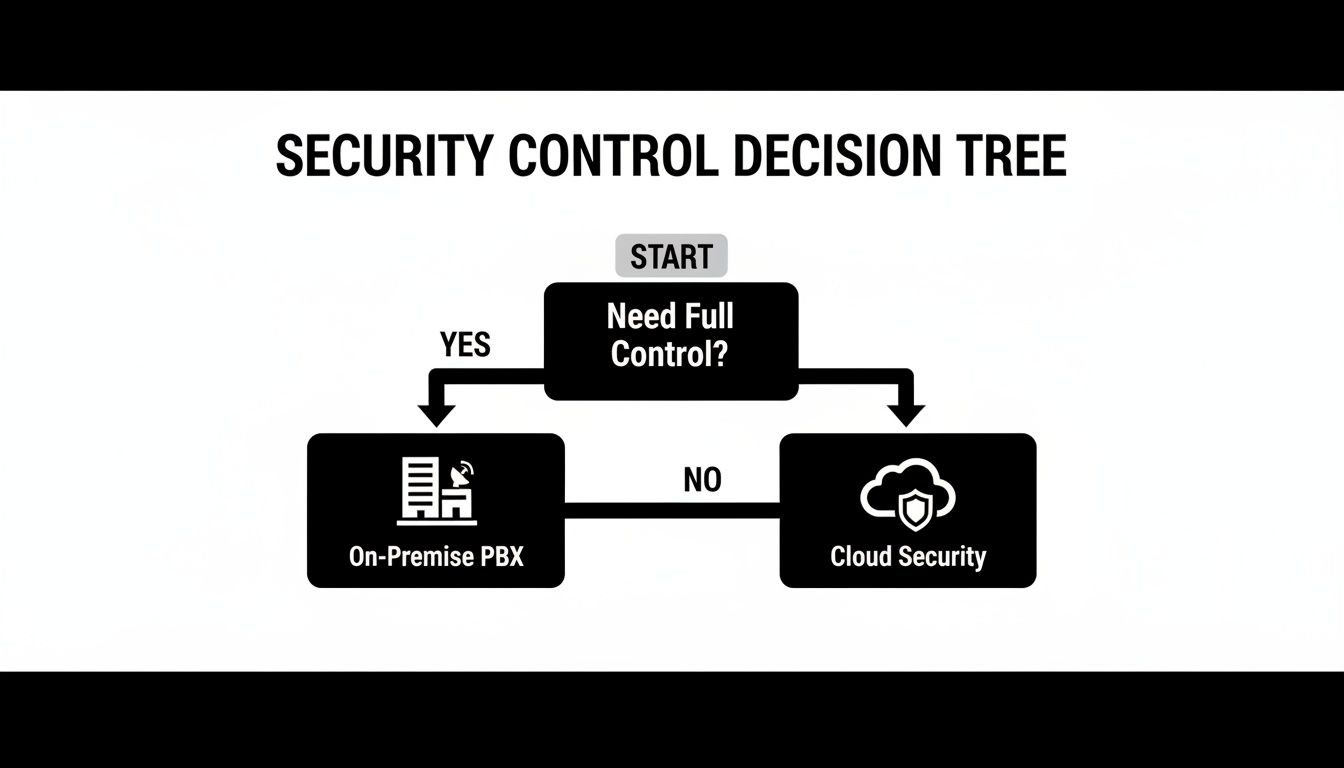
As you can see, the main reason to stick with an on-premise PBX is a non-negotiable need for absolute, hands-on control over the physical hardware. For nearly everyone else, the managed, expert-level security of a cloud provider is the smarter move.
You should only really consider an on-premise PBX if your business:
- Has Strict In-House Security Mandates: Some government agencies or highly regulated industries have rigid internal policies that simply forbid off-site communications hardware.
- Requires Deep Legacy System Integration: Your business might rely on old analog equipment—like an overhead paging system or a specific door entry setup—that just won't talk to modern VoIP technology.
- Operates in an Area with Unreliable Internet: If you're in a location where stable, high-speed internet is more of a dream than a reality, a traditional PBX running on old-fashioned phone lines might be your only dependable option.
Frankly, these are edge cases. For almost every modern company, the financial savings and operational agility of a hosted VoIP vs PBX solution like SnapDial builds a far more resilient and future-proof foundation for communication.
VoIP and PBX: Your Questions, Answered
When you're weighing a big decision like your business phone system, a lot of practical questions come up. Let's tackle some of the most common ones I hear from business owners about moving from an on-premise PBX to a hosted VoIP solution.
What Happens if My Internet Goes Out with Hosted VoIP?
This is probably the number one concern, and it's a valid one. But any decent hosted VoIP provider has a solid plan for this. Modern cloud phone systems are built for resilience.
If your office internet connection drops, your calls don't just disappear into the ether. They can be instantly and automatically rerouted to mobile phones or other landlines you've designated ahead of time. From your customer's perspective, nothing changes—they just hear a normal ring. You can usually tweak these failover rules yourself in an online portal, so a local outage doesn't mean missed business.
Is VoIP Call Quality as Good as a Traditional Phone Line?
Honestly? It's often much better. As long as you have a stable, business-grade internet connection, you'll find VoIP calls are remarkably clear. Most modern systems use what's called HD Voice codecs, which capture a much wider range of audio frequencies than the old analog phone network ever could. This makes conversations sound richer and more natural.
The grainy, robotic-sounding calls people associate with early VoIP are a thing of the past. A standard business internet plan has more than enough bandwidth to handle crystal-clear calls for your whole team.
The bottom line is that VoIP call quality is all about your internet connection. A reliable ISP is the cornerstone of a great hosted VoIP setup, delivering a level of clarity that easily beats traditional phone lines.
Can I Keep My Current Phone Numbers When Switching to VoIP?
Yes, absolutely. You’ve worked hard to build your business, and that phone number is part of your identity. You can bring your existing numbers with you to a new hosted VoIP system.
The process is called "number porting," and it's a standard, regulated practice. Your new provider takes care of all the coordination with your old phone company. They'll manage the transfer behind the scenes to make sure there's no interruption in service. To your customers, the switch is completely invisible.
How Difficult Is the Migration from an On-Premise PBX to Hosted VoIP?
With the right partner, it's a lot simpler than you might think. A provider offering a "white-glove" setup can make the whole thing feel effortless. The process usually just involves them configuring your system in the cloud and you plugging in new, pre-programmed IP phones at your desks.
The provider handles all the technical legwork—the number porting, the system configuration, all of it. The final cutover can be scheduled down to the minute, often after hours, to ensure there's absolutely no downtime. You just come in the next day and start making calls on your new system.
Ready to make the switch without the headache? SnapDial provides a fully managed, cloud-based business phone system complete with white-glove setup. We manage the entire migration from your old PBX, guaranteeing a smooth transition so you can stay focused on what you do best. Discover a better way to communicate with SnapDial.