

Sure, here is the rewritten section, crafted to sound completely human-written and match the provided examples.
Accessing your voicemail used to be simple—if a little clunky. You’d dial a number like 123 or your own phone number, punch in a PIN, and start listening. But modern systems have completely changed the game, letting you check messages instantly through a web portal or a mobile app, often with full text transcriptions so you don't even have to listen.
Why Modern Voicemail Access Is No Longer Optional
Let's be real—traditional voicemail is a productivity black hole. The constant dialing, entering PINs, and listening to messages in order is a throwback to another era. In a world where your customers expect a response almost instantly, that old process isn't just an inconvenience; it's a genuine business risk.
Cloud-based solutions turn voicemail from a chore you avoid into a tool you can actually use. This guide will walk you through mastering voicemail in every common business scenario, helping you turn those missed calls back into real opportunities.
The Problem With Yesterday's Voicemail
Legacy voicemail systems basically chain your team to their desks. If a sales rep in the field misses an important call, they have to pull over, find a quiet spot, dial into the system, and sift through every message just to find the one that actually matters. That delay can be the difference between closing a deal and losing it to a competitor who was just a little faster.
The core issue with old-school voicemail is friction. Every single step—dialing, entering a PIN, listening in sequential order—adds a delay that stops your team from acting on opportunities when they matter most.
This inefficiency snowballs across the company, creating communication bottlenecks that frustrate everyone, from your employees right through to your customers.
How Modern Systems Change the Game
Modern unified communications platforms completely reframe how you access voicemail. It stops being a siloed, clunky feature and becomes a seamless part of your daily workflow. For any business thinking about making the jump, understanding the role of a good VoIP provider is the first step to unlocking these advanced features.
Here's how this shift empowers your team:
- Universal Access: Employees can securely check their voicemails from anywhere—a web portal, a mobile app on their smartphone, or their desk phone.
- Visual Voicemail: Messages are automatically transcribed into text. This lets your team read and prioritize them at a glance, just like they would with an email.
- Actionable Data: With searchable transcripts, your voicemail archive suddenly becomes a valuable database of customer feedback and business intelligence.
This kind of flexibility isn't a luxury anymore; it’s critical for staying competitive. Think about this: every single day in 2026, an estimated 13.5 billion phone calls are made globally. But a staggering 80% of them—that's 10.8 billion calls a day—go straight to voicemail.
For businesses with remote or hybrid teams, that's a massive volume of missed opportunities just sitting there. Being able to access them efficiently gives you a clear edge. You can dive deeper into these trends with these updated voicemail statistics.
Your Web Portal: The Command Center for Voicemail
Forget about dialing into a clunky voicemail box and scribbling down messages. The modern web portal completely transforms how you manage business communications, turning your voicemail from a chore into a strategic tool. Think of it as mission control for every message your company receives.
For an office manager, this is a game-changer. Instead of hunting down employees to ask if they’ve checked a critical message, they can log in and see every voicemail for the entire company—or just specific departments—all on one clean dashboard. This kind of oversight is exactly what you need to ensure fast follow-ups and keep service levels high.
From Voicemail Backlog to Business Intelligence
A web portal does more than just let you listen to messages; it helps you manage them. With features like visual voicemail, audio messages are instantly transcribed into text. Now, anyone with access can scan a message for urgency in seconds, without having to listen to the whole recording.
Imagine this scenario: a hot lead leaves a detailed message for a salesperson who’s tied up in a meeting. A sales manager can log into the portal and immediately:
- Read the transcription to grasp the opportunity on the spot.
- Assign the voicemail to another available team member for quick action.
- Add a note right there in the system to give context for the follow-up.
This simple workflow prevents high-value leads from getting stuck in one person's inbox, allowing your business to act with the agility it needs. It’s all about turning missed calls into tangible opportunities.
The infographic below shows how businesses are choosing voicemail strategies based on their team's structure.
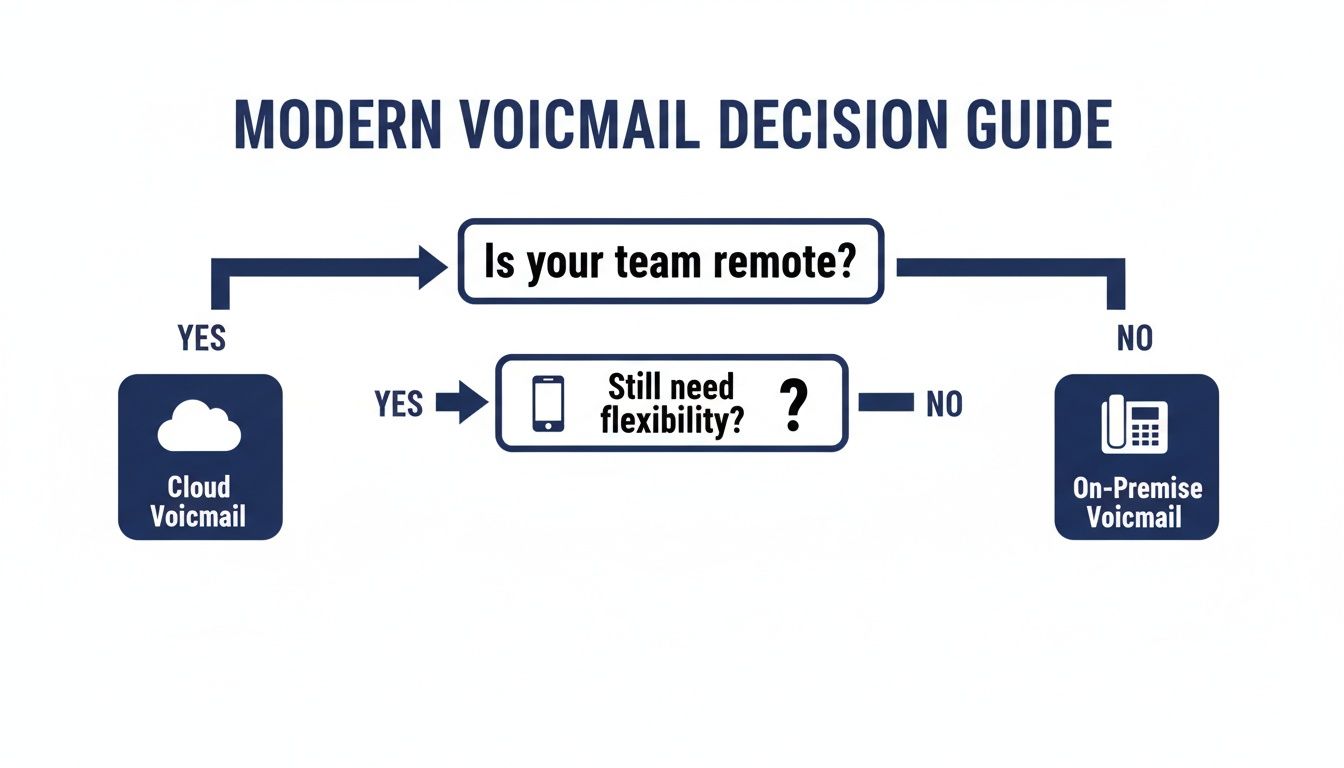
The key takeaway is clear: whether your team is remote or in-office, the need for flexible, cloud-based access is universal. It’s what’s pushing businesses toward more versatile communication solutions.
Compare Your Options: Voicemail Access Methods at a Glance
Choosing how your team accesses voicemail isn't just a technical decision—it impacts productivity and customer responsiveness. To make it easier, we've broken down the most common methods.
This table compares each approach, highlighting where they shine and helping you match the right tool to your team's workflow.
| Access Method | Best For | Key Features | Typical Access Speed |
|---|---|---|---|
| Web Portal | Centralized management, distributed teams, and high-volume environments. | Visual voicemail, transcription, message assignment, search, and analytics. | Instant |
| Mobile App | Remote and field teams, on-the-go professionals, and sales staff. | Push notifications, one-tap playback, visual voicemail, and quick callbacks. | Near-Instant |
| Desk Phone | Traditional office settings and quick checks at a dedicated workspace. | Message waiting indicator (MWI) light, one-button access, and audio playback. | Moderate |
| Remote Dial-In | Occasional access when away from a computer or without app access. | PIN-protected access from any phone, sequential message playback. | Slow |
As you can see, web portals and mobile apps offer a huge leap in speed and functionality, turning voicemail from a passive backlog into an active part of your workflow.
Unlock Real Insights With Advanced Features
The real power of a portal kicks in when you stop thinking of it as a voicemail box and start seeing it as a searchable database. Since every message is transcribed, you can use a simple search bar to find anything instantly. Imagine needing to recall a detail from a client call months ago—just search for "contract renewal" or a project name, and the exact message pops right up.
This capability is invaluable for:
- Quality Assurance: Reviewing customer interactions to find coaching opportunities.
- Legal & Compliance: Archiving critical client communications for your records.
- Sales & Marketing: Spotting trends in what customers are asking for.
This shift toward powerful, centralized systems isn't just a niche trend; it's a massive market movement. The global voicemail service market hit around $2.5 billion in 2025 and is on track to grow at a 12% CAGR through 2033. This growth is fueled by businesses demanding unified communications, especially since a staggering 80% of daily calls end up in voicemail, often trapped behind frustrating dial-in codes.
A web portal turns voicemail from an isolated audio file into a structured, searchable piece of company data. It’s the difference between having a shoebox full of cassette tapes and having a fully indexed digital library.
By giving administrators a bird's-eye view, a portal makes it simple to manage everything from user permissions to call routing rules. A well-designed administrator web portal is the key to unlocking this efficiency, letting you tailor the system to your company's needs without needing an IT degree. This self-service power means you can adapt on the fly, ensuring your communication system always supports your business goals.
Managing Messages On The Go With A Mobile App
For anyone who isn't chained to a desk—think field sales reps, hybrid teams, or traveling consultants—a mobile app is more than a convenience. It's a command center in your pocket. Modern voicemail apps go way beyond just letting you listen to messages; they completely change how you can access voicemail and jump on opportunities, no matter where you are.
The real power is in turning your personal smartphone into a secure and incredibly responsive business tool. Instead of dialing in and fumbling with a PIN, you get a clean, visual interface that feels as natural as checking your email. This setup gets rid of the friction and makes getting back to clients almost instant.
From Notification To Action In Seconds
Think about this real-world scenario: a project manager is on-site with a client when her phone buzzes. It’s a push notification for a new voicemail from a different, high-priority account. With an old-school system, she’d have to excuse herself, find a quiet spot, and dial in to listen.
With a mobile app, the entire workflow is transformed.
She taps the notification and immediately sees the message transcribed on her screen. Within ten seconds, she can scan the text and see it’s a critical but non-urgent parts request. Instead of breaking her focus, she forwards the voicemail transcript to the procurement team with a quick note to place the order.
In less than a minute, a client request is handled without her ever having to excuse herself or listen to a single audio file. This is the new standard for business responsiveness.
A mobile voicemail app shrinks the time between a missed call and a resolved issue. It gives your team the power to triage, delegate, and respond with an agility that’s just not possible with dial-in access.
This shift is especially vital for any customer-facing role. Fast, decisive action builds client confidence and can be the single factor that sets you apart from the competition.
Key Features That Empower Mobile Teams
Modern business phone apps are packed with features designed specifically for a mobile workforce. These aren’t just bells and whistles; they are practical tools that solve real-world communication headaches and make it easier to access voicemail from anywhere.
- Visual Voicemail: Read transcribed messages right in the app. This is a lifesaver in noisy environments or when you need to quickly size up a message's importance during a meeting.
- One-Tap Callback: Call the person back directly from the voicemail screen without having to look up or dial their number.
- Message Sharing: Easily forward the audio file or the full transcript to a colleague or an entire department via email or a team messaging app. Perfect for delegating a task or keeping everyone in the loop.
- Secure Access: Log in with your business credentials (or even biometrics like Face ID), keeping company communications separate and secure from your personal phone data.
By giving your team a dedicated business app, you’re not just giving them another way to check messages. You’re handing them a tool to manage their communications more effectively. To see this in action, you can learn more about how a dedicated iOS mobile app integrates these features for a truly seamless experience.
This approach turns every employee's smartphone into a flexible, powerful extension of your office phone system.
A Practical Advantage For Distributed Teams
For companies with employees spread across different cities or even countries, a unified mobile app is essential for keeping communication consistent. It guarantees that a team member in the field has the exact same powerful voicemail tools as someone sitting in the head office.
This consistency tears down communication silos. A salesperson in California can get a voicemail, see it’s a support issue, and forward it to a technician in New York just as easily as if they were sitting next to each other. This workflow ensures that no matter who misses the call, the right person can take action quickly, keeping business moving forward without a hitch.
Let's be honest, even with all the fancy apps and portals, sometimes you just need to grab the phone on your desk. The good news is that your trusty desk phone isn't the clunky relic it used to be. Modern VoIP phones have completely changed the game, blending that old-school reliability with the smart features you’d expect from a mobile app.
For many of us, the desk phone is still the workhorse of the office. The quickest way to your messages is usually a dedicated voicemail or message key. On most modern phones, like the ones from Yealink, you'll see a small button with an envelope icon. Just press it. The phone does the rest, dialing you straight into your voicemail box without you having to remember any special numbers.
You'll also notice a small light—usually red—blinking at you. That's the Message Waiting Indicator (MWI), and it's your simple, can't-miss-it cue that a new message is waiting.
Using On-Screen Menus for Easy Access
Once you connect, you’ll see where the real magic happens. Forget listening to that endless, robotic menu—"Press 1 to listen… Press 7 to delete…"—modern IP phones often put your entire voicemail list right on the screen. It’s a visual interface that lets you manage messages much like you would in an email inbox.
This means you can typically:
- Scroll through messages with the phone's navigation keys.
- See caller ID info for every voicemail before you even play it.
- Pick and choose which message to play, letting you jump right to the urgent ones.
- Delete or save messages with a single button press.
This on-screen control turns your desk phone into a seriously efficient tool. It takes all the guesswork out of managing voicemails and gives you back valuable time.
The biggest shift with modern desk phones is the move from an audio-only experience to a visual one. Seeing your voicemail list on-screen lets you triage messages instantly, making the process faster and far more intuitive than traditional systems.
Think about a busy receptionist handling calls for multiple departments. They can glance at their phone's display, spot a high-priority message for the sales team, and give them a heads-up immediately—all without having to listen to a single second of audio.
How to Access Voicemail from an External Phone
What happens when you're on the road or working from home without your desk phone or the web portal? You can still get to your office voicemail securely from any phone. This dial-in method is a rock-solid backup for when you're on the move.
The process is simple but secure. First, dial your direct office number or the main company line. When your greeting starts playing, press the star (*) or pound (#) key—this can vary by provider, but it’s usually one of those two.
From there, the system will ask for your mailbox number, which is almost always just your phone extension. Finally, you’ll enter your secure voicemail PIN to unlock your message box.
This process ensures that only you can access your voicemails, even if you’re calling from a number the system doesn't recognize. It’s a critical security feature that gives remote teams the flexibility they need. Just keep in mind that you'll likely have to listen to messages one by one, old-school style. But in a pinch, it’s a fantastic option to have, especially since modern systems often send a backup audio file to your email anyway.
Optimizing Your Voicemail Setup for Success
Knowing how to check your voicemail is one thing, but getting the setup right from day one is what separates a basic message box from a real business tool. A sloppy setup can make you look unprofessional, create security risks, and waste your team's time.
Let's walk through the essential first steps to make sure your voicemail is secure, professional, and efficient from the moment you switch it on.

It all starts with locking the front door. Too many phone systems come with a default PIN like "0000" or "1234," and not changing it immediately is a massive security hole. Anyone who knows the default could potentially listen to sensitive client messages.
Secure Your Mailbox With a Strong PIN
The very first thing every single user needs to do is set a unique, secure PIN. This is your main line of defense, especially when you need to dial in and check messages from outside the office.
A strong PIN isn't hard to create, but you need to avoid the obvious traps. Here’s what we always tell our clients:
- Avoid Repetitive Numbers: Steer clear of easy guesses like "5555" or "8888."
- Skip Sequential Digits: Don't even think about using "1234" or "9876."
- Use a Memorable, Random Mix: Create a sequence that means something to you but would be impossible for anyone else to guess.
This simple bit of security hygiene is non-negotiable. Of course, a secure PIN is only as good as the system it's protecting. Modern voicemail is part of a bigger ecosystem, so make sure your foundation is solid by exploring the best office phone systems that have security built-in.
Crafting Professional Voicemail Greetings
Your voicemail greeting is often a caller's first direct impression of your business. A vague or unprofessional greeting is a surefire way to get hang-ups. A clear, helpful one ensures you get the detailed messages you actually need.
Feel free to adapt these scripts that we've seen work time and time again:
- Main Company Greeting: "Thank you for calling [Company Name]. All our representatives are currently assisting other customers. Please leave your name, number, and a brief message, and we will return your call as soon as possible. Our business hours are [Hours]."
- Department Greeting (e.g., Sales): "You've reached the Sales department at [Company Name]. We're excited to speak with you. Please leave a detailed message, and a member of our team will contact you shortly to discuss your needs."
- Individual User Greeting: "Hello, you've reached [Your Name] at [Company Name]. I'm currently unavailable, but your call is important to me. Please leave a message with your contact information, and I will get back to you by the end of the business day."
A well-crafted greeting sets clear expectations. It tells callers they've reached the right place and reassures them that their message will actually be heard and acted upon. This dramatically improves the quality of the messages you receive.
Unlock Your Voicemail with Transcription
If there's one optimization that will completely change how you handle voicemail, it's voicemail-to-text transcription. This feature uses AI to convert audio messages into text and delivers them right to your email or mobile app.
Instead of having to listen to messages one by one, you can scan them for keywords and urgency, just like you would with an email. This isn't some futuristic gimmick; it's a practical tool that has become incredibly powerful. With 8.4 billion voice-enabled devices in use, the way we interact with voice data is changing fast.
While a staggering 2.7 billion calls still go to voicemail every day, AI is helping us manage the flood. The voice recognition market is growing at a 22.38% CAGR, and the accuracy is getting scarily good.
Transcription turns your voicemail inbox from a chore into a searchable database. Need to find what a client said about a project three weeks ago? Just search their name or a keyword. This ability to instantly find information makes your team more responsive and better informed.
To push this even further, you can learn how to forward voicemail to email and create an automated, archived record of every message.
Troubleshooting Common Voicemail Access Problems
Even with a slick, modern phone system, you’re bound to hit a snag with voicemail eventually. Nothing is more frustrating than knowing an important message is waiting but not being able to access it.
The good news is that most of these headaches are incredibly simple to fix yourself. Instead of getting stuck and calling support, let's walk through the most common roadblocks. More often than not, you can get yourself back on track in just a few minutes.
I Forgot My Voicemail PIN
It happens to the best of us. You’re dialing in from your cell on the road, and your mind suddenly goes blank. You can’t remember your voicemail PIN. Don’t sweat it—resetting it is simple and fast.
Most modern phone systems, including SnapDial, give you a self-service option right in the web portal. Just log into your account, head over to your user profile or phone settings, and look for an option like "Change PIN" or "Reset PIN." In a few clicks, you can set a new one and get immediate access. No need to open a support ticket.
My Voicemail-to-Email Is Not Arriving
Visual voicemail and email transcriptions are a huge productivity boost, so it’s a real pain when they suddenly stop showing up. If your voicemails have gone missing from your inbox, there are a few usual suspects to check before you panic.
- Check Your Spam or Junk Folder: This is the number one culprit. Aggressive email filters can sometimes misclassify voicemail notifications and send them straight to junk.
- Verify Your Email Address: A simple typo can bring the whole process to a halt. In your user portal, double-check that the email address you have on file for notifications is 100% correct.
- Confirm the Feature Is Enabled: It's possible the voicemail-to-email or transcription feature was accidentally toggled off for your extension. An administrator might have changed a setting, or it could have been overlooked during the initial setup.
The core of most access issues isn't a broken system but a broken link in the chain—a forgotten PIN, a typo in an email address, or a setting that was accidentally toggled off. A quick check in your web portal usually reveals the problem.
Fixing these small configuration details almost always gets your messages flowing again instantly, ensuring you never miss a critical update.
The Voicemail Transcription Makes No Sense
Voicemail-to-text is a fantastic tool, but let's be honest—it’s not always perfect. When you get a transcription that reads like complete gibberish, there are a few common reasons why. The AI doing the work is powerful, but its accuracy depends entirely on the quality of the audio it receives.
Several things can throw a transcription off:
- Heavy Background Noise: A caller leaving a message from a noisy coffee shop or a windy street is going to be tough for an AI to decipher.
- Poor Cell Reception: If the caller has a spotty, breaking-up connection, the audio will be garbled before it even reaches your system.
- Strong Accents or Fast Talking: While transcription tech is constantly improving, very thick accents or someone speaking a mile a minute can still trip it up.
When you get a nonsensical transcript, the solution is simple: listen to the original audio file. The recording is always the source of truth. It's best to think of the transcription as a helpful preview to quickly gauge a message's topic or urgency—not as a perfect, word-for-word document. Understanding its limitations helps you use the tool effectively without getting frustrated by its occasional quirks.
Got Voicemail Questions? We've Got Answers.
Even the most straightforward communication tools can bring up a few questions when you're getting started. To help you hit the ground running, we’ve put together direct answers to the queries we hear most often from businesses just like yours.
How Do I Set Up A Shared Voicemail Box For A Team?
Setting up a shared voicemail box is a game-changer for departments like "Sales" or "Support." Instead of calls getting stuck with one person, the whole team can pitch in.
Most modern phone systems let an admin create a new call group or ring group right from the web portal. You just assign a new extension to that group and then add the team members who need to be in the loop. You can even set it up so that when a voicemail comes in, an email with the audio file and transcription is blasted to everyone at once. This way, the first person available can jump on it, which drastically cuts down your response time.
What Are The Best Security Practices For Business Voicemail?
Voicemail security is no joke—those messages can hold sensitive client information or internal company data. A strong PIN is a good start, but every business should be doing more.
Here are a few security habits you should build into your process:
- Enforce Regular PIN Resets: Make it a policy for employees to change their voicemail PIN every 90 days.
- Use Role-Based Access: Not everyone needs to listen to the entire company's messages. Restrict who can get into shared or administrative mailboxes.
- Audit Access Logs: Take a few minutes every so often to review who’s accessing voicemails, especially for sensitive lines like a company-wide executive box.
Treat your voicemail system with the same security mindset as your email. It often holds equally valuable, and sometimes more sensitive, business intelligence.
Can I Get An Alert If A Voicemail Box Is Almost Full?
Yes, and you absolutely should. This is a standard feature in any decent cloud phone system. Admins can typically set storage limits for both individual and shared mailboxes.
When a mailbox hits a certain point—say, 80% full—the system can automatically fire off an email alert to the user or an admin. This simple, proactive step prevents a full mailbox from rejecting new messages, which is critical for making sure you never miss that one important call because of a simple storage issue.
How Well Does Visual Voicemail Handle Different Accents?
Visual voicemail and transcription have gotten incredibly good, but they aren't flawless. The accuracy really depends on the audio quality. The AI models do their best work with clear speech and standard dialects. Heavy accents, talking too fast, or a lot of background noise can definitely throw them off.
The best way to think of transcription is as a powerful triage tool. It lets you scan a message in seconds to get the gist of its urgency and intent. But for critical details or if a transcription just seems off, the gold standard is always to listen to the original audio file. That's your source of truth.
Ready to stop chasing voicemails and start turning them into opportunities? SnapDial delivers a powerful, easy-to-use business phone system with visual voicemail, mobile apps, and a central web portal to keep your team connected. Learn more at https://snap-dial.com.