
Think of it this way: a fantastic restaurant focuses on creating amazing food. They don't want to get bogged down with managing delivery drivers, so they partner with a professional delivery service. This is exactly what outsourced call center solutions do for your business. You let the experts handle customer interactions—the calls, emails, and chats—so you can concentrate on perfecting your products and services.
This isn't just about hiring someone else to answer the phone. It's a strategic move away from a costly, rigid in-house department toward a flexible, scalable partnership. By outsourcing, you get instant access to the three pillars of great customer service without the massive upfront investment.
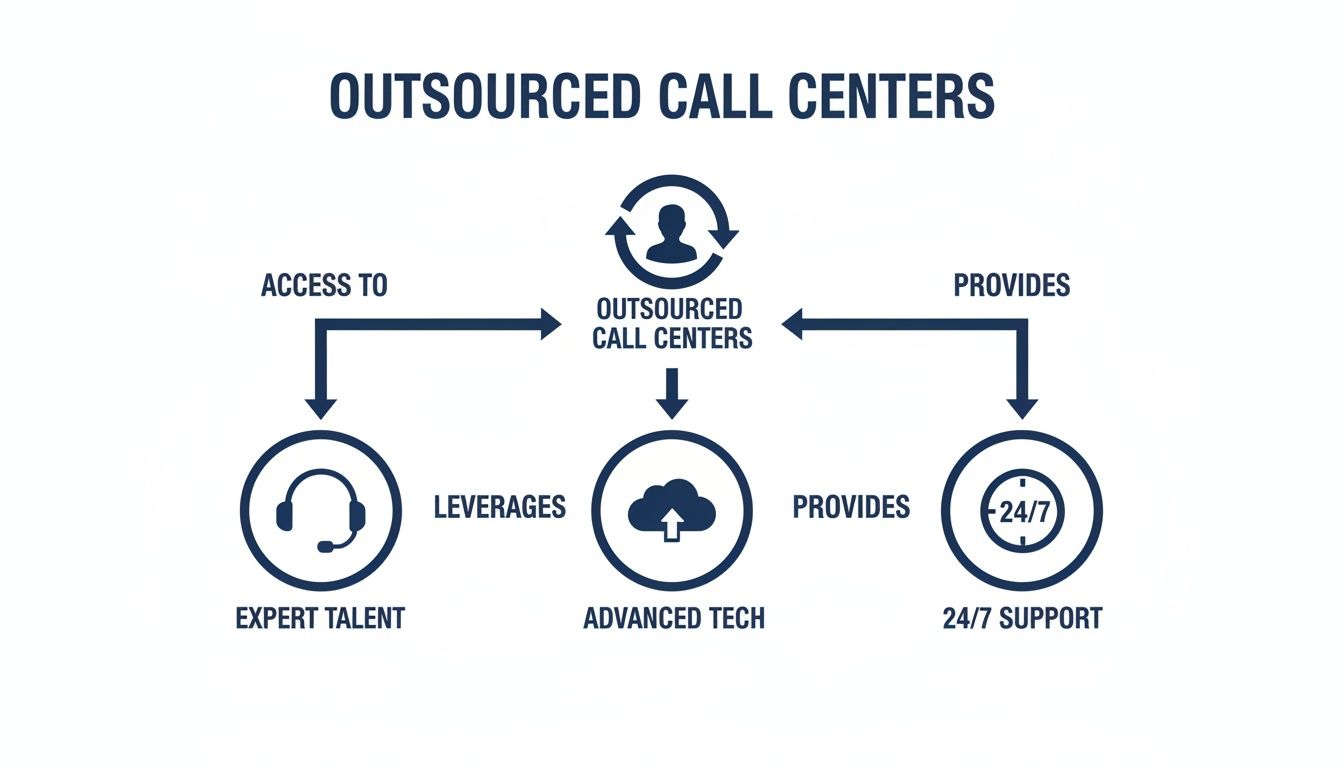
As you can see, a single partnership delivers trained agents, powerful technology, and the ability to be there for customers 24/7. It’s a complete customer experience engine ready to go from day one.
The Driving Force Behind Outsourcing
The demand for these services is exploding. The global market for contact center outsourcing hit USD 102.59 billion in 2024 and is on track to reach a staggering USD 242.80 billion by 2034. That's a compound annual growth rate (CAGR) of 9.00%, driven by companies looking for smarter ways to manage customer support without breaking the bank. Interestingly, onshore outsourcing holds the lion's share of the market at over 59%, as it offers significant savings without the cultural or language hurdles sometimes found with offshore options.
So, what's fueling this massive shift? It really boils down to three core advantages:
- Cost Reduction: You completely sidestep the huge capital expenses of building out facilities, buying tech, and hiring a full-time team.
- Access to Expertise: You immediately tap into a pool of highly trained agents and seasoned managers who live and breathe customer service.
- Scalability: Need to ramp up for the holidays or a big product launch? It’s easy. Things slow down? You can scale back just as quickly.
By outsourcing, a company converts the high fixed costs of an in-house call center into a predictable variable cost, aligning expenses directly with operational needs. This financial flexibility is a game-changer for growing businesses.
Getting to grips with the world of Call Center Outsourcing Services is the first step. Many businesses start by exploring different inbound call center services to see what model best fits their unique customer needs.
Onshore, Nearshore, And Offshore Outsourcing Explained
When you decide to outsource your call center, one of the first big questions you'll face is where your team will be located. Think of it like choosing the right tool for a job—each location model has its own distinct strengths and weaknesses. The three main options are all based on geography, and getting to know the differences is the first step toward building a smart outsourcing strategy.

This isn't just about dots on a map. Your choice directly shapes costs, cultural connection with your customers, language skills, and how you manage the day-to-day operations. Let's dig into what each model really means for your business.
Onshore Call Centers: Your Local Experts
Onshore outsourcing is simple: you partner with a call center located right in your own country. If your business is in the U.S., that means working with a team in a state like Florida or Arizona. This is often the go-to choice for companies where a deep, seamless connection with the customer base is non-negotiable.
The biggest win here is shared culture. Onshore agents just get the local slang, cultural references, and customer expectations without any special training. For brands built on a strong, familiar personality, that's priceless. Of course, this premium experience comes with a higher price tag. You'll still save money compared to running an in-house team, but labor costs will be the highest of the three outsourcing models.
Nearshore Call Centers: The Best Of Both Worlds
With nearshore outsourcing, you're partnering with a provider in a neighboring country, usually one in a very similar time zone. For American companies, this often means looking to places like Mexico, Costa Rica, or Jamaica. This model hits a sweet spot, offering a great balance between significant cost savings and close cultural ties.
Nearshore locations can slash your costs by 30-50% compared to an onshore partner, but you avoid the logistical headaches of vastly different time zones. Plus, many nearshore countries have a ton of bilingual talent and a strong cultural affinity with the U.S., making it a powerful middle-ground solution.
Offshore Call Centers: The Global Cost Leader
Offshore outsourcing means working with a call center in a faraway country, like the Philippines, India, or parts of Eastern Europe. This model is famous for one thing above all: delivering the biggest possible cost savings, thanks to much lower labor and operational expenses.
The trade-off? You’ll have to manage major time zone differences and bridge potential cultural gaps. That said, top offshore destinations like the Philippines have invested heavily in building a highly-skilled, English-speaking workforce known for its customer service mindset. And for businesses needing 24/7 support, that 12-hour time difference flips from a challenge into a huge advantage—it makes around-the-clock coverage completely natural.
The right model really boils down to your priorities. If your brand’s reputation hangs on a deep cultural connection and you have the budget, onshore is a fantastic choice. If you're looking for a smart blend of savings and easy collaboration, nearshore is tough to beat. But if maximum cost-efficiency and 24/7 coverage are at the top of your list, offshore is the undeniable winner.
To lay it all out clearly, here’s a quick breakdown of how these three primary outsourced call center solutions stack up against each other.
Onshore vs Nearshore vs Offshore Outsourcing Models
This table compares the key characteristics of the three main location-based call center outsourcing models, helping you see the trade-offs at a glance.
| Attribute | Onshore (e.g., USA) | Nearshore (e.g., Mexico) | Offshore (e.g., Philippines) |
|---|---|---|---|
| Cost Savings | Moderate (vs. in-house) | Significant | Highest |
| Cultural Alignment | Highest | High | Moderate |
| Time Zone | Same or similar | Similar (often 0-2 hours diff.) | Opposite (often 8-12 hours diff.) |
| Language Skills | Native proficiency | High bilingual proficiency | High English proficiency |
| Travel/Oversight | Easiest, most accessible | Relatively easy | Challenging, requires long travel |
Ultimately, choosing a location is a major strategic decision. Take the time to weigh what matters most—cost, customer experience, or operational ease—to find the model that will set your business up for success. It's the foundation of your entire customer support operation.
The Technology Driving Modern Call Centers
Forget the old image of a room full of people just answering phones. A modern outsourced call center is a high-tech operation, with sophisticated software working behind the scenes to make every customer interaction smooth, smart, and efficient. To really grasp the value of outsourcing, you have to look under the hood at this technology.
This tech stack isn't just about helping agents work faster. It’s about making every conversation more intelligent and personal. Without this powerful backbone, trying to manage thousands of daily customer calls would be pure chaos.
The Digital Front Door and Smart Traffic Control
The second a customer dials your number, two critical pieces of technology kick into gear. Their job is to get that caller to the right person, right away, without any of the usual frustration.
First up is the Interactive Voice Response (IVR). You can think of an IVR as a digital receptionist. It’s the friendly, automated voice that greets callers and guides them through a simple menu ("For sales, press one. For support, press two.") to figure out why they’re calling.
Once the IVR knows what the customer needs, the Automatic Call Distribution (ACD) system takes the baton. The ACD is like an expert traffic controller for all incoming calls. It instantly routes the call to the next available agent who has the specific skills to handle the request—a technical question goes to a product expert, a billing inquiry goes to the accounts team. This simple handoff ensures customers talk to the right person on the first try.
Optimizing Agent Performance and Scheduling
Beyond just routing calls, the best outsourced solutions use technology to manage their most valuable asset: their people. That's where Workforce Management enters the picture.
Workforce Management (WFM) software is the brain behind the call center's schedule. It crunches historical call volume data to accurately predict future demand. This means your partner can schedule the perfect number of agents for any given time—no more understaffing that leads to infuriatingly long hold times, and no overstaffing that wastes money.
This technology has a massive impact. A well-run call center can often get its call abandonment rate down to under 3%, meaning nearly every single person who calls gets to speak with an agent. That's the power of effective WFM.
By forecasting needs with such precision, WFM tools help maintain rock-solid service levels, even when a sudden surge of calls comes in. It's this operational stability that separates a truly professional partner from the rest.
Creating a Unified Customer View
There’s almost nothing more frustrating for a customer than having to repeat their entire story every time they talk to a new agent. This is precisely the problem that Customer Relationship Management (CRM) integration solves.
Your CRM system is the central hub that stores every interaction a customer has ever had with your business. When an outsourced agent takes a call, their screen immediately lights up with the caller’s entire history:
- Past Purchases: What did they buy and when?
- Previous Interactions: What were their last support tickets about?
- Contact Information: All their details, right at the agent’s fingertips.
- Account Status: Are they a brand-new customer or a long-time VIP?
This instant context allows the agent to skip the tedious questions and get straight to providing helpful, personalized support. It transforms a generic call into a productive conversation. The ability to seamlessly plug into these systems is a key benefit of powerful VoIP call center solutions, which bridge the gap between your in-house tools and your outsourced team.
Ensuring Security and Compliance
When customer interactions involve payments or sensitive data, security isn't just a feature—it's everything. Top-tier outsourced providers build their entire operation on a foundation of ironclad security.
The gold standard here is PCI DSS (Payment Card Industry Data Security Standard) compliance. This is a strict set of security protocols for any company that accepts, processes, or stores credit card information. Partnering with a PCI-compliant call center guarantees that your customers' financial data is protected from breaches. This isn't an optional extra; it's a fundamental requirement for safeguarding your customers and your company's reputation.
Weighing the Benefits and Risks of Outsourcing
Deciding to outsource your call center isn't just a budget decision—it's a major strategic move. It can give your business a serious leg up, but it's not a silver bullet. You have to go into it with your eyes wide open, ready to weigh the incredible advantages against some very real challenges.
Getting this right means making a smart, informed choice that protects your brand and, most importantly, keeps your customers happy. While the conversation usually kicks off with cost savings, the real value runs much deeper. It’s about tapping into capabilities you couldn't build yourself overnight and delivering a level of service that might otherwise be out of reach.
The Powerful Upsides of Outsourcing
When you bring on a professional call center partner, you're not just hiring more agents. You're plugging into an entire operational machine built from the ground up for efficiency and scale. This delivers some pretty immediate and impactful wins.
- Around-the-Clock Availability: An outsourced partner can flip the switch on 24/7/365 support almost instantly. For a national business or any e-commerce brand, this is huge. You’ll never miss a customer inquiry just because it's after 5 PM in your time zone.
- Immediate Access to Specialized Skills: The best providers pour resources into training their agents for specific industries, whether it's navigating healthcare compliance or troubleshooting complex software. You get that expertise on day one, without spending a dime or a minute on internal recruiting and training.
- Unmatched Scalability: Expecting a massive spike for a holiday sale or a new product launch? A good partner can handle it without breaking a sweat. This flexibility is a two-way street; you can also scale back down during quiet periods without the headache of layoffs.
One of the smartest things outsourcing does is turn a fixed overhead cost into a variable one. You stop paying for agents to sit around and wait for calls and instead pay for productive customer interactions. This simple shift can slash operational costs by 15% to 35%.
This frees up your key people to do what they do best—innovate, build better products, and grow the business—all with the peace of mind that customer support is being handled by pros.
Navigating the Potential Risks
Of course, handing over the keys to a critical, customer-facing part of your business isn't without risk. Knowing what to watch out for is the first step in making sure your partnership is a smashing success. The biggest worries usually boil down to control, brand identity, and data security.
The number one fear? A loss of direct control over the customer experience. When your managers aren't on the floor, how can you be sure agents are living up to your standards? This ties directly into worries about brand dilution, where the unique personality and values you've built get watered down into a generic, scripted conversation.
And finally, you're sharing customer data with a third party, which always introduces security vulnerabilities. Protecting that information is everything. A data breach at your partner’s facility is still your crisis to manage.
Smart Strategies for Risk Mitigation
Here's the good news: every single one of these risks is manageable. With the right strategy and a carefully chosen partner, you can turn those potential pitfalls into well-managed parts of a strong relationship.
Here’s how you tackle the big concerns from the get-go:
- Create Ironclad Service Level Agreements (SLAs): Don't leave anything up for interpretation. Your SLA should be ruthlessly specific, defining key performance indicators (KPIs) like average handle time, first-call resolution rates, and maximum hold times. Think of this document as your rulebook for maintaining control.
- Invest in Comprehensive Onboarding and Training: Treat the outsourced team like they're your own. Give them a deep-dive immersion into your brand voice, company culture, and product nuances. This ensures they don't just answer questions—they become true ambassadors for your brand.
- Conduct Rigorous Security Audits: Before you even think about signing a contract, get proof of their security chops. Look for certifications that matter to you, like PCI DSS for handling payments or HIPAA for sensitive health information. Regular audits and crystal-clear data protocols are completely non-negotiable.
By putting these safeguards in place, you can confidently tap into the massive benefits of outsourced call center solutions while keeping the potential downsides locked down.
Integrating Outsourcing with Your Cloud Phone System
Real power in business comes from integration, not isolation. Your outsourced call center team shouldn't feel like a disconnected island; it needs to operate as a seamless, natural extension of your company. This is where your cloud phone system steps in to become the central nervous system for all your customer communications.
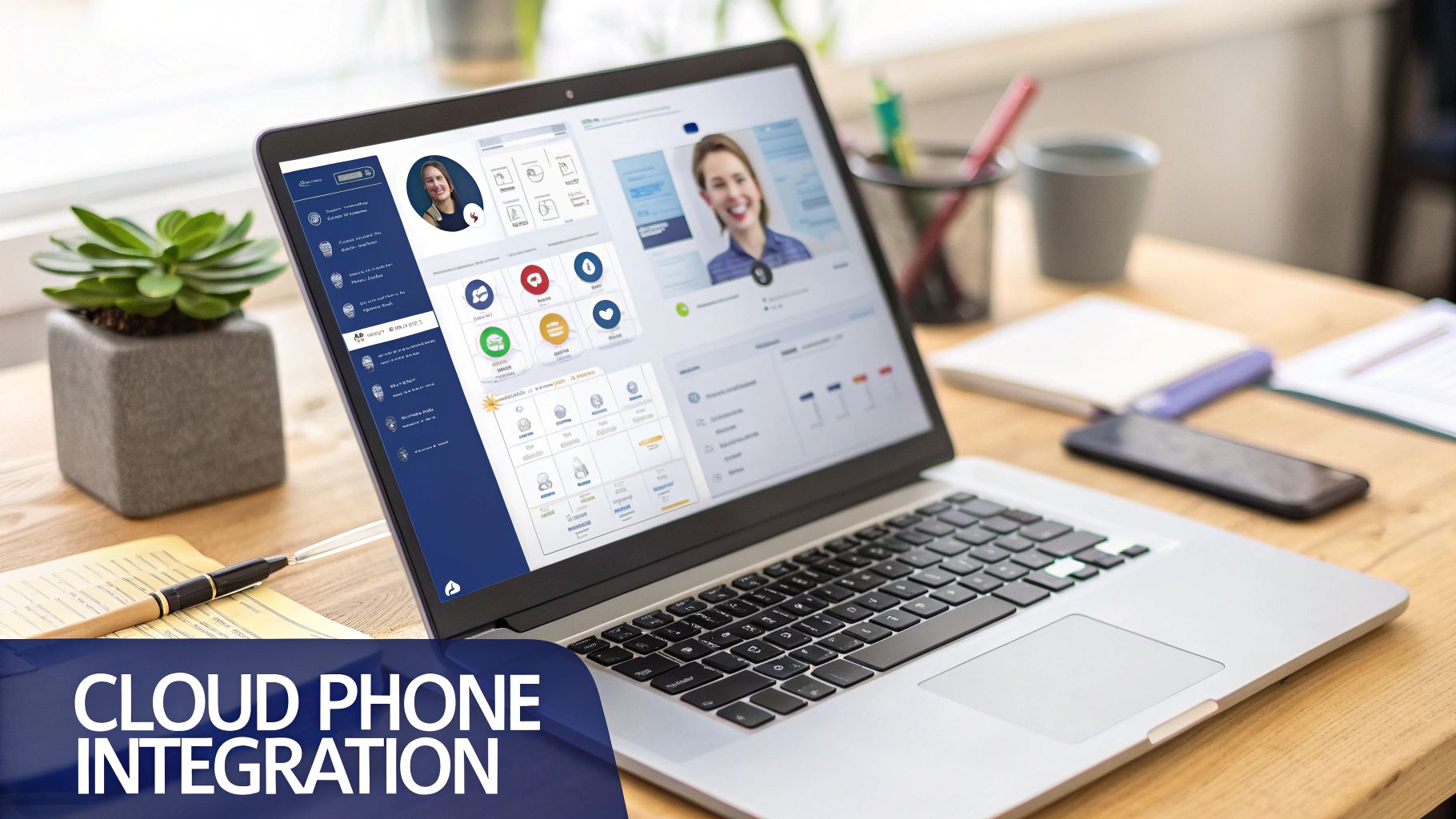
When you connect your outsourced call center solutions directly to your cloud PBX, you're creating a single, unified ecosystem. This ensures that every single call—whether it’s answered by your in-house staff or an agent halfway around the world—follows the same rules and delivers a consistent brand experience. Outsourcing isn't about giving up control; it's about extending your reach intelligently.
Your Cloud PBX as the Central Command Center
Think of your cloud phone system as the air traffic controller for all your business calls. It doesn’t care if an agent is sitting in your office or is a thousand miles away; the system sees them all as part of the same team. That unified approach is absolutely critical for maintaining quality and having a clear view of what’s happening.
Modern platforms like SnapDial let you build out sophisticated call routing rules that get customers to the right person, fast. You can set it up to forward calls to your outsourced team during specific hours, after a certain number of rings, or as an overflow when your internal team is slammed. This all happens behind the scenes, so your customer just gets a smooth, professional experience. To dig a bit deeper into these platforms, you can learn more about what is a cloud phone system and how they operate.
It’s this central control that prevents the fragmented, disjointed journey that customers absolutely despise.
Maintaining Quality Control from Afar
One of the biggest anxieties business owners have with outsourcing is losing oversight. How do you know if agents are doing a good job when you can't walk over to their desk? The answer lies in the powerful, built-in features that advanced cloud phone systems provide, giving you Fortune 500-level quality control.
These tools allow you to monitor and manage your external team with incredible precision:
- Advanced Call Queuing: You can set up smart queues that announce estimated wait times or even offer callers a callback. This simple feature drastically reduces frustration and abandoned calls.
- Real-Time Dashboards: From your own desk, you can see live data: how many people are waiting, which agents are on a call, and your current service level at a glance.
- Detailed Reporting: Pull reports on call volume, individual agent performance, and key satisfaction metrics. This is how you hold your partner accountable to the SLAs you agreed on.
- Call Recording and Monitoring: Listen in on live calls or review recordings later. It’s the best way to ensure agents are sticking to the script, providing accurate info, and matching your brand’s tone.
By using the integrated features of your cloud phone system, you’re not just trusting your partner to do a good job—you’re actively verifying it with hard data. This visibility is the key to a successful long-term partnership.
This deep integration proves that with the right technology, you really can get the cost savings and scalability of outsourced call center solutions without sacrificing an ounce of quality. Your cloud phone system becomes the bridge that connects your business goals with your partner’s execution, ensuring every customer interaction is a win.
How to Choose the Right Call Center Partner
Picking the right outsourced call center isn't just about hiring a vendor; it’s about finding a partner. This is arguably the most important decision you'll make in the whole process. You need a team that will act as a true extension of your brand, not just a group of people answering phones.
To find that perfect fit, you have to look past the slick sales presentations and dig into what a provider can actually do. A great partner integrates with your business, protects the reputation you've worked so hard to build, and genuinely helps you grow. Starting your search by checking out reviews of the best call center outsourcing companies is a smart first step. It helps you quickly build a shortlist of contenders to investigate further.
Look Under the Hood at Their Tech Stack
A call center's technology is its backbone. You absolutely have to make sure their systems are modern, reliable, and secure enough to handle your customer data. Don't just take their word for it—ask for a demo and get specific.
Here’s what you need to zero in on:
- System Reliability: What’s their guaranteed uptime? What happens if their primary site goes down? A single major outage can torpedo your customer experience and your reputation.
- CRM Integration: Can they easily plug into your existing CRM? This is non-negotiable. Without seamless integration, your agents are flying blind and can't offer personalized support.
- Reporting and Analytics: What data can you actually see? You should be looking for real-time dashboards and detailed reports that let you track the metrics that matter most to your business.
Gauge Their Real-World Experience and Agent Training
Generic call center experience just won’t cut it. You need a partner who gets the nuances of your industry, whether you’re in healthcare, e-commerce, or tech. A provider who already knows your world will get up and running faster and make far fewer mistakes.
A partner’s training program is a direct window into the quality of their service. Ask to see their training materials. A solid program goes way beyond basic scripts and covers deep product knowledge, how to nail your brand’s voice, and proven de-escalation techniques.
Always ask for case studies or references from businesses like yours. That's the best evidence they can handle the specific challenges you face. This need for specialized skills is a global trend. For instance, the Asia Pacific region now commands over 23% of the market, largely because of its huge pool of well-trained agents. You can find more about these global call center trends on readymode.com.
Put Their Security and Compliance Under a Microscope
When you outsource your call center, you're handing over the keys to one of your most valuable assets: your customer data. A security breach can shatter trust and cost you a fortune in fines and lost business. This makes security and compliance non-negotiable, foundational requirements.
Before you even think about signing a contract, you need to see proof of their security measures.
- Request Certifications: Ask for copies of their compliance certifications. Think PCI DSS for handling payments, HIPAA for healthcare information, or SOC 2 for general data security.
- Understand Data Handling: Get a clear explanation of how they manage, store, and protect customer data. What are their specific protocols for preventing a breach?
- Review Their History: Ask them directly if they’ve ever had a security incident. If they have, how they responded and what they did to prevent it from happening again will tell you everything you need to know.
Doing your homework here will help you find a partner who doesn't just meet your operational needs but also acts as a responsible guardian for your business and your customers.
Answering Your Lingering Questions
Diving into outsourced call center solutions is a big move, and of course, you're going to have questions. It's only natural. Let's tackle some of the most common ones we hear from businesses just like yours. We'll skip the jargon and get straight to the practical answers you need to decide if this is the right path for you.
Think of this as the final checklist before you take the plunge, covering everything from the price tag to protecting your brand's unique personality.
How Does the Pricing Actually Work?
Let's talk money—it's usually the first thing on everyone's mind. Most providers don't have a single, one-size-fits-all price. Instead, they offer a few common models, so you can find a structure that makes sense for your call volume and budget.
- Pay-Per-Minute: This is exactly what it sounds like. You're billed for the actual time agents are on the phone with your customers. It's a great fit if your call volume swings wildly from one month to the next.
- Pay-Per-Agent/Hour: With this model, you're paying a flat rate for a dedicated person or a set block of their time. This gives you predictable monthly costs, which is perfect when you need consistent, ongoing support.
- Pay-Per-Resolution: Here, you pay for a result—like a solved ticket or a completed sale—no matter how long the call takes. This approach really pushes agents to be efficient and is popular for technical support and sales teams.
A quick tip: always ask for a complete cost breakdown. You want to be sure there are no hidden setup fees or extra charges for software integrations hiding in the fine print.
How Long Until We're Up and Running?
The good news is that launching with an outsourced partner is almost always faster than building your own team from the ground up. Generally, you can expect to be live in about two to six weeks.
What makes the timeline shorter or longer? It really comes down to complexity. The biggest factors are how much training the agents need on your products, the technical legwork for integrating with your CRM, and how quickly you can develop call guides and knowledge bases. If you come prepared with clear documentation, you can definitely speed things up.
How Can I Trust Them to Sound Like Us?
This is probably the most important question of all. You've worked hard to build your brand, and you don't want a stranger to ruin it. The best providers get this, and they have a solid process for what they call "brand immersion." It goes way beyond just reading from a script.
A truly great partnership starts with the provider essentially becoming a student of your brand. They’ll dig into your company's mission, values, and who your customers are, ensuring their agents don't just answer questions, but speak with your unique voice.
This isn't just a promise; it's a process. It involves:
- Building Guides, Not Scripts: You'll work together to create flexible, conversational guides that empower agents to solve problems naturally.
- Deep-Dive Training: Agents go through intensive training to understand your services inside and out.
- Constant Quality Checks: Good providers are always listening to calls and coaching agents to make sure they're consistently hitting the right notes and upholding your brand standards.
Will I Lose Access to My Own Customer Data?
Not at all. In fact, it's the opposite. When you work with a top-tier provider, you don't give up your data; you get much better tools to understand it. Transparency is non-negotiable here.
You should be given access to a client portal where you can see everything in real-time. This means dashboards tracking performance, the ability to run detailed reports on any metric you want, and, yes, listening to call recordings whenever you need to. This access is crucial for making sure the provider is hitting their Service Level Agreements (SLAs). After all, it's your data, and you should always be in the driver's seat.
Ready to integrate a powerful, scalable support team with a cloud phone system that gives you complete control? SnapDial provides the advanced features and seamless integration you need to make your outsourced call center solutions a resounding success. Explore how SnapDial can elevate your customer communications.