
Voice agents AI are intelligent conversational partners that can understand and respond to human speech using natural language. But let's be real—unlike the rigid phone menus that feel like talking to a brick wall, these AI agents can hold fluid, human-like conversations. That single difference is a complete game-changer for how businesses talk to their customers.
Why Voice Agents AI Are Reshaping Business Communication
If you’ve ever found yourself stuck in a phone menu, repeatedly yelling "representative" at the automated voice, you've felt the pain of old-school phone systems. Traditional Interactive Voice Response (IVR) technology is basically a simple flowchart. It shoves callers down a narrow path of pre-set options ("Press 1 for sales, Press 2 for support"), often leading to frustrated customers and wasted time.
Voice agents AI represent a fundamental break from that outdated model. Instead of a one-way street of commands, they create a genuine two-way dialogue. This is possible because they don't just listen for keywords; they actually understand the caller's intent. To really get a handle on what they can do, you have to look at the powerful Voice AI platforms that drive these solutions.
The Old Way Versus The New Way
The difference between a legacy phone system and a modern cloud PBX armed with a voice AI agent is night and day. A traditional system is completely static and needs a technician for even the smallest changes. It’s a closed box with a very limited set of tricks.
A modern setup, on the other hand, is dynamic and intelligent. When a customer calls, they can just say what they need in their own words: "Hi, I need to reschedule my delivery for tomorrow afternoon." The AI gets it. It accesses the scheduling system, finds an open slot, and confirms the new time with the customer—all without a human lifting a finger. This leap in capability is quickly becoming a competitive must-have.
The Market Is Shifting to Voice Intelligence
This isn't just a niche trend; it's a massive market movement. The voice AI agents market is seeing explosive growth, projected to rocket from $2.4 billion to an incredible $47.5 billion in the next decade. That growth is fueled by a blistering compound annual growth rate (CAGR) of 34.8%, with North America leading the charge in adoption.
This rapid adoption sends a clear message: clinging to outdated phone menus is no longer a viable strategy. Customers now expect instant, intelligent, and personalized service, and voice AI is the key to delivering it at scale.
This shift turns business communication from a simple utility into a strategic asset. By integrating voice agents AI with modern phone systems like a cloud PBX, businesses can do more than just answer calls. They can gather insights, automate complex workflows, and create exceptional customer experiences that build loyalty and fuel growth. The table below really drives home the core differences.
Legacy IVR vs Voice Agents AI A Quick Comparison
To see just how far the technology has come, it's helpful to put the old and new side-by-side. The following table contrasts the rigid, limited capabilities of traditional phone systems with the dynamic, intelligent nature of modern AI-powered voice agents. It’s a clear illustration of the evolution in business communication.
| Feature | Traditional IVR and PBX | Voice Agent AI with Cloud PBX |
|---|---|---|
| Interaction Style | Rigid, menu-driven ("Press 1") | Natural, conversational dialogue |
| Understanding | Keyword-based recognition | Understands context and intent (NLP) |
| Flexibility | Static; requires manual programming | Dynamic; learns and adapts over time |
| Task Capability | Limited to basic call routing | Can perform complex tasks (e.g., booking, payments) |
| Integration | Minimal or complex integration | Seamless API-based connections to CRM, etc. |
| Customer Experience | Often frustrating and impersonal | Personalized and highly efficient |
As you can see, the shift isn't just an upgrade—it's a complete reimagining of what a business phone system can do. One frustrates customers, while the other empowers them, turning every interaction into a positive one.
How a Voice Agent AI Understands and Responds
Ever wonder how a machine can actually listen to you and reply in a way that makes sense? It might feel like a bit of magic, but the way an AI voice agent holds a conversation is a surprisingly logical, step-by-step sequence. It’s not all that different from how our own brains process information.
Think of it like a four-stage assembly line, all happening in the blink of an eye. Each stage has a specific job, and they work together lightning-fast to create a smooth, natural conversation. This is the process that separates a truly helpful voice agent from those clunky, old-fashioned phone menus we all dread.
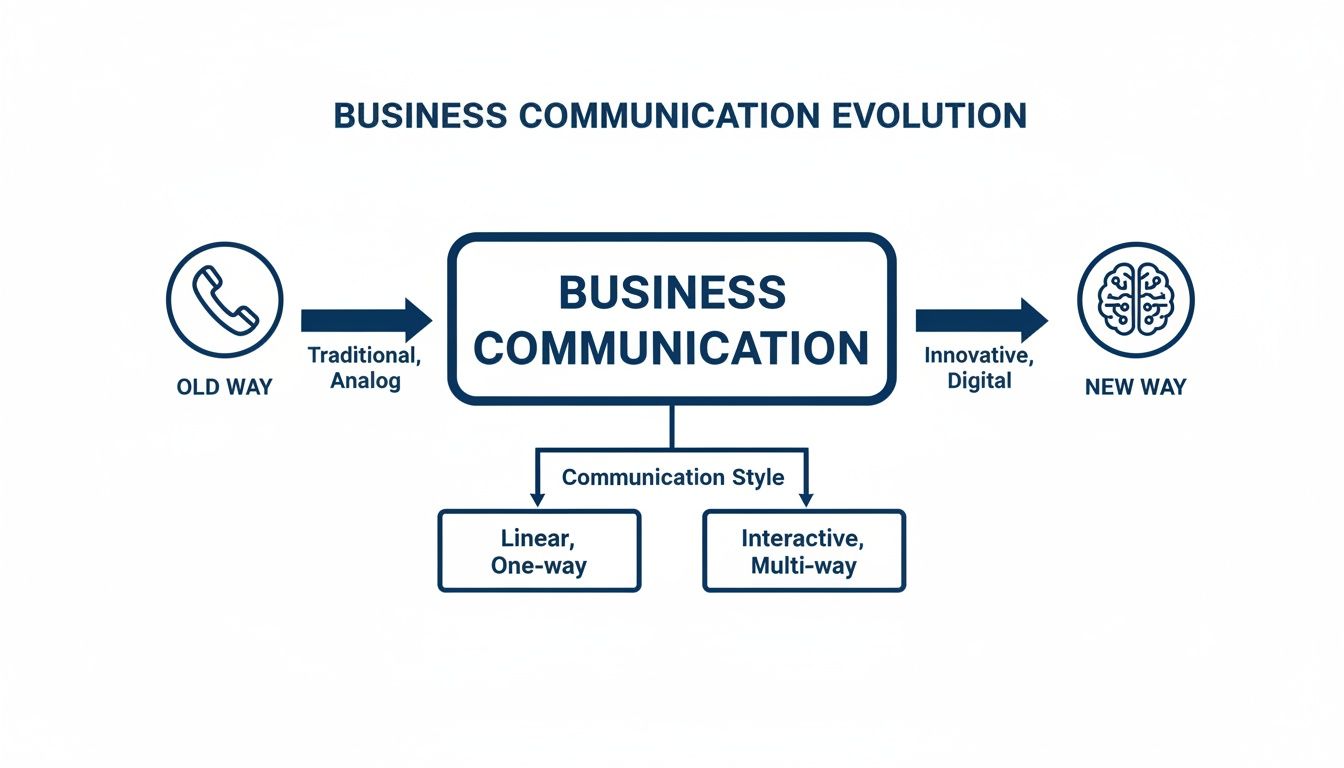
This is a huge leap from where we started. The old way was rigid and linear; the new way is dynamic and intelligent, moving communication from simple automation to something that feels a lot more like real understanding.
Stage 1: The Hearing Process
First things first, the AI has to "hear" what you’re saying. This is handled by a technology called Speech-to-Text (STT). When you speak, the STT engine acts like a digital ear, capturing the sound waves of your voice.
It then chops those sounds into tiny pieces and uses sophisticated algorithms to translate them into written text. This transformation from audio into data is the critical first link in the chain. For a deeper technical look, you can learn more by checking out our guide on how to configure Speech-to-Text for your system.
Stage 2: The Understanding Process
Once your words are in text format, the AI needs to figure out what you actually mean. This is where Natural Language Understanding (NLU) comes in. NLU is the cognitive engine that interprets human language, going way beyond just matching keywords.
NLU analyzes grammar, context, and even sentiment to figure out your true intent. It’s the reason an AI can tell the difference between "I need to book a flight to Austin" and "I need to check my booking for a flight to Austin"—two very similar sentences with completely different goals.
This ability to pick up on nuance is what makes a natural, unscripted conversation possible.
Stage 3: The Thinking Process
After understanding what you want, the AI has to decide what to do next. This "thinking" phase is managed by the AI and machine learning models, which basically act as the agent's brain.
This central processor takes your request and connects to other systems—like a CRM, scheduling software, or a knowledge base—to find the right information or perform a specific task. It then puts together a response designed to solve your problem quickly and correctly.
- For a booking request: It pings the calendar to find open slots.
- For a support question: It scans the knowledge base for the right article.
- For a transaction: It kicks off the payment process through a secure gateway.
Stage 4: The Speaking Process
Finally, the AI has to communicate its response back to you. The last step is handled by Text-to-Speech (TTS) technology. The AI’s carefully crafted text response is fed into a TTS engine.
This engine converts the text into audible, human-like speech, complete with natural pacing and intonation. Modern TTS has become so advanced that the voices are often hard to tell apart from a real person, creating a much more pleasant and engaging experience for the caller.
Together, these four stages form a continuous loop, making fluid and intelligent dialogue a reality.
Putting Voice Agents AI to Work in Your Business
It's one thing to understand the tech behind AI voice agents, but it’s another to see them in action. This isn’t some far-off, futuristic concept. Businesses are already using this technology right now to solve real problems, make customers happier, and grow their bottom line. It’s all about putting smart automation on the right tasks.
Let's move past the theory and look at the high-impact ways companies are putting AI to work. From customer support to sales, the applications are both practical and powerful.

Revolutionizing Customer Support
The most obvious and immediate place to use voice AI is in customer support. Your customers want answers fast, and AI agents can deliver them 24/7 without ever making someone wait on hold. They’re perfect for handling the flood of routine questions that can easily overwhelm a human team.
Think about these common scenarios where an AI agent can step in:
- Order Status Checks: A customer can just ask, "Where's my package?" and the AI connects to your shipping system to give them a real-time update.
- Password Resets: Instead of tying up a person, the AI can securely walk a user through verifying their identity and getting back into their account.
- Answering FAQs: The agent can instantly pull answers from your knowledge base for questions about store hours, return policies, or product specs.
This frees up your human agents to focus their expertise on the complex, sensitive issues that demand a real person's touch. You can learn more about how this works by reading our detailed guide on AI customer support agents. By automating the simple stuff, you let your team shine where they're needed most.
Accelerating Sales and Lead Generation
In sales, speed is the name of the game. An AI voice agent acts like a tireless assistant, making sure you never miss a chance to connect with a potential customer. They can work around the clock to qualify leads and book appointments, keeping your sales pipeline full.
Imagine a prospect fills out a "request a demo" form on your website at 10 PM. Instead of letting that lead go cold overnight, an AI agent can call them within minutes. It asks a few quick questions to make sure they're a good fit, checks your sales team's calendars, and books the demo right then and there.
This kind of instant response doesn't just impress potential customers; it dramatically shortens the sales cycle. Your team walks in the next morning to a calendar full of qualified meetings.
Streamlining Internal Operations
The benefits of voice AI aren't just for your customers. They can also make your own business run smoother. A great example is setting up an automated IT helpdesk.
When an employee has laptop trouble, they can call the helpdesk and explain the problem to an AI agent. The agent can guide them through basic troubleshooting, create a support ticket with all the necessary details, and even escalate the issue to the right IT specialist if the problem is more serious. This gives employees instant support and takes a huge manual load off your IT staff.
Putting It All Together: A Real-World Example
Let's look at how this plays out in the real world. An HVAC company was drowning in after-hours emergency calls. The owner was sick of being woken up at 3 AM for minor issues, while real emergencies sometimes had to wait until morning.
They brought in a voice agent AI and completely changed their process.
- Initial Triage: When a customer calls after hours, the AI agent answers instantly and asks what’s going on.
- Information Gathering: It collects the key details: name, address, and the nature of the problem (e.g., "My furnace won't turn on, and it's freezing in here!").
- Intelligent Scheduling: Based on the urgency, the AI either books an emergency repair with the next on-call technician or schedules a standard maintenance visit for the following day.
- System Integration: The agent automatically creates a new job in the company’s scheduling software, complete with the customer's info and notes.
The result? True emergencies get a fast response, the owner gets to sleep, and the next day's schedule is perfectly organized before the team even clocks in. This is a perfect example of how voice agents deliver a real, tangible return.
Connecting Voice AI to Your Phone System

A powerful voice agent is only half the equation. On its own, it’s like a genius strategist with no way to communicate their plans—it can think, but it can’t act. To actually bring its intelligence to life, you need to plug it into your company’s communication network. This is where a modern phone system, especially a Cloud PBX, becomes absolutely essential.
Think of your Cloud PBX as the central nervous system for your business communications. It’s the platform that manages every single call coming in and going out, routing traffic and keeping your team connected. The voice AI is the advanced brain that plugs directly into this system, giving it an incredible new layer of intelligence and control over how your calls flow.
This pairing is what turns a simple phone system into the foundation for a truly AI-driven communication strategy. It’s the bridge that lets the AI’s smarts translate into real-world actions that make a tangible difference for your customers and your bottom line.
Why a Cloud PBX is the Perfect Partner for Voice AI
Legacy, on-premise phone systems are rigid, closed-off boxes. They were built for a different era, making it incredibly difficult—if not impossible—to integrate them with modern software like voice agents ai. A Cloud PBX, on the other hand, is built from the ground up for this kind of connectivity.
Because it operates in the cloud, it communicates through APIs (Application Programming Interfaces). You can think of APIs as digital handshakes that let different software systems talk to each other seamlessly. This API-first design means connecting a voice agent isn't some complex, custom-coded project; it's a straightforward integration. To get a better handle on the underlying tech, you can check out our guide on what a cloud phone system is and see what makes it so flexible.
It’s this built-in connectivity that truly unlocks your voice agent's full potential.
Transforming Your Auto Attendant into a Virtual Receptionist
One of the most immediate and impactful upgrades you’ll see from this integration is the evolution of your auto attendant. A standard auto attendant is just a basic, robotic menu ("Press 1 for Sales…"). By plugging in a voice AI, you instantly upgrade it into a fully capable virtual receptionist that can handle complex, natural conversations.
Instead of being forced to navigate a rigid menu, a caller can simply say what they need:
- "I need to speak with someone in billing about my last invoice."
- "Can you transfer me to Sarah in the marketing department?"
- "I have a question about the status of my recent order."
The voice agent understands the caller's intent and routes the call to the right person or department in a split second. This creates a smooth, efficient experience that gets customers the help they need faster while eliminating the frustration of endless menu trees.
The integration between a Voice AI and a Cloud PBX does more than just route calls. It creates an intelligent front door for your business, one that is welcoming, efficient, and available 24/7.
Unlocking Advanced Call Management Capabilities
With the AI plugged into the core of your phone system, you can move way beyond basic call routing. This is where the real power of voice agents ai in a communications environment shines. The integration unlocks a whole suite of advanced functions that used to be reserved for massive enterprise call centers.
The AI gains the ability to:
- Perform Smart Call Routing: The agent can route calls based on complex rules it learns from your CRM. For example, it could automatically identify a high-value client and send them directly to their dedicated account manager, completely bypassing the general queue.
- Analyze Call Recordings: After a call wraps up, the AI can analyze the recording to detect customer sentiment, identify keywords related to complaints or sales opportunities, and automatically tag the call for follow-up. This provides invaluable data for improving your service quality.
- Manage Call Queues Intelligently: The voice agent can offer callers waiting in a queue the option for an automatic callback, provide surprisingly accurate wait-time estimates, or even handle the issue itself if it's a common request. This is a game-changer for reducing queue abandonment.
This deep integration means your phone system is no longer just a passive utility. It becomes an active, intelligent part of your customer service and sales operations, constantly working to optimize every single interaction.
A Practical Roadmap for Implementing Voice AI
Getting started with voice AI isn't like flipping a switch; it's a journey. A successful rollout needs a clear, practical plan that takes you from the initial idea all the way to ongoing improvements. If you break the process down into these manageable stages, any business can get this technology up and running smoothly and start seeing a real return, fast.
Think of this as your blueprint. Each step builds on the last, making sure the final result is perfectly tuned to what your business and your customers actually need.
Stage 1: Define Your Objective
Before you write a single line of script or talk to a vendor, you have to know what winning looks like. A fuzzy goal like "improve customer service" won't cut it. You need a specific, measurable target to guide every decision you make. This objective is your North Star.
So, what’s the single biggest communication headache you're trying to solve?
- Tired of long hold times? Your objective could be: "Decrease average caller wait time by 50% within three months."
- Need to free up your team? Try something like: "Automate 40% of routine inbound inquiries by the end of the quarter."
- Want to capture more leads? A great goal is: "Increase qualified sales appointments booked over the phone by 25%."
Having a concrete number gives you a clear benchmark for success. There's no ambiguity.
Stage 2: Pick Your First Use Case
Don't try to boil the ocean here. Instead of attempting to automate everything at once, pick one high-impact but relatively simple task to start. This approach lets you score a quick win, prove the value of the tech, and learn some valuable lessons before you tackle more complex jobs.
The best starting points are usually repetitive, high-volume tasks that follow a predictable script. For many businesses, automating appointment scheduling, booking reservations, or handling basic status lookups are perfect first choices. They provide immediate value and are straightforward to map out.
Stage 3: Design the Conversation
This is where you bring the experience to life. A well-designed conversation feels natural and helpful, guiding the caller to their goal without any friction. Start by creating a conversation flow diagram—it’s basically a flowchart that maps the entire interaction from "hello" to "goodbye."
Your design should cover a few key things:
- Scripting the Dialogue: Write out the exact phrases the AI will use. Make sure the tone and personality match your brand.
- Defining Escalation Paths: Figure out exactly when the AI should hand a call over to a human. This is critical for gracefully managing complex issues or frustrated callers.
- Mapping User Inputs: Think about all the different ways a customer might phrase their request and plan how the AI should respond to each one.
Stage 4: Integrate and Test Thoroughly
Once the conversation flow is designed, it's time to connect the dots technically. This means integrating the voice agents AI platform with your core business systems, like your Cloud PBX and your CRM. This is the magic that lets the agent perform real tasks, like looking up a customer's order or updating your calendar.
Before you go live, run a pilot program with a small group of internal users or a few trusted customers. This testing phase is absolutely critical for catching awkward phrasing, finding dead ends in the conversation, and making sure the integrations work flawlessly under real-world pressure.
Stage 5: Launch and Continuously Optimize
After you've ironed out the kinks in testing, you're ready to launch. But the work doesn't stop here. The real power of AI is its ability to learn and get better over time. You have to keep an eye on key metrics to see how your agent is performing and find opportunities for optimization.
This is where the real value gets unlocked. Autonomous voice AI agents are the powerhouse segment in this field, automating complex tasks and driving the market's incredible 34.8% CAGR. Businesses are seeing game-changing results, including a 150%+ first-year ROI and a 35% lift in customer satisfaction. You can read the full research about these voice AI market findings to see the potential for yourself. By tracking performance, you can refine scripts, adjust workflows, and expand the agent's capabilities to deliver even better results.
Got Questions About AI Voice Agents?
Jumping into any new technology can feel like a big step, and it's totally normal to have questions. When it comes to voice agents ai, we hear a lot of the same worries from business owners, especially those running small or mid-sized teams. Let's tackle some of the most common concerns head-on with some straight answers.
Most of the apprehension boils down to three things: the price tag, the fear of frustrating customers, and the technical headaches of getting it all to work. The good news? Modern AI voice tools are nothing like their clunky predecessors; they’re built to be more accessible, affordable, and user-friendly than ever.
Is a Voice AI Agent Too Expensive for My Business?
Not anymore. In the past, this kind of tech required a massive upfront investment in servers and software, putting it out of reach for most. But thanks to the cloud, that model has been completely flipped on its head. Today's solutions are almost always subscription-based, which means a much lower, more predictable monthly cost.
When you start to pencil it out, the return on investment becomes pretty clear. Think about the savings from reduced operational costs, the value of being available 24/7, and the boost you get from happier customers. Most businesses find that the technology pays for itself surprisingly quickly. A smart way to start is by picking one high-impact task, like automating appointment scheduling, to prove its value before you go all-in.
Will an AI Voice Agent Sound Robotic and Annoy My Customers?
This is probably the biggest fear, and it’s a fair one if your only experience is with those awful, old-school automated menus. But today’s AI voices are a world apart—they're remarkably natural. Modern Text-to-Speech (TTS) technology can handle tone, inflection, and cadence in a way that creates a genuinely pleasant, human-like listening experience.
The goal isn’t to trick people into thinking they’re talking to a human. It's to create an experience that’s so smooth and efficient that the interaction feels helpful, regardless of who—or what—is on the other end.
You can also customize the voice agent's personality and vocabulary to perfectly match your brand's style, keeping everything consistent for your customers. If you want to dig a bit deeper into this, you can explore frequently asked questions that cover more of the nuances.
How Hard Is It to Connect a Voice Agent to Our Other Systems?
Modern platforms are built with integration in mind. They use what are called Application Programming Interfaces (APIs) to connect smoothly with your Cloud PBX, CRM, or other business software without causing a big disruption. Think of an API as a universal translator that lets different programs talk to each other and share information seamlessly.
If your business is already using an API-friendly platform, the process is often surprisingly straightforward. A good vendor will walk you through it with solid support and clear instructions, helping you plug the AI into your existing workflow without bringing your daily operations to a standstill. This connectivity is what turns a standalone tool into a powerful, fully integrated part of how you do business.
Ready to see how SnapDial can be the foundation for your AI-powered communication strategy? Our cloud phone system is built to integrate seamlessly with the latest voice agents, transforming your customer interactions. Learn more about SnapDial and schedule a demo today.