

What Are Voice AI Agents and Why They Matter
Think about the last time you called a business and got stuck in that endless loop: "Press one for sales, press two for support…" It's frustrating, rigid, and feels completely impersonal. Now, imagine calling and instead being greeted by a calm, intelligent voice asking, "Hi, how can I help you today?"
You just state your problem in plain English, and it gets it. That's the difference a voice AI agent makes. These aren't just pre-recorded prompts playing on a loop; they are dynamic, conversational assistants for your business phone system. They mark a fundamental shift from clunky phone trees to genuine, intelligent problem-solving.
From Rigid Rules to Real Conversations
The real magic is in their ability to understand what you mean, not just what you say. A traditional Interactive Voice Response (IVR) system is built like a flowchart. If your problem doesn't fit neatly into one of its pre-programmed boxes, the experience shatters, and you're left mashing the zero key in frustration.
Voice AI agents work on a whole different level. They listen, process the intent behind your words, and figure out the best way to help. This lets them handle complex questions, navigate unexpected turns in the conversation, and often solve the issue right on the spot.
A traditional IVR is a narrow, one-way street with fixed turns. A voice AI agent is like having a GPS that can listen to your destination and instantly find the best route, even if there's traffic.
This leap in capability is why the market is absolutely exploding. The global Voice AI Agents market is on track to jump from $2.4 billion to an incredible $47.5 billion by 2034, growing at a staggering 34.8% compound annual growth rate. Businesses are racing to adopt this technology to slash operational costs while dramatically improving the customer experience. You can dig into the numbers in this market analysis of the voice AI opportunity.
Before we go deeper, it’s helpful to see just how different these two technologies really are. The old phone menus were a necessary evil for their time, but AI has completely changed the game.
Traditional IVR vs Modern Voice AI Agent
| Feature | Traditional IVR | Voice AI Agent |
|---|---|---|
| Interaction Style | Rigid "Press 1, Press 2" menu | Natural, conversational dialogue |
| Understanding | Listens for specific keywords or DTMF tones | Understands intent, context, and sentiment |
| Flexibility | Follows a fixed, pre-programmed script | Adapts to conversational turns and interruptions |
| Problem Solving | Limited to routing or simple information retrieval | Can handle complex tasks, answer questions, and complete transactions |
| Customer Experience | Often frustrating and impersonal | Engaging, efficient, and human-like |
| Integration | Basic routing to phone numbers or departments | Deep integration with CRMs, databases, and other business software |
This table really lays it bare. One system forces the customer into a box, while the other meets the customer where they are, ready to have a real conversation.
A Competitive Edge for Modern Businesses
Ultimately, voice AI agents give you a serious competitive advantage. They guarantee that every single call is answered instantly and handled with intelligence, creating a fantastic first impression.
By taking care of the routine, repetitive tasks, they also free up your human team to focus on the high-value, complex interactions that truly require a personal touch. For any company looking to modernize its communications, these agents have moved from a "nice-to-have" futuristic idea to a powerful, practical tool for running a smarter business and keeping customers happy.
How Voice AI Agents Actually Understand and Speak
When a voice AI agent holds a natural, helpful conversation, it can feel a bit like magic. In reality, it’s a lightning-fast process where four distinct technologies work together seamlessly. You can think of it like a highly skilled team: a listener, an interpreter, a strategist, and a speaker, all coordinating in fractions of a second.
This teamwork is what separates a truly helpful AI from those rigid, frustrating phone menus we all dread. This infographic really drives home the difference between an old-school system and the advanced capabilities of a modern voice AI.
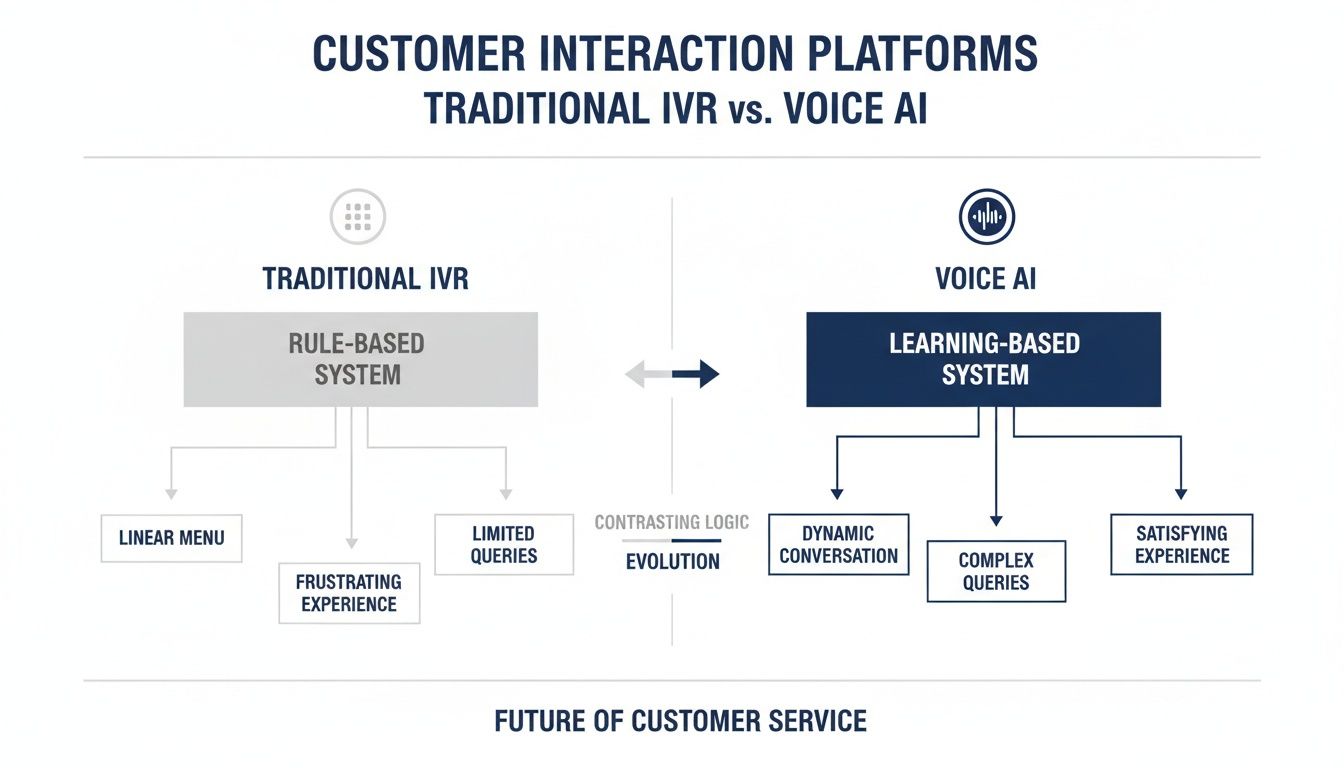
As you can see, it's a huge leap from simple numeric commands to a system that actually learns from and understands complex human dialogue. Let’s break down the four core components that make it all happen.
The Ears: Automatic Speech Recognition
The first step in any voice conversation is simply hearing and transcribing what the person is saying. This is the job of Automatic Speech Recognition (ASR), which acts as the agent's digital ears.
ASR technology captures the sound waves of a person’s voice and converts them into text that a machine can read. It’s the foundational layer everything else is built on. Making sure this initial transcription is accurate is critical, which is why a project's success often relies on the work of specialized ASR experts.
Modern ASR systems are incredibly good at this, able to distinguish between different accents, filter out background noise, and understand a massive vocabulary. For an AI to give an intelligent response, it needs a perfect transcript of the spoken words to start with.
The Brain: Natural Language Understanding
Once the words are in text form, the real intelligence kicks in with Natural Language Understanding (NLU). NLU is the brain of the operation. Its job is to figure out the meaning and intent behind the user's words.
For instance, a customer might say, "My internet is down," "I can't get online," or "Why isn't my WiFi working?" Even though the phrasing is totally different, NLU knows the core intent is the same: reporting a service outage. It then extracts key pieces of information (known as "entities") like "internet" or "WiFi" to understand precisely what the user needs help with.
NLU doesn't just read words; it comprehends context. It's the difference between hearing "book a flight" and understanding that the user wants to begin the reservation process.
The Strategist: Dialog Management
After understanding what the user wants, the Dialog Management component takes over. This is the strategist. It decides what the voice AI agent should do or say next to move the conversation forward in a productive way.
It looks at the user’s request, the conversation history, and the available business logic to figure out the most logical next step. Should it ask a clarifying question? Should it pull data from a database to check an order status? Or is this the right moment to transfer the call to a human agent?
Dialog Management is what creates a natural, back-and-forth conversational flow, making sure the interaction feels like a real conversation, not just a rigid script. If you want to dive deeper into the technical setup, you can check out our guide on how to configure speech-to-text settings.
The Voice: Text-to-Speech
Finally, once the agent has figured out its response, Text-to-Speech (TTS) technology gives it a voice. TTS converts the system's text-based reply into natural, human-sounding audio.
Today's neural TTS systems can generate voices with realistic intonation, pacing, and even emotional nuances, making the interaction feel far more personal and engaging than the robotic voices of the past.
Together, these four components—ASR, NLU, Dialog Management, and TTS—work in a seamless cycle, allowing voice AI agents to listen, understand, strategize, and speak.
Putting Voice AI to Work in Your Business
Okay, so we've pulled back the curtain on the tech behind voice AI agents. But let's be honest, the real question is: what can it actually do for my business? The value isn't in the fancy algorithms; it's in solving real-world problems, making your team more efficient, and giving your customers a better experience.
When you move past thinking about this as just a fancier way to route calls, you start to see how it can fundamentally change the way you do business. Let's dig into three powerful ways these agents are already making a huge difference.
Revolutionizing Customer Self-Service
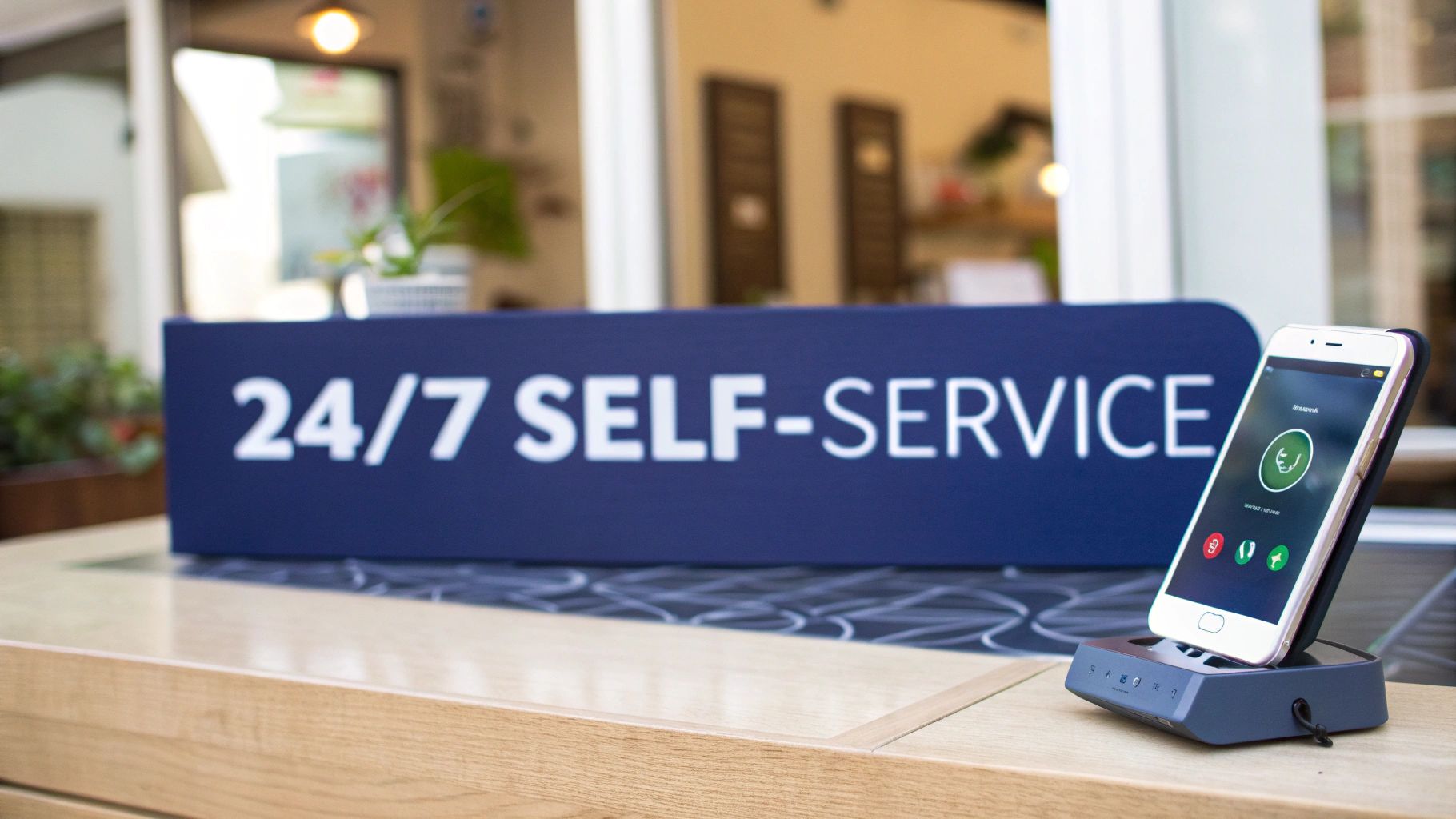
The most immediate and game-changing use for a voice AI agent is to create a smart, conversational front door for your company. Forget forcing callers through a rigid, press-one-for-this phone tree. You can now offer an intelligent self-service option that's ready to help 24/7.
Picture this: it's 10 PM and a frantic customer calls your plumbing business with a burst pipe. Instead of hitting a voicemail, they're greeted by an AI that understands the urgency. It gets their name and address, confirms it's an emergency, and schedules a dispatch—all without waking up a single human.
That's not just great service; it's a high-value lead you would have otherwise missed. Your phone system just went from a passive message-taker to an active problem-solver.
Deploying Intelligent Virtual Support Agents
So many of the calls your support team handles are the same old questions. "Where's my order?" "How do I reset my password?" "What are your hours?" These routine queries eat up time that your skilled human agents could be using for more complex, high-value conversations.
A voice AI agent can act as an intelligent virtual agent, handling these common requests flawlessly from start to finish. This frees up your team to focus where they truly shine—navigating tricky customer situations, providing in-depth product advice, or just building stronger relationships.
An e-commerce brand, for example, could have a virtual agent handle every single "Where is my order?" call. The AI asks for the order number, pulls the data from your system, and gives a real-time shipping update. The whole thing is resolved in under a minute.
By automating these routine questions, you don't just cut down on costs; you make your team's jobs better. They get to work on more interesting problems, which leads to higher morale and lower turnover.
Uncovering Insights with Call Summarization
Not every interaction has to be a full-on, automated conversation. Voice AI can also work quietly in the background, listening to calls handled by your human agents and turning all that talk into structured, usable data.
After a call wraps up, the AI can generate an instant summary, tag the main topics discussed, and even perform sentiment analysis to get a read on the customer's mood. For business intelligence, this stuff is pure gold.
This technology is already delivering staggering results. Telefónica Germany, for instance, now handles over 900,000 calls a month with voice agents, which has boosted their IVR resolution rates by 6%. In a much more critical field, Medtronic sees an estimated $22 million monthly ROI with 99% accuracy in healthcare scenarios, proving these agents can perform even when the stakes are high. You can find more details on the top-performing voice AI agents at Teneo.ai.
When you can analyze thousands of conversations, you start spotting trends you'd never see otherwise—like an emerging product issue, a common point of customer frustration, or even an opportunity for a new service. It’s like having a team of analysts listening to every single call.
Integrating Voice AI with Your Cloud Phone System
Knowing the tech behind voice AI is one thing, but seeing how it plugs into your daily business operations is where the lightbulb really goes on. For any business already running on a cloud phone system, the integration is surprisingly simple. Think of it less like a massive IT overhaul and more like adding a powerful new app to your phone—it just makes the core tool you already use that much better.
The goal isn't to rip and replace what you've got. It's to make your phone system dramatically smarter. A voice AI agent becomes the new, intelligent front door for all your inbound calls, working in perfect harmony with the routing, extensions, and features you already have set up.

How the Call Handoff Works
When a customer dials your main business number, your cloud phone system doesn't just ring a desk phone anymore. Instead, its very first move is to route that call directly to the voice AI agent. This happens in a fraction of a second, so the caller experiences zero delay.
From there, the AI takes the lead. It greets the caller, figures out why they're calling, and decides on the best next step. This is that crucial first point of contact where the magic happens, and the agent can handle a huge chunk of interactions right then and there.
The core idea is simple: let the AI handle everything it's great at—like answering common questions or gathering information—so your human team can focus on what they're best at. It's a system of triage, but one that feels like a helpful conversation.
If the AI can solve the caller's problem completely, like giving them business hours or confirming an appointment, the call ends there. The customer is happy, and your team was never interrupted. But if the situation needs a human touch, the integration really shows its power.
Seamless Transfers to the Right Person
When a call needs to be escalated, the voice AI agent doesn't just blindly forward it. It performs an intelligent, warm handoff back to your cloud phone system, armed with valuable context.
For example, after figuring out a caller needs to speak with the billing department about a specific invoice, the AI communicates this directly to the phone system. Your cloud PBX then routes the call—along with that context—to the correct person or department.
This means your team member picks up the phone already knowing who is on the line and what they need. No more frustrating transfers where the customer has to repeat their story three times. This seamless flow is a massive benefit for businesses already familiar with the power of modern communications. To learn more, check out our complete guide on what a cloud phone system is and the features it offers.
This process transforms your communications workflow in a few key ways:
- Initial Screening: The AI acts as a perfect gatekeeper, filtering and handling routine calls so your staff isn't constantly derailed by repetitive questions.
- Intelligent Routing: Calls are directed with precision based on the caller's actual needs, not just which button they mashed in a phone menu.
- Full Resolution: A huge number of calls are wrapped up without ever needing a human, which radically improves operational efficiency.
Ultimately, integrating a voice AI agent with your cloud phone system creates a powerful partnership. The AI provides the conversational brainpower, while your phone system provides the robust, reliable infrastructure to connect that intelligence to the right people at exactly the right time.
Your Roadmap to Implementing Voice AI
Jumping into a new technology like voice AI can feel like a massive undertaking, but it’s really more of a structured journey than a technical maze. With a clear roadmap, any business can get from an initial idea to a fully functional assistant that actually drives value. The process doesn’t start with code or complex platforms; it starts with a simple, strategic question: what’s our biggest communication headache right now?That first step is all about finding the point of maximum impact. Is your sales team drowning in calls from unqualified leads? Is your support staff spending half their day answering the same three basic questions over and over? By pinpointing a high-value, high-pain use case, your first voice AI project is guaranteed to deliver tangible results quickly, building momentum for whatever comes next.
Defining Your Goals and Scripting Success
Once you know the problem you’re solving, the next step is to define what success actually looks like. Your goals need to be specific and measurable. For instance, you might aim to reduce caller wait times by 50%, or have the AI automatically resolve 30% of routine support tickets without ever needing a human. These clear targets become the North Star for the entire project.
With your goals locked in, you can start scripting the initial conversation flows. This isn't about writing code—it's about mapping out a natural, helpful dialogue. What’s the very first thing your agent should say? What are the most likely questions customers will ask? How should the agent respond to each one? This initial script is the blueprint for your AI's personality and its core capabilities.
Choosing a Partner and Training Your Agent
You don't need a team of in-house AI experts to get started. The market is full of technology partners and platforms that make deploying voice AI agents pretty straightforward. The key is finding a provider who gets your business goals and can offer the right level of support—whether that's a fully managed "done-for-you" service or a user-friendly platform you can configure yourself.
After you've picked a partner, the training phase begins. This involves feeding your AI real-world examples of customer conversations, helping it learn your industry's specific jargon and the nuances of how your customers actually talk. A thorough testing process is absolutely critical here. You'll want to simulate all kinds of scenarios to iron out any kinks before a single real customer interacts with it.
An AI agent is like a new employee. It needs clear instructions, proper training on real-life situations, and a probationary period to ensure it's ready to represent your brand effectively.
Launching and Protecting Customer Data
The final steps are the go-live and an unwavering commitment to security. A phased rollout, maybe starting with just a small percentage of calls, is a smart move. It allows you to monitor performance closely and make adjustments on the fly. As you launch, safeguarding user data has to be a top priority. It's crucial to integrate Privacy by Design principles from the very beginning of development to build and maintain customer trust.
There’s a good reason enterprise adoption of voice AI is growing so fast. Capgemini predicts this technology could create up to $450 billion in economic value by 2028, and the U.S. user base is expected to hit 157.1 million by 2026. This isn't just a trend; it's a fundamental shift, moving voice assistants from consumer gadgets to essential business tools. By following a clear roadmap, your business can confidently join this movement.
Measuring the Success of Your Voice AI Agent
So, you've invested in new technology. The big question is always the same: is it actually working? Implementing a voice AI agent is no different. You have to move past gut feelings about "better calls" and dig into the hard data to understand your return on investment (ROI).
The good news is you don’t need a complicated analytics setup to see the results. By focusing on a few key indicators, you can get a crystal-clear picture of how your AI is boosting efficiency, cutting costs, and keeping customers happy.
Key Metrics for Voice AI Performance
Think of these metrics as your AI agent's report card. They tell you exactly how well it’s doing its job and where it’s delivering the most value. Each one tells a crucial part of the story.
Let's break down the three most important metrics to keep your eye on:
- Call Deflection Rate: This is the big one. It's the percentage of calls your voice AI agent handles from start to finish, without ever needing to pass the call to a human. A high deflection rate is a direct sign of efficiency—it shows the AI is successfully knocking out all those routine, repetitive questions on its own.
- First-Contact Resolution (FCR): This metric measures how many customer issues get completely solved during the very first interaction. When your AI agent nails an FCR, it’s a massive win for both customer satisfaction and your team's workload. No follow-ups, no frustration.
- Average Handle Time (AHT): This is simply the average time spent on a call. A well-designed voice AI can slash your AHT by instantly understanding what the caller wants and giving them an answer right away. This frees up your human agents to tackle the more complex, high-value conversations.
For a deeper dive into call metrics, our guide to understanding call analytics offers more detail on how these numbers reflect business performance.
Calculating Your Return on Investment
Seeing positive numbers on a dashboard is great, but translating them into dollars and cents is what really proves the value of your voice AI agents. Calculating the ROI doesn't have to be some complex accounting exercise; it’s a straightforward comparison of what you spent versus what you saved.
Your ROI is the proof that this technology isn’t just a fancy feature—it’s a powerful engine for business growth. It quantifies the savings in labor costs, the value of increased efficiency, and the financial benefit of happier, more loyal customers.
To get started, add up the total cost of your AI solution, including any subscription and setup fees. Then, calculate your savings by looking at concrete improvements. A simple way to start is by multiplying the number of deflected calls by your average cost-per-call to see your direct labor savings. From there, you can even factor in the value of reduced employee churn and increased customer retention. When you stack those tangible savings up against the initial cost, the financial case for voice AI often becomes overwhelmingly clear.
Of course. Here is the rewritten section, designed to sound completely human-written and match the provided expert style.
Answering Your Questions About Voice AI Agents
Adopting any new technology brings up good questions. When it’s something as close to your customers as your business communications, you need clear answers and the confidence that you’re making a smart, secure decision.
Plenty of business owners have the same concerns when they first start looking into voice AI agents. Let’s tackle the most common ones head-on to clear things up and show just how accessible this technology has become.
How Secure Is Customer Data?
Handing conversations over to an AI naturally makes you think about security, and it absolutely should. Protecting customer information is non-negotiable, and any reputable voice AI platform is built with security at its core.
It all starts with end-to-end encryption, which scrambles the data from the moment a customer speaks to the moment it's processed and stored. On top of that, if you handle any payments over the phone, it’s critical that the solution is PCI compliant. This creates a secure bubble for processing credit card details without ever storing sensitive information on your systems.
Can a Voice AI Agent Actually Sound Human?
We’ve all been stuck in a phone menu with a robotic, monotone voice that sounds like it’s from the 90s. It’s a common fear that an AI will sound clunky and create a frustrating experience. But today’s technology is a world away from that.
Modern voice AI agents are powered by advanced neural Text-to-Speech (TTS) engines. These systems have been trained on enormous libraries of human speech, which allows them to generate voices with incredibly natural tones, inflections, and pacing.
The goal of modern TTS isn't just to read words aloud. It’s to convey warmth and meaning through subtle vocal nuances, making the conversation feel comfortable and engaging, not cold and robotic.
This leap in quality means your customers can have a genuinely pleasant and effective conversation with an AI. The agent can sound calm, professional, and helpful—a perfect first impression for your brand.
What Does It Cost to Implement?
This is probably the biggest myth out there: that voice AI is a complex, eye-wateringly expensive technology reserved for massive corporations with huge IT budgets. While that might have been true a few years ago, things have changed completely.
Pricing models have become flexible and accessible, often based on usage (like simple per-minute rates) or flat-rate subscriptions. This shift makes it possible for small and mid-sized businesses to deploy powerful voice AI without a massive upfront investment.
The final cost will depend on how complex you need the agent to be, but powerful and affordable solutions are now well within reach. The technology has matured, making the ROI clearer and the barrier to entry lower than ever. You can get enterprise-level functionality without the enterprise-level price tag.
Ready to see how an intelligent, conversational front door can transform your business communications? SnapDial makes it simple to integrate a powerful voice AI agent with a reliable cloud phone system. Learn more about our all-in-one solution.