Let's be honest, thinking about your business phone system probably isn't the most exciting part of your day. But what if it could work more like Netflix and less like a clunky DVD player you have to keep in a closet?
That’s the core idea behind a VoIP business system. It ditches the old-school copper landlines and uses your internet connection to handle all your calls. It’s a modern communication hub that moves your entire phone service online, giving you a suite of powerful tools and some serious cost savings in the process.
What Is a VoIP Business System, Really?

Think of a traditional phone system as its own private, physical road network built just for your office. It needs a big, expensive piece of hardware—a PBX (Private Branch Exchange) box bolted to a wall—and its own dedicated wiring snaked through your building. It’s costly to install, a headache to maintain, and totally inflexible. Need to add a new employee? Get ready to call a technician and open your wallet.
A VoIP business system completely flips that model on its head.
Instead of a private road, it uses the internet—the public superhighway that already connects you to the world. VoIP, which stands for Voice over Internet Protocol, simply converts your voice into digital data and sends it over your existing internet connection.
This simple shift from hardware to software is a game-changer. Your "phone system" no longer lives in an office closet; it exists in the cloud, managed entirely by your provider. This frees your business from the limits of a physical location and unlocks a world of communication tools that were once only for the big enterprise players.
The Shift from Hardware to Software
The real magic here is moving from a clunky, capital-intensive hardware model to a flexible, subscription-based service. With an old-school PBX, you buy the box, pay for the installation, and you're on the hook for every repair and upgrade. With a modern VoIP system, you just pay a predictable monthly fee for each user.
This approach delivers some immediate, obvious wins:
- No On-Premise Hardware: You can finally get rid of that bulky, expensive PBX box. All the heavy lifting is handled by your provider in their secure data centers.
- Total Location Independence: Because calls travel over the internet, your team can make and receive calls from their business number on any device—a desk phone, a computer, or a mobile app—from anywhere with a Wi-Fi signal.
- Predictable Costs: You get simple, all-inclusive pricing that covers your calling, features, and support. Budgeting becomes transparent and straightforward.
This software-driven model is what turns your phone system from a static utility into a dynamic tool that actually helps you run your business better. To dig deeper into the architecture, you can learn more about what a cloud phone system is and how it works.
A Clear Comparison
To really see why so many businesses are making the switch, it helps to put the two models side-by-side. The move isn't just a technology upgrade; it's a strategic shift in how your business communicates with the world.
Let's break down the key differences.
Traditional PBX vs Modern VoIP Business System
| Aspect | Traditional PBX | Modern VoIP Business System |
|---|---|---|
| Technology | Analog signals over copper wires | Digital data over the internet |
| Hardware | On-site PBX box, physical phones | IP phones, mobile apps, computers |
| Scalability | Difficult and expensive to add lines | Add or remove users in minutes |
| Flexibility | Tied to a physical office location | Work from anywhere with an internet connection |
| Cost Model | High upfront cost, ongoing maintenance fees | Low monthly subscription per user |
| Features | Basic calling, voicemail | Auto-attendant, call recording, mobile apps |
As you can see, the operational models are worlds apart. One forces you to become a phone system expert, while the other lets you focus on your business while a provider handles all the tech. For most businesses, the agility and predictable costs of VoIP make it the clear winner.
The Real Benefits of Upgrading Your Phone System
Beyond all the tech specs and jargon, what does upgrading your phone system actually do for your business? It’s not about getting shiny new gadgets; it’s a strategic decision that directly boosts your bottom line and makes your entire operation more agile. The benefits are practical, measurable, and felt across the whole company.
Let's start with the most compelling reason for most businesses: a massive drop in costs. Old-school phone systems are money pits. You're constantly getting hit with surprise bills for hardware maintenance, technician visits, and rigid, overpriced contracts. A modern VoIP business system just makes all of that disappear.
By sending calls over the internet, you kill the whole concept of "long-distance" charges. Calling a client across town or a supplier across the country costs the same. For any business with a national footprint, that alone can lead to some pretty dramatic savings.
Drastic Cost Reductions
The financial argument for making the switch is incredibly strong. You’re not just shaving a few dollars off your bill; you're changing your entire cost structure. It shifts your phone system from a major capital expense (CapEx) to a predictable, low operational expense (OpEx), freeing up cash you can pour back into growing the business.
The numbers speak for themselves. Companies can save up to 60% on their total phone bills by switching. For most small to mid-sized businesses, this works out to cutting $20 to $50 per user, per month. One well-documented case showed a business with 30 phones slashed its monthly bill by $1,200 right after moving to the cloud—an immediate ROI with zero upfront hardware cost. You can learn more about the real-world savings VoIP offers and what those numbers could look like for your budget.
This cost-cutting magic comes from a few key places:
- No More Maintenance Contracts: Your provider handles all the system upkeep and software updates in the cloud. You'll never pay a technician to come service that dusty old PBX box in the closet again.
- Predictable Subscription: You pay a simple per-user monthly fee. Budgeting becomes a breeze, with no surprise bills for repairs or long-distance overages.
- Lower Total Cost of Ownership: When you don't have to buy and maintain expensive hardware, the long-term cost of your phone system plummets compared to a traditional setup.
Unmatched Scalability and Flexibility
Beyond the savings, a modern phone system gives you a level of operational flexibility that just wasn't possible before. With a classic PBX, adding or removing lines is a slow, expensive headache involving technicians, physical wiring, and scheduling. A VoIP business system, on the other hand, scales instantly.
Imagine you’re heading into your busy season and need to bring on ten temporary customer service reps. With a cloud system, you just log into a web portal and add ten new users to your account. When the season's over, you can remove them just as easily. That kind of on-the-fly agility is impossible with legacy hardware.
This on-demand scalability means your phone system can perfectly mirror your business needs—whether you're in a high-growth phase, managing seasonal demand, or opening a new office. You only pay for what you use, right when you use it.
Enhanced Reliability and Business Continuity
What happens to your business if the office loses power or the local internet service goes down? With an old-school landline system, the answer is ugly: your phones are dead, and you're officially out of business until it's fixed. This is where the reliability of a cloud-based VoIP system really proves its worth.
Because the whole system "lives" in secure, redundant data centers, it isn’t tied to your office's physical location or power grid. A huge benefit of upgrading is better call reliability, especially for mobile teams. Even solutions for improving mobile phone signal for critical business calls can be integrated to ensure your team stays connected on the move.
If an outage hits your office, your VoIP system automatically and intelligently keeps you in business:
- Automatic Rerouting: The system can instantly forward all incoming calls to your team's mobile phones. No customer call ever has to go unanswered.
- Location Independence: Your team can keep right on working from anywhere with an internet connection—home, a coffee shop, another office—using their desktop or mobile apps.
- Voicemail to Email: If a call can’t be answered, the voicemail is immediately transcribed and emailed to the employee, so they can follow up fast.
This built-in disaster recovery turns your phone system from a potential point of failure into a powerful tool for business continuity. It ensures you stay connected and operational, no matter what happens at your physical location.
The Core Features That Actually Power Your Business
A modern VoIP business system is so much more than just a replacement for your old desk phone. It’s really a collection of powerful tools designed to solve the kinds of problems every business faces, from making sure you never miss a lead to keeping a mobile team connected.
These are the features that were once only available to giant corporations with eye-watering budgets. Now, they're accessible to any business ready to work smarter.
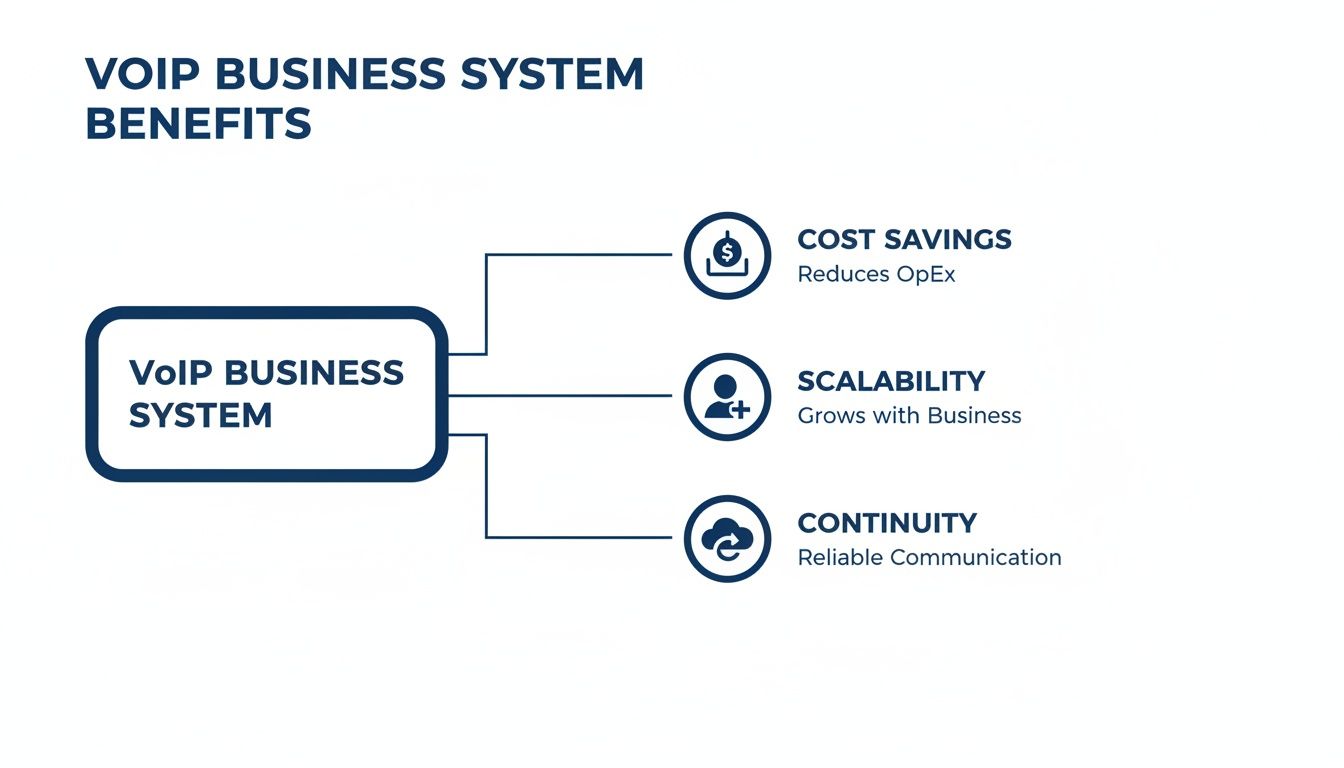
As you can see, the biggest advantages of a VoIP system—saving money, growing without headaches, and staying online no matter what—are all driven by these core features working together.
Your 24/7 Digital Receptionist
One of the most powerful features you'll get is the Auto Attendant, sometimes called an IVR. Think of it as the perfect digital receptionist. It’s always professional, always on duty, and it never calls in sick.
Instead of a human operator scrambling to direct every call, the Auto Attendant greets every single caller with a polished, studio-quality recording and gives them a simple menu. "Press 1 for Sales, Press 2 for Support, Press 3 for our company directory."
This one tool has a massive impact:
- A Polished First Impression: It instantly makes your company sound bigger and more organized, building trust from the very first ring.
- Capture Every Lead: It guarantees every call gets answered and routed to the right person or department, even after hours. No more valuable opportunities slipping through the cracks.
- Boost Team Efficiency: It frees up your people from the constant interruption of answering and transferring basic calls, letting them focus on the work that actually matters.
Smart Call Routing and True Mobility
What happens when your best salesperson is on the road or a key support agent is working from home? With a VoIP system, their physical location just doesn't matter anymore. Smart call routing and powerful mobile apps ensure your team is always connected.
You can create sophisticated rules that tell the system exactly how to handle calls. For instance, a call to an employee's direct line can ring their desk phone for 15 seconds, then simultaneously ring their mobile app and a colleague's phone. This "find me/follow me" logic creates a truly unified presence.
This changes everything. An employee's business number is no longer tied to a piece of plastic on a desk. It becomes a personal communication identity that follows them anywhere—an absolute must-have for any mobile workforce.
Bringing All Your Communications Together
Let's face it, modern business communication is a mess. You’ve got phone calls, voicemails, text messages, and even faxes coming in from all different directions. It's chaos. A top-tier VoIP system is designed to bring all of it into one manageable place, a concept often called Unified Communications (UC).
Features like visual voicemail are a perfect example. Instead of dialing in to check messages, the system transcribes them to text and emails them to you. You can scan them in seconds and prioritize who to call back first. Cloud faxing does the same thing for faxes, turning them into PDF attachments in your email and killing off that clunky old machine in the corner.
The real magic happens when these tools connect to your other business software. To see how this works in practice, check out our guide on VoIP CRM integration and how it streamlines workflows.
Advanced Call Center Power for Everyone
For any business that depends on customer service or sales calls, a VoIP system delivers features that used to be exclusively for huge, enterprise-level call centers. Advanced call queuing is a perfect example.
Instead of hitting a frustrating busy signal, your callers are placed in a smart queue with professional on-hold music and regular updates on their position. You can even offer a queue callback option, which lets callers hang up, keep their spot in line, and get an automatic call back when it's their turn. It’s a game-changer for customer satisfaction.
In fact, around 40% of businesses using a CRM also use a VoIP solution, pairing these call management tools with customer data to deliver a far better experience. These features directly slash caller frustration and prevent hang-ups, helping you provide the best service possible.
How to Choose the Right VoIP Provider
Picking a VoIP provider isn't like buying office supplies; you're not just buying a product, you’re choosing a long-term communications partner. Get it right, and your provider will feel like an extension of your team. Get it wrong, and you're in for endless headaches, dropped calls, and customer complaints.
It's tempting to get swayed by flashy marketing and rock-bottom prices. But you need to look past that and focus on the handful of criteria that actually determine whether a provider can deliver a smooth, reliable experience for your team and customers. This is about asking the tough questions and finding a partner who aligns with your business goals, not just a vendor selling a dial tone.
Focus on Reliability and Uptime Guarantees
Let's be blunt: if your phones don't work, you're out of business. Reliability is the single most important factor, period. Don't settle for vague promises of "great service." You need a formal Service Level Agreement (SLA) that contractually guarantees a specific percentage of uptime.
The number you're looking for is 99.999% uptime, often called "five-nines" reliability. That industry-leading standard translates to less than six minutes of potential downtime in an entire year. Providers achieve this with geographically redundant data centers, so if one location has an outage, your service automatically fails over to another without you or your customers ever noticing.
A strong SLA is non-negotiable. It's your assurance that the provider is financially and operationally committed to keeping your business communications running without interruption.
Scrutinize Security Protocols
Because your calls travel over the internet, security can't be an afterthought. A reputable provider builds multi-layered security measures into their network to shield your conversations from eavesdroppers and bad actors. When you're vetting potential partners, ask them to walk you through their security architecture.
Here's what to look for:
- Call Encryption: They must use protocols like Transport Layer Security (TLS) and Secure Real-time Transport Protocol (SRTP). These scramble your call data, making it unreadable to anyone who might intercept it.
- Network Security: The provider should have robust firewalls, intrusion detection systems, and dedicated teams doing proactive 24/7 network monitoring to stop cyber threats before they start.
- Compliance: If you're in a regulated industry like healthcare or finance, you absolutely need to confirm the provider meets standards like HIPAA or PCI-DSS.
Insist on Transparent Pricing
Hidden fees can quickly turn an affordable VoIP plan into a budget disaster. A VoIP system is a subscription service, and understanding the true cost of SaaS is key to making a smart decision. Be very wary of any provider that advertises an unbelievably low per-user price without being crystal clear about what’s included.
A trustworthy partner offers all-inclusive pricing. Demand a detailed quote that breaks down every single cost, including any taxes and regulatory fees. There should be zero surprises on your monthly bill. If you need a hand sorting through the options, our detailed comparison of the top VoIP business providers can help you see how different vendors stack up.
The Vendor Selection Checklist
To cut through the marketing noise, use this checklist to compare providers side-by-side. A provider who can confidently say "yes" to every one of these points is one worth talking to.
Essential Provider Criteria:
- Uptime Guarantee: Do they offer a 99.999% uptime SLA?
- Security: Do they provide end-to-end encryption (TLS/SRTP)?
- Support: Is 24/7, U.S.-based human support available by phone?
- Pricing: Is the pricing all-inclusive with no hidden fees?
- Setup & Migration: Do they offer a "white-glove" setup and number porting process at no extra cost?
- Scalability: Can you easily add or remove users through a self-service portal?
- Core Features: Does the standard plan include an auto attendant, call recording, and mobile apps?
This checklist forces the conversation beyond vague promises and into the operational reality of working with a provider. Things like high-quality support and a fully managed, zero-downtime transition are just as critical as the features themselves—they're what guarantees your switch is a success from day one.
VoIP in Action: Real-World Business Scenarios

It’s easy to get lost in a sea of features and technical specs. But the real "aha!" moment comes when you see how a voip business system solves the frustrating, everyday problems that cost you time and customers. These aren't just abstract tools; they're the fixes for common operational headaches that directly impact your brand and your ability to grow.
The proof is in the numbers. The global VoIP market hit roughly $132.47 billion in 2023 and is on track to become the default for business communication by 2030. With over 90% of businesses already on board and SMB adoption jumping by over 15% annually, this isn't a trend—it's a fundamental shift driven by real-world results. You can see the detailed VoIP market projections for yourself to understand the scale of this change.
Let’s step into a few common business scenarios to see how this plays out.
The Multi-Location Retailer
Imagine a small chain with three boutique clothing stores. Before, each shop was its own island with its own phone lines. A customer calls the downtown store about a dress, but it's only in stock at the mall location. The employee has to awkwardly tell them to hang up and dial a completely different number. It’s clunky, unprofessional, and a terrible customer experience.
After switching to a unified VoIP system, everything changed. All three stores now operate on a single, cloud-based platform.
- Unified Directory: An employee at any store can see who’s working at the other locations and transfer the caller with a single click. The customer experience is instantly seamless.
- Centralized Answering: A single auto attendant greets every caller, offering a simple menu to get them to the right place. "Press 1 for our Downtown location, Press 2 for the Mall."
- Consistent Presence: Every store now shares the same professional greeting and on-hold music, creating a single, cohesive brand no matter which number a customer dials.
They didn't just upgrade their phones; they unified their business. What was three separate phone systems became one communication hub that boosted both customer service and internal efficiency.
The Growing Law Firm
Think about a busy law firm where attorneys are constantly bouncing between the office, the courthouse, and client meetings. Their old desk phones chained them down, leading to critical missed calls from clients and opposing counsel—a huge liability in their field. A modern VoIP system was the perfect solution.
For a law firm, every single call can be critical. Missed communication isn't just a missed opportunity; it's a potential compliance risk. A VoIP system with mobile integration and call recording isn't a luxury—it's a necessity for modern legal practice.
Here’s how it solved their biggest challenges:
- True Mobile Accessibility: The mobile app instantly turns each attorney’s smartphone into their office extension. They can make and receive calls from their business number no matter where they are, protecting their personal number and maintaining a professional image.
- Call Recording for Compliance: With client consent, they can record important calls and have them automatically archived. This creates a secure record for training, dispute resolution, and proving compliance.
- A Professional Front Door: The auto attendant ensures every client is greeted professionally and can easily find their attorney or paralegal, building confidence from the very first interaction.
The Customer Service Team
Finally, let's look at a company with a small but swamped customer service team. They were drowning in high call volumes, plagued by long wait times, and dealing with justifiably frustrated callers. Worse, they had no visibility—no idea how many people were calling or why they were hanging up.
Implementing a VoIP system with built-in call center features gave them the data and tools they needed to completely turn their service quality around.
- Smart Call Queues: Instead of a frustrating busy signal, callers are placed in a professional queue. Offering a queue callback feature gives them the option to hang up and get an automatic call back when it's their turn, which dramatically reduces frustration and abandonment.
- Real-Time Analytics: The manager can now pull up a live dashboard showing calls in queue, average hold times, and agent status. This data allows for immediate adjustments, like moving an agent to the queue during a rush to keep wait times down.
- Improved Agent Performance: Call recordings and detailed reports help the manager pinpoint specific areas for coaching, leading to better-trained agents and a higher first-call resolution rate.
Answering Your Top VoIP Questions
Making the final call on a new phone system can feel like a big step. I get it. Even after seeing all the benefits and features, a few lingering questions about reliability, cost, and the switch-over process are completely normal.
Let's tackle those head-on. This is where we get into the nitty-gritty, giving you the straightforward answers you need to feel confident about your decision.
How Reliable Is a VoIP Business System Compared to a Traditional Landline?
This is often the number one concern, and the answer usually surprises people. A modern voip business system isn't just reliable—it's often more resilient than an old-school landline. Top-tier providers build their networks on enterprise-grade infrastructure with layers of redundancy.
This allows them to offer uptime guarantees, usually in a formal Service Level Agreement (SLA), of 99.999%. That's the "five-nines" standard, which translates to less than six minutes of potential downtime across an entire year.
The real difference is how each system handles a problem. A traditional landline is tied to your physical location. If a construction crew cuts the line down the street or the local exchange has an issue, your phones are simply dead. A cloud-based VoIP system has no such weakness.
If your office loses power or internet, a high-quality VoIP system keeps your business online. It instantly and automatically reroutes incoming calls to your team's mobile phones or another location, so you never miss a customer call.
This built-in continuity turns your phone system from a potential point of failure into a genuine tool for resilience.
Will I Have to Buy All New Hardware to Switch to VoIP?
Not necessarily, but it's usually the best way to guarantee a smooth, frustration-free experience. While some of your existing SIP-compatible phones might work, using hardware that your provider has pre-configured and certified is the only way to ensure every feature works perfectly.
Providers like SnapDial offer a curated selection of IP phones tested to deliver exceptional HD voice quality and seamless integration with their platform. The cost of new, modern phones is often minimal, especially when you factor in the major long-term savings you get from switching to VoIP.
Plus, one of the biggest advantages of a modern voip business system is that not everyone even needs a desk phone anymore. Many on your team can work just as effectively—or even better—using the desktop softphone on their computer or the mobile app on their smartphone. This flexibility can cut your initial hardware costs even further and empower a more mobile team.
Is Migrating to a VoIP System Difficult and Will There Be Downtime?
With the right provider, the move to VoIP is not only easy but is designed from the ground up to happen with zero downtime. This is a non-negotiable point to confirm when you're evaluating partners. A quality provider doesn’t just sell you a service; they manage the entire transition for you.
This is what's known as a "white-glove" setup or porting service. Their dedicated team handles all the technical heavy lifting:
- Number Porting: They work directly with your old carrier to move your existing business phone numbers over to their network seamlessly.
- System Configuration: They build out your entire call flow, setting up the auto-attendant menus, call routing rules, and ring groups to match how your business operates.
- Hardware Setup: They ship your new IP phones pre-configured and ready to go. You just plug them in, and they work.
The final cutover is timed and executed perfectly. Your old system stops ringing, and the new one starts, all without your customers ever knowing a switch happened. This managed approach takes the technical burden completely off your shoulders and guarantees a smooth start.
How Secure Is a VoIP Business System from Hacking?
Security isn't an add-on; it's a core part of any reputable VoIP service. Since your calls travel over the internet, providers invest heavily in multiple layers of security to protect the privacy of your business communications.
For starters, the calls themselves are protected using advanced encryption standards like Transport Layer Security (TLS) and Secure Real-time Transport Protocol (SRTP). These protocols essentially scramble the voice data, making your conversation completely unintelligible to anyone who might try to listen in.
Beyond encrypting the calls, providers defend their core network with a formidable security posture. This includes powerful firewalls, sophisticated intrusion detection systems, and security teams actively monitoring the network 24/7/365 to block unauthorized access and cyber threats. When you're talking to a potential provider, always ask them to walk you through their specific security and compliance measures.
Ready to see how a truly reliable, secure, and feature-rich communication platform can transform your business? SnapDial offers a modern VoIP business system with all-inclusive pricing and a zero-downtime, white-glove setup managed entirely by our U.S.-based team. Explore SnapDial's powerful features and get a personalized quote today.