
Not long ago, a VoIP for small businesses phone system felt like a nice-to-have. Today, it’s simply the new standard for how modern companies communicate. At its core, VoIP works by turning your voice into digital data that zips across the internet, much like an email. This makes it worlds more flexible and affordable than a clunky old landline.
Why VoIP Is the New Standard for Small Businesses
For decades, small businesses were stuck with expensive, rigid landline systems. Those old Public Switched Telephone Network (PSTN) lines were reliable, sure, but they were a nightmare to manage. Adding a new line was a slow, costly ordeal involving a technician, and trying to support a remote employee was next to impossible.
Enter VoIP, or Voice over Internet Protocol. It completely changed the game by using the internet connection you already pay for to handle all your business calls. Think of it like this: shifting from a landline to VoIP is like ditching your old rotary phone for a new smartphone. The basic function—making a call—is the same, but the power and possibilities are in a different universe.
To really get why this matters, let’s quickly compare the two head-to-head.
VoIP vs Traditional Phone Lines At a Glance
The table below breaks down the fundamental differences. It’s pretty clear why businesses are making the switch once you see the direct comparison of capabilities and costs.
| Feature | VoIP System | Traditional Landline |
|---|---|---|
| Technology | Voice calls over the internet | Voice calls over copper wires |
| Cost Structure | Low monthly fee, minimal hardware | High setup costs, ongoing line rental |
| Scalability | Add or remove users instantly | Slow and expensive; requires technician |
| Remote Work | Natively supported via mobile & desktop apps | Not supported; tied to a physical office |
| Advanced Features | Included (IVR, call routing, analytics) | Basic calling only; features are non-existent |
One look at this and you can see it's a choice between a flexible, modern tool and a technology that’s stuck in the past.
The Shift from Option to Necessity
The move to VoIP isn't just a trend; it's accelerating for a few very practical reasons. First, the cost savings are impossible to ignore. New businesses can slash their initial communication costs by up to 90%, while established companies can save up to 68% over just two years.
Second, the flexibility is a total game-changer. Your business number is no longer chained to a desk. With mobile apps and softphones, your team can make and receive professional calls from absolutely anywhere, creating a seamless mobile office. In today’s world of remote and hybrid work, this isn't just a perk—it's essential.
Finally, VoIP gives small businesses access to the kind of powerful features that were once only available to giant corporations. These tools often fit into a broader strategy called Unified Communications, which connects all your team's communication channels. You can explore the advantages of unified communications in our detailed guide to see how it all works together.
VoIP levels the playing field. It gives small businesses the agility and professional tools to compete with the big players, but without the enterprise-level price tag. It’s all about working smarter, not just spending less.
As you start exploring the move to VoIP, it's crucial to find a partner that fits your specific needs. Researching the best VoIP phone systems for small business is a great first step, because the right provider delivers more than just technology—they deliver a real partnership for growth.
How VoIP Technology Actually Works
So, what's really going on under the hood with VoIP for small businesses? Forget the technical manual—the idea is actually pretty simple once you strip away the jargon. At its core, VoIP takes your voice, chops it up into digital bits, and sends it over the internet, just like an email.
Think of it like this: your voice is a continuous stream of sound. VoIP acts like a super-fast digital mailroom that instantly converts that sound into tiny data packets. Each packet gets a destination address stamped on it and is sent on its way through the internet.
These packets zip across the web, sometimes taking different paths to get there. But on the other end, the system reassembles them in the right order in a split second. The result? A clear, seamless conversation. This is precisely why a solid internet connection is the bedrock of any good VoIP system.
From Analog Sound to Digital Data
The real magic is in how your voice is transformed from an analog sound wave into digital data packets. It’s a four-step journey that happens almost instantly.
- Digitization: Your phone's microphone captures your voice, and a component called a codec (coder-decoder) converts the sound waves into digital information.
- Packetization: The system then slices that digital information into small, manageable pieces called packets. It’s like breaking a sentence down into individual words and putting each one into a tiny, separate envelope.
- Transmission: These packets shoot off across your internet connection, each one finding the most efficient route available at that moment.
- Reassembly: The device on the other end catches all the packets, puts them back in the correct order, and turns them back into clear audio for the listener.
This method is far more efficient than dedicating an entire physical copper wire just for one call, which is how old landlines worked. If you want to dive deeper into the nuts and bolts, we have a detailed guide on how VoIP phones work.
The benefits this unlocks are huge, from major cost savings to professional features that were once out of reach for smaller companies.
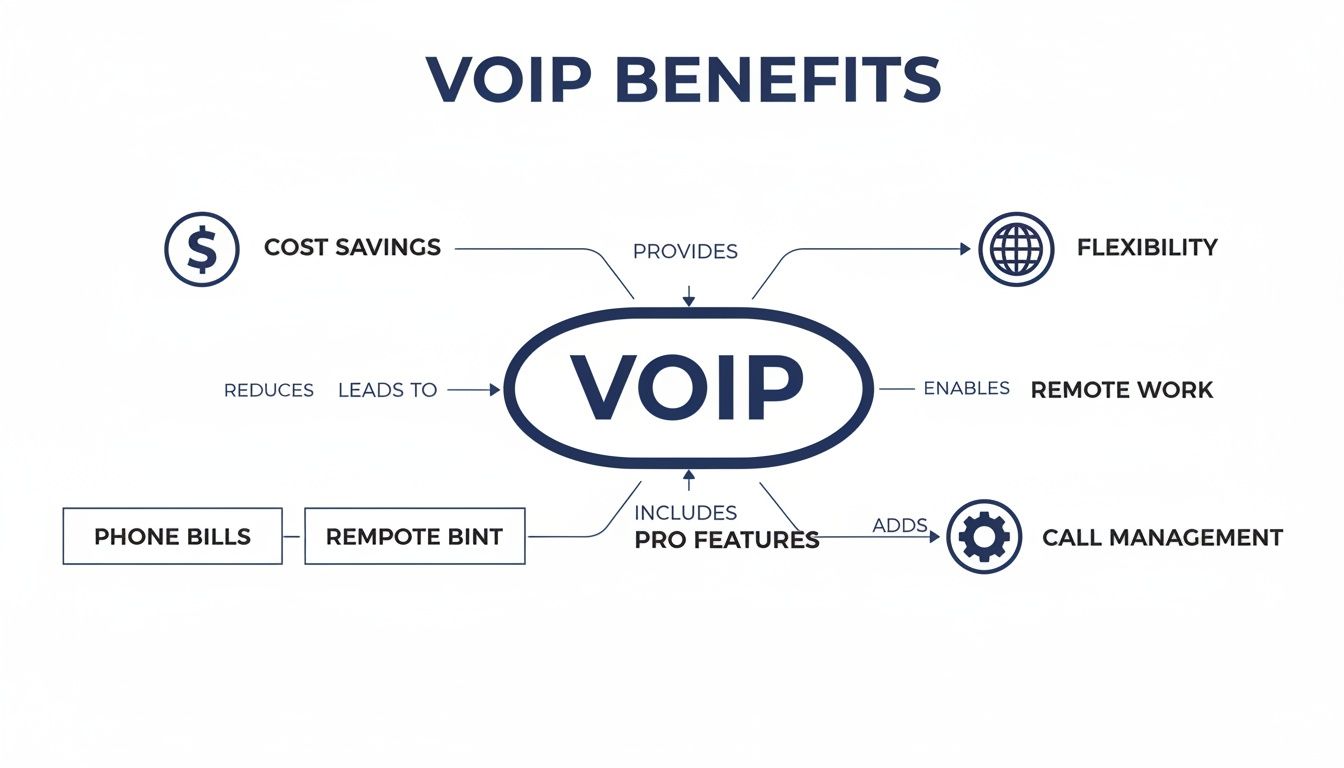
As you can see, shifting to an internet-based phone system opens the door to global flexibility, serious cost reductions, and a suite of powerful business tools.
Why This Technology Matters for Your Business
Once you understand that your calls are just another form of internet data, it becomes clear why VoIP can do so much more than a traditional phone line. Your calls can be managed, routed, and integrated in ways that were simply impossible before.
A VoIP for small businesses system isn't just a phone service; it's a software platform. This is the key shift. Moving from hardware to software is what gives you the power to control everything from auto-attendants to call analytics right from a web browser.
This software-first approach is what truly separates your phone number from a physical desk. It lets you take business calls on your mobile phone from anywhere. It also lets your phone system talk to other business software, like your CRM, which paves the way for smarter customer interactions and a truly connected workplace.
Essential VoIP Features That Power Growth

Understanding how VoIP works is one thing, but the real game-changer is what it can actually do for your business. A modern VoIP system for small businesses isn't just a phone line. It’s a powerful suite of tools designed to solve real-world problems, professionalize your customer interactions, and clear the path for growth.
These aren't complex, pricey add-ons anymore. They're built right into modern VoIP plans, turning what used to be a simple utility into a genuine strategic asset.
Let's break down the essential features that give you a serious competitive advantage.
Your 24/7 Virtual Receptionist
Imagine having a perfectly professional receptionist who answers every single call, 24/7, and instantly routes callers to the right person—even after you've all gone home. That’s exactly what an Auto Attendant (or Interactive Voice Response/IVR) does.
Instead of one phone ringing off the hook, callers are greeted with a simple, professional menu: "Press 1 for Sales, Press 2 for Support." Right away, your small business sounds bigger and more organized. More importantly, it stops calls from falling through the cracks and makes sure customers get the help they need on the first try, cutting down on frustration for everyone.
For a growing business, this one feature solves a massive operational headache, freeing your team from the constant interruption of answering and transferring calls.
The Go-Anywhere Mobile Office
One of the biggest handcuffs of an old-school phone line is being physically tethered to a desk. VoIP cuts that cord for good with advanced call routing and powerful mobile apps. This is the heart of what makes a "mobile office" possible.
Your team can make and take calls on their business line from literally anywhere, using an app on their smartphone or a softphone on their laptop. To the customer, it's completely seamless. They dial your main business number, and the call finds your employee wherever they happen to be working. This is absolutely vital for supporting remote and hybrid teams.
Key Takeaway: With mobile apps and smart routing, your business phone system follows your team. You maintain a professional presence and stay connected, whether your staff is in the office, at home, or on the road.
This kind of flexibility means you never miss that critical call just because someone stepped away from their desk.
Tools to Elevate Your Customer Experience
Modern VoIP brings powerful call center features—once reserved for huge corporations—straight to small businesses. Providers like SnapDial build these advanced tools right into their platforms to help you manage customer calls with incredible efficiency and insight.
These features are designed to slash customer wait times and dramatically improve the quality of service.
- Smart Queue Management: Instead of hitting a frustrating busy signal, callers are placed into a virtual queue. The system can play music, give an estimated wait time, or share important updates, turning a potential pain point into a managed experience.
- Queue Callback: This is a customer favorite. The system offers to save a caller's place in line and automatically call them back when an agent is free. It’s a simple feature that shows you respect your customer's time.
- Real-Time Analytics: With detailed reports, you can finally see your call volumes, peak hours, average wait times, and abandoned call rates. This data is pure gold for making smart staffing decisions and spotting where your service can get even better.
These tools empower even the smallest team to deliver a highly professional and responsive customer experience.
Read Your Voicemails on the Go
Let's be honest: dialing in to check voicemails is a slow, clunky process. You have to find a quiet place, enter a password, and listen to every message in order. Visual Voicemail and voicemail-to-email transcription change the game entirely.
VoIP systems can automatically convert voice messages into text and send them right to your email or display them in your mobile app. This means you can "read" your voicemails in the middle of a meeting, on a noisy train, or any time it’s not convenient to listen. It turns your voicemail inbox into a searchable, scannable to-do list.
This is all part of a larger move toward truly integrated communications. New data shows that for 47% of small businesses, adding services like SMS to their VoIP system is a top priority. This directly tackles a major customer service challenge, as 56% of customers will jump to another support channel if they don't get a fast response. You can dig into more insights on the importance of integrated communications in a recent VoIP statistics report. By bringing all these channels together, businesses create a much smoother and faster journey for their customers.
Calculating the Real Cost and ROI of VoIP
When you’re looking at any upgrade for your business, the bottom line is always front and center. With a VoIP for small businesses system, figuring out the true cost and return on investment (ROI) is actually a lot simpler than you might think. It’s a clean break from the confusing, nickel-and-dime world of traditional phone systems.
The old way was a mess of heavy upfront costs for an on-site PBX server, expensive installation fees, separate charges for every single phone line, and ongoing maintenance contracts. It was a capital-intensive model full of financial surprises.
Hosted VoIP completely flips this script. The most common pricing is a straightforward per-user, per-month subscription. This predictable fee wraps the service, a whole host of features, and customer support into one, turning a huge capital expense into a simple, manageable operating expense.
Breaking Down the Costs and Savings
When you move to VoIP, the financial wins show up in a few key places. The most immediate impact is the death of large, one-time bills and a sharp drop in your monthly spend. But the real value goes far beyond just the phone bill itself.
Let’s look at the primary areas where a small business can expect to see serious savings:
- Hardware and Installation: Instead of buying a pricey PBX box and paying for complicated wiring, hosted VoIP runs on cloud servers. This move alone can slash initial setup costs by as much as 90%.
- Monthly Service Fees: VoIP plans bundle your lines, long-distance calling, and all the key features into one low price. This consolidation often leads to savings of 40-60% on your monthly communication bill.
- Maintenance and Support: With a hosted solution, there's no hardware in your closet to maintain or repair. The provider handles all the updates and troubleshooting, which means no more expensive visits from a technician.
The switch to VoIP is less about buying a product and more about subscribing to a service. This fundamental shift from ownership to access is what drives down costs and simplifies your budget.
This subscription model makes your expenses predictable and easy to scale. You only pay for the users you have, and you can add or remove them with just a few clicks.
A Real-World ROI Example
To make this tangible, let’s run the numbers for a hypothetical 10-person business switching from a classic phone system to a modern VoIP solution. By calculating the potential savings over one year, you can see just how quickly the return on investment kicks in.
This table provides a conservative estimate of how the numbers might stack up for a typical small business.
Sample ROI Calculation for a 10-Person Business Switching to VoIP
| Cost Category | Traditional PBX (Annual) | Hosted VoIP (Annual) | Annual Savings |
|---|---|---|---|
| Upfront Hardware | $7,000 (prorated over 5 years) | $0 | $1,400 |
| Installation & Setup | $1,500 (one-time) | $0 | $1,500 |
| Monthly Line Rental | $4,800 ($40/line x 10 lines) | $2,400 ($20/user x 10 users) | $2,400 |
| Maintenance Contract | $1,000 | $0 | $1,000 |
| Total Annual Cost | $8,700 | $2,400 | $6,300 |
In this scenario, the business saves $6,300 in the first year alone. The ROI isn't just positive; it's immediate and substantial. For many small businesses, a system like this pays for itself in just a few months.
When you're running these figures, looking at a provider that offers an all-inclusive hosted VoIP seat can make your estimates even more straightforward.
The Hidden ROI of Productivity
While the direct cost savings are compelling, they're only part of the story. The often-overlooked ROI comes from the huge productivity gains you get from modern VoIP features. Just think about the business value of never missing a critical sales call because it was automatically routed to a team member's mobile phone.
Consider the time your team saves by reading transcribed voicemails instead of stopping their work to listen to them. Or the improved efficiency when your CRM integration pops up a caller's entire history before you even pick up the phone. These small improvements add up fast, allowing your team to focus on high-value work instead of just managing communications.
Your Step-By-Step Plan for a Smooth Switch to VoIP

Making the leap to a new phone system is exciting, but let’s be honest—the thought of the actual switch can feel a bit overwhelming. A successful move to VoIP is all about having a clear, step-by-step plan.
With the right roadmap, you can shift your communications to the cloud with almost no disruption and a whole lot of confidence. This checklist breaks the entire process down into simple, manageable stages.
Step 1: Assess Your Current Setup
Before you can move forward, you have to know exactly where you're starting from. It’s time to take inventory of your current communication tools and what they’re really costing you.
How many phone lines do you have? What’s your monthly bill look like? Most importantly, make a list of every single phone number that's critical to your business—the ones you absolutely have to keep.
This initial audit is your baseline. It helps you define what you need and gives you a concrete number to measure your cost savings against. It’s also the perfect time to pinpoint your current pain points, like constant busy signals or the inability for your team to work remotely.
Step 2: Verify Your Internet Readiness
Think of your internet connection as the foundation of your new VoIP system. Before you do anything else, you have to confirm your network can handle the voice traffic. This doesn't mean you need the most expensive plan on the market, but you do need enough bandwidth and, even more crucial, a stable connection.
A good VoIP provider can help you with this. They usually have online tools that test your network's speed, latency (the delay), and jitter (the variation in that delay). Getting a green light on this test is a non-negotiable step for a high-quality VoIP experience.
Pro Tip: Stability is far more important than raw speed. A consistent connection with low latency will give you crystal-clear calls, whereas a super-fast connection that drops out frequently will just lead to frustration.
Step 3: Plan Your Implementation
A well-thought-out plan is the secret to a zero-downtime migration. This is where you map out the whole process, from picking a provider to training your team. A great provider will guide you, but here are the key pieces you need to nail down:
- Number Porting: Decide which phone numbers you're bringing over. While the porting process is standard, it requires coordination. Your new provider does the technical work, but you'll need to give them the right account info from your old carrier.
- Feature Configuration: How do you want calls to be handled? Plan out your auto-attendant menu ("Press 1 for Sales…"), your call routing rules for different times of day, and which employees belong in specific call groups.
- Team Training: Block out a little time to walk your team through the new system. Show them how to use the mobile app, manage voicemail, and get the most out of the new features.
This structured approach is becoming the standard. Small and medium-sized businesses are now driving 45–60% of all cloud VoIP adoption, with 85% of them choosing hosted setups. The market is projected to hit $195.39 billion by 2026, which just confirms that a well-managed cloud migration is the way modern businesses operate.
Step 4: Go Live and Fine-Tune
On your go-live day, your numbers are officially switched over to your new VoIP service. A quality provider like SnapDial offers a 'white-glove' setup, which means they manage the entire migration for you to make sure everything works perfectly from the very first call.
After launch, take some time to get feedback from your team and customers. You might find you want to tweak your auto-attendant greeting or adjust a call routing rule. A huge benefit of VoIP is that these changes can be made instantly through a simple web portal, letting you constantly optimize your system.
As you think about long-term operations, looking into a guide on managed IT services for small business can give you some great ideas on how to keep everything running efficiently and cost-effectively.
Got Questions? We've Got Answers
Making the final call on a new phone system can feel like a big step. I get it. Even when the benefits seem clear, moving to a new technology always brings up a few last-minute questions.
To help you feel completely confident in your choice, we’ve put together straightforward answers to the concerns we hear most often from business owners just like yours.
Is VoIP Reliable Enough for My Business?
This is a big one, and the short answer is: yes, absolutely. Modern VoIP systems, especially from providers built for business, are often even more reliable than old-school landlines. Any worries about call quality are a relic of the past, solved by today's tech and better internet connections.
High-quality VoIP providers build their systems on a foundation of redundancy. This means they run on a network of multiple data centers. If one center has a problem, your service instantly and automatically fails over to a backup. You and your customers won't notice a thing. This creates a level of uptime that's tough for a single on-premise system to match. The only thing you need is a stable, high-speed internet connection.
Key Insight: VoIP reliability isn't just about the technology; it's also about proactive planning. Top-tier providers include features like automatic call forwarding to mobile numbers during an internet outage, ensuring you never miss a critical call. In today's market, VoIP reliability is a proven standard, not a question mark.
Think of it like having a backup generator for your phone system, but one that kicks in instantly and automatically.
What Happens to My Existing Business Phone Numbers?
Your phone numbers are a core part of your business identity, and you absolutely get to keep them. The process of moving your numbers from your old carrier to your new VoIP provider is called number porting.
It's a standardized, regulated procedure that ensures a smooth transition, and a reputable provider will handle the entire process for you. They coordinate directly with your old carrier to move the numbers over seamlessly.
From your customers' point of view, nothing changes. They keep calling the same number they've always used, but the calls are now routed through your new, more powerful system. This ensures total business continuity, so there's no need to update your website, business cards, or marketing materials. It’s your number, and it stays with you.
Can My Team Use VoIP When Working Remotely?
Absolutely—and this is one of the single biggest advantages of switching to VoIP. Because the system runs over the internet, your business phone is no longer chained to a specific desk or physical office. This is what unlocks the true "work-from-anywhere" reality.
Your team can make and receive calls on their business line from wherever they are, using a few different tools:
- Mobile Apps: A dedicated app on their smartphone (iOS or Android) turns their personal device into a full-featured business phone.
- Softphones: A software application on their laptop or desktop lets them manage calls right from their screen using a headset.
When an employee makes a call using these tools, the caller ID always shows your main business number, keeping everything professional and consistent. For any business with a remote or hybrid team, this isn't just a perk anymore; it's a core operational need.
Do I Need Special Tech Skills to Manage a VoIP System?
Not at all. This is a common myth that comes from the days of complex, on-premise PBX systems that needed a specialized technician for even a small change. Modern hosted VoIP solutions are designed from the ground up to be managed by business owners, not IT experts.
Providers like SnapDial give you a clean, intuitive web portal where you can manage every part of your phone system with a few clicks. From this online dashboard, you can:
- Add or remove users instantly.
- Change call routing rules for your auto-attendant.
- Listen to call recordings.
- View detailed call logs and analytics.
The system is designed for self-service day-to-day administration. And for the initial setup or any complex changes, a dedicated support team is there to walk you through it. The whole idea is to simplify your communications so you can focus on running your business, not becoming a phone system guru.
Ready to see how a modern phone system can transform your business communications? The team at SnapDial offers a completely managed, white-glove setup to ensure a seamless transition with zero downtime. Explore our all-inclusive VoIP plans and discover how easy it is to upgrade your business phone system today.