
For businesses in Dallas, the best VoIP phone systems aren't just about a dial tone. They're about finding a partner that delivers a powerhouse combination of enterprise-grade features, predictable pricing, and local Texas-based support. The right solution is a complete communications platform that actually helps you grow, makes customer interactions better, and gives your remote or hybrid teams the flexibility they need.
How to Choose the Right VoIP Phone System in Dallas

Making the jump from an old-school PBX to a modern VoIP phone system is a critical move for any Dallas business that wants to be more agile and scalable. This decision directly impacts how well your company connects with customers. The right partner isn't just selling you technology; they're providing the foundation for how you communicate.
This guide cuts through the noise with a clear, data-driven comparison of VoIP systems specifically for the Dallas market. We'll go beyond generic feature lists to look at the providers and solutions that truly meet the demands of local companies. Our focus is on the criteria that actually matter to your bottom line.
Key Evaluation Criteria for Dallas Businesses
When you start looking at different VoIP systems, you need to understand the nuances between what providers offer. It's not just about finding a phone line; it's about evaluating a whole new set of tools for business communication, including these company phone alternatives. We're talking about tricky pricing models, the real-world value of having Texas-based support, and how to plan a migration that doesn't cause a headache.
Here's a quick look at what you should be comparing:
| Criteria | Why It Matters for Dallas Businesses | What to Look For |
|---|---|---|
| Local Support | Getting direct access to Texas-based experts who know the local business climate means you get problems solved faster and more effectively. | 24/7 availability, a direct line to knowledgeable Tier 2/3 support, and a real local presence. |
| Pricing Model | Predictable, all-inclusive pricing stops you from getting hit with surprise fees for essential tools like call recording or an auto-attendant. | A single per-user/per-month fee that includes everything you need, not a confusing à la carte menu. |
| Scalability | Your phone system has to grow with you, whether you're hiring more people in Dallas or opening a new branch in Fort Worth. | Simple user management you can handle yourself from a web portal and the ability to add lines without a technical ordeal. |
Whether you're a startup needing an affordable phone solution or a larger company that requires advanced unified communications, this guide will give you the insights to pick a true long-term communications partner. For a deeper dive, check out our guide on selecting the best IP phone system.
Comparing The Top VoIP Providers For Dallas Businesses
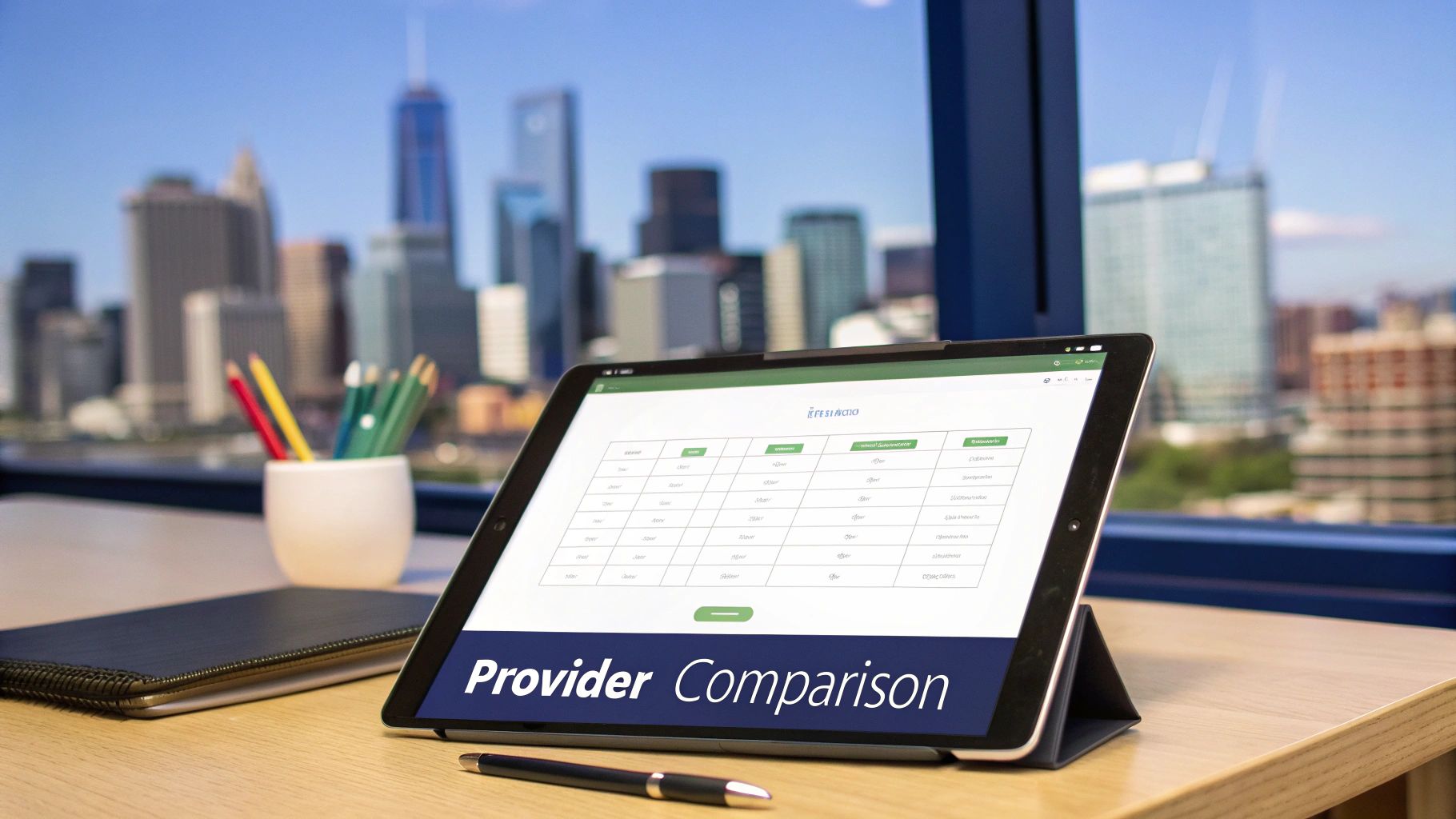
Choosing the right VoIP phone system in Dallas isn't just about comparing the monthly cost per user. It’s about finding a partner whose service actually fits how you operate, what your customers expect, and where your business is headed. That means taking a hard look at the providers serving the DFW area, from the national giants to local specialists like us here at SnapDial.
To make a smart decision, you have to look past the sales pitch and evaluate providers on the things that really impact your day-to-day business in Dallas. We're going to break it down across four key areas: local support, pricing transparency, scalability, and the core features you can't live without. This is where you find out who’s truly set up to help you succeed.
VoIP Provider Comparison for Dallas Businesses
When you’re weighing your options, the details matter. This table cuts through the marketing noise to show how a local, all-inclusive provider stacks up against the typical national players on the criteria that are most critical for a Dallas-based business.
| Decision Criteria | SnapDial | National Provider A | National Provider B |
|---|---|---|---|
| Support Model | Texas-based team, direct access | Massive national call center, tiered support | Offshore/dispersed call centers, ticket system |
| Pricing Structure | All-inclusive, predictable flat fee | À la carte, base fee + multiple add-ons | Tiered plans, essential features cost extra |
| Setup & Onboarding | White-glove setup included | DIY setup with online guides, paid support | Self-service portal, professional setup is a separate fee |
| SLA & Uptime | 99.999% uptime guarantee | Standard 99.9% uptime | Varies by plan, premium SLA is an add-on |
| Core Features | All included (AI transcription, call recording) | Basic features standard, advanced tools extra | Features locked behind higher-priced tiers |
| Scalability | Instant user changes via self-service portal | User changes can take 24-48 hours | Self-service, but features may require plan upgrade |
This side-by-side view makes it clear: the choice isn't just about features, it's about the entire service model. For a Dallas business, having a partner who bundles everything with local, expert support often delivers far more value than a low entry price from a national brand that comes with hidden costs and support headaches.
Local Support vs. National Call Centers
The first—and arguably most critical—difference shows up the moment something goes wrong: support. The big national providers route you through massive call centers spread across the country or even the globe. Sure, they’re available 24/7, but you'll likely face long hold times, frustrating phone trees, and agents who are just reading from a script.
A provider with a dedicated, Texas-based support center like SnapDial offers a completely different experience. Our technicians know the local business landscape and can get to the root of a problem faster. You get direct access to an expert who can actually solve your issue, which means less downtime for your business.
For a Dallas-based business, having a support team in the same time zone who understands local network conditions isn't a luxury—it's a core operational benefit that minimizes disruption and ensures business continuity.
This local expertise is invaluable, especially during setup and migration. Instead of getting a one-size-fits-all solution, you get guidance that’s tailored to the reality of running a company in North Texas.
Pricing Models: All-Inclusive vs. À La Carte
Pricing is another area where philosophies clash. Many of the giant VoIP companies will lure you in with a low sticker price, but they operate on a complex à la carte model. Suddenly, essential tools like call recording, AI transcription, or even a professional auto-attendant are extra monthly fees. Your bill quickly balloons, making your costs completely unpredictable.
An all-inclusive pricing model, on the other hand, gives you clarity. Providers like SnapDial bundle every core and advanced feature into a single, flat per-user fee. This straightforward approach means you get access to the entire toolkit from day one without ever worrying about hidden charges or confusing feature tiers.
This model makes budgeting simple and empowers your team to use the system to its fullest. To see a deeper dive into how these structures compare, check out our complete business phone systems comparison.
Scalability and Core Feature Sets
As your business grows, your communication needs will change. A scalable VoIP system should let you add new users, locations, and phone lines instantly through a simple web portal—no technical overhaul required. This ease of administration is what really separates modern systems from clunky, outdated ones.
The core feature set is just as important. Most providers will give you the basics like voicemail and call forwarding, but the real difference is in the quality and inclusion of advanced tools.
- Unlimited Lines: This is a big one. It prevents busy signals for your customers, making sure every single call gets through.
- Call Recording: Absolutely crucial for training, quality assurance, and settling any disputes.
- AI-Powered Voicemail Transcription: Lets your team read voicemails in their email or app, which is a massive time-saver and improves how quickly you can respond.
- Mobile App Functionality: Turns any employee's smartphone into a secure business line, enabling true work-from-anywhere flexibility.
The move toward these platforms is undeniable. The global VoIP services market was valued at $132.47 billion in 2023 and is projected to hit $326.27 billion by 2032, showing just how heavily businesses are investing in modern communications.
Ultimately, the best VoIP phone systems Dallas providers give you a powerful mix of robust features, transparent pricing, and expert support that understands the local market.
Finding the Right VoIP Solution for Your Dallas Business
The best VoIP phone system for a Dallas business is never a one-size-fits-all product. It’s a solution that has to line up perfectly with how you operate, what your customers expect, and where you plan to grow. A feature that’s a minor convenience for one company can be a complete game-changer for another.
Figuring out your business model is the first step toward picking a system that delivers a real return. Below, we’ll break down our recommendations for common Dallas business types, showing how specific VoIP features solve real-world problems and make your team more efficient.
For Small and Mid-Sized Businesses (SMBs)
For most Dallas SMBs, it’s all about projecting a professional image and making every dollar count. Your phone system has to be affordable, reliable, and powerful enough to let you compete with the big guys—without needing a dedicated IT team to keep it running.
This is where features that automate and simplify your workflow provide huge value. An SMB can't afford to have staff tied up manually directing calls or miss a big opportunity because someone stepped away from their desk.
Key Features for SMB Success:
- Professional Auto-Attendant: This is your digital receptionist, greeting every caller professionally and getting them to the right person or department. It guarantees you never miss a lead and instantly gives your small business the polished feel of a much larger organization.
- Mobile App Integration: With a mobile app, your business line goes wherever you do. Team members can make and receive calls from their business number on their personal smartphones, keeping work and personal life separate while staying connected from anywhere in the DFW metroplex.
- Visual Voicemail & Transcription: Reading voicemails as emails or texts is a massive time-saver. This feature allows for faster responses to customers and makes it simple to forward important messages to the right team member without them ever having to dial into a voicemail box.
For a Dallas SMB, the strategic advantage comes from using enterprise-grade tools on a small business budget. Features like an auto-attendant and mobile app don't just add convenience; they create a more responsive and professional customer experience that builds trust and loyalty.
For Multi-Location Enterprises
When your business operates across multiple locations—whether in different Dallas neighborhoods or across Texas—communication consistency is everything. The real challenge is making every office feel like part of a single, unified organization, both for your employees and your customers.
A modern VoIP system erases those geographical lines. It brings all your locations under one centrally managed communication network, making collaboration between offices as simple as if everyone were in the same building.
Essential Tools for Unified Operations:
- Seamless Extension Dialing: An employee in your Plano office should be able to dial a simple 4-digit extension to reach a colleague in your downtown Dallas headquarters. This small feature removes the friction of dialing full phone numbers and encourages more frequent, fluid communication between teams.
- Unified Company Directory: A shared directory, accessible from any desk phone or mobile app, ensures everyone can find the right contact information in seconds. This simple tool breaks down communication silos and eliminates wasted time hunting for numbers.
- Centralized System Administration: Your IT manager can add new users, change call routing rules, and manage settings for every single location from one web-based portal. This dramatically cuts down on administrative work and ensures consistent policies across the entire company.
For High-Volume Contact Centers
In a contact center, every second counts. Your phone system is the heart of your operation, directly impacting agent productivity, customer happiness, and, ultimately, your bottom line. Standard calling features just won't cut it; you need specialized tools designed for managing a high volume of calls.
The advanced VoIP phone systems Dallas contact centers rely on are built to optimize call flows and provide deep insights into performance. These aren't just communication tools—they are data-driven platforms for improving how you deliver service. It’s no surprise the corporate world is all-in on this tech, with business VoIP services forecasted to grow from $162.4 billion in 2023 to $508.7 billion by 2030. Read the full analysis of the VoIP market growth on ResearchAndMarkets.com.
Mission-Critical Contact Center Features:
- Intelligent Call Queues: Go beyond simple "first-in, first-out" routing. Use skills-based routing to send callers to the agent best qualified to handle their specific issue, which is proven to improve first-call resolution rates.
- Real-Time Analytics Dashboards: Supervisors need to see what's happening right now. Live dashboards show call volumes, agent availability, and wait times, allowing for immediate adjustments to staffing and resources to meet demand.
- Automated Queue Callback: This feature is a game-changer. It offers callers the option to get a callback when an agent is free instead of waiting on hold. It dramatically improves the customer experience and cuts down on call abandonment rates, a critical metric for any contact center.
Why Texas-Based Support is a Real Competitive Advantage
When your phone system is the lifeblood of your business, the quality of technical support isn't just a feature—it's a critical business function. For any company in Dallas, the difference between getting a local Texas-based expert on the line and navigating a massive national call center can be the difference between a minor hiccup and a full-blown, costly outage.
Choosing a VoIP provider with dedicated technicians right here in Texas isn't just about hearing a familiar accent. It's about getting faster, smarter solutions when the pressure is on.
The Value of Local Expertise
The biggest and most immediate advantage is speed. A local support team means you bypass the soul-crushing phone trees and automated systems, connecting you straight to an expert who can actually solve your problem on the first call. These technicians live and breathe the local business climate and know the specific network conditions in the DFW area.
That local context is more important than you might think. A support agent halfway around the world won't have a clue about a local fiber cut or a regional power issue that could be affecting your service. A Texas-based expert does, which translates to quicker diagnostics and more accurate fixes.
For any Dallas company looking at VoIP phone systems, having direct access to local, knowledgeable technicians provides incredible operational peace of mind. It guarantees that when an issue pops up, it gets handled fast, protecting your downtime and your customer relationships.
Contrast that with the all-too-common frustrations of large, outsourced call centers, which often create bottlenecks. The usual pain points include:
- Tiered Support Delays: You’re forced to start with a Level 1 agent reading from a script and have to fight your way up the chain to talk to someone with real technical know-how.
- Communication Hurdles: Language barriers and time zone differences can turn a simple troubleshooting session into a drawn-out, confusing ordeal.
- Zero Accountability: With a huge, anonymous support pool, it's nearly impossible to find one person who will take ownership of your problem from start to finish.
A Mature Market Demands Better Service
The North American market is the most established region for VoIP, which means businesses here are operating in a fiercely competitive environment. This maturity shows in how deeply the technology is woven into our daily work; a staggering 74% of employees now use mobile VoIP apps for business calls.
As a leader in this space, Dallas businesses should demand a higher standard of service. This is where a provider with 24/7, US-based support becomes a genuine competitive edge. It’s a guarantee that no matter when trouble strikes, you can reach an expert who will get you back up and running, protecting both your revenue and your reputation. You can dig into more VoIP statistics and trends to see just how fast the market is moving.
A Practical Plan for Migrating to Your New VoIP System
Switching to a new phone system should feel like an upgrade that empowers your business, not a disruptive headache. A successful move to VoIP is all about smart planning and careful execution. This checklist breaks the process down into three manageable phases to ensure a smooth, confident transition with zero downtime for your Dallas operations.
The real key to a seamless switch is what happens before a single phone gets unplugged. This pre-migration phase is where you lay the groundwork for success and head off common problems before they even start. It's about auditing what you have now and making sure your network is ready for the crystal-clear call quality modern VoIP delivers.
Pre-Migration: The Network Audit and Prep Work
Before you dive in, taking a hard look at your current network is non-negotiable. VoIP systems depend on a stable internet connection to perform at their best. You need to start by making sure your internet bandwidth can comfortably handle all your existing data traffic plus the new voice traffic.
A professional provider will help you run this audit, but here are the key steps involved:
- Bandwidth Verification: Check your current internet speed and see how it stacks up against the provider's recommendations. For most businesses, a dedicated, business-grade fiber connection is the way to go.
- Network Hardware Check: Make sure your routers, switches, and cabling are modern enough to support Quality of Service (QoS). This is a crucial feature that prioritizes voice traffic to prevent annoying jitter and dropped calls.
- IT Asset Inventory: Catalog all your existing telecom hardware. As you plan your move to a new VoIP system, you should think about the secure and compliant disposal of any outdated equipment through professional IT Asset Disposition Services.
This diagram shows the direct path to getting issues solved when you have a Texas-based support model backing you up.
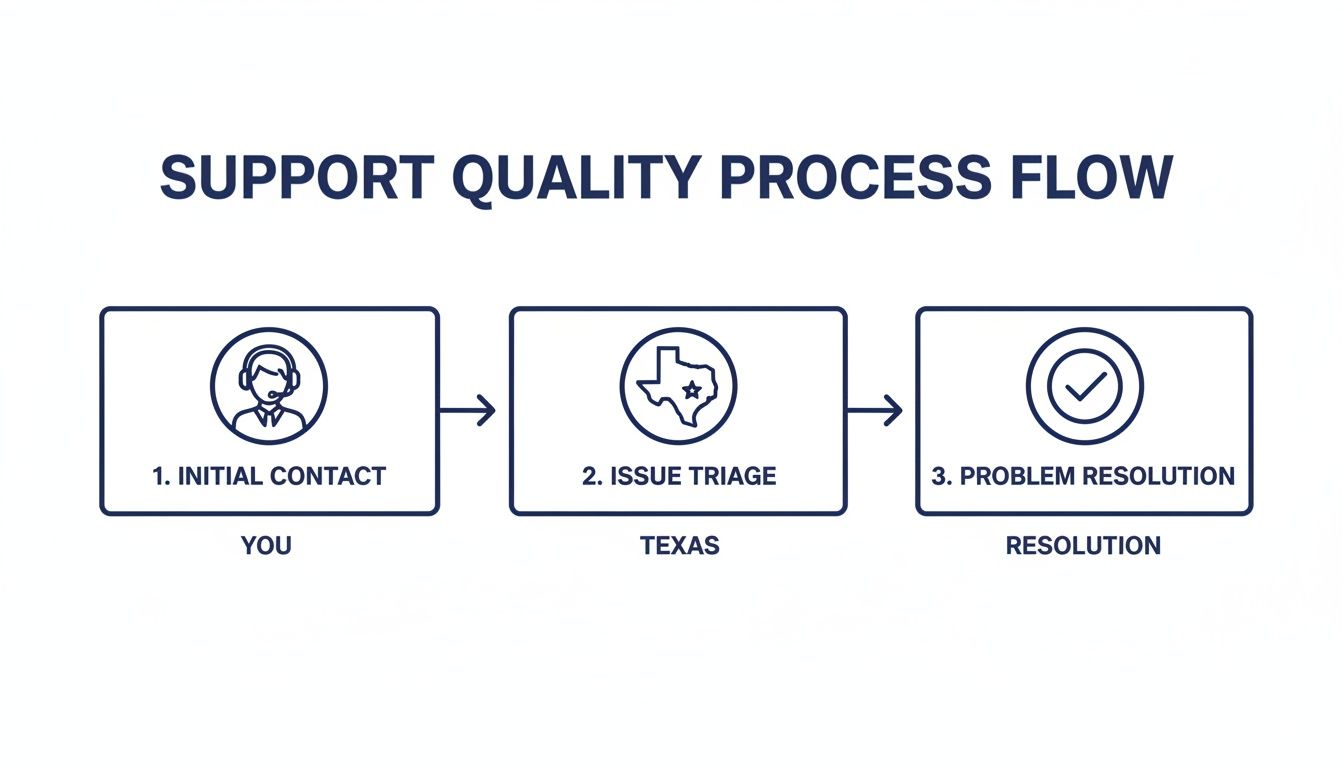
As you can see, local expertise cuts out the middleman, moving you straight from your initial contact to a fast resolution.
Implementation: The Go-Live Execution
With the prep work done, it's time for the implementation phase. This is where a provider offering a "white-glove" setup process really proves its worth. Instead of just shipping you a box of phones and a link to a help guide, a dedicated team handles all the technical heavy lifting for you.
A provider-led, white-glove setup is the single most effective way to guarantee zero downtime during your transition. It shifts the technical burden from your team to the experts, allowing you to focus on running your business.
Your provider will meticulously handle the core steps of this phase:
- Number Porting Management: Your provider will kick off and manage the entire process of transferring your existing Dallas business phone numbers to the new system. It's a carefully coordinated effort to make sure you don't miss a single call.
- IP Phone Deployment: New, pre-configured IP phones are installed at every desk. The provider makes sure each device is connected, tested, and ready for your team to use.
- User Training Session: Before the system goes live, a training session gets your staff comfortable with the new phones, the mobile app, and the self-service web portal. This step is critical for getting everyone on board and productive right away.
Post-Migration: Optimization and Training
Your migration doesn't end the moment the phones start ringing. The post-launch phase is all about fine-tuning the system to be a perfect match for your business workflows and empowering your team to get the most out of their new communication tools. The right Voip phone systems Dallas providers will stick with you to make sure you’re getting maximum value.
This final stage involves a few key activities:
- Optimizing Call Flows: Work with your provider to adjust the auto-attendant menu and call routing rules based on how calls are coming in. This ensures callers get to the right person as efficiently as possible.
- Admin Portal Training: Pick someone on your team to become an expert on the self-service admin portal. This empowers you to make minor changes—like adding a new employee or adjusting business hours—instantly, without needing to contact support.
- Feature Adoption: Encourage your team to explore the more advanced features. For instance, you can show them how the mobile app keeps them connected on the go or how voicemail-to-email transcription can save them a ton of time.
A well-planned migration transforms what could be a complex technical project into a smooth enhancement for your business. To learn more about the technology behind these systems, you might be interested in our guide to cloud-based VoIP phone systems.
Got Questions About Dallas VoIP Systems? We've Got Answers.
As you start seriously looking at the VoIP phone systems Dallas has to offer, a few key questions almost always bubble to the surface. Getting clear, straightforward answers is what separates a confident decision from a shot in the dark.
This section tackles the most common concerns we hear from Dallas business owners who are thinking about moving to a modern communications platform. Let's cut through the noise and get right to it.
How Much Can Our Business Actually Save by Switching to VoIP?
This is usually the first question, and for good reason. The most compelling driver for the switch is the significant cost reduction. Most businesses we work with see savings between 40-60% on their monthly phone bills compared to their old-school landlines.
These savings aren't just from one place. You get to ditch expensive hardware maintenance contracts, you get unlimited nationwide calling baked in, and you consolidate everything into one predictable monthly bill. An all-inclusive provider also gets rid of those surprise add-on fees for essentials like call recording or an auto-attendant—things legacy systems are notorious for nickel-and-diming you on.
Can We Keep Our Existing Business Phone Numbers?
Yes, absolutely. You don't have to give up the numbers your customers already know. The process is called number porting, and it's a standard, federally regulated procedure that guarantees you can take your numbers with you to a new provider.
Your chosen VoIP partner will manage the entire porting process from start to finish. It’s handled carefully behind the scenes to ensure all your local Dallas and toll-free numbers move over smoothly, without any service interruption. This continuity is non-negotiable for maintaining your brand and making sure customers can always reach you.
For any Dallas business, keeping your established phone numbers is a deal-breaker. A reliable VoIP partner makes this a seamless, background process, guaranteeing zero disruption to your customer communications during the switch.
What’s the Backup Plan if Our Office Internet Goes Down?
Modern VoIP systems are built for exactly this scenario. If the primary internet connection at your Dallas office goes down, your phone system doesn't have to. It's all about business continuity.
Calls can be automatically and instantly rerouted to predetermined backup destinations, ensuring you never miss a critical call. These failover routes can include:
- Employees' mobile phones
- An alternate office location or branch
- A specialized voicemail box with a custom "outage" greeting
Plus, with a powerful mobile app, your team can keep making and receiving calls on their business line using their smartphone's cellular data. This means that even during a local internet outage, it’s business as usual for your customer-facing communications.
Ready to see how a modern, all-inclusive communication platform can support your Dallas business? The team at SnapDial offers a complete, white-glove solution with 24/7 Texas-based support. Explore SnapDial's features and get a personalized quote today!