
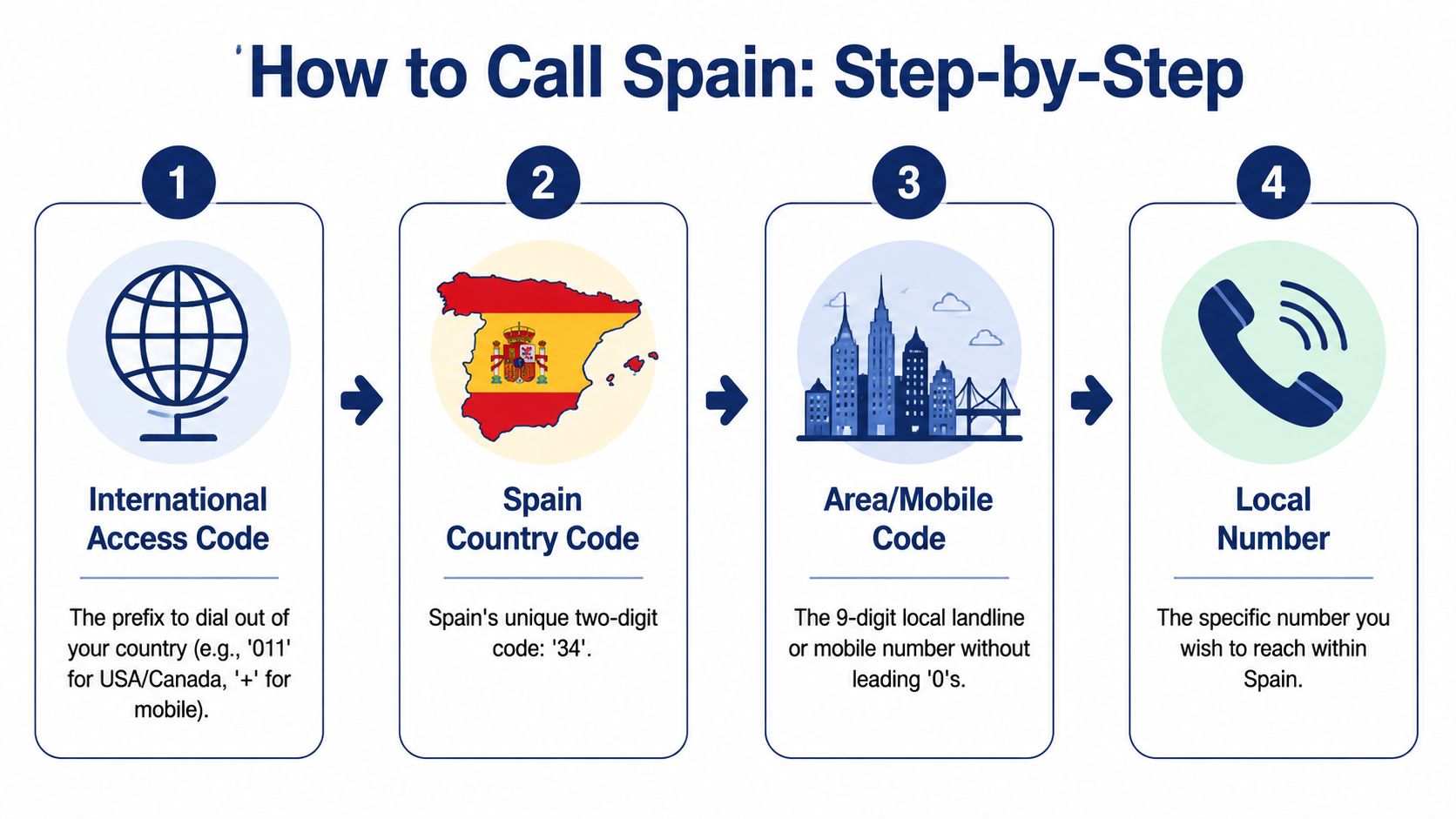
Dial 011, then 34, then the 9-digit Spanish phone number. If you're calling from a mobile or VoIP app, use +34 followed by the same 9-digit number.
That gets the call started. But if you're calling Spain for business, the dialing string is the easy part. The harder part is making sure the call connects, sounds professional, and doesn't turn into a recurring cost problem for your team.
A lot of business owners end up in the same spot. They need to reach a supplier in Madrid, a customer in Barcelona, or a remote teammate somewhere else in Spain. The number looks simple enough, yet the call fails, quality is inconsistent, or nobody answers because the timing was wrong. When that happens repeatedly, it stops being a minor annoyance and starts affecting sales, service, and credibility.
Connecting Your Business to Spain
If your company needs to call Spain regularly, you need more than the number format. You need a calling process that your team can repeat without mistakes, across desk phones, mobile apps, and whatever system your office already uses.
That matters even more for companies with traveling staff, hybrid teams, or regional managers who place calls from different devices and networks. If your operation depends on global business connectivity, consistency matters just as much as the first successful call.
The simplest rule is this:
- From the US landline network: dial 011 + 34 + the 9-digit Spanish number
- From mobile or VoIP systems: dial +34 + the 9-digit Spanish number
- For business use: standardize one format across your team so people don't improvise
A lot of avoidable problems come from letting every employee handle international dialing differently. One person stores numbers with 011, another uses +34, another copies a local Spanish format from an email signature, and someone else adds digits that don't belong. The result is wasted time and avoidable failed calls.
For businesses replacing older phone setups, this becomes part of a bigger communications decision. International calling works best when your phone system treats Spain like a normal destination, not a one-off exception. If your team is already reviewing broader phone infrastructure, it helps to look at options for global phone services for business instead of patching together international calling one call at a time.
Good international calling isn't just about reaching Spain. It's about making the process easy enough that nobody on your team has to think twice before placing the call.
The International Dialing Format for Spain
Calling Spain is straightforward once you understand the structure. Spain uses the country code 34, and the number you dial after that is a 9-digit national number.
Start with the exit code or plus sign
From the United States, the international exit code is 011. So if you're dialing from a traditional US line, the sequence starts there.
If you're using a mobile phone, softphone, or business VoIP platform, use the + symbol instead. That's usually the cleaner format because the system handles the country routing automatically.
According to Telnyx's Spain calling guide, the correct US format is 011-34-91-XXX-XXXX for a Madrid landline or 011-34-6XX-XXX-XXX for a Spanish mobile, and around 15% of failed international calls come from incorrectly including domestic trunk prefixes.
Universal format: +34XXXXXXXXX
That's the format your business should save in your CRM, call lists, and shared contact directories.
Know what comes after 34
After Spain's country code, you dial the full 9-digit Spanish number.
For landlines, the opening digits indicate the region. Common examples include:
- Madrid: 91
- Barcelona: 93
For mobiles, the number starts with 6 or 7.
Here are practical examples your team can copy:
| Call type | Format to use from the US | Format to save in VoIP or mobile |
|---|---|---|
| Madrid landline | 011-34-91-1234567 | +34911234567 |
| Barcelona landline | 011-34-93-1234567 | +34931234567 |
| Spanish mobile | 011-34-612345678 | +34612345678 |
What UK callers should do
If someone on your team is dialing from the UK, the principle stays the same. Use the UK international prefix, then Spain's country code, then the full 9-digit number.
- From the UK: 00-34-91-1234567
- From UK mobile or VoIP: +34911234567
That's why E.164 format is the safest standard for business systems. It removes country-by-country guesswork and gives your phone platform one clean number format to route.
The mistake that breaks good numbers
The number may look wrong if you're used to domestic calling habits. That's where people trip up. They see a Spanish number written locally and add extra digits out of habit.
Don't do that.
- Don't add a leading 0
- Don't insert an extra domestic trunk prefix
- Don't shorten the number because it “looks too long”
If your business saves Spanish numbers in +34 format from the start, you remove most of the dialing errors before they happen.
For teams that call Spain often, this isn't just a formatting preference. It's an operations rule.
Upgrade Your Spanish Calls with Business VoIP
Traditional international calling still causes problems for a lot of companies because the phone system treats overseas calls as an exception. That usually shows up in two ways. Calls cost more than expected, and quality gets worse when your team needs it most.
Business VoIP fixes that when it's configured properly. It gives your staff one calling environment across desk phones, laptops, and mobile devices, instead of a mix of carrier lines, personal cell phones, and ad hoc workarounds.
Why business users run into trouble
A consumer-style guide tells you what digits to dial. It usually doesn't tell you why a business system fails after the number is entered correctly.
That gap matters. According to Vonage's guidance on calling Spain from the U.S., businesses using standard landlines often miss critical VoIP configurations, which can lead to 20-30% call failure rates on international routes. The same source notes that 45% of multi-location businesses report international call drops as a key pain point.
Those aren't abstract telecom problems. They show up as missed sales calls, support delays, and awkward follow-ups that make your company look disorganized.
What works better in practice
A business-ready cloud phone system usually solves the problems that older setups create:
- Centralized routing: your team places calls from one system instead of juggling office lines and personal phones
- Consistent number formatting: shared directories can store Spain contacts in +34 format
- Call records in one place: supervisors can verify whether calls were attempted, answered, or missed
- Mobile continuity: staff can place business calls to Spain without exposing personal numbers
If your team needs a practical primer on the underlying technology, AONMeetings on internet calling gives a useful overview of how VoIP works in day-to-day business communication.
What to ask before you rely on a phone system for Spain
If I were reviewing a phone setup for international business use, I'd look for operational basics before I worried about fancy features.
Can users dial in +34 format without workarounds?
If not, your system will create unnecessary confusion.Are call logs easy to audit?
When a client says they never got your call, your team needs a clear record.Can staff call from desktop and mobile with the same business identity?
That matters for traveling managers and remote employees.Is international routing handled for you, or left to internal guesswork?
If your office has to troubleshoot every overseas route manually, you'll keep paying in staff time.
For many companies, the shift to a hosted system starts with basics like getting a VoIP phone number for business use and standardizing how calls are placed across the organization.
A reliable Spain calling setup should feel boring. Staff should open the app, click the contact, and talk. If international calling needs tribal knowledge, the system is the problem.
Navigating Spanish Time Zones and Business Etiquette
You can dial the number perfectly and still have a bad outcome if you call at the wrong time. Spain runs on CET and CEST, and the practical takeaway for US callers is simple: Spain is well ahead of the US workday.

A simple scheduling cheat sheet
When you're calling from the US, think in overlap windows rather than raw time difference. The best business calls usually happen when the recipient is clearly into the workday, but not at lunch and not during the evening wind-down.
| US time zone | What it means for Spain |
|---|---|
| Eastern | Spain is ahead, so your morning often reaches their afternoon |
| Central | Early US calls usually hit Spain later in the business day |
| Pacific | Your business morning can be close to Spain's evening |
The practical issue isn't only the clock. Spanish business culture often includes a longer midday break than many US teams expect. If you call during the middle of the day in Spain, you may get voicemail, a rushed answer, or no answer at all.
A better habit is to test two windows: late US morning for same-day conversations, or earlier US morning if you want to catch Spain before the local afternoon slows down.
Phone etiquette that helps, not hurts
The first few seconds of the call matter. Even if the other person speaks English, a courteous opening helps.
Use simple phrases naturally:
- Buenos días if it's morning in Spain
- Buenas tardes if it's later in the day
- Señor or Señora with a surname when the relationship is formal
If your team regularly works across borders, these effective cross-cultural communication tips are useful for setting expectations around tone, pace, and formality.
Keep your speaking pace steady. Don't jump straight into a hard ask. On business calls with Spain, rapport still matters.
A short overview can help your team hear how everyday Spanish phone interactions sound in context:
A well-timed call beats a technically perfect call placed at the wrong hour.
Common International Calling Errors to Avoid
Most failed calls to Spain aren't mysterious. They come from habits people learned for domestic dialing and never unlearned for international numbers.
That's why businesses should treat formatting as a policy, not a suggestion. If your staff enters numbers differently, your failure rate goes up even when everyone thinks they're doing the right thing.
The biggest rookie mistake
Spain changed its numbering structure years ago, and that change still matters now. As explained in Zadarma's overview of Spain's numbering plan, Spain unified its system in 1998, making landline and mobile numbers a consistent 9-digit format after +34 and affecting over 18 million lines. For international callers, that means you should never add a leading 0 or old city trunk code after +34.
That old instinct is exactly what breaks valid numbers.
A quick troubleshooting checklist
If a call to Spain fails, check these before you blame the carrier:
- Extra zero added: if the stored number includes a leading 0 after +34, remove it
- Wrong format saved: convert contacts to full international format instead of local display format
- Mixed contact standards: one user saves 011 format, another saves +34, another saves local notation
- Landline confusion: staff may not recognize that numbers beginning with 6 or 7 are mobiles
- Copy-paste errors: email signatures and websites sometimes display numbers in a way that isn't ideal for direct dialing
What businesses should standardize
The fix is operational, not technical.
Create one rule for everyone:
- Save all Spanish numbers in +34XXXXXXXXX
- Keep that format in your CRM, phone directory, and shared spreadsheets
- Train front-office staff and sales reps not to “correct” numbers manually
- Test a few live contacts before rolling the format out across the team
When an international number fails, the first thing to suspect is formatting, not the person you're calling.
This is one of those small process decisions that saves a surprising amount of time.
Make Every Call to Spain Count
The answer to how to call spain is simple. Dial 011 + 34 + the 9-digit Spanish number, or use +34 on mobile and VoIP systems. The business advantage comes from everything around that sequence.
Companies get better results when they do three things well:
- Store numbers correctly so staff stops introducing formatting errors
- Call at smart times so good contacts don't turn into missed connections
- Use a business phone setup built for international work so overseas calls don't feel like a workaround
If your team still relies on scattered devices, personal mobiles, or inconsistent office lines, Spain is usually where those weaknesses start to show. One person gets through. Another doesn't. A manager calls from the road and the recipient sees the wrong number. Support can't verify whether a client was contacted.
That's why international calling should be part of a broader communications decision. A system that handles Spain well will usually handle the rest of your global calling needs well too. If your business is evaluating how to make inbound and outbound calling easier to manage, it's also worth reviewing options like a business toll-free number as part of a cleaner overall phone strategy.
The goal isn't memorizing country code 34. It's making every overseas call feel routine, professional, and easy for your team to manage.
If you're ready to replace patchwork international calling with a cleaner business phone setup, SnapDial is built for companies that need reliable cloud calling, mobile-ready access, and predictable administration without legacy PBX friction. It's a practical fit for teams that want international communication to work the same way every time.