Your team has the contact. The customer is waiting. The French office number looks correct in the CRM. Then the call fails, or worse, your PBX mangles the number unnoticed and sends it nowhere useful.
That usually starts with a basic misunderstanding. Country code 33 is France. The part that trips up businesses isn't identifying the code. It's handling the French number correctly when humans, CRMs, SIP trunks, mobile apps, and call routing rules all touch it in different formats.
If you call France often, support French clients, or run a multi-location phone system, country code 33 isn't just a dialing fact. It's a formatting rule that affects call completion, caller ID matching, and how your cloud phone system should normalize numbers.
What is Country Code 33
A failed call to France often starts with a number that looks right in the CRM but is stored in the wrong format for your phone system. Country code 33 is the international dialing code for France, and it tells carriers and VoIP platforms that the call should route to the French numbering space.

The business problem is not recognizing 33. The problem is using it consistently across hand-dialed calls, imported contact lists, softphones, and PBX normalization rules.
For example, a French number may be written locally as 01 23 45 67 89. That version is for domestic use inside France. From outside France, the call must be formatted with +33 and without the leading 0. If your CRM stores one version, your users dial another, and your PBX expects a third, call routing errors show up fast.
Country code 33 affects three operational areas:
- User dialing behavior: Staff calling from abroad need the correct international format.
- Contact normalization: CRM and directory records should use one standard, ideally E.164.
- PBX and VoIP logic: Dial plans must strip, add, or preserve digits predictably so French numbers route correctly every time.
I have seen teams train users to dial France properly but leave number formatting uncontrolled in the rest of the stack. That usually works until click-to-call, mobile apps, call recording tools, or multiple carriers enter the mix. At that point, inconsistent French number formatting stops being a minor annoyance and starts causing missed sales calls, broken caller ID matching, and support delays.
Practical rule: If your business calls France regularly, treat country code 33 as a configuration and data standard issue, not just a fact for end users to memorize.
That is why businesses reviewing global phone services for business teams should check how the platform handles French number normalization before rollout. A phone system that stores numbers cleanly and rewrites them correctly will prevent many of the avoidable failures that show up later in production.
Understanding the French Numbering Plan
French number handling usually breaks before the call ever reaches the carrier. A sales rep copies 01 23 45 67 89 from an email signature, saves it in the CRM exactly as written, and the cloud PBX later sends that domestic format through an international route. The result is predictable. Pattern match fails, caller ID matching breaks, or the trunk rejects the call.
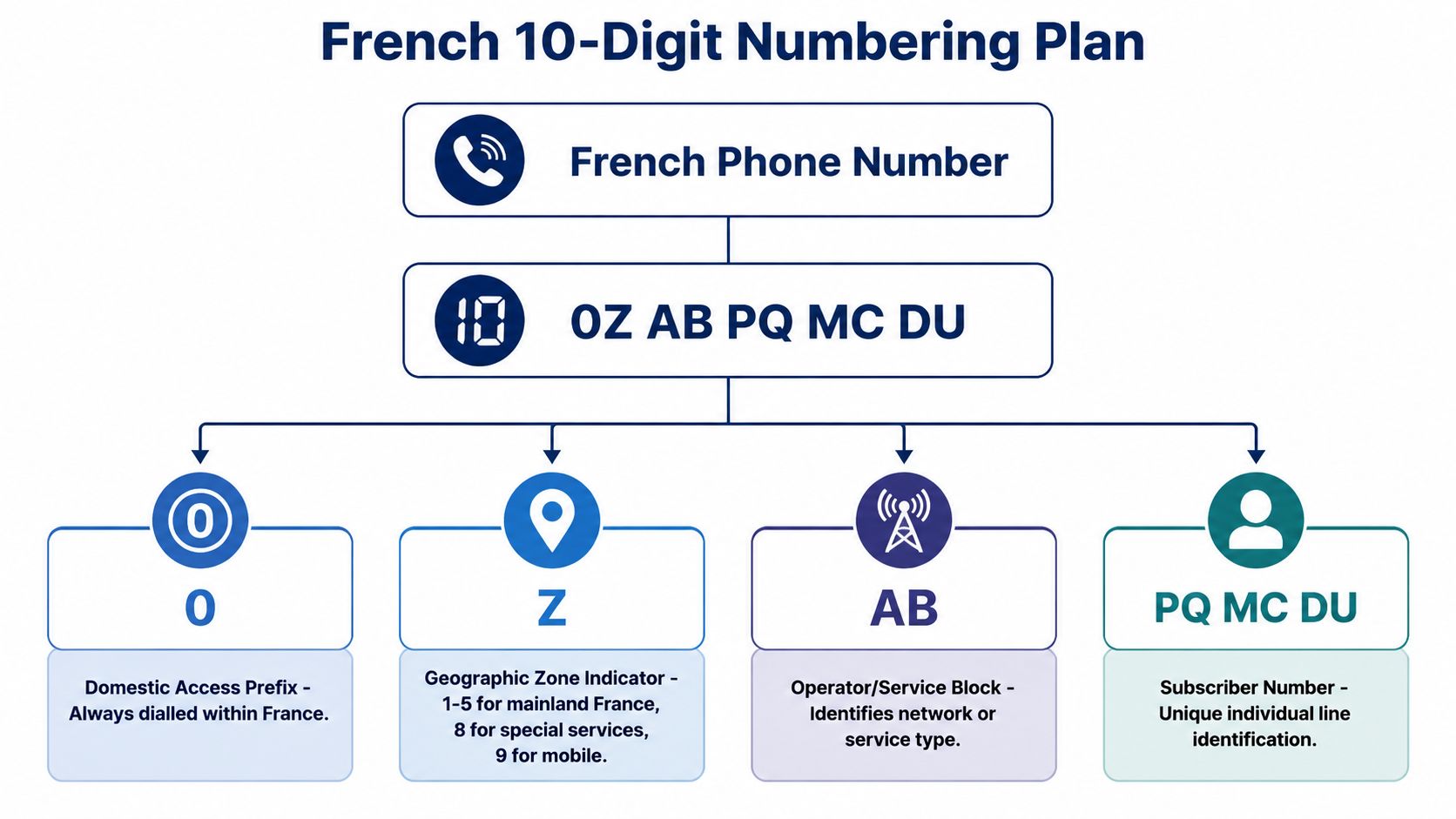
France uses a closed 10-digit national numbering plan. In day-to-day business data, you will usually see numbers written in pairs, such as 01 23 45 67 89.
How the structure works
In domestic French format, the first digit is 0. That digit is part of national dialing inside France. It is not kept when the number is converted to international format for storage or outbound routing.
The next digit tells you the broad number range your system is dealing with first:
- 01 for Paris and Île-de-France
- 02 for Northwest France
- 03 for Northeast France
- 04 for Southeast France and Corsica
- 05 for Southwest France
The remaining digits identify the subscriber line. For PBX work, that means the number has structure your dial plan can test against, rewrite, and normalize.
Why the numbering plan affects business systems
A French number is not just a string of ten digits. It carries formatting rules that affect call routing, contact matching, and outbound policy. If one record is stored as 01 23 45 67 89 and another as +33 1 23 45 67 89, many CRMs and phone systems will treat them as different contacts unless normalization is enforced.
I usually recommend one rule for mixed-country environments. Store French numbers in E.164 and convert user input at the edge, during CRM import, API ingestion, click-to-call, and handset dialing. That keeps the database clean and lets the PBX make predictable routing decisions.
| Workflow | What the numbering plan affects | Typical issue |
|---|---|---|
| CRM click-to-call | Whether the dialer sends domestic or E.164 format | Leading zero sent on an international route |
| Inbound caller ID matching | Whether contacts match existing records | Same contact stored in multiple formats |
| PBX routing | Which outbound rule gets triggered | Pattern does not match French dial string |
| Reporting | Whether calls group under one destination | France traffic split across duplicate number variants |
What a new IT manager should watch
Treat French numbers as structured input, not free-form text. That one decision prevents a lot of cleanup later.
Set validation rules for French records. If a user enters a domestic French number, your system should recognize it, preserve it for display if needed, and store the canonical version separately as +33 plus the national number without the leading zero. The same discipline helps with other country formats too. Teams that also call Iberia often run into similar formatting issues, so a related reference on dialing Spain from abroad in business phone systems can help when building broader normalization rules.
The same principle applies outside voice. If your operations team also needs to send a fax overseas without machines, international formatting discipline still matters because fax platforms, SIP trunks, and messaging tools all depend on clean destination numbers.
How to Dial France Correctly from Abroad
The action is simple once you separate local display format from international dialing format.
From abroad, the sequence is:
- Dial your country's international exit code, or use + on systems that support it.
- Dial 33.
- Dial the French number without the leading 0.
If the French contact shares a number the way it appears locally, your job is to strip that domestic zero before sending the call.
French Dialing Format Comparison
| Call Type | Example French Number (Paris) | Dialing Format to Use |
|---|---|---|
| Local dialing within France | 01 23 45 67 89 | 01 23 45 67 89 |
| International dialing from abroad | 01 23 45 67 89 | +33 1 23 45 67 89 |
That's the difference that matters most. The number a French customer emails to you is often formatted for local use. Your calling platform shouldn't send it unchanged if the call originates outside France.
What works and what doesn't
Works: saving the contact in international format and letting your dialer pass it as-is.
Usually fails: copying the domestic French number into an international field and assuming the trunk will fix it for you.
If your team also handles cross-border document workflows, the same discipline applies outside voice. A good companion reference is how to send a fax overseas without machines, because fax, voice, and messaging systems all break when international number formatting is inconsistent.
For admins supporting multiple European destinations, it also helps to compare country-specific handling. This guide on how to call Spain from a business phone system is useful because it highlights how international normalization rules vary by country even when users think “Europe is all the same.”
Practical Dialing Scenarios and Examples
Rules stick better when they look like real work.
A sales manager in the U.S. gets a Paris office number from a prospect: 01 23 45 67 89. The user shouldn't dial it exactly as written from abroad. They need the international form: +33 1 23 45 67 89. If their device requires an exit code instead of plus-dialing, the logic is still the same. Exit code, then 33, then the French number without the domestic zero.
A support agent in another country receives a mobile contact saved locally in French style as 07 XX XX XX XX. The agent must convert it to +33 7 XX XX XX XX before the call leaves the system. The important point isn't the mobile label. It's that the domestic trunk prefix doesn't travel.
Three common business examples
- Paris headquarters landline: Domestic record shows 01 23 45 67 89. International format becomes +33 1 23 45 67 89.
- French mobile contact: Domestic record shows 07 …. International format becomes +33 7 ….
- French number stored in CRM with spaces or punctuation: Strip formatting noise first, then apply the same logic. Domestic 0 stays only for local French dialing.
Where teams usually go wrong
One user reads the number from an email signature. Another copies it from a spreadsheet. A third taps it from a mobile app contact card. If those systems don't share one normalization rule, each one can send a different dialing string for the same person.
The safest habit is to store one master version of each French contact in international format, then let local presentation views add spacing for readability.
That cuts down on duplicate records, failed click-to-call attempts, and the “it worked on my desk phone but not on the app” problem that shows up in hybrid deployments.
Critical Pitfalls That Cause Call Failures
A French client says your main line never rang, but your call log shows an outbound attempt. In many cases, the failure happened before the call ever had a fair chance to route. The dialed string was wrong.
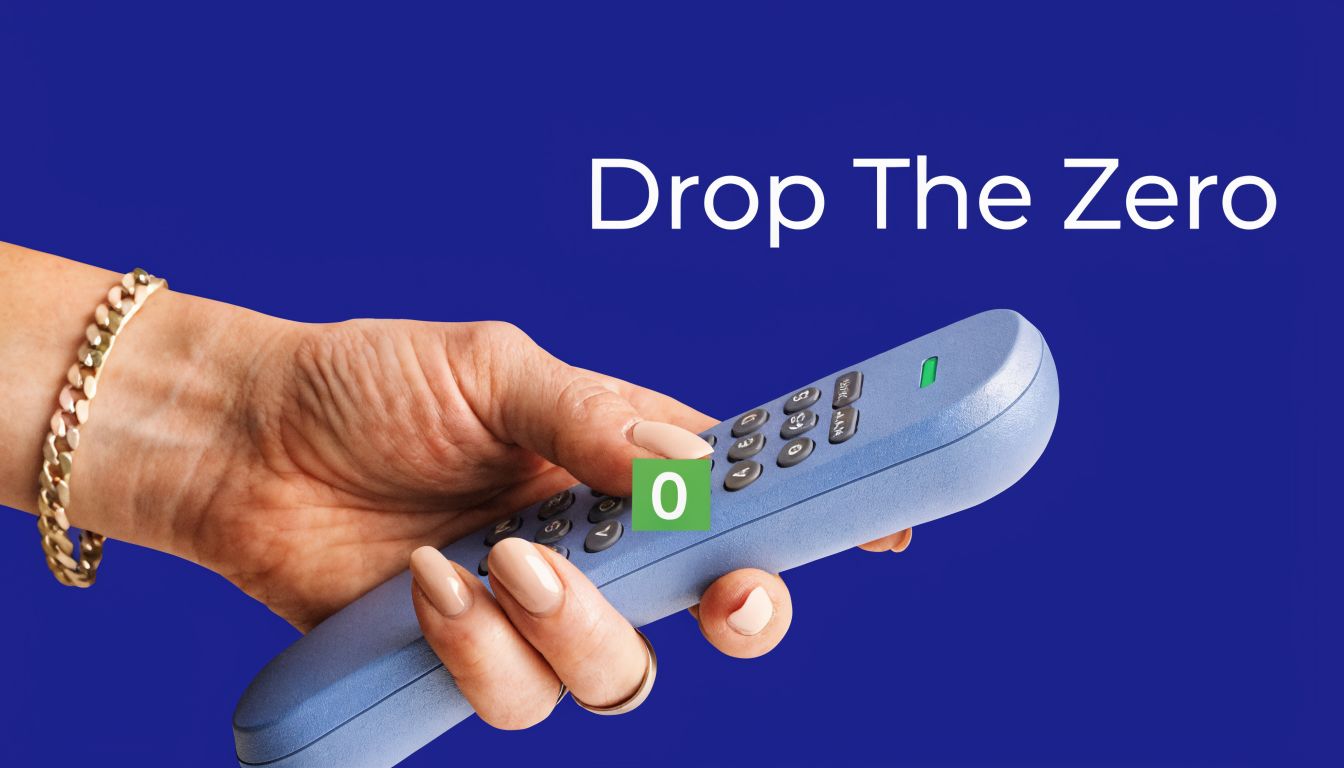
The mistake I see most often is simple. A user, CRM, or PBX sends the French domestic leading 0 along with +33. For international routing, that zero does not belong in the number. If your system sends +330123456789 instead of +33123456789, many carriers or downstream systems will reject it or mishandle it.
That error causes trouble well beyond one failed call. It breaks click-to-call, confuses call reporting, and can stop inbound matching if your platform tries to tie returned calls to the wrong stored format. If you use direct inward dialing for local presence or call distribution, your number inventory also needs consistent formatting. This matters when reviewing how DID numbers work in business telephony.
Why French calls fail even when the number looks right
Users read numbers the way they appear in signatures, CRMs, and address books. SIP trunks do not. They match patterns.
If your outbound rule is built for +33 plus the French national number, any extra digit at the front can break the match. Some platforms reject the call immediately with a normalization or routing error. Others pass the malformed string to the carrier, which makes the failure look random even though the root cause is consistent.
A typical fault path looks like this:
- User input fault: The contact is stored as 01 23 45 67 89 and passed out unchanged
- Normalization fault: The PBX accepts the string but never removes the domestic prefix
- Routing fault: The trunk receives an invalid French E.164 number and rejects it
- Application fault: CRM or softphone logs the failed attempt under a format that no longer matches the customer record
Small formatting errors with real operational impact
French dialing problems are often blamed on the carrier first. In practice, I would inspect the exact called number before checking codecs, firewall rules, or packet loss.
A one-character mistake is enough.
The same issue appears when teams import contacts from third-party tools, temporary virtual numbers, or verification workflows. If a staff member copies a French number from SMS Activate for anonymous verification and stores it in local format, your outbound policy still has to normalize it before routing. The source of the number matters less than the format your phone system sends.
A short walkthrough helps if you're troubleshooting live behavior:
What to check first
Start with the SIP INVITE or the trunk-side dial string, not the user-facing contact card.
- Look for +330 at the start. That is the fastest sign of a bad normalization rule.
- Compare the stored number with the transmitted number. They can differ, and in a well-configured system they often should.
- Check every input path. Desk phones, softphones, CRM click-to-call tools, and mobile apps do not always use the same formatting logic.
- Test one known-good French destination in canonical format. If that works, your trunk is usually fine and your normalization policy needs attention.
The fix is usually straightforward. The business risk comes from leaving one exception in place, then discovering that only one app, one user group, or one office still sends French numbers incorrectly.
VoIP and PBX Configuration for French Numbers
For IT admins, country code 33 becomes a dial-plan problem. You don't want to rely on end users to remember formatting every time. You want the system to accept the number they type, convert it into the right outbound format, and route inbound calls back into something your users and applications can recognize.
Normalize numbers before routing
The right design is simple in principle:
- Accept common user inputs
- Convert them into one canonical format
- Hand only the canonical format to the SIP trunk
For French numbers, that canonical format should be +33 followed by the French national number without the domestic zero.
A practical normalization recipe looks like this:
| Input seen by PBX | Normalization action | Outbound result |
|---|---|---|
| 01 23 45 67 89 | Remove spaces, drop leading 0, prepend +33 | +33 1 23 45 67 89 |
| 07 XX XX XX XX | Remove spaces, drop leading 0, prepend +33 | +33 7 XX XX XX XX |
| +33 1 23 45 67 89 | Preserve as canonical | +33 1 23 45 67 89 |
Outbound rule logic
Different PBX vendors express dial plans differently, but the logic is usually the same.
Option one accepts domestic French input
If a user dials a French number beginning with 0 and the total digit count matches the French domestic pattern, rewrite it to international format before handing it to the trunk.
Pseudo-logic:
- Match French domestic number
- Remove the first digit if it is 0
- Prepend +33
- Route through international-enabled trunk
This is the rule that saves users from themselves.
Option two accepts already-normalized input
If the user, CRM, softphone, or API sends +33 plus the rest of the number in valid international form, pass it unchanged.
Some teams mix desk phones with browser dialers and mobile apps. One path may generate domestic input, while another may already produce E.164. Your system should handle both cleanly.
Store one canonical version. Accept many input styles. That is the core design principle.
Inbound call handling
Inbound normalization matters just as much. A French caller may arrive at your system with a caller ID already in international form. If your CRM stores the same contact in domestic format, the screen pop can fail even though the number is technically correct.
Set inbound rules so that your PBX or integration can:
- Preserve E.164 for system records
- Map +33 variants to internal contact records
- Present a readable local-style display if users prefer it
That split is healthy. Machines should keep the canonical number. Humans can see a prettier version.
DID mapping and internal consistency
If you assign French DIDs or support local presence numbers, make sure your routing rules don't create multiple identities for the same endpoint. That issue often appears when one module stores numbers with spaces, another strips punctuation, and a third adds the domestic zero back for display.
This is also where understanding a DID number in cloud telephony helps, because direct inward dialing, caller ID presentation, and number normalization all intersect in real deployments.
A useful admin habit
Before you roll out French dialing company-wide, test with:
- One manually entered domestic-format number
- One CRM click-to-call record
- One mobile-app initiated call
- One inbound callback from a French number
If all four resolve to the same canonical record and route successfully, your dial plan is probably sound.
Teams that also work with disposable or verification-oriented number flows sometimes review tools like SMS Activate for anonymous verification to understand how international number presentation varies across services. That isn't the same use case as business voice, but it does reinforce one lesson: the exact number format a platform expects is never a minor detail.
A Business Checklist for Calling France
If your company calls France often, keep the operating rule simple. France uses country code 33, and your systems should treat French numbers as structured international data, not casual text copied from email signatures.
Use this as the checklist your team can easily follow:
- Store French contacts in one standard format: Keep the master record in international form with +33 and no domestic leading zero.
- Let the PBX normalize user input: Staff will still type numbers the way they see them. Your system should fix that automatically.
- Audit CRM and click-to-call integrations: These tools often send exactly what is stored, including bad domestic formatting.
- Separate machine format from user display: Preserve canonical international format in the backend. Show spaced local formatting in interfaces if your team prefers it.
- Test all input paths: Desk phones, softphones, mobile apps, browser extensions, and API-driven dialing should all produce the same outbound result.
- Train the team on one memorable rule: If the call is going to France from abroad, use +33 and drop the 0.
Clean number normalization prevents a surprising amount of avoidable telecom trouble.
Businesses usually don't lose French calls because France is difficult. They lose them because their systems are inconsistent. Fix the formatting once in the PBX, enforce one contact standard, and international calling becomes routine instead of fragile.
If you're replacing a legacy PBX or want a cloud phone system that can handle international dialing logic cleanly, SnapDial is built for business teams that need reliable routing, unified communications, managed setup, and straightforward administration without making IT babysit every call rule.