
A customer calls with a billing problem. Your first agent answers, confirms the account, listens carefully, and then realizes the issue belongs with retention or technical support. The customer gets placed on hold. A click happens. Then another. A new voice comes on and asks, “Can you explain what's going on?”
That moment is where trust drops.
Operations managers usually notice the downstream symptoms before they name the cause. Repeat calls rise. Escalations pile up. Agents complain that callers arrive irritated before the actual conversation even starts. Supervisors see average handle time move in the wrong direction, but the bigger problem is hidden in the transfer itself. The customer doesn't feel handed off. They feel dropped.
A warm transfer fixes that. Not as a courtesy feature, but as an operational discipline that protects context, improves first-call resolution, and makes your phone system work like one team instead of separate silos.
The All-Too-Common Call You Never Want Your Customers to Experience
A customer has already explained the issue once. They gave their name, account details, and a short version of what went wrong. The first agent understands enough to know another team needs to take over. Then the call gets transferred without any introduction.
The next agent has no context. The customer starts over. The tone changes. What began as a normal service interaction becomes a test of patience.

This is one of the most common failure points in customer operations because it looks small from the inside. To a manager, it can seem like a simple routing event. To the caller, it feels like the company forgot everything they just said.
What the customer hears
A cold transfer often sounds like this:
- Agent one: “Let me send you to the right department.”
- Silence and hold music: No explanation of what happens next.
- Agent two: “How can I help you today?”
That final question is where the damage happens. It tells the caller their time wasn't carried forward.
A transfer should move the conversation forward, not reset it.
This problem shows up everywhere, from support desks to healthcare scheduling. If your team handles sensitive or high-friction calls, the handoff matters even more. For teams thinking about how better voice workflows affect patient or customer communication, the Simbie AI healthcare communication guide is a useful read because it treats voice interactions as operational processes, not just phone events.
What managers usually miss
The transfer itself is rarely the only issue. Poor handoffs create a chain reaction:
- Customers get irritated early: They enter the next interaction defensive.
- Agents lose time: They collect information that was already captured.
- Resolution slows down: The second agent has to reconstruct the situation.
- Follow-up work grows: Notes, callbacks, and escalations become more likely.
Many customer service departments don't need more transfers. They need better ones.
Defining the Warm Transfer A Personal Introduction
The easiest way to understand what is a warm transfer is to compare it to introducing two people at a meeting.
You don't point across the room and walk away. You bring them together, share the relevant context, and make sure the conversation starts in the right place. A warm transfer works the same way on a call.
Instead of sending the customer blindly to another extension or queue, the first agent stays involved long enough to brief the receiving agent and make the introduction. That brief moment changes the customer experience from “I got passed around” to “they connected me with the right person.”
How it works in practice
The technical process is straightforward. According to Vonage's explanation of warm transfer mechanics, the originating agent establishes a consultative bridge with the receiving agent before the customer handoff. The customer is placed on hold while the two agents connect through an off-line or conference-bridge channel, allowing the first agent to pass along the full context so the customer doesn't have to repeat it.
In practical terms, the flow looks like this:
The first agent identifies the need to transfer
The issue belongs with another person, skill group, or department.The customer is told what's happening
The agent explains why the transfer is needed and sets expectations.The first agent consults the next agent
This is the key difference. The receiving agent gets the customer's name, issue summary, and any steps already taken.The customer is brought into the handoff
The first agent introduces the second agent instead of disappearing.The first agent exits
Once both sides are connected and oriented, the original agent leaves the call.
Why this method works
A warm transfer preserves momentum. The receiving agent doesn't start from zero, and the customer doesn't feel like they're entering a new conversation.
Practical rule: If the caller has to repeat the problem from scratch, it wasn't a warm transfer. It was a delayed cold transfer.
What makes it different from a simple transfer feature
Many phone systems technically allow transfers. That doesn't mean teams are using them well. A proper warm transfer depends on two things working together:
- System capability: Hold, consult, conference, and reliable routing have to work cleanly.
- Agent behavior: The first agent has to provide a useful briefing, not just ask, “Can you take this?”
That's why warm transfers aren't just a phone feature. They're a service standard.
Warm vs Cold Transfers A Head-to-Head Comparison
The debate isn't whether warm transfers sound nicer. It's whether they produce better operational outcomes than cold transfers. In most customer-facing environments, they do.
The core difference
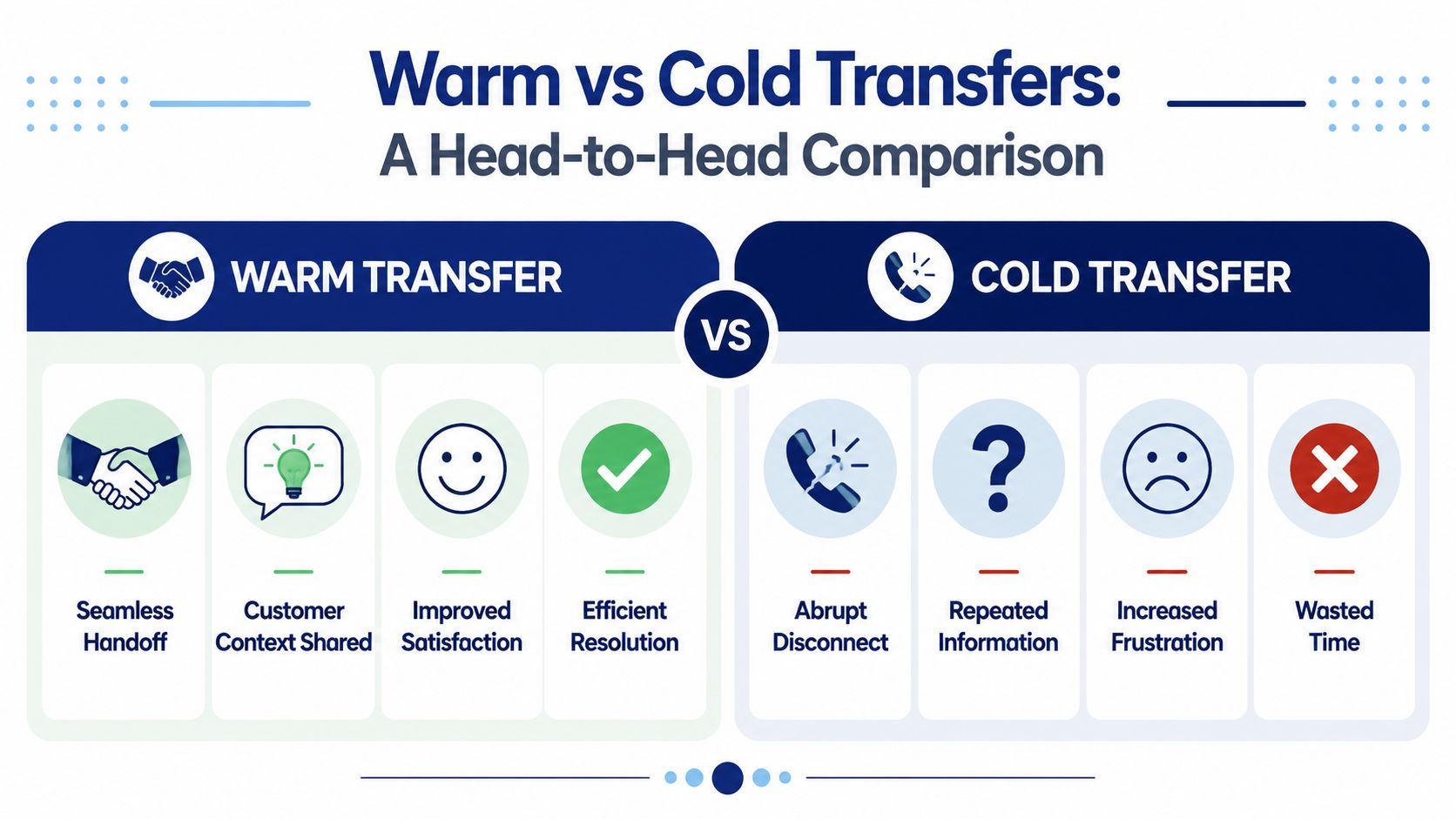
A cold transfer moves the caller without context. A warm transfer moves the caller with context and introduction.
That sounds like a small process difference, but the business effect is much larger.
Side-by-side impact
| Transfer type | What the customer experiences | What the receiving agent gets | Likely operational result |
|---|---|---|---|
| Warm transfer | A guided handoff with explanation | A summary before the caller joins | Better continuity and more efficient resolution |
| Cold transfer | An abrupt move and often a restart | Little or no context | More repetition, more frustration, more cleanup work |
Industry benchmark data cited in Voiso's warm transfer analysis shows warm transfers can lead to up to 30% higher customer satisfaction scores and a 20% reduction in repeat calls. The same analysis says cold transfers cause 25% higher call abandonment rates and a 30% spike in repeat calls, even if they offer only minor average handle time savings.
Why cold transfers look efficient on paper
Managers sometimes defend cold transfers because they appear faster in the moment. The first agent exits quickly. The transfer button gets used. The call moves on.
But that narrow view usually ignores the rest of the cost:
- The second agent restarts discovery
- The customer repeats details already given
- The issue may still land in the wrong place
- The next call arrives with a frustrated caller
So yes, a cold transfer can shorten one agent's involvement. It often lengthens the company's total work.
When a blind handoff creates hidden waste
A poor transfer drives waste in places dashboards don't always connect automatically:
- Repeat contacts: The customer calls back because the issue still isn't resolved.
- Escalation pressure: Supervisors step in after the customer loses confidence.
- Training drag: New agents inherit upset callers and perform worse than they should.
- Brand damage: The customer remembers the friction more than the final outcome.
If you want to improve first-call resolution, start by checking whether transfers preserve context. FCR usually breaks before the specialist even says hello.
The practical trade-off
Warm transfers do require more discipline. The first agent spends a little more time on the front end. But the handoff is cleaner, the second agent starts with direction, and the customer doesn't feel stranded.
Cold transfers optimize for agent exit. Warm transfers optimize for customer progress.
For most support, retention, billing, onboarding, and high-value service calls, that's the metric that matters.
The Tangible Business Benefits of a Warmer Handoff
Warm transfers matter because they improve business outcomes, not because they sound more polished in training documents.

When a handoff preserves context, the company keeps control of the interaction. The customer doesn't need to restart. The next agent doesn't need to reconstruct the situation. That affects retention, staffing efficiency, and service consistency.
Better satisfaction and lower churn pressure
A warm transfer reduces one of the most frustrating parts of customer service, which is having to explain the same problem multiple times.
Verified benchmark data states that a 2023 Zendesk report found customers experiencing smooth transfers had 20% higher satisfaction scores and were 15% less likely to churn. The same verified data also says Gartner estimates small call centers can save $50-100K annually per 10 agents by adopting warm transfers, while 68% still default to cold transfers because of training or technology gaps.
Those numbers line up with what operations teams already see in practice. Customers judge competence by continuity. If your departments communicate cleanly, the company appears organized. If they don't, even a correct final answer can feel expensive.
Stronger first-call resolution
Warm transfers also support FCR because the second agent starts with a briefing instead of a blank page. That doesn't guarantee resolution on every call, but it removes a major source of waste.
For teams actively working on this metric, it helps to define warm transfer performance as part of a broader service model. The SupportGPT omnichannel service framework is useful here because it connects handoffs across channels, not just voice. If your phone team, chat team, and email team all handle the same accounts, continuity has to extend beyond the call itself.
A focused review of first-call resolution improvement tactics also helps managers tie transfer quality to measurable service outcomes.
Less agent friction and cleaner operations
Warm transfers don't just help customers. They make life easier for agents who inherit complex calls.
Common gains include:
- Less repeated questioning: The second agent can confirm details instead of collecting them from zero.
- More confident ownership: The receiving agent knows why the call is arriving.
- Lower avoidable tension: Customers are less likely to open the next conversation already upset.
- Better note quality: Handoff summaries tend to be clearer when teams treat the transfer as part of the workflow.
Here's a quick explainer that shows how transfer methods affect service flow:
Why the bottom line improves
Warm transfers look like a customer experience decision, but they're really an operating model choice. You're deciding whether the company should absorb the complexity of the handoff or make the customer absorb it.
The businesses that perform better usually pick the first option.
Implementing and Measuring Warm Transfers with Your Cloud PBX
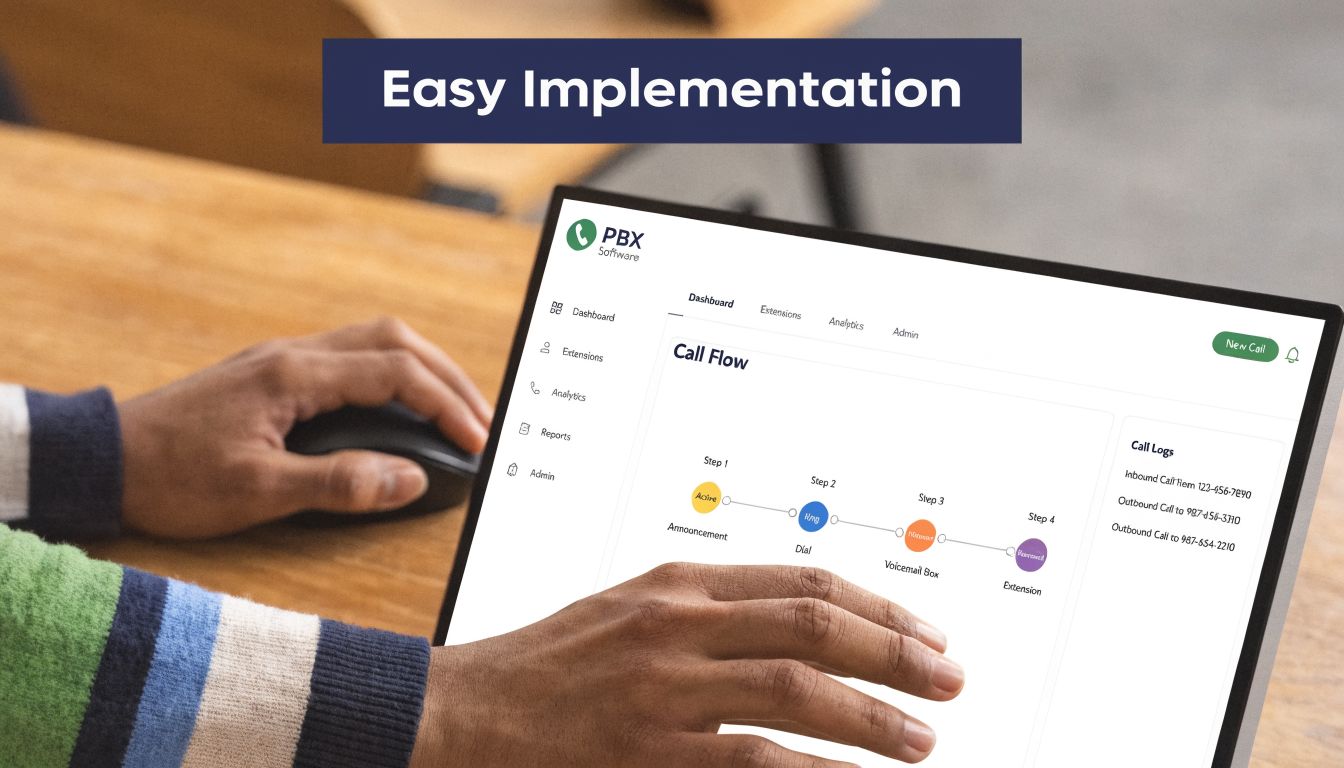
The good news is that warm transfers don't require a complicated rollout. If you're using a modern cloud phone system, the technical pieces are usually already available. The harder part is setting a clear call flow and measuring whether agents use it correctly.
If you're sorting through voice infrastructure first, it helps to align everyone on the basics of internet-based business telephony. This plain-language guide on what is a VoIP number is a solid starting point for non-technical stakeholders.
The setup you actually need
At minimum, your phone environment should support:
- Hold and consult functions: Agents need to place the caller on hold and reach the next person first.
- Three-way or conference capability: The first agent needs a clean way to bring everyone together briefly.
- Directory or queue visibility: Agents should know who is available before attempting the handoff.
- Call notes or CRM visibility: Context should travel with the transfer when possible.
- Reporting: Supervisors need to review transfer outcomes, not just transfer counts.
Without those basics, teams improvise. Improvised transfer behavior usually turns into rushed cold transfers.
A practical rollout sequence
Most successful implementations follow a simple order:
Define when a warm transfer is required
Billing disputes, cancellations, technical escalations, service failures, and account-sensitive calls usually belong on the list.Create a short consult standard
Keep it brief. Customer name, issue summary, priority, and steps already taken are enough in many environments.Map destination paths
Agents shouldn't guess where to send a call. Build clear routing logic by team, skill, or issue type.Train with live examples
Practice the hold-consult-introduce-exit sequence until it feels routine.Audit a sample of calls Listen for whether the receiving agent was briefed and whether the customer had to repeat themselves.
For teams that need a more detailed operations reference, this walkthrough on how to transfer calls is useful as a process aid for supervisors and agents.
Why real-time handoffs beat callbacks in high-stakes workflows
One of the strongest pieces of evidence for immediate handoff comes from outside the typical call center example. In a decentralized clinical trial recruitment study, warm transfers achieved a 25% enrollment rate compared with 12.9% for scheduled callbacks, according to the published analysis on PubMed Central.
That matters because callbacks often feel operationally neat but commercially weak. Once the first moment of intent passes, people drop off. In business terms, the lesson is simple. When the next step matters, live transfer often beats delayed follow-up.
The handoff is part of the conversion path. Treating it as an admin task is where teams lose momentum.
What to measure after launch
Don't stop at “agents are using the transfer button.” Measure whether the transfer improved the outcome.
Track indicators such as:
- Transfer success rate: Did the call reach the right destination on the first try?
- FCR after transfer: Was the issue resolved without another contact?
- Repeat-call volume: Are customers calling back on the same issue?
- CSAT for transferred calls: Do transferred interactions score differently from direct resolutions?
- Escalation patterns: Are certain queues receiving poorly prepared transfers?
Where AI is starting to help
Some teams now use AI to pre-brief agents, summarize prior interaction history, or suggest the best destination before the consult happens. That doesn't replace agent judgment. It supports it.
The strongest use case is simple. Let technology assemble context quickly, then let the agent handle the introduction like a person who understands the customer's situation.
Best Practices for a Flawless Warm Transfer
Technology enables warm transfers. Agent behavior determines whether they feel smooth or clumsy.
The most reliable process is simple, repeatable, and short enough to use under pressure.
The essentials every agent should follow
- Ask permission first: Tell the caller why a transfer is needed and who they're being connected to.
- Capture a callback number: If the transfer fails, recovery should be immediate.
- Brief the next agent clearly: Share the name, issue, urgency, and actions already taken.
- Introduce both parties: Don't disappear at the moment of connection.
- Exit cleanly: Leave only after the customer and receiving agent are oriented.
A short script that works
An agent can say:
“I'm going to bring in our billing specialist because they can fix this faster than I can. I'll place you on a brief hold, explain the issue, and then introduce you so you won't need to repeat everything.”
Then, during the consult:
“I have Maria on the line. She's calling about an invoice discrepancy, we've already confirmed the account details, and she needs help with the latest charge.”
Then, on the handoff:
“Maria, I have James from billing with us now. He's up to speed on the issue and can take it from here.”
Use AI where it removes friction
Verified trend data says 42% of mid-sized businesses now use AI for smart warm handoffs, which cuts transfer times by 35% and reduces missed escalations by 28% for hybrid teams. The best use of that capability is to support the consult step, not to turn the handoff into a robotic script.
For teams tightening their broader call workflow, these call handling best practices are a practical complement to transfer training.
The standard to aim for is straightforward. The customer should feel guided, the receiving agent should feel prepared, and the business should avoid doing the same work twice.
If your team is replacing a legacy phone system or trying to improve transfer quality across support, sales, and multi-location operations, SnapDial gives you the cloud PBX foundation to do it cleanly, with modern routing, reporting, and call handling tools that make warm transfers easier to execute and easier to manage.