

You're probably here because the old setup has started to break.
Maybe sales calls still ring a founder's cell phone. Maybe support requests hit a single receptionist who can't see who handled the last conversation. Maybe you're opening a new market and want a local number without opening a physical office. Or maybe you just don't want your business tied to one employee's mobile number anymore.
Buying a phone number is now easy. In most modern business phone systems, you can search by area code or vanity keyword, add the number to an account, and activate it almost immediately, which is a major change from the older carrier-driven process that took much longer, as noted in CallLoop's guide to buying a phone number. The mistake is assuming that because the transaction is simple, the decision is simple.
A business number affects how customers judge your company before anyone answers. It shapes local trust, brand recall, call handling, and what happens later if you outgrow your provider. That last point gets ignored in most guides. They focus on checkout screens and skip the harder question: when you buy a number, are you building a durable communications asset, or are you walking into provider lock-in?
Your Business Number Is More Than Just Digits
A business number does three jobs at once. It identifies your company, routes customer conversations, and becomes part of your operating infrastructure. If you choose badly, the pain shows up later in missed calls, messy handoffs, and expensive migration work.
The easy part is getting one live. The harder part is deciding what role that number should play in the business.
What the number signals to customers
A local number tells customers you serve their market. That matters for contractors, law firms, clinics, field service teams, and any company expanding city by city. You don't need a physical office in every location to create a local calling presence, but you do need to use it responsibly. If the customer experience feels distant or disorganized, the local number won't save you.
A memorable number helps when recall matters more than geography. That's common in radio ads, fleet vehicles, direct mail, and any campaign where people need to remember the number later without clicking a link.
A phone number is often the first part of your communications stack customers interact with. Treat it like infrastructure, not stationery.
Why the purchase is simple and the decision isn't
Modern providers made procurement fast. That's good for distributed teams, urgent launches, and regional expansion. But speed also encourages bad buying behavior. Teams grab whatever number is available, then realize later it doesn't fit routing, texting, branding, or future portability.
That's where long-term thinking matters. Before you buy, decide whether the number is meant to be:
- A brand asset tied to marketing
- A departmental line for sales, support, or billing
- A market-entry tool for a new city or region
- A temporary campaign number that may later be retired or parked
If you don't define that upfront, you'll end up making technical decisions with business consequences. That's how companies accidentally make their main public number hard to move, hard to manage, or dependent on one vendor's workflow.
Choosing the Right Type of Business Number
The first real decision isn't provider. It's number type.
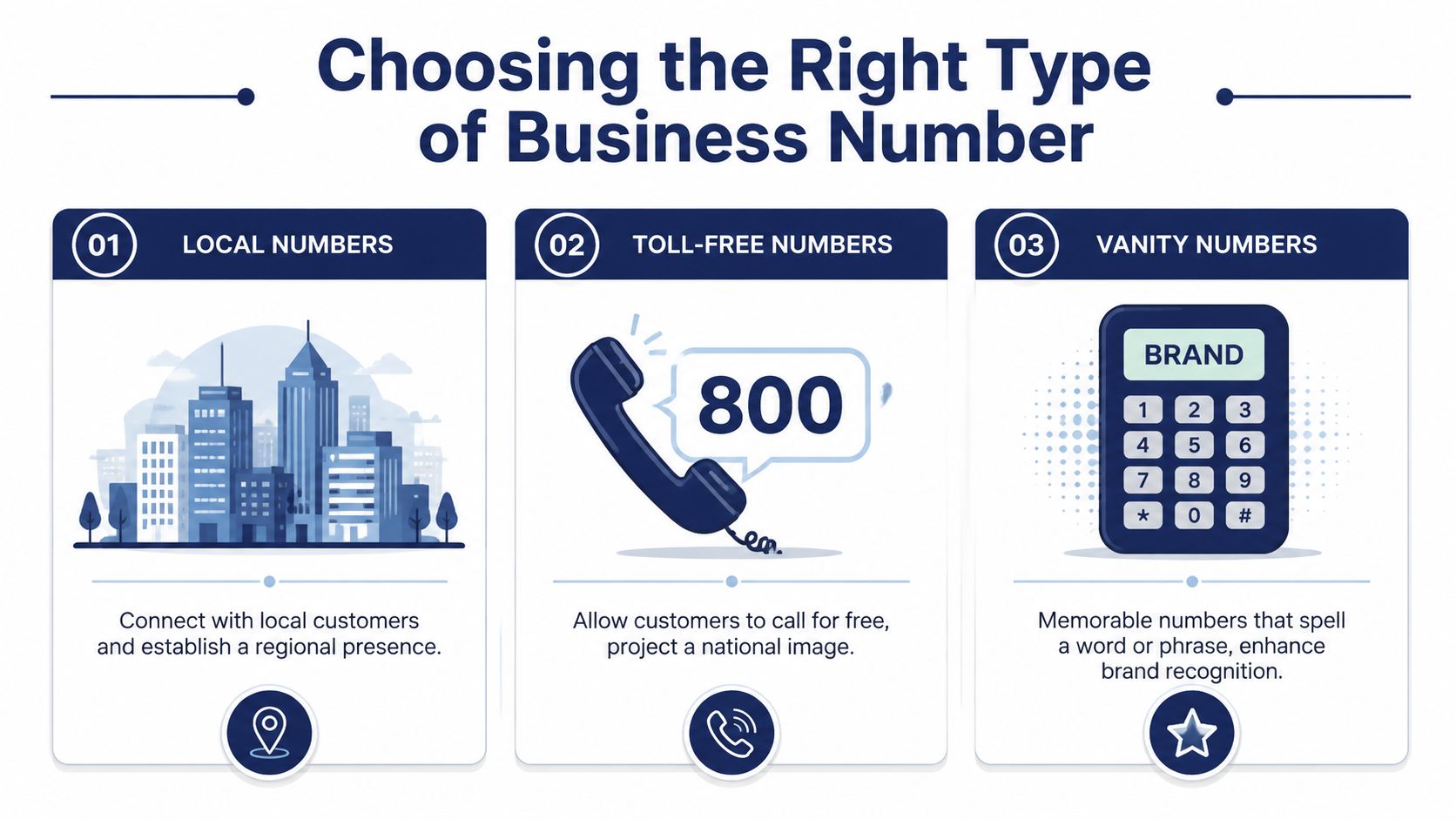
Businesses commonly buy local numbers, mobile numbers, and toll-free numbers, and the choice affects the use case directly. Toll-free numbers reduce calling friction for customers, while local numbers help establish a presence in a specific market, according to Cognism's overview of business phone number types.
Local numbers
If your business wins on proximity, local numbers usually make the most sense.
A local number works well when you want to appear established in a city, route calls to a branch, or support market-specific advertising. Franchises, home services companies, regional medical practices, and multi-location retailers use them well because the number matches how customers already think about the service area.
Local numbers also pair naturally with internet-based calling. If you need a quick primer on how these systems work, this guide on what a VoIP phone number is is useful because it explains why a business can use a local number without tying it to one desk phone.
Toll-free numbers
Toll-free numbers serve a different purpose. They say, “this company can handle calls at scale.”
They fit national support lines, central sales teams, and businesses that don't want geography to define the brand. They also reduce friction for callers, which matters if customers are calling for service, order questions, or problem resolution.
The trade-off is trust in local markets. In some industries, a toll-free number looks polished. In others, it can feel distant.
Vanity numbers
Vanity numbers are about memory and branding. If the number spells a word or follows a repeating pattern, people are more likely to recall it from an ad, truck wrap, billboard, or podcast mention.
They aren't always the right fit. If most of your leads come through search, web forms, or CRM-driven outreach, a vanity number may add less value than a strong routing setup or better SMS handling. But if your marketing depends on recall, a vanity number can be worth the premium.
A simple way to choose
Here's the practical comparison I use with clients:
| Number type | Best for | Main upside | Main caution |
|---|---|---|---|
| Local | Regional service, city expansion, branch presence | Builds local familiarity | Can fragment your brand if every market runs differently |
| Toll-free | National support, central sales, broad brand presence | Easier for customers to call without friction | May feel less local |
| Vanity | Advertising, memorable branding, campaigns | Easier recall | Usually costs more and may not improve operations on its own |
Buy the number that matches how customers already decide to call you. Don't buy based on what looks impressive in a provider dashboard.
How to Evaluate Phone Number Providers
Most buyers compare providers the wrong way. They start with price, then look at features, then ask about porting only if something goes wrong.
That order creates expensive mistakes.

Start with total cost, not sticker price
Provider pricing varies widely. Some providers offer numbers starting at $5, with parking or forwarding available for a few dollars per month, while others bundle numbers into plans starting at $10 or more per month, as described in NumberBarn's pricing overview. That's why the upfront number price tells you very little.
A cheap number can become the expensive option once you add hosting, forwarding, texting capability, user seats, call recording, or porting work later.
The questions that actually matter
When I review providers, I care about five issues more than the homepage price:
- Porting-out policy. If you leave, how hard is it to move the number?
- Routing flexibility. Can you forward, ring groups, branch by time of day, or connect the number to software cleanly?
- SMS support and registration path. If your team plans to text customers, the provider should make compliance manageable.
- Admin usability. If simple changes require support tickets, your operating costs go up.
- Support quality. During cutovers and outages, responsiveness matters more than feature lists.
If your business is moving offices or redesigning its telecom setup during relocation, this resource on telephony options for workplace relocation is worth reviewing. It's helpful because number strategy often gets tangled up with physical moves, internet changes, and old PBX retirement.
Where providers create lock-in
Lock-in doesn't usually show up as a contract term. It shows up operationally.
Some providers make it easy to buy but vague to leave. Others blur the line between number control, call handling, and app usage, so the business can't tell what it would take to move the number elsewhere. That's a problem if your main public line is tied to your reputation.
Watch for warning signs like these:
- Unclear documentation about porting credentials or release steps
- Routing that only works inside the provider's app
- Support answers that avoid direct portability questions
- Feature bundles that make the number cheap but the full system expensive
A provider should be able to explain, in plain language, how the number is hosted, how it can be exported, and what information you'll need if you port later.
A short explainer can help sharpen your checklist before you compare options:
The Purchase and Verification Workflow
The cleanest phone number purchases happen before anyone clicks “buy.”
Teams that get stuck usually don't have a technical problem. They have a paperwork problem. The provider asks for business details, messaging registration, or identity verification, and suddenly a task that looked instant turns into a stalled rollout.
What you should gather before checkout
For business and CRM purchases, expect to provide identity and registration details such as your EIN or business registration number, company name, and address, and expect additional verification like A2P 10DLC registration for SMS use cases, as described in Instantly's phone number purchase workflow.
That means you should have the following ready before anyone starts searching inventory:
- Registered business details that match your legal records
- Primary company contact information used consistently across systems
- Intended use case for the number, especially if texting is involved
- Decision on number type so the search doesn't drift
If your use case points toward a national front door for sales or support, it helps to review what to expect when you get a toll-free number, especially if multiple teams will share it.

The workflow that avoids rework
The practical buying flow is usually straightforward:
Define the number you need
Decide whether you want local, toll-free, vanity, or a number intended mainly for forwarding or app-based use.Search inventory carefully
Area code matters, but pattern matters too. Check whether the exact number is good enough for public use, not just available.Complete verification cleanly
Most delays happen because the legal business name, address, or registration information doesn't match.Assign internal ownership
Someone in the business should be responsible for the number after purchase. Not just for answering calls, but for documentation and change control.
Operational rule: Buy numbers with the same discipline you use for domains and payment systems. If no one owns the recordkeeping, problems show up during a port, an audit, or a staffing change.
What slows purchases down
The most common hold-up is mismatched identity data. The legal entity name in one system doesn't match the registration on file somewhere else, or the person buying the number doesn't know which address the business should use.
The second problem is trying to buy first and figure out texting later. If SMS matters, treat registration and compliance as part of the purchase, not as a future task.
Configuring Call Routing and Advanced Features
The purchase is only the handoff. The actual work starts the moment the number lands in your account.
A technically sound workflow is to purchase the number and then immediately configure routing, whether that means forwarding to an existing line, connecting it to VoIP software, or parking it for later use. Planning routing before activation prevents delays and rework, according to NumberBarn's guide to buying a phone number in 2026.
Decide what the number should do on day one
Every number should have an immediate destination. If it doesn't, calls get mishandled, voicemails disappear into the wrong inbox, or teams start using ad hoc call forwarding that nobody documents.
The usual options are simple:
- Forward to an existing line when you need fast deployment
- Connect to a VoIP platform when multiple users need access
- Park the number when you want to secure it before full rollout
The point isn't sophistication. It's control.
Routing features that improve operations
Good routing reduces missed calls and internal confusion. Most growing businesses don't need exotic telecom engineering. They need a few settings configured properly.
Here's what usually matters first:
- Auto-attendant. Useful when callers need “Press 1 for Sales” instead of a live operator handling every call.
- Time-based routing. Critical for after-hours handling, lunch coverage, and holiday schedules.
- Ring groups. Better than sending all calls to one person and hoping they're available.
- Visual voicemail and shared access. Important when several people need context.
- Mobile forwarding. Necessary for field teams and hybrid staff.
If you need a practical overview of the logic behind these setups, this guide on what call routing is is a solid reference.
Keep routing aligned with devices and staffing
Routing design should match how your people work. A front-desk-heavy office needs a different flow than a field service company or remote sales team.
That also means checking endpoint quality. If your staff will answer business calls on mobile devices, they need dependable hardware and a predictable support plan. For teams evaluating replacement handsets economically, Used Mobiles 4 U offers a practical consumer-side view of refurbished iPhone buying.
Don't build call flow logic around an org chart. Build it around who can reliably answer, transfer, and resolve the call.
What doesn't work
Three patterns cause most of the mess I see:
| Bad setup | Why it fails |
|---|---|
| Everything forwards to one mobile | No visibility, weak coverage during absences, poor team handoff |
| No after-hours rule | Calls ring out, customers assume no one is available |
| Complex IVR on day one | Too much branching before the team understands call patterns |
Start simple. Then refine after you've seen real traffic and real failure points.
Post-Purchase Practices for Ownership and Compliance
This is the part buyers skip, and it's the part that matters most later.
When you “buy” a business phone number, you're often entering a hosting arrangement, not obtaining permanent ownership in the way people imagine. The critical issue is whether the number can be moved to another carrier later, and what rules apply if you want to leave, as explained in NumberBarn's purchase and port guidance.
Ask the ownership question the right way
The wrong question is, “Do I own this number?”
The better questions are:
- Who is hosting the number right now
- Who controls the account and credentials
- What documentation is required to port it out
- What happens if the admin who bought it leaves the company
That framing matters because continuity is what you're really protecting. If your website, ads, CRM, customers, and vendor records all point to one number, losing control of it is a serious operating risk.
How to avoid provider lock-in
Lock-in is preventable if you set rules early.
Keep the number under a business-controlled account. Don't let a freelancer, former employee, or outsourced marketer buy the company's main number under their personal login. Document the provider, account owner, billing contact, and any release steps needed for future porting.
Use this checklist:
- Centralize account control under the business, not an individual employee
- Store purchase records and any porting credentials in your internal documentation
- Confirm port-out policy before purchase rather than during a crisis
- Avoid unnecessary dependency on proprietary routing that can't be reproduced elsewhere
- Review compliance needs if the number is used for texting or customer outreach
If a provider makes it easy to activate but hard to understand porting, assume you'll pay for that confusion later.
Keep compliance tied to reputation
A number isn't just a route for calls. It carries business reputation.
If your company uses calling and texting actively, ongoing compliance affects deliverability, trust, and whether customers see your outreach as legitimate. The specifics vary by use case and provider, but the operating principle is consistent: keep registration details current, keep usage aligned with what the number was approved for, and don't let informal workarounds creep into production.
A clean post-purchase discipline usually includes:
- Periodic review of business registration details
- Documented responsibility for messaging use
- Consistent caller identity across teams
- Formal change control before migrations or vendor switches
The businesses that handle this well treat numbers the same way they treat domains, payment processors, and core software licenses. They assume the number will outlive individual employees, campaigns, and even providers.
That's the right mindset if you want to know how to buy a phone number without creating a future headache. The transaction takes minutes. Protecting the asset takes intent.
If you're replacing a legacy phone setup or want a business number you can grow with, SnapDial is built for exactly that kind of transition. It gives growing teams a cloud phone system with predictable pricing, white-glove setup, and the routing, mobility, and support needed to keep numbers working without downtime or lock-in surprises.