
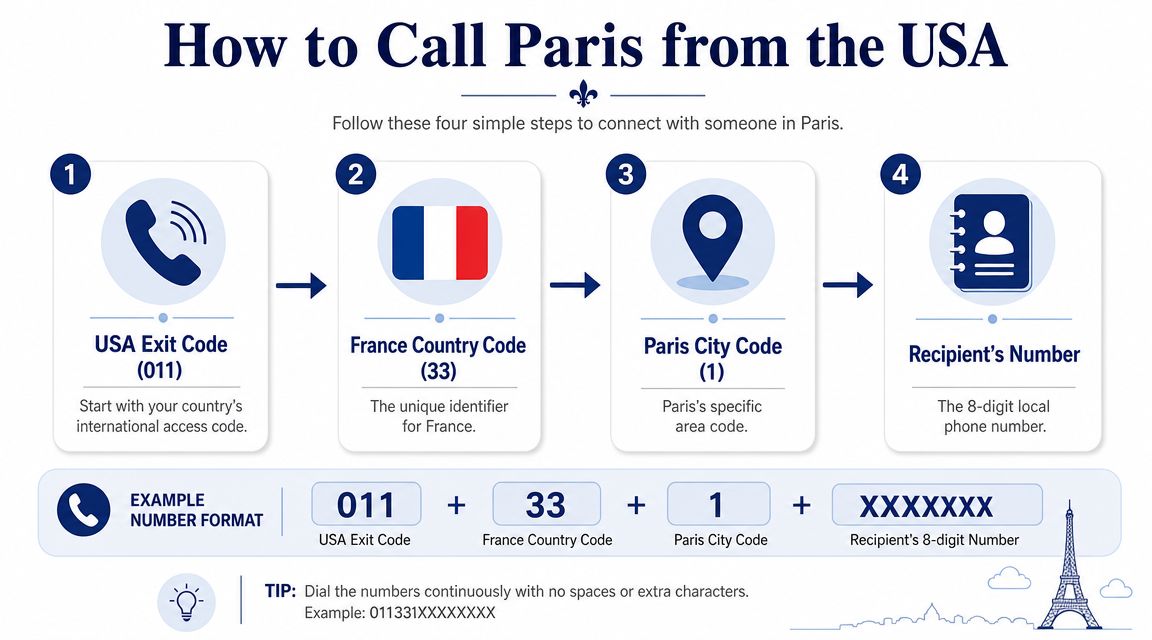
Dial 011, then 33, then 1, followed by the local 8-digit number to call Paris from the USA. That's the direct dialing format, but it's only one option, and for many business calls it isn't always the smartest one.
If you're trying to reach a client in Paris, confirm a hotel booking, or connect your support team with a French partner, the dialing itself is simple. The part that usually causes trouble is everything around the call: whether the number is formatted correctly, whether your carrier handles international calls cleanly, and whether direct dialing makes sense at all when your team needs reliable, trackable communication.
Connecting with Paris From the United States
A lot of people search how to call paris france from usa because they need an answer fast. Usually the moment is practical: a contract needs approval, a shipment needs clarification, or a colleague in Paris is waiting on a decision. In those moments, the code matters, but so does the method.
The call can be easy. The setup can still be wrong
If you're making a one-off personal call, direct international dialing may be enough. If you're calling from a business line, a team mobile, or a shared support desk, the right question is broader: should you place the call manually at all, or should you route it through a modern phone system?
That distinction matters because business callers don't just need a connection. They need:
- Consistent reachability so calls don't die with one employee's mobile
- Predictable handling when someone's unavailable, out of office, or traveling
- Professional presentation with stable caller ID and organized follow-up
- Centralized visibility so managers can see missed calls, voicemails, and call logs
Most basic guides stop at the dialing sequence. That's useful, but incomplete. As RingCentral's discussion of calling France from the U.S. notes, many guides explain the prefix but miss the practical business issue: direct dialing may not be the best method when cost control, reachability, and workflow integration matter.
If the call to Paris is part of an ongoing business process, the phone system matters more than the country code.
What works for different callers
A solo caller can usually get by with a mobile phone or app. A business manager has a different set of concerns. You might need a receptionist to transfer the call, a record of the conversation, routing rules after hours, or a way to move the call from desktop to mobile without losing context.
That's where this topic gets more interesting than 011 + 33 + 1 + number. The syntax gets you through the network. The platform you choose determines whether the call fits your operation.
The Standard Dialing Format for Paris Explained
Calling Paris from the United States follows a fixed sequence. The format is 011 + 33 + 1 + the 8-digit local number, as explained in 8×8's guide to calling France from the U.S..
What each part means
Here's the breakdown:
011
This is the U.S. international exit code. It tells your carrier you're placing a call outside the country.33
This is France's country code.1
This is the Paris area code used in international format.The local 8-digit number
This is the rest of the Paris phone number after the city code.
Practical rule: If the French number is written for domestic use, convert it before dialing internationally.
The mistake that breaks the call
France uses a numbering format where domestic numbers are written with a leading zero. For Paris, landlines commonly appear as 01 xx xx xx xx. That zero is part of the domestic format, but it must be dropped in the international version.
A locally written number such as 01 66 66 66 66 becomes 011-33-1-66-66-66-66 from the U.S., according to 8×8's explanation of France's numbering format.
That's where many failed calls start. People copy the number exactly as it appears on a French website or email signature and keep the zero. The network expects the international form, not the domestic one.
A business formatting habit that saves time
If your staff stores French contacts inside a shared directory, CRM, or cloud phone system, save them in international format from the start. That keeps click-to-dial cleaner and reduces user error. It also helps when teams work across desk phones, mobile apps, and softphones.
If your staff also handles transfers and menu trees, it helps to standardize number handling alongside managing IVR extension systems, because both tasks depend on consistent formatting and fewer manual dialing mistakes.
Example: Paris number shown locally as 01 xx xx xx xx should be stored and dialed internationally as 011-33-1-xx-xx-xx-xx from a U.S. line.
Comparing Your Calling Options From the USA
The dialing format tells you how to reach Paris. It doesn't tell you which tool you should use. For that, you need to compare the available options.
Four common ways to place the call
Some methods are fine for occasional use. Others hold up better when teams make repeated international calls.
| Method | Typical Cost | Best For | Key Limitation |
|---|---|---|---|
| Traditional landline | Varies by carrier and plan | Occasional personal calls from an office line | Limited flexibility and little visibility for teams |
| U.S. mobile carrier | Varies by carrier and international plan | Fast one-off calls from a personal device | Can become messy for business follow-up and shared accountability |
| Consumer VoIP app | Often app-based rather than direct phone calling | Casual conversations when both parties use the same app | Not ideal for business routing, logs, or professional caller identity |
| Business VoIP system | Usually subscription-based with centralized administration | Support teams, sales teams, remote staff, multi-location businesses | Requires setup and policy decisions up front |
What each option does well
Landlines are familiar. They're easy for a receptionist or front desk, and they can work well for infrequent international calls. The weakness is control. You usually don't get mobile continuity, shared logs, or flexible routing.
Mobile carriers win on convenience. A manager can call from anywhere. But business communication starts to fragment when calls live on individual devices, personal call histories, and separate voicemail boxes.
Consumer apps can be useful when both sides already use the same platform. They're common for informal communication. The downside is that they often sit outside your business workflow, so your team may lose caller history, transfer capability, and a consistent customer-facing number.
Business VoIP systems are built for repeatable communication. They make more sense when calls to Paris are part of sales, support, recruiting, vendor management, or executive coordination. If you need a primer on the technology behind that model, this guide to VoIP for businesses gives a helpful overview.
Where business users usually land
Most business managers don't struggle with the digits. They struggle with process. Who answers the call if the account owner is unavailable? Where does the voicemail go? Can another team member see that a Paris client called back? Does the same business number work on desktop and mobile?
Those questions point toward hosted calling rather than manual dialing.
For teams evaluating that shift, understanding what a VoIP phone number is helps clarify the difference between placing a call and managing business communications properly.
Direct dialing solves access. A business phone platform solves accountability.
A Smarter Approach for Business Communications
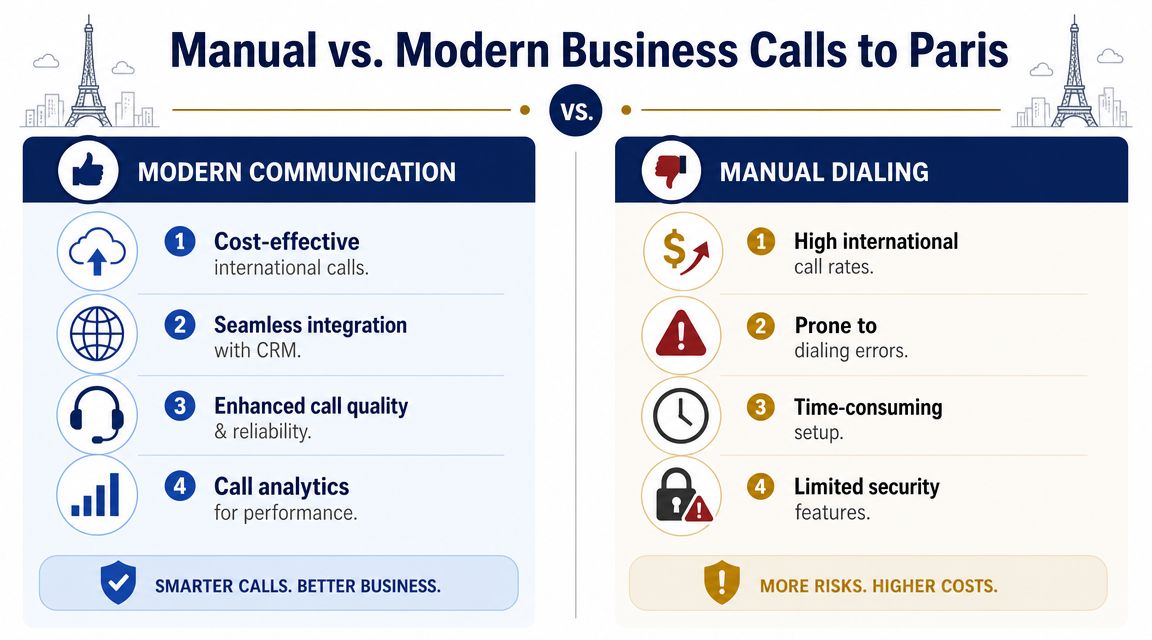
When a company calls Paris once in a while, manual dialing is manageable. When Paris becomes part of normal operations, manual dialing starts to show its limits.
Why direct dialing stops working well
A direct call from one employee's device is fragile. If that employee is traveling, offline, sick, or leaves the company, the communication chain breaks. The number may still be reachable, but the business process isn't.
That's why the actual issue isn't just international dialing syntax. As noted in RingCentral's view of the gap in “call France” guides, the harder business problem is reachability, cost management, and tying calls into the rest of your workflow.
Here's what direct dialing often lacks:
- Shared call visibility so teams can see what happened and what needs follow-up
- Routing logic for after-hours, overflow, or employee availability
- Unified devices so a user can answer from desktop, desk phone, or mobile app
- Business continuity when one person isn't available
What a cloud system changes
A cloud phone setup gives managers control that manual dialing can't. Calls can route to a queue, ring multiple devices, drop into voicemail with transcription, or pass through an auto attendant before they reach the right person.
That matters for support teams and distributed staff, but it also matters for a small company with one office manager and a few remote employees. Even a modest operation benefits when inbound and outbound communication runs through one managed layer instead of scattered personal devices.
If you regularly call contacts who may need language support, teams can also streamline communication with phone interpreters instead of leaving multilingual calls to improvisation.
The better question to ask
Instead of asking only, “What do I dial to call Paris?” ask this:
How should my team handle international communication so calls are answered, tracked, and easy to continue on any device?
That question leads to better infrastructure. It also reduces the friction that usually causes missed calls, duplicated effort, and poor handoffs between employees.
Key Considerations Before You Dial
Even with the right number format, calls can still go badly if you place them at the wrong time or from the wrong plan.
Timing matters more than people expect
Paris business hours won't line up neatly with every U.S. workday. Before you dial, check your local time against Paris and aim for a window when the recipient is likely to be at a desk, not commuting or off the clock.
For business teams, this is less about etiquette and more about efficiency. A well-timed call gets answered. A poorly timed one creates voicemail loops, email follow-ups, and delays.
Check the plan before you call
Don't assume your office line, employee mobile, or carrier bundle handles international calls the way you expect. Some plans require activation, special permissions, or a different dialing behavior.
Use a quick pre-call checklist:
- Verify calling permissions on the line or user account
- Confirm how your provider bills international calls
- Test the number format before a high-stakes call
- Decide who owns follow-up if the first call goes unanswered
Keep the opening simple
When you reach someone in Paris, a straightforward business introduction works best. State your name, company, and reason for calling clearly. If the call matters, have the local number, contact name, and any account details in front of you before you dial.
Troubleshooting and Tips for Phone Admins
When a call to Paris fails, the cause is usually basic. The most common problem is formatting the French number as if you were dialing inside France instead of from the U.S.
According to DialLink's explanation of calling France from the U.S., the correct format is 011 + 33 + 1 + the 8-digit local number, and a common failure point is keeping the domestic leading zero from a number written as 01 xx xx xx xx. That produces an invalid international format.
Common fixes for everyday users
Start with these checks:
- Remove the trunk zero if the number was copied from a local French listing
- Confirm international calling is enabled on the device or provider
- Try the saved number again after rewriting it carefully from the original source
- Check whether the issue is device-specific by testing from another approved line
A correctly formatted number still won't connect if the carrier or phone system blocks international outbound calling.
Admin advice for hosted systems
Phone admins should go one step further and standardize French contacts in E.164 format, which typically means storing the number with the country code and no domestic trunk prefix. That's especially useful for cloud PBX directories, CRM syncing, click-to-dial tools, and mobile softphones.
Also verify outbound permissions on your hosted PBX, SIP provider, or call policy settings. A lot of failed “bad number” complaints turn out to be blocked international dialing at the admin level, not user error.
If your team calls Paris often, build one tested contact record, use it as the directory template, and stop letting every user type the number from scratch.
If your business needs a better way to handle international calling than manual dialing, SnapDial gives teams a managed cloud phone system with business routing, mobile-ready calling, centralized administration, and support that helps you stay reachable without the chaos of scattered personal devices.