
You've got the classic symptoms already. Calls come in, the front desk or IVR sends them to whoever's free, and the customer ends up repeating the same problem to multiple people before someone with the right knowledge finally picks it up. By then, frustration's high, the agent is annoyed, and the business has burned time on avoidable transfers.
Skills based call routing fixes that mismatch. Instead of treating every available agent as interchangeable, it tries to match the caller's need to the right skill set from the first touchpoint, which is exactly why it's become a practical design choice in modern call-center environments and not just a nice-to-have software toggle (Wallace and Whitt paper).
Why Callers Hang Up and How Routing Fixes It
A caller reaches a small or midsize contact center with a billing dispute, gets routed to a generalist, then lands in collections, only to be bounced again because the account sits under a premium plan or a special exception. Each transfer adds friction, and by the third handoff the caller is already questioning whether anyone owns the issue.
Routing logic matters because it sends the request to the agent most likely to solve it on the first try, instead of sending it to whoever happens to be free. That operational choice is the core of skills-based routing, and it lines up with the way operations research treats inbound work, as the routing problem centers on matching caller needs to available agent capabilities while still managing service quality and wait time.
A round-robin queue can look fair and still produce poor outcomes when the next available person is not trained for the issue. In practice, that means more transfers, longer holds, and more repeat contacts than the operation planned for. I see this most often in businesses with separate billing, technical support, retention, and multilingual needs, where one queue cannot treat every call the same way.
Practical rule: if callers regularly need more than one department to solve the same issue, routing by availability alone is usually too blunt.
The impact goes beyond caller irritation. Agents spend more time triaging issues they cannot close and less time resolving the calls they were hired to handle, which hurts morale and slows down the queue. If your team is already seeing abandonment pressure, start by reviewing your call abandonment rate and comparing it with where transfers happen. The same routing mistakes usually show up in both places.
For a plain-language overview of routing mechanics, Simbie AI call routing explained is a useful companion read, especially if you are mapping routing rules inside a cloud PBX.
How Skills Based Call Routing Works
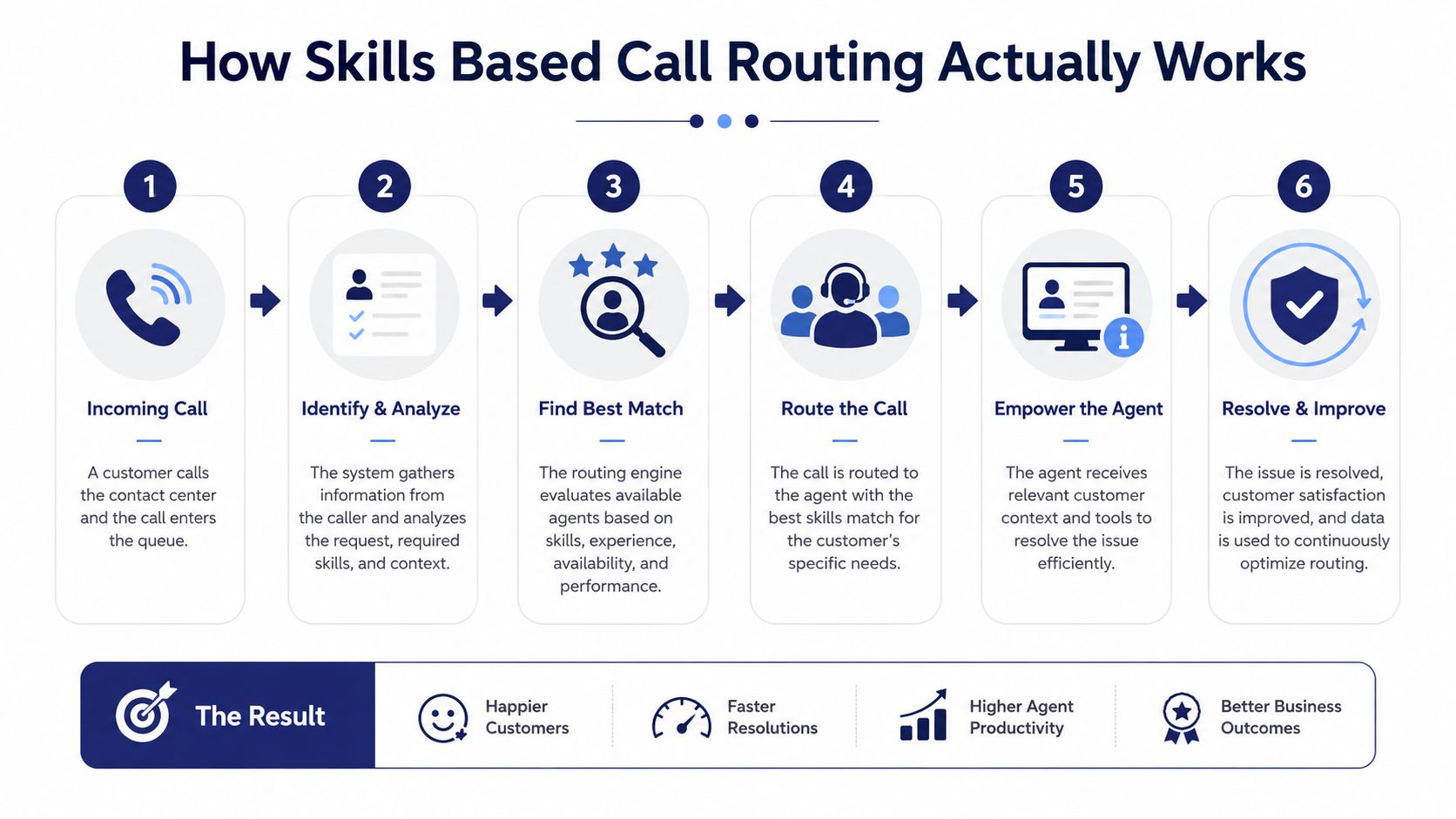
A caller reaches the queue, and the platform starts sorting before the call ever lands with an agent. In a cloud PBX or contact center, that usually means an ACD decision layer pulls in IVR selections, CRM data, ANI or DNIS details, and sometimes caller history, then compares that context against the agent skills matrix to decide who should take the call. The basic logic is simple: caller need on one side, agent capability on the other, then a routing decision in the middle, as outlined in this call routing guide.
The routing engine makes a match, then checks the fallback path
A hospital triage desk works in the same operational pattern. The first open room is not the deciding factor, symptoms, urgency, and specialist availability are. Skills-based call routing follows that same logic by scoring available agents against proficiency, idle time, and queue conditions so the call goes to the strongest fit first.
If no agent meets the minimum skill threshold within the configured wait window, the system should not sit on the call indefinitely. Overflow rules can relax the threshold or shift the call into a fallback pool, which keeps service moving and avoids letting one narrow rule block the whole queue. That fallback design matters in cloud PBX environments because routing has to protect quality and throughput at the same time.
A routing policy only works if it fails gracefully. When demand spikes, it needs a way to widen the pool instead of becoming the bottleneck itself.
For a plain-language overview of the term itself, Simbie AI call routing explained is a useful reference before you start tuning more advanced rules. If you are working in SnapDial, the starting point is usually call queues and routing behavior, then you refine the setup with skill assignments and queue logic.
The useful part is what happens after the first match
The biggest operational mistake is treating routing as a one-time decision. Good systems feed handle time, transfers, and resolution outcomes back into the skill model so the rules can be adjusted over time. That feedback loop keeps a routing configuration from drifting into guesswork and helps teams spot when a rule that looked clean on paper is creating avoidable transfers in live traffic.
In practice, the goal is not a perfect rule on day one. The goal is a clean matching model, a clear fallback path, and enough performance feedback to tighten skill thresholds when the queue proves they are too loose or too strict.
Measurable Business Benefits of Intelligent Routing
Skills-based routing pays off when it moves the numbers leadership already tracks. The clearest one is first-call resolution, because it shows whether the caller solved the issue without a second contact or a transfer chain. SQM Group reports that specialized agents handling matched call types achieve FCR performance that is 5% to 15% higher than generalist agents, and says intelligent skill-based routing can improve both FCR and customer satisfaction by the same 5% to 15% range (SQM Group).
That matters because FCR is more than a reporting metric. It changes how many repeat calls the team absorbs, how often agents get pulled into escalations, and how much time the operation spends on issues that should have been resolved the first time. When routing places expertise earlier in the call path, the queue wastes less effort on avoidable handoffs.
The CX and cost link is direct
Aircall's summary of SQM Group's independent research across 500+ North American contact centers says every 1% improvement in FCR produces a 1% improvement in customer satisfaction and a 1% reduction in operating cost (Aircall summary of SQM research). Executives usually understand that connection quickly, because it ties routing logic to satisfaction and cost in the same sentence.
| Business outcome | What routing changes | Why it matters |
|---|---|---|
| FCR | More calls reach the right expert on the first attempt | Fewer repeat contacts and transfers |
| Customer satisfaction | Less repetition and shorter problem paths | Callers feel understood faster |
| Operating cost | Less rework and fewer unnecessary escalations | Agents spend more time resolving, less time rerouting |
The practical takeaway is simple. Skills-based routing is not only a service tactic, it is a capacity strategy. When the right people get the right calls, the queue stays cleaner, the agent workload becomes more coherent, and the business stops paying for bad handoffs.
Real-World Use Cases and Sample Routing Rules
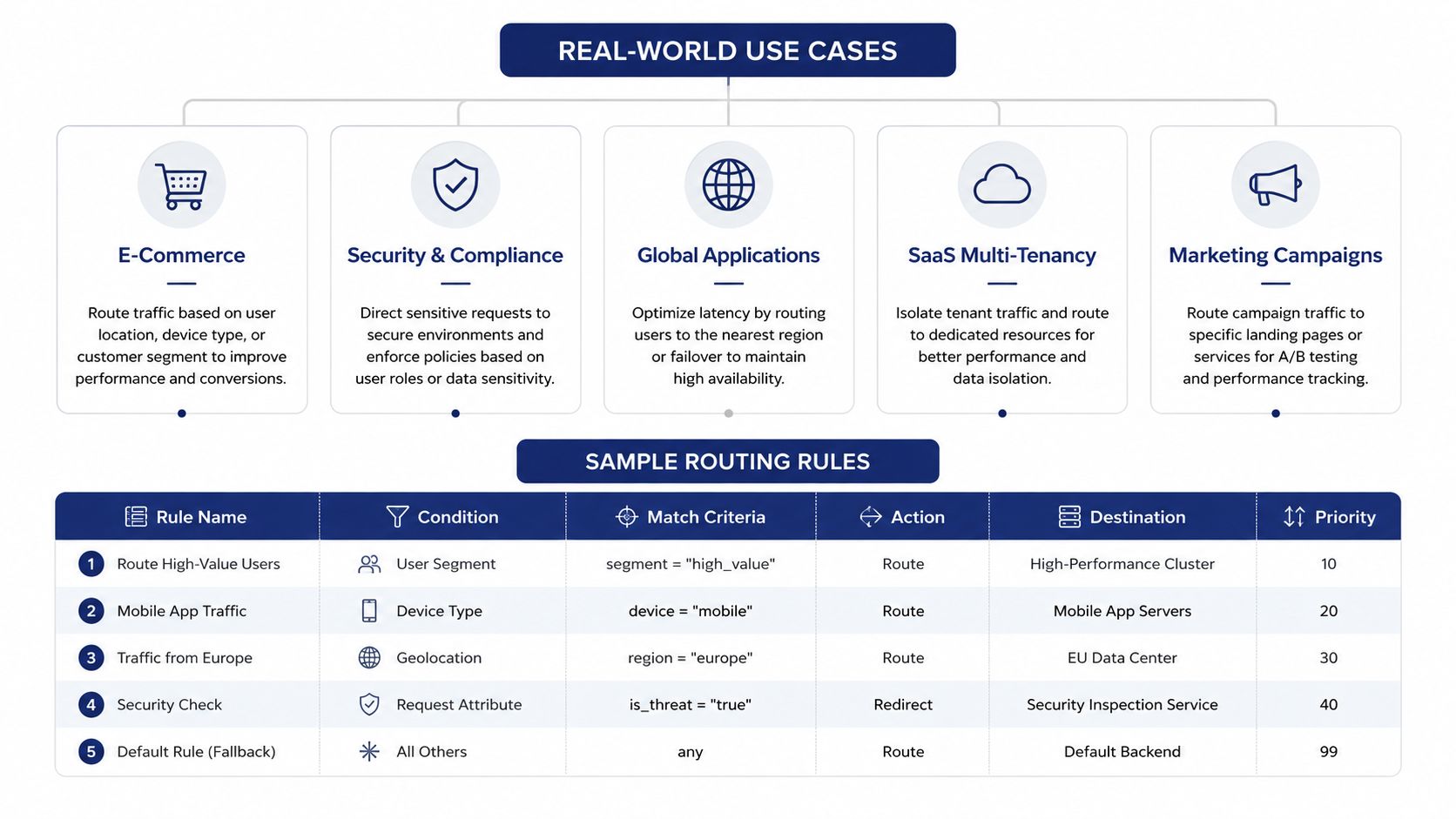
A SaaS company is usually the clearest place to start. Billing questions should go to finance-trained agents, while bugs and outages need product or engineering support. A simple rule set can route account questions by a billing skill tag and incident calls by a technical skill tag, then send overflow into a general support pool if the specialist queue is full. That setup keeps routine tickets moving without forcing every caller through the same path.
A multi-location healthcare practice needs a different structure. Spanish-speaking callers should reach bilingual staff first, and appointment cancellations can go to a scheduling pool that handles high-turnover tasks quickly. In that setting, language and task type matter more than call order, because the wrong assignment usually creates another callback or pushes the caller past a useful appointment window.
An e-commerce operation usually cares most about retention and recovery. If caller history identifies a VIP customer or someone tied to a recent delivery failure, the system can route that call to a senior retention specialist instead of a standard service agent. That is not about giving one caller special treatment. It is about matching urgency and business value to the right level of response.
Sample routing rules that actually make sense
| Scenario | Skill rule | Routing behavior | Overflow rule |
|---|---|---|---|
| SaaS billing | Billing-trained agent required | Send to finance queue first | Relax to general support after wait threshold |
| Healthcare language support | Bilingual skill required | Prefer bilingual pool | Expand to broader team if no match appears |
| E-commerce retention | VIP or retention tag | Route to senior specialists | Fallback to standard support with priority |
The test is whether supervisors can maintain the rules without guessing. If a routing rule needs a long explanation every time staffing changes, the logic is too hard to run cleanly.
I have seen teams overbuild this part by adding too many tags at once. Start with the few categories that drive transfers, then add nuance only where the call data shows it is needed.
Implementation Best Practices and Troubleshooting
A solid rollout starts with a skills inventory, not a routing rule. Before you turn anything on, document who can handle what, what they can handle well, and what they can handle only with backup. That's the difference between a useful matrix and a paper exercise.
Build the matrix around proficiency, not just yes or no
Binary skill tags are too crude. A new hire who can take billing calls under supervision isn't the same as a senior specialist who closes edge cases without escalation, so the matrix should reflect that difference. In cloud PBX systems that support more advanced routing, that usually means separating baseline eligibility from stronger proficiency levels.
Track the KPIs that show whether the routing logic is helping or hiding problems. Average handle time, first-call resolution, average wait time, and transfer rate are the four that tell the clearest story in day-to-day operations.
Don't tune for elegance. Tune for fewer transfers, cleaner queues, and fewer calls that come back the same day.
Troubleshooting usually falls into three patterns
If calls are waiting too long, the skill filter is probably too restrictive. Relaxing the threshold, widening the fallback pool, or allowing a broader expert group to pick up overflow traffic usually fixes that faster than adding headcount.
If one specialty keeps getting buried during peak hours, the issue may be the skill mix, not the routing rule. You may need more cross-trained agents so the queue can absorb demand spikes without leaving expert-only work stranded. Academic work on staffing with skill-based routing shows that routing policy and staffing mix are interdependent, so queue performance depends on how overlap between skill sets is engineered (ScienceDirect article).
If transfers drop but resolution quality doesn't improve, the routing rule may be sending too many borderline calls to the same small group. That's when handle-time feedback matters, because it tells you whether the routing model is concentrating work efficiently or just concentrating pain.
A practical launch checklist usually looks like this:
- Map the top call types first. Start with the issues that create the most transfers or repeat calls.
- Assign skill levels clearly. Define who is eligible, who is preferred, and who is backup.
- Set a fallback path. Make sure no call can sit in a dead queue.
- Review queue stats daily at launch. Watch wait time and transfer rate before changing anything else.
- Adjust one rule at a time. If you change too many variables at once, you won't know what helped.
If you want a managed cloud PBX environment that includes routing, queue handling, reporting, and IVR under one roof, SnapDial is one option to evaluate alongside your current stack. The point isn't the brand name, it's whether the system lets you maintain the skills model without turning every change into an IT ticket.
Skills Based Routing Versus Simpler Alternatives
Round-robin routing works well when every agent can handle nearly every call. It is easy to explain, easy to administer, and often enough for very small teams with similar work. Once call types start to vary, though, rotating calls evenly can feel fair to the queue while still being unfair to the caller.
Time-based routing is useful when call flow needs to follow hours, locations, or shift patterns. It gives operations more control, but it still does not solve expertise matching. A caller who needs a product specialist at 4 p.m. still gets stuck if the next available generalist receives the call.
Simultaneous ring is the bluntest option. It is simple, and in a tiny team it can cover basic demand, but it does not preserve specialist capacity very well when harder issues arrive. Skills-based routing matters more as product complexity and customer expectations rise, because the routing decision has to do more than find any open phone.
| Routing Method | Best For | Setup Complexity | FCR Impact |
|---|---|---|---|
| Round-robin | Small teams with similar skills | Low | Limited |
| Time-based | Shift-driven operations | Low to moderate | Limited |
| Simultaneous ring | Very small groups, simple coverage | Low | Limited |
| Skills based routing | Mixed issue types, specialist teams, larger queues | Moderate to high | Stronger when skills are mapped well |
The practical cutoff is usually easy to see. If you can describe your call types in one sentence and every agent handles the same work, a simpler route is fine. If callers regularly need different expertise, the more advanced model reduces handoffs and shortens the path to resolution. It also gives managers a cleaner way to protect specialist time instead of scattering those calls across whoever happens to be free.
That trade-off matters in cloud PBX environments, where routing changes can be made quickly but bad rules also spread quickly. If you need a structured example of how agent capability can be organized, Frida's skill set shows the kind of inventory that makes routing rules easier to maintain over time. For queue behavior and rule setup, the call queue documentation is the right reference point for how routing logic connects to live queue handling.
How SnapDial Supports Skills Based Call Routing
SnapDial's cloud PBX and call-center tooling line up well with the routing mechanics described above. The Auto Attendant and IVR can capture caller intent at the first touchpoint, which gives the routing engine useful context before an agent is selected. Administrators can manage routing rules, user settings, and queue behavior in the self-service portal instead of opening a ticket every time the business changes a skill assignment.
That matters in real operations, because routing only stays accurate if the skill inventory stays current. If your team needs a reminder on the discipline behind that, Frida's skill set is a good example of how a structured skill inventory can be organized around agent capability rather than just job title.
SnapDial also supports the operational layer that keeps routing from becoming brittle. Features like smart queue management, queue callback, wait-time announcements, real-time statistics, and detailed reporting give supervisors the visibility they need to see whether the routing logic is working or drifting. The call queue documentation is the right place to map those queue behaviors to your own team structure.
The practical advantage is continuity. A team can move from a legacy PBX to a cloud environment, keep the call flow intact, and then refine the routing rules as call patterns become clearer. With white-glove setup and 24/7 Texas-based support, the migration path is less about rebuilding the phone system from scratch and more about tightening the routing model around the work your team already does.
If you're ready to reduce transfers and route callers to the right expert faster, explore how SnapDial handles IVR, queues, and call routing in one cloud PBX. It's a practical next step if you want skills based call routing without stitching together separate tools and manual workarounds.