
Your front desk is tied up. Sales is on another line. A customer calls with intent to buy, book, or get help. They wait, hear hold music, get shuffled through a menu, and hang up.
That hang-up usually doesn't feel dramatic inside the business. Nobody sees the caller roll their eyes, move to a competitor, or decide not to try again. All you see is one more missed interaction in the phone log. That's why the call abandonment rate matters so much. It turns a vague sense of “we're probably missing some calls” into a hard operating signal you can manage.
For small and mid-sized businesses, this metric is often the fastest way to spot whether the phone system is helping your team or getting in the way. If you're already relying on tools like missed call notifications, you've seen the symptom. The next step is understanding the pattern behind it.
That Call You Just Missed Was More Than a Hang-Up
A missed call isn't just a phone event. It's usually a customer decision.
Maybe it was a new lead calling during lunch when half the office was away from their desks. Maybe it was an existing customer who picked up the phone because email felt too slow. Maybe it was a patient, a tenant, a buyer, or a client who already had a problem and wanted a fast answer. They called because the issue mattered enough to speak to a person.
Then they waited. And left.
That moment carries three costs at once:
- Immediate loss: You may have lost a sale, an appointment, or a service opportunity.
- Customer frustration: The caller now associates your brand with delay.
- Operational blind spot: If nobody measures the pattern, the team keeps treating each hang-up as a one-off.
Most owners don't have a “phone problem.” They have a queueing, routing, or coverage problem that shows up through the phone.
When callers abandon, they're telling you something about your operation. Usually they're saying the path to a human is slower or more confusing than they expected.
This is why seasoned contact center teams track abandonment closely. It isn't a vanity metric. It sits close to revenue, service quality, and staffing decisions. When the number rises, something is usually off. Sometimes it's obvious, like too few people answering calls at peak times. Sometimes it's structural, like a clunky IVR, bad routing logic, or no callback option.
The fix starts when you stop treating abandoned calls as random noise and start treating them as operational evidence.
What Is Call Abandonment Rate and Why It Matters
Call abandonment rate is the percentage of inbound callers who hang up before reaching an agent or representative. On paper, that sounds simple. In practice, it's one of the clearest indicators of whether your phone operation feels usable to customers.
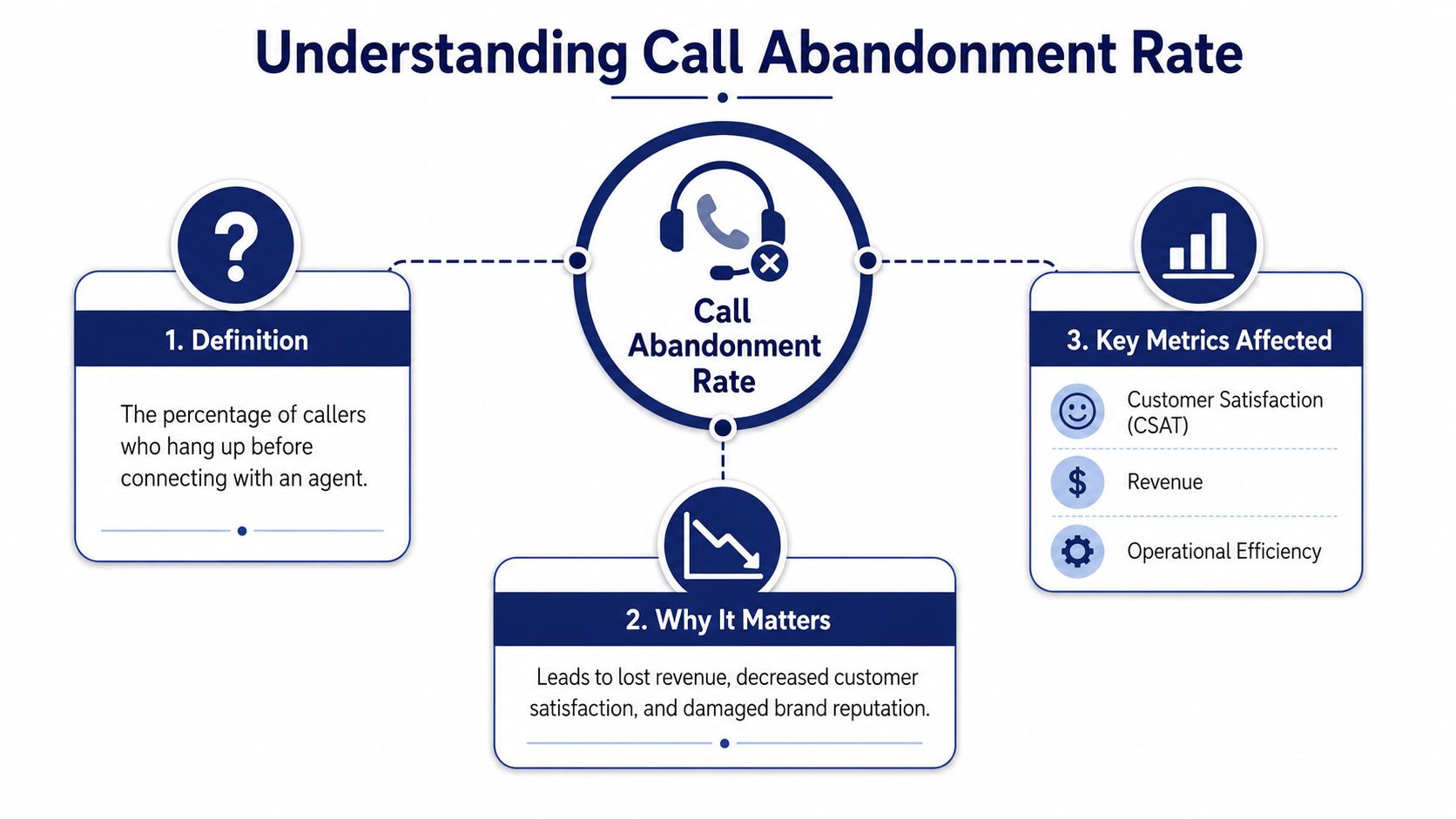
A lot of SMB owners underestimate the damage because abandoned calls don't always create a visible complaint. The customer disappears. That's what makes the metric dangerous. A poor website conversion path usually gets reviewed. A poor phone experience often gets normalized.
Why this KPI hits harder than most
When abandonment rises, it usually means the caller experience has already broken down. They didn't leave because they were neutral. They left because waiting, navigating, or repeating themselves became too frustrating.
That frustration has measurable consequences. Empirical data shows that when abandonment exceeds 5%, customer satisfaction scores correlate with an 80% reduction, driven primarily by queue wait times over 20 seconds, which is also the threshold where 80% of callers historically disconnect, according to Geckoboard's call abandonment rate benchmark guide.
For an owner or operations lead, that matters in practical terms:
- Sales teams lose reachable demand: People who wanted to talk now never enter the pipeline.
- Support teams create repeat work: Customers who hang up often call back later, sending more volume into the same strained queue.
- Managers make bad decisions: Without tracking the metric, teams assume they need more people when the underlying issue may be poor routing or weak queue design.
What the metric is really telling you
A healthy abandonment number usually means your business is doing several things right at once. Calls are getting answered quickly enough. Menus are understandable. The caller reaches the right person without bouncing around. Peaks are visible before they become chaos.
That's why strong phone operations are part of broader call center operations, even for companies that don't think of themselves as running a “call center.” If your business depends on inbound calls, you are running one. It may just be informal.
Practical rule: If customers still prefer to call for urgent or high-intent issues, abandonment is not a side metric. It's a frontline customer experience metric.
How to Accurately Calculate Your Abandonment Rate
You can't fix what you don't measure correctly. And this is one metric that teams often calculate badly.
The basic version is straightforward:
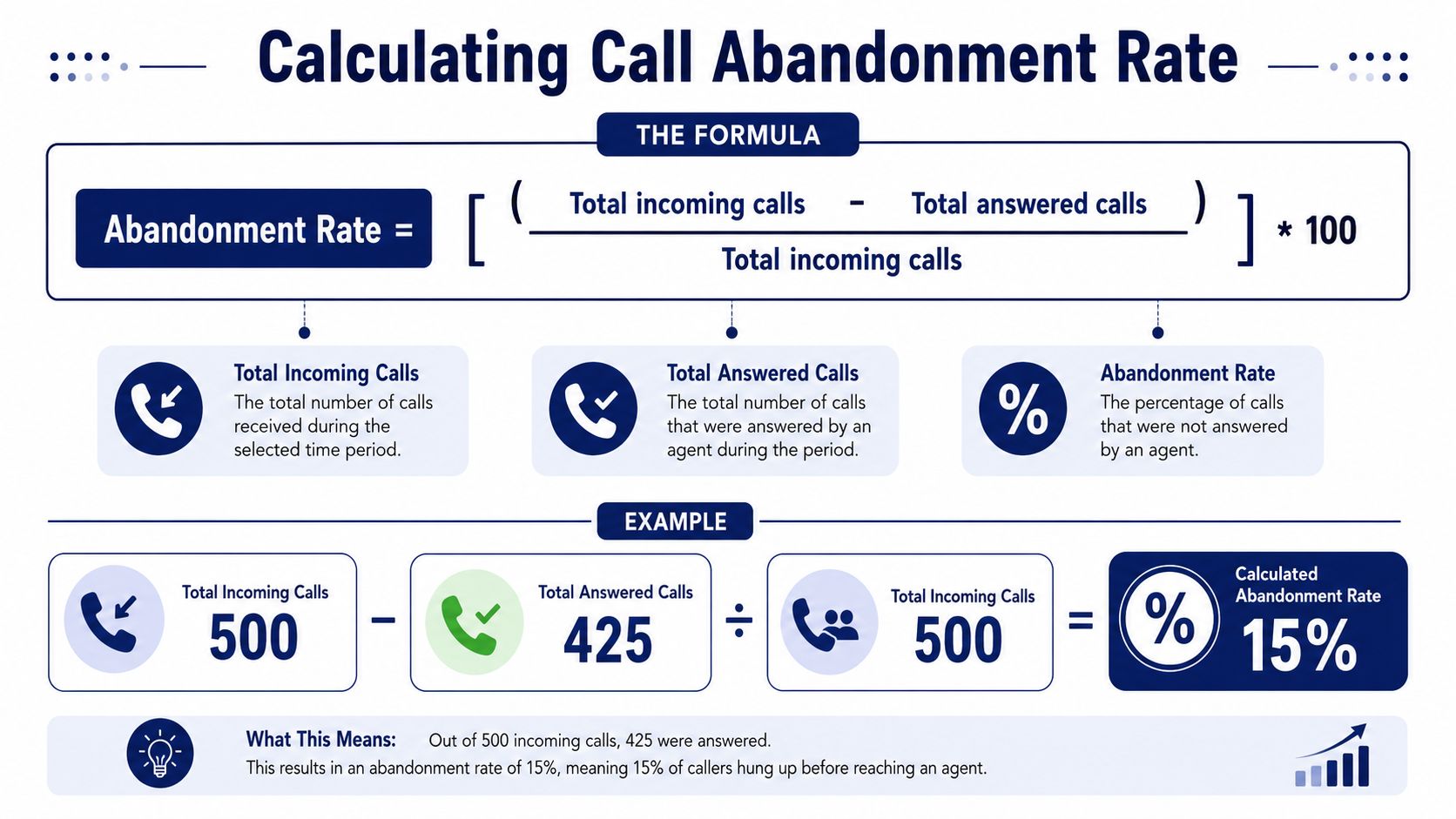
Abandonment Rate = [(Total incoming calls – Total answered calls) / Total incoming calls] × 100
The infographic example uses 500 incoming calls and 425 answered calls, which produces a 15% abandonment rate. That math is fine as a starting point because it quickly shows whether you have a serious gap.
The professional adjustment that changes the result
The problem is that not every disconnected call reflects a service failure.
Some callers misdial. Some hit the wrong extension and hang up immediately. Some calls drop so quickly that counting them as “abandoned” tells you nothing useful about customer frustration. That's why technical specifications for accurate call abandonment rate calculation require excluding “short abandons,” meaning calls terminated within 5 or 10 seconds, as explained in SQM Group's guide to call abandonment rate.
Their recommended formula is:
((Received Calls – Calls Abandoned >10s – Handled Calls) / Received Calls) × 100
That nuance matters more than is widely recognized.
If you count every fast disconnect as an abandonment, you'll overstate the problem and often throw staff at what is actually bad data.
A simple before-and-after example
Say you receive 500 inbound calls.
- 425 were answered
- 75 were not answered
Using the basic formula, your abandonment rate is 15%.
Now look closer. If part of those unanswered calls were very short disconnects, your real service problem may be smaller than the raw number suggests. You still have an issue. But now you're looking at the issue more accurately.
That's not just a reporting detail. It changes decisions about staffing, callback thresholds, queue alerts, and IVR design.
What to check before trusting your number
A clean abandonment metric depends on disciplined reporting. Teams that want get auditable answers for your business should treat phone reporting the same way they treat financial reporting. Define the logic once, document it, and make sure everyone reads the same number the same way.
Use this checklist:
- Exclude short abandons: Follow a clear threshold of 5 or 10 seconds.
- Separate business-hours and after-hours traffic: A caller hanging up when nobody is open is a different operational issue from a queued caller giving up.
- Compare system sources: If ACD reports and carrier reports don't align, check for logging or configuration problems.
- Review by queue, not just company-wide: A blended number can hide one team that is failing badly.
A sloppy abandonment rate creates sloppy fixes. An accurate one gives you a real operating lever.
Understanding Industry Benchmarks and Targets
Once you trust your number, the next question is whether it's good.
The broad benchmark is clear enough to be useful. The cross-industry average call abandonment rate globally sits between 5% and 8%. Top performance is under 3%, and rates above 8% to 10% are a red flag for severe operational problems, according to this benchmark summary of abandonment rate standards.
But broad benchmarks only get you so far. They're a starting point, not a verdict.
One target doesn't fit every operation
A retailer with simple pre-sales questions should usually expect lower abandonment than a healthcare practice handling urgent, complex, emotionally charged calls. The phone flow, caller patience, and transfer complexity are different.
That's why a flat benchmark can mislead owners in both directions. Some teams panic when they're operating within the context of their industry. Others feel comfortable with a number that would be unacceptable in a less complex environment.
Here's a practical comparison table based on the verified benchmark ranges available.
| Industry | Acceptable Rate | High Rate (Needs Attention) |
|---|---|---|
| Cross-industry general benchmark | 5% to 8% | Above 8% to 10% |
| Top-performing contact centers | Under 3% | 3% and above moves away from top-tier performance |
| Healthcare and medical practices | Up to 10% to 15% can occur due to sector-specific factors | At the upper end of that range, review routing, urgency handling, and callback design |
How to set a target that's usable
Set a target that reflects your actual call environment:
- If calls are transactional: Push toward the lower end of the general benchmark.
- If calls are complex: Allow more room, but don't use complexity as an excuse for avoidable friction.
- If you're multi-location: Track each site or queue separately. A portfolio average can hide weak locations.
- If your team handles multiple call types: Set different internal targets by intent, not one blanket rate.
If you want a wider management view than abandonment alone, it helps to look at beyond CSAT customer service metrics so you can compare abandonment against service level, queue behavior, and operational efficiency rather than treating it in isolation.
The right target isn't the one that sounds impressive. It's the one that matches your call mix and still pushes the operation to improve.
Common Causes of High Call Abandonment
A customer calls during lunch rush, gets stuck in a long queue, hears a vague hold message, reaches the wrong person, and hangs up before anyone solves the problem. That abandonment did not start with impatience. It started with a process failure.
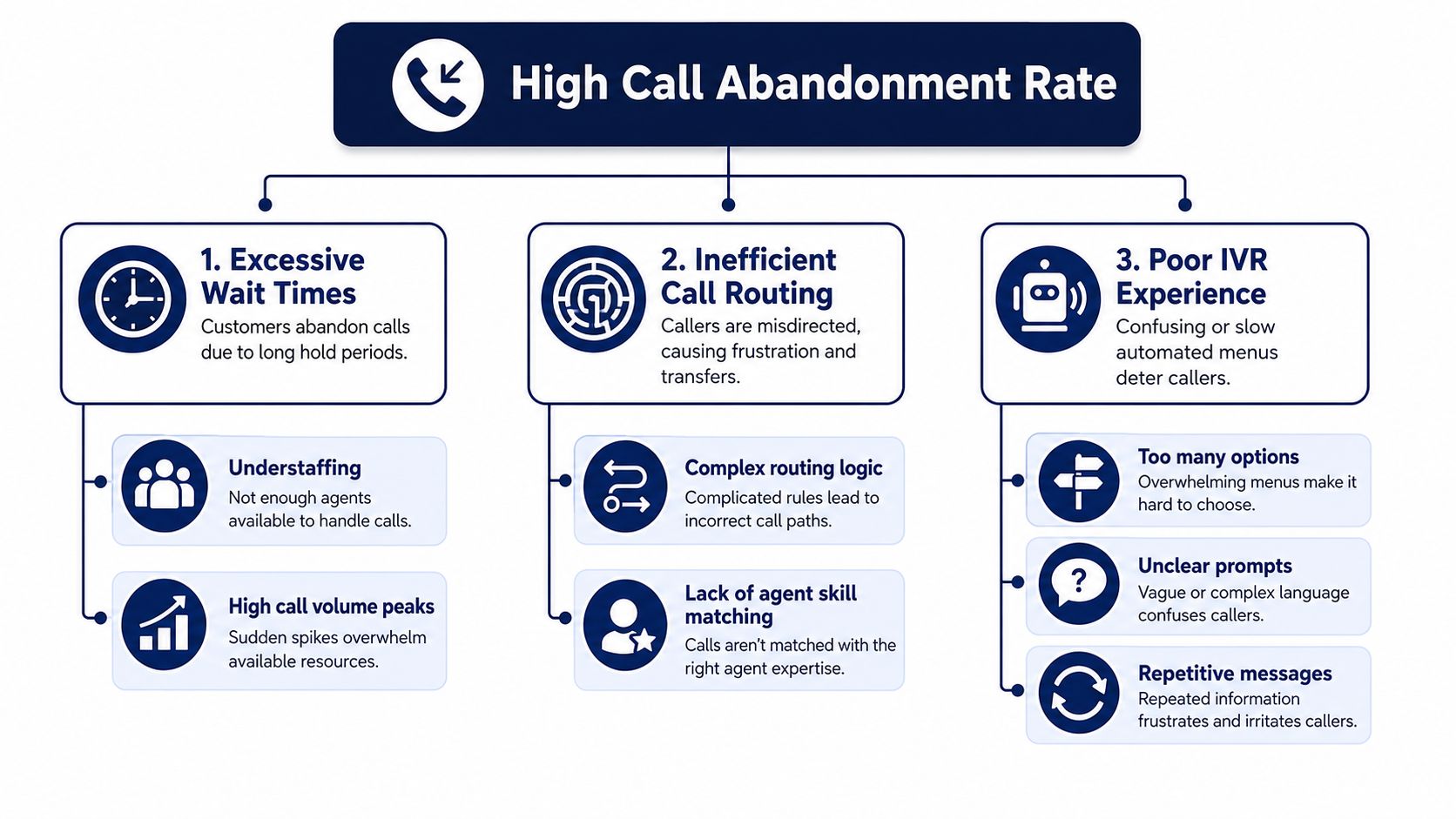
In practice, high abandonment usually comes from three places: coverage gaps, poor call flow, and avoidable caller friction. The reason that matters is simple. Each cause needs a different fix. If you treat all abandonment as a staffing problem, you spend more on payroll and still leave the actual bottleneck in place.
Staffing and operations
Coverage mismatch is still a common cause. Many SMBs staff for an average hour, but calls arrive in bursts. Opening time, lunch, late afternoon, and post-campaign spikes can overload a small team fast.
Watch for patterns like these:
- Peak-hour spikes: Abandonment rises at the same times each day or week.
- Break overlap: Too many agents or front-desk staff step away at once.
- Single-point dependency: One person handles scheduling, sales inquiries, and service calls, so one absence or busy stretch backs up the whole queue.
Hiring may help, but it is rarely the whole answer. A better first move is to check whether your cloud phone system can spread calls across users, locations, mobile devices, or overflow paths before the queue builds.
Routing and system design
Here, I see the biggest avoidable losses.
Callers will tolerate some wait if the path feels logical. They hang up faster when the system sends them in circles, drops them into the wrong queue, or forces a transfer that should have been prevented upstream.
The usual failures are operational, not mysterious:
- Too many transfers: The first person answers, but cannot resolve the issue.
- Skill mismatch: Calls land with whoever is available, not whoever can help.
- Bad queue logic: Ring groups, hunt order, and department routing do not match real call intent.
- No overflow plan: Once the main team is busy, calls just stack up instead of moving to a backup path.
That last point hits revenue directly. Sales and service teams that care about capturing every lead need overflow handling built into the call flow, not left to chance.
Customer experience friction
Some callers abandon before staffing or routing even has a chance to work.
Confusing IVR menus, repeated prompts, long silence on hold, and generic announcements all create uncertainty. Uncertainty shortens patience. If the caller does not know how long the wait is, whether they picked the right option, or whether anyone is going to answer, the call feels low priority.
Channel mismatch adds to the problem. If your website, chat, or scheduling form fails, customers call as a fallback. Those calls often arrive already frustrated, which means they abandon faster when the phone experience is clunky.
A quick diagnosis framework
Use four questions to find the cause:
- When does abandonment spike? Time patterns usually point to coverage gaps or poor scheduling.
- Where does the caller drop? In the IVR, in queue, or after a transfer.
- Which call types abandon most often? New sales, support, billing, and appointment calls usually behave differently.
- What did the caller experience before hanging up? Silence, menu confusion, repeated transfers, or no clear next step.
Clear answers usually expose a specific fix. That is the key point. High abandonment is rarely one big problem. It is usually several smaller call-flow problems hiding inside the same metric.
How to Reduce Call Abandonment with a Cloud Phone System
A customer calls during lunch, hears two menu prompts, sits in silence for a minute, and hangs up before anyone answers. The problem is not always headcount. In many SMBs, it is call design.
A modern cloud phone system reduces abandonment by fixing the points where callers lose confidence: long hold times, unclear next steps, bad routing, and no recovery path when no one is free. If you are still relying on a legacy PBX or a basic multiline setup, staff end up compensating for process failures by working harder. That gets expensive fast, and it still leaves callers waiting.

A cloud phone system changes that operating model. It gives you queue control, routing rules, mobile answering, reporting, and overflow handling in one place. That matters because abandonment usually comes from several small breakdowns in the call flow, not one dramatic staffing issue.
Match the feature to the failure point
Start with where the call is failing.
If callers give up during long holds, turn on queue callback. That keeps their place in line without forcing them to sit on hold and wonder if anyone will pick up. Callback does more than reduce frustration. It protects sales and service calls that would otherwise disappear during busy periods.
If callers drop because the experience feels uncertain, add wait-time announcements and short queue messages that confirm they are in the right place. People are more patient when the system tells them what is happening and what to expect next.
If callers are reaching the wrong team, fix routing logic before you add labor. Clean IVR paths, skill-based routing, and priority rules for high-value calls usually cut abandonment faster than extending hold capacity. I have seen small teams lower missed-opportunity volume just by sending new sales calls to the first available qualified rep instead of a general line.
Reduce pressure before the queue forms
The best cloud setups keep low-urgency and misdirected calls from clogging the same queue as urgent ones.
Use tools like:
- Auto attendant with clear menu paths: Keep prompts short, specific, and based on customer intent.
- Direct-to-device routing: Let available staff answer from desktop and mobile apps instead of sending every call through a front desk bottleneck.
- Business-hour rules and overflow routing: Route calls to an alternate team, answering service, or voicemail path with a clear next step instead of letting calls ring out.
- Voicemail transcription and call logs: Give staff a fast way to recover missed conversations and respond in order of value or urgency.
Overflow planning deserves special attention. If your business gets sudden call bursts, you need a defined process for capturing every lead, not a hope that someone will grab the next ring. Good systems route overflow intentionally. They do not just let the queue get longer.
A short demonstration helps make that real:
Use reporting to prevent repeat failures
The biggest gains usually come after setup, once managers can see exactly where callers are dropping.
Real-time dashboards and queue reports show abandonment patterns:
- By time of day
- By queue or department
- By agent group
- By short-abandon pattern versus true wait abandonment
That view changes the conversation. Maybe the fix is turning on callbacks before the lunch rush. Maybe one IVR branch causes confusion and needs to be shortened. Maybe after-hours calls need a better overflow destination, not another person on payroll.
The practical trade-off is simple. Staffing still matters, but staffing alone is the blunt instrument. Cloud phone features let you target the cause. You can reduce hold time pressure, route high-intent calls faster, recover missed demand, and make better scheduling decisions with actual queue data.
If your business is losing callers before they reach a person, it may be time to replace reactive phone coverage with a system designed for modern inbound demand. SnapDial gives SMBs and growing teams the cloud calling tools that directly address abandonment, including smart queue management, queue callback, wait-time announcements, mobile-ready routing, and real-time reporting.