
Most advice on reducing operational costs starts with a list of things to cut: staff, software, suppliers, office space, or equipment. That approach often lowers a visible bill while raising a less visible one. A cheaper phone system can create missed calls, a smaller support team can lengthen queues, and a canceled tool can return work to spreadsheets and manual administration.
The better question is how to reduce operational costs without weakening the activities that protect revenue, quality, and resilience. That requires a cost map before a cost cut. For an SMB, communications are a practical place to begin because phone contracts, hardware, support, user administration, missed contacts, and downtime often sit across different budgets.
A disciplined program measures the full cost of each process, benchmarks capacity rather than invoices alone, tests changes against service outcomes, and records whether projected savings materialize.
Stop Cutting Before You Start Measuring
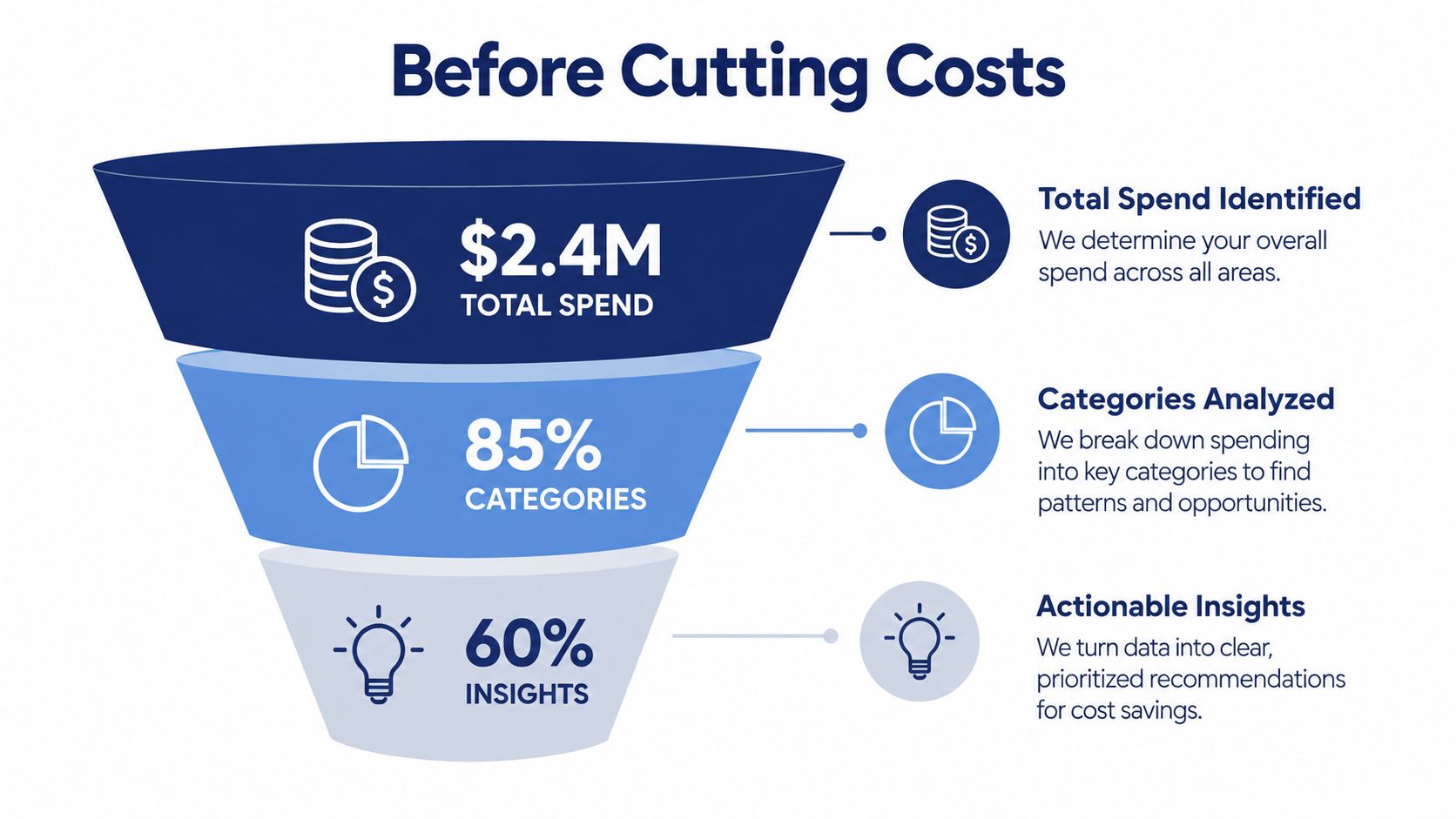
Indiscriminate cost cutting feels decisive because the result appears quickly in the accounts. The problem is that accounting visibility and operational visibility aren't the same thing. Removing a software subscription may save money immediately, but if employees then spend more time reconciling data manually, the business hasn't removed the cost. It has moved it.
A 2025 Australian survey of 1,136 small businesses found that rent and utilities, business inputs, staff costs, and administrative overhead were among the largest expense categories, while technology and software represented 26% of reported expenses. Nearly one-third of respondents were already cutting tools, machinery, or equipment to manage costs, according to the survey of small-business conditions.pdf). That creates a clear risk: visible technology savings can produce hidden labor, service, and reliability costs.
Build a process-level cost map
Start with the activity, not the department. A communications process might include the phone subscription, handsets, internet dependencies, user changes, call routing, transcription, reporting, training, troubleshooting, and the employee time spent administering separate systems.
For each process, record:
- Direct spend: invoices, licenses, maintenance, hardware, and contractor fees.
- Internal effort: hours spent configuring users, handling exceptions, compiling reports, or correcting errors.
- Failure cost: missed calls, rework, delays, abandoned queues, and recovery labor.
- Control value: security, compliance, redundancy, customer access, and continuity.
- Change cost: migration, training, integration, testing, and vendor management.
This is total cost of ownership, applied to an operating process rather than a product brochure. It helps distinguish structural waste from a cost that earns its place by protecting service or capacity. Teams looking for a practical way to connect measurement with process improvement can use this guide to SME operations KPIs and automation as a reference point.
Practical rule: Never approve a cut until someone names the work that will disappear, the work that will remain, and the metric that will prove service hasn't deteriorated.
A useful communications baseline includes cost per successful customer interaction, administrative hours per user change, answer and abandonment patterns, response time, support tickets, and downtime. The phone bill matters, but it isn't the whole operating model. Once those measures exist, you can remove duplicate contracts or manual tasks with confidence instead of treating every line item as equally disposable.
Building a Benchmark-to-Execution Cost Program
A cost program should begin with visibility, not a savings target. Set a baseline, assign an owner, and distinguish planned savings from savings that reach the operating result. McKinsey's review of 24 industrial companies found that a structured benchmark-to-execution approach reduced indirect costs by 15–20% over 12–18 months. That result is not an SMB forecast. It shows why disciplined execution usually beats isolated budget cuts. See the McKinsey review of indirect-cost reduction for the framework.
Use six connected steps
Map the current state. Group indirect costs by function, activity, location, and vendor. Follow the work across teams rather than relying on the organization chart.
Standardize definitions. Agree on what counts as a customer interaction, support ticket, active user, location, and administrative task. Consistent definitions prevent debates over incompatible spreadsheets.
Benchmark capacity. Compare cost per employee, user, ticket, location, or successful interaction. Raw spend can misrepresent an efficient regional team when wages, inflation, or geography differ.
Quantify opportunities. Estimate the labor hours, errors, delays, duplicate licenses, and recovery work a change could remove. Keep recurring savings separate from one-time implementation costs.
Prioritize the intervention. Choose digitization, consolidation, outsourcing, or process redesign according to service impact and implementation effort. A smaller, low-risk saving may outperform a larger theoretical saving that depends on a fragile migration.
Govern the result. Name the owner, milestone, baseline, implementation date, and benefits record. After launch, track recurring savings, one-time costs, and service-level effects.
Measure what the operation produces
Two locations can pay different communications costs while delivering different workloads. An invoice comparison alone cannot explain the gap. Compare cost per employee, queue interaction, successful interaction, answer time, and administration hours so managers can see whether a price difference reflects activity or waste.
McKinsey reports typical impacts of 5–15% from reducing work packages, reports, and meetings, and 5–10% from reallocating responsibilities among local, central, and external teams, as stated in the same McKinsey indirect-cost research. Treat those figures as investigation categories, not automatic targets. Validate the work removed, the service effect, and the implementation burden before counting any saving.
The benefits register should record the baseline, accountable owner, expected recurring saving, one-time investment, launch date, and effect on availability or customer response. Teams can use resources such as find money-saving opportunities to generate options, then have finance and operations test each one against actual workload and outcomes. Communications consolidation is a useful starting point because it exposes duplicate contracts, administrative effort, and service dependencies that broader cost reviews often miss.
Consolidating Communications and VoIP Infrastructure
Communications costs rarely live in one place. A business may pay for a legacy PBX, separate mobile services, conference software, call recording, faxing, reporting tools, support contracts, and internal IT time. The monthly phone invoice can look acceptable while the combined operating model remains expensive to administer.
A legacy on-premise system usually carries hardware ownership, maintenance, upgrades, specialist support, physical dependencies, and replacement planning. A hosted VoIP model shifts much of that infrastructure into a managed service, but the comparison still needs to include implementation, number porting, user training, call-flow testing, security controls, and fallback procedures.
| Cost factor | Legacy PBX | Hosted VoIP |
|---|---|---|
| Hardware | Business-owned equipment and replacement planning | Provider-managed platform, with compatible endpoints |
| Administration | Often dependent on internal specialists or contractors | Web-based user and routing administration |
| Expansion | May require capacity planning and hardware changes | Usually configured through the hosted platform |
| Reporting | Can require separate tools or manual exports | Often included with call logs and reporting features |
| Risk to assess | Hardware failure and site dependency | Connectivity, vendor dependency, and migration quality |
Consolidate the work, not just the contracts
The strongest case for consolidation isn't a lower subscription in isolation. It comes from removing duplicate administration and giving staff one operating system for calling. Auto-attendant routing, mobile applications, visual voicemail with transcription, call queues, recordings, reporting, and user changes can reduce the number of handoffs between systems.
For a multi-location company, centralized administration can make onboarding and routing changes more consistent. For a call center, queue callbacks, wait-time announcements, real-time statistics, and detailed reporting can help managers identify service problems before they become recurring rework. The business should track answer rates, abandoned contacts, callback completion, resolution time, and administrative hours before and after a change.
Cost test: Compare the fully loaded cost of the current communications process with the fully loaded cost of the replacement. Include migration labor, training, support, failure recovery, and the value of employee time.
A hosted provider such as SnapDial offers all-inclusive pricing, end-to-end setup, cloud calling, mobile access, routing, reporting, and ongoing support as part of a managed communications model. That makes it one possible entry point for an audit, not a substitute for measuring service quality. Businesses evaluating VoIP solutions for small business should ask who owns configuration, how outages are handled, how users are trained, and which reports will be available after implementation.
The decision is sound when consolidation removes duplicated tools and manual work without creating new availability or compliance risks. It isn't sound when management chooses the cheapest monthly plan and ignores connectivity, support coverage, or the work required to make the system reliable.
Implementing Automation Without Ignoring the Human Factor
Automation reduces operating costs when it removes repetitive work and preserves or improves the output. It doesn't create savings because software performs a task. Someone still has to redesign the workflow, define exceptions, train users, test results, monitor failures, and decide what happens when the automated path cannot complete the job.
McKinsey Global Institute's 2017 analysis estimated that automation could increase worldwide productivity growth by 0.8 to 1.4 percentage points annually. The same automation analysis found that potential labor-cost savings vary substantially by activity and industry, from approximately 10–15% of operating costs in examples such as hospital emergency departments and grocery stores, about 25% in aircraft maintenance, and more than 90% in mortgage origination.
Those ranges show why no responsible operator should apply a generic automation target. Communications teams should examine call routing, queue handling, call logging, transcription, reporting, and administrative user changes, then calculate the current labor and error cost for each activity.
Calculate the loaded cost
Before buying automation, document:
- Current effort: Manual hours, rework, corrections, and supervision.
- Implementation effort: Migration, integration, number-porting work, configuration, and testing.
- Workforce impact: Training, process ownership, quality assurance, and exception handling.
- Reliability cost: Monitoring, fallback procedures, vendor support, and recovery when the system fails.
- Service effect: Answer rates, abandonment, resolution time, customer access, and compliance.
A 2025 Chase survey found that 48% of respondents planned to add AI tools, particularly for customer service and chatbots, while 59% identified wages as their primary cost driver, as reported in the 2025 Business Leaders Outlook. Interest in automation is therefore understandable, but interest isn't a business case. The implementation must show that the new process costs less after all ownership expenses are included.

Lean and Kaizen users in a 2025 SME process-optimization study reported higher cost reductions than non-users, while resource limitations and resistance to change remained barriers. The practical lesson is straightforward: redesign the process before automating it, and involve the people who handle exceptions every day.
Teams assessing customer service automation should define escalation rules before launch. A bot or workflow that saves handling time but sends complex customers into an unmonitored queue has reduced one metric while damaging the operation.
Automation is a labor and process decision, not only a software decision. Keep a human owner for exceptions, quality review, and recovery.
Leveraging Remote Work for Structural Savings
Remote work can create a recurring time resource, but only when the communications layer preserves accountability and customer access. An analysis of work-from-home patterns across 27 countries found that employees working from home daily saved an average of 72 minutes per day in commuting time and devoted approximately 29 additional minutes to work. The analysis estimated that, after pandemic conditions normalized, remote work could still save about one hour per week per worker, equivalent to roughly 2.2% of a 46-hour workweek. The analysis of working-from-home patterns also reported that United States employees working from home daily saved about 55 minutes of commuting time, with 23 minutes redirected to job activities.
These figures don't prove that every remote arrangement improves productivity. They quantify time that an organization can preserve when employees have dependable cloud communications, mobile calling, clear routing, and collaboration processes. For an SMB, the structural opportunity may include less dependence on centralized office infrastructure and fewer location-bound administrative tasks.
Put service controls around flexibility
Remote work becomes a cost strategy when managers measure outcomes rather than just removing desks. Compare call volume, response times, employee availability, customer outcomes, occupancy costs, turnover, training needs, and coordination effort before and after the operating model changes.
A communications setup for distributed teams should answer practical questions:
- Can employees receive and return business calls from approved devices?
- Can managers see queue activity and response performance?
- Can a customer reach the right location without knowing where staff are working?
- Can administrators change users and routing without rebuilding the system?
- Can the business continue calling if a location loses access?
Tools and staffing choices should be assessed together. Businesses considering the best place to hire Latin American virtual assistants should calculate supervision, onboarding, scheduling, security, and communication requirements alongside any labor flexibility. Lower payroll alone doesn't establish lower operating cost.
For distributed calling, review remote work phone system options against response quality and continuity, not just feature count. Remote work saves money when technology keeps people reachable and managers accountable. It costs money when the office disappears but fragmented tools, delayed handoffs, and missed customer contacts take its place.
Measuring Resilience as a Cost-Control Investment
Resilience belongs in the operating-cost model because a failure consumes labor, interrupts revenue activity, and creates recovery work. A communications outage can stop inbound calls, delay customer responses, isolate locations, and leave employees unable to perform work that payroll still funds.
Available SMB research reports downtime costs ranging from $137 to $427 per minute, while a separate estimate places average small-business breach losses near $120,000 per incident, according to the SMB network design and setup research. The same source reports that a tested response plan can enable recovery 75% faster and reduce breach-remediation spending by 60% compared with organizations without formal plans. These figures shouldn't replace a company-specific calculation, but they show why availability and recovery are cost controls rather than optional security extras.
Govern savings against failure
Start by listing critical processes and dependencies. For communications, that includes connectivity, power, user access, routing logic, endpoints, provider support, recordings, and the people who know how to restore service. Then calculate the financial cost of downtime per minute by combining lost productive time, missed contacts, recovery labor, customer impact, and any contractual or compliance exposure.
Rank failure scenarios by probability and consequence. Apply preventive controls and redundancy where the exposure justifies the investment, document the response, and test it through exercises. Quarterly failover and recovery tests should measure recovery time objective, recovery point objective, service restoration, and customer-contact continuity.
Track realized savings
Every approved initiative should enter one governance record containing:
- Baseline: The cost, volume, quality, and resilience measures before change.
- Owner: The person accountable for implementation and reporting.
- Investment: Setup, migration, training, integration, and recurring ownership costs.
- Benefit: Actual recurring savings, capacity released, errors avoided, or downtime reduced.
- Guardrail: The service metric that must not deteriorate.
- Review date: The point when finance and operations confirm the result.
This framework prevents a common failure. A company may reduce support coverage and report lower payroll while call abandonment and resolution time rise. It may cancel redundancy and report lower infrastructure spend while the next outage creates a much larger loss. Savings count only when the business realizes them without transferring the cost to customers, employees, or recovery teams.
Operational cost reduction is therefore a management system. Visibility identifies waste, benchmarking gives it context, consolidation removes duplicated effort, automation redesigns repetitive work, remote operations preserve capacity, and resilience keeps those gains from disappearing during disruption.
SnapDial provides hosted VoIP with predictable all-inclusive pricing, managed setup, mobile calling, routing, reporting, and 24/7 support for businesses replacing fragmented or legacy communications. Review your current phone-system cost per successful interaction, administration hours, and downtime exposure, then visit SnapDial to evaluate whether a consolidated communications model fits your cost-reduction plan.