
The most popular advice on SIP Trunking vs VoIP is also the most misleading. It tells you hosted VoIP is modern, SIP trunking is legacy, and you should rip out your PBX and move on. Don't buy that framing. You're not choosing between old and new. You're choosing who runs the PBX, who owns failover, and how much change your business can absorb without breaking working workflows.
Why This Comparison Matters More Than You Think
Most comparisons crown hosted VoIP in the first paragraph. That's convenient for vendors selling per seat licenses, but it's bad advice for an SMB with a healthy IP-PBX, custom call routing, or a contact center that can't miss calls during a clumsy cutover. SIP trunking and hosted VoIP overlap, and treating them as rival products leads you to compare quotes that aren't for the same thing.
SIP trunking is a connectivity method. It connects your existing IP-PBX to the public telephone network over IP and replaces physical PRI or analog trunks. Hosted VoIP is a complete service model. The provider runs the PBX functions in its cloud, including call routing, voicemail, auto-attendant, and extension management.
That distinction changes everything you're buying. With SIP trunking, you modernize carrier access and keep your dial plan, handsets, and integrations. With hosted VoIP, you shift software, upgrades, infrastructure, and much of the administration to the provider, but you also accept the provider's platform limits and redesign whatever doesn't map cleanly.

This isn't a new or experimental fork in the road. ITU reporting on early IP telephony estimated about 4 billion VoIP minutes in 2000 and noted most IP telephony traveled over managed private IP networks rather than the public Internet. Enterprise voice over IP was never supposed to mean uncontrolled consumer internet calling. Managed networks, signaling discipline, and quality controls were there from the start.
The Wrong Frame Produces the Wrong Vendor
If you shop on monthly price alone, you'll miss the costs that hurt. Number porting errors strand customers. Weak failover turns an internet outage into a phone outage. Stale emergency location records create legal and safety risk. A cheaper seat price doesn't compensate for any of that.
My rule for SMB cutovers: Decide who should own the PBX first. Price, features, and handsets come second, because ownership determines your risk for years.
Judge SIP Trunking vs VoIP on control, failover, E911 governance, integration risk, and total change exposure. If a salesperson can't answer questions on those five points in plain language, don't sign, no matter how attractive the introductory rate looks.
How SIP Trunking and Hosted VoIP Actually Work
Start with the signal path. Session Initiation Protocol, or SIP, sets up, manages, and ends communication sessions. A SIP trunk uses that protocol to carry signaling and media between your IP-PBX and a carrier. Your PBX still decides how calls route internally, which ring groups answer, and how voicemail and IVR menus behave.
The diagram below separates the two architectures visually before you compare vendor quotes.
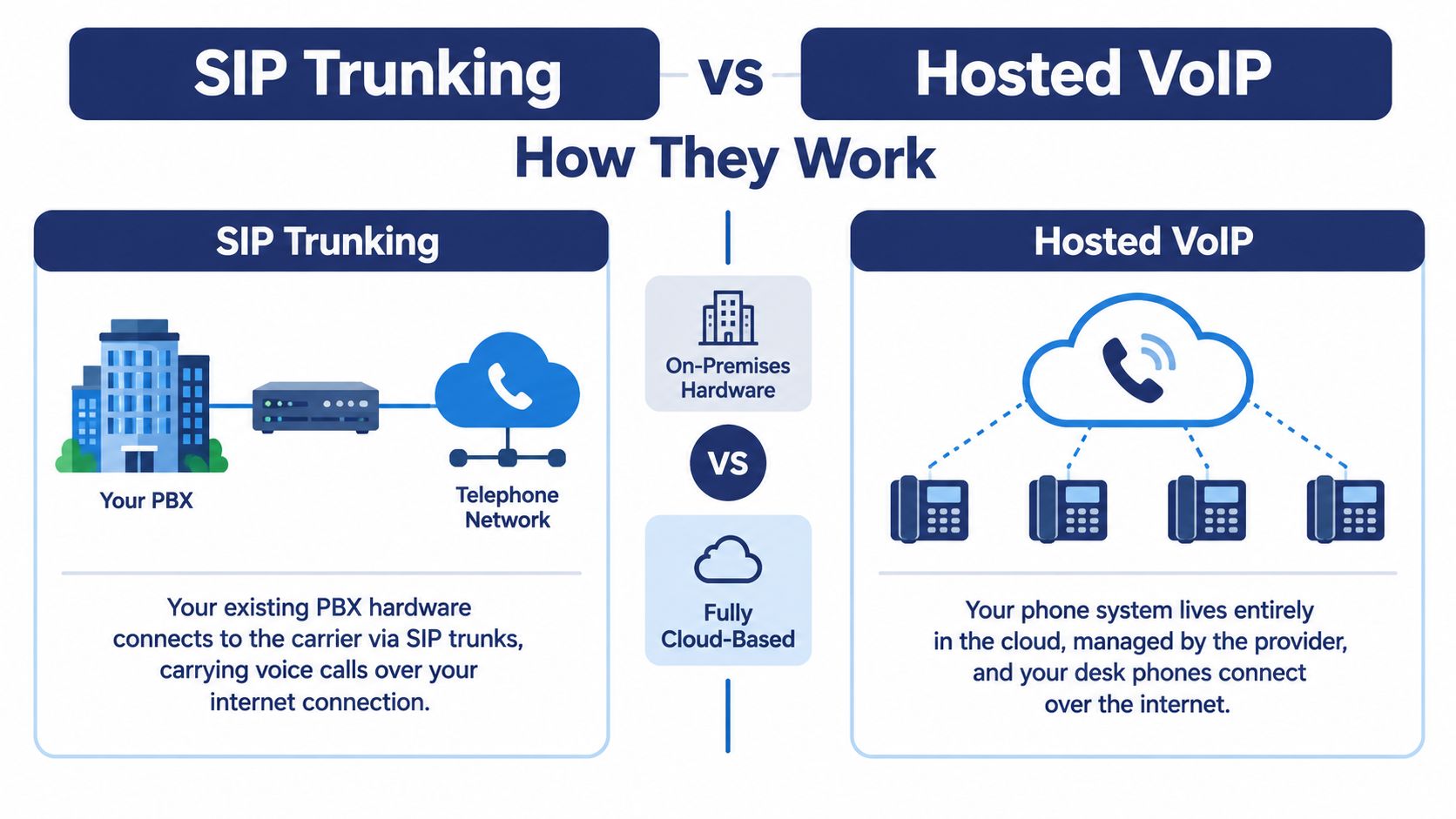
Hosted VoIP moves the PBX itself. Call routing, IVR, voicemail, conferencing, auto-attendant, and extension management live in the provider's cloud platform. Your desk phones, softphones, and mobile apps register to that platform over your internet connection. You administer users through a portal instead of maintaining PBX software and hardware on site.
That model became a mainstream telephone replacement, not a niche experiment. FCC tracking from June 2010 reported nearly 20% of 97 million U.S. residential phone lines were interconnected VoIP subscriptions, meaning broadband voice that could place and receive calls with the public switched telephone network. Businesses adopted the same underlying shift, then split on whether to keep the PBX or outsource it.
Architecture Terminology at a Glance
| Component | SIP Trunking | Hosted VoIP |
|---|---|---|
| PBX location | Your premises or your managed environment | Provider cloud platform |
| Trunk connection | SIP trunk from your PBX to the carrier | Provider handles carrier connectivity behind its platform |
| Endpoints | Phones register to your PBX | Phones and apps register to the provider |
| Upgrades | Your team or your PBX vendor | Provider |
| Local survivability | Possible if you engineer it | Depends on internet access and provider design |
If you're unclear on the trunk definition itself, review the SIP trunk definition and core terminology before you request pricing. Half the confusion I see in proposals comes from one vendor quoting trunks and another quoting a full cloud system, with the buyer comparing line items as if they're identical.
Hardware also exposes the difference. SIP trunking may reuse your PBX and compatible phones, while a legacy system may need a gateway. If you're inventorying gateways and adapters, office VoIP hardware at Godukkan is a useful reference for the category of equipment that bridges older systems to IP service.
This short video walkthrough reinforces the architecture split in visual form.
Ask every bidder one direct question. Are you selling me connectivity for my PBX or a replacement for my PBX? The answer tells you which column you're in.
The Criteria That Actually Decide an SMB Choice
Forget generic pros and cons. They hide the tradeoffs that determine whether your phones keep working on a bad day. Score both options against operational criteria, then let price break a tie, not make the decision.
The chart below summarizes the decision dimensions that matter most for small and midsize deployments.
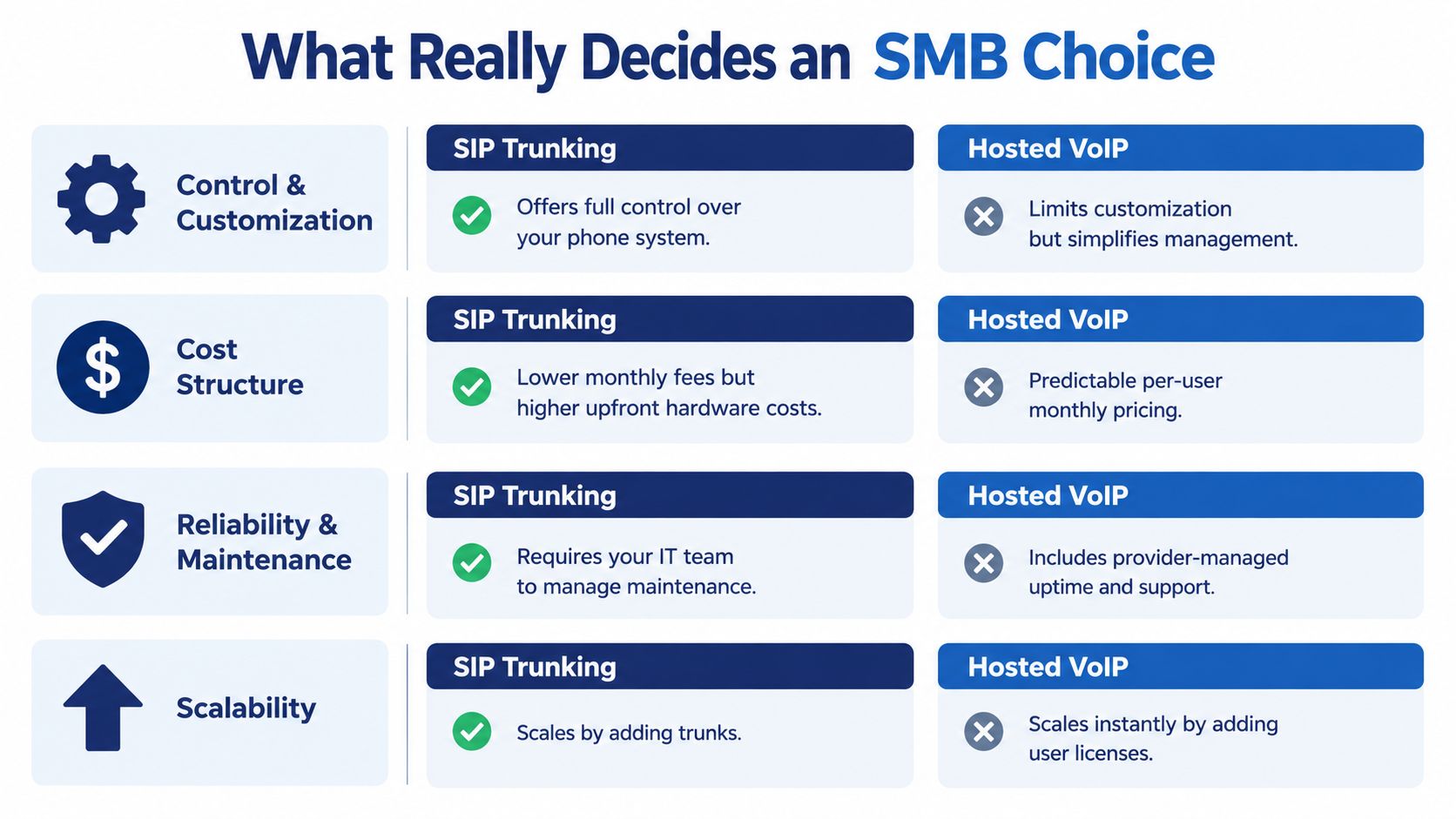
A serious evaluation has a defined scope. VideoSDK SIP connectivity guidance frames that evaluation around concurrent call capacity, geographic redundancy, emergency calling behavior, codec and DTMF support, number portability, failover routing, and SLA scope, not monthly price alone. Use that list as your minimum, then add your integrations and local survivability needs.
Control Versus Managed Responsibility
Choose SIP trunking when you need direct control. You keep your dial plan, session border controller policies, call recording setup, and specialized routing. You also own PBX patches, capacity planning, QoS, security, and redundancy. If nobody on your team wants that work, control isn't an advantage. It's a liability.
Choose hosted VoIP when you want managed responsibility. The provider operates the platform, applies upgrades, and gives remote staff the same system without VPN gymnastics. You give up deep customization and depend on the provider's roadmap, support quality, and cloud architecture. For lean IT teams, that trade is usually worth it.
Capacity, Codecs, and Failover
Don't accept vague promises on these points. Pin vendors down in writing.
- Concurrent calls: Confirm how capacity is counted, whether it's per trunk, per channel, or per seat, and what happens when you hit the limit during a peak.
- Codec and DTMF support: Verify compatibility with your PBX, IVR, fax workflows, door phones, and alarm or elevator lines before porting anything.
- Failover routing: Ask where calls go if your PBX, your internet circuit, or the provider platform fails, and test that behavior instead of trusting a slide.
- Media path: Determine whether voice stays on a managed network or traverses the public Internet, because that affects quality control and troubleshooting.
- SLA scope: Read what's covered, what's excluded, and whether credits matter compared with the cost of missed customer calls.
Hosted VoIP doesn't automatically solve continuity, and SIP trunking doesn't automatically provide survivability. Both require explicit design.
Hosted VoIP wins on multi-site administration, remote worker enablement, and fast user changes. SIP trunking wins on preserving a sound PBX investment, premises survivability, and specialized integrations. If your business depends on a contact center platform, on-site recording, or unusual handsets, don't let a tidy per seat quote talk you into rebuilding all of it at once.
E911 belongs in this scoring too, not in an appendix. Ask who updates location records when people move offices, work from home, or take a softphone to another site. The vendor with the clearer accountability model gets the point, regardless of architecture.
Cost, Quality, and the Hidden Change Exposure
The cheapest monthly quote often creates the most expensive project. I evaluate SIP Trunking vs VoIP on total change exposure, which includes recurring service, one-time transition work, internal labor, and the cost of things breaking during the change. That's the number your business experiences.
SIP trunking is commonly priced around trunk or channel capacity and usage, while hosted VoIP is commonly priced per user or seat. Neither structure is cheaper. A business with many registered users but modest simultaneous calling may waste money funding every seat equally. A business with no usable PBX may waste more money buying, installing, and maintaining one just to chase a lower trunk rate.
Count the One-Time Work Honestly
Build a transition budget before you compare subscriptions. Include these items even if a vendor waves them away.
- Phones and gateways: Replacement handsets, analog adapters, paging interfaces, and conference units that won't register or won't behave correctly on the new platform.
- Network remediation: Switching, PoE capacity, voice VLAN work, firewall changes, QoS configuration, and a second internet path where continuity matters.
- Professional services: Dial plan rebuilds, IVR recreation, call recording migration, CRM integration, and user training.
- Number porting: Inventory cleanup, carrier record correction, temporary forwarding, and testing for main numbers, direct inward dial numbers, fax numbers, and toll-free numbers.
- Internal labor: Your staff time for discovery, cutover support, floor walking, and fixing the small routing errors every project surfaces.
If your PBX is healthy and your integrations work, SIP trunking usually carries lower change exposure because you're replacing carrier access, not the phone system. If your PBX is end of life, unsupported, or already causing outages, hosted VoIP may carry lower exposure because keeping it creates a second forced migration later. Don't preserve hardware out of sentiment. Preserve it only if it's supportable and meets your needs.
Quality Is a Network Number, Not a Marketing Claim
Call quality doesn't improve because a proposal says cloud or SIP. It improves when delay, jitter, and packet loss stay inside engineering limits under peak load. Test during your busiest period, not on a quiet afternoon when any demo sounds clean.
ITU-T G.114 guidance summarized in SIP trunking engineering material sets a commonly applied target of no more than 150 milliseconds one-way mouth to ear delay, with conversational overlap becoming noticeable around 300 milliseconds round trip, and G.711 bandwidth commonly requiring about 80 to 100 kbps per direction after overhead. The same engineering approach keeps jitter below roughly 20 to 30 milliseconds and packet loss below 1%, because loss above that level produces clipping, gaps, and distorted speech.
Do the bandwidth math with overhead included. A G.711 call carries encoded audio plus packet and link overhead, so headcount isn't your sizing unit. Concurrent calls are. Use the detailed bandwidth requirements for business voice planning to model peak simultaneous calls per site, then add headroom for signaling, data traffic, and failover.
For a practical example, take a midsize office with heavy morning inbound volume across sales and support. If its peak is far below its seat count, channel based trunk capacity may fit actual demand better than uniform seat licensing. If that same office has staff scattered across homes and small sites, hosted administration may save more in labor than channel efficiency saves in service fees. The right answer comes from your call pattern and staffing model, not from a universal verdict.
Require acceptance testing that measures RTP packet loss, jitter, one-way delay, and post-dial delay while the trunk or platform is busy. Congestion defects hide during idle baselines. Also test DTMF through your IVR, fax behavior if you still depend on it, call transfer behavior, and failover with the primary path disabled. A vendor who resists load testing is telling you something important.
Which Option Fits Which Real-World Scenario
Abstract criteria become useful when you map them to operating conditions. These three patterns cover most SMB decisions I see, and they don't all point the same direction.
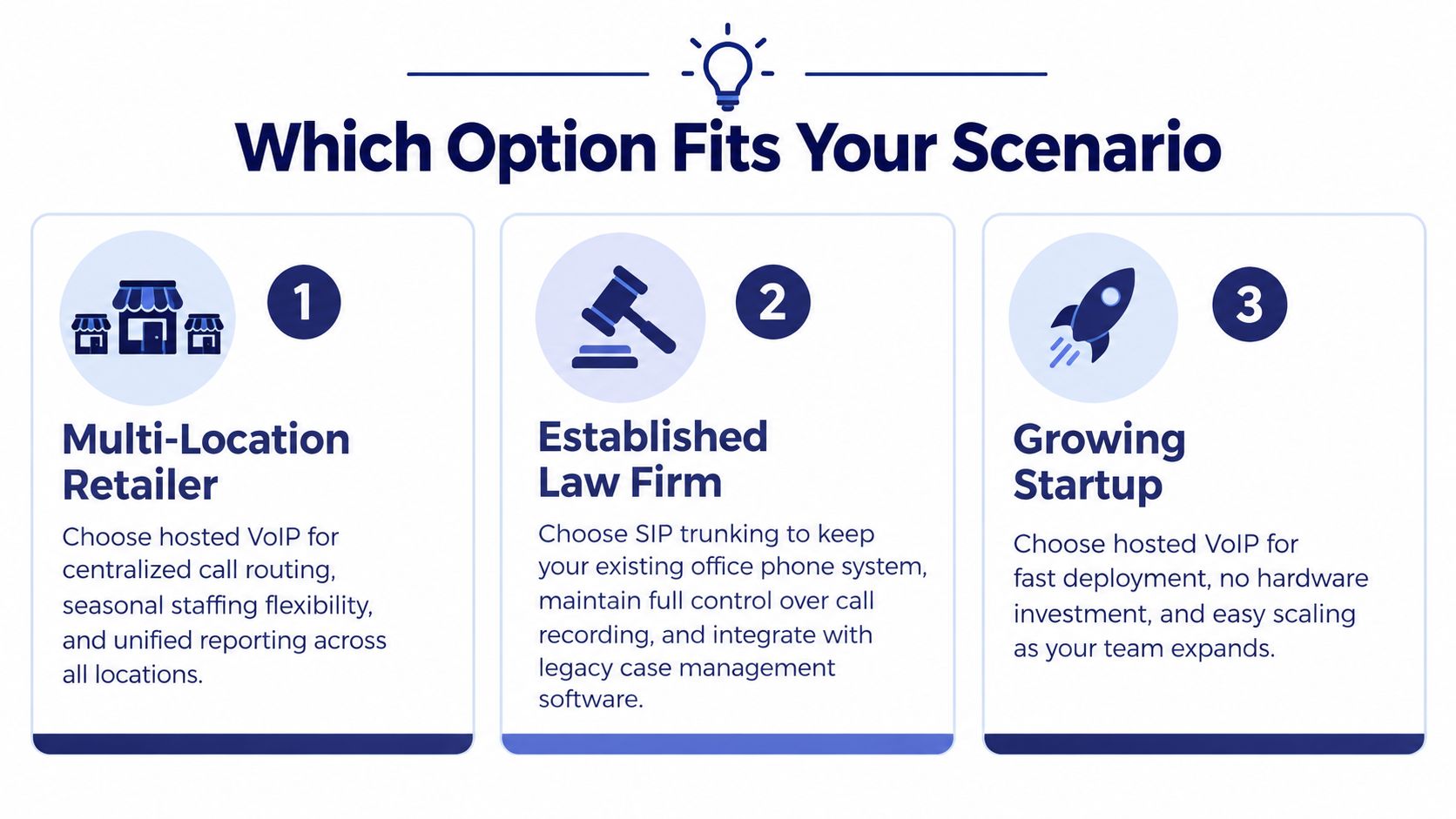
The visual below matches common business situations to the architecture that usually fits them best.
Coexistence is the normal market outcome, not a temporary compromise. Mordor Intelligence SIP trunking market data indicate on-premises deployments represented about 75.12% of the SIP trunking market in 2025, even while cloud deployment continues to grow. Businesses keep premises systems for concrete operational reasons, not because they missed a trend.
Multi-Location Retailer With Seasonal Staff
Pick hosted VoIP. A retailer opening sites, adding seasonal extensions, and centralizing customer calls needs fast provisioning and one administrative model. Managers can add users, copy call flows, and keep reporting consistent without shipping PBX hardware to every store. The main conditions are reliable internet at each site, tested failover to mobile numbers, and disciplined E911 records per location.
Don't choose hosted service here because it's fashionable. Choose it because site churn and distributed administration are the dominant costs. A premises PBX at every store multiplies maintenance and makes standard routing harder to enforce.
Regulated Contact Center With Existing Integrations
Keep the PBX if it's supportable, and add SIP trunking. A regulated operation may depend on on-site call recording, specialized agent handsets, screen pop integrations, custom queue logic, and local survivability during a WAN failure. Rebuilding all of that inside a hosted platform creates the highest change exposure in the entire decision.
SIP trunking modernizes the carrier connection while preserving tested workflows. Your obligations don't disappear. You still own QoS, session border controller security, capacity, upgrades, and redundant routing. If your team can't operate those functions competently, hire a managed provider for the PBX layer or reconsider hosted service with a long migration runway.
Hybrid Team Working Across Homes and Offices
Pick hosted VoIP in most cases. Mobile apps, softphones, visual voicemail, and web based administration fit people who don't sit at the same desk every day. IT doesn't have to extend a premises PBX to every home network, and new hires can be provisioned without desk hardware if your policy allows softphones.
The risk shifts to home internet quality and emergency location governance. Set expectations for wired connections where call quality matters, define which devices are approved for emergency calling, and make users update their registered location when they move. Convenience without that policy is incomplete.
A hybrid path is also legitimate. Keep SIP trunking at a headquarters or contact center where control matters, and use hosted VoIP for branch or remote teams. The design needs consistent number ownership, inter-site dialing expectations, and clear support boundaries. Mixed architecture works when it's deliberate. It fails when it's accidental.
A Staged Migration Path From a Legacy PBX
Don't start with a cutover date. Start with discovery, because undocumented call flows and forgotten analog devices cause more migration pain than the trunk configuration itself. Work in stages and keep a rollback path until acceptance testing passes.
Stage the Work in This Order
- Inventory everything: Document PBX model and support status, phones, PRI or analog lines, direct numbers, toll-free numbers, fax lines, alarms, door entry systems, paging, and every integration that touches voice.
- Map call behavior: Record auto-attendants, hunt groups, queues, after-hours routing, voicemail ownership, call recording rules, and transfer paths exactly as they work today.
- Prove network readiness: Configure voice VLANs and DSCP aware QoS, verify PoE and switching, test peak load quality, and decide whether dual WAN or cellular backup is required.
- Choose the handoff point: Move to SIP trunking if the PBX is healthy and integrations matter, or move to hosted VoIP if the PBX is end of life and administrative capacity is limited.
- Rehearse before porting: Build the new routing, test inbound and outbound calls on temporary numbers, validate DTMF and failover, and train pilot users before the production numbers move.
Use the step by step VoIP phone system setup sequence as a working checklist during build and pilot testing. Don't let number porting become your first real test. By the time numbers move, routing, voicemail greetings, emergency calling, and support escalation should already be proven.
Analog remnants deserve special attention. Fax machines, postage meters, elevator phones, and alarm panels often surface late because nobody owns them as phone system assets. A legacy channels overview from AgentStack is useful background when you're cataloging older communication paths that still need a deliberate keep, convert, or retire decision.
Emergency calling is a gate, not a cleanup task. SIP.US E911 information reflects U.S. requirements under Kari's Law for direct 911 dialing without an outside line prefix and Ray Baum's Act for transmitting a dispatchable location, both of which get harder when extensions move between offices, floors, or homes. Assign per site address ownership, map extensions to locations, test direct dialing, configure on-site notification, and document the process for moves and closures.
Non-negotiable: If E911 location ownership isn't named, tested, and documented, you're not ready to cut over.
Port numbers in a controlled window with carrier records cleaned in advance. Confirm the authorized name, service address, account details, and every number on the order, including numbers nobody dials daily. Keep temporary forwarding ready, staff the first business morning heavily, and don't disconnect legacy service until inbound, outbound, emergency, and failover tests all pass on the new path.
Decision Checklist and Common Questions
Use this checklist with every bidder and require written answers.
- PBX condition: Is your current system supportable, secure, and capable of your required routing and integrations?
- Ownership fit: Do you have staff who will own QoS, upgrades, security, and failover, or should a provider own them?
- Continuity: What happens to inbound calls during an internet, power, PBX, or provider failure?
- E911 governance: Who updates dispatchable locations for office moves, remote workers, and softphones?
- Change exposure: Have you priced phones, gateways, network work, integrations, training, and internal labor?
- Acceptance testing: Will the vendor test quality, DTMF, fax behavior, and failover under peak load before final acceptance?
Short Answers to the Questions SMBs Ask Most
Can you keep an existing PBX and add SIP trunks? Yes, if it's IP capable or can be connected through suitable gateway equipment, and if it remains supportable. That's the lowest change path when your call flows and integrations already work.
What does failover look like in practice? With SIP trunking, you design alternate trunks, carriers, internet paths, or premises survivability. With hosted VoIP, calls can often reroute in the provider cloud to other sites or mobiles, but local phones still need working connectivity.
Is hybrid realistic? Yes. Many SMBs keep controlled SIP trunking where specialized workflows live and use hosted VoIP for branches and remote staff. It works when number ownership, support responsibility, and E911 governance are explicit.
What's the biggest red flag? A quote that competes only on monthly price and won't document capacity, SLA scope, emergency calling, porting responsibility, or failover behavior. Walk away from that quote.
If you're replacing a legacy PBX and want hosted VoIP without guessing through porting, routing, voicemail, mobile apps, and cutover testing on your own, talk to SnapDial about a managed cloud PBX setup built around your sites and call flows. Bring your current PBX inventory, peak call pattern, and failover expectations, and get a direct recommendation on whether hosted service, SIP trunking, or a staged hybrid path carries the least risk for your business.