Your hosted VoIP rollout is live. Agents are taking calls, recordings are accumulating, SMS replies are landing in the CRM, and someone on the operations team is still checking opt-outs by hand. Then a customer asks when consent was captured, an agent forgets to disclose recording, or a payment call is stored with card data audible in the background. The question isn't whether your business has a compliance policy. It's whether you can produce the right evidence quickly and show that your systems acted on it.
For a five-to-200-seat contact center, call center compliance is an operating discipline. You need controls that connect the cloud PBX, dialer, SMS platform, CRM, recording store, and QA workflow. This guide focuses on what a small or mid-sized team can deploy this quarter, without building an enterprise legal department.
What Call Center Compliance Actually Means for Your Business
Call center compliance means producing defensible evidence that each call, text, and customer record followed the rules that applied to that interaction. A policy document may describe what agents should do, but it won't prove what happened. Evidence does.
That evidence should answer practical questions without forcing someone to search across disconnected systems:
- Before the dial: What consent authorized the call or text, when was it captured, and what disclosure did the customer receive?
- At the start of the call: Was recording disclosed before sensitive information was discussed, and did the caller have a reasonable way to decline?
- During payment handling: Was card data kept out of the recording and away from unnecessary agent access?
- After an opt-out: Did the request reach voice, SMS, campaign, and CRM suppression workflows within the required period?
- During an inquiry: Can an authorized employee retrieve the recording, disposition, consent event, and suppression history as one coherent record?
TCPA, Do Not Call, Telemarketing Sales Rule, PCI DSS, HIPAA, and recording-consent laws can apply to different parts of the same interaction. A service call might become a payment call. A voice conversation might create a follow-up text. A recording might feed transcription and AI scoring after the customer hangs up. Treating each rule as a separate checklist creates gaps at the handoffs.
Paperwork is not proof
A signed policy says an agent must use a disclosure. A timestamped call event can show whether the disclosure played before recording began. A training acknowledgment says an agent learned the opt-out process. A linked suppression event can show whether the agent entered the request and whether the dialer stopped future outreach.
Practical rule: If you can't connect the evidence to a specific interaction, the control is incomplete.
Use the cloud PBX as the event source for calls, the CRM as the customer-context source, and a centralized consent and suppression store as the authority for permission status. Store shared identifiers across all three. Your aim isn't to make every employee a lawyer. It's to make the compliant action the default path and make exceptions visible.
The Regulatory Stack Your Contact Center Sits On
A five-seat outbound team can trigger several regulatory duties in one conversation. A call may involve consent to contact, recording disclosure, payment details, health information, and a later SMS follow-up. Assigning each rule to a separate owner leaves the handoffs unproven. TCPA controls the outreach decision, recording rules control disclosure, PCI DSS controls payment data, HIPAA controls protected health information, and the FTC Telemarketing Sales Rule adds disclosure and recordkeeping duties. Your cloud PBX, CRM, dialer, and messaging tools must preserve one connected record of what happened.
Where the rules bite
TCPA and Do Not Call controls belong before the dial. The platform should verify permission, check internal suppression, apply campaign restrictions, and preserve the consent record behind the decision. Under the FCC's 2025 revocation framework, consumers can withdraw consent through any reasonable method, and phrases such as STOP or UNSUBSCRIBE count as valid revocation requests. The requirement took effect on April 11, 2025, while some cross-channel elements were delayed to April 11, 2026, as described in the FCC revocation framework analysis.
PCI DSS begins when an agent collects payment details. Recording should pause, suppress, or tokenize sensitive card data before it enters the audio stream. Monitor both the recording event and payment workflow. A failed resume control can leave a missing call record, while recording too early can expose card data.
HIPAA applies when protected health information enters the agent's screen, notes, recording, or downstream analytics. Review access permissions, vendor agreements, storage, and secondary use together. A transcript searchable by a broad quality-assurance group can expand access to health information beyond the original call workflow.
The FTC Telemarketing Sales Rule requires operational recordkeeping for telemarketing activity. Current guidance identifies a five-year retention period for records tied to each telemarketing call, including the number, date and time, duration, prerecorded-message use, script, and disposition, according to this outbound compliance checklist.
| Regulation | Operational Trigger | Evidence Required | Penalty Tier |
|---|---|---|---|
| TCPA and DNC | Outbound calls, texts, and revocation requests | Consent receipt, dial decision, suppression event, campaign record | $500 per violation, increasing to $1,500 for willful or knowing conduct, with no aggregate cap in private actions, according to this TCPA overview |
| Call recording laws | Recording, monitoring, or analyzing calls | Disclosure timestamp, jurisdiction logic, recording status, opt-out path | Jurisdiction-dependent exposure |
| PCI DSS | Card data collected by phone | Pause or masking event, payment token, restricted access log | Payment-card and contractual exposure |
| HIPAA | Protected health information handled by agents or systems | Access log, authorization basis, vendor controls, retention record | Sector-specific regulatory and contractual exposure |
| FTC TSR | Telemarketing calls and related records | Number, time, duration, script, message type, disposition | Federal enforcement and litigation risk |
Build shared controls for consent, disclosure, access, retention, suppression, and retrieval, then map each regulation to those controls. Store common identifiers across the cloud PBX, CRM, dialer, and SMS platform. An auditor should be able to retrieve the call, the permission decision, the disclosure event, and the resulting suppression history without reconstructing the interaction from separate exports.
Recording Consent Laws Across the US and Canada
The federal baseline in the United States follows one-party consent, but state rules can be stricter. Twelve states require all-party consent, including California, Florida, Illinois, Massachusetts, Pennsylvania, and Washington, according to this call-recording law guide. Canada adds a separate privacy expectation. Under PIPEDA, organizations should tell customers that calls are recorded, explain the purpose, and obtain meaningful consent. Implied consent may be possible when a customer continues after receiving that information.
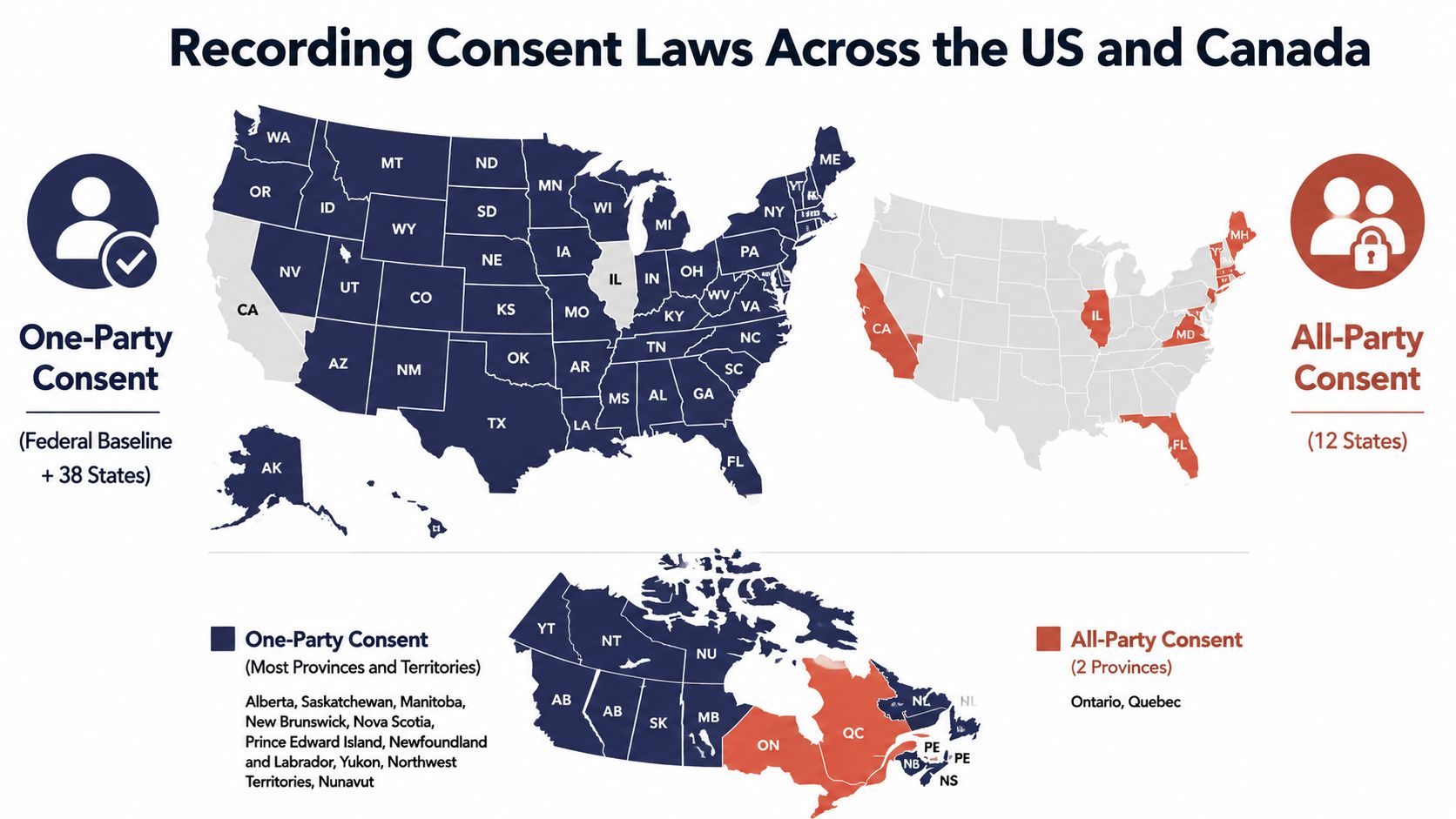
A single blanket prompt is unsafe because the parties may be in different jurisdictions. A mobile caller can cross a state line during the conversation. An agent can work from another state. A disclosure that plays after account details or payment information have already been discussed arrives too late for the evidence you need.
Use a disclosure with three parts
Your recording prompt should be short, understandable, and logged as an event:
- Announcement: Tell the caller that the interaction may be monitored or recorded.
- Purpose: Explain whether recording supports quality assurance, training, security, transaction processing, or another defined purpose.
- Choice: Give the caller a practical way to continue without recording, where your workflow supports it, or to end the interaction.
Don't bury the disclosure in a long greeting. Play it before recording begins, localize it for the caller's language, and make sure the alternative route doesn't accidentally start recording again.
For a deeper implementation discussion, review call recording for business, then configure your PBX to associate the disclosure event with the recording metadata. The record should include the jurisdiction logic used, the prompt version, the language played, the timestamp, and the caller's response or continuation.
Canada requires the same operational discipline even when a US-based team thinks of recording consent only as a wiretap issue. Purpose limitation and meaningful notice belong in the call flow, not just the privacy policy.
Technical Controls Inside a Compliant Cloud PBX
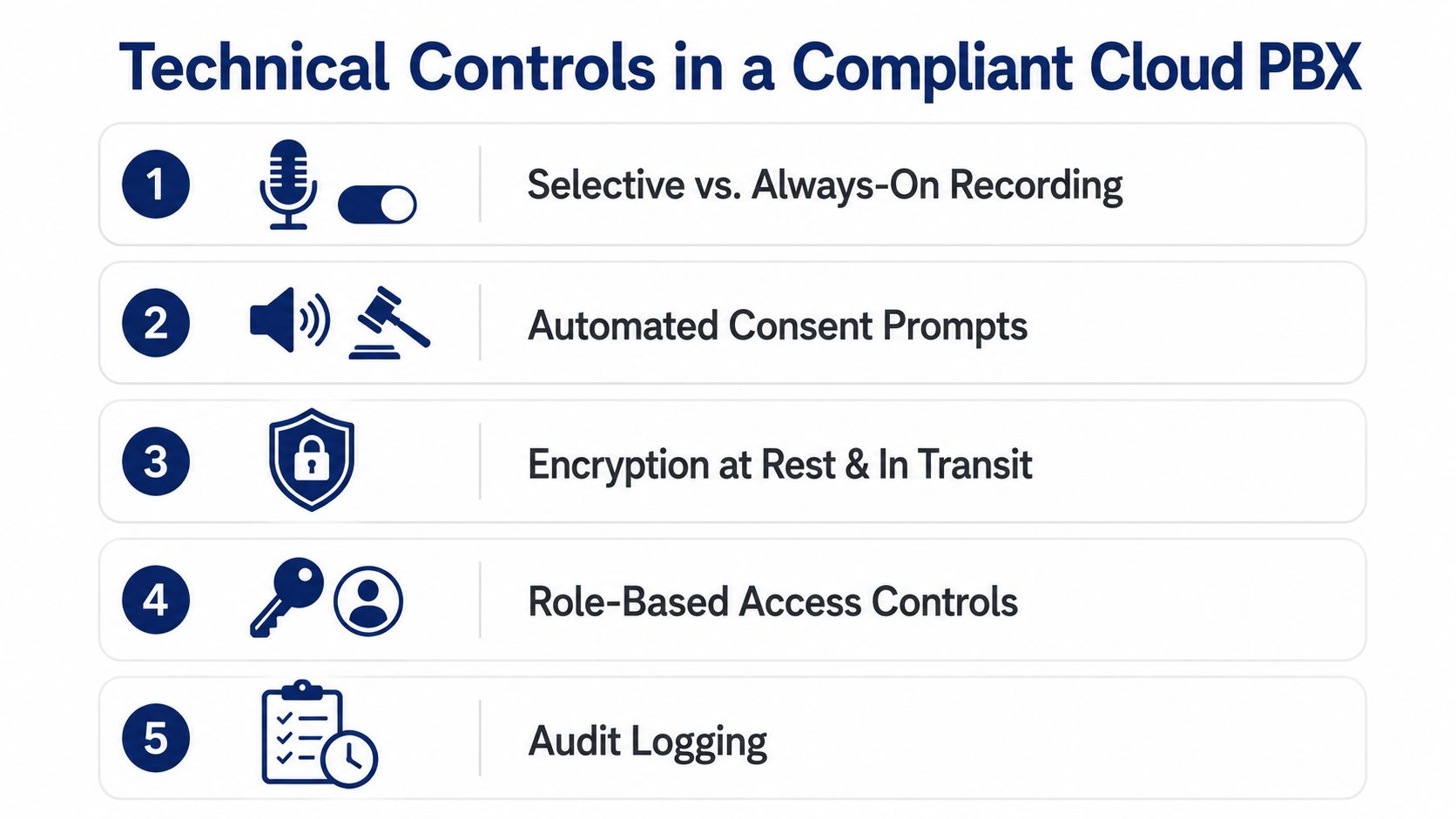
A hosted phone system becomes defensible only when its settings enforce the intended behavior. Start with selective recording, not always-on recording, when your disclosure process requires consent before capture. Selective mode lets the call flow play the notice, capture the response, and begin recording only after the consent event. Always-on recording can still fit some environments, but it demands stronger pre-call disclosure logic and careful treatment of the opening seconds.
Configure the controls in the right order
Consent capture comes next. A DTMF keypress can provide a clear event. A spoken acknowledgment can be logged when the platform supports reliable recognition, but store the audio and timestamp rather than relying on a transcript alone. The CRM should receive the consent status, prompt version, and event time through a stable interaction identifier.
Encryption and access control protect the evidence after capture. Require encryption at rest and TLS 1.2 or later in transit, then enforce role-based access with SSO where available. An agent may need to listen to a call for QA, while a supervisor may need disposition access, and a security coordinator may need audit logs. Those aren't the same permission.
Audit logs must leave the platform. Export access, download, deletion, configuration, and retention events to a SIEM or read-only storage. If the only copy of the audit trail lives inside the system being investigated, your evidence model is fragile. A separate cloud security evaluation service can help review vendor controls and identify gaps before an incident.

Set retention by obligation and purpose
Don't use one indefinite retention setting for every recording. Map each category to its business and regulatory need, automate deletion when the period ends, and support a legal hold that suspends deletion for a defined record.
Document the retention decision for each data class. Payment recordings, health-related calls, marketing calls, training copies, transcripts, and QA exports may need different handling. Your network and signaling design also affects reliability and troubleshooting, so review SIP and IP port guidance while validating the deployment.
Building an Audit-Ready Evidence Trail
A regulator, plaintiff's attorney, or internal auditor won't ask whether your team has a compliance folder. They'll ask about a particular call. Your system should reconstruct that call from a single interaction key and show what happened before, during, and after the conversation.
Start with a stable correlation model. Use the call SID or platform interaction ID as the primary key, then associate the ANI, agent ID, queue, timestamp, CRM ticket, campaign, consent receipt, disposition, and suppression events. Don't use a customer name as the key. Names change, can be duplicated, and don't reliably bind voice and SMS activity.
Store the evidence where each system is strongest
Keep the recording in a controlled object store and calculate a SHA-256 hash so you can detect alteration. Store the CRM disposition as a structured field, not only as free-text notes. Maintain consent events in a dedicated log with the source, timestamp, disclosure version, channel, and status.
SMS opt-outs belong in a keyword and event table. When a customer sends STOP or UNSUBSCRIBE, preserve the inbound message, receipt timestamp, originating number, normalized contact identity, and suppression actions sent to the voice and SMS systems. The FCC framework makes revocation a workflow requirement, not merely an agent instruction.
The retrieval test: Give an authorized reviewer one interaction ID and require the system to return the complete event chain without manual reconstruction from scattered inboxes.
The FCC framework identifies a 10-business-day cross-channel revocation window. Use that as your operational proof deadline, even when your systems can act faster. A quarterly drill should select a sample call, retrieve every linked artifact, replay the consent and disclosure sequence, and confirm that an opt-out propagated across voice and SMS.
A successful drill produces a report with the interaction key, missing artifacts, timing exceptions, access failures, and corrective owner. A failed drill is useful only if someone fixes the data model and repeats it.
Governance, Monitoring, and Incident Response
Small contact centers don't need a compliance committee. They need named owners who know which control they operate and what happens when it fails.
Assign an operations lead to daily QA and agent workflow checks. A security coordinator should own access reviews, vendor escalations, and incident triage. An executive sponsor should approve the policy set, accept documented risk, and sign off on the annual review. One person can hold more than one role, but the responsibilities must be explicit.
Use a cadence people can maintain
| Activity | Frequency | Owner |
|---|---|---|
| Recording and disclosure QA | Weekly sample of recorded calls | Operations lead |
| Access and permissions review | Monthly | Security coordinator |
| Vendor and third-party risk review | Quarterly | Security coordinator and executive sponsor |
| Policy and control refresh | Annually and after material changes | Executive sponsor |
| Agent compliance training | At onboarding and recurring refresh | Operations lead |
Your QA sample should test behavior, not just audio quality. Review whether the disclosure played before recording, whether the agent handled sensitive data correctly, whether the disposition matched the call, and whether an opt-out reached the suppression system.
Run incidents in five moves
- Detect: Flag a failed disclosure, exposed payment recording, unauthorized download, or missed revocation.
- Contain: Stop the affected campaign, revoke access, quarantine the recording, or disable the faulty integration.
- Assess scope: Identify customers, channels, recordings, agents, vendors, and time periods involved.
- Notify: Escalate through the documented internal and external notification process applicable to the event.
- Remediate: Fix the setting, retrain the team, preserve evidence, and verify the correction with a repeat test.
Train agents on disclosure scripts, DNC handling, payment escalation, and incident reporting in a focused module. They need to know what action to take when a caller says “stop,” not memorize a statute.
AI, Omnichannel, and the New Compliance Boundary
AI changes the evidence problem because it turns a call recording into searchable, reusable data. A raw audio file may sit in a restricted store. A transcript, summary, sentiment label, or quality score can spread into the CRM, analytics platform, coaching tool, and vendor environment. That expansion can increase PCI exposure, create secondary-use questions for health information, and widen access beyond the original recording audience.
Voice isn't the only channel that needs control. SMS, WhatsApp, web chat, and other messaging channels can carry sales content, consent signals, and opt-out requests. A customer who revokes permission in a text thread shouldn't remain callable because the voice platform stores a separate status. The operational answer is a shared consent and suppression layer with channel-specific evidence.
Ask vendors uncomfortable questions
Before enabling transcription, speech analytics, or automated scoring, require clear answers:
- Storage: Where are raw audio files, transcripts, summaries, and embeddings stored?
- Access: Which vendor staff, customer roles, and integrations can retrieve them?
- Training use: Does the vendor use customer content to train models, and is that use opt-in?
- Retention: Can you set separate deletion rules for audio, transcripts, and derived analytics?
- Consent: Can the platform capture consent separately for voice recording, transcription, coaching, and automated analysis?
- Redaction: Does masking happen before data reaches the transcription or analytics service?
- Retrieval: Can the vendor export the full event chain with timestamps and identifiers?
Teams adding channels should also study Chatgrow's omnichannel SMB playbook for the customer-service operating model, then add the consent and evidence requirements before launch. If you're evaluating AI voice agents, apply the same questions to generated speech, call summaries, escalation logs, and opt-out handling.
Don't treat AI as only a QA feature. Once a system searches, summarizes, classifies, or redistributes customer content, it becomes part of the compliance boundary.
Your 30-Day Compliance Rollout and Quick Answers
A small team can make meaningful progress in a month by fixing the evidence path before adding more automation.
| Week | Focus Area | Key Tasks | Owner | Deliverable |
|---|---|---|---|---|
| Week 1 | Inventory and gap review | Map PBX, dialer, SMS, CRM, recordings, vendors, and applicable rules. Review a sample of recent interactions. | Operations lead | Risk and evidence inventory |
| Week 2 | Disclosure and recording | Update scripts, configure jurisdiction-aware prompts, enable selective recording, and set retention rules. | PBX administrator | Tested call flow and recording policy |
| Week 3 | Consent and suppression | Link consent events to CRM records, centralize DNC handling, map STOP and UNSUBSCRIBE events, and assign governance roles. | CRM owner and security coordinator | Working consent and suppression workflow |
| Week 4 | Verification and training | Run an incident tabletop, deliver agent training, complete a retrieval drill, and schedule recurring QA. | Executive sponsor and operations lead | Signed rollout report and compliance calendar |
Quick answers for operators
Does one disclosure script work in every state? No. The US federal baseline is not enough for a nationwide center because twelve states require all-party consent, and Canada requires meaningful notice and consent under PIPEDA. Use jurisdiction-aware prompts and record which prompt played.
What is the TCPA exposure per unlawful call or text? Statutory damages are $500 per violation, increasing to $1,500 per violation for willful or knowing conduct, with no aggregate cap in private actions, according to the TCPA liability summary. Treat every dial decision as an evidence decision.
Does pause-and-resume recording eliminate PCI risk? No. It can reduce the chance that payment data enters a recording, but a failed pause, late activation, transcript copy, CRM note, or agent-side exposure can still create a gap. Test the entire payment interaction, including what happens when the control fails.
Print the following checklist and place it beside the QA station:
- Consent: Confirm the call or text has a linked permission record.
- Disclosure: Verify the correct recording prompt played before capture.
- Suppression: Confirm voice and SMS systems receive opt-outs.
- Payment: Test pause, masking, resume, and failure behavior.
- Access: Review who can listen, download, export, or delete.
- Retention: Apply documented deletion rules and legal holds.
- Evidence: Retrieve one complete interaction record during each scheduled drill.
- Training: Escalate unclear consent, payment, health, or privacy events.
The right goal isn't a perfect binder. It's a contact center that can show what happened, prove which control acted, and correct a failure before it repeats.
SnapDial provides cloud PBX capabilities such as call recording, call routing, queue management, call logs, and centralized administration that can support an evidence-focused compliance workflow when configured with your policies. Visit SnapDial to discuss a hosted VoIP rollout for your team and build the recording, access, and retrieval controls into the deployment from the start.