
A 50-person logistics company in Texas can have a clean sales process on paper and still be in trouble the moment calls start crossing state lines. An agent records a prospect in California, a support rep handles a customer in New York, and a partner call pulls in someone in Germany. Suddenly call recording compliance is not a policy doc sitting in a shared drive, it's a live routing problem with consent prompts, storage rules, and deletion obligations changing by caller.
That's the part many SMBs miss. They treat recording as a checkbox, then leave the work to agents, managers, and a generic setting in the phone system. The legal exposure grows every time an audio file is created without the right notice, retained without a documented reason, or played back by someone who shouldn't have access.
Why Call Recording Compliance Is a Design Problem
A recording policy usually fails at the point of use. The phone system, call scripts, storage layer, and retention rules have to work together while the call is live.
A logistics team may want recordings for training, dispute resolution, and quality checks. That is reasonable operationally, but each jurisdiction on the line can change what the business must do before recording starts. In the U.S., the split between one-party and all-party consent means a workflow that works for one caller can be wrong for the next, even if the agent never leaves the same desk. That turns compliance into a multi-jurisdiction design problem.
Practical rule: if your telephony stack cannot vary consent behavior by jurisdiction, the business is taking legal risk every time it records.
The better setup treats consent as part of call routing. The disclosure prompt, the recording flag, and the storage policy should travel with the call record itself. If those controls sit in separate places, agents end up making judgment calls under pressure, and that is where compliance breaks down. For a useful primer on business use cases and setup options, see how call recording fits into a business phone system.
There is also a staffing trade-off. Sales wants low-friction recordings for coaching and follow-up. Support wants a record for escalations. Legal wants proof that the company knew which rule applied to which call. Those goals can coexist, but only if the system enforces them in real time instead of asking people to remember the rules.
Understanding One-Party and Two-Party Consent Laws
A call can sound routine and still trigger different consent rules depending on where each participant sits. The U.S. baseline starts with the federal Wiretap Act and the ECPA, which use a one-party consent standard. Industry summaries identify 38 states plus the District of Columbia as following that approach, while 12 states require all-party consent as of 2026, namely California, Connecticut, Florida, Illinois, Maryland, Massachusetts, Michigan, Montana, Nevada, New Hampshire, Pennsylvania, and Washington. In one-party jurisdictions, the agent's consent can be enough. In all-party states, every participant has to be informed and agree before recording starts. Source for the state split and operational implication
Why location changes the control you need
A call center agent in Texas cannot assume Texas law controls if the caller is in California. Routing logic has to check where the call is landing and trigger the right disclosure before media mixing starts, not after the recording file already exists. Technical control guidance on pre-recording disclosure
That creates a design choice for SMBs. If the platform cannot vary consent behavior by jurisdiction, agents end up deciding on the fly, and that is where mistakes happen.
California shows the risk clearly. Penal Code §632 is widely treated as one of the strictest call-recording regimes, and it sits inside a strong expectation-of-privacy framework. A standard “this call may be recorded” greeting does not work as a universal safety net, because the rule set changes with jurisdiction and call type. California penalty context and privacy framing
One-party vs. all-party consent at a glance
| Jurisdiction | Consent Model | Key Statute | Operational Implication |
|---|---|---|---|
| Federal baseline, many states | One-party consent | Wiretap Act, ECPA | One participant's consent can be enough if no stricter rule applies |
| California and other all-party states | All-party consent | State wiretapping laws, including Penal Code §632 | The system must notify everyone before recording begins |
| Multi-state outbound and inbound calls | Mixed risk | State law plus federal baseline | The safest workflow is to apply the stricter rule when location is unclear |
International teams face a different legal question. GDPR treats voice recordings as personal data, and consent is only one possible lawful basis. For those programs, the core issue is what basis you are relying on, and whether you can prove it later. If you are building broader people or compliance workflows, build a thriving team with Zilo AI is a useful adjacent resource for thinking about policy enforcement across operations.
Real Penalties for Non-Compliant Call Recording
A recording program can look fine on paper and still fail in practice. The weak point is usually the handoff between the phone system, the agent script, the storage layer, and the retention rule set while the call is still active.
The U.S. side of the risk
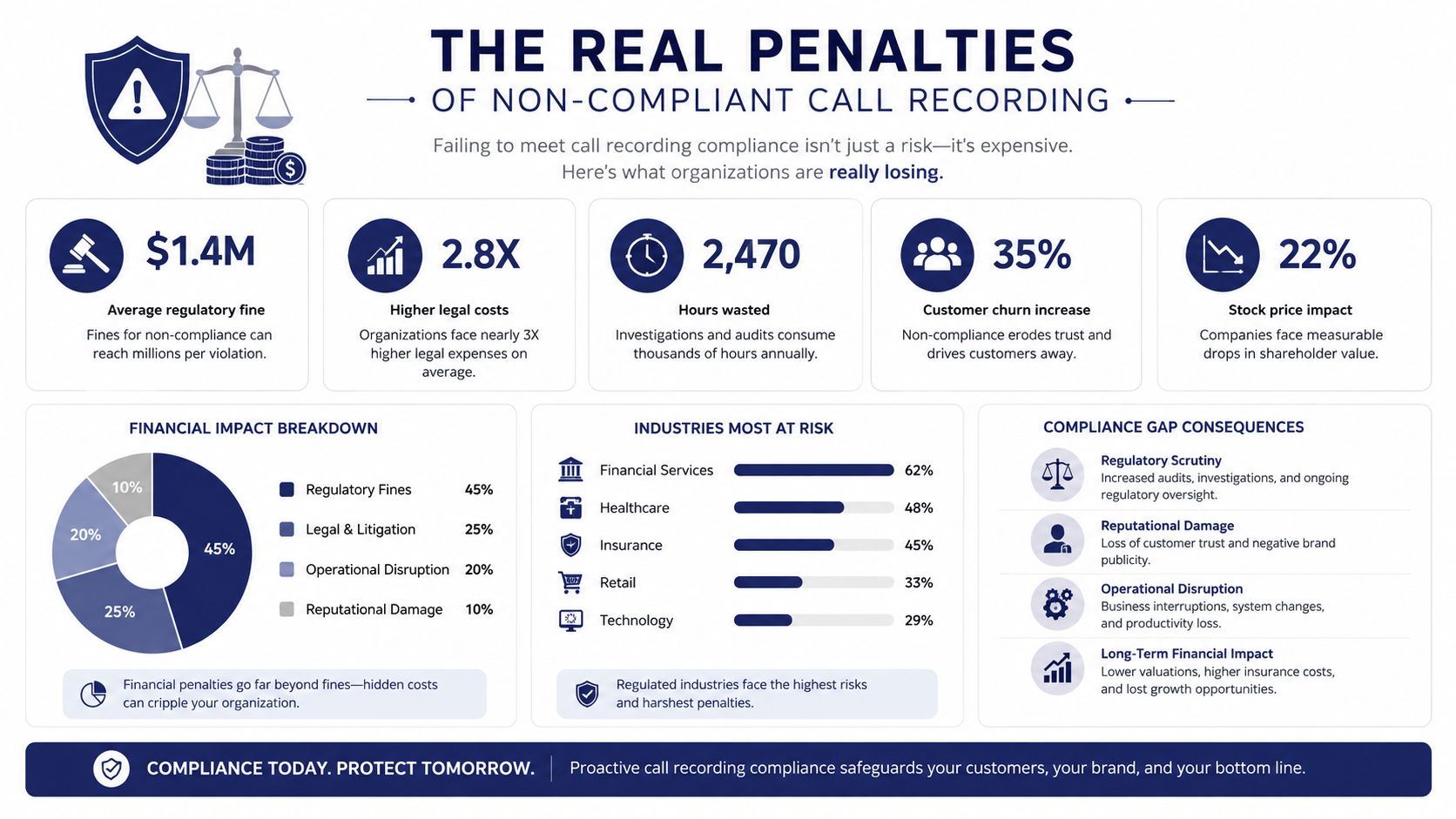
California's §632 shows how costly one unlawful recording can become. Industry summaries note a criminal fine of up to $2,500 per violation and civil damages up to $5,000 per violation under §637.2. Other states create different exposure, but the risk stays serious. Summaries also point to felony treatment in Florida, where violations may be punishable by up to five years in prison. California and Florida risk summary
Federal law adds another layer. Under the Wiretap Act, a non-compliant recording can trigger criminal and civil exposure before you account for plaintiff discovery costs, internal remediation, or the time staff spend responding to an investigation. Once the audio exists, the issue can shift from compliance review to litigation very quickly.
Why GDPR makes the problem broader
GDPR treats voice recordings as personal data, so notice alone is not enough. Organizations need a lawful basis, clear disclosure, security controls, and a deletion process once the recording is no longer needed. Recent EU-focused reporting cited 213 enforcement actions in 2025 tied to call recording practices, with penalties totaling EUR 147 million. EU enforcement reporting
A recording program can work technically and still be legally defective if the business cannot explain why it kept the audio, who could access it, and when it was deleted.
The operational risk is easy to miss. If a recording was collected illegally, it may be unusable as evidence. That can turn a routine customer dispute into a broader litigation problem, and the compliance failure no longer stays inside one team.
Technical Controls That Protect Your Recordings
A compliant recording program needs more than a disclosure line. It needs controls around the audio file from the moment the call starts until the moment the file is deleted.
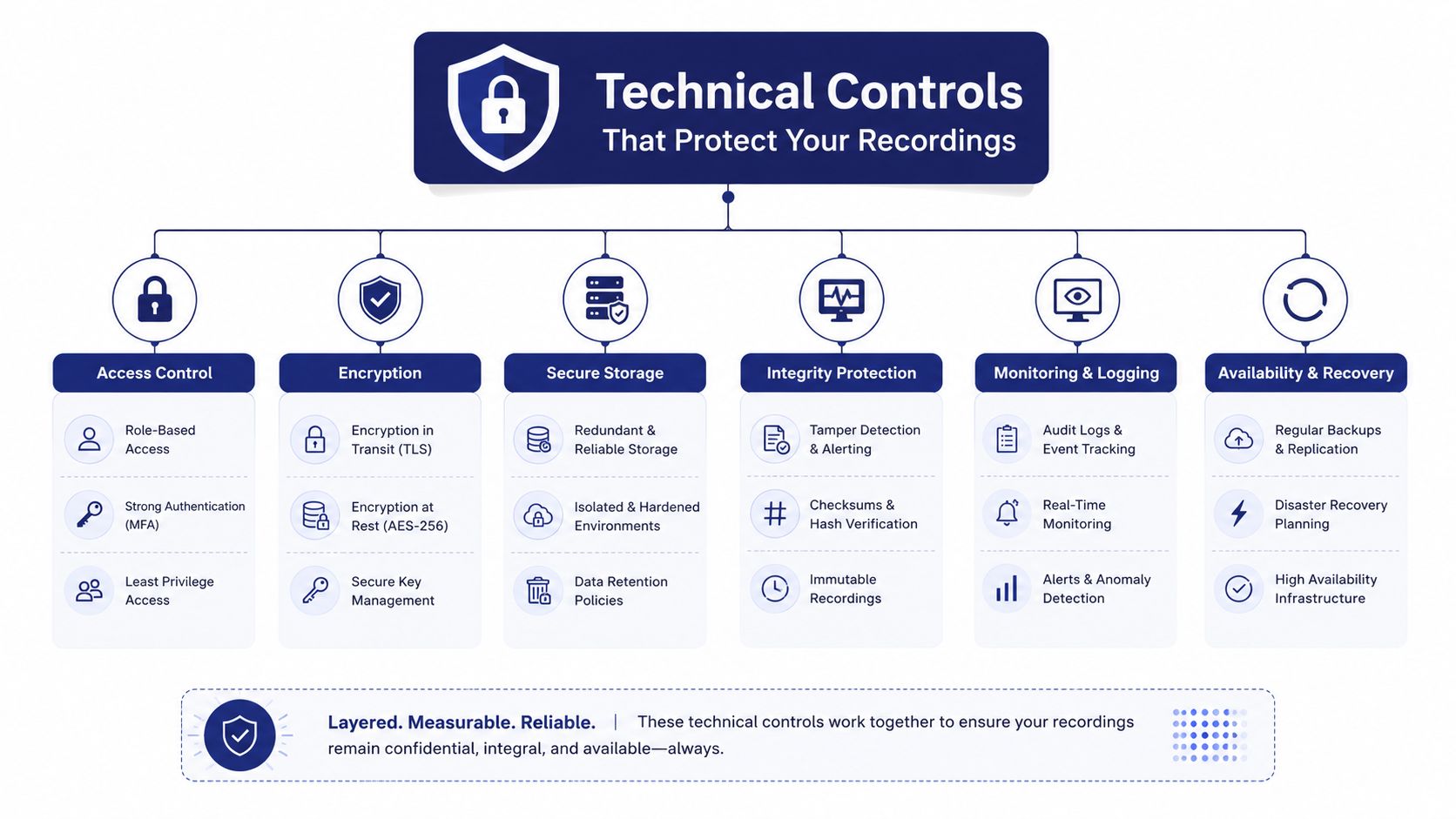
The first control point is metadata. Your platform should tag each recording with the consent model that applied, the time notice was delivered, and whether the caller agreed before recording began. That gives compliance staff a traceable record instead of relying on agent memory or call notes. For SMBs, this matters most when the same team takes calls across states or countries, because the system has to show which rule applied to which call.
Many systems break at this stage. If the recording flag turns on too early, or if the disclosure prompt is just a script on a screen, you've got a process that depends on perfect human behavior. That's not a control.
Recordings should be encrypted in transit and at rest, with role-based access controls for playback, download, deletion, and export. Access logging matters just as much as access restriction, because auditors need to see who opened what and when. A recording that can be played by anyone with a login is not a controlled asset.
Retention automation is the next layer. The system should purge or archive recordings according to policy, not wait for someone to clean up a backlog by hand. GDPR-oriented guidance on GDPR workflow and retention guidance treats deletion when a recording is no longer needed as part of the compliance workflow, not an optional admin task.
Practical rule: if retention is manual, it will drift. If access is broad, it will be abused. If consent isn't logged, it will be hard to defend.
Redaction is the last piece. Sensitive data, including payment card details and personal identifiers, should be masked or removed before long-term storage or QA review. For teams handling card data, that often means pausing recording during sensitive entry rather than hoping someone remembers to scrub the file later. If you want a practical setup example, see how to record a phone call in a business environment.
Building a Lawful Basis and Retention Workflow
Consent is useful, but it's not always the right lawful basis. GDPR allows other bases too, and the right choice depends on why the call is being recorded and what the business needs to do with it later. Recent EU-facing guidance makes the point clearly, consent is not the only path, and using it for every call can create unnecessary fragility. Lawful-basis guidance for call recording
Match the basis to the call purpose
A support call recorded for quality assurance may fit legitimate interests if the business can document the purpose and balancing test. An order-verification call may fit contractual necessity. A regulated financial services call may fit legal obligation. A marketing call that depends on caller permission may require explicit consent.
The operational mistake is treating all recordings the same. That leads to one blanket notice, one blanket retention period, and one blanket deletion policy. Mixed call environments need separate rules by purpose, because the reason for recording is what drives the retention logic.
Tie the lawful basis to deletion
Once the basis is set, retention needs to follow it. Some recordings justify short operational retention, then automatic deletion. Others need to stay longer for a defined legal reason. What matters is that the company can explain the reason for keeping the file and show that the system enforces that rule.
That means your workflow should carry documentation through each stage.
- Purpose statement so the team knows why the recording exists.
- Lawful basis record so compliance can defend the choice later.
- Retention rule so storage doesn't become indefinite by default.
- Withdrawal handling so a revoked consent request can be traced to the specific file.
Withdrawal handling is where distributed storage becomes risky. If a caller withdraws consent, the business needs a way to locate the recording, flag it, and delete it without disturbing other active matters. A good archive structure and a searchable metadata layer make that possible; a folder full of unlabeled files does not.
For a useful operations reference on policy alignment and central administration, see call center compliance guidance.
Implementation Checklist and Sample Consent Scripts
A workable rollout starts before the first recorded call. Legal, IT, and operations each own a piece of the system, and they need to finish in sequence or the live environment will outpace the policy.
Phased checklist for deployment
- Pre-deployment, legal owns this. Map jurisdictions, define the consent model for each call flow, and document the lawful basis for each recording type.
- Pre-deployment, IT owns this. Configure prompts, recording flags, retention rules, access permissions, and audit logs in the telephony platform.
- Go-live, operations owns this. Train agents, test the opening disclosure, and validate that the system stops recording when it should.
- Ongoing, all three teams own this. Review retention settings, test incident response, and audit access logs on a recurring schedule.
The tests need to reflect real calls, not just lab conditions. If agents transfer callers, put third-party participants on the line, or use multilingual scripts, those scenarios should be part of the validation set. That's where hidden failures usually surface.
Sample scripts for common scenarios
All-party consent IVR greeting
“This call may be recorded. By continuing, you agree to the recording of this conversation.”
One-party notification statement
“This call may be recorded for quality and training purposes.”
GDPR-style verbal request
“We'd like to record this call for [purpose]. You can say no, and you can withdraw consent later if you change your mind.”
A written policy should cover scope, lawful basis, access restrictions, retention periods, and incident response. If the policy can't answer who may listen, how long files stay, and what happens after a complaint, it's incomplete. For teams that prefer a visual walkthrough, this short video is a useful operational reference.
How SnapDial Supports Call Recording Compliance
The quickest way to cut recording risk is to stop depending on agents to remember every rule. A cloud PBX can trigger disclosure prompts, restrict who can play recordings, and apply retention settings automatically instead of leaving those choices to memory and spreadsheets.
SnapDial fits that operational model. It combines call recording with centralized administration, access controls, and configurable recording behavior by user and workflow. That matters because the control point sits inside the call path, not in a separate policy binder. For teams thinking about storage recovery and lifecycle controls, mdrepairs hard drive recovery is a useful reminder that archived business data should be recoverable only through a controlled, documented process.
The value is practical, not cosmetic. Automated prompts reduce user error during busy call windows. Role-based access limits playback to authorized staff. Retention settings help teams match storage to a documented lawful basis instead of keeping recordings indefinitely. Those are the controls auditors look for, and they are the ones SMBs usually struggle to maintain manually.
Encryption and redaction also matter. If a team records card numbers or other sensitive content, the platform has to support secure handling from capture through storage. That matters for QA, support follow-up, and dispute resolution, because the same file can carry business value and compliance risk.
If your current phone setup leaves disclosure, access, and retention to individual users, the process is already too fragile. SnapDial is one way to move those decisions into the platform itself and make the recording workflow more defensible.
If you are cleaning up a recording program, review how your phone system handles consent, retention, and access before the next audit or complaint lands. Visit SnapDial to see how a cloud PBX can centralize call recording controls and reduce manual compliance work across mixed-jurisdiction call flows.