

Your team probably isn't searching “calls to japan” because someone forgot the country code. The usual problem is messier. Bills jump around from month to month, mobile calls cost more than expected, caller ID doesn't display correctly, and Japanese customers or partners don't always call back because the number looks unfamiliar or unreliable.
That's why businesses should treat calls to Japan as an operations issue, not a dialing issue. The question isn't just how to place a call. It's how to make sure calls connect consistently, present the right identity, route to the right team, and stay affordable as volume grows.
Connecting Your Business to Japan
Japan is too important a market to handle with improvised calling workflows. If your team sells into Japan, supports Japanese customers, works with suppliers there, or fields inbound interest from Japanese travelers and businesses, the phone system matters more than most companies expect.

Japan's cross-border communication needs are growing. Japan's inbound tourism reached a record 42.7 million international visitors in 2025, and the United States was a top-four source market with 3.3 million visitors, up 21.4%, according to Nippon's Japan data summary. That doesn't just matter to hotels and travel brands. It affects manufacturers, service businesses, healthcare groups, education providers, and support teams that now interact with more international customers, partners, and remote staff.
Many "calls to japan" resources focus solely on dialing instructions. While that is helpful once, it fails to address business problems:
- Cost control: Rates vary by destination type, and mixed traffic can distort budgeting fast.
- Answerability: If caller ID is wrong or inconsistent, people may ignore the call.
- Routing: A single published number often needs to reach sales, support, after-hours voicemail, or an IVR.
- Consistency: Remote and office staff need the same calling identity and call history.
Practical rule: If more than one employee contacts Japan, you need a system, not a habit.
Businesses that still rely on desk phones tied to a local carrier usually feel the pain first. They can place a call, but they can't easily control routing, monitor usage, manage recordings, or standardize outbound caller ID across locations. Mobile-first teams run into a different issue. Calls are convenient to place, but hard to supervise and even harder to present professionally.
A cloud phone platform fixes the actual problem because it centralizes outbound calling, inbound routing, logs, recordings, and user management. It also gives you one place to control how calls to Japan are handled across the business. If you're evaluating options for international business communications, global phone services for multi-location teams are a better starting point than another how-to-dial guide.
How to Dial Japan from Any Device
The dialing format is simple once you normalize it. The confusion usually comes from local Japanese number formatting, especially the leading zero in area codes and mobile prefixes.
The standard format
For international calls to Japan, use:
international exit code + 81 + area or mobile code without the leading 0 + local number
Japan's country code is +81. If the Japanese number is written domestically with a leading zero, drop that zero when dialing from outside Japan.
Examples:
Tokyo landline written locally: 03-xxxx-xxxx
International format: +81 3 xxxx xxxxOsaka landline written locally: 06-xxxx-xxxx
International format: +81 6 xxxx xxxxJapanese mobile written locally: 090-xxxx-xxxx
International format: +81 90 xxxx xxxx
Examples by calling country
Different countries use different international exit codes on traditional lines or carrier dialing.
From the US or Canada
Dial:011 + 81 + number without the leading 0
Example:011 81 3 xxxx xxxxFrom the UK
Dial:00 + 81 + number without the leading 0
Example:00 81 3 xxxx xxxxFrom Australia
Dial:0011 + 81 + number without the leading 0
Example:0011 81 3 xxxx xxxx
Store Japanese contacts in E.164 format with +81 at the front. It cuts down dialing errors across desk phones, softphones, CRMs, and mobile apps.
The two mistakes that cause trouble
The first mistake is keeping the leading zero. A number that works inside Japan often fails internationally if you dial it exactly as written on a local business card.
The second mistake is inconsistent contact formatting. One rep saves a contact as 03-xxxx-xxxx, another uses +81 3 xxxx xxxx, and a third pastes in a mobile number with spaces and punctuation. Then your CRM click-to-call tools behave unpredictably.
A better workflow is to standardize every Japanese contact record in one international format:
- Use +81
- Remove the domestic leading 0
- Keep one canonical number format in your CRM
- Test both landline and mobile examples before rollout
Why VoIP makes this easier
Modern cloud calling platforms simplify calls to japan because users typically dial the number in international format, starting with +81, from a desk phone, browser app, or mobile app. They don't need to remember whether they're on a US line, a UK line, or a hotel phone that expects a different exit code.
That sounds minor, but it matters in real operations. Standardized dialing reduces failed calls, lowers training overhead, and makes call logs cleaner. For businesses with multiple locations or remote staff, those small gains add up quickly.
Choosing the Right Way to Call Japan
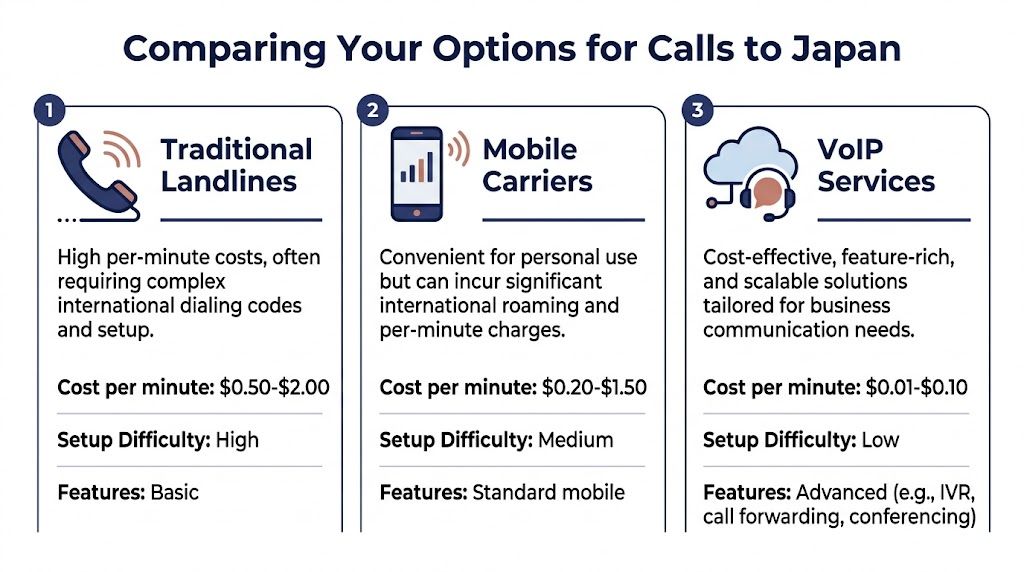
Most businesses have three realistic options for calls to japan. They can use traditional PSTN lines, rely on mobile carrier international calling, or move traffic through a cloud VoIP system. All three can place the call. They differ sharply in control, visibility, and scalability.
What matters in practice
When companies compare calling options, they often focus too narrowly on the advertised rate. That misses the bigger picture. For business use, the important questions are:
- Can you control outbound caller ID?
- Can you route inbound calls by team, schedule, or language?
- Can managers review call logs and recordings?
- Can remote staff use the same business identity?
- Can you separate personal calling from business calling?
If the answer to those questions is no, the cheaper-looking option often becomes the more expensive one operationally.
Comparison of Calling Options for Japan
| Feature | Traditional PSTN | Mobile International Plan | Cloud VoIP (SnapDial) |
|---|---|---|---|
| Setup model | Carrier line provisioning and hardware dependent | Fast to start on existing mobiles | Centralized admin with apps, IP phones, and browser calling |
| Dialing experience | Manual international dialing can be cumbersome | Easy for individuals, inconsistent across teams | Standardized international dialing across users |
| Caller ID control | Limited | Often tied to personal mobile number | Stronger business identity management |
| Inbound routing | Basic hunt groups or manual forwarding | Usually minimal | Advanced IVR, queues, ring groups, and routing rules |
| Reporting | Limited | Fragmented by device and carrier | Centralized logs, recordings, and admin visibility |
| Remote work support | Weak | Good for one user, poor for team management | Strong across office, home, and mobile environments |
| Scalability | Slower changes | Scales by adding phones, but with less control | Built for multi-user and multi-location growth |
| Best fit | Very low complexity environments | Individual travelers or occasional use | Teams with recurring international business traffic |
Where each option breaks down
Traditional PSTN still works for basic outbound calling, but it's rigid. It doesn't adapt well when your US support team needs a Japanese inbound number routed to a queue, or when after-hours calls should go to a voicemail box with transcription.
Mobile carrier plans are fine for a single executive traveling occasionally. They're not ideal when multiple employees need shared visibility, call recording, or a consistent company number. They also blur the line between personal and business communications.
Cloud VoIP is the strongest option when Japan is part of regular operations. It lets the business control the number, route the call intelligently, and give staff the same tools whether they're in an office or working remotely.
The best calling method isn't the one that can reach Japan. It's the one your team can manage cleanly at scale.
A good decision rule
Choose based on workflow, not just call volume.
- Occasional one-off calls: a carrier option may be enough
- Department use: use a business phone platform
- Sales and support workflows: use cloud PBX or SIP-based calling with centralized routing
- Multi-location or hybrid teams: avoid ad hoc mobile-only setups
That's the inflection point. Once calls to japan involve more than one person, more than one number, or more than one department, the problem stops being personal calling and becomes telecom operations.
How to Reduce Costs for Calls to Japan
Most businesses overspend on calls to japan for one reason. They assume Japan is a single rate destination. It isn't. Your bill depends on where the call terminates and what kind of number you're using for inbound traffic.
The clearest example comes from Twilio's Japan pricing. A standard Japan or Tokyo geographic route is $0.0746 per minute, while a Japan mobile call is $0.1850 per minute. That means mobile termination can cost about 2.5x more than a standard geographic call, as shown on Twilio's Japan voice pricing page. Twilio also lists Japan 0570 at $0.1200 per minute, local inbound at $0.0100 per minute plus $4.75 per month, and toll-free inbound at $0.1854 per minute plus $25.00 per month on that same rate card.
The cost drivers that actually matter
A finance team looking at one blended total often misses the root cause. The important variables are:
- Destination class: landline, mobile, VOIP, or 0570
- Inbound number type: local DID or toll-free
- Traffic mix: sales callbacks, support queues, and mobile-heavy customer lists all behave differently
- Call pattern: short transactional calls versus long support conversations
If your team mostly calls Japanese mobile numbers, your effective cost profile is very different from a business that mainly reaches office landlines.
How to manage the bill without hurting answer rates
The fix isn't “call less.” It's to route and design traffic intentionally.
Segment your call data
Split usage into mobile, geographic, and inbound categories. If you don't know the route mix, you can't forecast accurately.
Decide when a local number makes sense
A local Japanese DID can make inbound access simpler for Japanese customers. It may also create a more familiar contact path than asking people to call an overseas number.
Separate support from outbound prospecting
Support teams often generate longer calls and more callbacks. Sales teams often generate more attempts and more voicemail drops. Those should be modeled differently.
Review 0570 and toll-free use carefully
Marketing likes memorable numbers. Operations pays for them. If call volume is high, the number type matters.
Cost discipline starts with route discipline. If you lump all Japan traffic into one bucket, you'll never know why the invoice moved.
What works better than chasing the lowest posted rate
A lot of businesses shop for the cheapest-looking per-minute number and stop there. That usually backfires. The better approach is to use a platform that gives you visibility into call mix, lets you manage number types deliberately, and keeps remote and office teams on the same routing logic.
If you're comparing providers, low-cost VoIP service options for business calling are worth evaluating through that lens. The question isn't who advertises the lowest headline price. It's who helps you avoid expensive routing mistakes.
There's also a quality side to cost control. Cheap routes that produce poor audio or unreliable connection behavior waste staff time and damage customer experience. In real business use, the lowest apparent rate only wins if the call connects cleanly and the conversation finishes without repetition, transfer confusion, or a callback loop.
Configuring Your VoIP System for Japan
The technical setup matters more with Japan than many teams expect. You can have a good cloud phone system and still get poor results if caller ID, inbound mapping, and routing logic aren't tested properly.
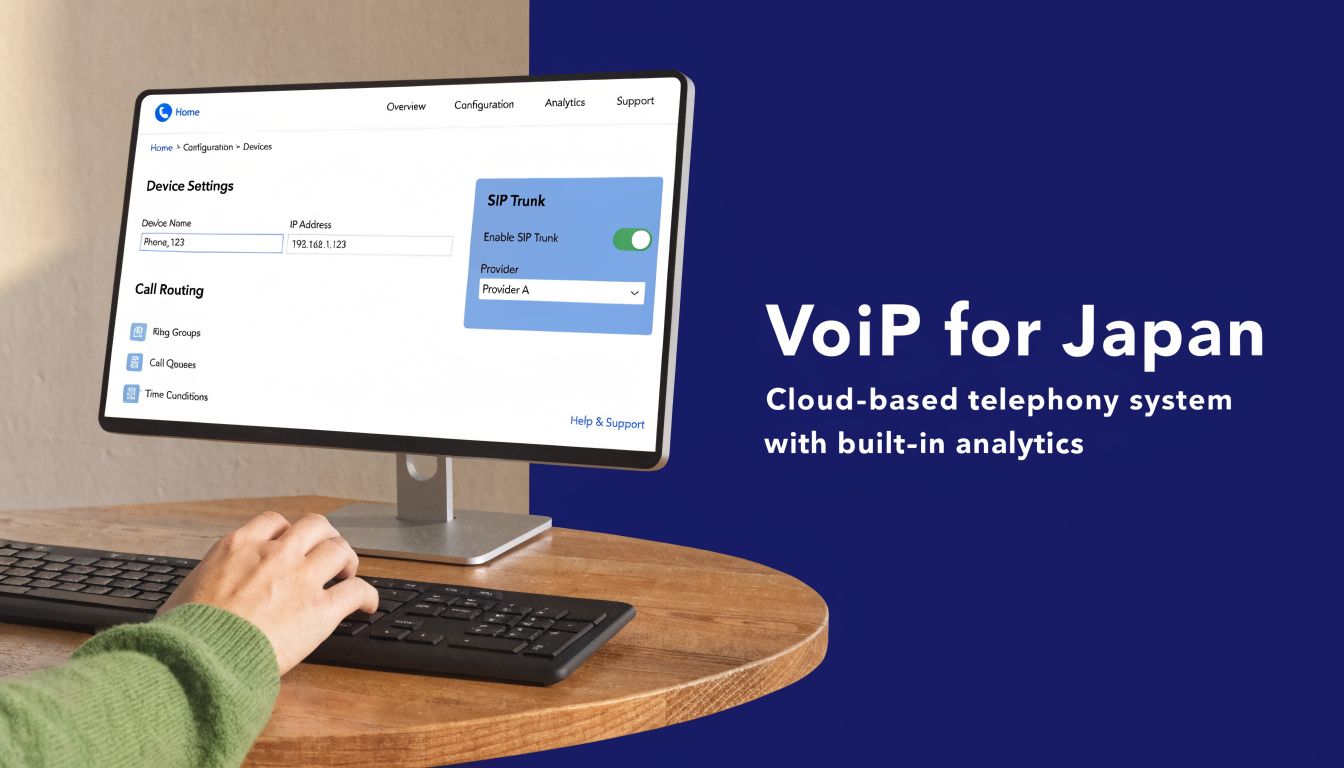
Vonage's Japan guidance highlights a real operational issue. Caller ID presentation significantly impacts answer rates, and some carriers treat calls from improperly configured numbers as best-effort only, which can affect delivery without warning, according to Vonage's Japan voice features and restrictions.
Start with caller ID and test it early
Many teams treat caller ID as a cosmetic detail. In Japan, it's not. It affects whether the call is trusted, answered, and returned.
A solid rollout checklist includes:
- Validate the outbound number format your carrier or platform will present
- Test from domestic and non-domestic originating numbers if your workflow uses both
- Confirm callback behavior so returned calls land where you expect
- Document approved outbound identities so staff don't improvise
If your reps can place calls from multiple apps or devices, lock this down centrally. Don't leave caller ID behavior to individual user settings.
Build inbound routing around the real destination
Vonage also notes that Japan toll-free numbers may be mapped to DID numbers for inbound forwarding rather than terminating directly on the toll-free identity. That means your routing design should follow the underlying number path, not just the marketing number shown publicly.
Many IVRs become fragile in these scenarios. Teams publish one Japanese number, but the callback path, hunt group, voicemail destination, and after-hours flow weren't built around the actual inbound behavior.
A stronger setup looks like this:
| Configuration area | What to do |
|---|---|
| Outbound permissions | Allow approved users and departments to place international calls |
| CLI presentation | Standardize the business number shown on outbound calls |
| Inbound number mapping | Route the published Japanese number to the correct DID and destination |
| Time-of-day routing | Send calls to live staff during business hours and voicemail or alternate queues after hours |
| Queue design | Separate sales, support, and partner calls if they need different handling |
| Fallback path | Define where unanswered or failed transfers should land |
Use time-of-day rules like a professional front desk
Japan business communications often break down outside local working hours. A caller reaches a ring group in another country, nobody answers, and the business loses credibility.
Time-based routing solves that. During Japanese business hours, send calls to a live team or queue. Outside those hours, route to a localized message, voicemail with transcription, or an on-call path if the issue is urgent.
Test your after-hours path with the same care you test daytime calling. That's where many international setups fail.
If you're unfamiliar with the structure behind local inbound numbers, a quick primer on what a DID number does in business telephony helps when planning Japanese routing.
Time Zones and Etiquette for Business Calls
A technically correct call can still go badly if the timing or delivery feels careless. That's especially true with Japan. The communication standard is usually orderly, punctual, and more formal than many US teams expect.
Japan operates on Japan Standard Time, UTC+9. The practical lesson is simple. Don't place unscheduled business calls casually and hope someone picks up. Schedule them, confirm them, and keep the purpose tight.
Good timing beats more call attempts
For business calls to japan, the safest pattern is:
- Schedule in advance
- Send a calendar invite with the time clearly stated
- Confirm which number will be used
- Decide whether the call is voice-only or should move to video
- Prepare a short agenda
That discipline reduces missed calls and awkward rescheduling. It also makes internal handoff easier when multiple people from your side are joining.
The etiquette that actually matters
A few habits go a long way:
- Use a formal opening: Start with names, roles, and company context.
- Be on time: If the call starts at the stated time, join a little early.
- Speak clearly: Slow down slightly, especially if the conversation is in English.
- Avoid interrupting: Leave room after key points.
- Summarize next steps: Confirm responsibilities before hanging up.
None of that is complicated. But teams that skip it often create unnecessary friction, then blame language barriers or telecom issues.
Clear structure makes international calls easier for everyone on the line.
Why documentation matters more than usual
There's a useful cultural parallel here. The Japanese practice of shisa kanko, often translated as point-and-call, has been shown to reduce workplace errors by up to 85%, as summarized in this overview of shisa kanko and error reduction. The business takeaway isn't that phone teams should imitate rail workers. It's that process, confirmation, and visible accuracy matter.
That's why call recording, voicemail transcription, searchable logs, and post-call notes are so valuable in calls to japan. They reduce ambiguity. They give teams a record of what was agreed. They also help when a US-based sales rep, a Japan-based partner, and an operations manager all remember the same conversation slightly differently.
If your team is building a repeatable process for documenting important conversations, recorded calls and written summaries are far more reliable than memory alone.
A simple operating standard
Use this internal rule for important Japan calls:
- Confirm the scheduled time in writing
- Place the call from the approved business number
- Record or log the conversation when policy allows
- Send a written summary with action items
- Keep the call history searchable for the team
That approach is more effective than relying on individual habits. It also fits the broader expectation of professionalism and consistency that Japanese business contacts often appreciate.
If your team needs a cleaner way to handle calls to Japan, SnapDial gives you a managed cloud phone system with business routing, mobile-ready calling, call recording, reporting, and white-glove setup. It's a practical upgrade for companies that want fewer missed calls, better control, and a more professional international calling workflow.