

$12.8 billion in 2025, projected to reach $28.6 billion by 2034 at a 9.3% CAGR. That's the scale of the international calling apps market, according to DataIntelo's international calling apps market report. For a business owner or IT manager, that number matters because it changes how international calling should be treated. It's no longer a phone bill line item. It's part of your operating model.
Most businesses still think about international calls the old way. They compare per-minute rates, keep a few desk phones alive, and hope staff know which prefix to dial. That approach breaks down fast when you have remote employees, overseas vendors, distributed support teams, or customers who expect a local number and a clean handoff every time they call.
Legacy international calling still has a place. Some businesses rely on it for specific routes, regulated workflows, or areas where internet performance is inconsistent. But for most growing companies, the bigger problem isn't whether the old system still works. It's that the old system creates friction everywhere else. Billing is harder to predict. Number management becomes scattered. Reporting is weak. Moves, adds, and changes take too long.
Cloud voice fixes those business issues when it's deployed correctly. It centralizes routing, standardizes number formats, supports mobile and desk users in the same system, and gives operations teams one place to manage policy and visibility. That's the shift. International calling is moving from carrier logic to software logic.
The Future of Global Business Communication Is Here
International calling is no longer a side expense that finance reviews once a month. For growing companies, it affects margin, customer access, staffing flexibility, and how quickly new markets can be opened.
The shift to cloud voice is happening because the old model creates operating drag. Legacy carriers, fixed office hardware, and country-by-country number management are hard to justify when teams work across locations and customers expect a local number, fast answer times, and consistent call handling. A cloud system fixes many of those problems, but only if the business treats it as an operating model decision, not a rate-shopping exercise.
Why the shift is happening now
Business structure changed faster than many phone systems did. Sales may sit in London, support in Manila, account managers on the road, and leadership split across regions. That setup puts pressure on any calling environment built around a single office, a local PBX, or manual carrier provisioning.
The issue is not only flexibility. It is administrative effort. Every new user, number, routing rule, and regional requirement adds work for IT and operations. Companies that move to software-based calling usually do it to cut that overhead, standardize policy, and make expansion less painful.
A useful test is simple. If international calling still depends on office equipment to support remote staff or overseas teams, the phone environment is already limiting the business.
What businesses are actually paying for
The value is operational control.
That usually includes:
- Central administration for users, numbers, routing rules, and permissions across countries
- Mobility so staff can use one business identity across desk phones, laptops, and mobile devices
- Consistent customer experience across headquarters, regional offices, and remote teams
- Reporting and policy visibility so managers can track usage, enforce calling rules, and spot waste
This is why many businesses move toward global phone services for distributed business teams. The gain is not just lower per-minute pricing. It is faster deployment, fewer support tickets, better oversight, and a calling setup that can keep pace with hiring and expansion.
There is also an infrastructure consideration that gets missed in consumer-focused advice. Voice platforms need to scale with the rest of the business stack. Teams planning a broader cloud migration should evaluate calling in the same context as identity, security, CRM, and a scalable cloud architecture for SaaS. That reduces integration rework later and helps avoid the common mistake of replacing legacy lines with a newer system that is still managed country by country.
The future of global business communication is software-driven, centrally managed, and tied closely to finance, compliance, and customer operations. Businesses that treat international calling that way usually get better cost control and a cleaner customer experience at the same time.
How Global Calling Technology Actually Works
International calling gets much easier to manage when you understand the transport underneath it. Most businesses are dealing with some mix of three layers: PSTN, VoIP, and SIP trunking. Each serves a purpose, but they don't behave the same way on cost, flexibility, or administration.
PSTN and VoIP are built on different logic
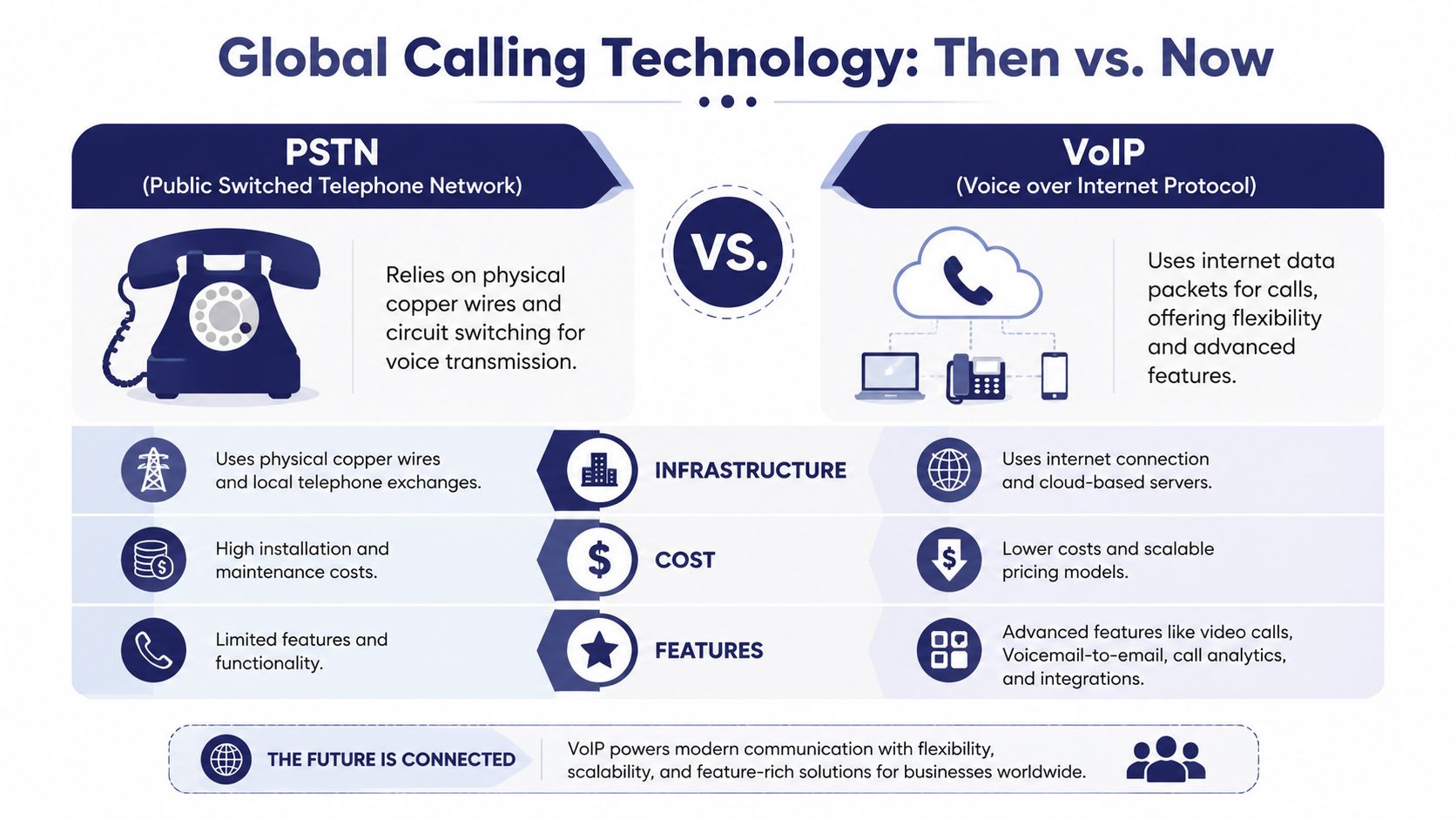
The traditional model is the Public Switched Telephone Network, or PSTN. Think of it as a dedicated road system designed specifically for voice. It's dependable, familiar, and still important in many environments. But it's also rigid. Capacity is tied closely to carrier infrastructure, hardware, and established routing paths.
The traditional international call services market was valued at USD 1.44 billion in 2024 and is projected to reach USD 2.29 billion by 2032, growing at 6.00% CAGR, according to Data Bridge Market Research's international call services report. That tells you two things. Legacy calling is still commercially relevant, and its growth is slower than cloud-based alternatives.
VoIP works differently. Instead of holding open a dedicated voice circuit, it converts speech into data packets and sends them across IP networks. That changes both the cost structure and the operating model. Voice becomes another managed application in your business environment, not a separate utility with its own silo.
SIP trunking is the bridge most businesses need
A lot of migrations aren't clean break-and-replace projects. Companies may have existing PBX hardware, analog devices, conference rooms, or branch office workflows they can't discard immediately. That's where SIP trunking becomes useful.
SIP trunking lets a business connect its phone system to internet-based voice services without maintaining the same dependency on old carrier circuits. It's often the transition layer between on-premise telephony and a full cloud model. If you need a straightforward primer, this explanation of what SIP trunking means in business telephony is worth reviewing.
Infrastructure matters more than feature lists
A lot of IT teams focus on call features first and network design second. In practice, that order causes problems. Voice is unforgiving when the underlying environment is unstable. If the network is poorly designed, international calling quality drops fast, no matter how polished the admin portal looks.
That's why businesses moving core communications into software should think beyond phones and ask whether their wider environment supports reliability, elasticity, and centralized management. The same principles behind scalable cloud architecture for SaaS apply here. If the platform layer scales well but the supporting architecture doesn't, users still experience failure as missed calls, poor audio, and routing inconsistencies.
| Technology | Best fit | Main drawback |
|---|---|---|
| PSTN | Legacy environments, fixed-site telephony, specific regulated use cases | Less flexible and often harder to scale globally |
| VoIP | Distributed teams, mobile workforces, centralized management | Sensitive to network performance |
| SIP trunking | Hybrid migration from PBX to cloud | Can preserve legacy complexity if used without a larger plan |
The mistake isn't using legacy and cloud tools together. The mistake is keeping a hybrid setup indefinitely without deciding what should be standardized and what should be retired.
Mastering International Dialing Codes and Formats
A surprising amount of international calling failure has nothing to do with carriers, firewalls, or bad audio. The number itself is often formatted wrong before the call even starts.
E.164 is the standard that keeps calls routable
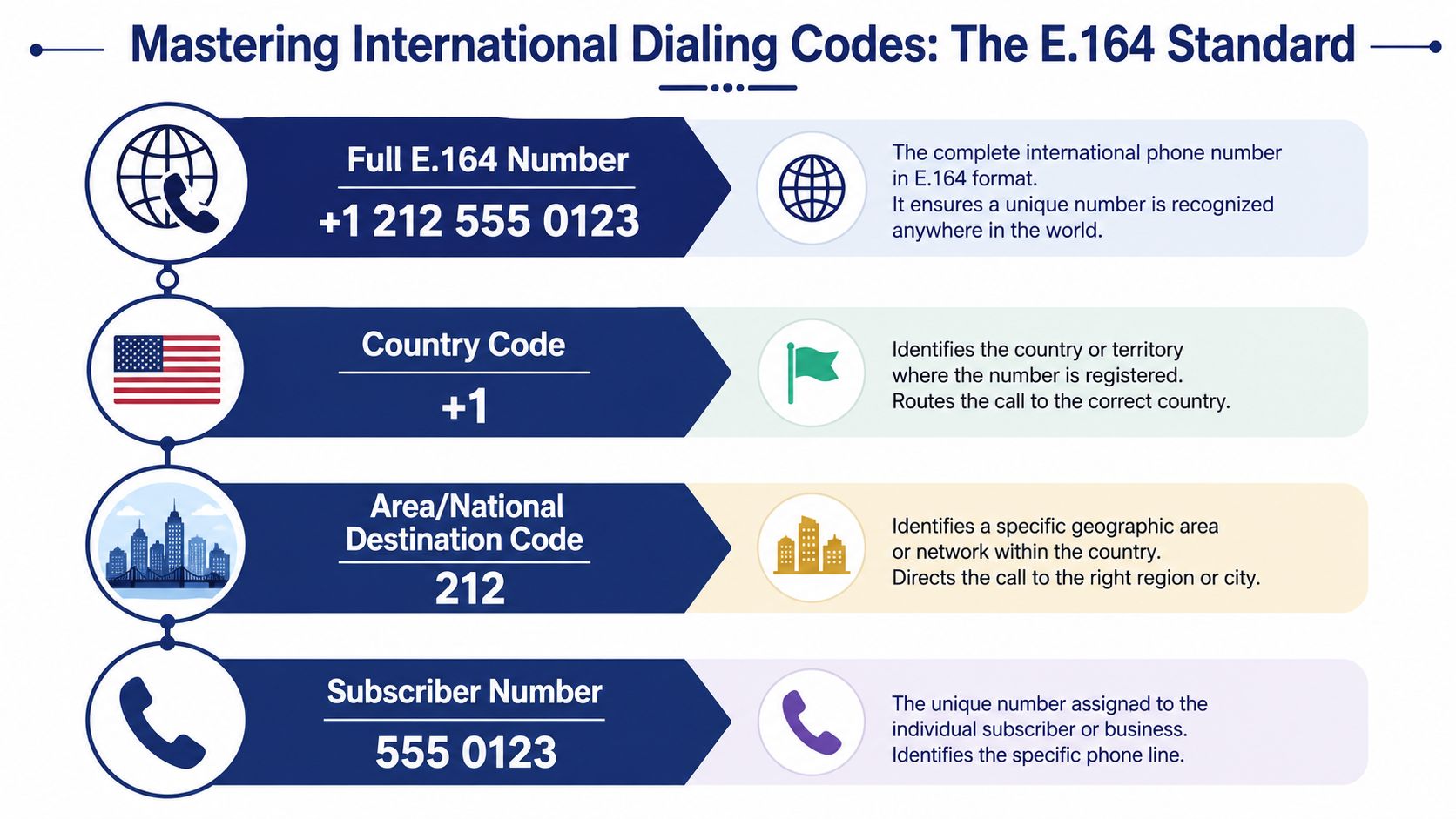
For business use, the number format that matters is E.164. It's the global numbering standard that tells systems how to route calls across countries and networks. In practical terms, the format is simple:
+ [Country Code] [Area or National Destination Code] [Subscriber Number]
That structure matters because cloud phone systems, CRMs, mobile apps, and PBX platforms all rely on consistent formatting. If one contact is stored with a local trunk prefix, another with missing country code digits, and another with an old domestic pattern, your dialing behavior becomes unpredictable.
The plus sign and 011 are not interchangeable everywhere
The most common confusion is the international access prefix. Mobile devices interpret “+” as the international access code, while US landlines typically require 011 before the country code. According to Dialpad's international calling guide, that distinction causes 15 to 20% of failed international call attempts from non-mobile devices when the prefix is used incorrectly.
That's not a consumer nuisance. In a business setting, it turns into failed outreach, missed callbacks, and support queues that look understaffed when the underlying problem is dialing logic.
What to standardize inside a business
The safest policy is to store all international business contacts in full E.164 format. Don't rely on users to remember local dialing habits. Build the format into the directory, CRM, and contact sync rules.
Use this checklist:
- Store numbers with the plus sign so mobile apps and cloud systems can interpret them consistently
- Include the country code every time even for contacts your team calls regularly
- Strip local-only prefixes that make sense domestically but fail in global routing
- Test from more than one endpoint because desk phones, softphones, and mobile apps may handle shortcuts differently
A related concept many teams miss is the role of a DID, or direct inward dial number. If your business serves international customers, local numbers can improve answer rates and trust, but they need to be tied back to a clean global numbering plan. This overview of how DID numbers work for business calling is useful when planning numbering strategy.
Clean number formatting isn't admin polish. It's a reliability control.
Uncovering the Real Costs of International Calling
International calling costs rarely break a budget because of the advertised per-minute rate alone. The bigger problem is spend that gets scattered across carrier charges, failed contact attempts, inconsistent user behavior, and avoidable delays in reaching customers or partners.
For a business migrating off legacy calling, that distinction matters. A low published rate can still produce a high operating cost if teams are calling mobile numbers overseas, redialing failed calls, or mixing company phone systems with personal carrier plans.
The hidden bilateral cost problem
One cost many finance teams miss sits on the other end of the call. In some countries and mobile scenarios, the recipient may pay to answer an international carrier call. This discussion of international calling charges and recipient fees highlights why overseas contacts often hesitate to pick up unfamiliar international calls, especially on mobile.
That behavior shows up in business metrics fast. Sales reps see lower connect rates. Support teams wait longer to resolve open issues. Account managers switch to email or chat for conversations that should have been handled in one call.
VoIP helps here when both sides are reached through internet-based apps or locally presented business numbers, but it does not remove every cost risk by default. Routing policy, caller ID strategy, and number assignment still shape whether people answer.
If overseas contacts avoid your calls, the issue may be cost exposure on their side, not poor engagement.
Why legacy bills are harder to control
Traditional carrier billing often spreads charges across country groups, mobile routes, roaming behavior, taxes, add-ons, and usage that sits outside the corporate phone system. That makes forecasting difficult, especially for growing companies with distributed teams.
The problem gets worse in a few common cases:
- Sales teams calling prospects across several countries with different mobile termination rates
- Support teams returning calls to customers who are traveling or using foreign mobile numbers
- Remote and hybrid staff splitting calling between business apps and personal carrier plans
- Travel-heavy organizations where calling patterns change by country, network, and device
For companies with traveling employees, assumptions about territories and billing treatment create their own cost problems. This traveler's guide to Puerto Rico phone service is a useful example of how easily teams can misread what counts as domestic, roaming, or international usage.
The operational cost of confusion
The largest cost usually doesn't show up as a line item called “inefficiency.” It appears in repeated call attempts, handoffs to email, delayed approvals, and finance reviews triggered by bills no one can explain quickly.
I see this pattern often during migrations. One office uses desk phones, another uses mobile carrier dialing, and remote staff use whatever is convenient that day. The business ends up paying for the same conversation path three different ways while losing visibility into who called whom, from where, and at what cost.
Cost reduction comes from routing and policy, not just from choosing a provider with lower headline rates. A cloud calling model works best when international usage is centralized, reporting is easy to audit, and teams follow one calling path across regions. That improves budget control, shortens response times, and removes friction for customers who just want a reachable local or familiar number.
Essential Features for a Business International Calling Service
When businesses shop for international calling, they often get distracted by the wrong checklist. Unlimited domestic bundles, phone hardware aesthetics, and one-off promotional rates don't solve the hard parts of global communications. The right evaluation starts with workflows.
Numbers, routing, and local presence
A business international calling service should let you establish a local presence without creating local silos. That usually means assigning regional or country-specific numbers while routing calls through one managed platform.
The features that matter most here are:
- Local and international numbers so customers can reach you through familiar dialing patterns
- Consistent caller ID presentation so outbound calls look trustworthy and recognizable
- Time-based and location-based routing so calls reach the right team without manual forwarding
- Auto attendants and IVR paths so one published number can support multiple countries, languages, or departments
A local number without thoughtful routing just moves the problem. The customer dials a familiar number, but if the call lands in the wrong queue or reaches voicemail after hours in the wrong timezone, trust drops fast.
Management features that save time later
The second category is administrative. Here, strong platforms separate themselves from basic internet phone services.
Look for:
- A self-service admin portal that lets IT manage users, call flows, recordings, and permissions without opening support tickets for routine tasks
- Call logs and reporting that combine international activity with domestic traffic in one reporting view
- Mobile and desktop apps so employees can use business identity from anywhere
- Call recording and voicemail transcription when compliance, coaching, or response speed matter
If you're comparing platforms for a smaller company, this guide to choosing the best business VoIP for small business is useful because it frames features in terms of real business usage rather than spec-sheet noise.
What separates business-grade from consumer-grade
Consumer calling apps are fine for ad hoc conversations. They're weak when you need accountability.
Here's the practical difference:
| Capability | Consumer app mindset | Business requirement |
|---|---|---|
| Identity | Personal account-based | Company-controlled numbers and caller identity |
| Routing | User decides manually | Rules-based routing across teams and locations |
| Visibility | Limited records | Auditable logs, reports, and admin oversight |
| Continuity | Tied to one device or user | Shared access, reassignment, and centralized control |
Good international calling for business should reduce dependence on individual user behavior. The system should carry the policy.
A Step-by-Step Plan for Migrating Your Business Calling
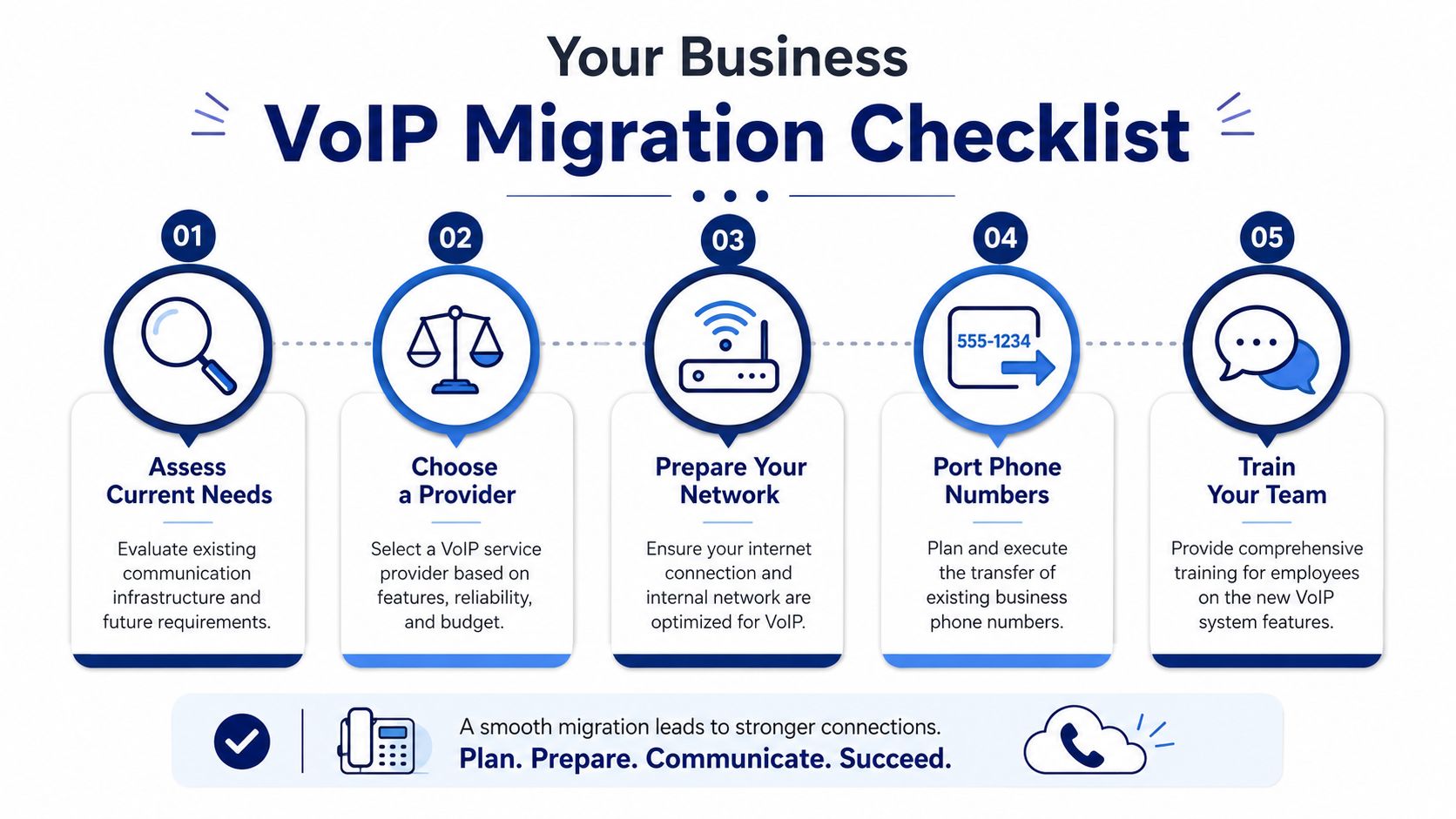
Most international calling migrations fail in planning, not in technology. Teams rush to pick a provider before they understand call patterns, numbering dependencies, and the state of their contact data.
Start with the call inventory
Before you change anything, audit what you already have. Pull billing records, export number inventories, and identify which teams make international calls. Don't assume the loudest stakeholders represent the whole business.
Separate your current environment into categories:
- Numbers that must be retained
- Numbers that can be retired
- Users who need full voice service
- Departments that only need limited calling or inbound coverage
- Special workflows, such as analog devices, call recording requirements, or queue-based support
That inventory becomes the basis for porting, licensing, and routing design.
Clean the data before you move the phones
This step gets skipped constantly, and it causes avoidable rollout pain. In business VoIP systems, 40% of international call failures stem from dialing format errors rather than network issues, according to Ultra Mobile's international calling guidance. The usual problems are missing country codes, extra local digits, and legacy contact formats that don't translate well into cloud systems.
If your CRM, ERP, Outlook contacts, and help desk tools all store numbers differently, fix that before cutover.
Migration warning: Dirty contact data turns a technically successful deployment into a user adoption problem.
Use a practical cleanup sequence:
- Export every shared contact source so you can see formatting inconsistencies in one place
- Normalize all international numbers to E.164 rather than keeping local habits by region
- Remove duplicates and obsolete entries that confuse call history and directory search
- Test critical numbers in staging before you train users on the new system
A short implementation walkthrough can also help stakeholders visualize the process:
Port in phases and train for real use
Number porting should be planned around business risk, not just convenience. Start with low-risk groups if you need to validate routing and user behavior, then move frontline teams when the process is stable. Critical inbound numbers need a rollback plan, ownership verification, and clear timing windows.
Training should also reflect actual calling behavior. Don't stop at “here's how to make a call.” Teach staff how to transfer calls across regions, use mobile apps correctly, verify caller ID, and recognize when a failed call is a formatting issue versus a network issue.
A good migration feels boring on launch day. That's the standard to aim for.
Best Practices for Call Quality and Cost Reduction
Once the platform is live, cost control and call quality become an operations job. Companies that run international calling well treat voice the same way they treat finance systems or CRM. It needs owners, standards, and regular review.
Protect quality before users complain
International VoIP often cuts calling costs compared with legacy international carrier pricing, but savings disappear fast if calls are unreliable. A cheap minute rate does not help if sales calls break up, support transfers fail, or remote staff fall back to mobile dialing because they do not trust the system.
Poor quality is usually traced to the access network, Wi-Fi congestion, unmanaged home setups, or endpoint inconsistency. Users still blame the phone platform first. That is why the best operators monitor packet loss, jitter, latency, and failure rates before complaints stack up in IT or customer support.
Focus on the controls that matter
A few operating practices make the biggest difference:
- Prioritize voice traffic on the network so calls are not competing with large uploads, backups, and video-heavy apps
- Standardize approved headsets, desk phones, and softphone configurations so teams are not troubleshooting five different quality problems across five device types
- Set clear policies for mobile and softphone use so staff use the lowest-cost, highest-quality route instead of defaulting to carrier minutes
- Review call destinations and usage patterns every month so managers can spot avoidable spend, routing mistakes, and teams that should use another channel first
This is also where businesses save money in ways rate cards do not show. Some international conversations should start in chat and move to voice only when needed. Some should use local presence numbers to increase answer rates. High-volume destinations may justify dedicated routing review or bundled plans, while low-volume regions may be better handled with stricter dialing policies.
Treat calling quality as a customer experience issue
International call quality affects revenue, retention, and brand perception. Customers notice clipped audio, long post-dial delay, dropped transfers, and agents talking over each other because of latency. Those issues make the business sound disorganized, even when the product and team are strong.
The fix is ownership. Assign one team to review call quality trends, failed call reports, and carrier performance by region. Recheck network readiness when you open a new office, add a BPO partner, or onboard a cluster of remote users in another country. If no one owns that review cycle, avoidable quality issues turn into a recurring cost.
The strongest businesses also set thresholds that trigger action. For example, if call failures rise in one country, reroute traffic, test an alternate provider, or restrict certain endpoints until the cause is clear. That discipline keeps international calling from becoming a hidden support problem that erodes margin and customer trust.
If you're replacing a legacy PBX or trying to unify international calling across remote teams, SnapDial is worth a close look. It gives growing businesses a cloud-based phone system with predictable pricing, white-glove setup, mobile-ready calling, and the administrative control most companies need when they expand across locations and borders.