

The cheapest-looking SIP trunk quote is often the most expensive service. Fixed-rate plans commonly run $15–$30 per concurrent channel per month, but phone numbers, usage, taxes, emergency-service fees, connectivity, and failover arrive as separate charges (SIP trunk pricing guide). Compare channel rates alone and you will approve the wrong vendor.
Whether buying channels and calling minutes separately still beats a flat-fee cloud phone system on total monthly cost is the core question. Answer it by rebuilding the invoice line by line, then checking whether the trunk's savings survive number charges, porting, bandwidth, and backup routing. For many SMBs, the flat fee wins. For related guidance on managing business communications, the Zeus Command Hub blog is worth a regular read.
What SIP Trunking Really Costs Beyond the Sticker Price
SIP trunking can be less expensive than legacy voice service, but “SIP is cheap” isn't a budget. The actual cost depends on what the provider includes and what it bills separately. A channel charge may cover call capacity while leaving numbers, metered minutes, emergency calling, taxes, porting, or failover as additional line items. If the quote doesn't show those charges, you don't yet know the price.
Start with the billing model. A fixed-rate plan charges for concurrent call capacity, sometimes with domestic calling included. A metered plan may reduce or remove the recurring channel charge, then bill usage by the minute. International calling can change the comparison because rates vary by destination. Even a plan described as unlimited deserves a close read: confirm what destinations and traffic it covers and whether any use restrictions or add-on fees apply.
Then price the service that makes the trunk usable at each location. Count the phone numbers your staff need, check how emergency-service charges are assessed, and ask whether taxes and regulatory fees are included in the quote or added later. If the business relies on voice during an internet outage, include the backup connection and failover arrangement. Those aren't optional details for an organization that can't afford to lose inbound calls.
Don't approve a headline rate. Approve an itemized, location-by-location total.
The decision isn't SIP versus a traditional circuit. It's SIP's complete delivered cost versus the cost of a cloud phone service that bundles calling and administration. Ask both providers to price the same users, numbers, call pattern, sites, support, and resilience. That makes it much harder for a low base rate to hide an expensive service.
How Concurrent Channels, Users, and DIDs Drive SIP Cost
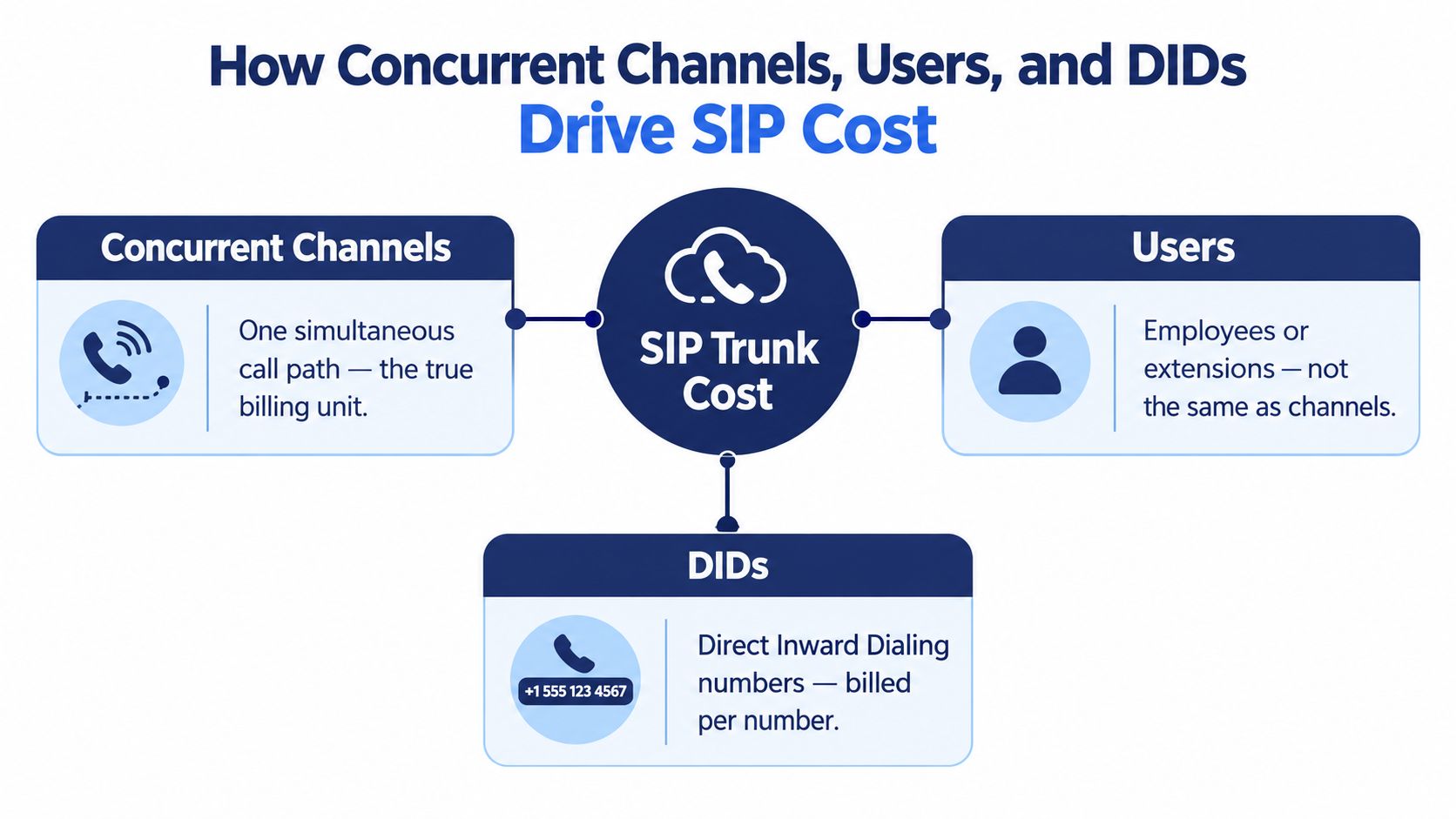
A channel is one simultaneous call path. It isn't an employee, desk phone, or phone number. A Direct Inward Dialing number, or DID, is a number callers dial directly, and providers often bill it separately from call capacity. For a plain-language breakdown, see this guide to what a DID number is and how it works.
Channels work like seats in a coffee shop: the shop needs enough seats for the customers likely to arrive at the same time, not one seat for everyone who might ever visit. A 50-person office that rarely runs more than a handful of simultaneous calls has no business pricing 50 channels. Because peak concurrency typically sits well below headcount, capacity-based pricing lets you buy call paths independently of staff count.
A call center inverts this logic: agents are speaking simultaneously most of the hour, so concurrency approaches headcount. Size the trunk for that demand, not for the office average.
Use this sequence to size capacity:
- Find the busy-hour peak. Count the calls that overlap during your busiest period, not the extensions on the floor plan.
- Separate numbers from calls. A company can own hundreds of DIDs yet need a fraction of that in channels if inbound and outbound calls rarely stack up.
- Stress-test the estimate against operations. A front office with staggered calls and a support queue with agents on back-to-back calls are different demand profiles. Price each site accordingly.
The sizing question that matters is how many calls must connect at once, not how many people work there.
The Line Items That Make Up a SIP Trunk Bill
The channel rate is usually the smallest number on a SIP invoice. The rest is a stack of charges providers describe with words like "unlimited," "included," and "standard." Each of those words deserves a follow-up question: what does it cover, at which sites, and under what conditions.
| Component | Typical range | Bundled or a la carte | Cost driver |
|---|---|---|---|
| Channel subscription | Fixed-rate plans commonly run $15–$30 per concurrent channel monthly, as benchmarked earlier | Bundled or separate | Peak simultaneous calls and plan structure |
| DID rental | About $1–$3 per number monthly (DID and metered pricing benchmarks) | Often a la carte | Number count and number type |
| Domestic usage | Metered plans may charge $0.005–$0.02 per U.S. minute (same benchmark source) | Included or metered | Minutes and billing terms |
| International usage | Varies by destination | Usually confirm separately | Destination and call volume |
| Taxes and emergency-service charges | Ask for an itemized quote | Often separate | Location, numbers, and provider policy |
| Setup and porting | Must be quoted | One-time, sometimes bundled | Number inventory and migration scope |
| Failover and network access | Must be quoted | Often separate | Sites, backup routes, and resilience needs |
"Unlimited domestic" is the term that causes the most trouble. It rarely says whether toll-free calling, international traffic, or specific destinations are covered, and carriers interpret it differently. Get the written definition and the rate sheet for anything outside the bundle before you compare quotes.
Metered plans suit businesses with uneven call patterns, and they shift more of the cost risk onto your usage forecast. Understanding how metered billing models structure per-minute charges helps you ask sharper questions, though the provider's contract and rate sheet decide the comparison.
The invoice to demand is the fully loaded monthly estimate, plus a separate list of one-time fees.
Sample SIP Cost Calculations for Common SMB Scenarios
A worked estimate only helps if it separates known costs from unknown ones. The channel and metered rates below are the published benchmarks cited earlier, not a provider quote, and the volumes are illustrative. Taxes, emergency-service charges, porting, and network costs will differ across businesses, so treat each total as a template rather than a prediction.
A professional services office
Take an office that needs eight concurrent channels. At the $15–$30 per-channel benchmark, the base charge runs $120–$240 per month before numbers, taxes, regulatory fees, and usage. Add monthly rental for each DID at the per-number rates quoted earlier, plus any one-time porting or setup cost. For metered service, multiply domestic minutes by the provider's written rate, then add international calling and the same number and site charges.
A retailer across multiple locations
Company-wide channel math hides the true cost. A four-branch retailer might budget 4 channels per site at the benchmark rate, landing at $240–$480 per month for 16 channels, plus 4 local DIDs per branch at $1–$3 each for another $16–$48. That total still excludes per-site access circuits, backup routes, and toll-free usage, which is where branch deployments routinely blow past the sticker estimate. Build a separate worksheet for each location. A trunk that prices well at the main office may not represent the delivered cost when every branch needs its own connectivity and resilience.
An inbound call center
High-concurrency operations should run both models against actual peak demand. Say a center peaks at 20 simultaneous calls: unlimited channels at the benchmark rate cost $300–$600 monthly. If agents log 25,000 domestic minutes in the same month, metered billing at the $0.005–$0.02 per-minute range works out to $125–$500, plus whatever the provider charges for channels, numbers, and access on top. The cheaper model flips with call duration and seat count, so the only honest comparison uses the center's own call records.
For each scenario, request both totals in writing. There's no honest breakpoint calculation without the business's call minutes, destinations, number inventory, and provider fees. Compare the full monthly totals and one-time migration costs, then check what happens if volume climbs or a site drops its connection.
SIP vs PRI and PSTN Total Cost of Ownership
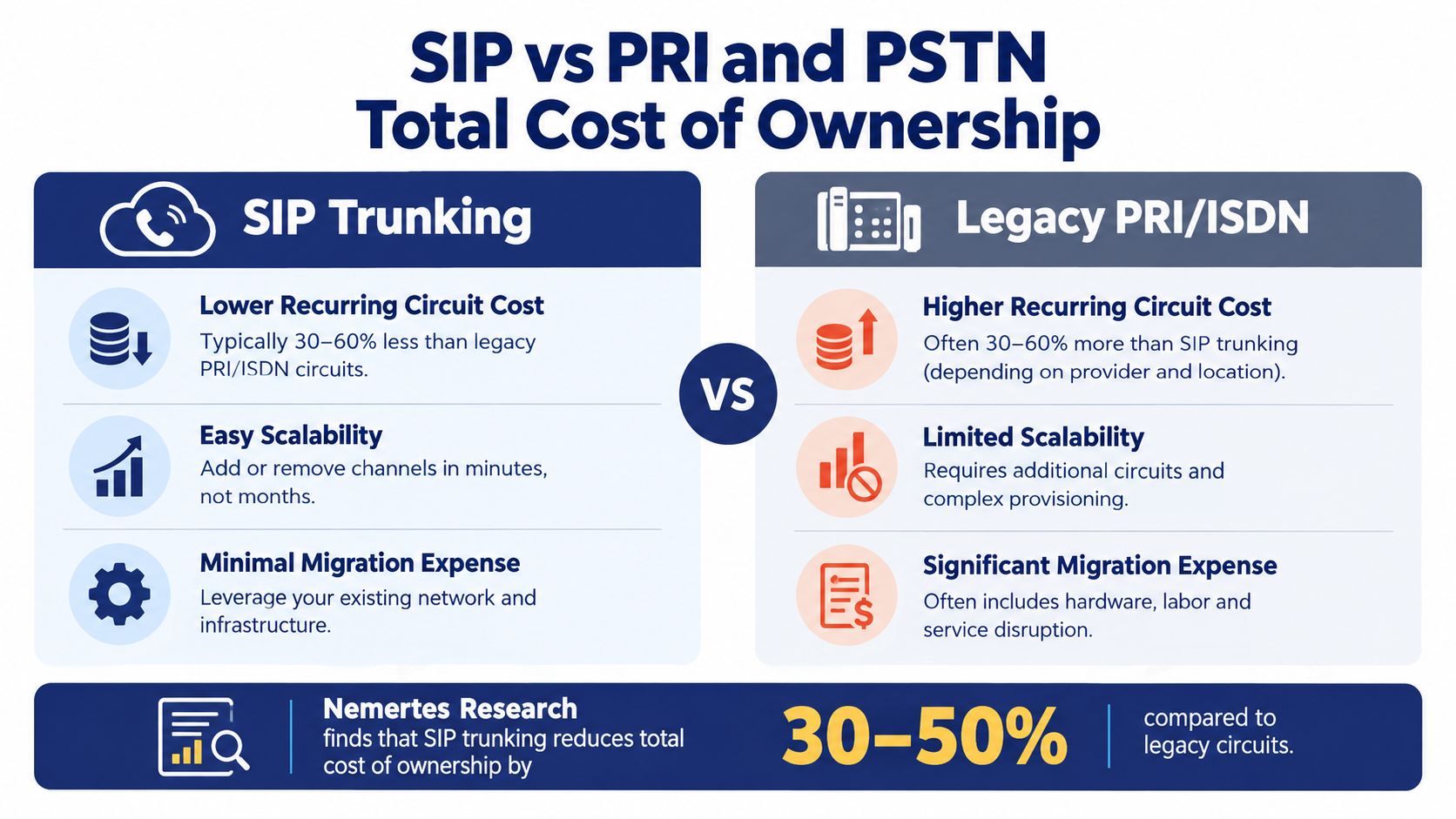
The strongest cost case for SIP is often replacing a legacy PRI or ISDN circuit that locks voice capacity to a site. A white paper citing Nemertes Research reports that replacing PRI with SIP can reduce monthly circuit costs by about 40%. Broader industry commentary puts potential telecom-cost reductions at 30%–70%, depending on locations, call volume, international traffic, and remaining hardware and maintenance costs (CDW white paper on SIP trunking).
Treat those figures as benchmarks, not savings guarantees. A multi-location business paying for separate legacy circuits may have more room to consolidate voice transport than a single office with a lightly used PRI. But migration can bring its own costs: network upgrades, session-border controllers, backup connectivity, number porting, installation, security controls, and support. The savings calculation should include those items rather than treating migration as free.
Compare the options across the costs that matter:
- Recurring service: Put the circuit or trunk charge beside the fees for numbers, usage, taxes, and support.
- Scalability: Check whether adding call capacity requires new site-bound infrastructure or a change to the SIP service.
- Migration: Include equipment, network work, porting, and the labor needed to move without disrupting callers.
SIP is a strong candidate when it removes expensive fixed capacity or simplifies service across multiple locations. It isn't an automatic win if the migration bill consumes the savings.
A small business with one underused PRI should run the full payback calculation before authorizing a project. A multi-site or high-volume organization should do the same, but include the cost of every existing circuit and the operational value of centrally managed capacity.
Bandwidth, Codecs, and Failover Costs Most Buyers Forget
A cheap trunk can still be expensive if the business network can't carry its calls reliably. Bandwidth needs depend on codec and simultaneous calls. A recent pricing source estimates 85–100 Kbps per concurrent call with G.711, compared with 30–50 Kbps with compressed codecs; at 100 simultaneous calls, that implies about 8.5–10 Mbps of voice bandwidth before overhead, redundancy, and other business traffic (SIP trunk bandwidth and cost discussion).
That's not a recommendation to squeeze bandwidth by choosing a compressed codec without testing it. Codec choice can involve quality, compatibility, and transcoding trade-offs. Have the provider and network administrator test the expected call load, set appropriate traffic priorities, and verify that ordinary business traffic won't crowd out voice. For practical guidance on improving call quality in a home setup, see this advice on how to fix home network call dropouts. Review the organization's SIP bandwidth requirements as part of the network assessment.
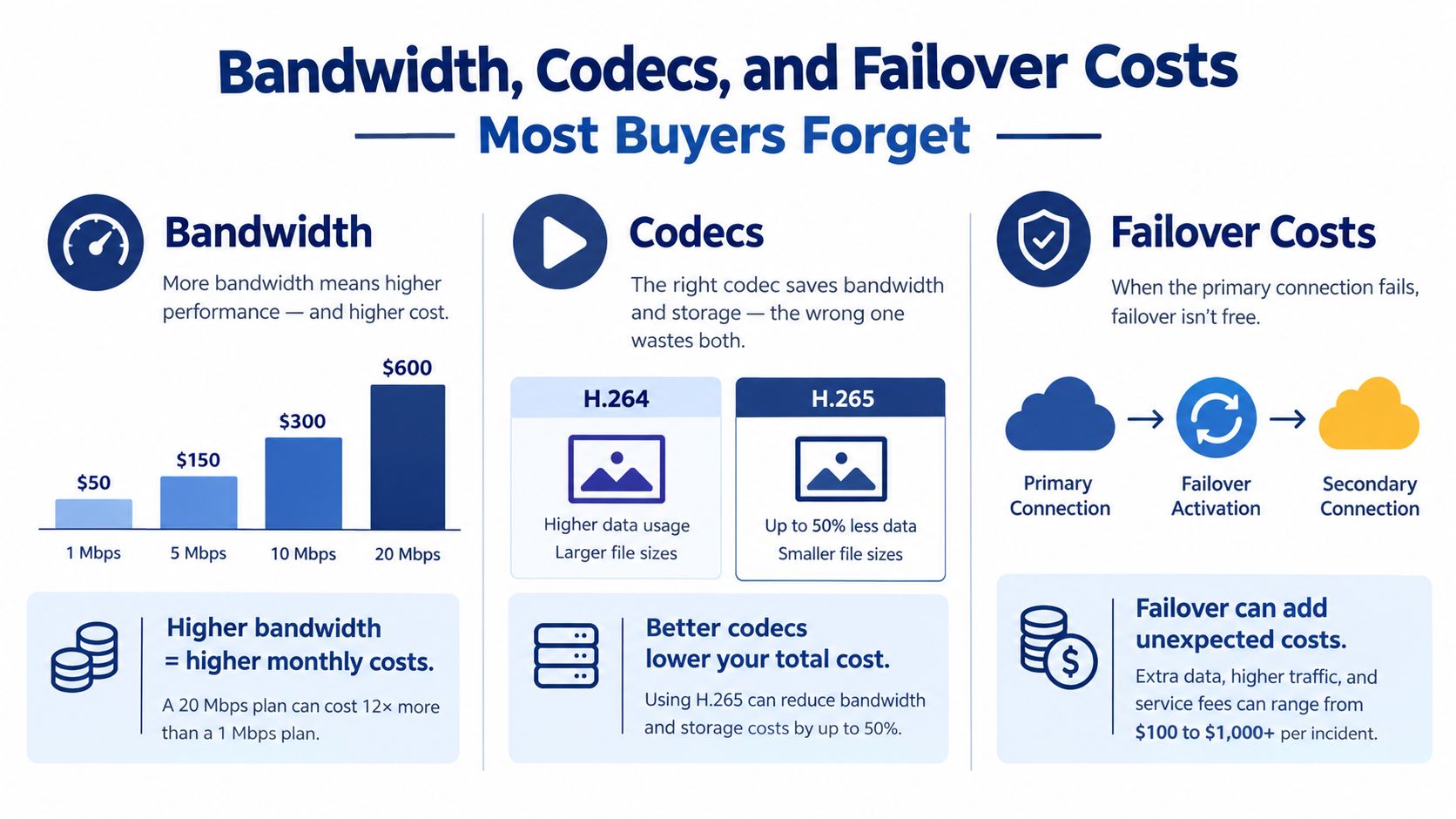
A backup route also has a price. Redundant internet access, monitoring, and automatic failover can raise recurring costs, but omitting them leaves the business exposed to outages at the primary connection. Singtel's published tariff lists SIP-to-SIP auto-failover at $600 per trunk access, illustrating that resilience can be a material charge beyond the headline trunk price (Singtel tariff filing).
See how call quality and connectivity affect the economics in this overview:
Hidden Fees and the All-Inclusive Alternative
A quote can be technically accurate and still leave buyers unprepared for the first invoice. Before signing, check for automatic renewal, number-by-number porting charges, rounding rules on international minutes, exclusions from “unlimited domestic” calling, and emergency-service charges assessed by address or number. Ask which charges are recurring, which are one-time, and how the provider handles changes to locations, numbers, and capacity.
Then compare the itemized SIP total with a flat-fee hosted phone service. A cloud phone system can make budgeting simpler by combining calling and administration in a predictable recurring fee, rather than splitting the service across trunk capacity, minutes, and separate features. That doesn't mean every bundle includes the same services. Confirm the included numbers, calling, support, setup, porting, and emergency-service arrangements before comparing it with a SIP quote.

SnapDial is one option for businesses evaluating this model: it provides hosted VoIP and cloud PBX with predictable pricing and white-glove setup and ongoing support described as included in its published materials. Ask for a written proposal and confirm exactly what the recurring fee covers.
Choose the predictable bundle when your team lacks the time or telecom expertise to monitor channel utilization, minute charges, taxes, and site-level add-ons. Choose SIP when you have a clear reason to manage trunks directly and can compare the complete cost, not just the rate card.
Your SIP Trunk Cost Decision Checklist
Before signing, make the provider show the numbers that determine your actual bill. A quote that lists only a channel rate isn't ready for approval.
- Confirm peak concurrency. Use busy-period call activity to size channels, rather than matching capacity to employee count.
- Audit every DID. Identify the numbers to keep, remove, or add, and confirm their recurring charges.
- Separate call patterns. Estimate domestic and international usage independently, then confirm how each destination is billed.
- Get fees in writing. Request taxes, emergency-service charges, number porting, setup, and any minimums as itemized lines.
- Price resilience. Include site connectivity, backup access, and failover routing where losing service would disrupt operations.
- Total migration costs. Include network changes, equipment, porting, installation, security, and support.
- Compare the full term. Put the SIP proposal beside a flat-rate hosted PBX quote using the same locations, users, numbers, and service requirements.
SIP is usually the stronger candidate for a multi-site, high-volume, IT-managed environment that can benefit from direct control over capacity and routing. A flat-fee cloud phone system may suit a smaller organization that values predictable bills, managed setup, mobile calling, and less telecom administration. PRI deserves consideration only after the business compares its existing circuit costs with migration expense and the service requirements of the replacement.
The decision rule is straightforward: buy SIP when the fully loaded cost and operational flexibility beat the alternative; choose a hosted system when bundling and simpler administration are worth more than managing each trunk line. Don't sign until the provider has priced numbers, usage, fees, connectivity, failover, and migration in writing.
If you're comparing SIP trunk rates with a predictable hosted phone system, ask SnapDial for a proposal that spells out setup, support, and recurring costs. Visit SnapDial to discuss a cloud phone system for your team.