Imagine your business phone system could operate just like streaming services—instead of being tied to clunky, physical phone lines, all your calls travel right over the internet. That's the core idea behind VoIP business services. This technology frees you from expensive on-site hardware and turns your internet connection into a powerful, flexible communications hub for your entire team.
What Are VoIP Business Services Anyway

Think of a traditional phone system like a railroad. To get a train from one city to another, you need a dedicated, physical track connecting them. In the same way, old-school phone systems require a physical copper wire running from the telephone company all the way to the desk phone in your office. It's rigid and expensive.
This is where VoIP (Voice over Internet Protocol) completely changes the game. It’s more like modern shipping, where packages are sent efficiently over a vast network of roads and highways—in this case, the internet. VoIP simply converts your voice into digital data and sends it over your existing internet connection. This simple shift away from dedicated wires unlocks a whole new level of flexibility and power.
Providers of VoIP business services, like SnapDial, handle all the complex technology for you in the cloud. That means you can finally get rid of that clunky phone closet (the PBX) that's taking up space on-site. Instead, you get a feature-rich, enterprise-grade phone system that’s managed entirely by your provider.
Why Is This Shift Happening Now
The move to VoIP isn't just another tech trend; it's a direct response to how modern businesses actually work. Several key factors are accelerating this change, making traditional phone systems feel more like relics every day for companies that want to stay competitive and agile.
The global market reflects this rapid adoption. Valued at roughly $169.38 billion in 2025, the VoIP services market is projected to surge to $264.27 billion by 2029. This growth is being supercharged by the remote work revolution and the widespread availability of high-speed internet, which makes advanced communication accessible from anywhere.
This digital shift in communications is no longer just an option but a necessity for growth. By untethering your phone system from a physical location, VoIP business services empower companies to operate with far greater efficiency, professionalism, and resilience.
The Power of a Cloud-Based System
The real strength of VoIP lies in its cloud-first design. Because the entire system lives on the internet, it delivers capabilities that are simply impossible with old-school phone lines. You can get a deeper understanding of this by exploring what a cloud phone system is and how it fundamentally operates.
The key advantages of this model are immediate and impactful:
- Location Independence: Your office phone number is no longer chained to a physical desk. Employees can make and receive calls from their work number on a desk phone, a computer softphone, or a mobile app—whether they're in the office, at home, or on the road.
- Effortless Scalability: Need to add a new employee? It's as simple as assigning them a user license in a web portal. There’s no need to call a technician to come out and install a new phone line. This flexibility allows your phone system to grow or shrink instantly right along with your business.
- Advanced Functionality: Enterprise-grade features that were once reserved for massive corporations are now standard. To get a sense of the wide-ranging applications, consider the tools offered by VoIP call center software. These features are designed to help you manage high call volumes and dramatically improve customer interactions.
The Core Features That Power Your Business

The real magic of VoIP isn't just that calls run over the internet. It’s the powerful toolkit of features that comes standard—tools that were once out of reach for most small businesses. These aren't just bells and whistles. They are specific solutions designed to make your company sound more professional, help your team work from anywhere, and uncover insights that drive real growth.
Think of it this way: a feature like the Auto Attendant is more than just a menu. It’s your perfect, 24/7 virtual receptionist. It greets every caller professionally and guides them to the right person without fail—no lunch breaks, no sick days, and no human error. Suddenly, your small business has the polished front of a major corporation.
This move toward smarter, more agile communication is happening fast. Small and medium-sized businesses (SMBs) are ditching outdated hardware for systems that can actually keep up with them. The global VoIP market, valued at $161.79 billion in 2025, is on track to hit $415.20 billion by 2034, and SMBs are the driving force behind that growth. You can see the full breakdown in this Precedence Research report on the growth of VoIP technology.
Let’s take a look at the features that really matter. To make this easy to digest, here's a side-by-side look at how a modern VoIP service stacks up against a traditional PBX system you might have in a closet somewhere.
Traditional PBX vs. Modern VoIP Business Services
This table gives you a clear, at-a-glance comparison between the old way of doing things and the advantages a modern VoIP solution brings to the table.
| Feature/Aspect | Traditional PBX System | Modern VoIP Service (like SnapDial) |
|---|---|---|
| First Impression | Basic call answering, often leads to busy signals. | Professional Auto Attendant, custom greetings & music. |
| Team Flexibility | Tied to a desk phone in a specific office. | Full-featured mobile & desktop apps for work anywhere. |
| Voicemail | Dial-in to listen to messages sequentially. | Visual voicemail with transcription sent to email. |
| Call Management | Limited to transfers and basic call waiting. | Advanced call routing, Find Me/Follow Me, call queues. |
| Productivity Tools | None built-in; integrations are complex and costly. | Call recording, CRM integration, and real-time analytics. |
| Scalability | Requires new hardware and on-site technician visits. | Add or remove users instantly through a web portal. |
As you can see, the difference isn't just about technology; it's about what the technology empowers you to do. One system keeps you tethered to the past, while the other gives you the agility to compete and grow.
Tools That Build a Professional Image
Your phone system is often the first handshake a customer has with your business. VoIP features make sure that first impression is a great one, whether you’re a solo operation or a team of fifty.
It’s all about creating a seamless, professional experience for the caller. Features like custom greetings, on-hold music, and intelligent call routing work together so no potential client ever hits a frustrating busy signal or gets lost in the shuffle.
With VoIP, you're not just buying a phone line; you're investing in a customer experience platform. Every touchpoint, from the initial greeting to how a call gets handled, is a chance to impress.
Features for Unlocking Team Flexibility
Modern work happens everywhere, not just in one office. VoIP business services were built from the ground up for this reality, giving your team the tools to stay connected and productive no matter where they are.
These features essentially turn any internet connection into a full-fledged office extension:
- Mobile & Desktop Apps: Often called "softphones," these apps put your office phone right on your laptop or smartphone. Your team can make and take calls using the company’s number, keeping their personal number private and ensuring they always sound professional.
- Visual Voicemail: Forget dialing in to check messages. Voicemails show up in a neat list on an app or get delivered straight to your email. Services like SnapDial even transcribe the message to text, so you can read it at a glance during a meeting or in a noisy environment.
- Find Me/Follow Me: This is your "never miss a call" feature. It can ring an employee's desk phone, then their mobile app, and even their home office phone in any sequence you want. It's the ultimate safety net for important calls.
This level of flexibility is a game-changer for hybrid and remote teams, but it’s also perfect for businesses looking to connect multiple locations under one unified phone system.
Boosting Productivity and Management Insight
Great VoIP service goes beyond just connecting calls. It gives you tools that make your entire team more efficient and provides managers with the data they need to lead effectively.
Call recording, for example, is a powerhouse for training and quality control. A new sales rep can learn from the calls of your top performers, and a manager can review a tricky support interaction to offer specific, helpful coaching.
The other huge win for productivity is integration. When your phone system can talk to your other business software, you eliminate busywork and automate tasks. To see what this looks like in action, check out our guide on connecting your phone system with CRM software. It shows how you can automatically log calls and sync customer data, creating a smarter workflow for everyone.
Real-World Benefits for Your Business
Understanding the features of voip business services is one thing, but seeing how they translate into real, measurable results is where the value becomes impossible to ignore. For businesses of all shapes and sizes, this technology isn't just a new way to make calls; it's about operating smarter, looking more professional, and unlocking some serious financial and operational wins.
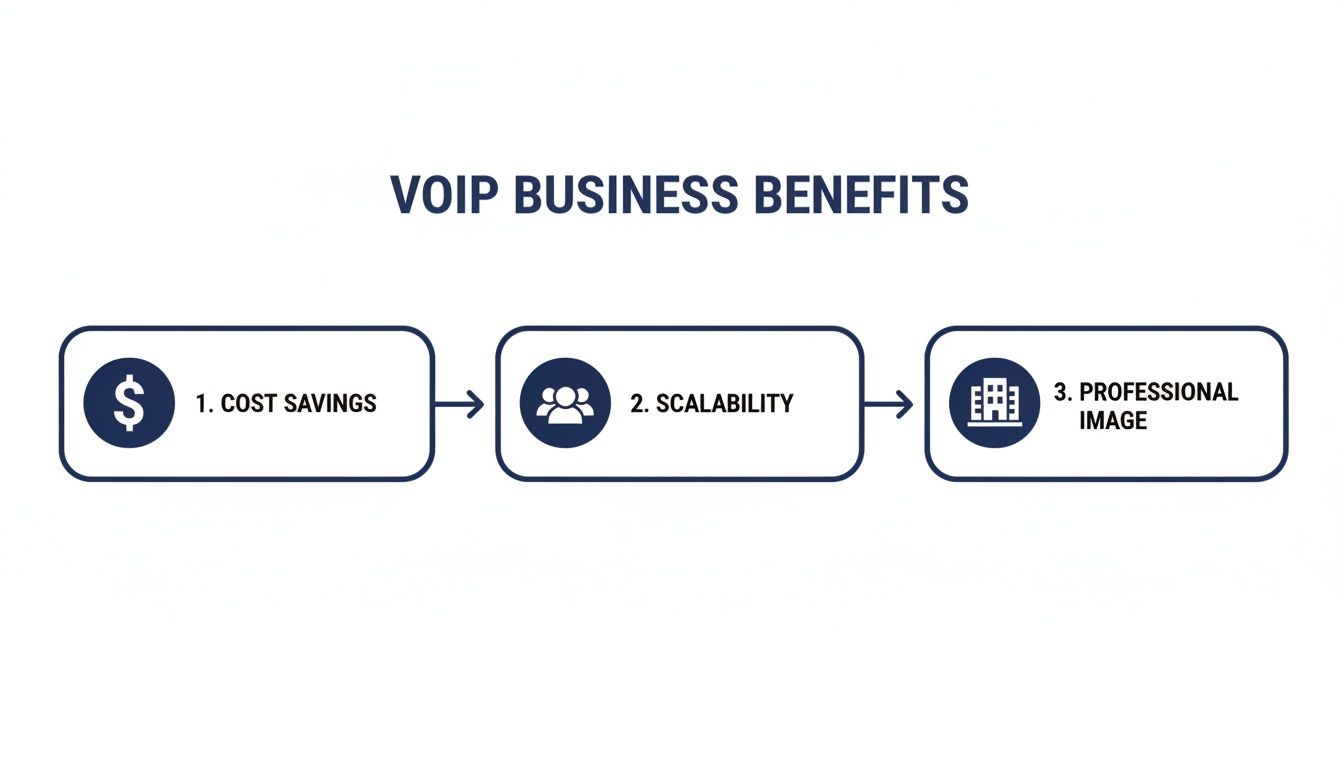
Let’s dig into the direct impact VoIP can have, starting with the three biggest advantages for small and mid-sized businesses. These are the benefits that hit your bottom line and sharpen your competitive edge right away.
The SMB Advantage: Cost, Scalability, and Professionalism
For a small or growing business, every dollar and every customer interaction counts. This is where VoIP stops being a simple utility and becomes a strategic asset that punches well above its weight.
- Massive Cost Savings: When you ditch the on-premise hardware, you’re not just avoiding a huge upfront expense; you’re also ditching those unpredictable maintenance contracts. Instead of paying a technician for every little change, you get a predictable, all-inclusive monthly fee. Businesses routinely see a 40-60% drop in their monthly phone bills after making the switch.
- Effortless Scalability: Imagine a new team member is starting on Monday. With VoIP, adding a new line is as simple as a few clicks in a web portal. This on-demand scalability means your phone system grows or shrinks right alongside your business needs, without any costly delays or infrastructure projects.
- A Polished Corporate Image: Features like a professional auto-attendant, custom on-hold music, and a unified business number for your whole team create a slick first impression. Even a one-person startup can sound like a Fortune 500 company, which builds instant trust and credibility with callers.
Think about a growing retail company with three stores and a central office. Before VoIP, they were juggling four separate, clunky phone systems. After switching to a unified solution, they now operate as one cohesive unit. A call to any store can be seamlessly transferred to the warehouse or a manager's mobile app on the road, making sure no customer call ever falls through the cracks. This doesn’t just improve customer service; it makes managing the whole operation a lot simpler.
Mastering Operations for Call Centers
For businesses that live and die by high call volumes—like support teams and sales floors—VoIP provides the tools for total operational control. It transforms a chaotic call environment into a well-oiled machine that’s driven by data and laser-focused on efficiency. Providers like SnapDial bring these powerful tools to businesses of any size, making elite communication capabilities accessible to everyone.
With VoIP, a call center isn't just answering phones—it's actively managing the customer journey. The system provides the intelligence to reduce friction, resolve issues faster, and give managers the visibility they need to optimize performance in real-time.
Here’s how that translates into key operational benefits for call centers:
- Reduced Wait Times: Smart call queues route callers to the best-available agent based on their skill or priority. Features like automated callback options let customers hang up and get a call back when an agent is free, which dramatically improves their experience.
- Increased First-Call Resolution: When agents can see a customer's history through CRM integrations and review past call recordings, they are far better equipped to solve problems on the first try. This boosts agent confidence and customer satisfaction in one fell swoop.
- Data-Driven Performance Management: Real-time analytics dashboards are a total game-changer. Managers can see call volume, wait times, and agent status at a glance. Detailed reports on call outcomes help pinpoint coaching opportunities and optimize staffing levels.
By taking advantage of these benefits, businesses can move beyond basic phone service and start using their communication system as a real tool for growth. To see more practical applications, you might be interested in these examples of how VoIP is used across different industries. It really highlights just how versatile this technology can be.
How to Plan Your Migration to a New System
Thinking about switching your business phone system can feel overwhelming. I get it. But moving from an old, clunky setup to a modern cloud VoIP solution doesn't have to be a headache that grinds your business to a halt.
The secret is having a solid, step-by-step plan. A smooth transition is all about mapping out the journey before you take the first step. This means taking a hard look at your current setup, figuring out the logistics of transferring phone numbers, and getting your team ready.
A little forethought here ensures you start reaping the rewards of your new system right away, without any painful downtime. A single switch to voip business services can spark a chain reaction of positive outcomes, strengthening your brand and your bottom line.
Your Migration Checklist
To make sure your transition is a success, follow this simple checklist. Think of it less as a technical manual and more as a strategic roadmap to a launch without the usual bumps and bruises.
Assess Your Internet Readiness: The foundation of a great VoIP experience is a stable, high-quality internet connection. Before you do anything else, you need to test your network. It's not just about speed; you're looking for low latency (delay) and minimal jitter (inconsistent delay), which are the true culprits behind choppy calls. A quality provider can help you run a proper test to confirm your connection is up to the task.
Define Your Must-Have Features: What problems are you actually trying to solve? Do you need a digital receptionist (auto-attendant) to route calls professionally? Do you have a remote team that needs mobile apps? Is call recording a must-have for training and quality assurance? Make a concrete list of your non-negotiables so you can evaluate providers based on what your business truly needs.
Handle Number Porting Correctly: Keeping your existing business number is probably your top priority—as it should be. The process, known as number porting, is standard practice, but it has to be managed with precision. A great provider will handle this entire process for you, coordinating with your old carrier to ensure there is absolutely zero downtime. You keep the number your customers know, and they never even notice the switch happened.
The single biggest fear for business owners is service disruption. Choosing a provider like SnapDial with a white-glove setup process means they manage the entire transition for you, from porting numbers to configuring phones, effectively eliminating that risk.
Getting Your Team Onboard
Here’s the thing: new technology is only as good as the people who use it. The final, and arguably most important, step in a successful migration is getting your team excited and prepared. Don't just drop new phones on their desks and expect magic to happen.
A few brief training sessions can make all the difference. A simple 30-minute walkthrough is usually all it takes to build confidence and show everyone how the new tools will make their jobs easier.
- System Basics: Cover the simple stuff first. How to answer, transfer, and place calls on hold using the new phones or apps.
- Key Features in Action: This is where you build excitement. Demonstrate the power of visual voicemail, show them how the mobile app works, and walk them through logging into the web portal to manage their settings.
- Real-World Practice: Run a few practice calls. Let everyone get comfortable with the new workflow before the system officially goes live.
When your team sees how the new capabilities help them stay connected and be more productive from anywhere, adoption happens naturally. The switch stops feeling like a chore and starts feeling like a genuine upgrade for everyone involved.
Understanding the Costs and Calculating Your ROI
Let’s talk money. Any time you’re looking at new technology, it all comes down to the financial case. Understanding how VoIP pricing works is the first step toward seeing its real value. This is where we can pull back the curtain on the costs and show you exactly what to expect on your monthly bill.Most voip business services run on a simple, predictable model: a flat fee per user, per month. It’s a game-changer for budgeting, especially with providers like SnapDial that offer all-inclusive plans. These plans get rid of the surprise charges that always seem to pop up with old-school phone systems.
This predictability is a world away from the chaotic and often hidden costs of traditional PBX hardware. With a legacy system, your budget can get torpedoed by unexpected expenses like hefty maintenance contracts, expensive technician call-out fees for simple changes, and per-minute charges for long-distance calls that add up fast.
Breaking Down VoIP Pricing Models
That “per-user, per-month” structure is a breath of fresh air for anyone managing a budget. Imagine your phone bill working just like a software subscription—you pay for the number of people using it, and that’s it. This model typically includes a full suite of professional features, unlimited domestic calling, and ongoing support without extra fees.
This all-in-one approach simplifies everything. You get one bill with one clear number, making it easy to forecast your communications spending for the entire year. It’s a welcome relief from the nickel-and-diming that defines traditional telecom contracts.
The core benefit of modern VoIP pricing is financial clarity. By bundling features, calling, and support into a single monthly fee, businesses can finally treat their phone system as a predictable operating expense, not a source of financial surprises.
Calculating Your Return on Investment
Calculating your return on investment (ROI) is about more than just finding a lower monthly bill. A proper analysis looks at both the direct "hard savings" and the valuable "soft savings" that come from making your team more productive and efficient. To budget effectively, it's crucial to examine effective methods and strategies for accurate ROI calculation for services like these.
Let's break down what to measure.
Hard Savings (Direct Cost Reductions):
- Lower Monthly Bills: This is the most obvious win. Compare your total current phone-related spending (line rentals, long-distance charges, maintenance) to an all-inclusive VoIP quote. Many businesses see their bills drop by 40-60%.
- Elimination of Hardware Costs: Factor in the thousands of dollars you’ll save by not purchasing or maintaining a physical PBX box in your office.
- No More Technician Fees: Look at what you spent last year on technician visits for repairs or system changes. With VoIP, that cost drops to zero.
Soft Savings (Productivity Gains):
- Fewer Missed Calls: Features like mobile apps and smart call routing mean more calls get answered. That translates directly to more sales opportunities and happier customers.
- Increased Employee Efficiency: How much time does your team waste dialing into voicemail or manually logging calls? Tools like visual voicemail and CRM integrations give that time right back.
- Enhanced Team Flexibility: A team that can work effectively from anywhere is more productive and resilient. This reduces downtime and keeps the business moving forward, no matter what.
Think about it this way: if your team saves just 15 minutes per day through better call handling and fewer manual tasks, that reclaimed time adds up to significant payroll savings and increased output over the course of a year. That alone can make the financial case for switching crystal clear.
Common Questions About VoIP Business Services
Making the final call on a new phone system can feel like a big step. I get it. To help you feel confident in your choice, we’ve put together straightforward answers to the questions we hear most often from businesses just like yours.
We'll tackle the big topics head-on—from reliability and security to the practical details of keeping your phone number. The goal is to clear up any confusion and show you why a modern phone system is such a powerful tool for your business.
Is VoIP as Reliable as a Traditional Landline?
This is often the first question people ask, and the answer is a confident yes. Modern VoIP from a quality provider is exceptionally reliable, often even more so than an old-school landline. The real difference comes down to two things: your internet connection and your provider's infrastructure.
For most companies today, a high-speed business internet connection is a given. Top-tier providers build on that solid foundation by using geographically redundant data centers. That means if one of their server locations has an issue, your service automatically fails over to another one, so your calls continue without a hiccup.
Think of it this way: the old PBX box in your closet is a single point of failure. If it goes down, your entire phone system is dead. A cloud-based system, on the other hand, has multiple layers of backup built right in.
Features like automatic call forwarding to your cell phone during a power or internet outage mean you're actually more resilient with VoIP. A landline can be cut, but a cloud system always has a way to keep you connected to your customers.
Can I Keep My Existing Business Phone Numbers?
Yes, absolutely. You don't have to give up the numbers your customers already know and trust. This is a federally regulated process known as number porting, and it's a standard part of any professional VoIP migration. It guarantees that you, the business owner, always keep ownership of your phone numbers.
A professional provider like SnapDial will manage the entire porting process for you. Think of it as a white-glove service designed to create a seamless transition with zero downtime or disruption.
You can port all your critical numbers, including:
- Your main business line: The primary number your customers have known and used for years.
- Toll-free numbers: Your 800-series numbers will transfer over smoothly.
- Direct-dial numbers (DIDs): Individual numbers assigned to specific employees or departments.
The end result is that your customers experience no change. They can keep reaching you at the numbers they’ve always known, preserving your brand identity and preventing any confusion.
How Secure Are VoIP Communications?
Security is a big one, and the short answer is: very secure. It's a cornerstone of any enterprise-grade voip business services platform. Reputable providers build their systems with multiple layers of protection to safeguard your calls and data. This isn't an afterthought; it's a core component of the service.
Your conversations are protected through methods like call encryption. Using protocols such as Transport Layer Security (TLS) and Secure Real-time Transport Protocol (SRTP), your voice data is scrambled as it travels over the internet, effectively preventing anyone from eavesdropping.
Beyond just the calls themselves, the provider's infrastructure is heavily fortified.
| Security Layer | How It Protects Your Business |
|---|---|
| Data Centers | Hosted in highly secure facilities with 24/7 monitoring, biometric access, and redundant power. |
| Network Firewalls | Act as a digital gatekeeper, blocking malicious traffic and preventing unauthorized access to the system. |
| Intrusion Detection | Actively monitors for suspicious activity and alerts security teams to potential threats in real-time. |
| System Configuration | A good provider configures your system to prevent common fraud tactics, like unauthorized international calls. |
In almost every case, a professionally managed VoIP system is far more secure than an old on-premise PBX sitting unmonitored in a closet, rarely getting security updates.
What Kind of Internet Do I Need for VoIP?
You need a stable, quality internet connection, but you don't necessarily need the fastest plan out there. Voice data actually doesn't use a lot of bandwidth. As a general rule of thumb, each simultaneous VoIP call only uses about 0.1 Mbps of both upload and download speed.
That means a standard business broadband connection can easily handle dozens of calls at once without breaking a sweat. What matters much more than raw speed is the quality of your connection.
Two key metrics determine voice quality:
- Low Latency: This is the time it takes for data to travel from your office to the provider and back. High latency causes that annoying lag or echo in a conversation.
- Low Jitter: This measures the variation in that delay time. High jitter is what makes words sound garbled or jumbled, as the data packets arrive out of order.
A business-grade fiber or cable connection is usually perfect, as they offer the low latency and jitter needed for crystal-clear voice. Before you switch, any reputable provider will help you run a network readiness test to make sure your connection can support flawless call quality from day one.
Ready to transform your business communications with a system that’s reliable, secure, and incredibly powerful? SnapDial offers all-inclusive pricing, white-glove setup at no cost, and 24/7 Texas-based support to make your transition seamless. Explore SnapDial's features today!